“Get your ass out,” Cynthia Mitchell snapped, pointing toward the side gate. “This pool belongs to my HOA.”
Marcus Reeves remained in the reclining chair beside the water, one hand loosely wrapped around a cold drink. His fitted white tank top showed the powerful build beneath it, while dark sunglasses concealed whatever reaction Cynthia expected to provoke. “Take one more step and find out whose property this is.”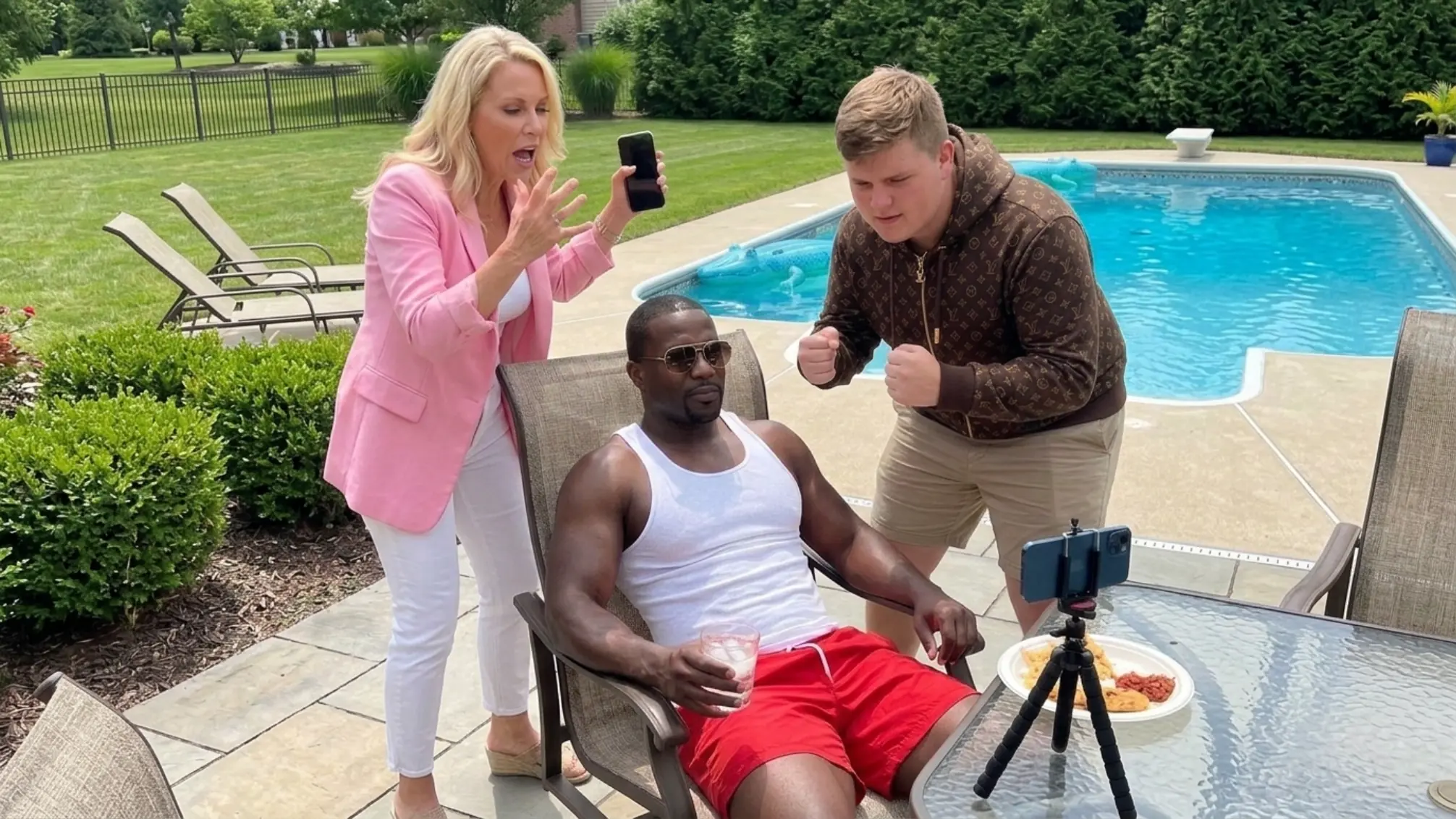
Cynthia’s twenty-four-year-old son, Brandon, moved closer with both fists clenched. “Stand up, old man. I’ll drag you out myself.”
Marcus placed his drink on the patio table beside the phone recording the confrontation. “Touch me, and your mother watches me put you in cuffs.”
Brandon laughed because he believed the warning was empty.
His mother did not laugh. She raised her phone and continued recording, keeping the camera close enough to capture Marcus but not the tripod positioned near the plate of grilled meat and fries. Behind him, an inflatable green alligator drifted across the blue water as if nothing unusual were happening.
“You’re threatening my son now,” Cynthia said. “Excellent. The board will love hearing that.”
“You entered my locked yard without permission.”
“This is common recreational property.”
“It’s attached to my house.”
“The HOA controls every exterior recreational feature in Willowbrook Estates.”
Marcus tilted his head slightly. “That sentence doesn’t even mean anything.”
Cynthia’s face tightened behind her oversized sunglasses. She wore a bright pink blazer, white trousers, beige heels, and a silver badge identifying her as president of the Willowbrook Estates Homeowners Association. The badge had no legal authority, but Cynthia wore it with the solemn importance of a federal credential.
“I have the community map,” she said.
“You have a drawing.”
“It was approved by the board.”
“County property records weren’t.”
Brandon leaned toward Marcus’s chair. “My mother runs this neighborhood.”
“She runs meetings.”
“She can fine you until you lose this house.”
Marcus looked up at him. “Try.”
The single word unsettled Brandon more than shouting would have. Most residents lowered their eyes when Cynthia threatened fines, liens, inspections, or legal action. Marcus had lived in Willowbrook for six months, and not once had he behaved as though her title impressed him.
That had made him a target almost immediately.
Willowbrook Estates appeared peaceful from the outside. Its lawns were clipped evenly, mailboxes matched, flower beds stayed within approved boundaries, and every home had been painted from a narrow list of acceptable colors. Families moved there expecting quiet streets, stable property values, and neighbors who cared about the community.
Instead, they found Cynthia.
She had served as HOA president for three years, though “served” was not the word most residents used privately. She controlled the board through intimidation, selective enforcement, and carefully distributed favors. People who supported her received warnings before fines; people who questioned her received inspections.
An elderly widow named Margaret Patterson had been fined two hundred dollars because three garden gnomes violated the community’s aesthetic standards. When she appealed, Cynthia cited her porch light, mailbox color, and oversized welcome mat. By the end of the month, Margaret owed more than three thousand dollars.
A young couple named Tom and Sarah Johnson received a five-hundred-dollar fine because their ten-year-old Honda sat three inches across a painted parking line. Brandon regularly left his BMW across two spaces without consequence.
Mr. Chen’s lawn mower disappeared from his open garage and returned broken two days later. A security camera showed Brandon using it, but Cynthia threatened the Chens with legal action when they asked for reimbursement. The following week, they were cited for failing to maintain their grass.
Marcus noticed everything.
When Cynthia introduced herself shortly after he moved in, she arrived carrying muffins and a forty-seven-page rulebook. Her smile remained fixed while she warned him that his moving truck had blocked a neighbor’s driveway for twenty minutes.
“I’d hate for your first week to begin with a violation,” she said.
Marcus accepted the basket. “That almost sounded like concern.”
“It was.”
“Good. I’d hate to misunderstand you.”
She studied him, uncertain whether she had been challenged.
Marcus told neighbors he worked in public service. That was true, but incomplete. He had recently been elected sheriff of the county after twenty-one years in law enforcement, including assignments in major crimes, fraud, and public corruption.
He kept his profession quiet because he wanted his home to remain separate from his office. He did not want neighbors behaving differently because of a badge, asking for favors, or expecting him to settle every disagreement.
For several months, the decision worked.
Then Brandon began testing him.
The young man held parties until three in the morning, blocked Marcus’s driveway, threw bottles into his yard, and deliberately revved his BMW whenever Marcus worked outside. Each time, Marcus asked him to stop calmly.
Brandon interpreted restraint as weakness.
His mother interpreted it as defiance.
Cynthia began sending violation letters. One claimed Marcus’s grass exceeded the permitted height by one-quarter inch. Another declared his county-issued truck a prohibited commercial vehicle, despite an exemption for government and emergency vehicles.
Marcus responded only when necessary. He requested the specific bylaw authorizing each fine, copies of board votes, inspection photographs, and written appeal procedures.
Cynthia rarely provided them.
Instead, the penalties increased.
Marcus started documenting everything—not as sheriff, but as a homeowner protecting himself. His cameras captured Brandon’s late-night driving, trash thrown across his lawn, and repeated entries onto private property. He preserved every letter, envelope, email, and voicemail.
Neighbors gradually began speaking to him.
Margaret Patterson arrived one evening carrying a casserole dish and trembling so badly she nearly dropped it. She explained that Cynthia’s fines had forced her to delay purchasing medication.
Tom Johnson described how his car had been keyed after he questioned a penalty. David Rodriguez said Cynthia threatened to report invented building-code violations when he challenged a special assessment. Marcus Webb, a single father, produced photographs of graffiti painted across his fence shortly before Cynthia fined him for the “eyesore.”
The stories formed a pattern.
Cynthia used the HOA to pressure residents into silence. Brandon created many of the problems, and his mother punished anyone who complained about him.
Marcus advised each resident to preserve evidence and request official records. He did not promise arrests or dramatic revenge. HOA disputes were usually civil matters, and being unpleasant was not automatically criminal.
Then financial discrepancies appeared.
David Rodriguez, an attorney experienced in property disputes, noticed that several special assessments lacked required board votes. Vendors listed in HOA records had no physical addresses or active business registrations. Payments went to companies formed by people connected to Cynthia.
Marcus referred the information to the county attorney and state regulatory investigators. Because he lived inside the community and had been personally targeted, he removed himself from direct control of the financial investigation.
The pool confrontation happened while that independent review was already underway.
Marcus had purchased his home partly because of the private backyard. The pool appeared on the county deed, construction permits, tax assessment, and property survey. No legal document described it as community property.
Cynthia knew that.
She also knew the property contained an eight-foot privacy fence and a locked side gate.
Brandon climbed over it on Saturday afternoon.
Marcus was sitting beside the pool when the young man appeared and ordered him to leave. Brandon claimed his mother had shown him a map proving the pool belonged to the HOA.
Marcus told him to exit.
Brandon called Cynthia.
She arrived less than five minutes later, entered through the gate her son had unlocked, and began recording. She accused Marcus of occupying common property, threatening HOA leadership, and violating community standards.
He gave them one final instruction.
“Leave now.”
Cynthia crossed her arms. “Or what?”
“Or I document criminal trespass and let someone without a personal connection decide what happens.”
“You think you can frighten me with legal words?”
“No. Facts usually do enough.”
Brandon stepped closer.
“You’re nobody,” he said. “My family owns this neighborhood.”
Marcus rose slowly from the chair.
At six feet three inches, he stood several inches above Brandon and carried far more muscle than the younger man had expected. Cynthia took one step backward, but Brandon remained close because retreating in front of his mother would have embarrassed him.
“Leave,” Marcus repeated.
Brandon pushed one finger against his chest.
Marcus looked down at it.
“Do that again,” he said, “and your life changes.”
Brandon withdrew his hand, pretending the warning had not affected him. Cynthia told her son they were leaving because Marcus would face the board on Monday.
As she reached the gate, she turned around.
“Fifteen thousand dollars in fines,” she announced. “Your truck will be towed tomorrow, and the board will begin proceedings to force you out.”
Marcus glanced toward the recording phone.
“Say that again.”
Cynthia smiled. “The board will take your home.”
Then she walked away.
That evening, Marcus copied the recording to three secure locations. He photographed the disturbed gate, saved Cynthia’s threats, and filed a trespassing report through an outside agency so no one could accuse him of using his position personally.
The next several days became worse.
Brandon drove past the house repeatedly, blasting his horn. Trash appeared on the lawn. Two tires on Marcus’s truck were slashed during the night.
Every incident appeared on camera.
On Friday evening, while Marcus attended a county emergency-planning meeting, Brandon and nearly twenty friends entered the backyard. They drank alcohol, threw bottles into the pool, overturned chairs, pushed the grill into the water, and damaged landscaping.
The cameras captured faces, vehicles, timestamps, and audio.
One recording caught Brandon raising a bottle toward the lens.
“Film this, old man.”
He smashed it against the patio.
Cynthia arrived during the party.
Instead of stopping it, she stood beside the gate and laughed. When Margaret Patterson called to ask whether police should be notified, Cynthia warned that any neighbor interfering would receive immediate inspections and fines.
The destruction lasted four hours.
Marcus returned shortly before midnight.
He stood beside the ruined pool without touching anything. Broken glass glittered across the deck. Food floated in the water, and the grill lay on its side beneath the shallow end.
For several minutes, he said nothing.
Then he called the state investigators already reviewing the HOA.
The response moved quickly.
Evidence technicians photographed the property. Deputies who did not report directly to Marcus collected statements. Parents were notified that minors had been drinking on private property, and the county attorney reviewed potential charges.
Marcus provided the complete archive covering six months.
Cynthia scheduled her emergency HOA meeting for Monday evening.
She believed the meeting would publicly destroy him.
Every household received a notice describing Marcus as dangerous, hostile, and unwilling to respect community authority. Residents were told the board would consider fifteen thousand dollars in fines, towing his vehicle, placing a lien on his home, and beginning legal action.
The community center filled before seven.
Cynthia sat behind a long table in another bright pink suit. Four nervous board members occupied chairs beside her. Brandon sat in the front row, holding his phone horizontally to record what he expected would become a humiliating video.
Marcus entered wearing dark jeans and a simple button-down shirt. He carried one leather folder.
Cynthia began immediately.
She displayed photographs of his house, truck, and backyard. She claimed the pool belonged to the community and accused Marcus of threatening her son when Brandon politely asked him to leave.
Brandon stood and performed his role.
“I felt unsafe,” he said. “He became aggressive for no reason. My mother only tried to explain the rules.”
Cynthia placed a protective hand on his shoulder.
The proposed penalties appeared on the projector.
Fifteen thousand dollars.
Immediate removal of Marcus’s government truck.
Daily inspections.
Legal action seeking a forced sale if he failed to comply.
“This is not vindictive,” Cynthia told the crowded room. “It is about protecting Willowbrook from people who believe rules do not apply to them.”
Marcus waited until she finished.
“May I respond?”
“Briefly.”
He walked toward the front and opened the folder.
First, he produced the county deed, original survey, tax map, and pool permit. Each confirmed the pool sat entirely within his private property.
Cynthia claimed the documents were forged.
Marcus displayed the county verification codes on the screen.
“Anyone can confirm them tonight,” he said.
The room stirred.
Next, he played the pool recording.
Residents watched Brandon climb over the fence, order Marcus out, threaten to drag him from the chair, and claim his family owned the neighborhood. They watched Cynthia enter without permission and threaten to take Marcus’s home.
The edited story collapsed in less than three minutes.
Brandon lowered his phone.
Marcus played the footage from Friday’s party.
Faces became clear on the large screen. Neighbors watched teenagers break furniture, throw bottles, damage the grill, and laugh as Brandon spoke directly to the camera.
Then Cynthia appeared.
Her recorded voice filled the room.
“If anyone calls the police, I’ll inspect every house on this block until I find something.”
Margaret Patterson stood.
“You told me the same thing.”
Her voice trembled, but she continued. She described the garden-gnome fine, the escalating inspections, and the medication she could not afford after paying Cynthia’s penalties.
Tom Johnson stood next.
Then Marcus Webb.
Then the Chens.
One resident after another spoke until the meeting stopped resembling Cynthia’s tribunal and became testimony against her.
“You’re all lying,” she shouted. “He organized this!”
David Rodriguez rose from the second row. “No, Cynthia. You organized it by threatening everyone separately. We simply compared notes.”
Marcus opened the thicker section of his folder.
“Independent investigators have compared more than notes.”
Cynthia stared at him. “Who do you think you are?”
Marcus removed a leather credential wallet and placed it on the table.
The gold sheriff’s badge caught the overhead lights.
“My name is Marcus Reeves,” he said. “I am the elected sheriff of this county.”
The room went silent.
Cynthia’s mouth opened, but no words came immediately.
“You told us you worked in public service,” she finally whispered.
“I do.”
Brandon stood so quickly that his chair struck the floor.
“That badge doesn’t scare me.”
“It should remind you to stop talking.”
“You think you’re tough because you tricked us?”
“I did not tell you to enter my yard, destroy my property, or lie in front of this neighborhood.”
Brandon approached the table.
His mother grabbed his sleeve, but he pulled away. Panic and humiliation had replaced the smug confidence he carried at the pool.
“You’re just some old man hiding behind a badge.”
Marcus remained still.
“Sit down, Brandon.”
“Make me.”
He shoved Marcus with both hands.
Gasps swept through the room.
Marcus moved only half a step. Brandon appeared more surprised by the failed push than by what followed.
Two uniformed deputies entered through the rear doors. State investigators accompanied them, having waited outside under instructions to intervene only if necessary.
Marcus stepped back.
“Deputies, he is yours.”
Brandon attempted to retreat. One deputy caught his arm while the other secured his wrists.
“This is assault!” Cynthia screamed. “You attacked my son!”
The entire room had witnessed otherwise.
Brandon began cursing, then pleading, then insisting the push was only a joke. The deputies read his rights and escorted him toward the door.
Cynthia tried to block them.
A state investigator warned her to step aside.
“Do you know who I am?” she shouted.
“Yes,” the investigator replied. “That is why we are here.”
He presented a search warrant authorizing the seizure of HOA financial records, computers, account statements, and electronic devices. Another investigator explained that Cynthia was being investigated for fraud, misappropriation, falsifying records, and coercive collection practices.
Her face turned white.
“You cannot access my bank records.”
“The court disagreed.”
The board members began moving away from her.
Gerald Hutchins, who had supported Cynthia for years, stood with both hands gripping the table.
“I move that Cynthia Mitchell be removed as HOA president immediately.”
Another member seconded the motion.
Every board member voted yes.
Residents raised their hands when Gerald requested confirmation from the community. Not one person supported Cynthia.
Three years of authority disappeared in less than a minute.
“You cowards,” she hissed. “I made every one of you.”
“No,” Margaret Patterson said. “You frightened us.”
Cynthia looked around the room and finally understood that fear had ended.
The investigation uncovered more than forty thousand dollars diverted from HOA accounts. Some fines had never entered the official books. Fake vendors received payments before transferring money into accounts connected to Cynthia.
Several assessments had been imposed without legal votes.
Her fabricated property map had been created to pressure Marcus into surrendering control of his pool for community events managed by her family. Cynthia intended to charge private rental fees and direct the money through another false vendor.
Brandon faced charges related to trespassing, vandalism, property destruction, underage alcohol offenses, and assault. Because he was twenty-four rather than a minor, his mother could no longer explain his behavior as youthful foolishness.
He eventually accepted a plea agreement requiring restitution, community service, probation, and counseling.
Cynthia pleaded guilty to fraud and misappropriation after investigators matched deposits to unauthorized HOA collections. She was ordered to repay residents, barred from managing community associations, and received a sentence that included confinement and supervised release.
Seventeen families also joined a civil lawsuit.
Willowbrook changed after the Mitchells left.
The new board canceled improper fines, published financial reports, simplified the bylaws, and established an independent appeal process. Margaret’s garden gnomes returned to her yard.
Residents organized a voluntary pool gathering at Marcus’s home the following summer.
Children floated beside the same inflatable alligator that had drifted behind him during the confrontation. Tom Johnson repaired the grill, Marcus Webb handled the food, and Margaret arrived carrying potato salad.
No one claimed the pool belonged to the HOA.
As sunset settled over the houses, Gerald approached Marcus beside the water.
“Why didn’t you reveal the badge sooner?”
“Because a badge changes how people behave.”
“You could have frightened Cynthia into stopping.”
“For a week, perhaps. Then she would have become more careful.”
Gerald looked toward the neighbors laughing around the pool. “Instead, she showed everyone exactly who she was.”
“She believed no one here could challenge her.”
“She was wrong.”
Marcus watched Margaret place one of her garden gnomes near the gate as a joke.
“Bullies usually are,” he said. “They just need enough silence to forget it.”
Cynthia had entered the backyard believing authority came from a title printed on a silver HOA badge. Brandon believed power meant being willing to threaten someone more loudly than everyone else.
Neither understood the man sitting calmly beside the pool.
Marcus did not defeat them because he was stronger, though he was. He did not defeat them because he carried a gold shield, though he did.
He defeated them by recording the truth, protecting the evidence, and giving frightened neighbors enough room to speak.
Cynthia pointed toward the gate and ordered him out of his own pool.
Her son promised to drag him from the chair.
Then Brandon placed his hands on the county sheriff in front of a room full of witnesses.
And everything their family had built through fear collapsed before those handcuffs finished closing.