The roar of cement mixers reached Dale Brennan’s farmhouse before sunrise. By the time the fifty-eight-year-old farmer crossed his back pasture, three construction crews had already crushed the willow trees beside Cottonwood Creek and buried its smooth granite bed beneath wet gray concrete. Dale stood in a dark charcoal work jacket, black-and-red flannel shirt, faded black jeans, and mud-caked farm boots, staring at the stream his grandfather had protected for nearly seventy years. Directly across the unfinished channel, HOA president Brenda Hartwell pointed an unauthorized construction order at his chest while a police officer watched from several yards behind her.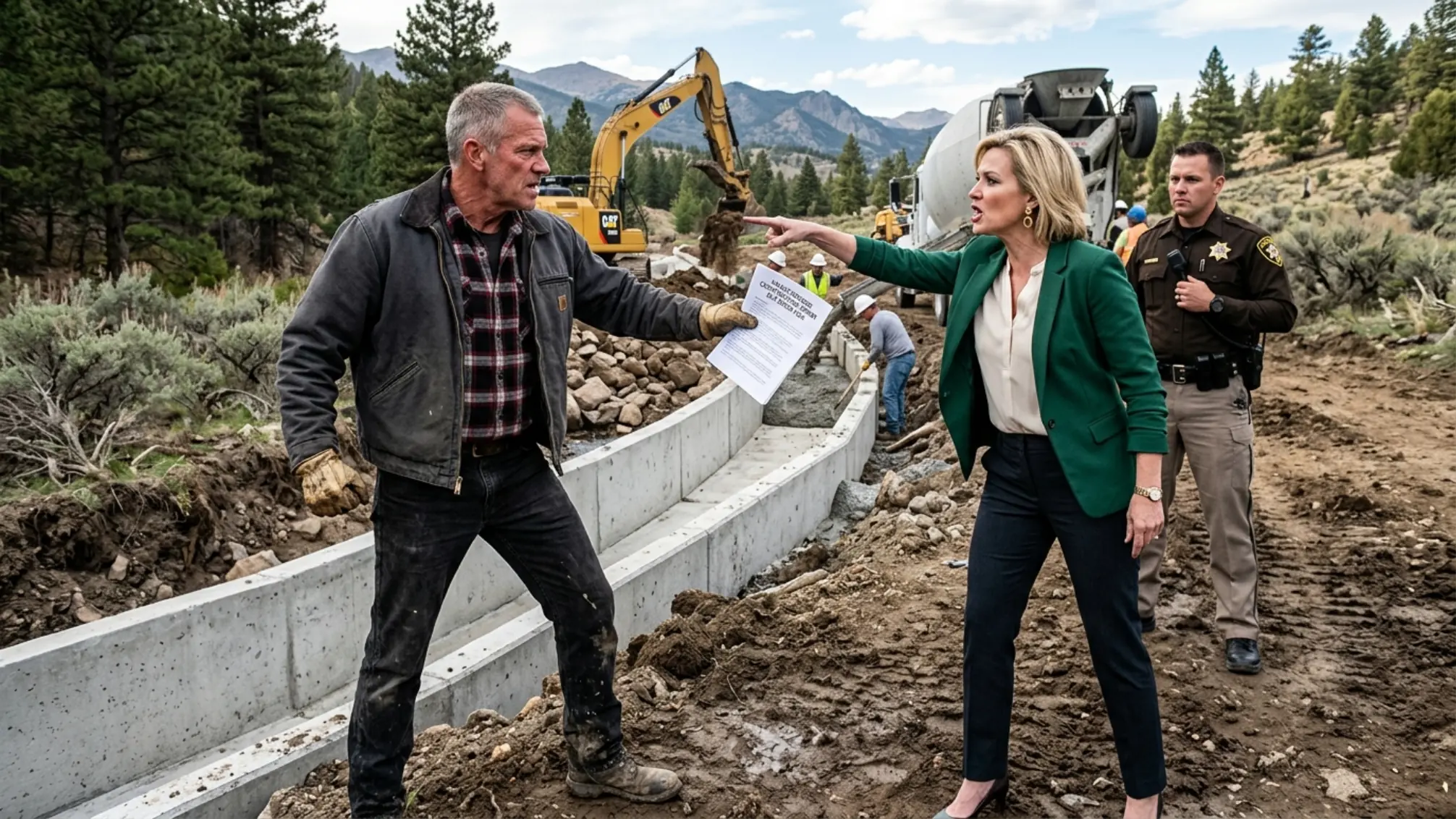
Brenda laughed as though he had threatened her with magic rather than physics. At fifty-two, she was polished, wealthy, and accustomed to watching contractors, lawyers, and neighbors obey before she finished speaking. Her emerald-green blazer remained immaculate despite the mud, and her blonde hair had not moved beneath the wind sweeping down from the Colorado foothills. Behind her, a yellow excavator tore another cottonwood from the creek bank.
Dale’s property had belonged to his family since 1873. His grandfather, William Brennan, bought the original acreage after returning from years of hard labor on western railroad projects, then built a small ranch house, a workshop, and a system of stone-lined bends along the stream. He understood water better than most engineers of his generation, and every boulder he positioned slowed the current, spread floodwater into the meadow, and protected the lower valley.
For decades, Cottonwood Creek carried snowmelt safely past the Brennan farm. It twisted through gravel beds, willow roots, shallow pools, and a broad natural floodplain that absorbed excess water during heavy spring runoff. Trout spawned beneath the shaded banks, children caught minnows in summer, and Dale’s wife, Martha, often sat beside the porch listening to water move through stones.
Then Willowbrook Estates appeared downstream.
Forty-seven luxury homes rose on former cattle pasture, each with manicured lawns, tall windows, imported stone, and a price approaching one million dollars. Most buyers knew little about the land beneath their foundations. They saw mountain views, private roads, and a homeowners association promising to preserve property values.
Brenda became HOA president less than a year after moving into the largest house.
Her first conflict with Dale concerned the motorcycle parts stored beside his workshop. She mailed violation notices claiming the rusted frames, fuel tanks, and covered engines damaged the neighborhood’s appearance. Dale responded with a copy of his deed showing that his land predated the subdivision and remained entirely outside its covenants.
Brenda refused to accept the answer.
She reported his workshop as an illegal commercial operation. County inspectors searched the building, questioned him about noise, and examined decades of tools and restored motorcycles. They found nothing unlawful, but the inspection cost Dale twelve hundred dollars in legal advice and several days of lost work.
When that failed, Brenda turned toward the creek.
Her attorneys filed a nuisance complaint alleging that Dale’s natural stream created dangerous runoff threatening Willowbrook’s houses. They relied on drainage maps from 1967, before highways, subdivisions, and modern storm systems altered the entire watershed. The complaint demanded that Dale pay for an environmental assessment and modify the creek at his own expense.
Brenda expected a tired farmer to surrender.
She did not know Dale had spent thirty years working as a hydrologist before retiring to the family property.
He had designed drainage systems, studied mountain watersheds, and investigated flood failures across several western states. He knew that Cottonwood Creek did not endanger Willowbrook. The natural bends and porous ground on his property protected it.
Dale contacted an old colleague at the Colorado Water Authority and obtained current surveys. The data showed that Willowbrook’s roads and rooftops had dramatically increased runoff, while the Brennan section of creek reduced peak flow before the water reached the subdivision. The county dismissed Brenda’s complaint and formally reaffirmed Dale’s historical water rights.
The local newspaper published the decision under a humiliating headline:
HOA Lectures Retired Water Expert Using Fifty-Year-Old Maps.
Brenda never forgave him.
Three weeks later, she called an emergency HOA meeting while Dale and Martha were visiting their daughter in Oregon. Only seven board members attended. Brenda presented photographs of erosion near the creek and claimed an immediate flood emergency required concrete channeling before the next storm.
The photographs were deceptive.
Workers hired by one of Brenda’s associates had dug the supposed erosion trenches themselves. Her “engineering consultant” was not a licensed hydrologist but a landscaping contractor related to one of her real-estate partners.
The board approved a special assessment of eighteen hundred dollars per homeowner. Brenda awarded a one-hundred-twenty-seven-thousand-dollar contract without competitive bids and instructed the crew to begin before Dale returned.
The meeting notice was mailed to an address he had not used in fourteen years.
A concerned board member named Edwin Kowalski called Dale in Oregon. By the time Dale and Martha drove through the night and reached Colorado, the damage had already begun.
The sight broke something inside Martha.
The clear water that once moved around granite stones now raced through a narrow concrete trench. Broken branches, uprooted willows, and crushed fish habitat lay beneath the machinery. The creek sounded different—not gentle, not alive, but trapped and angry.
“They killed it,” Martha whispered.
Dale did not answer immediately.
He watched water accelerate through the smooth channel toward Brenda’s subdivision. Without stones, roots, curves, and soil to slow it, the current moved with frightening efficiency. The concrete did not control the water.
It weaponized it.
Dale spent the next week documenting every violation. He photographed the destruction, measured flow rates, collected water samples, and mapped the construction. Then he searched county, state, and federal permit databases.
Brenda’s contractors had obtained none of the approvals required to alter a natural waterway.
The project violated county codes, state water law, and federal environmental regulations. The construction company had a history of similar offenses, including previous fines for entering waterways before receiving permits.
Dale filed complaints with every agency that held jurisdiction. A regional environmental group provided technical support, and a university legal clinic offered representation. Trout protection organizations joined after learning that the channel had destroyed a documented spawning area.
Brenda responded by escalating.
She mailed new HOA fines even though Dale was not an HOA member. Anonymous complaints appeared online attacking Martha’s tutoring work. Someone called her school principal and suggested she was married to a dangerous extremist.
Then Dale’s workshop was vandalized.
Tools disappeared, restored motorcycle parts were thrown across the floor, and sugar was poured into the fuel tank of his 1972 Harley. The intruders failed to notice the security cameras Dale installed after the first HOA conflict.
The video showed two masked figures leaving in Brenda’s white Tesla.
Dale preserved the footage but did not confront her immediately. He understood that angry accusations could be denied. Organized evidence could not.
A young environmental law student named Sarah Olivia began reviewing the HOA’s finances. She compared construction invoices with market prices, vendor records, and corporate registrations. Within days, she discovered that the concrete channel should have cost less than forty thousand dollars.
Nearly eighty-seven thousand dollars had disappeared into inflated consulting fees and emergency premiums.
The companies receiving that money were connected to Brenda’s real-estate network.
Further examination revealed similar patterns in landscaping, security, legal, and maintenance contracts. For almost three years, Brenda had approved inflated payments to businesses controlled by friends and associates. The estimated missing funds exceeded two hundred thousand dollars.
The creek project was not only revenge.
It was theft.
Dale found the most important evidence in a cedar chest beneath his grandfather’s workbench. Inside were photographs, handwritten calculations, and a county report dated 1973. William Brennan had studied the exact valley and warned officials never to replace the creek’s natural channel with concrete.
His report predicted that a narrow artificial channel would eliminate ground absorption and increase downstream flood velocity by more than three hundred percent.
One sentence had been underlined twice:
The creek will eventually reclaim its floodplain. Concrete will only determine how violently it arrives.
Dale carried the report to the university.
Modern engineers entered the measurements into computer models. Their results closely matched William’s fifty-year-old calculations. During ordinary conditions, the concrete channel appeared efficient.
During heavy snowmelt, it became catastrophic.
The artificial trench would direct nearly the entire runoff surge toward Willowbrook’s foundations. Dale’s farmhouse and workshop stood on naturally elevated ground upstream. Brenda’s mansion sat in the historical overflow zone.
Spring snowpack that year was the heaviest in two decades.
Brenda had built a hydraulic weapon and aimed it at herself.
Dale attempted to warn the homeowners. He presented the engineering model at a community meeting, but Brenda called him a bitter troublemaker trying to frighten residents and destroy property values. She claimed his predictions were retaliation because the HOA improved “his neglected ditch.”
“Cottonwood Creek has protected this valley longer than your subdivision has existed,” Dale said.
Brenda smiled. “Your creek is gone.”
“No,” Dale answered. “You only made it faster.”
Several homeowners listened, but most trusted their president. They had paid for the project and wanted to believe the expense made them safer. Admitting the truth meant accepting that their own money had created the danger.
Two weeks later, Brenda invited Dale to her real-estate office.
Vanilla candles burned beside a glass desk. She wore another expensive green jacket and pushed a thick envelope toward him.
Inside was a cashier’s check for five hundred thousand dollars.
The accompanying agreement required Dale to stop every complaint, surrender his water rights, leave the county within six months, and never discuss the construction publicly. Brenda described it as a peaceful solution.
Then she threatened Martha.
“Legal wars destroy families,” Brenda said. “School boards become nervous when teachers are connected to radical activists.”
Dale had placed a small recorder inside his jacket.
“Are you threatening my wife’s job?”
“I’m explaining how communities protect themselves.”
“And the money?”
“Compensation for your cooperation.”
Dale slid the check back.
“You stole from your neighbors to destroy my creek. Now you’re trying to buy my silence with their money.”
Brenda leaned across the desk. “Take the offer before I make you regret refusing it.”
Dale stood.
“You already made your worst mistake.”
“What mistake?”
“You thought the concrete would obey you.”
The investigation widened quickly after that meeting. The FBI opened a white-collar fraud case. State investigators examined the missing HOA funds, and environmental enforcement officers secured the construction site.
Three board members resigned.
Edwin provided a recording of the emergency meeting. On it, Brenda admitted that the project’s real purpose was removing rural features and pressuring “incompatible residents” to leave.
She had described Dale’s farm, workshop, and creek as obstacles to the upscale image she sold to new buyers.
Spring arrived early.
Warm winds crossed the mountains, releasing snowmelt faster than predicted. Cottonwood Creek rose one foot, then another. Water rushed through the concrete trench with a low continuous roar.
Dale measured the flow every morning.
The speed doubled within six days.
He warned the sheriff, county emergency officials, and Willowbrook residents that the channel might undermine foundations. Some families moved furniture from basements and purchased pumps. Brenda told others Dale was manufacturing panic to support his lawsuit.
Then she began secretly moving furniture out of her own house.
Edwin saw the truck at dawn and called Dale.
The woman assuring everyone that the subdivision was safe was preparing to flee.
Brenda made one final legal attack. She filed for a restraining order accusing Dale of stalking, threatening HOA property, and conducting suspicious surveillance. She submitted photographs of him measuring creek levels as evidence.
The hearing took place on the same morning the National Weather Service issued a flash-flood warning.
The Denver courtroom was crowded with homeowners, reporters, environmental advocates, and investigators. Brenda sat beside her attorney in a dark-green suit, presenting herself as a frightened community leader targeted by an unstable farmer.
Her attorney described the concrete channel as professionally designed flood-control infrastructure.
Dale’s lawyer played the recordings.
The court heard Brenda threaten Martha’s career. It heard her offer money for silence and admit that the construction was intended to pressure rural residents from the area. It heard the secret HOA meeting in which she discussed using homeowner assessments to finance legal attacks against Dale.
Then the financial documents appeared.
Companies connected to Brenda had received hundreds of thousands of dollars through inflated contracts. The concrete project alone produced enough fraudulent payments to support multiple criminal charges.
Brenda’s attorney requested a recess.
Before the judge could rule, an emergency alert sounded on several phones.
Cottonwood Creek had overtopped the lower end of the concrete channel.
Water struck the subdivision at a speed the natural creek had never produced. It swept across lawns, entered basements, and carved soil away from foundation walls. Several concrete retaining sections cracked under pressure, redirecting even more water toward the homes.
Television helicopters broadcast the scene live.
Brenda’s mansion stood in nearly two feet of muddy water. Her basement windows had broken, the rear patio was collapsing, and a widening foundation crack climbed the eastern wall.
Dale’s farmhouse remained dry.
The natural meadow upstream absorbed the overflow exactly as his grandfather designed it to do.
The courtroom watched silently as Brenda’s “flood-control project” flooded the homes it was supposed to protect.
She stood abruptly.
“He sabotaged it!”
The judge looked over her glasses. “Sit down.”
“He manipulated the water!”
“Ms. Hartwell, are you suggesting Mr. Brennan controls snowmelt?”
“He knew this would happen.”
“Yes,” Dale said. “I warned you.”
Brenda turned toward him with a face stripped of polish and authority.
“You wanted this.”
“No. I wanted you to stop it.”
Federal agents entered during the recess.
They carried warrants relating to fraud, embezzlement, witness intimidation, bribery, and destruction of protected habitat. Brenda was taken from the courtroom before the afternoon session resumed.
The judge dismissed her restraining-order request and ruled in Dale’s favor on the civil claims. The HOA and contractors were ordered to remove the illegal concrete, restore the natural creek, and compensate Dale for environmental damage, legal costs, vandalism, and harassment.
The total judgment reached seven hundred fifty thousand dollars.
Brenda later pleaded guilty to multiple financial charges. Her real-estate license was revoked, her assets were seized for restitution, and she received a prison sentence followed by supervised release.
The construction-company owner faced separate penalties and millions in environmental fines.
Willowbrook residents removed the remaining board and elected Edwin as president. New bylaws required competitive bidding, independent financial reviews, and environmental approval before any project near the creek.
Restoration began that summer.
Crews broke the concrete into manageable sections and carried it away. Volunteers rebuilt the curved channel according to William Brennan’s old plans and modern engineering standards. Granite boulders returned to the stream, native willows were planted, and broad gravel beds slowed the current before it reached the subdivision.
The cost was less than one-third of Brenda’s destructive project.
By autumn, trout had returned.
Martha often walked beside the restored bank at sunset. The water once again moved around stones instead of striking concrete walls. Children from the subdivision visited to learn how floodplains, roots, curves, and porous soil protected their homes better than a rigid trench ever could.
The judgment money paid for restoration and created an environmental engineering scholarship bearing William Brennan’s name. Sarah, whose investigation uncovered the HOA fraud, became the first recipient.
Dale returned to farming and repairing motorcycles.
His dark work jackets remained stained with grease. His workshop stayed cluttered, and he never removed the old parts Brenda once called an embarrassment. Residents who had looked down on him now brought their children to watch him rebuild engines and explain how water found its path.
Months later, Dale stood beside the creek when Edwin approached.
“Brenda believed concrete meant control,” Edwin said.
“A lot of people do.”
“What does control look like to you?”
Dale watched the current divide around a granite boulder, slow beneath willow roots, and spread gently through the meadow.
“Understanding what you cannot command.”
The creek had never needed revenge.
It needed only gravity, time, and enough water to expose the stupidity built across its path.
Brenda poured concrete into a living stream because she believed wealth and authority could force nature to obey.
When spring arrived, nature answered without anger.
It simply followed the route she had created—straight toward her front door.