Marcus Reed knew something was wrong with his pool before he reached the patio door.
From inside the kitchen of his two-story home in Brookstone Ridge, a planned suburban community outside Atlanta, he could see a dark blue cloud spreading beneath the water near the shallow end. It did not resemble ordinary pool treatment, algae, or anything his maintenance company had used during the four years he had owned the property. The color moved slowly beneath the surface like ink dissolving through glass.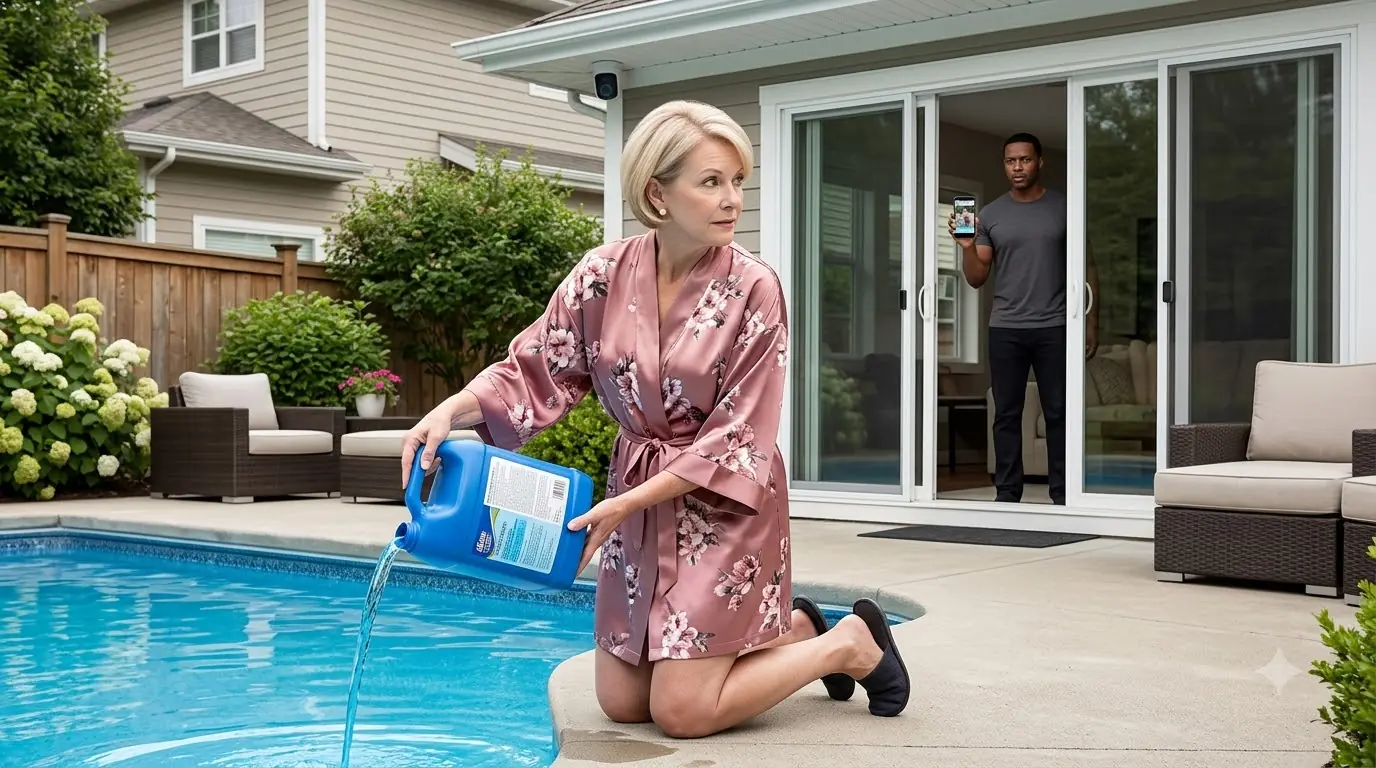
Marcus set his coffee mug on the counter and walked outside.
The Saturday morning was bright and quiet. Sprinklers clicked two houses away, a lawn mower hummed somewhere behind the row of privacy fences, and sunlight reflected off the pool strongly enough that Marcus had to narrow his eyes as he approached the edge. The blue cloud had already begun spreading toward the center.
He crouched beside the brick coping.
A chemical smell hung faintly above the water.
Marcus did not touch it.
Instead, he pulled out his phone and photographed the pool from several angles before calling the company that serviced it every other Friday.
“Did you add anything yesterday?” he asked when the technician answered.
“No,” the man replied. “Your regular service is next week.”
“Nothing blue?”
“Nothing at all.”
Marcus looked back at the water.
“All right. Don’t come yet.”
The technician hesitated.
“You want me to test it?”
“I do. But give me an hour.”
Marcus ended the call.
He had learned during fifteen years of managing construction projects that evidence disappeared fastest when everyone rushed to fix the problem. Before anybody drained, diluted, cleaned, touched, moved, or explained anything, he wanted to know what had happened.
That instinct would matter.
Marcus was forty-two years old, broad-shouldered, quiet, and patient enough that people occasionally mistook patience for passivity. He had purchased the Brookstone Ridge house after years of moving between apartments while building his career, and the property mattered to him less as a status symbol than as proof that stability could be constructed deliberately.
The backyard was his favorite part.
He had rebuilt the patio himself, redesigned the drainage around the pool, planted two rows of privacy hedges, and installed a small outdoor kitchen beside the covered porch. Most evenings, he sat near the water after work and read while the neighborhood quieted.
The only part of Brookstone Ridge he disliked was the homeowners association.
More specifically, he disliked Beverly Crane.
Beverly had been HOA president for nearly six years.
She was sixty-two, carefully dressed even when collecting mail, with a short blonde bob, pearl earrings, and the habit of speaking as though every neighborhood guideline had personally descended from a higher authority into her hands.
Marcus had encountered her during his first month in Brookstone Ridge.
She had knocked on his door at 7:10 on a Saturday morning because his recycling bin remained visible from the street eleven minutes after the community rule supposedly required it to be removed.
Marcus had assumed she was joking.
She was not.
“I’m only helping you avoid a written violation,” Beverly had said.
Marcus looked at the empty street behind her.
“Thank you.”
Beverly smiled.
“Residents sometimes underestimate how quickly standards can slip.”
Marcus had closed the door without arguing.
Within six months, Beverly cited him for the wrong shade of mulch.
Three months later, she complained about a delivery van remaining in his driveway for forty-three minutes.
Then came a notice about patio lighting allegedly being visible from the street, despite Marcus’s backyard fence making that physically impossible.
Each time, Marcus responded with photographs, receipts, measurements, or the exact language from the HOA covenants.
Each time, the violation quietly disappeared.
That should have ended the tension.
Instead, it seemed to irritate Beverly.
She was accustomed to homeowners either obeying immediately or becoming emotional enough that she could characterize them as unreasonable. Marcus did neither. He read every notice carefully, answered only what could be documented, and kept copies of everything.
The relationship worsened the previous autumn when Beverly attempted to fine him $500 for modifications to the pool deck.
Marcus had obtained written architectural approval fourteen months earlier.
He sent Beverly the approval email.
She replied that the committee had “reconsidered the visual effect.”
Marcus requested the section of the bylaws allowing retroactive revocation of completed architectural approval.
There was none.
The fine vanished.
Two days later, Beverly appeared beside his mailbox.
“You enjoy making everything difficult,” she said.
Marcus looked at her.
“I enjoy knowing what I agreed to.”
“It’s a community.”
“I know.”
“Sometimes cooperation matters more than technicalities.”
Marcus gave a small nod.
“That works both ways.”
Beverly walked away without answering.
Three weeks before the strange blue substance appeared in his pool, another dispute began.
The HOA sent Marcus a notice claiming his pool water was “visibly inconsistent with community sanitation standards” and could create an unsightly appearance observable from neighboring homes.
Marcus read the letter twice.
His pool was professionally maintained.
The water was clear.
He photographed it, attached the latest maintenance report, and emailed both to the HOA management address.
Beverly answered personally.
“The board retains authority to verify outdoor conditions when complaints are received.”
Marcus asked which neighbor had complained.
Beverly refused to identify the person.
He asked what exactly had been observed.
She replied only, “Water condition.”
Marcus asked when.
No answer came.
Then Beverly requested access to his backyard for an HOA inspection.
Marcus refused.
“My backyard is fenced private property,” he wrote. “If the HOA believes a violation exists, please provide the specific covenant provision authorizing physical entry without homeowner consent.”
There was no response for four days.
Then another violation notice arrived.
That was when Marcus upgraded his backyard cameras.
He had already used a basic doorbell system and driveway camera, but years in construction management had taught him how disputes often changed once objective records existed.
He installed one camera beneath the covered patio aimed toward the pool.
Another watched the side gate.
A third faced the rear fence.
The system stored recordings automatically.
Marcus almost forgot about it.
Until the pool turned blue.
Standing beside the contaminated water that Saturday morning, Marcus looked up toward the small camera beneath the patio roof.
Then he smiled once.
Not because the situation was funny.
Because suddenly there was somewhere to look.
He returned inside.
Opened the security application.
Selected the previous twelve hours.
At 6:17 that morning, the side gate moved.
Marcus froze the video.
A woman stepped into the backyard.
Pink satin robe.
Dark slippers.
Short blonde hair.
Marcus leaned closer to the screen.
“Beverly.”
The camera recorded her walking slowly along the patio while repeatedly glancing toward the house.
In her right hand she carried a large blue plastic container.
She stopped beside the pool.
Looked toward the windows.
Unscrewed the lid.
Then knelt.
Marcus watched without moving.
Beverly tilted the container.
A stream of bright blue liquid poured into the shallow end.