The metallic locks engaged across Heron Bay Estates at exactly ten o’clock on Independence Day. Six neighborhood gates, forty-two electronic keypads, and every temporary pool code issued during the previous two summers died at the same instant. Red letters replaced the cheerful welcome message on the screen beside Evan Brooks’s private pool: ACCESS REVOKED — PRIVATE PROPERTY — PARCEL 7A. Outside the locked iron gate, HOA President Linda Caldwell stared at the screen while thirty vacation renters crowded behind her with coolers, towels, inflatable toys, and receipts proving she had charged them for something she did not own.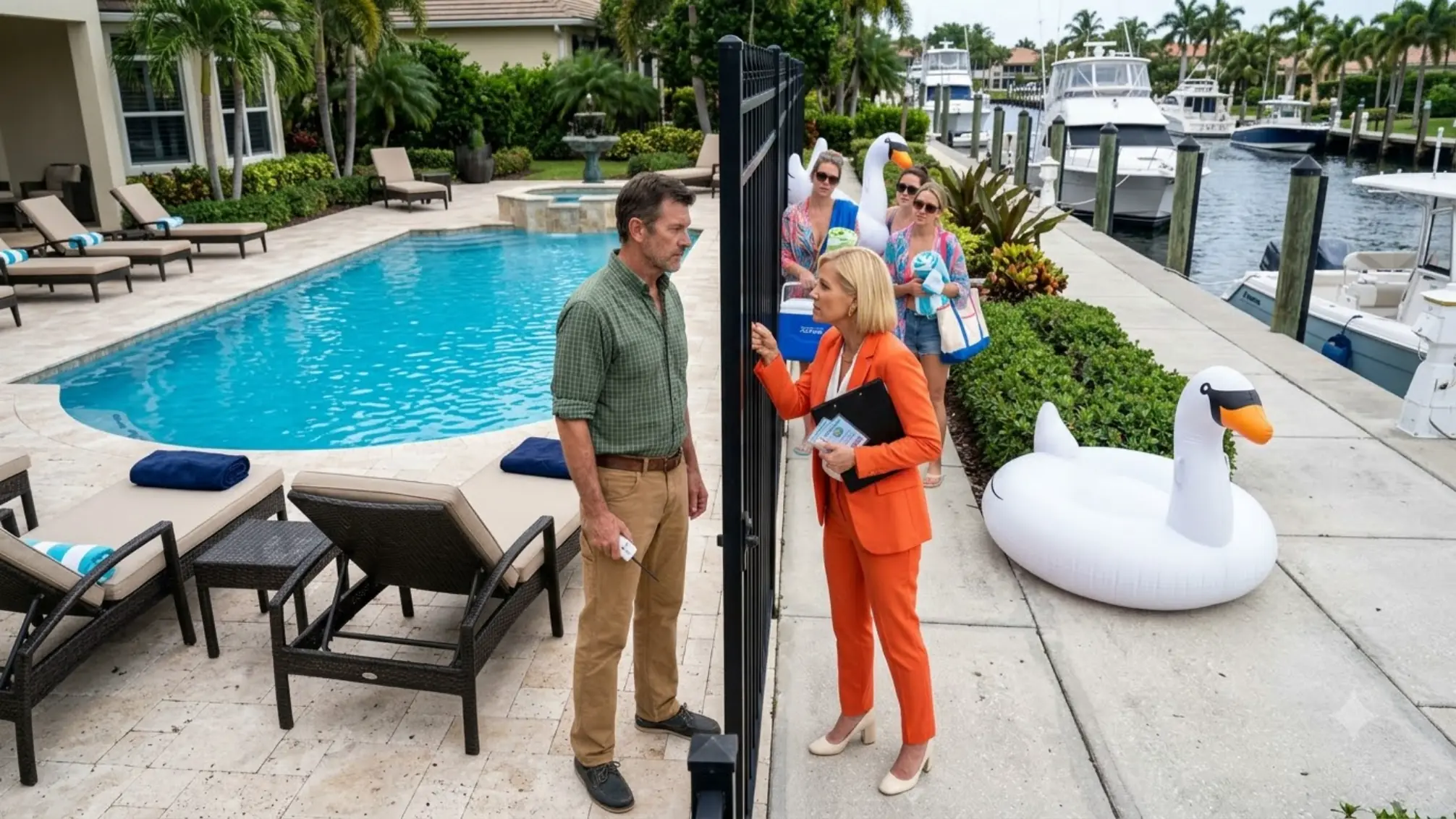
Evan stood on the opposite side of the gate, firmly inside his own property. The bright-blue saltwater pool stretched behind him, surrounded by pale travertine and trimmed palms swaying beneath the Florida sun. At the center of the deck stood a bronze sea-turtle fountain bearing the initials of his late wife, Mary Ann. He held the gate remote at his side and watched Linda strike the keypad again.
“Open this gate!” she shouted.
The screen flashed red.
USER LINDA CALDWELL — ADMINISTRATIVE PRIVILEGES REVOKED.
Linda punched in another code.
Red again.
A vacation renter in a University of Tennessee cover-up stepped forward. “You told us this was a private resort amenity.”
“It is,” Linda snapped. “The homeowner is having an episode.”
Evan’s expression did not change.
He had spent nine years designing access-control systems for courthouses, hospitals, casinos, and government buildings. He understood the difference between anger and strategy. Anger was loud, immediate, and easy to dismiss. Strategy waited until every document, witness, and digital record stood in the correct place.
Linda raised her phone.
“I’m calling the police.”
“Please do,” Evan said.
She expected fear.
Instead, he pulled a folding chair closer to the pool and sat down.
The conflict had begun two summers earlier, though Evan did not understand its scale at first. He had returned from visiting Mary Ann’s grave one Tuesday afternoon and found an SUV with Ohio plates parked in his driveway. Children ran through his flower beds, strangers floated in his pool, and a man with a canned drink was attempting to climb the bronze fountain.
Linda stood at the gate handing out laminated passes.
“Welcome to the Heron Bay amenities,” she called while another family entered.
Evan stopped beside the driveway. “Linda, what are these people doing here?”
She smiled as if he had asked a charmingly foolish question.
“They’re vacation guests.”
“This is my backyard.”
“It’s a community amenity.”
“The pool sits inside my deeded parcel.”
Linda patted his shoulder. “You’ve been alone too long, Evan. Sharing might be healthy for you.”
His hands went still.
That fountain had not been decorative landscaping. Evan had built it six months after Mary Ann died from pancreatic cancer. During treatment, the pool had been the only place where the pain briefly loosened its grip on her body.
She used to float before sunrise while Evan sat beside the water and counted her breaths.
After she died, he commissioned a bronze sea turtle from a craftsman in Sarasota. He mounted it himself, connected the waterline, and pressed Mary Ann’s initials into a plate beneath the shell. At night, the fountain’s quiet flow gave shape to the silence inside their house.
Now strangers were climbing it while Linda collected money at the gate.
Evan asked everyone to leave.
Linda stepped between him and the renters. “You don’t have authority to close a shared facility.”
“My name is on the deed.”
“The HOA master plan supersedes individual preferences.”
“Property ownership isn’t a preference.”
Her smile vanished. “You’re embarrassing yourself.”
The renters had been told they were welcome, and most of them looked confused rather than malicious. Evan did not yell at them. He waited until they gathered their belongings and then mailed Linda a certified letter containing his deed and a formal demand that the HOA stop distributing pool access.
Three days later, he received a seven-hundred-and-fifty-dollar violation.
The letter claimed his front hedge exceeded HOA height restrictions by three inches.
Pete Hollister arrived in a golf cart while Evan was reading it in his driveway. Pete was a retired charter captain with one damaged knee and a talent for uncovering neighborhood gossip before breakfast.
“She’s running vacation rentals,” Pete said.
Evan looked up. “Who?”
“Linda. Caldwell Coastal Hospitality. Eleven houses.”
Pete handed him printed screenshots from rental listings. Each advertised “exclusive private resort pool access” and displayed a photograph of Evan’s fountain as its main attraction.
The image showed Mary Ann’s initials.
“How much is she charging?” Evan asked.
“A hundred and fifty dollars a day per family.”
Evan studied the pages.
Linda had not simply misunderstood the property boundary. She had built a business around his pool and his wife’s memorial.
They drove to the county clerk’s office that afternoon. An employee pulled the original subdivision map from 1998 and displayed it on a microfilm reader. Parcel 7A included the pool, the deck, the fountain, and the fenced walkway connecting them to Evan’s house.
The original record described the pool as a private recreational easement belonging exclusively to the residence.
A later HOA filing from 2004 attempted to label the pool common property, but the document lacked the owner’s signature and the required boundary survey. It was legally defective.
The clerk printed three copies.
“You own the pool,” she said. “Looks like you always did.”
Evan traced the parcel line with one finger.
“What about the HOA assessments I’ve paid?”
“If they charged you to maintain property you already owned, you need an attorney.”
Evan called Warren Tanner before leaving the building.
Warren had represented contractors, property owners, and small businesses across Sarasota County for thirty-five years. He listened without interrupting, then asked Evan to bring every document and screenshot to his office.
“Don’t confront her yet,” Warren advised. “Document first.”
“She’s still selling access.”
“Let her keep creating evidence.”
Evan disliked allowing strangers near the fountain, but he understood the logic. Linda had spent years surviving complaints by reframing them as personal disputes. One angry homeowner could be dismissed as bitter or confused.
A complete paper trail could not.
Evan began what he called the shadow file.
He saved every rental listing, guest review, payment description, laminated pass, email, violation notice, and photograph. He installed cameras within his property boundaries and exported the access logs from the gate system.
The system still answered to him.
Nine years earlier, Heron Bay’s developer had asked Evan to build the electronic gate network because the new community lacked money for a commercial vendor. Evan created the infrastructure, maintained the primary account, and agreed to transfer administration once the HOA hired a replacement.
The transfer never happened.
Linda had been issuing temporary codes through a limited user panel without realizing the master account remained under Evan’s control. Every code she created appeared in his logs with a timestamp, user label, and access history.
He could have disabled them immediately.
Instead, he watched.
The records revealed that Linda had created hundreds of codes connected to Caldwell Coastal Hospitality. Some remained active for seven days, others for entire months. Guests used them not only at the pool but also at neighborhood gates intended for residents.
Nora Kensington, the HOA treasurer, confirmed the financial side.
She met Evan and Pete late one evening at a diner outside the neighborhood. Nora looked exhausted and kept glancing toward the windows before sliding two envelopes across the table.
The first contained HOA bank statements.
The second contained deposit records from Linda’s private company.
Caldwell Coastal Hospitality had collected more than eighty-seven thousand dollars in pool-access fees. None of it appeared in the HOA accounts.
“She told us the money was being consolidated,” Nora whispered. “I thought it covered administrative expenses.”
“Did the board approve private rentals?” Warren asked.
“No.”
“Did you sign any agreement allowing her company to use the pool?”
“No.”
Evan opened the second envelope.
Several deposits came directly from online rental platforms operating across state lines.
Warren looked at him. “This just became larger than a property dispute.”
Linda’s behavior grew more aggressive as rumors spread. She sent violation notices about Evan’s hedges, trash cans, driveway stains, and the supposed unauthorized fountain. Her husband, Gregory, visited the house and offered to purchase Parcel 7A “above market” if Evan agreed to leave the neighborhood quietly.
Evan stood in the doorway without inviting him inside.
“You don’t want to fight us,” Gregory said.
“I don’t,” Evan replied. “I want your wife answering questions on the record.”
Gregory’s smile disappeared.
The following week, someone photographed Evan’s property from inside his side yard and emailed the images to his pregnant daughter. The anonymous message claimed Evan’s mental condition had deteriorated since Mary Ann’s death.
His daughter, Haley, called immediately.
“She’s trying to make me think you’re unstable.”
“She wants the argument to become about me instead of the deed.”
“I’m coming down.”
“Stay home.”
“No.”
Evan knew the tone. Haley had inherited it from her mother.
“Come July third,” he said. “Not before.”
The emotional line was crossed at Linda’s Sunset Pool Mixer.
She invited more than forty renters to an evening event with music, drinks, and “exclusive amenity networking.” Evan watched from inside his darkened kitchen while strangers filled his backyard.
A man climbed onto the fountain.
Before Evan could reach him, the man jumped backward into the pool.
His heel struck the bronze turtle.
The fountain broke at its base and fell into the deep end.
The sound silenced Evan more effectively than any insult could have. Beneath the underwater lights, the turtle sank slowly, pulling Mary Ann’s engraved plate behind it.
Linda raised a plastic glass when she saw Evan approaching.
“Come have a drink.”
“That fountain is my wife’s memorial.”
Her expression showed annoyance rather than regret.
“These things happen at community events.”
“This is not a community event.”
“It was an unauthorized modification anyway.”
Evan stepped close enough that her smile faltered.
For one second, he considered throwing every guest out by force.
Then he turned away.
Pete followed him into the kitchen.
Evan sat with both palms flat against the table. He could hear music and laughter outside while water sprayed from the broken fountain line.
Pete remained silent until Evan’s breathing slowed.
“You’ve been patient,” Pete finally said. “Patience finished its job tonight.”
Before sunrise, Evan entered the cloudy pool and recovered the broken bronze turtle. He wrapped it in Mary Ann’s old beach towel and carried it to the workbench where he had assembled the fountain years earlier.
Then he opened a new folder on his computer.
He named it PROCEDURAL.
Warren filed a quiet-title action asking the county court to confirm Evan’s ownership and invalidate the defective HOA claim. He also demanded repayment of assessments collected on the private pool, compensation for unauthorized commercial use, and damages to the fountain.
Nora submitted financial evidence to investigators.
Separate complaints went to state licensing authorities, the county, and tax officials. The rental listings, payment records, and access logs demonstrated that Linda had sold entry to private property through an unlicensed commercial arrangement.
Evan contacted investigative reporter Mallory Pierce.
She reviewed the deed, plat map, account records, and photographs of the broken fountain.
“When do you want this exposed?” she asked.
“Independence Day.”
Mallory looked up. “Why then?”
“Linda scheduled her largest pool event.”
“How many guests?”
“At least seventy.”
Mallory smiled. “I’ll bring a camera.”
Evan rebuilt the access system on a secure computer and prepared a scheduled command. At ten o’clock on July fourth, every rental code would expire. Resident codes belonging to families Evan personally authorized would continue functioning.
The main screens would display the parcel number, court filing, and trespass warning.
Everything remained legal because Evan controlled the system serving his property.
Still, Warren warned him about appearances.
“Linda will say you trapped families outside a holiday pool.”
“The families are victims too.”
“Then make that clear.”
Evan prepared printed notices explaining that anyone who had paid Linda should preserve their receipts and request refunds. He arranged for residents with legitimate permission to receive new cards.
He did not want revenge against innocent renters.
He wanted every lie to become visible at once.
Haley arrived the evening before the event. Pete brought food, Nora delivered final records, and Evan ran one last test of the system.
All nodes showed green.
Before bed, Evan placed the restored bronze turtle onto its new base. He had reinforced the shell, repaired Mary Ann’s initials, and made the fountain stronger than before.
He lit a candle beside it.
“Tomorrow,” he whispered.
By nine fifty the next morning, Linda stood outside the pool gate in a white linen outfit, handing passes to incoming guests. Travis Shelton, her loyal HOA assistant, directed traffic while rental vehicles lined the street.
Evan watched from his kitchen.
Mallory’s news van parked nearby at nine fifty-eight.
A sheriff’s cruiser waited two streets away.
At ten o’clock, Evan pressed the remote.
Every unauthorized code died.
The main pool gate locked with a heavy metallic clunk. Linda struck the keypad, expecting it to open.
The screen rejected her.
She tried again.
Rejected.
The crowd grew restless.
A father holding two children’s towels pushed toward Travis. “We paid seven hundred dollars for pool access.”
“There’s a technical issue,” Travis said.
The red screen displayed the truth.
PRIVATE PROPERTY OF EVAN BROOKS. ALL COMMERCIAL ACCESS REVOKED.
Linda spotted Evan standing beyond the bars with his pool behind him.
“Open it!”
“No.”
“These guests paid.”
“They paid you.”
“This is an HOA facility.”
Evan raised the remote. “Not according to the deed.”
Linda shook the gate with both hands.
“Unlock it before I call the police.”
“Call them.”
She did.
Mallory stepped from the news van while Linda was still speaking to the dispatcher.
“Mrs. Caldwell, did your company collect fees for access to this pool?”
Linda turned sharply. “No comment.”
A woman behind her raised a printed confirmation. “Then what did we pay for?”
Other renters began checking their phones and receipts. The mood shifted as they realized they had not been denied something they owned.
They had been sold something Linda never possessed.
Deputy Ellery Landry arrived moments later.
Linda hurried toward him.
“Officer, this homeowner locked paying guests out of a community amenity and threatened me.”
Deputy Landry looked through the gate. “Did he threaten physical harm?”
“He said I’d leave in cuffs.”
“Did you try entering his property?”
“It’s not his.”
Evan held a sealed folder through the bars.
The deputy read the deed, original plat map, and court filing. He compared the parcel description to the visible boundaries.
“This pool is inside Parcel 7A,” he said.
Linda pointed toward an HOA map on her clipboard. “Our documents identify it as common property.”
The deputy examined the copy.
“This has no surveyor’s seal.”
“The board approved it.”
“A board cannot approve taking someone’s land.”
Linda’s face reddened. “My husband serves on the county planning commission.”
“That doesn’t change the deed.”
Evan unlocked a narrow document slot without opening the pedestrian gate and passed out the electronic access logs.
“These show every code her company created and every entry into my parcel.”
Deputy Landry reviewed the records.
“Mrs. Caldwell, step away from the gate.”
“You don’t understand who I am.”
“I understand you’re standing outside private property demanding entry.”
She looked around for support.
The renters no longer stood behind her as customers. They surrounded her as witnesses.
One man held up his phone. “She charged me four hundred dollars.”
Another woman said, “We paid separately for a VIP pass.”
Mallory’s camera continued recording.
A state business-regulation vehicle entered the street. Inspector Harlan Estes stepped out holding a cease-and-desist order addressed to Caldwell Coastal Hospitality.
“Mrs. Caldwell,” he called, “I need your commercial-access records.”
Linda backed toward the gate.
Evan remained inside.
She had nowhere to redirect the confrontation.
The paperwork, screens, witnesses, and property line all pointed toward her.
“This is harassment,” she said.
“No,” Evan replied. “This is accounting.”
The deputy asked Linda whether she had accepted payment for access to Parcel 7A. She refused to answer and attempted to walk away.
Inspector Estes informed her that the state was seizing business records connected to the operation. Mallory asked how many families had paid for access over the previous two years.
The renters began shouting for refunds.
Linda’s control collapsed.
She pushed past one woman and grabbed the gate again.
Deputy Landry seized her wrist.
“I told you to step away.”
“This is my community!”
“It is not your pool.”
When she continued resisting, he placed her in handcuffs.
The click of metal carried across the deck.
Evan watched without celebration.
Linda had imagined this moment as a fight between a grieving widower and a powerful HOA president. Instead, she stood surrounded by people holding receipts while officers reviewed evidence she had created herself.
Travis quietly removed his HOA lanyard.
Nobody stopped him from leaving.
After Linda entered the cruiser, Evan opened the gate for eleven resident families whose permission had never been in question. Two children wearing swimming goggles waited with their grandmother.
Evan handed them new access cards.
“You’re good,” he said. “Swim safely.”
They ran toward the water.
The vacation renters remained outside because their contracts were with Linda, not Evan. However, he gave them copies of the refund instructions and provided contact information for investigators.
Several thanked him.
One apologized for having entered his property during an earlier visit.
“You were lied to,” Evan said. “Keep your receipt.”
The quiet-title hearing took place three weeks later. The judge examined the original plat, the defective HOA filing, and decades of assessments charged against a pool the association never owned.
Ownership was confirmed permanently to Evan Brooks and his heirs.
The HOA was ordered to return the wrongful assessments with interest.
Linda’s criminal case expanded after investigators traced rental income through online platforms and uncovered additional financial misconduct. Gregory resigned from the planning commission following a conflict-of-interest investigation.
Nora received legal protection for cooperating.
The HOA held a special election and removed the remaining leadership connected to Linda’s operation. Joanne Pettigrew, a retired librarian known for documenting everything, became the new president under one condition: meeting records would be published within forty-eight hours.
Evan used the assessment refund to establish the Mary Ann Brooks Aquatic Foundation.
Every Sunday morning, the private pool opened by invitation to children from nearby communities with limited access to swimming lessons. Certified instructors taught them water safety, floating, and basic rescue skills.
The pool remained private.
Opening it became Evan’s choice rather than Linda’s product.
The repaired bronze fountain returned to the center of the deck with a small plaque beneath Mary Ann’s initials:
She loved water. She loved children. This is the pool she would have wanted.
Months later, Haley returned with Evan’s newborn granddaughter. They sat beside the fountain while children practiced floating across the shallow end.
Pete occupied the chair beside them with a diet soda.
“You ever miss the quiet?” he asked.
Evan watched an instructor help a frightened child release the pool wall.
“Not this kind.”
The electronic access system remained under his control, but the rules were now transparent. Every card belonged to a named user. Every guest received clear permission. No HOA officer could create commercial passes or sell access without Evan’s authorization.
Linda had believed the pool belonged to whoever shouted loudest at the gate.
Evan understood that ownership lived in quieter places: deeds, maps, server logs, receipts, and the right to decide who crossed the boundary.
When she forced vacation renters toward his backyard, she expected him to surrender rather than cause a public scene.
Instead, he let her gather every witness herself.
Then he killed every false code at once.
The police did not drag Evan from his private yard.
They stood outside his locked gate, read the deed, and removed the woman who had spent two years selling his water as though it belonged to her.