Broderick Callahan had watched many people cross his front yard during the eleven years he lived in Sycamore Creek Estates. Children chased runaway balls across the grass. Neighbors left holiday cookies on his porch. Delivery drivers occasionally stepped on the flower bed while wrestling oversized packages toward his door.
But only one person walked to his mailbox as if everything inside belonged to her.
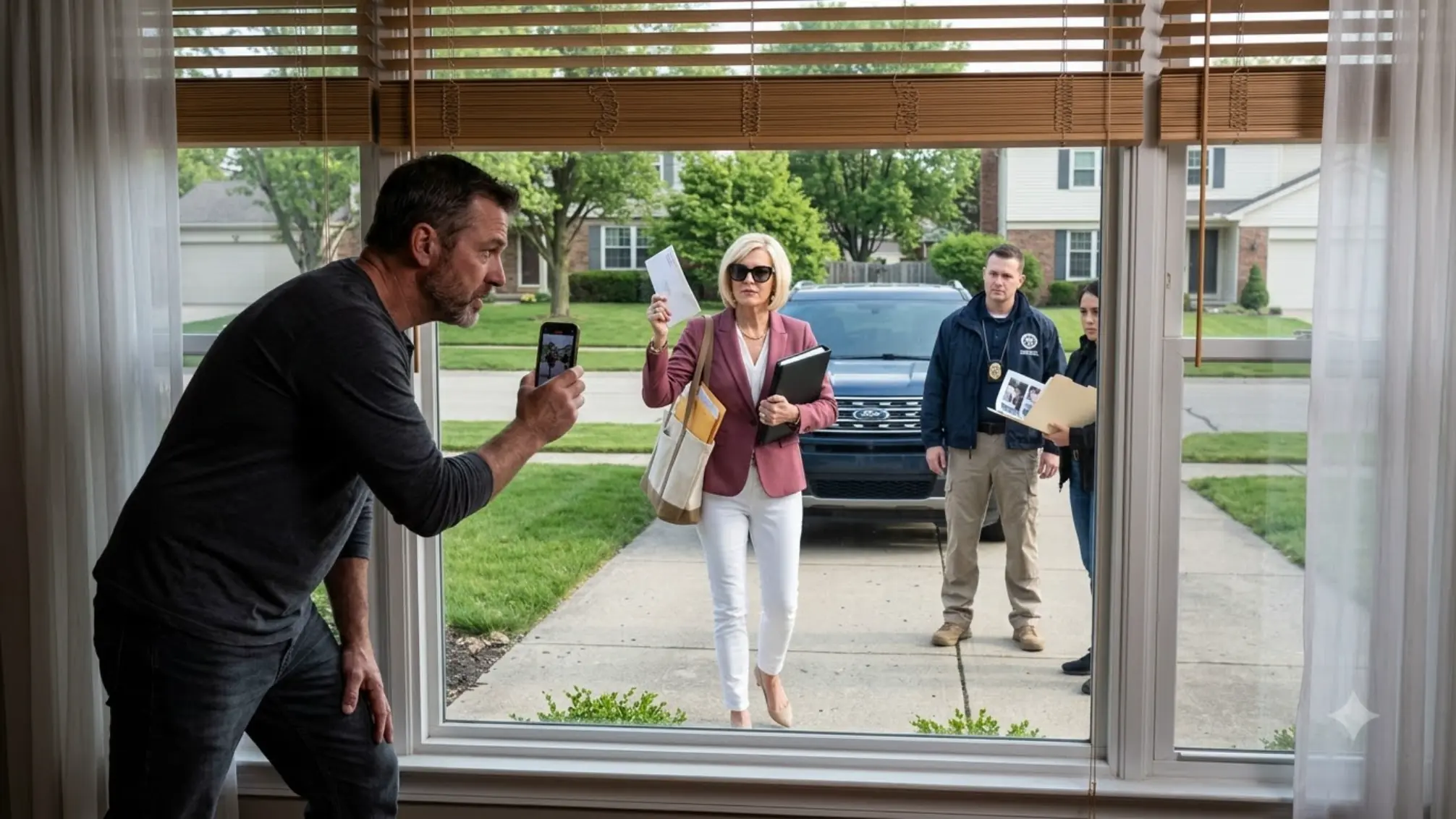
Constance Holt wore a dark-pink blazer over a white blouse, slim white pants, beige heels, oversized black sunglasses, and the calm expression of a woman who had spent seven years confusing authority with ownership. She opened Broderick’s black roadside mailbox, removed three envelopes, and slipped them into the canvas tote hanging beside her large HOA compliance binder. Then she closed the mailbox carefully and began walking away without looking hurried, frightened, or remotely guilty.
It was the fourth time she had taken his mail that week.
Broderick stood inside his front window wearing a charcoal long-sleeve shirt and dark jeans, his phone raised in one hand. He kept recording even though anger made his fingers tighten around the device. Among the stolen envelopes, he recognized the heavy cream paper used by one of his largest electrical clients.
That envelope might contain another contract.
Or a payment.
Or the explanation for why a client had suddenly stopped returning his calls.
Constance reached the middle of his driveway before noticing him behind the glass. She stopped, removed one envelope from her tote, and lifted it toward the window with a faint smile.
“Keep staring,” she called. “I’ll fine you for harassing an HOA officer.”
Broderick continued recording.
“Smile, Constance,” he said through the partly opened window. “That’s federal evidence in your hand.”
Her smile disappeared.
She turned toward his front door, clutching the envelope between two fingers. “Come outside and say that to my face.”
Broderick lowered the phone just enough to look beyond her.
A dark, unmarked SUV had stopped at the curb.
Two plainclothes American postal inspectors stepped onto the sidewalk. The first was a Black American woman in her late forties wearing a tan jacket over dark professional clothes. She raised a federal badge as she approached. Her white American partner, a broad-shouldered man with short gray hair, carried a thick evidence folder containing printed images taken from Broderick’s security cameras.
“Don’t move,” the woman said.
Constance slowly turned around.
“You can say it to us instead.”
For the first time in seven years, the HOA president of Sycamore Creek Estates appeared to have no prepared answer.
Broderick had not always believed Constance was stealing his mail.
At fifty-four, he had spent most of his life repairing electrical systems, first as a union electrician and later as the owner of Callahan Electrical Services. His work required patience. Bad wiring rarely announced itself clearly. A burned outlet might originate from a damaged junction several rooms away, and the most dangerous problems often hid behind walls that looked perfectly normal.
People could work the same way.
When Broderick’s health insurance company first reported returned correspondence, he blamed a clerical error. When two supplier invoices arrived late, he assumed the local post office was understaffed. Even after a certified letter appeared with its seal slightly misaligned, he told himself an employee had opened it accidentally.
Then a fourteen-thousand-dollar contract vanished.
The client had selected Broderick’s company to rewire a renovated restaurant downtown. The job required specialized equipment, three temporary workers, and a difficult ten-day deadline, but it would have carried his small business through the slow winter months.
The client mailed the signed agreement.
Broderick never received it.
Three weeks later, the client called to ask why no work had begun. By then another contractor had accepted the job. Broderick lost the project, the deposit, and the client’s trust.
That evening, he reviewed footage from the security camera facing his mailbox.
Constance appeared on the screen at 9:12 on a Thursday morning. She wore a pale cardigan, sunglasses, and the same canvas tote she carried to HOA meetings. She opened his mailbox, looked through the envelopes, selected two, and carried them home.
Broderick replayed the footage six times.
His first impulse was to cross the street, pound on her door, and demand everything she had taken. Instead, years of tracing hidden electrical faults took control.
He saved the video in three separate locations.
Then he reviewed the previous month.
Constance appeared again.
And again.
Sometimes she took one envelope. Sometimes several. Once she opened a business letter beside the mailbox before folding it into her bag. Another time she removed a medical notice, read the front and back, then carried it away.
Broderick did not confront her.
He contacted the United States Postal Inspection Service.
The complaint took less than half an hour. He uploaded video clips, listed missing documents, described the financial damage, and provided dates and times for every incident he could verify. Two days later, he received a case number.
The confirmation should have reassured him.
Instead, it made the situation feel real.
Constance Holt, retired school administrator and seven-year HOA president, was not merely an unpleasant neighbor. She had been taking federally protected mail from his box while issuing him weekly fines for parking his work van in his own driveway.
She was committing crimes.
He was paying penalties.
Three days after filing the complaint, Broderick found a handwritten note inside his mailbox.
YOU SHOULD BE MORE CAREFUL.
There was no envelope and no signature.
He photographed it, sealed it inside a plastic sleeve, and forwarded a copy to the postal inspector assigned to his complaint.
That was when Constance began using the HOA openly.
She called an emergency board meeting and proposed that the cluster mailbox area be designated as “HOA-controlled community property.” She claimed the new authority was necessary to protect residents from package theft and suspicious activity.
Eleven board members were notified.
Three were not.
The published minutes described the vote as unanimous.
Broderick learned about the meeting from Wendell Pierce, a retired postal worker who lived three houses away. Wendell attended nearly every community meeting, took detailed notes, and possessed the unsettling ability to remember statements people hoped everyone had forgotten.
“She’s building herself an excuse,” Wendell told Broderick over coffee.
“For taking mail?”
“For controlling who receives what. People like Constance don’t create rules because they need permission. They create rules so they can pretend they always had it.”
Broderick requested the HOA’s governing documents.
The management company delayed until he cited the Ohio law giving homeowners access to association records. Forty-seven pages arrived by certified mail. He read them at his kitchen table with a yellow highlighter, just as he once examined wiring diagrams for a failing apartment complex.
Article Eleven, Section Four prohibited board officers from interfering with a homeowner’s legal rights or quiet enjoyment of property.
He highlighted it twice.
The emergency vote presented another problem. Fourteen members were eligible, but only eleven had received notice. Constance had excluded the three most likely to oppose her, then recorded the decision as though the full board agreed.
Broderick added the documents to a growing accordion folder.
Constance responded by installing a locked parcel station beside the community mailbox bank. Residents received a cheerful letter explaining that packages could now be redirected there for “community safety.”
Every homeowner received an access code.
Every homeowner except Broderick.
He contacted the local postmaster, who confirmed that the HOA had no authority to create its own package-delivery station beside federal postal infrastructure. Carriers had already been told not to use it.
Broderick sent the written confirmation to the management company and the board attorney.
The parcel station disappeared eleven nights later.
Constance described its removal as “temporary maintenance.”
Then came the van fines.
Callahan Electrical Services used a white Ford Transit. The HOA’s rules prohibited commercial vehicles over ten thousand pounds or vehicles displaying more than two square feet of business advertising.
Broderick’s van weighed less than the stated limit.
The removable magnetic signs measured less than two square feet and were taken off every evening.
Constance issued a one-hundred-fifty-dollar violation anyway.
Broderick photographed the vehicle, measured the signs beside a ruler, attached the manufacturer’s weight specifications, and formally disputed the notice.
The fine was rescinded.
No apology followed.
Instead, Constance created a private neighborhood group online and posted warnings about unnamed homeowners operating dangerous commercial businesses from residential property. She complained about work vehicles, declining property values, and residents who “weaponized technicalities against volunteers.”
She never wrote Broderick’s name.
She did not need to.
The campaign might have worked if she had treated everyone equally. But two of her closest friends operated businesses from home and parked larger work vehicles in their driveways. Neither received a violation.
Broderick began documenting every comparable vehicle.
A daycare van.
A landscaping trailer.
A contractor’s pickup.
He created a spreadsheet comparing identical circumstances with HOA enforcement actions. The pattern was unmistakable. Rules followed personal loyalty rather than community standards.
His attorney called it selective enforcement.
She also warned that board members could face personal liability if they knowingly used HOA powers to target specific homeowners.
Broderick thought that discovery might be the worst thing inside the records.
Then he requested the financial statements.
The association’s reserve fund should have contained approximately eighty-seven thousand dollars. The balance showed slightly more than forty-one thousand.
Broderick spent an entire Saturday reviewing expenditures.
Twenty-six payments had been made to a vendor called BCH Property Maintenance LLC. The amounts varied from eight hundred to forty-four hundred dollars. Together they totaled forty-three thousand five hundred dollars.
There was no vendor contract.
No board approval.
No work order.
No photograph showing completed repairs.
No credible evidence the company had done anything for Sycamore Creek Estates.
Broderick searched the Ohio business registry.
BCH Property Maintenance LLC existed on paper.
The registered agent was Constance B. Holt.
The address led to a rented mailbox in another town. The company had been formed during the same month Constance became HOA president.
BCH.
Birchfield Constance Holt.
Broderick stared at the screen until his coffee went cold.
The mail theft suddenly became more than neighborhood harassment. Constance had not been stealing random correspondence merely to prove she could. She had targeted a business owner who read contracts, checked numbers, and challenged improper rules.
She wanted to know what he received.
She wanted to interrupt his income.
She wanted him too distracted, financially damaged, and intimidated to examine the HOA’s finances.
Broderick called his attorney.
She told him not to confront anyone.
A forensic accountant reviewed the reserve fund and produced a forty-page report confirming that the vendor had no business history, licensing, employees, public presence, or documented work. Homeowner money had moved into a company controlled by the HOA president.
Meanwhile, the postal inspectors continued their own investigation.
Teresa Mills, the neighborhood’s mail carrier, had maintained a personal log for nearly two years. She recorded unusual activity around the mailbox bank, including Constance approaching shortly after deliveries and repeatedly handling mail addressed to other residents.
The investigators compared Teresa’s notes with Broderick’s videos.
Dates matched.
Times matched.
Envelope descriptions matched missing documents reported by multiple homeowners.
Constance had not taken mail only from Broderick.
He had simply been the first person to build a case.
The opportunity to expose everything came during the annual homeowners meeting.
Every resident could attend, speak, and demand financial records. Constance had controlled those meetings for seven years, using procedure, limited speaking time, and selective agendas to prevent meaningful questions.
This year, Broderick’s attorney served a formal demand for financial accounting ten days in advance.
Seventy-four homeowners attended.
The previous attendance record was thirty-one.
Broderick arranged stacks of evidence reports near the entrance. Wendell brought pecan cookies because, as he explained, people remained longer when they were comfortable. Diane, one of the board members excluded from Constance’s emergency meeting, carried a recording of a phone call in which Constance offered to withdraw violations against certain homeowners in exchange for delaying the financial review.
Teresa sat in the third row.
A real estate attorney named Daphne Moore placed a sealed envelope from the Ohio Attorney General’s Office on the front table.
Constance arrived wearing a navy blazer and carrying the same canvas tote seen in Broderick’s security videos. She scanned the crowded room, the financial reports, the connected presentation screen, and the residents standing along the walls.
At precisely seven o’clock, she called the meeting to order.
Her first move was to delay the financial discussion.
Daphne read the relevant statute aloud and explained that the properly noticed review could not be removed through a simple board motion.
Constance requested a recess.
No one seconded it.
Broderick displayed his first slide.
Twenty-six payments to BCH Property Maintenance LLC appeared in the left column.
The right column showed supporting documentation.
Every row was blank.
The room became so quiet that the fluorescent lights seemed loud.
A woman near the front whispered, “That’s our money.”
Broderick changed slides.
The business registration appeared.
BCH Property Maintenance LLC.
Registered Agent: Constance B. Holt.
A murmur moved through the clubhouse, but no one shouted. The silence became heavier because everyone reached the same conclusion at nearly the same time.
Constance stood.
She claimed the documents were incomplete.
She insisted there was a reasonable explanation.
She accused Broderick of presenting confidential information outside the proper process and said residents needed to trust experienced leadership.
Daphne opened the sealed envelope.
“The Ohio Attorney General’s Office has acknowledged a formal complaint regarding these expenditures.”
Constance’s prepared expression began to fracture.
Then Diane described the recorded phone call.
“You offered to dismiss violations against four homeowners if I voted to delay this review.”
“That is not what happened,” Constance said.
“I recorded the call.”
The room erupted.
Two people standing near the rear wall stepped forward.
Postal inspectors.
One identified herself and explained that an active federal investigation concerned mail theft and obstruction affecting residents of Sycamore Creek Estates. She clarified that the inspectors were not there to make an arrest that night.
They were observing.
They would contact specific individuals afterward.
The inspector looked at Constance for two silent seconds.
Constance sat down.
A motion placed her on immediate administrative leave pending a complete forensic audit.
Sixty-one residents voted in favor.
Eight opposed.
Five abstained.
Ten days later, Constance resigned from the board.
But the story did not end there.
After leaving the homeowners meeting, she became more reckless.
She believed Broderick’s footage covered only the cluster mailboxes. She did not realize his private roadside mailbox had its own camera, positioned inside the porch window and another beneath the roofline.
She also did not know investigators had arranged to observe the neighborhood after identifying a pattern in Teresa’s delivery schedule.
That Tuesday morning, Teresa placed three envelopes inside Broderick’s mailbox.
Constance emerged from her house twelve minutes later.
She wore the dark-pink blazer, white pants, and sunglasses. Her canvas tote hung from one shoulder, while the black HOA binder remained beneath her arm even though she no longer held office.
Perhaps she carried it from habit.
Perhaps she believed the object still gave her authority.
She crossed Broderick’s lawn.
Opened his mailbox.
Removed all three envelopes.
Broderick watched from his front window.
This time, the postal inspectors watched from the unmarked SUV.
When Constance saw Broderick recording, she raised one envelope toward him and threatened another fine.
Then the agents stepped out behind her.
The female inspector approached slowly.
“Mrs. Holt, place the envelopes on top of the mailbox.”
Constance recovered some of her old composure.
“This is an HOA matter.”
“You are no longer the HOA president.”
“I remain responsible for protecting community property.”
“That mailbox is not community property.”
“The board designated the entire area—”
“The United States Postal Service did not.”
Constance looked toward Broderick’s window. “He has been operating an illegal business. These documents may concern violations.”
The inspector opened her evidence folder.
Inside were printed still images showing Constance at Broderick’s mailbox on eight different dates.
“You are holding mail addressed to another person,” the inspector said. “We have video of you doing the same thing repeatedly.”
“This is harassment.”
“No, ma’am. This is an investigation.”
Constance attempted to place the envelopes back into the mailbox.
The second inspector stopped her.
“Keep your hands where we can see them.”
Her voice rose. “Do you know who I am?”
Broderick opened his front door and stepped onto the porch.
For years, that question had ended arguments in Sycamore Creek.
Neighbors knew who she was.
Board members knew who she was.
Management employees knew who she was.
She was the woman who issued fines, controlled meetings, and could make life exhausting for anyone who resisted.
The postal inspector showed no reaction.
“Yes,” she answered. “You’re the person in every photograph.”
Constance looked toward Broderick.
“You caused this.”
He descended one porch step.
“No. I documented it.”
“You destroyed this community.”
“You stole from it.”
“I protected property values.”
“You took business contracts from my mailbox.”
“You cannot prove what was inside those envelopes.”
The male inspector opened another page.
“We recovered several pieces of Mr. Callahan’s mail during a lawful search conducted this morning.”
Constance became very still.
Broderick understood then why the agents had arrived so quickly. The visit to his street was not the beginning of their operation.
It was the final observation.
The inspector informed Constance that she was being detained pending further questioning. When the metal handcuffs closed around her wrists, neighbors began appearing behind windows and front doors. No one cheered.
The moment was too serious for celebration.
Mrs. Ketterer stood near her porch holding a watering can. Wendell watched from his driveway, arms folded. Teresa remained at the end of the street beside her postal vehicle, her face solemn.
Constance had ruled through the belief that everyone was isolated.
Now the entire neighborhood witnessed the same truth together.
She had never possessed absolute power.
She had only counted on people refusing to compare notes.
The federal investigation later moved forward with evidence of mail theft and obstruction. The state inquiry examined HOA funds, falsified records, and payments made to BCH Property Maintenance LLC.
The shell company was dissolved.
A civil settlement required repayment of more than fifty-one thousand dollars, including interest and legal costs. Broderick recovered part of the business loss linked to the stolen contract, though no payment could fully restore the client or opportunity that disappeared.
Sycamore Creek elected a new board.
Financial statements became available to every homeowner. Meeting notices were sent properly. Votes included full attendance records, and no officer could approve vendor payments without documentation and independent review.
The pool was finally resurfaced.
The playground received new equipment.
Fraudulent fines were withdrawn.
The white work van remained in Broderick’s driveway.
Months later, the neighborhood held its first block party in three years. Families placed folding tables across the common lawn, children rode bicycles between driveways, and music played without anyone measuring the volume.
Teresa finished her postal route and accepted a plate from Broderick.
“I kept those notes for two years,” she told him. “I kept thinking someone would eventually ask.”
Broderick looked across the gathering.
“They mattered.”
“So did your camera.”
“So did everybody talking to one another.”
Teresa nodded.
Near the mailboxes, a new sign stood where Constance’s unauthorized parcel station had once been.
It contained no HOA warning.
Only a simple reminder:
FEDERAL MAIL DELIVERY AREA — AUTHORIZED ACCESS ONLY
Broderick’s mailbox remained where it had always been.
Black metal.
Red flag.
One small dent along the side.
Ordinary enough that no one passing through the neighborhood would understand how much it had exposed.
But Broderick understood.
People imagined corruption revealed itself through dramatic moments—secret meetings, hidden cash, or confessions shouted before witnesses. Sometimes it did.
More often, it began with smaller things.
An envelope that never arrived.
A fine issued without cause.
A vote missing three names.
A vendor nobody recognized.
A woman walking calmly across a neighbor’s lawn because experience had taught her that confidence often looked enough like permission to prevent questions.
Constance believed she could continue forever because no single act seemed large enough to stop her.
She underestimated accumulation.
One video became eight.
One missing letter became a federal case.
One homeowner requesting documents became seventy-four residents attending a meeting.
One unexplained payment became twenty-six.
Petty power depended on exhaustion, silence, and isolation.
The moment people began recording, reading, comparing, and standing together, her entire structure collapsed.
Broderick never recovered every envelope.
He never learned exactly how many opportunities Constance stole before he noticed. Yet each morning after the case ended, he walked to the mailbox without checking the window first.
He opened the door.
Removed his letters.
And carried them home himself.
Not because receiving mail should have felt like victory.
Because for several months, one woman had tried to make him believe even the smallest ordinary part of his life existed only with her permission.
The postal inspectors proved otherwise.
The documents proved otherwise.
The neighborhood finally proved otherwise.
Constance Holt once walked away from Broderick’s mailbox holding his business contract and threatening to take his house next.
Minutes later, two USPS agents stepped out behind her.
And for the first time in seven years, the woman who believed she owned the neighborhood discovered that federal law did not belong to her HOA.