Daniel Carter had spent fourteen years restoring his 1968 Ford Mustang.
Not buying it.
Not replacing it.
Restoring it.
There was a difference.
Anyone with enough money could purchase a classic car from a collector.
But bringing an old machine back to life required patience.
It required knowledge.
It required thousands of hours spent searching for rare parts, repairing damaged components, and preserving something that most people would have considered forgotten.
To Daniel, the Mustang was not just a vehicle.
It was a memory.
The Mustang originally belonged to his grandfather.
When Daniel was a child, he remembered sitting in the passenger seat while his grandfather drove him through the countryside.
The car was already old then.
The paint had faded.
The engine needed work.
The interior was worn.
But his grandfather loved it.
“This car has stories,” he used to say.
Daniel did not fully understand that when he was young.
Years later, he did.
Machines carried memories.
The scratches.
The repairs.
The miles.
Everything told a story.
After his grandfather passed away, Daniel inherited the Mustang.
It was sitting in a garage, covered by a dusty blue tarp.
Many family members suggested selling it.
“It’s just an old car.”
“Restoring it will cost more than it’s worth.”
“You could buy something newer.”
Daniel ignored them.
Because he knew something they did not.
Not everything valuable could be measured by price.
For years, he worked on the Mustang.
After work.
On weekends.
During holidays.
He learned every detail of the car.
The engine.
The transmission.
The body panels.
The electrical system.
Every repair brought the car closer to the way it looked decades earlier.
Finally, after years of effort, the Mustang was finished.
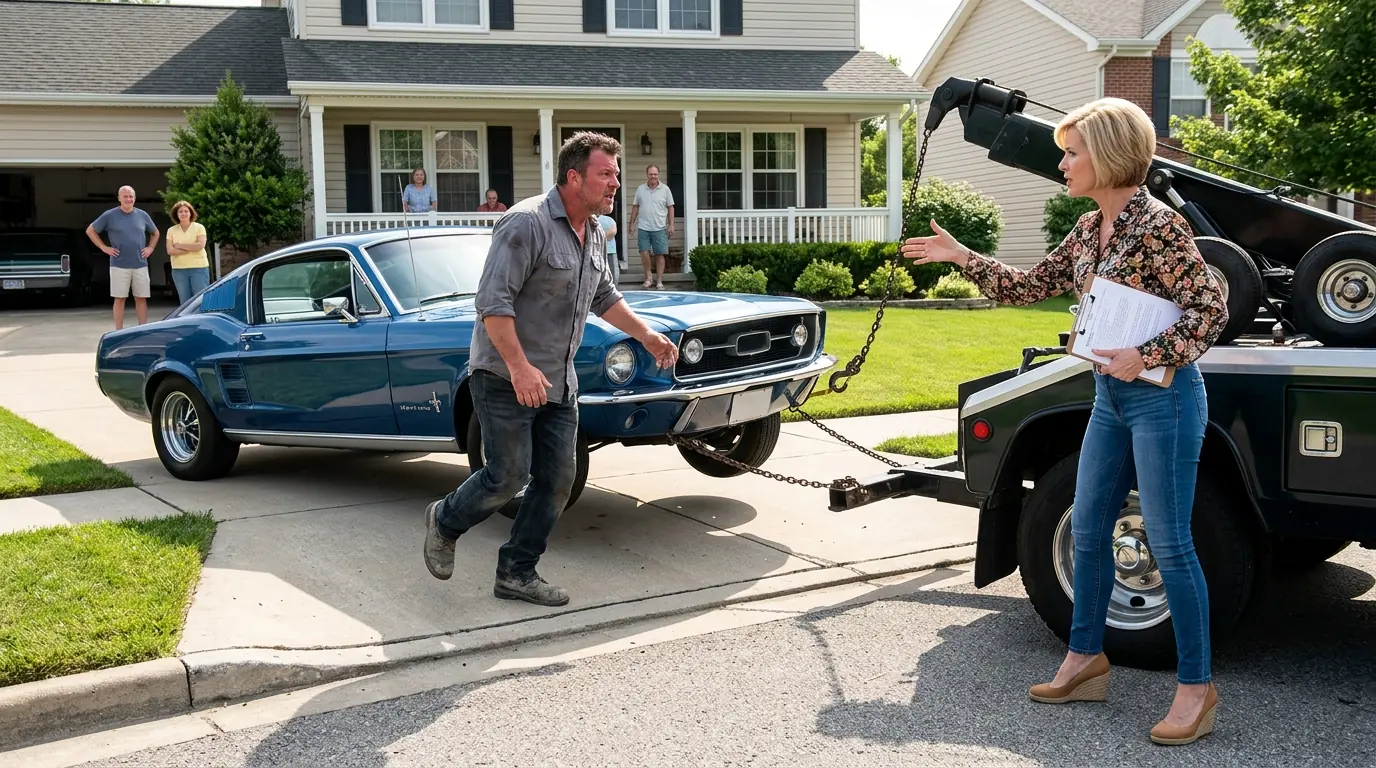
A beautiful blue classic fastback sitting proudly in his driveway.
The same driveway where his grandfather once parked it.
Daniel lived in Willow Creek Estates.
A suburban neighborhood with strict HOA rules.
At first, he had no problem with the HOA.
He understood that communities needed organization.
Rules about shared spaces.
Maintenance.
Safety.
Those things made sense.
But after Caroline Whitmore became HOA president, things started changing.
Caroline was a sixty-year-old woman who believed strongly in appearances.
She cared about perfect lawns.
Perfect houses.
Perfect streets.
She often said:
“A neighborhood’s image determines its value.”
Many residents agreed.
At first.
But slowly, people noticed something.
Caroline cared more about how things looked than how people felt.
She started sending violation notices frequently.
A mailbox was too old.
A decoration was too large.
A truck was parked incorrectly.
A garden was not approved.
Everything became a problem.
Daniel first interacted with Caroline when she noticed his Mustang.
She stopped while walking past his house.
The car was parked in the driveway.
Clean.
Polished.
Beautiful.
She stared at it.
Then looked at Daniel.
“That vehicle will need to be reviewed.”
Daniel frowned.
“Reviewed?”
“Yes.”
“For what?”
“The neighborhood appearance standards.”
Daniel looked at the Mustang.
“My grandfather’s car?”
Caroline nodded.
“I understand its sentimental value.”
Her tone suggested she did not.
“But we need consistency.”
Daniel remained calm.
“Is there a violation?”
She paused.
“We will determine that.”
That answer told Daniel everything.
For weeks, Caroline kept watching the Mustang.
Every time she walked past.
Every time she drove by.
She looked at it like it was a problem waiting to happen.
Eventually, she sent a formal notice.
The complaint stated that the vehicle was “not consistent with neighborhood aesthetics.”
Daniel read it carefully.
Then checked the HOA documents.
There was no rule against classic cars.
No restriction.
No violation.
He responded with copies of the documents.
The issue should have ended.
It did not.
The morning everything happened started normally.
Daniel left early for work.
The Mustang remained parked in the driveway.
Locked.
Protected.
Exactly where it belonged.
When he returned home that afternoon, he noticed something immediately.
The driveway looked empty.
Too empty.
His heart dropped.
The Mustang was gone.
For a moment, Daniel thought someone had stolen it.
Then he noticed something else.
Fresh tire marks.
A piece of paper left near the driveway.
A towing company receipt.
Daniel picked it up.
His expression changed.
The vehicle had been removed by order of the HOA.
He immediately checked his security cameras.
The footage showed everything.
A tow truck arrived.
A driver stepped out.
Caroline stood beside him holding paperwork.
She pointed toward the Mustang.
The driver attached the chains.
The car was pulled away.
And Caroline watched.
Not concerned.
Satisfied.
Daniel called the towing company.
“Why was my vehicle removed?”
The employee checked the record.
“HOA authorization.”
“Was there a police order?”
“No.”
“Was there a legal seizure?”
“No.”
Daniel became silent.
Because he understood.
Caroline had done exactly what he thought.
She used her position to make something happen.
The next morning, Daniel drove to the HOA office.
But before he arrived, Caroline was already waiting.
She stood outside wearing a professional outfit and holding a clipboard.
Almost like she expected him.
“You’re upset.”
Daniel looked at her.
“My grandfather’s Mustang was towed from my private driveway.”
“Yes.”
“You approved that?”
“Yes.”
“Why?”
Caroline lifted the clipboard.
“Community standards.”
Daniel stared.
“There was no violation.”
“There was a concern.”
“A concern is not permission.”
Caroline smiled.
“You need to understand how this neighborhood works.”
Daniel stepped closer.
“No.”
A pause.
“You need to understand how ownership works.”
Caroline became irritated.
“You are making this personal.”
“It is personal.”
Daniel pointed toward the street.
“That car was in my driveway.”
“You could have worked with us.”
“You could have asked.”
Silence.
Because she never did.
Caroline crossed her arms.
“The HOA has authority.”
Daniel looked at her.
“Over shared property.”
“Yes.”
“Not my driveway.”
Her expression changed slightly.
Then she said something that made Daniel realize how confident she was.
“Do you really want to challenge the HOA over an old car?”
Daniel looked at her.
“It’s not about the car.”
“Then what is it?”
“It’s about whether you believe rules apply to everyone.”
That afternoon, Daniel contacted the sheriff’s office.
Not because he wanted revenge.
Because he wanted documentation.
The deputy reviewed the situation.
The property records.
The HOA documents.
The towing authorization.
Then he said something important.
“This does not look like a normal HOA matter.”
Daniel nodded.
“That’s what I thought.”
The sheriff’s office requested the towing records.
They discovered something Caroline did not expect.
The towing company had been told the vehicle was abandoned.
But it was not abandoned.
It was registered.
Insured.
Parked legally.
The information given to the company was inaccurate.
The biggest mistake Caroline made was assuming nobody would investigate.
She believed the HOA title would protect her.
But titles did not change facts.
A week later, the Mustang appeared at a public auction.
The towing company had scheduled the sale process after claiming the owner failed to respond.
But Daniel had already filed the proper complaints.
The sheriff arrived before the auction began.
And suddenly, everything changed.
Caroline was there.
She expected to see the car sold.
She expected Daniel to lose.
Instead, she saw the sheriff walking toward the auction area.
The crowd became quiet.
The sheriff held a folder.
“Who authorized this vehicle removal?”
Caroline stepped forward.
“I did.”
The sheriff looked at her.
“Based on what authority?”
She hesitated.
“The HOA.”
The sheriff opened the folder.
“The HOA does not have authority to remove legally parked private vehicles from private driveways.”
The entire crowd heard.
Daniel stood beside the Mustang.
The same car Caroline thought she could take.
The same car she believed was just an old vehicle.