The patrol car rolled to a stop beside Marcus Bennett’s driveway, its lights flashing silently across the polished trunk of his silver sedan. Karen Whitmore released the grocery bag only after one of the officers stepped onto the street, but she kept her phone raised and aimed at Marcus as though recording him could transform her accusation into truth. Behind her, Tyler Whitmore folded his arms over his expensive beige hoodie and continued smiling for the neighbors gathering near their mailboxes.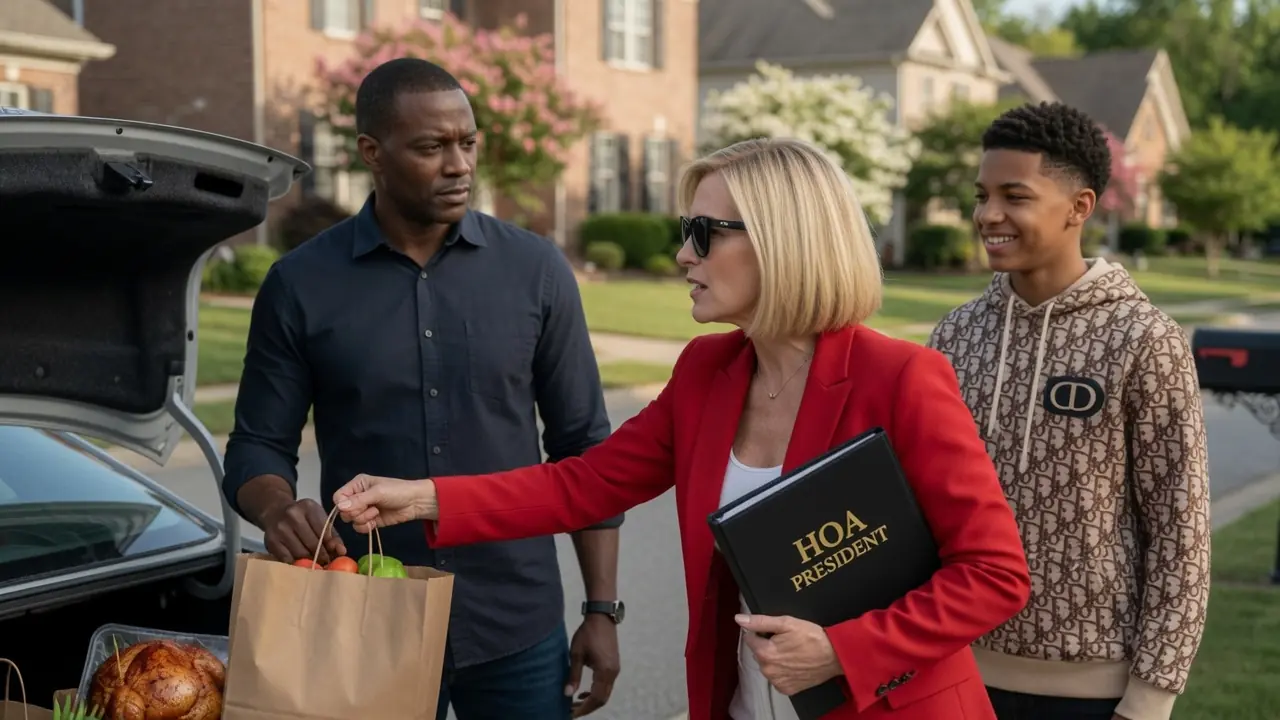
Marcus placed the brown paper bag carefully on the edge of the open trunk. He was forty-two, broad-shouldered, and dressed in a navy button-up shirt and dark jeans after spending the morning delivering groceries to elderly residents across Briarwood Estates. He had lived in the neighborhood for eighteen months, yet Karen still spoke to him as though he had entered through an unlocked gate and refused to explain himself.
Officer Elena Ruiz approached first, accompanied by Officer Mark Sullivan. Karen immediately stepped off the driveway and pointed toward Marcus.
“That man stole supplies from our community food drive,” she announced. “I caught him unloading the evidence.”
Marcus looked toward the bags filling his trunk. They contained bread, rice, vegetables, canned soup, fruit, and two roasted chickens purchased less than thirty minutes earlier. Every item had been paid for with his personal debit card.
Officer Ruiz glanced at the open trunk. “Mr. Bennett, did you call us?”
“Yes.”
Karen’s mouth fell open. “He called you?”
Marcus nodded toward the bag she had attempted to take. “The documents are inside.”
Tyler’s smile weakened.
Officer Sullivan moved closer to the vehicle. “Documents concerning what?”
“The missing money from the Briarwood Families First fund.”
The words changed the expression on Karen’s face. Only slightly, but Marcus noticed. Her outrage had always been loudest when she believed everyone else knew less than she did.
Briarwood Families First had been created after severe spring flooding damaged dozens of homes across the southern edge of the county. Residents donated food, clothing, cash, and gift cards through the HOA, believing the supplies would be distributed to displaced families and low-income workers.
Karen promoted the campaign aggressively.
She posed beside donation boxes, appeared in the neighborhood newsletter, and praised Tyler for supposedly organizing young volunteers. Her photograph appeared beneath a headline calling her “the heart of Briarwood.”
The drive collected nearly forty-two thousand dollars in six weeks.
Yet the community shelter received less than four thousand dollars in food.
When residents asked where the rest had gone, Karen claimed that privacy laws prevented the HOA from identifying recipients. She said administrative expenses, transportation, and emergency purchases consumed much of the balance.
Most homeowners accepted the answer.
Marcus did not.
He worked as a forensic accountant specializing in nonprofit fraud and financial misconduct. He had spent fifteen years tracing money through fake vendors, altered invoices, and accounts designed to appear ordinary until someone compared them closely.
At first, Marcus had no intention of auditing the HOA. He joined the food drive because his mother had raised him in public housing after his father died, and food pantries had carried their family through months when her nursing wages were not enough. Marcus donated three thousand dollars and volunteered to deliver supplies.
The first warning appeared during his second delivery.
A shelter director named Ruth Coleman showed Marcus the official HOA invoice claiming Briarwood had provided twelve thousand dollars in food. Ruth had signed a receipt confirming delivery, but the document she remembered signing listed only two thousand eight hundred dollars.
Someone had altered the total after she signed.
Marcus asked Karen for the fund’s bank statements.
She refused.
“You are a homeowner, not an auditor,” she told him during a board meeting. “Your financial background does not give you authority to investigate charitable recipients.”
Marcus did not accuse her publicly. He requested an independent review under the HOA bylaws, which allowed homeowners to inspect association expenditures.
Karen delayed the request for three weeks.
Then she began issuing violations against his property.
First, she claimed his recycling bins remained visible from the street. Then she fined him for parking his sedan in his own driveway rather than inside the garage. A third notice accused him of operating a commercial delivery service because neighbors had seen him loading grocery bags into his trunk.
Every violation was false.
Every fine arrived after he asked another question.
Tyler joined the harassment online. Using an anonymous neighborhood account, he posted photographs of Marcus delivering food and suggested that “certain residents” might be helping themselves to donations before they reached families.
Marcus saved every post.
He never responded.
The previous evening, a grocery-store manager called him privately. Her name was Denise Park, and she had processed several large purchases made with Briarwood’s charitable debit card. The card was supposed to be restricted to food and household supplies.
Instead, it purchased prepaid gift cards, expensive headphones, gaming equipment, designer clothing, and four cases of imported liquor.
The signature on each receipt read Tyler Whitmore.
Denise had questioned the purchases, but Tyler showed her a letter bearing Karen’s signature authorizing him to buy “flexible emergency assistance items.” When Denise later learned that flood victims had received almost none of the promised support, she copied the receipts and preserved security footage.
She placed the evidence inside a sealed envelope.
That morning, Marcus met her at the store. He purchased groceries for three families with his own money, and Denise concealed the envelope inside one of the brown bags in case anyone was watching.
Someone had been watching.
Karen’s SUV followed Marcus from the shopping center to Briarwood. When he opened his trunk, she and Tyler appeared from across the street as though they had been waiting for the moment.
Now Officer Ruiz reached into the grocery bag and removed the envelope.
Karen stepped forward. “You cannot open that. It belongs to the HOA.”
Marcus looked at her. “Five seconds ago, you said I stole the entire bag.”
“The evidence inside may contain confidential information.”
“Evidence?” Officer Sullivan repeated.
Karen realized her mistake.
“I meant financial records,” she corrected quickly. “Documents connected to association business.”
Officer Ruiz opened the envelope.
The first page was a receipt for forty prepaid gift cards worth five hundred dollars each. The HOA charitable debit card appeared as the payment method. Beneath the total was Tyler’s signature.
The second receipt showed the purchase of two gaming laptops.
The third listed designer shoes, headphones, and a television.
Each transaction had occurred during the food drive.
Tyler unfolded his arms. “Those were supposed to be prizes for volunteers.”
Marcus looked at him. “Which volunteers?”
“The younger volunteers.”
“There were no prizes approved.”
“My mom approved them.”
Karen’s voice rose. “Stop speaking.”
The neighbors moved closer.
Lorraine Jacobs, an elderly widow who had donated five hundred dollars, stood beside her mailbox holding the same newsletter that praised Karen’s leadership. Miguel Torres, whose landscaping company contributed two truckloads of bottled water, began recording.
Karen faced the officers. “This is an internal accounting disagreement. Mr. Bennett has been stalking my family and trying to take over the HOA.”
Officer Ruiz continued examining the documents. “We received a report concerning possible charitable fraud this morning.”
“From him?”
“From the grocery store.”
Tyler looked at Marcus as though he had arranged the call personally.
Denise had contacted the county financial-crimes unit before handing over the copies. The patrol officers were sent to preserve the documents and prevent confrontation until detectives arrived.
A second vehicle turned onto the street.
It was an unmarked sedan.
Two detectives stepped out, followed by Denise and an attorney representing the grocery chain. Karen lowered her phone for the first time.
Detective Aaron Wallace introduced himself and requested that nobody leave. He had already reviewed the store’s transaction logs and part of the security footage.
Karen attempted to regain control.
“My son made authorized purchases on behalf of the community.”
“Did the HOA board authorize twenty thousand dollars in gift cards?” Wallace asked.
“The board gave me emergency discretion.”
“Did it authorize electronics?”
“They were raffled to increase participation.”
“Where are the raffle records?”
“At the association office.”
Marcus opened the trunk wider. “Check Tyler’s social-media store.”
Tyler’s face changed.
For eight months, he had operated an online resale account under the name Briarwood Luxury Drops. The page offered new electronics, designer clothing, prepaid cards, and unopened household items at discounted prices.
Marcus discovered it while tracing an identifying number printed on a donated air fryer. The appliance had never reached the shelter. Tyler sold it online two days after the HOA collected it.
Detective Wallace already knew about the account.
The grocery-store receipts contained serial numbers for several gift cards. Investigators matched three of those numbers to cards Tyler sold through private messages.
“Give me your phone,” Karen whispered to her son.
Wallace heard her. “Do not delete anything.”
Tyler placed one hand over his pocket. “You need a warrant.”
“We have one.”
A third vehicle entered the street, carrying two additional investigators and a uniformed deputy holding a sealed document. The warrant covered Tyler’s phone, Karen’s HOA office, their residence, and the pearl-colored SUV parked in their garage.
Karen turned toward Marcus. “You planned all of this.”
“No,” he said. “You followed me onto my driveway and demanded the bag containing evidence against you.”
“You set us up.”
“I bought groceries.”
“You knew I would confront you.”
Marcus looked at the neighbors surrounding them. “I knew you had become comfortable confronting me.”
That was the difference Karen could not accept.
Marcus had not needed to lure her. She approached him because she believed she could accuse a Black homeowner publicly, seize his belongings, and rely on her title to make everyone assume she was protecting the neighborhood.
Tyler believed the same thing.
The video he recorded captured his mother demanding the bag, accusing Marcus of theft, and declaring that the groceries belonged to the HOA before inspecting a single receipt. His phone also captured Tyler laughing about the police dragging Marcus away.
The recording did not protect them.
It documented motive.
Investigators searched the Whitmore residence that afternoon. In Tyler’s bedroom, they found fourteen prepaid cards purchased with charity funds, three unopened laptops, cases of donated baby formula, and boxes of clothing intended for displaced families.
Karen’s home office contained altered invoices.
One invoice claimed a company named Whitmore Emergency Logistics received nine thousand dollars for transportation and storage. The company’s registered address was Karen’s house.
Another invoice charged the charity six thousand dollars for consulting work performed by Tyler.
The food drive had paid him three hundred dollars an hour to “coordinate youth engagement.”
Only four teenagers had volunteered.
Three said Tyler never appeared.
The most damaging evidence was hidden inside Karen’s locked filing cabinet. Investigators found a spreadsheet listing residents by donation amount, income estimate, property value, and “influence risk.”
Marcus’s name carried a red warning:
Financial professional. Discredit if he asks questions.
Next to Lorraine Jacobs’s name, Karen had written:
Elderly. Unlikely to challenge records.
Beside Miguel Torres:
Vendor. Threaten permit status if necessary.
The food drive had never been only charity theft. Karen used the fund to measure which homeowners could be manipulated, which local businesses depended on HOA approval, and which residents might expose her.
For years, she had treated Briarwood as a private enterprise.
The flood merely gave her a new source of money.
An emergency HOA meeting was scheduled for that evening. Karen attempted to attend as president, but the board’s attorney informed her that her access had been suspended pending investigation.
She arrived anyway.
Tyler followed in silence, no longer wearing the smug expression from Marcus’s driveway. He had surrendered his phone but carried a printed statement prepared by the family attorney.
The Briarwood clubhouse was packed.
Marcus sat near the back rather than at the board table. He did not want Karen claiming the meeting was an attempt to seize her position. The evidence belonged to the community, not to him.
Vice President Elaine Brooks opened the meeting by displaying the charitable account.
Forty-two thousand dollars had entered.
Less than six thousand reached legitimate recipients.
Nearly twenty-seven thousand flowed to Karen, Tyler, or businesses connected to them. The rest disappeared through cash withdrawals and unverifiable reimbursements.
Karen stood. “The figures ignore goods purchased for future distribution.”
“Where are those goods?” Elaine asked.
“Temporarily stored.”
“In your son’s bedroom?”
The room filled with angry voices.
Karen struck the table with her folder. “This community elected me because I was willing to make decisions. Everyone praises charity until administration costs money.”
Ruth Coleman, the shelter director, rose from the front row.
“You used our families as decoration for your newsletter.”
Karen looked away.
Ruth held up the altered receipt. “You changed my signature from twenty-eight hundred dollars to twelve thousand. That is not administration.”
Karen turned toward Marcus. “He manipulated you.”
Marcus remained seated. “Your numbers did.”
Tyler stood beside his mother. “I didn’t know where the money came from.”
A neighbor shouted, “Your name is on every receipt.”
“My mom said the card was for community expenses.”
“You sold the gift cards.”
“She told me they were leftovers.”
Karen grabbed his sleeve. “Do not answer questions without the lawyer.”
Tyler pulled away.
For the first time, he looked at her without obedience. “Were they leftovers?”
Karen’s silence answered him.
Tyler sat down.
The board voted unanimously to remove Karen as president, terminate Whitmore Emergency Logistics, and refer every financial record to county investigators. Elaine also introduced a motion to place all charitable spending under independent dual-signature control.
It passed without opposition.
Marcus was asked to chair the audit committee.
He declined.
“I will help organize the review,” he said, “but this community does not need another person with unchecked authority. It needs records everyone can see.”
The homeowners approved an independent accounting firm and elected a five-person oversight committee representing different parts of the neighborhood.
Lorraine became one of its members.
Miguel became another.
The criminal investigation lasted four months. Karen was charged with charitable fraud, forgery, theft, falsifying business records, and obstruction after investigators discovered that she attempted to delete cloud files from the HOA office.
Tyler accepted a plea agreement.
His attorney argued that he acted under his mother’s direction, but the evidence showed he knowingly resold donated property and laughed about victims who could not prove where the goods went. He received probation, community service, restitution obligations, and a permanent fraud conviction that cost him a prestigious internship.
Karen blamed Marcus throughout the proceedings.
Outside court, she told reporters that he had targeted a successful white woman because he wanted control of Briarwood.
Marcus refused to answer through the media.
He gave his testimony, provided the records, and returned home.
The court ordered more than thirty thousand dollars restored to the charitable fund. The HOA’s insurance carrier covered part of the remaining loss, while the grocery chain donated replacement cards after completing its internal review.
Marcus contributed groceries again.
This time, every bag carried a numbered receipt visible through a transparent sleeve. Volunteers scanned each delivery into a public system that donors could review without exposing recipients’ private identities.
No single president controlled the money.
Ruth’s shelter received everything promised.
Months later, Marcus stood beside his sedan unloading another round of groceries when Tyler approached from the sidewalk. He wore plain work clothes instead of the designer hoodie and carried boxes from the community warehouse as part of his service requirement.
For several seconds, neither man spoke.
Tyler placed the boxes near Marcus’s trunk. “I was wrong.”
Marcus continued arranging the bags. “About what?”
“You.”
“That is not specific enough.”
Tyler looked toward the driveway where the confrontation had occurred. “I thought because my mom ran the HOA, anything she said became true. When she said you stole something, I didn’t need proof.”
“You enjoyed it.”
Tyler lowered his eyes. “Yes.”
“Why?”
“Because humiliating someone with her made me feel important.”
Marcus closed the trunk.
“And now?”
“Now everyone knows what we did.”
“That is embarrassment. It is not change.”
Tyler nodded slowly. “What does change look like?”
Marcus pointed toward the community shelter truck waiting at the curb.
“Load every box. Ask Ruth where it goes. Do not photograph the families receiving it. Do not post yourself helping. Then come back next week without anyone forcing you.”
Tyler looked at him. “Will that fix it?”
“No.”
Marcus handed him a grocery bag.
“But it is where you start.”
Tyler carried the bag toward the truck.
One year after Karen’s removal, Briarwood held another food drive. It collected less money than the previous campaign because the new committee refused flashy advertising and expensive fundraising events.
Yet nearly every dollar reached someone who needed it.
The annual report listed every purchase, vendor, receipt, and delivery total. Residents could ask questions without receiving violations the following week.
Lorraine read the final numbers aloud during the board meeting.
When she finished, she looked toward Marcus.
“You were right to call the police.”
Marcus shook his head. “The store manager called the investigators.”
“You called the patrol car when Karen approached.”
“I called because she had followed me home.”
Lorraine smiled. “And because you knew she would grab that bag.”
“I hoped she would make a better decision.”
“Did you really?”
Marcus thought about Karen’s hand reaching for his property and Tyler grinning beside her.
“No,” he admitted. “But people should always be given the opportunity to reveal who they are.”
The brown paper bag from that afternoon now sat inside the clubhouse display case. It was empty except for copies of the first three receipts discovered inside.
A small plaque explained why the HOA preserved it:
This bag contained groceries purchased by a homeowner and evidence of money stolen from families in need. It reminds us that accusation is not proof, authority is not ownership, and transparency must begin before trust is requested.
Marcus disliked being treated as the hero of the story.
The real courage belonged to Denise, who copied the receipts; Ruth, who preserved the altered invoice; Rachel, who admitted the donations never arrived; and the residents who compared records instead of accepting Karen’s title as truth.
Still, people remembered the driveway.
They remembered Karen demanding the bag and Tyler celebrating the arrival of the police. They remembered Marcus remaining calm while both believed the officers had come to remove him.
What they remembered most was what happened after the patrol car stopped.
The officers did not ask Marcus to surrender the groceries.
They asked Karen and her son to explain why their names were printed across everything missing from them.