The first thing Ethan Cole noticed was the folder in Patricia Langford’s hand.
The second was the police cruiser parked at the end of his driveway.
The third was Patricia’s twenty-two-year-old son, Brandon, standing beside Ethan’s spotless black Ford F-150 Limited as though he had already decided where he was driving it that afternoon.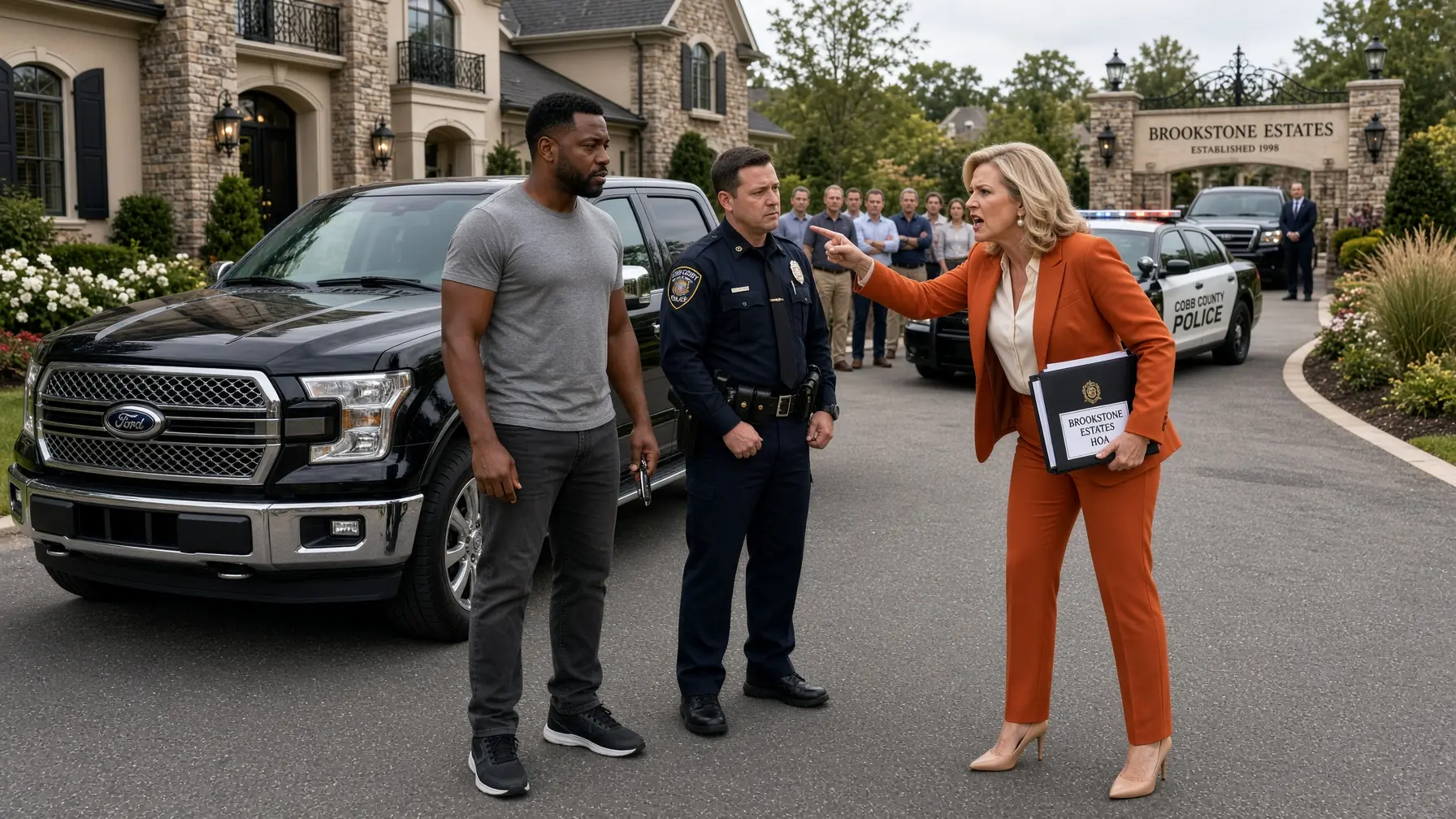
Ethan stopped halfway down his front steps and stared at all three of them.
Patricia Langford, fifty-four, president of the Brookstone Estates Homeowners Association, wore a perfectly tailored burnt-orange pantsuit over a cream silk blouse. Her blonde hair rested neatly against her shoulders, her pearl earrings caught the morning light, and her expression carried the familiar confidence of someone who had spent years mistaking paperwork for ownership.
She raised the folder.
“There he is.”
Ethan walked slowly toward the driveway.
At forty, he was tall and muscular, with deep-brown skin, close-cut black hair, a trimmed beard, and dark eyes that rarely revealed what he was thinking. He wore a gray T-shirt, dark jeans, and black sneakers, and the key fob to his truck hung loosely from his right hand.
Officer Daniel Ruiz stood between Patricia and the truck.
He looked uncomfortable.
That interested Ethan.
“What’s going on?” Ethan asked.
Patricia answered before the officer could.
“My son needs that truck, and after all your unpaid HOA violations, I’m taking it as association property.”
Ethan looked at Brandon.
The young man immediately looked away.
Then Ethan looked back at Patricia.
“You’re taking my truck.”
“Yes.”
“For your son.”
“You’ve ignored eleven violation notices.”
“That doesn’t answer the question.”
Patricia stepped closer.
“You owe the association more than eighteen thousand dollars.”
“No, I don’t.”
“You do according to our records.”
Ethan held out one hand.
“Show me.”
Patricia smiled.
She pulled a document from the folder and pushed it toward him.
The heading read:
NOTICE OF ASSOCIATION ASSET SEIZURE AND TRANSFER OF PERSONAL PROPERTY
Ethan read the first paragraph.
Then the second.
He almost laughed.
The document claimed the HOA possessed authority to seize “movable property located on a delinquent member’s parcel” to satisfy unpaid fines.
It listed Ethan’s truck by make, model, year, VIN, and approximate value.
Then came the strangest part.
Under proposed disposition, someone had typed:
Temporary assignment to association officer family member pending liquidation.
Ethan looked at Brandon again.
“You were planning to drive it.”
Brandon shrugged.
“My mom said the HOA could take it.”
Ethan turned toward Patricia.
“You forged one seizure notice and called police hoping nobody would read the title.”
Her smile vanished.
“Watch yourself.”
Officer Ruiz finally spoke.
“Mr. Cole, Ms. Langford contacted us saying there was a disputed association repossession.”
“There is no repossession.”
Patricia cut in.
“He is delinquent.”
Ethan looked at Ruiz.
“Does she have a court order?”
Ruiz glanced toward Patricia.
“No.”
“A judgment?”
“No.”
“Lien against the truck?”
Ruiz hesitated.
“She gave us that notice.”
Ethan nodded toward the paper.
“That’s an HOA letter.”
Patricia slammed the folder against the hood of the F-150.
“The association has remedies.”
Ethan’s jaw tightened.
“Take your folder off my truck.”
She ignored him.
“I have put up with your arrogance for almost a year.”
Ethan looked toward the officer.
“Is your body camera running?”
Ruiz nodded.
“Yes.”
“Good.”
Ethan turned back to Patricia.
“Please repeat what you said about giving my truck to your son.”
For the first time, Patricia hesitated.
Brandon muttered, “Mom.”
She snapped at him.
“Be quiet.”
Then she looked at Ethan.
“The vehicle is being taken to satisfy your debt. What happens afterward is association business.”
Ethan raised his phone.
A message was already open on the screen.
Ruiz glanced at it.
Patricia frowned.
“What are you doing?”
Ethan looked toward the road behind the patrol cruiser.
A black sedan had just turned into Brookstone Estates.
“Waiting.”
“For what?”
Ethan nodded toward the approaching vehicle.
“Don’t touch my truck. The State Attorney who read your paperwork just arrived.”
Patricia turned.
The black sedan stopped behind Ruiz’s cruiser.
A woman in a charcoal suit stepped out carrying a leather portfolio.
Beside her came a younger investigator with a state identification badge clipped to his belt.
Patricia’s face changed.
Not dramatically.
Just enough.
Ethan noticed.
Officer Ruiz did too.
The woman walked up the driveway.
“Mr. Cole?”
“Yes.”
She held out her hand.
“Assistant State Attorney Rebecca Sloan.”
Ethan shook it.
Patricia immediately stepped forward.
“This is a private HOA matter.”
Rebecca looked at her.
“Then I’m sure the documents will explain everything.”
Nobody spoke.
Rebecca pointed toward the orange folder resting on Ethan’s hood.
“Is that the seizure notice?”
Ethan nodded.
Patricia grabbed for it.
Rebecca’s investigator moved closer.
“Please leave it where it is.”
Patricia stopped.
Rebecca picked up the document.
She read the heading.
Then the paragraph claiming seizure authority.
Then the transfer language involving Brandon.
Her eyebrows slowly rose.
She looked toward Patricia.
“Who drafted this?”
“Our association administration.”
“Who specifically?”
“That’s privileged.”
Rebecca almost smiled.
“No, it isn’t.”
Patricia folded her arms.
“You’re overstepping.”
Rebecca turned toward Officer Ruiz.
“Has anyone attempted to take possession of the vehicle?”
“Not yet.”
“Keys?”
“Still with Mr. Cole.”
“Good.”
She looked at Ethan.
“Do not hand those to anyone.”
Patricia laughed sharply.
“You can’t just interfere with HOA enforcement.”
Rebecca turned.
“Ms. Langford, I reviewed the Brookstone declaration last night.”
Patricia’s expression changed again.
Rebecca continued.
“It contains no provision authorizing seizure of personal vehicles for unpaid covenant fines.”
Silence.
“It also does not permit assignment of seized property to a board member’s relative.”
Brandon took one step away from the truck.
Patricia stared at Rebecca.
“You don’t understand how our enforcement system works.”
Rebecca closed the folder.
“I understand it better than you hoped.”
The dispute had begun eleven months earlier with something absurdly small.
Ethan parked his F-150 in his driveway overnight.
That was it.
Brookstone Estates allowed residential vehicles in driveways. The original covenants prohibited commercial trucks, recreational vehicles, and disabled automobiles from remaining visible for extended periods, but Ethan’s Ford was registered personally and used primarily to commute to his job as a civil construction superintendent.
Patricia sent him a violation anyway.
Oversized commercial-style vehicle negatively impacting neighborhood appearance.
Ethan responded with the rule.
She sent another notice.
He appealed.
The board denied it.
Then came a $250 fine.
Ethan paid an attorney to send a short letter explaining that the HOA’s own declaration did not prohibit his truck.
The fine disappeared.
For three weeks.
Then Patricia cited him for washing the truck in his driveway.
No rule prohibited it.
That fine disappeared too.
Then came one for parking “too close to the sidewalk.”
Ethan measured.
His bumper was nearly four feet inside the property line.
Another violation accused him of performing mechanical work because his hood had been open while he replaced a battery.
Then his mailbox.
Then his landscape lights.
Then his trash bins.
Each notice seemed increasingly disconnected from actual rules.
Ethan started keeping every document.
He did not like conflict.
But he hated sloppy paperwork.
His late father had taught him that anything involving money, property, or authority deserved a paper trail.
So Ethan created one.
Dates.
Notices.
Photographs.
Certified letters.
Appeal requests.
Board responses.
By month six, the HOA claimed he owed $4,700.
By month eight, more than $9,000.
Some of those numbers came from late fees charged on fines Ethan was still formally disputing.
Then the association added “administrative enforcement costs.”
Then “legal preparation expenses.”
Then “vehicle compliance penalties.”
Ethan’s attorney challenged everything.
Patricia did something unexpected.
She escalated.
A letter arrived threatening to record a lien against Ethan’s house.
That got his full attention.
The problem was not merely the amount.
Ethan’s mortgage was current.
His taxes were current.
His property was worth more than $800,000.
A wrongful lien could create complications with refinancing, sale, title insurance, and credit.
He hired Rebecca Sloan privately at first.
Before entering state government, Rebecca had spent years practicing property law. She now worked in the state attorney’s consumer and property-fraud unit, but because Ethan’s initial dispute looked private, she referred him to an outside attorney and told him to preserve everything.
Then Ethan brought her something that changed the situation.
Three other homeowners had received nearly identical vehicle fines.
All involved trucks.
All were eventually threatened with asset seizure.
One homeowner, elderly widower Frank Morris, had actually surrendered a utility trailer after Patricia told him the HOA could “take movable property” to satisfy his balance.
The trailer disappeared.
No auction record existed.
No credit appeared on Frank’s account.
Ethan asked where it went.
Frank shrugged.
“Patricia said the association sold it.”
“For how much?”
“She never told me.”
“Who bought it?”
“I don’t know.”
Ethan called Rebecca.
This time, she listened differently.
“Find out whether anybody else surrendered property.”
Within a week, they had five names.
A riding mower.
A utility trailer.
A golf cart.
An antique motorcycle.
A commercial pressure washer.
Each item had supposedly been taken to satisfy HOA debt.
Residents had received internally produced paperwork.
None showed a court judgment.
None contained a sheriff’s levy.
None showed a legitimate auction process.
Rebecca opened a preliminary state inquiry.
Quietly.
Patricia knew nothing.