That morning, I stepped into my side yard and saw nothing but a bare square of concrete where a transformer and switch cabinet had hummed for almost nineteen years.
Vanessa Caldwell stood beside her white SUV in a ruby-red blazer, arms folded, smiling like she had finally polished the last stain off her perfect neighborhood.
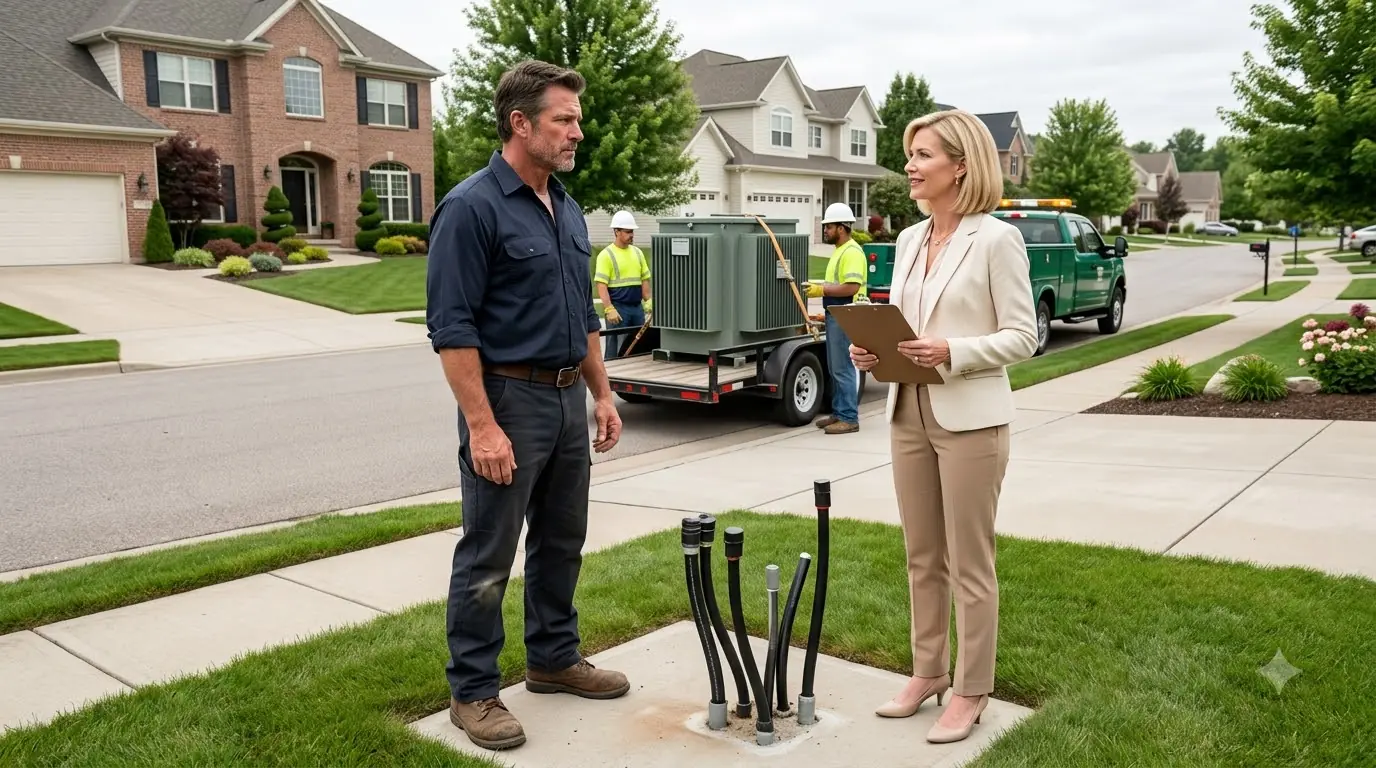
"We removed that ugly thing from our community," she said.
Before I could answer, the streetlights at the Cedar Meridian entrance went dark.
Then the clubhouse.
Then one row of houses after another fell silent.
When the utility engineer arrived, he looked at the empty pad, turned to Vanessa, and asked the question that changed everything.
"Who authorized you to remove the equipment feeding nearly two hundred homes?"
Vanessa had spent a year calling my land a community problem.
By lunch, she was about to learn what an easement really meant.
September in Coeur d'Alene can feel like summer forgot one hand on your shoulder while autumn stands at the gate.
That Tuesday morning, the air smelled of dry pine needles, lake dust, and the cold metallic tang that comes before rain in the mountains.
I pulled into my gravel drive a little before nine, left the truck running one second too long, and looked toward the east corner of my land.
The fence was open.
Not unlocked.
Cut.
The chain-link fencing had been folded back like somebody had peeled tin from a can.
Beyond it sat a bare square of concrete with four anchor bolts sticking up from the corners, each one catching the pale sun.
For almost nineteen years, a pad-mounted transformer and switch cabinet had stood there humming through summer heat, February ice, and every quiet night after my wife Annie died.
Now there was only a stain where the steel had been.
Vanessa Caldwell leaned against a white SUV at the edge of my grass.
She wore a ruby-red blazer so bright it looked staged against the brown weeds and gray gravel, with black slacks, black heels, and that manufactured smile people use when they think manners are a weapon.
Her platinum bob did not move in the wind.
I remember noticing that the world around her was full of loose things, flagging tape, cut wire ties, crushed grass, and she looked as if she had been poured into place.
"We removed that ugly thing from our community," she said.
I did not answer right away.
I was looking past her at the flatbed truck parked near the gravel access route, where the transformer sat strapped down and chained.
It looked smaller out in the open.
Equipment always does.
Inside an enclosure with warning placards, grounding, conduit risers, and everything arranged around it, equipment like that has authority.
On a truck bed, it looked like a mistake someone had already made and was still pretending was a plan.
"Vanessa," I said, "did the utility isolate that feed before anybody touched it?"
She tilted her head like I had asked the question in German.
"The contractor knows what he is doing."
That was when the entrance lights went out.
There was no bang.
No shower of sparks.
No drama big enough for television.
The stone sign for Cedar Meridian Estates simply lost its golden wash of light, even though the sun was already high enough that you had to know where to look.
A second later, the irrigation heads along the median stopped mid-arc, and water fell straight down like strings cut from a puppet.
Then the clubhouse windows went flat and black.
Beyond that, on the first loop of houses, garage doors froze halfway, air conditioners wound down, and the soft mechanical sound of a wealthy neighborhood began to disappear in sections.
Silence is not empty.
It has weight.
When almost two hundred houses stop humming, when compressors, pool pumps, routers, refrigerators, fans, and landscape timers all quit in a staggered wave, the air changes shape around you.
I could hear a woman call from a porch.
A car alarm chirped once and stopped.
Somewhere, a dog barked, confused by something nobody could see.
Vanessa pushed away from the SUV.
Her smile held for another breath, then loosened at the corners.
"What did you do?"
"I just got home."
"This neighborhood cannot be without power."
Her voice sharpened, but not into shouting.
She was too practiced for that.
"There are elderly residents. There are families. You need to fix this."
I looked at the empty pad.
Then I looked at the transformer sitting on the truck.
"You removed the thing you want me to fix."
A man with a clipboard stood ten feet behind her, eyes down.
Four workers in hard hats had gone still near the flatbed.
One of them had taken his gloves off.
That told me more than anything he might have said.
A man takes his gloves off when his hands no longer want any part of the work.
The first utility truck came eleven minutes later.
A young technician stepped out, walked to the pad, studied the capped cable ends, looked at the flatbed, and got on his radio without speaking to any of us.
Two more trucks followed.
Then a white pickup with the utility logo pulled in behind them, and Marcus Hail got out with a tablet under his arm.
Marcus was the lead distribution engineer for the region, a tall man in his early fifties with close-cut gray hair and the calm posture of someone who had read enough incident reports to know panic wastes time.
He did not ask for opinions.
He photographed the fence.
The cable ends.
The pad.
The truck.
The chain on the transformer.
The license plate.
Then he turned to Vanessa.
"Where is the transformer?"
"The association had obsolete equipment relocated," she said. "It was affecting community appearance and value."
Marcus looked at her for a long second.
His face did not change, but his fingers stopped moving on the tablet.
"Who authorized you to remove the equipment feeding nearly two hundred homes?"
The yard went so quiet I could hear one of the workers swallow.
Vanessa blinked once.
"That equipment served his property."
"No, ma'am."
"We were told it was private."
Marcus opened a network diagram on the tablet and turned the screen toward her.
I had seen a version of that diagram once, but not in color.
Not with every circuit labeled.
Lines ran from the highway feed through the corner of my land and out into Cedar Meridian like veins under skin.
"This assembly is a transition point between the incoming primary and multiple distribution circuits inside the subdivision. It has been in service since the original buildout."
Vanessa's face tightened the way polished wood tightens before it cracks.
"Why was the HOA never informed?"
Marcus tapped the tablet twice.
"The HOA was informed before your term as president."
Right there, while half the neighborhood stood in their driveways with dead phones and warming refrigerators, Vanessa Caldwell's perfect smile disappeared.
Marcus scrolled to a scanned agreement carrying signatures from a year when she had not even lived in Idaho.
Then he looked from the empty pad to the transformer on the flatbed and asked his second question.
"Who signed the removal order?"
The story did not start with Vanessa Caldwell.
People like her often think they are the beginning of things because they arrive with letterhead, committees, and a way of saying "community" that sounds like a locked gate.
But my land was there before her.
Before Cedar Meridian Estates.
Before the clubhouse roofline showed up on glossy brochures.
Before anyone decided a mountain neighborhood needed three approved shades of mailbox bronze.
My father ran Bennett Electric Repair out of a cinder-block shop on that land when I was a boy.
He fixed pump motors, rewound old starters, rebuilt panels for sawmills, and taught me that electricity does not care what title is printed on your business card.
It cares whether the path is right.
When he died, the house, the shop, and 3.7 acres came to me.
I was not rich enough to call that inheritance a blessing without also calling it a responsibility.
The place needed a roof.
The shop needed a service upgrade.
The east field had more rocks than soil.
Annie saw it differently.
She stood in the kitchen the first evening after we moved in, watched light pour over the scarred pine floor, and said the house looked like it had been waiting for someone to forgive it.
That was Annie.
She could make a cracked window sound like a second chance.
I built my business from that shop.
Industrial electrical maintenance is not glamorous work.
You get called when a cold-storage warehouse loses a compressor, when a pump station trips at two in the morning, when a mill has a motor starter coughing smoke and twenty people standing around pretending not to be scared.
I learned to carry spare fuses, a thermos, and humility.
The last one weighs the most.
Years later, a developer bought the timberland and scrub pasture beyond my east fence.
They called the project Cedar Meridian Estates, which sounded cleaner than what it was at the time.
Mud.
Survey stakes.
Diesel smoke.