At 6:10 in the morning, twenty vehicles rolled through the east gate of Everett Hale’s farm carrying private security guards, tow equipment, portable fencing, replacement locks, and a court order that did not exist anywhere in the state court system.
By 6:16, Silver Briar HOA President Marjorie Voss was standing in the middle of Everett’s machinery yard with a bullhorn in one hand and a red-stamped folder in the other.
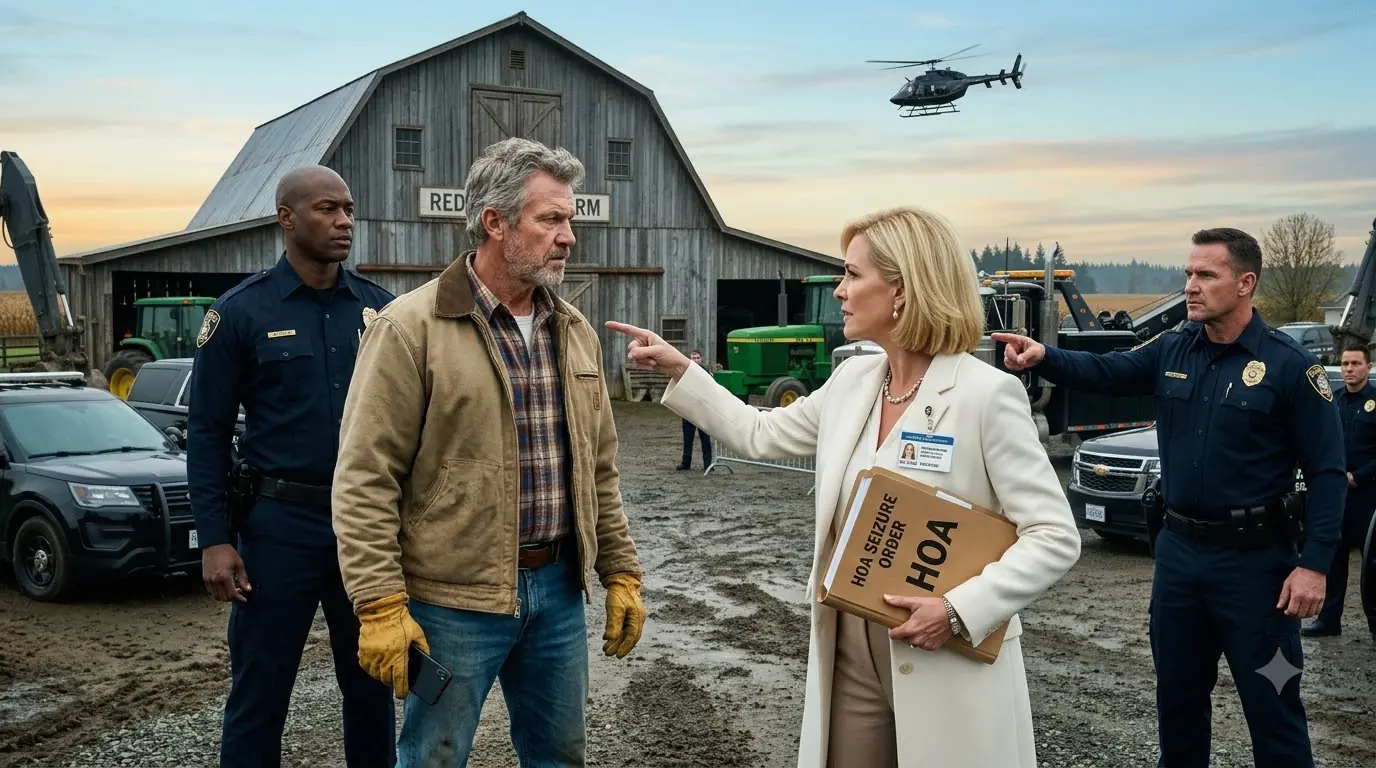
She gave him ten minutes.
Ten minutes to surrender the farmhouse.
The barns.
The tractors.
The trucks.
The irrigation equipment.
The security system.
And every acre of land his family had worked for three generations.
According to Marjorie, Red Hollow Farm now belonged to Silver Briar Estates because Everett owed $486,000 in unpaid assessments, fines, penalties, and enforcement costs.
Everett looked at the paper she handed him.
Then at the convoy spreading across his property.
Then back at Marjorie.
“No.”
That was all he said.
Marjorie smiled.
It was the patient smile she used whenever someone had not yet understood that she considered resistance temporary.
“You have nine minutes.”
Everett folded the supposed seizure order once.
He did not argue.
He did not threaten anyone.
He walked toward the machinery barn, locked the steel door behind him, and called his wife.
Marjorie laughed when she saw him raise the phone.
“Call whoever you want.”
Everett looked at her through the gap beside the barn door.
“I already did.”
She raised the bullhorn again.
“Eight minutes.”
What Marjorie did not know was that Everett’s wife was not an attorney.
She was not a county commissioner.
She was not another angry homeowner.
Laurel Hale was a senior commander in the state police.
And when Everett’s video reached her phone, she recognized within minutes that the document Marjorie was holding was not merely questionable.
Its case number belonged to a completely unrelated commercial matter that had closed four years earlier.
The judge’s signature had been copied from another order.
The seal was wrong.
There was no sheriff’s return.
No authorized enforcement officer.
No docket entry.
No seizure order for Red Hollow Farm.
By the time Marjorie reached five minutes on her countdown, Laurel had already recused herself from the initial authorization because the target property belonged to her husband.
Another senior commander had taken control.
The state prosecutor’s office was reviewing the document independently.
County law enforcement had been notified.
An aviation unit was in the air.
And several miles away, radios inside the convoy began receiving instructions that nobody working for Silver Briar had expected to hear.
Marjorie believed she had arrived to seize a farm.
What she had actually done was drive nearly twenty vehicles directly into the middle of the largest piece of evidence investigators had seen in a four-year property scheme.
Everett Hale had been awake since 4:45 that morning.
That was normal.
Red Hollow Farm had never operated according to the preferences of people who enjoyed sleeping late.
The property covered a little more than two hundred acres of rolling agricultural ground bordered by hardwood stands on the west and a narrow creek along the eastern edge.
The Hale family grew seed corn, hay, and specialty vegetables.
They also leased part of the western pasture to a neighboring cattle operation.
The farm was not enormous.
It was large enough to be complicated.
Everett’s grandfather had purchased the original ninety-six acres in the late 1950s.
His father added neighboring parcels during the 1970s and 1980s.
Everett bought the final southern tract after taking over operations.
By the time the surrounding land began filling with subdivisions, Red Hollow existed as one contiguous farm supported by a network of underground irrigation lines, wells, storage ponds, equipment roads, drainage swales, and power feeds that had accumulated over decades.
To someone looking at a county map, one strip of land along the northern boundary appeared unremarkable.
To Everett, it was the spine of the farm.
A primary buried water line crossed beneath it.
Two field roads converged there.
The route connected the machinery yard with the northern production ground.
Run a public access road through that strip and Red Hollow would not become impossible to farm.
It would become much harder.
Heavy equipment would have to cross residential traffic.
Irrigation infrastructure would need to be relocated.
Drainage would change.
The field layout his father had spent thirty years refining would be cut in two.
That was why Everett had kept saying no.
Not because he hated development.
Not because he believed farmland should remain frozen forever.
He simply did not want a four-lane access connector running through the middle of a functioning agricultural system.
Silver Briar Estates arrived long after Red Hollow.
The subdivision began as seventy-three expensive homes built on former pasture east of the farm.
Then another phase followed.
Then another.
By the time Everett was forty-six, Silver Briar contained more than three hundred homes, a clubhouse, tennis courts, two decorative ponds, gated entrances, private security patrols, and a homeowners association with a larger annual budget than some nearby towns.
Marjorie Voss had been HOA president for nine years.
She was fifty-seven.
Always polished.
Always prepared.
Always carrying a folder.
She wore expensive clothes without appearing flashy, spoke in the measured language of somebody accustomed to meetings, and possessed an extraordinary ability to make personal preference sound like administrative necessity.
Residents either loved her or avoided her.
There was rarely much in between.
Under Marjorie, Silver Briar’s landscaping improved.
Reserve accounts grew.
The clubhouse was renovated.
Security increased.
Property values rose.
Those accomplishments mattered because they made her more difficult to challenge.
People trusted the leader who got results.
Then, gradually, Marjorie began treating that trust as transferable.
If she was right about landscaping, she assumed she was right about parking.
If she was right about security, she assumed she was right about boundaries.
If she had successfully negotiated one easement, she assumed resistance to the next was merely unreasonable.
The line between managing Silver Briar and controlling everything around it became less visible to her every year.
Then came Silver Briar Reserve.
The project was much larger than another subdivision phase.
An outside developer planned a resort complex surrounding a golf course.
A 180-room hotel.
Event center.
Ninety-six luxury homes.
Restaurants.
Small retail plaza.
Recreation facilities.
Conference space.
The projected investment ran into the hundreds of millions.
Marjorie loved it immediately.
She spoke about Silver Briar Reserve at association meetings as though it were already inevitable.
The project would increase home values.
Create amenities.
Improve roads.
Attract better commercial services.
Give Silver Briar greater regional influence.
What residents did not know was that Marjorie had also developed a private financial interest in the project through a consulting arrangement investigators would discover much later.
If the development closed as planned, her compensation could become enormous.
There was only one serious problem.
Access.
The planned resort had a primary boulevard connecting to the state highway.
Traffic engineers required another route for the project as designed.
Emergency access.
Service traffic.
Construction movement.
Future congestion relief.
The easiest corridor ran directly through Red Hollow’s northern strip.
On development renderings, the road looked insignificant.
A gray line.
To Everett, that gray line crossed an irrigation main his grandfather had started digging by hand decades earlier.
Marjorie first visited Red Hollow six months before the convoy.
She came alone.
No security.
No lawyers.
Everett was repairing a hydraulic hose near the machinery barn when her white SUV pulled into the yard.
She stepped out wearing a pale green coat and low boots that were completely wrong for mud.
“Mr. Hale?”
Everett wiped his hands.
“Yes.”
“Marjorie Voss.”
“I know.”
That surprised her slightly.
“I suppose everyone around here knows everyone.”
“No.”
Everett nodded toward the Silver Briar entrance monument visible through the trees.
“Your name is on enough letters.”
She smiled.
“I’ll take that as a compliment.”
“You shouldn’t.”
Marjorie laughed as though he had made a joke.
She opened a folder.
“We have an opportunity.”
That was the first offer.
Three hundred thousand dollars.
Permanent roadway easement.
Everett read the map.
“No.”
Marjorie blinked.
“You haven’t seen the valuation.”
“I saw the route.”
“Three hundred thousand dollars for approximately seven acres of access rights is extremely favorable.”
“It crosses the water system.”
“We would relocate anything necessary.”
“No.”
“Mr. Hale…”
“Everett.”
“Everett, this project is going to happen.”
“Probably.”
“The question is whether you benefit from it.”
“I already benefit from my land.”
Marjorie studied him.
Most people negotiated.
Everett did not even ask for a higher number.
“What would make this workable?”
“Move the road.”
She smiled again.
“That may not be realistic.”
“Then you have a problem.”
“I would say we have a shared problem.”
“No.”
Everett folded the map.
“It’s yours.”
That conversation lasted eighteen minutes.
Marjorie left still believing Everett would reconsider.
Two weeks later, the offer became $600,000.
Then $1.1 million.
Everett still refused.
Laurel read the third proposal at their kitchen table.
“That is a lot of money.”
“It is.”
“You still don’t want it.”
“No.”
“Then reject it.”
Everett looked at her.
“That easy?”
“It’s your property.”
“Our property.”
“You operate it.”
“We own it together.”
Laurel smiled.
“Fine. Our property.”
She pushed the document back.
“Still no.”
That was the only role Laurel played initially.
Wife.
Property owner.
Nothing else.
She refused to contact county officials through professional channels.
Refused to call anyone at state headquarters.
Refused even to mention the dispute to colleagues unless directly relevant.
“If this ever becomes litigation,” she told Everett, “I don’t want one person saying the Hale family got a different process because of me.”
Everett agreed.
That caution later saved them.
Marjorie interpreted it differently.
She knew what Laurel did.
Everybody around Silver Briar eventually knew.