The wind off the Detroit River did not blow that night.
It screamed. It came down the empty avenues like something with teeth, carrying ice crystals that cut against brick and steel and exposed skin, and it filled the boarded-up factories with a low, mournful howl that sounded almost human.
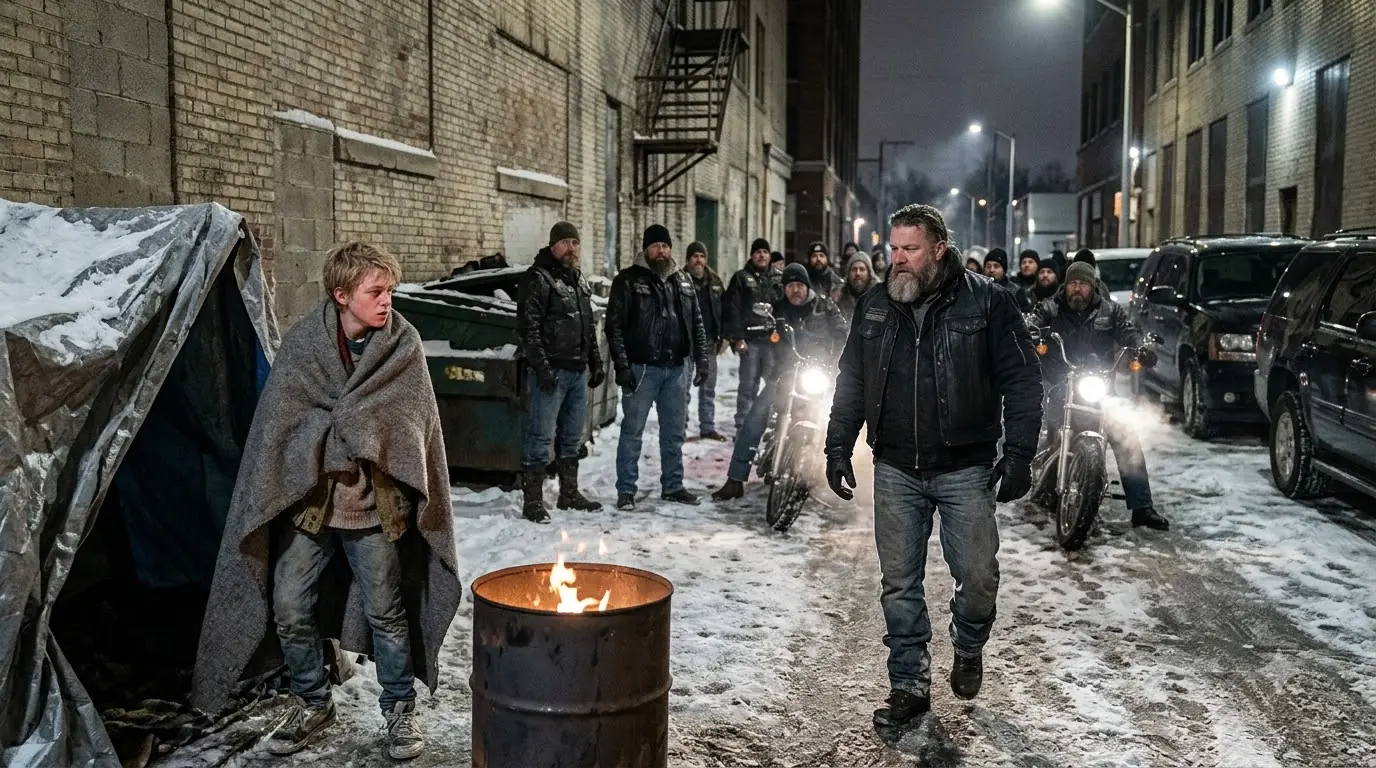
The thermometer on the bank sign at the corner of Jefferson and Woodward read -19°, and it was still falling. The street lights along the industrial corridor flickered against the snow, casting long, broken shadows across drifts that had already swallowed the parked cars.
The plows had given up hours ago. The city had locked its doors.
The free clinic on Mack Avenue had been open for 9 years.
Maggie Whitlock had signed the lease on a Tuesday in March of the year after her son died, and she had painted the walls herself, alone, on a series of weekends when she could not bear to be inside her own house.
The sign above the door read Whitlock Free Clinic in letters she had stenciled by hand. Below the name, in smaller letters, four words she had chosen carefully: no questions, no charge.
In 9 years, she had not turned a single person away. She had stitched up knife wounds at 2:00 in the morning. She had set broken fingers for women who would not say how the fingers had been broken. She had counseled teenage girls who could not go home and old men who had nowhere else to go.
She kept a cot in the back room and a coffee pot that was never empty, and the men of the Detroit Charter had built her a small steel safe behind the reception desk where she kept the medications that the pharmaceutical reps brought her quietly, off the books, because she had earned, in 9 years, a kind of reputation that crossed lines that did not usually get crossed.
That night, the night of the storm, she had stayed at the clinic until almost 11:00.
A boy of 17 had come in at 9:00 with a deep laceration on his forearm, the kind of laceration that comes from a knife, and he had not wanted to talk about how it had happened, and she had not asked.
She had cleaned the wound and stitched it closed and given him antibiotics and a sandwich, and she had sent him out into the snow with a wool hat she kept in a basket by the door for boys who came in without one.
Then she had locked up. She had set the alarm. She had gotten into her sedan, the one Beau had bought her for their 20th anniversary, and she had pointed the car west on Mack Avenue toward home.
She had called Beau from the parking lot.
"I am headed home, honey."
"The roads are bad, Mags. Take it slow."
"I always take it slow."
"I know you do. I love you."
"I love you, too. I will be there in 40 minutes."
She had hung up. She had pulled out of the parking lot.
She had no way of knowing that a black pickup truck had been sitting in the lot of the abandoned gas station across the street for the last hour, waiting for her.
In a narrow alley between a condemned auto parts store and the rusted skeleton of an old stamping plant, a boy curled himself into the smallest shape a body can make.
His name was Eli Carter.
He was 14 years old, and he weighed 90 lb soaking wet, and he had not eaten anything since the half a turkey sandwich he had found in the dumpster behind the deli on Tuesday afternoon.
That sandwich was now wrapped in a piece of newspaper inside the front pocket of his canvas parka. He had been rationing it for 2 days, three small bites a day.
He told himself that was enough.
He told himself a lot of things to keep moving.
Eli had run away from his foster home in Toledo when he was 12.
The man who was supposed to be his father had a temper that came out of a bottle, and the woman who was supposed to be his mother had a way of looking through him like he was a window onto something unpleasant.
Eli had taken his mother's old wool blanket, the only thing left of her, and he had walked out the back door one summer night and never gone back.
He had ridden freight trains north. He had slept in libraries and church basements and underneath the bleachers of high school football fields.
He had learned which dumpsters held the cleanest food, which alleys belonged to which men, and which steam grates pushed out warm air in the deep cold months.
His mother had died of cancer when he was 9.
Her name was Hannah.
She had hair the color of wheat and a laugh that sounded like wind chimes, and on her last day in the hospital, she had held his small hand in both of hers and told him that he was going to build beautiful things one day.
Eli wanted to be an architect.
He wanted to design houses that were always warm.
He had a notebook he kept inside his shirt against his skin, and in it he drew floor plans by candlelight: houses with thick walls, houses with fireplaces in every room, houses with no locks on the bedroom doors.
He had never known his father.
His father was a name on a piece of paper, a man who had died in some kind of accident in Pittsburgh when Eli was 6, before memory took root.
His mother used to say his father was a good man who worked with his hands and loved his family.
That was all Eli had: a name and a sentence.
Tonight, the cold was different.
Eli had survived two Detroit winters by knowing the city's secret warm places, but tonight the cold had teeth that found him through three thrift store sweaters and an oversized canvas parka and his mother's wool blanket pulled up over his head like a shroud.
He breathed into the small dark cave he had made of himself and tried to keep the air warm against his face.
His fingers were beginning to ache in that particular way that meant the next stage was numbness, and after the numbness came the white, waxy skin, and after that came the part where you stopped feeling anything at all and went to sleep and did not wake up.
He had seen it happen the winter before to an old man named Gregory who had taught him how to fold cardboard for insulation.
They had found Gregory frozen to a bench in Cass Park in March.
Eli had cried for a man he had known for 3 months as if he were blood.
He was thinking about Gregory when he heard the crash.
It came from the avenue two blocks west.
The sound traveled strangely through the snow, muffled and yet enormous, the unmistakable music of metal failing and glass breaking and something heavy leaving the road.
Then, cutting through it, the ugly throat of a heavy truck engine accelerating away.
Eli froze inside his blanket.
He knew the sound of an accident.
He knew the sound of an accident that was not an accident.
The streets had taught him the difference.
He held his breath.
He counted to 100.
He listened for sirens and heard none.
In this part of the city, on a night like this, the police would come when they came. An ambulance was a luxury reserved for neighborhoods the city still pretended to care about.
Then he heard the footsteps.
They were wrong.
That was the first thing he noticed.
They did not have the rhythm of a person walking.
They had the rhythm of a person trying to walk and almost failing.
Drag step.
Drag step.
Something heavy being pulled by a body that did not have much left to give.
The footsteps came down the side street and turned into his alley, and Eli pressed himself deeper into the cardboard and pulled the blanket tighter and prayed to the God his mother had believed in that whoever it was would pass by.
She did not pass by.
She made it 10 ft into the alley before her legs gave out, and Eli heard her go down.
He heard the soft, heavy sound of a body meeting the snow, and then he heard nothing at all except the wind.
He waited.
He counted again.
He told himself, "Mind your own business. That is the rule. The only rule, the rule that has kept you alive for 2 years on these streets. Mind your own business."
But the silence stretched, and the silence was a kind of death, and Eli Carter was a son of a woman who had told him on her last day that he was going to build beautiful things.
He pushed the blanket off his head.
She was lying on her side about 12 ft from him, half buried already in the blowing snow.
A woman, older than him by a lot, maybe 45. Dark hair coming loose from a braid. A wool coat that had been good once and was now soaked through with blood at the shoulder.
And under the coat, half visible, the black leather of a vest.
And on the back of that vest, even in the dim light of the alley, even half hidden by her arm, Eli could see the shape he had been taught to fear and to never ever look directly at.
The winged death's head, the colors of the Hells Angels Motorcycle Club.
Eli's breath stopped in his chest.
He knew who they were.
Every kid on the streets knew who they were.
They were not a gang. They were something older and harder than that, a brotherhood that ran like iron veins through every American city, and the patch on a man's back was a wall you did not climb and a door you did not knock on.
And the patch on a woman's back, on the back of a woman who belonged to one of them, was something even more sacred and more dangerous.
You did not see it.
You did not remember seeing it.
You walked away.
She was going to die in 5 minutes.
Eli knew this the way he knew the temperature, the way he knew the position of the moon, the way he knew his own hunger.
He had seen it before.
The snow was already covering her. Her breath was making no visible cloud. The blood at her shoulder was not even pooling anymore because her heart was not pushing hard enough.
He crawled out of his cardboard.
The cold hit him like a hand across the face.
He gasped against it and felt the inside of his nose freeze instantly, felt his eyes water and the water freeze on his lashes.
He scrambled to her on his hands and knees through the snow.
"Ma'am," he whispered.
He did not know why he whispered. There was no one to hear.
"Ma'am, you can't be here. You can't sleep here."
Her eyes opened.
That was the moment later that Eli would remember for the rest of his life.
Not the cold, not the patch, not what came after.
The moment her eyes opened and she looked at him.
Hazel eyes, unfocused, searching and then sharpening. The eyes of a person who had been a long way away and was choosing, against great odds, to come back.
She looked at him for a long second, and then she did something that Eli was not prepared for.
She reached out a shaking, gloved hand and touched his face.
"Honey," she said.
Her voice was a rasp, almost nothing, but the word was clear.
"Honey, your lips are blue."
Eli stared at her.
He had been ready for a lot of things.
He had been ready for her to grab him, to threaten him, to beg him to die.
He had not been ready for her to see him.
People did not see him.
People had not seen him in 2 years.
He was a thing that moved at the edges of their vision, a smear of dirty canvas they crossed the street to avoid, and this woman dying in the snow with a hole in her shoulder had looked at him and seen a child who was cold.
Something broke open inside him.
"You're hurt," he said, his voice cracked. "You're hurt bad. I have to get you out of the wind."