“Excuse me, ma’am. May I sit on your porch tonight? I won’t disturb you.”
“How long have you been standing out in this rain?”
“A while.”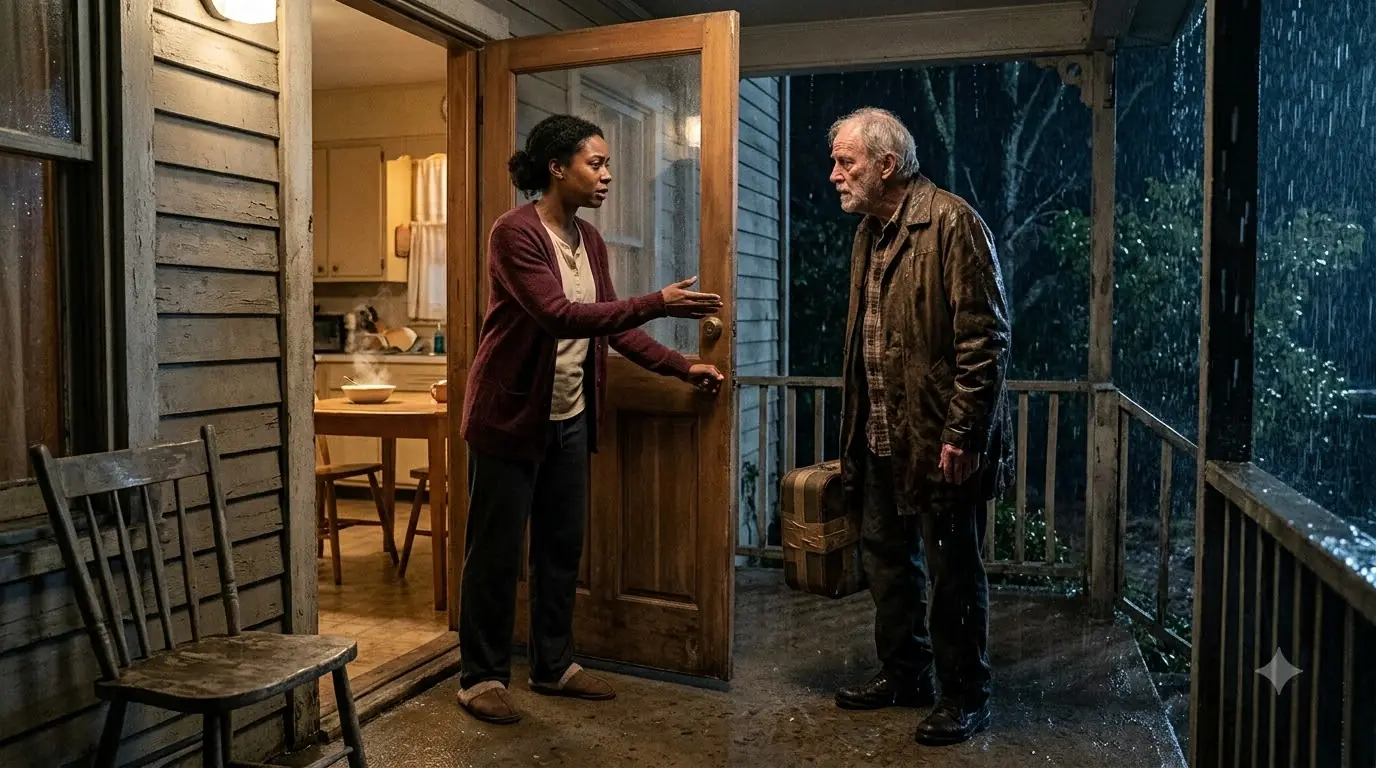
“Have you eaten anything?”
The old man shivered. His hands would not stop shaking.
“Come inside. I’m making soup.”
“Oh, no. I don’t want to trouble you. The porch is fine. I just…”
“Sir, you’re shivering. I won’t let you sit out here. Come inside.”
That was Simone Adams.
A widow with thirty-eight dollars in her bank account. Her daughter sleeping just steps away. Four months behind on a mortgage she could not pay.
And she had just invited a complete stranger into her home when she could barely feed herself and her child.
Six months later, when the town discovered who that old man really was, Simone’s kindness would shake the entire city council chamber.
Let me tell you about Simone Adams.
Not the version people saw later in that council chamber.
The version from before.
The one nobody noticed.
At 5:45 a.m. in October, the alarm went off in a house that smelled like old wood and lavender.
The lavender had been her grandmother Ruth’s thing. Ruth had lived in that house for forty-one years before she passed.
Two bedrooms, one bathroom, and a kitchen where the faucet dripped no matter how many times you tightened it.
Simone rolled out of bed.
Same routine every morning.
Brush teeth. Pull her hair back. Check on Lily.
Lily was still curled up under the blanket, clutching a stuffed rabbit that James had won at a county fair two years ago.
James.
Eight months gone.
Construction accident at a Reedman Construction site.
Scaffolding collapsed.
The company sent one letter.
After a thorough internal review, we have determined that Mr. Adams failed to comply with established safety protocols. We regret to inform you that your claim for compensation has been denied.
That letter sat in Simone’s kitchen drawer.
She had read it forty times.
She could not afford a lawyer. She could not afford to fight. She could barely afford to breathe.
Mortgage on the house, eight hundred and fifty dollars a month.
James had been paying it.
Now Simone was four months behind.
Total debt, mortgage plus funeral costs, somewhere north of eighteen thousand dollars.
Her bank account had thirty-eight dollars.
Not thirty-eight hundred.
Thirty-eight.
But Simone Adams did not stay in bed feeling sorry for herself.
Not once.
Not ever.
She kissed Lily’s forehead, then dropped her off at Miss Nadine’s next door.
Nadine Brooks was sixty years old, a retired school secretary, the kind of neighbor who never once said no.
Then Simone caught the 6:15 bus to Mabel’s Diner.
Mabel’s was the kind of place where the coffee was always too strong and the tips were always too small.
Simone worked the morning shift, 6:30 to 2:00, eleven dollars and fifty cents an hour, plus whatever people left on the table.
She was good at her job.
Not fake-smile good.
Genuinely good.
She remembered names. She remembered orders.
Old Mr. Patterson always wanted his eggs over easy with the toast cut diagonal, not straight.
Simone never forgot.
But here is what you really need to know about Simone Adams.
A young mother came in one Tuesday morning with a little boy, maybe three.
The mother ordered pancakes for him and coffee for herself.
When the check came, her card declined.
She tried it again.
Declined.
Her face went red. The little boy was already eating, syrup all over his fingers, not a care in the world.
Simone walked over quietly.
“Don’t worry about it. It’s taken care of.”
“What? No, I can’t let you do that.”
“It’s already done, ma’am. Enjoy your morning.”
Simone paid with her own tips.
Eleven dollars and forty cents.
Almost everything she made that entire shift.
She did not tell anyone. She did not post about it. She just went back to refilling coffee like nothing had happened.
That was who Simone Adams was.
That was exactly who she had always been.
Now here is the part that would make your stomach turn.
Every weeknight, after picking up Lily from Nadine’s and putting her to bed, Simone caught the 9:15 bus to her second job, cleaning the Collinsville Municipal Building.
She mopped floors, emptied trash cans, scrubbed bathrooms, and every single night she walked past offices with nameplates she never thought twice about.
One of those nameplates read, Alderman Preston Holt, Ward Four.
One Thursday night, she was emptying Holt’s trash when she noticed a document sitting on his desk.
A map.
Her street was highlighted in yellow.
At the top, in bold letters, it said, Crestview Plaza, Proposed Rezoning Application.
She did not understand all of it.
But she understood the yellow highlight covering her block.
She understood the words acquisition and eminent domain.
She pulled out her phone and took a photo.
She did not know exactly why.
Then she finished mopping, caught the last bus home, and sat at the kitchen table staring at that photo until her eyes burned.
Fourteen houses on her street.
Ruth’s house.
James’s house.
Lily’s house.
All highlighted in yellow, like they were already gone.
The next morning, Nadine leaned over the fence while Simone was heading out for work.
“Baby, you see those new signs on the empty lots?”
“What signs?”
“Future home of Crestview Plaza. They’re coming for this whole block.”
“They can’t take our homes, Miss Nadine.”
“Honey, they don’t take. They just make it so you can’t afford to stay.”
That same Thursday night, the rain started around nine and never let up.
Simone got home from the municipal building at 10:40, carried sleeping Lily home from Nadine’s, tucked her in, kissed her forehead, then sat at the kitchen table, staring at the rezoning photo on her phone.
At 11:20 p.m., there was a knock at the door.
Soft.
Almost apologetic.
Nobody knocked on Simone’s door at 11:20 at night.
She walked to the door and looked through the peephole.
An old man.
White.
Seventies, maybe.
Soaking wet.
A thin coat plastered to his body.
A small suitcase held together with packing tape.
And his shoes had no laces, the kind of detail you only see on someone who has been in a shelter where they take your laces.
She opened the door.
“Excuse me, ma’am,” he said. “May I just sit on your porch tonight? I won’t disturb you.”
His voice was steady.
His body was not.
His hands were shaking. Not from nerves. From cold, from hunger, from however many nights he had spent outside before this one.
“How long you been out in this rain?”
“A while.”
“You eat anything today?”
He looked down.
That was his answer.
Simone looked at this man, seventy-three years old, she would find out later, standing in the rain and asking for nothing more than permission to sit on her porch.
Not to come in.
Not for food.
Just to sit somewhere dry.
And Simone Adams, thirty-eight dollars in her account, four months behind on the mortgage, a daughter sleeping ten feet away, said the thing only she would say.
“Come inside. I’ve got soup on the stove.”
“No, no, please. The porch is fine. Really.”
“Sir, you’re shivering. I’m not letting you sit out here. Come in.”
He hesitated.
He saw Lily’s small pink shoes by the door.
“You have a child. I really shouldn’t.”
“I have soup, and you need it more than I do. Come inside before you catch something worse than a cold.”
He stepped in slowly, like he had forgotten what a doorway felt like.
Simone gave him a towel, dry socks, James’s old socks that were still folded in the drawer, and a bowl of canned chicken noodle soup.
Nothing fancy.
But the way that man held that bowl, both hands wrapped around it, not eating yet, just feeling the warmth, you would think she had handed him something sacred.
“Thank you,” he whispered. “I can’t remember the last time someone…”
He stopped, pressed his lips together, and looked away.
Simone did not push.
She sat across from him and let him eat.
She watched him take the first spoonful. His eyes closed just for a second, like that sip of broth was the first kind thing the world had given him in a very long time.
When he finished, he washed the bowl himself, dried it, and put it back exactly where he found it.
“You didn’t have to do that,” Simone said.
“You didn’t have to open the door.”
“But I did.”
She set up the couch with a blanket and one of Lily’s extra pillows.
“You sleep here tonight. We’ll figure the rest out tomorrow.”
“Ma’am, I don’t even know your name.”
“Simone.”
“Edmund.”
A pause.
“Thank you, Simone. Truly.”
She turned off the light and went to bed.
She did not know his last name.
She did not ask where he came from.
She just gave a stranger soup and a dry place to sleep.
At 5:45 a.m., Simone left for work.
She left a note on the counter.
There’s coffee. Lock the door if you leave. S.
When she came back that afternoon, the house was spotless.
Dishes washed.
Floors swept.
That leaking faucet, the one that had dripped for two straight years, was fixed.
And Lily was sitting on the couch next to Edmund, laughing while he read her a picture book in silly voices.
Laughing.
Simone had not heard that sound in eight months.
Edmund stood up quickly, like he had been caught doing something wrong.
“I’m sorry. She came right over and asked me to read.”
Simone stood in the doorway, looking at her daughter’s face, then at the faucet, then back at Edmund.
“You fixed my faucet.”
“I used to work with my hands. Long time ago.”
“You got somewhere to go tonight, Edmund?”
Silence.
His eyes were already saying goodbye.
“Then stay.”
“Simone, I can’t keep…”
“You fixed my faucet. You read to my kid. You cleaned my whole house. Stay.”
Edmund looked at Lily, who was already flipping to the next page, waiting for him to come back and finish the story.
He sat back down.
And he stayed.
The first week, Edmund tried to leave three times.
Monday morning, Simone came home from her shift and found his blanket folded neatly on the couch, his suitcase by the door.
“What are you doing?”
“I’ve stayed too long. You’ve been too kind already.”
“Edmund, it’s been four days.”
“That’s three more than I asked for.”
Simone picked up his suitcase and put it back in the corner.
“You leave when you’ve got somewhere to go. Not before.”
He did not argue.
He just stood there holding his coat, looking like a man who had forgotten what it felt like to be wanted somewhere.
By the second week, things changed.
Not big things.
Small things, the kind you do not notice until you add them up.
Edmund fixed the loose step on the front porch that Simone had been stepping over for a year.
He resealed the window in Lily’s bedroom that let cold air in every night.
He found a crack in the support beam under the roof and reinforced it using scrap wood from the garage.
Every repair was precise.
Professional.
Not the work of a handyman.
The work of someone who had built things for a living.
“How do you know how to do all this?” Simone asked, watching him work.
“Another life,” he said.
Nothing more.
“You were in construction?”
“Something like that.”
He wiped his hands and changed the subject.
“Lily says she wants spaghetti tonight. I can make it if you have noodles.”
He always did that.
Anytime Simone got close to his past, he would turn a corner and talk about dinner or the weather or something Lily had said, like there was a door inside him he had locked long ago and thrown away the key.
But here was what Edmund could not hide.
He was sick.
That first week, sleeping in the rain had done real damage.
A cough that would not quit.
Some nights, Simone could hear him through the wall, trying to muffle it so he would not wake Lily.
One night, she came out and found him on the couch, shivering under the blanket, coughing so deeply it sounded like it came from somewhere broken.
“Edmund, you need medicine.”
“I’m fine. It’ll pass.”
“You’re not fine.”
The next morning, Simone bought cold medicine at the pharmacy.
Twenty-three dollars.
Her tips from the whole day.
That night, she ate bread from her work bag so Edmund and Lily could have a full dinner.
She did not mention it.
She never did.
The third week, Simone took Edmund to the public library to get a library card.
Free ID alternative.
No driver’s license needed.
Just a name and address.
The librarian smiled.
“Last name?”
Edmund’s hand froze over the form for just a second.
Then quietly, he said, “Townsend.”
The librarian did not react. She wrote it down and handed him the card.
But here was what was interesting.
Edmund did not check out novels or newspapers.
He went straight to the legal section.
Property law.
Zoning regulations.
Homeowner rights.
Simone noticed, but she did not push.
That same week, Lily brought Simone a new drawing before bed.
She had been drawing their house every night since James passed.
Always four people standing in front.
Mama, Lily, Daddy, and Great-Grandma Ruth.
But this time, there were five.
The fifth figure was taller, with white hair, standing right next to Lily.
“Who’s that, baby?”
“That’s Grandpa Ed.”
Simone looked at the drawing for a long time.
Then she looked at Edmund washing dishes in the kitchen, humming a song she did not recognize.
She taped the drawing to the refrigerator right next to the others.
And for the first time in eight months, that refrigerator did not look so sad.
Two months in, November turned to December, and the Crestview Plaza rezoning hearing was set for a Thursday evening at the Collinsville Community Center.
Edmund had been preparing Simone for two weeks.
Every night after Lily went to bed, they sat at the kitchen table with library books between them. Edmund would point at a paragraph. Simone would read it out loud. He would explain what it meant in plain English.
Then he would quiz her, not like a teacher, more like a coach getting a fighter ready.
“This right here,” he said one night, tapping the rezoning application Simone had photographed. “Filed September 14. The public comment period didn’t open until September 28.”
“What does that mean?”
“It means they submitted the application before the public was allowed to have a say.”
“That’s a procedural violation?”
“It’s enough to delay them. Maybe long enough to matter.”
Simone stared at the document.
“How do you know all this, Edmund?”
He closed the book.
“I told you. Another life.”
“That’s not an answer.”
“It’s the only one I’ve got right now.”
She let it go.
But she filed it away.
He also found something else, a detail about Simone’s mortgage.
The bank had skipped the required certified-mail notice ninety days before initiating foreclosure.
That bought Simone extra time.
“You’re telling me the bank made an error?” Simone asked.
“I’m telling you the bank didn’t follow its own rules. That gives you leverage.”
For the first time in months, Simone felt something unexpected.
Not hope exactly.
More like a crack in the wall where a little light got through.
The night of the hearing, the community center was packed.
Folding chairs filled every row. People stood along the walls.
Nadine saved Simone a seat, then whispered, “You sure about this, baby?”
“No. But I’m doing it anyway.”
Alderman Preston Holt sat at the front table with two council members and a developer in a gray suit.
The developer went first.
Slides.
Projections.
Renderings.
Crestview Plaza. Two hundred luxury units. Ground-floor retail. Rooftop fitness center. Revitalizing the Collinsville corridor. Creating jobs. Raising property values.
Nobody in that room wanted their property values raised.
They knew what that meant.
Taxes they could not pay.
Being pushed out until they had no choice but to sell.
But nobody knew how to say it in the language that mattered.
Then Simone stood up.
Her hands were shaking.
Holt looked at her, the cleaning lady from his office, standing up at a public hearing.
“Ma’am, do you have a comment?”
“Yes, sir, I do.”
She pulled out her phone and opened the photo from his office.
“This rezoning application was filed on September 14. The public comment period didn’t open until September 28. That’s a procedural violation under Section 12.4 of the municipal zoning code.”
Silence.
Holt blinked.
“I appreciate your enthusiasm, ma’am, but I think you’re misreading the timeline.”
“I’m reading your own document, sir. I photographed it.”
She held up her phone.
“September 14. Clear as day.”
Murmurs moved through the crowd.
Someone clapped.
Then more.
Holt’s smile stayed, but his eyes changed. Something cold moved behind them.
“We’ll take your comment under advisement. Thank you.”
The council voted to delay the rezoning decision by sixty days.
Sixty days.
Not a victory.
But not a loss either.
A breath.
Outside, people Simone had never spoken to shook her hand.
Mr. Wallace, eighty years old, Black, a veteran who had lived on the block longer than anyone, found her by the door.
“Young lady, I got a letter last month saying they want to buy my house. Offered sixty thousand for a place worth twice that.”
“You still got the letter?”
“I got every letter they sent me.”
“Bring them by tomorrow. I’ll help you go through them.”
Simone was exhausted.
Up since 5:45. Full shift at the diner. Put Lily to bed. Then challenged a city alderman with nothing but a phone and a library book.
She had every right to go home and collapse.
Instead, she told an eighty-year-old man to bring his letters by.
That was Simone.
Edmund watched from across the parking lot.
He did not say anything, but Simone caught him wiping his eyes before he turned away.
The next night, Mr. Wallace came with a shoebox full of letters.
Official notices.
Buyout offers.
Code warnings.
All addressed to homeowners on the same blocks.
Simone and Edmund sat with him for two hours, reading every single one.
Edmund took notes.
Simone made copies at the library the next morning.
“They’re doing the same thing to everyone,” Simone said.
“Not the same thing,” Edmund corrected. “The same pattern. A pattern means it’s coordinated.”
He looked at her.
“You’ll need more than one photograph to fight this.”
“Then we’ll get more.”
Meanwhile, Holt was not sleeping either.
The morning after the hearing, he called code enforcement.
By Friday, an inspector showed up at Simone’s front door with a clipboard.
Three violations.
Chipped exterior paint.
An unauthorized occupant without a lease.
A non-compliant electrical panel.
Total fines, twenty-eight hundred dollars.
Simone made nineteen hundred dollars a month.
She stood on the porch holding that citation, and for the first time since James passed, she felt something worse than grief.
She felt targeted.
Edmund read the citation twice.
“This is retaliation. Textbook.”
“What do you mean?”
“They didn’t send an inspector because your paint is chipped. Every house on this block has chipped paint. They sent him because you embarrassed a man who doesn’t like being embarrassed.”
“So what do I do?”
“Document everything. Keep copies. Don’t stop.”
Simone looked at the number.
Twenty-eight hundred dollars.
The mortgage.
The funeral debt.
The thirty-eight dollars now closer to twelve.
“I can’t afford this, Edmund.”
“I know.”
“I can’t afford any of this.”
Edmund sat next to her on the porch step, quiet for a long time.
Then he said something she did not expect.
“I had a son once who sat in rooms like that hearing tonight. Except he sat on the other side, the side with the slides and the projections.”
Simone looked at him.
“What happened?”
Edmund stared ahead.
“I told him he was becoming someone his mother wouldn’t recognize. He told me I was living in the past.”
A long pause.
“I walked out. Haven’t spoken to him since.”
It was the most Edmund had ever said about himself.
And it hit Simone in a place she was not ready for.
She did not press.
She just sat next to him, both of them staring at a citation neither could pay, in front of a house neither wanted to lose.
After a while, she said, “Well, I guess we both know what it’s like to lose someone to a world that don’t care about people like us.”
Edmund nodded slowly.
“I guess we do.”
Month three.
Then four.
Something strange happened in that little house in Collinsville.
It started to feel like a home again.
Edmund picked up work where he could. He restored old furniture people left on the curb. A chair here, a side table there. He sanded them down, repainted them, and sold them at the weekend flea market for fifteen or twenty dollars apiece.
Every single dollar went into a jar on the kitchen counter labeled House.
He never touched it.
That was for Simone.
“Edmund, you don’t have to do that.”
“I eat your food. I sleep on your couch. Yes, I do.”
Evening settled into a rhythm.
Simone cooked.
Edmund washed dishes.
Lily sat between them at the table drawing pictures while Edmund told her stories about buildings he had worked on.
Towers.
Bridges.
Things that touched the sky.
“You built a bridge?”
“Grandpa Ed helped build one a long time ago.”
“Was it big?”
“Big enough that when you stood on top, you could see the whole city spread out beneath you.”
Lily’s eyes went wide.
Simone watched from the kitchen doorway, drying a plate, saying nothing.
But she was smiling.
She had not smiled like that in a very long time.
One afternoon, Simone’s coworker at the diner flipped through a magazine someone had left on the counter.
“Hey, you ever heard of this guy? Townsend something. Says here he just bought half of downtown Dallas. Billionaire.”
Simone glanced at the cover.
A man in a dark suit.
Sharp jaw.
Cold eyes.
The name underneath read, Conrad Townsend, CEO, Townsend Capital Group.
Townsend.
She looked at it for a second too long, then went back to clearing tables.
That night, after Lily was asleep, Simone found Edmund sitting on the porch in the dark.
He was holding the cheap prepaid phone she had bought him.
The screen glowed, a number typed in.
His thumb hovered right over the call button.
He did not press it.
He stared at that screen for a long time, then deleted the number, put the phone down, and stared straight ahead at nothing.
Simone stepped back inside quietly.
She did not say a word.
But now she had two things she could not stop thinking about.
A magazine cover.
And a phone call that was never made.
Month five.
Everything fell apart at once.
It started with a yellow notice taped to Simone’s front door.
She found it on a Tuesday afternoon, still in her diner uniform, Lily on her hip.
City of Collinsville, Notice of Condemnation.
The house had been declared structurally unsound. She had thirty days to bring it up to code or vacate the property.
Estimated cost of repairs, twenty-two thousand dollars.
Simone read it twice.
Then a third time.
The words did not change.
She put Lily down inside, walked back to the porch, sat on the step, and pressed her hands against her face.
She did not cry.
She was past crying.
She was in the place beyond that, the place where your body just goes quiet because it does not know what else to do.
Edmund came outside and read the notice over her shoulder.
His jaw tightened. His hands clenched at his sides.
“This isn’t about the house,” he said. “The house is fine. I reinforced the beam myself.”
“This is Holt.”
“I know it’s Holt.”
“He’s trying to bury you in paper until you give up.”
“I know that, too.”
That same week, Holt played his other card.
He visited three neighbors on the block privately, one by one.
He did not threaten.
He did not yell.
He simply suggested that Edmund might not be who he seemed.
No ID.
No background.
No one knows where this man came from.
You have families on this street. Children.
I just think the community has a right to ask questions.
Three neighbors signed a petition requesting that the council investigate the unidentified occupant at Simone Adams’s residence.
The petition was posted on the community bulletin board at the corner store.
Simone saw her name on it walking home from the bus stop.
Nadine refused to sign.
She told Holt to his face, “I’ve known that girl since she was running barefoot in the yard. Don’t you dare drag me into this.”
But three signatures were enough.
The whispers got louder.
People who had shaken Simone’s hand after the hearing now crossed the street when they saw Edmund on the porch.
That night, Edmund sat Simone down at the kitchen table.
Lily was asleep.
“I need to go, Simone.”
“No.”
“Listen to me. They’re coming after you because of me. The petition, the condemnation, all of it. If I leave, it stops.”
“You don’t know that.”
“I know that I’m making everything harder for you. You’re about to lose your home, and I’m the reason they’re pushing faster.”
Simone looked at him.
This man who had fixed her faucet.
This man who read to her daughter every single night.
This man who put every dollar he earned into a jar he never touched.
This man who ate last so Lily could eat first.
This man who had nowhere else in the world to go.
“Edmund, you’re family now. You hear me? You are family. And family doesn’t put each other out on the street.”
“Simone, no.”
“You’re staying. We’ll figure it out. We always do.”
Edmund’s shoulders dropped.
Not in defeat.
In something else.
Something he had not felt in a very long time.
He looked away quickly so she would not see his face.
The next evening, Simone came home early and heard Edmund’s voice from the back porch.
He was on the phone, speaking low, almost whispering.
“Tell him it’s his father calling. Please, just tell him.”
A pause.
A long one.
“I understand. Thank you.”
He hung up.
He sat there holding the phone with both hands, staring at the ground.
When he looked up and saw Simone standing in the doorway, something in him broke open.
“Sit down, Edmund,” she said quietly. “Tell me.”
And he did.
His real name was Edmund Townsend.
His son was Conrad Townsend, the billionaire on the magazine cover, the man who bought half of downtown Dallas, the man whose company moved families out of neighborhoods so luxury condos could go up in their place.
Two years ago, Edmund and Conrad had the worst argument of their lives.
Edmund’s wife, Lorraine, had passed five years before that. She had been the bridge between them. Without her, there was nothing left to absorb the collision.
“I told him he was becoming someone his mother would be ashamed of,” Edmund said. “He told me I was a relic. That I didn’t understand how the world worked anymore.”
“So you left?”
“I walked out of his front door and never went back. Pride, stubbornness, I don’t even know what to call it. I just couldn’t stay in a house built on money that came from pushing people out of theirs.”
Then the savings ran out after a year.
Shelters after that.
Then the street.
Simone sat with that for a moment.
The billionaire’s father sleeping on the street, eating at soup kitchens, showing up on her porch in the rain with no laces in his shoes.
“So you’ve been helping me fight the exact same thing your son does for a living.”
Edmund looked at her.
“Last time, I just walked away. I told myself that was enough. That leaving was the same as standing up. It wasn’t. Walking away never changed anything.”
His voice cracked.
“This time, I wanted to stay. I wanted to do something that actually mattered.”
Simone was quiet for a long time.
Then she said, “You should have told me sooner.”
“I know.”
“But I understand why you didn’t.”
She reached across the table and put her hand on his.
“You’re still family, Edmund. That part doesn’t change.”
Then she asked one more question, a quiet one.
“The construction company where James had his accident. Reedman Construction. Does that name mean anything to you?”
Edmund’s face changed.
Not shock exactly.
More like recognition.
The kind that comes with dread.
“Reedman was a subcontractor. They worked on several Townsend Capital projects. Cut corners everywhere. I warned Conrad about them years ago.”
Simone pulled her hand back slowly.
“My husband died on one of their sites, Edmund.”
The kitchen went silent.
Edmund closed his eyes.
When he opened them, they were wet.
“I didn’t know that. I swear to you, I didn’t know.”
“I believe you.”
And she did.
Because Simone Adams did not keep people in her life based on what they could give her.
She kept them based on who they were when they had nothing left to give.
What neither of them knew was that two miles away, in the Collinsville Municipal Building, Alderman Preston Holt had just run Edmund’s name through a public record search.
What he found made him pick up the phone.
“Mr. Townsend’s office? Yes. My name is Preston Holt. I’m a city alderman in Collinsville. I believe I know where his father is, and I think we can help each other.”
The next morning, Simone made two cups of coffee, set one in front of Edmund, and sat down across from him like it was any other morning.
Edmund looked at the cup, then at her.
“You’re not angry.”
“I didn’t say that.”
“But you’re sitting here.”
“I’m sitting here because we’ve got work to do, and because you don’t stop being family just because you kept a secret. You stop being family when you stop showing up. And you are still here.”
Edmund wrapped his hands around the mug.
He did not drink.
He just held it like the soup bowl that first night.
“So what now?” he asked.
“Now we fight. But this time, with everything we’ve got.”
They spent three days building the case.
Everything they had spread across the kitchen table like a war room.
Simone’s photograph of the rezoning application, the procedural violation that started it all.
Mr. Wallace’s shoebox of letters, buyout offers sent to every homeowner on three blocks, all within the same sixty-day window.
Edmund’s notes from the library, cross-referencing council records with contractor bids.
And that was where they found it.
Holt’s brother-in-law, a man named Gary Lester, owned a contracting company called Lester & Sons.
That company had submitted bids on three separate Crestview Plaza subcontracts.
The alderman pushing the project had a direct family member profiting from it.
“That’s a conflict of interest,” Edmund said, clear as glass.
“Can we prove it?”
“The bids are public record. The family connection is public record. All someone has to do is put them side by side.”
They also had testimony.
Two other homeowners, Mrs. Dalton and Mr. Reeves, had received condemnation notices identical to Simone’s.
Same inspector.
Same thirty-day window.
All three homes sat directly on the Crestview Plaza footprint.
Three notices.
Same inspector.
Same deadline.
Same project.
That was not code enforcement.
That was a coordinated pattern.
Simone needed one more thing.
Someone official who would actually listen.
She found him on a Wednesday afternoon.
Officer Dale Carver had been on the Collinsville force for twelve years. He had responded to a noise complaint on Simone’s block two months earlier.
Routine.
Nothing came of it.
But Simone remembered him.
He had been polite.
He had listened like he meant it.
She waited outside the precinct after his shift.
“Officer Carver, I’m Simone Adams. You came to my street back in October.”
“I remember you. What can I do for you?”
She showed him the pattern.
Three condemnation notices.
Matching timelines.
Same inspector on all three.
Carver studied the documents carefully.
His expression did not change, but his eyes moved faster.
“I can’t take sides officially,” he said. “But I can tell you the state inspector general’s office accepts anonymous complaints, and they take patterns very seriously.”
“Thank you.”
“Miss Adams, be careful. People who push back against city hall don’t always get pushed back gently.”
“I know. I’ve already been pushed.”
That night, after Lily was asleep, Edmund made the call.
The real one.
Not through a receptionist.
Not through an assistant.
He called the private number he had been deleting from his phone for four months.
It rang three times.
“Hello?”
“Conrad. It’s your father.”
Silence.
Five seconds.
Ten.
“Dad.”
Conrad’s voice broke on that single word.
“I’ve had people looking for you for two years.”
“I know. I wasn’t ready to be found.”
“Where are you? Are you okay?”
“I’m in a town called Collinsville. I’m staying with a young woman named Simone Adams. She took me in when I had nowhere to go. She fed me with money she didn’t have. She called me family when the whole town turned against me.”
“Dad…”
“I’m not calling to ask for money, Conrad. I’m calling because Simone needs help I can’t give alone. This town is trying to take her home the same way your company takes homes, and I need you to come here and see it for yourself.”
Another silence.
Longer this time.
“There’s also something about a contractor called Reedman. Something you need to know, but not on the phone. Come here. Look this woman in the eye. Then decide what kind of man you want to be.”
Conrad did not speak for a long time.
Simone could hear Edmund’s hand shaking against the phone.
Then, quietly, Conrad said, “I’ll be there Thursday.”
Edmund hung up, put the phone down on the table, and closed his eyes.
Simone set a glass of water next to him without saying a word.
Some conversations do not need a response.
They just need someone nearby when they are over.
Thursday came.
A black SUV pulled up to Simone’s street at 2:14 in the afternoon.
It looked like it had landed from another planet.
Every neighbor on the block noticed.
Nadine nearly dropped her watering can.
Conrad Townsend stepped out.
Tall.
Charcoal suit.
Silver cufflinks.
The same man from the magazine cover, except up close he looked tired.
The kind of tired money cannot fix.
Edmund was standing on the porch.
He had not sat down all morning.
Conrad crossed the yard, stopped at the bottom of the steps, and looked up at his father.
Neither of them moved for a long moment.
Then Conrad walked up the steps and put his hand on Edmund’s shoulder.
Edmund put his hand over his son’s.
That was it.
No dramatic embrace.
No speeches.
Just a father and son standing on a porch in the middle of a neighborhood they had never shared, saying everything they could not put into words.
Simone watched from inside the screen door.
She gave them their moment.
Then she opened it.
“Mr. Townsend, come in.”
Conrad walked into the house.
He saw the kitchen table still covered with documents, evidence, notes in Edmund’s handwriting.
He saw Lily’s drawings taped to the refrigerator, five figures in front of a house.
He saw the framed photo of James on the wall.
He saw the jar labeled House on the counter, Edmund’s flea-market money still untouched.
He saw code violation notices stacked next to a box of crayons.
He saw everything.
Simone sat him down at the kitchen table, the same table where she had fed Edmund soup six months ago.
“I’m not asking you for money, Mr. Townsend. I’m asking you to look at what’s happening in this town and tell me if it’s right.”
Conrad looked at her for a long time.
Then he said, “Show me everything.”
She did.
Every document.
Every letter.
Every photograph.
Every note.
Conrad made one phone call.
His legal team was in Collinsville by Friday morning.
Four attorneys.
Two investigators.
Forty-eight hours.
What they found was enough to crack the whole thing open.
Gary Lester, Holt’s brother-in-law, had been awarded three subcontracts for Crestview Plaza totaling 4.2 million dollars.
Holt had voted to approve the rezoning that made those contracts possible.
Conflict of interest exposed.
Three condemnation notices, Simone’s, Mrs. Dalton’s, Mr. Reeves’s, had all been issued by the same inspector, in the same thirty-day window, targeting homes on the redevelopment footprint.
No other homes in Collinsville received condemnation notices that entire year.
Selective enforcement confirmed.
The rezoning application had been filed on September 14, fourteen days before the public comment period opened.
Procedural violation documented.
And the phone call, Holt’s call to Conrad’s office, had been recorded by Conrad’s assistant as standard protocol.
On that recording, Holt explicitly offered to facilitate the reunion between Conrad and Edmund in exchange for Townsend Capital’s investment in Crestview Plaza.
He had tried to trade a homeless old man for a business deal.
Conrad listened to that recording in Simone’s kitchen.
He played it twice.
The second time, his hands were shaking.
“This is who I’ve been feeding,” he said quietly.
Not to anyone.
Just to himself.
“This is the system I built.”
The council meeting was set for the following Tuesday, six months to the day since Edmund first knocked on Simone’s door.
The chamber was packed tight, standing room only.
Local news had a camera in the back corner.
Holt sat at the front table, confident, expecting Conrad to announce his investment in Crestview Plaza. He had told two council members as much that very morning.
Lily stayed home with Nadine.
Simone sat in the third row, Edmund next to her.
He reached over and squeezed her hand once.
She squeezed back.
Conrad Townsend walked to the microphone.
He placed a single folder on the podium.
Thin.
Almost nothing.
The same kind of folder from the cold opening.
The one that was about to change everything.
He looked out across the room.
Then he spoke.
“Six months ago, a twenty-six-year-old widow in this town had every reason to lock her door. She was drowning in debt, raising her daughter alone, and about to lose her home. But when my father, a seventy-three-year-old man with no name, no ID, and nothing left, knocked on her porch and asked to sit out of the rain, she didn’t lock the door. She opened it.”
He paused.
The room was dead silent.
“She gave him soup with money she didn’t have. She gave him a place to sleep on a couch she couldn’t afford to replace. And when this city came after her, when the fines came, when the condemnation notice came, when her own neighbors signed a petition against her, she looked at my father and said, ‘You’re family. Family doesn’t put each other out on the street.’”
Conrad opened the folder.
“I’m not here to invest in Crestview Plaza. I’m here to show you what Crestview Plaza really is.”
He laid out the evidence piece by piece.
The conflict of interest.
The selective enforcement.
The procedural violation.
Then he played the recording.
Holt’s voice filled the chamber.
“I believe I know where his father is, and I think we can help each other.”
The room erupted.
Holt grabbed his microphone.
The council chair cut it off.
Conrad was not finished.
“I also need to say something no one in this room expects.”
He looked down at the podium, then back up.
“My company, Townsend Capital, is part of this problem. Not this specific project, but the system. We’ve built our success on deals that prioritize profit over people. We’ve used contractors who cut corners because they were cheaper. One of those contractors was Reedman Construction.”
He looked directly at Simone.
“Simone Adams’s husband, James Adams, lost his life at a Reedman Construction site, a site where safety protocols were ignored because it was cheaper to ignore them. My company didn’t build that site, but we built the world that allowed it to exist. And my father tried to warn me. I didn’t listen.”
The room was completely still.
Someone in the back row was crying quietly.
Conrad placed both hands on the podium.
“Kindness given freely is the only investment that never loses value.”
He stepped back from the microphone.
The council voted unanimously to suspend the Crestview Plaza rezoning pending a full ethics investigation into Alderman Holt’s conduct.
Holt sat motionless in his chair.
His career was not over with a bang.
It was over with a vote.
Outside, the air was cold.
People surrounded Simone. Neighbors, strangers, people she had never met.
A reporter pushed through the crowd.
“Miss Adams, did you know who Edmund was when you took him in?”
Simone looked at the reporter, then at Edmund, standing a few feet away, his son’s hand still on his shoulder.
“No,” she said. “And it wouldn’t have mattered. He was a man standing in the rain. I had a porch. That’s all there was to it.”
The reporter opened her mouth to ask another question, but Simone had already turned away.
She walked over to Edmund, put her hand on his arm, and said, “Let’s go home. Lily’s waiting.”
And they walked back to the car together.
A twenty-six-year-old Black widow.
A seventy-three-year-old white man.
And a billionaire who was just beginning to understand what family actually meant.
One month later, Conrad paid off Simone’s mortgage and the remaining funeral costs.
Simone resisted.
“I didn’t ask for this.”
“I know,” Conrad said. “This isn’t charity, Simone. This is responsibility. My system helped create the world that took your husband. The least I can do is make sure it doesn’t take your home, too.”
She accepted.
Not easily.
But because he was right.
Conrad established the James Adams Community Trust, offering free legal aid for residents facing forced buyouts and independent safety investigations at construction sites across the state.
James’s name was placed on something that would protect other families from what happened to his.
Reedman Construction was referred to the federal inspector general.
An investigation opened within weeks.
Simone received a full scholarship to study law.
Not paralegal work.
Law.
She started in the spring.
Edmund moved into a small apartment three blocks away.
His choice.
Conrad offered him everything. A penthouse, a house in the suburbs, anything.
Edmund wanted three blocks away.
Every afternoon at 3:15, he walked to Lily’s preschool and picked her up.
Hand in hand, Lily told him about her day in that breathless way four-year-olds do.
She still called him Grandpa Ed.
Edmund and Conrad had dinner every Sunday, slowly, carefully, two men learning how to be father and son again after two years of silence.
Holt did not win reelection.
No dramatic downfall.
Just a quiet exit.
Nobody threw a parade.
Nobody needed to.
The three neighbors who had signed the petition came to Simone’s door on a Saturday.
They brought a cake.
The woman in front could not look Simone in the eye.
“We’re sorry. We should have known better.”
Simone looked at them, then opened the door wider.
“Come in. I just made coffee.”
They sat at the kitchen table, the same table where everything had happened, and ate cake and talked about the weather and whose kid was starting kindergarten.
Simone did not need an apology speech.
She just needed the door to stay open.
That evening, Simone and Edmund sat on the porch.
Same porch.
Same two chairs.
From inside, Lily was singing something she had learned at school.
Off-key.
Beautiful.
Edmund poured Simone a cup of coffee without asking, the way he always did now.
“You ever think about what would have happened if you didn’t open the door that night?”
Simone took the cup and held it with both hands.
“No. Because James always said, ‘We were the people standing in the rain once, so we never lock the door when it’s raining.’”
Edmund looked at her, then at the street.
Fireflies.
Somewhere down the block, someone was grilling, the smell of charcoal drifting like a quiet hello from the neighborhood.
He did not say anything.
He did not need to.
Nadine Brooks still sits on her porch every single evening.
She tells this story to anyone who will listen.
The mailman.
The new neighbors.
The kid delivering groceries.
She tells it the same exact way every time, and every time, her voice cracks at the same part.
“That girl gave a stranger her last bowl of soup. Her last bowl.”
She never gets tired of telling it because some stories are not about billionaires or courtrooms.
They are about a bowl of soup on a rainy night.
A woman who said stay when she had every reason to say go.
A door that stayed open when the whole world said shut it.
After this story, one thing stays with you.
The people who give the most are rarely the ones who have the most.
They are the ones who remember what it feels like to have nothing.
They remember the rain.
They remember the hunger.
They remember what it feels like to stand outside a door hoping someone kind will see you as human.
And because they remember, they share what they can, even when it does not make sense on paper.
Even when the world tells them to protect themselves.
Even when all they have is soup.
Kindness given freely is the only investment that never loses value.
Not once.
Not ever.