The officer’s laughter ended before the final word left Maya Whitmore’s mouth. She stood in the sunrise inspection yard of Kestrel Ridge NATO Medical Camp with the torn back of her navy uniform hanging from one shoulder and Lieutenant Travis Cole’s wrist locked between her hands. Behind them, twenty soldiers who had been laughing only seconds earlier stared at the black tactical emblem exposed across her shoulder blades. It showed a raven diving through a broken triangle, surrounded by three coded marks that existed in no public military registry.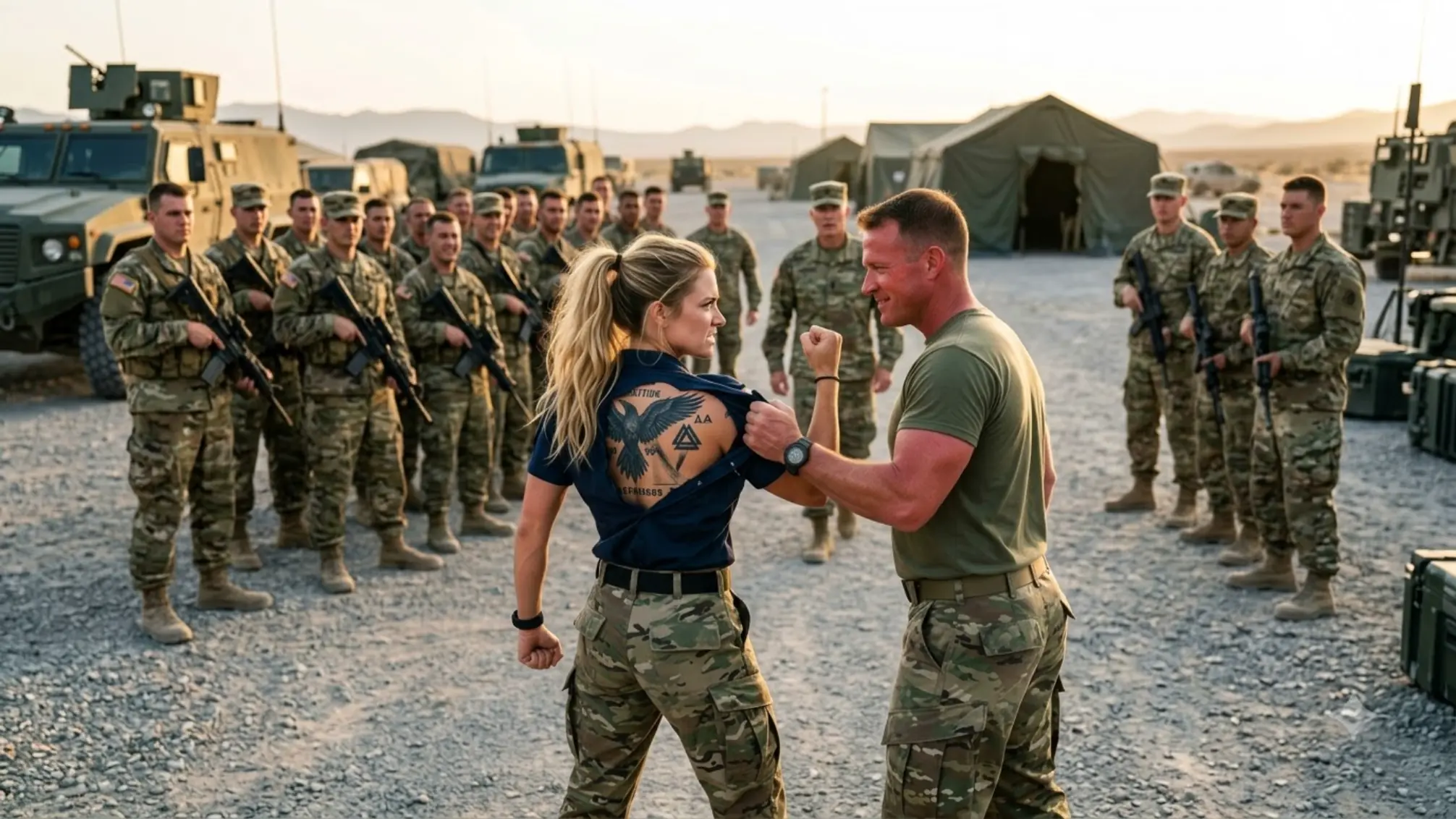
Two senior officers at the rear of the formation had recognized it immediately. Commander Reeve Holston took one involuntary step forward, while a visiting British special operations colonel named James Vale went completely still. Both men had spent years hearing stories about an operator called Phantom Raven, a combat nurse and intelligence specialist who entered places from which conventional teams had already withdrawn. Official records stated that she had died seven years earlier during a failed extraction in Eastern Europe.
Maya released Cole’s wrist with a sharp push. He staggered backward, clutching his hand and staring at her as though she had transformed in front of him. She calmly pulled the torn navy fabric across her exposed back, but she made no effort to hide the tattoo now that everyone had seen it. Her blonde ponytail shifted in the cold desert wind, and the fury in her gray-blue eyes had become something colder than anger.
Colonel Harlan Drummond, commander of Kestrel Ridge, marched across the inspection yard. He was a broad-shouldered man in his late fifties with silver hair, a decorated uniform, and the permanent expression of someone offended by any authority other than his own. The inspection had been his idea, and humiliating Maya had clearly been part of the morning’s entertainment. What he had not expected was for one of his officers to expose a symbol that changed the balance of power in an instant.
“What is the meaning of that marking?” Drummond demanded.
Maya faced forward. “A closed chapter, sir.”
“That is not an answer.”
“It is the only one your clearance permits.”
A murmur moved through the formation. No junior nurse spoke to a commanding colonel that way, especially not Maya, who had spent six weeks quietly accepting the worst assignments in the hospital. She had changed dressings, inventoried supply rooms, transported patients, and absorbed insults without visible resistance. Most of the camp believed she was an inexperienced civilian-trained nurse trying to adjust to military discipline.
Drummond looked toward Commander Holston. “Do you recognize it?”
Holston’s gaze remained fixed on Maya. Seven years earlier, he had been wounded during an operation no official report acknowledged. He remembered lying on a frozen hillside with a chest wound, unable to breathe, while a masked medic kept pressure inside the injury with one hand for nearly four hours. He never saw her full face, but he remembered gray-blue eyes and a voice ordering him not to die before she was finished.
“I recognize enough,” Holston said.
Drummond’s jaw tightened. “Then explain it.”
“I cannot do that in an open yard.”
The colonel turned back to Maya. “Report to my office immediately. Lieutenant Cole, place her under administrative restraint until we determine whether she is impersonating classified personnel.”
Cole hesitated.
Maya glanced at him. “Try touching me again.”
His injured wrist remained pressed against his chest. He did not move.
Colonel Vale walked forward, his boots striking the concrete with slow precision. He stopped three feet from Maya and studied the tattoo, the thin scar above her eyebrow, and the controlled way she balanced her weight. His expression carried no suspicion. It carried recognition mixed with disbelief.
“State your operational designation,” he said.
Maya looked directly at him. “I have no active designation.”
“That was not my question.”
She remained silent.
Vale’s voice softened. “Were you assigned to Raven Company?”
Every soldier in the yard waited.
Maya finally answered. “For three years.”
The silence became absolute.
Raven Company was not a conventional unit. It had been assembled from military medicine, intelligence, reconnaissance, and special operations personnel for missions in politically denied territory. Its operators moved without flags, official identification, or guaranteed extraction. When the unit disappeared after a catastrophic mission seven years earlier, the public explanation described the dead as victims of an aviation training accident.
Drummond recovered first. “Anyone can claim membership in a dead unit.”
Maya pulled the torn shirt tighter. “Anyone can claim authority, Colonel. Evidence decides who keeps it.”
His face hardened. “My office. Now.”
“No.”
Several soldiers exchanged startled looks.
Drummond stepped closer. “You are refusing a lawful order.”
“I am refusing to enter a closed room with the man who has spent six weeks trying to force me off this installation before I finish my work.”
The colonel’s expression changed. For the first time, a trace of fear appeared beneath his anger.
“What work?”
Maya looked toward the administrative building. “The work you thought no one would ever find.”
Commander Holston noticed the reaction. He had arrived at Kestrel Ridge for what should have been a three-day medical coordination visit, yet irregularities had kept him there for nearly two weeks. Supply numbers did not match treatment records. Experienced nurses had been moved into clerical roles. Equipment had disappeared from active inventory and later surfaced under contracts linked to private defense companies.
Until that moment, Holston had suspected poor leadership and financial misconduct. Maya’s presence suggested something much larger.
Drummond pointed toward two military police officers near the gate. “Detain her.”
Neither officer moved immediately.
Colonel Vale stepped between Maya and the approaching men. “Before anyone restrains her, I recommend verifying her identity through secure command.”
“This is my installation,” Drummond snapped.
“And that tattoo belongs to a NATO black-access medical operator,” Vale answered. “If it is authentic, your authority ends several levels below hers.”
Drummond’s face reddened. “She is a rookie nurse.”
Maya turned slightly, revealing the entire raven emblem. “That is why I was useful.”
The confrontation ended when Holston’s secure phone vibrated. He had submitted a photograph of the tattoo through a classified verification channel less than two minutes earlier. The response contained only three lines.
PHANTOM RAVEN DESIGNATION CONFIRMED.
SUBJECT STATUS CURRENTLY LISTED KILLED IN ACTION.
DO NOT DETAIN. NOTIFY DEFENSE OVERSIGHT IMMEDIATELY.
Holston read the message twice. Then he raised his eyes toward Maya.
“They still have you listed as dead.”
“I know.”
Drummond looked from the phone to her. “This is some kind of deception.”
“Yes,” Maya said. “But not mine.”
She walked away from the formation before anyone granted permission. The torn navy shirt moved against her shoulders, exposing fragments of the raven tattoo with every step. Holston followed, as did Colonel Vale, while the soldiers remained in formation beneath the growing desert light.
Maya entered the medical building and went directly to the quartermaster room. She accepted a replacement navy uniform shirt, signed the issue form, and changed without explanation. When she emerged, Holston was waiting in the corridor.
“You knew the tattoo could expose you,” he said.
“I knew it was a possibility.”
“Then why allow Cole to reach behind you?”
“I needed to know who would laugh.”
Holston studied her. “You staged it?”
“No. Drummond staged it. I simply let everyone reveal which side they were already standing on.”
Colonel Vale joined them. “Defense oversight is requesting immediate secure contact.”
Maya continued walking. “They ignored my transmissions for twelve hours.”
“They are answering now.”
“Because the tattoo created witnesses.”
Vale understood. Evidence could be buried. Public recognition among senior officers was more difficult to erase.
They entered a small secure briefing room beneath the hospital. Maya locked the door, checked the electronic shielding, and removed a thin data device hidden inside the sole of her combat boot. Holston watched her place it on the table.
“What is that?”
“Six weeks of procurement records, personnel actions, surgical inventory discrepancies, and command communications.”
“You collected all of that while working as a nurse?”
“I collected it because I was working as a nurse.”
Medical staff moved through every department. They saw which equipment arrived, which patients disappeared from official schedules, and which records were altered after treatment. People spoke freely around nurses they considered unimportant. Drummond had ensured that Maya received the most exhausting and humiliating assignments, unknowingly placing her inside supply rooms, records offices, maintenance bays, and patient wards.
“What were you looking for?” Holston asked.
“The financial chain connected to the mission that killed Raven Company.”
Vale leaned forward. “You believe Kestrel Ridge was involved?”
“Not the hospital itself. Its procurement network.”
Maya opened the drive. The screen displayed shipping records showing military medical equipment purchased through inflated contracts, marked damaged, and transferred to private security firms. Some serial numbers matched equipment used during Raven Company’s final operation.
“The mission was not merely compromised,” Maya explained. “It was supplied through a network designed to expose us.”
Holston stared at the records. “Someone funded the operation and sold the route to the people waiting for you.”
“Four operators died. Two were wounded. I was left behind and entered as killed in action before the extraction window even closed.”
Vale’s expression darkened. “Who authorized it?”
Maya displayed a scanned signature.
“Retired Brigadier General Warren Stale.”
Holston recognized the name. Stale now worked as a senior adviser for a private defense contractor that held multiple agreements with Kestrel Ridge. Colonel Drummond had approved those contracts during his previous assignment and continued authorizing them after taking command of the medical center.
“Drummond has been maintaining the network,” Maya said. “He did not create it, but he knows enough to protect it.”
A sharp knock struck the door.
“Commander Holston,” a voice called. “Colonel Drummond orders you to surrender Nurse Whitmore and all unauthorized materials.”
Maya closed the laptop.
Holston looked toward the door. “How did he know we were here?”
“He tracks secure-room access.”
Colonel Vale reached for his phone. “I can place the entire facility under temporary NATO review.”
“Not yet,” Maya said.
“Why?”
“Because Drummond is frightened, and frightened people move evidence.”
She opened a live security feed on the screen. The system showed a maintenance corridor beneath the administrative wing, where Warrant Officer Gideon Pratt was carrying two document cases toward the motor pool. Pratt supervised night logistics and had spent weeks collecting information about dissatisfied staff members.
“He is taking the original files,” Maya said.
Holston stood. “We stop him.”
“Not inside the building. We let him reach whoever is waiting.”
The three officers left through a service passage and emerged near the motor pool. Maya moved quickly but without drawing attention, navigating paths she had mapped during early morning inventory assignments. Through the fence, she saw a black sport-utility vehicle idling fifty yards beyond the authorized parking line.
Pratt approached it with the document cases.
Maya signaled Holston and Vale to remain behind cover. She moved alone through the rows of parked medical vehicles, using their shadows to close the distance. When Pratt reached the SUV, the rear door opened.
A man in a dark suit extended one hand.
“Those had better be complete,” he said.
Maya stepped from behind an ambulance. “They are complete enough to send Stale to prison.”
Pratt froze.
The man inside the vehicle reached beneath his jacket. Maya moved before the weapon cleared the fabric. She caught his arm against the doorframe, struck the nerve above his wrist, and forced the handgun onto the pavement. Pratt dropped one case and tried to run.
Holston intercepted him.
The commander drove Pratt against the side of the SUV and secured his arms while Vale called military police through an independent channel. Maya kept the suited man pinned against the door until federal investigators arrived at the gate.
Drummond appeared moments later with his own security detail.
“What have you done?” he shouted.
Maya released the man into federal custody. “What I came here to do.”
“You have no authority to conduct operations on my installation.”
Deputy Director Nora Callum stepped from the lead federal vehicle. She was a compact woman in her fifties with short dark hair and the composed expression of someone accustomed to dismantling powerful careers.
“She has my authority,” Callum said.
Drummond stopped.
Callum showed him a signed order from the Defense Investigations Command. It authorized the seizure of procurement records, communication systems, private contractor files, and administrative accounts connected to the Kestrel Ridge medical network.
“You cannot enter my command based on the claims of a nurse,” Drummond said.
Callum looked toward Maya. “She is not merely a nurse.”
Maya’s eyes narrowed slightly.
Callum corrected herself. “She is not merely anything.”
Federal teams entered the administrative wing. Investigators secured offices, copied servers, and recovered files from the cases Pratt had attempted to deliver. The contents included payment records linking Drummond to a consulting agreement controlled by Stale’s company.
Drummond was escorted to the conference room for questioning. Before leaving the motor pool, he turned toward Maya.
“You let me humiliate you for six weeks.”
“You were humiliating yourself. I was documenting it.”
His eyes hardened. “Do you believe this makes you powerful?”
“No. It makes you accountable.”
Inside the hospital, the news spread faster than any official announcement. Soldiers who had laughed in the inspection yard avoided Maya’s eyes. Some apologized quietly. Others acted as though they had never participated.
Lieutenant Cole approached her near the nurses’ station with his injured wrist wrapped in a support brace.
“I was following Colonel Drummond’s orders,” he said.
“He ordered an equipment inspection.”
Cole said nothing.
“He did not order you to tear a woman’s clothing while a formation laughed.”
“I did not know who you were.”
Maya’s expression became colder. “That is not a defense.”
He looked down.
“You should not have needed a classified tattoo to know it was wrong.”
Cole was removed from training duties pending investigation. Video footage showed that he had deliberately yanked the uniform after the seam began tearing. Several soldiers confirmed he had mocked Maya before the inspection and encouraged others to treat her as weak.
The hospital’s review uncovered a broader pattern. Nurses who challenged unsafe orders received punishment assignments. Medical technicians who reported missing equipment lost promotion opportunities. Drummond had created an environment where obedience mattered more than patient safety.
Three experienced nurses were restored to clinical positions. A protected reporting channel was established outside the local chain of command. Procurement officers began verifying every piece of transferred medical equipment against physical serial numbers.
Maya returned to the ward during the investigation.
A twenty-year-old soldier named Nate Ellison lay recovering from emergency vascular surgery after a vehicle accident. Maya had recognized the threatened blood supply in his damaged leg while Drummond initially refused to interrupt a senior surgical briefing.
Ellison watched her enter. “They said you saved my leg.”
“The surgeon saved it.”
“They said you told her how to reach the damaged vessel.”
Maya checked the monitor. “Your circulation is strong.”
“Were you really dead?”
She paused.
“On paper.”
“What was it like?”
“Quiet.”
Ellison considered that. “Are you leaving?”
“When the investigation no longer needs me.”
He looked disappointed. “People here need you too.”
Maya adjusted his blanket. “Then they need to learn what I know before I go.”
Over the next several days, she trained the medical staff in trauma assessment, battlefield stabilization, and rapid vascular response. She did not speak about Raven Company unless a lesson required it. Her authority came not from the tattoo but from the calm certainty of someone who had performed the procedures under conditions most doctors could barely imagine.
Commander Holston attended one session from the back of the room.
Afterward, he waited until the staff left. “You held my wound closed for four hours.”
Maya stopped arranging instruments.
“You remember.”
“I remembered the injury. I did not know your name until I saw the old casualty file.”
“I searched for you.”
“You were not supposed to find me.”
“I wanted to know whether you survived.”
“So did I.”
He smiled faintly. “That sounds like you.”
Holston explained that he had awakened aboard an extraction aircraft and asked for the medic who stayed behind. No one answered. The mission report listed Phantom Raven among the dead.
“I spent six years believing you died after saving me.”
Maya closed the trauma kit. “Four others did.”
“That does not erase what you did.”
“No. It explains why I could not walk away.”
The investigation expanded beyond Kestrel Ridge. Stale attempted to negotiate by offering records connected to other compromised missions. Callum refused immunity but accepted limited sentencing consideration in exchange for full disclosure.
His files revealed that Raven Company’s destruction had been a test. Private contractors wanted to determine whether classified medical and intelligence units could be redirected, exposed, and erased through manipulated logistics records. After the operation succeeded, versions of the system continued under different names.
Maya read the summary in silence.
Callum watched her. “We need people who understand how the network operates.”
“You are asking me to return.”
“I am informing you that the work exists. The decision remains yours.”
Maya looked through the office window toward the ward. Nurses moved between patients, monitors sounded, and Ellison practiced standing with a physical therapist.
“My record?”
“Corrected. Active status restored. Raven Company’s casualties have been reclassified as deaths during a classified operation. Their families will receive the benefits they were denied.”
Maya lowered her eyes.
For seven years, four families had been told their children, spouses, and siblings died in a routine training accident. The correction would not return anyone, but it would replace a lie with the truth.
“Let me speak to them,” Maya said.
Callum nodded. “We can arrange it.”
Drummond was formally charged with abuse of command, obstruction, retaliation, and conspiracy to conceal federal evidence. Pratt entered a plea agreement and identified three additional members of the procurement network. Lieutenant Cole received disciplinary action for assault and public humiliation during the inspection.
No dramatic courtroom declaration ended the case. Accountability arrived through pages of evidence, sworn testimony, archived communications, and signatures powerful men believed no one would ever connect.
Kestrel Ridge received a new commanding officer, Colonel Dena Marsh. She restored clinical staff, reversed retaliatory assignments, and asked Maya to review the hospital’s emergency reporting structure.
“People will not trust another policy announcement,” Maya told her. “They need to watch the system protect someone who speaks.”
Marsh wrote the words down. “Then that is what we will build.”
On Maya’s final morning, she returned to the inspection yard before sunrise. No formation waited there now. The concrete stretched empty beneath a deep-blue sky, almost identical to the morning her uniform had been torn.
Holston found her standing where it happened.
“You still have the tattoo,” he said.
“I considered removing it.”
“Why didn’t you?”
“It belonged to people who deserved to be remembered.”
He stood beside her in silence.
Maya wore a new navy uniform shirt, perfectly fitted and unmarked. Beneath it, the diving raven remained across her back, invisible to anyone who did not already know it was there.
“Callum told me about the active program,” Holston said. “Are you going after it?”
“I have not decided.”
“That means yes eventually.”
“It means I have not decided.”
He smiled. “Of course.”
Maya looked toward the medical building. Suki Farand was beginning the morning shift. Ellison would soon take his first unsupported steps. The young nurse who once allowed physicians to silence her had been assigned to lead the new patient-safety review.
Those changes mattered.
Callum’s vehicle waited near the gate. Inside it was a corrected personnel file bearing Maya’s real service history. The words killed in action had finally been removed.
Maya began walking toward the gate.
Holston called after her. “Phantom Raven.”
She stopped but did not turn.
“Are you still alive?”
For seven years, she had existed between records, missions, and borrowed identities. She had allowed people to believe she was weak because weakness made an effective disguise. She had accepted laughter, isolation, and humiliation while following the evidence toward the men who betrayed her team.
Now the truth stood inside federal files, family notifications, and criminal charges.
Maya looked over her shoulder.
“Alive enough to finish it.”
Then she walked into the rising light, carrying the raven no longer as proof of a ghost, but as a promise that the people erased from history had finally been seen.