There is a category of audacity that transcends ordinary entitlement.
Ordinary entitlement is someone who parks in your space and acts put out when you ask them to move.
Ordinary entitlement is someone who uses your shared fence as a trellis without asking. Ordinary entitlement is the minor daily friction of people who have slightly miscalibrated their sense of where their rights end and other people's begin.
What I am describing is something beyond that category.
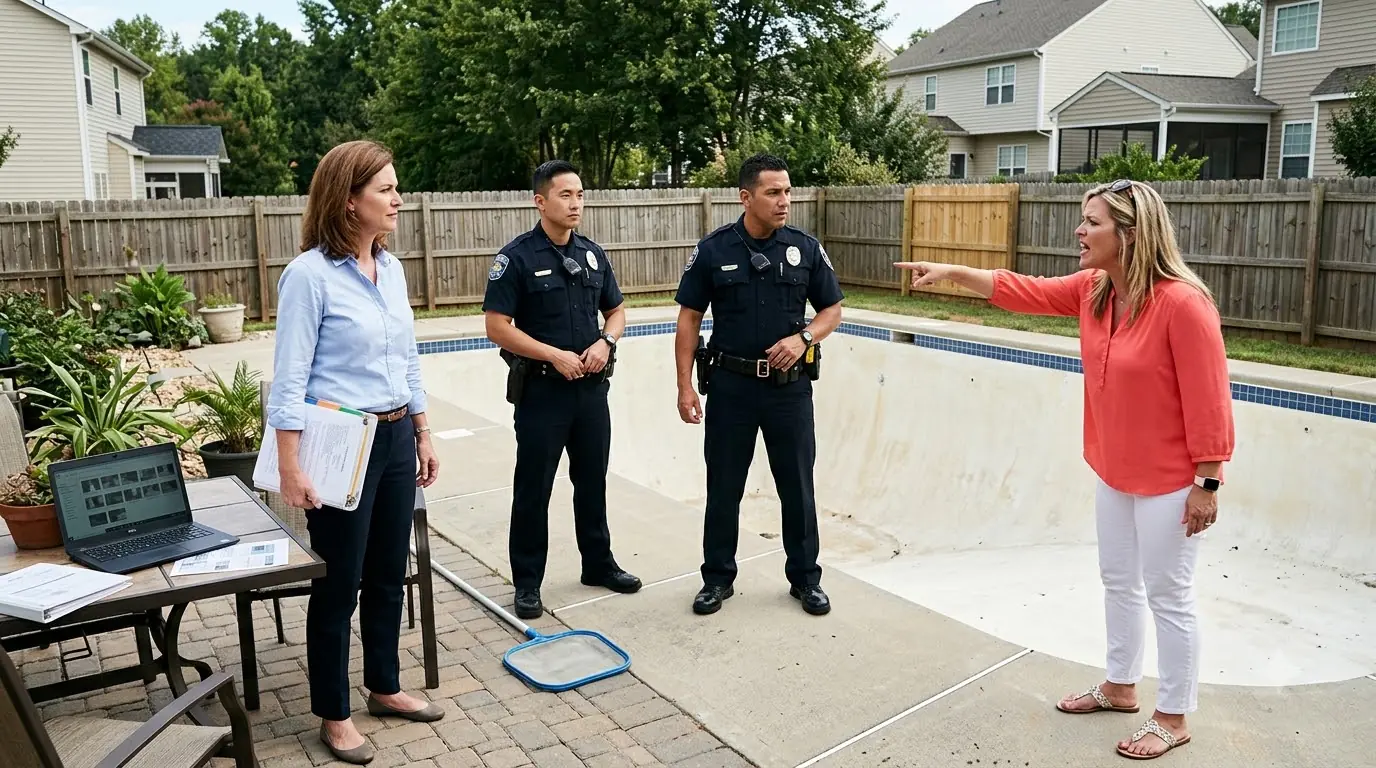
What I am describing is someone who, after 7 months of using another person's pool without permission, returns to that pool with two police officers and states, without apparent irony or hesitation, that the pool is hers and that the person who built and paid for and maintained it for 7 years had no right to drain it.
That is not a miscalibration of entitlement. That is a complete departure from the relationship between believing something and it being true.
That is a person who has confused what they want with what exists and who has made that confusion formal by bringing law enforcement to witness it.
The police officers, to their considerable credit, did not accept the confusion as fact.
What they did instead was stand in my backyard and ask questions in the methodical way that police officers ask questions when they are trying to determine what is actually happening rather than what the person who called them believes is happening. And what they found when they asked those questions was a documentation file that I had been building for 7 months and that answered every question they might have asked about the ownership, the installation, the permits, the maintenance records.
And the specific sequence of events that had led to this moment in which a drained concrete pool sat in my backyard and a woman named Sandra Fielding was telling two uniformed officers that I had destroyed her property.
I will tell you about the documentation file. I will tell you what was in it and why it was there and how it came to be organized the way it was.
But first, I need to tell you about the pool because the pool is not incidental to this story. The pool is the story.
My name is Rachel Pemberton. I am 47 years old.
I'm an accountant by profession and a methodical person by disposition, which means I keep records the way some people breathe, not because I am thinking about it, but because not keeping records is a condition I am incapable of sustaining. I bought my house at 14 Cloverfield Road 15 years ago.
The house had no pool when I bought it. I wanted a pool.
3 years after I moved in, I had a pool installed.
The pool is an in-ground concrete pool, 22 ft by 44 ft with a tile border at the waterline and a concrete coping around the edge. It was installed by a company called Aqua Design Solutions, permitted through the county, and has been maintained by a pool service company every week since installation.
The installation cost was significant. The annual maintenance cost is something I budget for.
The pool is in the inventory of things I own and care about, one of the more significant items, not the most valuable, but the one that has produced over 12 years of summer evenings and weekend afternoons, and the particular pleasure of having cold water available on hot days, a quality-of-life return that no spreadsheet could capture.
Sandra Fielding moved into the house at 16 Cloverfield Road, directly adjacent to mine, sharing my eastern fence line, 9 years after I bought my house. She moved in with two young children and a set of opinions about the neighborhood that became, over the 2 years following her arrival, apparent to everyone who lived within earshot.
Sandra was not a subtle person.
She had preferences and she expressed them. And when reality did not conform to her preferences, she expressed herself about that, too.
A preference for my pool was expressed approximately 3 months after she moved in. She came to my door on a Saturday morning in June and said the children would love to swim, and she wondered if I would mind if they used the pool occasionally.
I said I would think about it. I did think about it, and what I thought was that occasional supervised access was not something I objected to in principle, and I said so when she knocked again 2 days later.
I said yes, occasionally with her supervision was fine.
The word occasionally is doing a lot of work in that sentence, and I should have been more specific about it. What I understood by occasionally was once every couple of weeks, maybe on weekends when I was around and the weather was good, and it was a natural thing for the children to come over and swim.
What Sandra understood by occasionally was apparently significantly more frequent than that.
By July, she and the children were in my pool 4 days a week. By August, it was 5 days a week, and she had begun bringing guests, her sister, her sister's children, a rotating cast of people I had not met.
By September, when the season was winding down, she had brought people to swim in my pool on 17 occasions when I was not home, and had apparently used a key to my gate that I could only conclude she had obtained when I left it briefly accessible during a maintenance visit.
I addressed this in September with a direct conversation, calm, clear, in the kind of tone that conveys both the seriousness of the message and the preference for resolution over conflict. I said the original arrangement had been for occasional supervised swimming, and that what had happened over the summer was significantly beyond that.
I said I was not comfortable with the volume of people who had been using the pool and with the access that had been obtained without my knowledge. I said the arrangement was going to be more limited going forward.
Sandra said she understood and that she had thought I was more open to sharing than I apparently was. The tone of that sentence, I had thought you were more open to sharing, was worth noting.
It suggested a perspective in which my pool was a resource to be shared and my desire to control access to it was a character failing rather than a property right. I noted the tone and did not comment on it and went back inside.
For October and November, the pool season being essentially over, nothing happened. I added a new lock to the gate.
The following April, when the weather began warming and I started opening the pool for the season, Sandra came to my door again. She said she and the children were looking forward to another summer and wanted to discuss arrangements.