She would say it into the cold morning air before she had a single shred of proof.
“I know it’s you.”
Just that, whispered to a jar of milk sitting on her porch step in the gray light before sunrise, the glass still fogged with dew, no footprints anywhere close enough to explain it.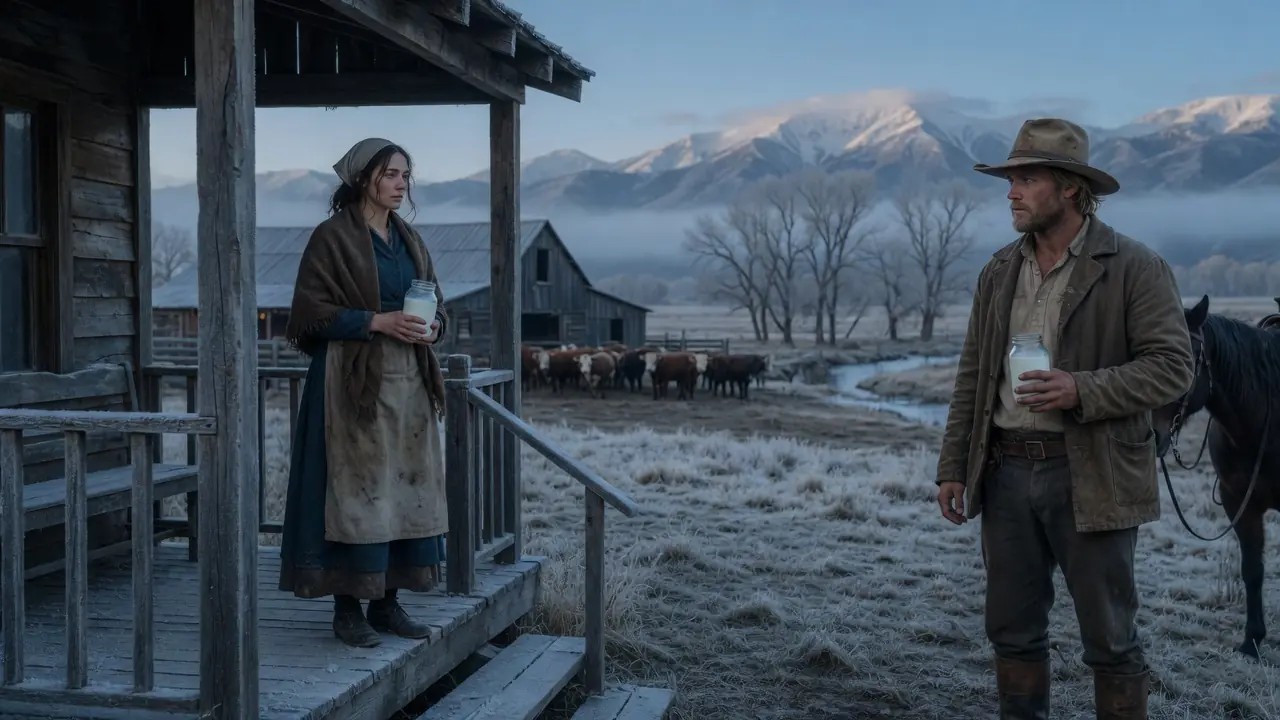
She said it every morning for three months without ever once being right about who might hear her.
And on the morning she finally said it to his face instead of to the empty yard, Thomas Calder would stop walking like a man who had just been caught at something, and Mara Hensley would understand that the waiting was the only proof she had ever needed.
Willow Creek sat against the eastern slope of the Wyoming Territory in the autumn of 1884, a town of maybe two hundred souls, the kind of place where everyone believed they knew everyone else’s business and were mostly wrong about it.
The mountains held snow on their high shoulders even in September. The creek that gave the town its name ran cold and fast out of the hills and slowed as it crossed the valley floor, cutting through pasture land that had been fought over one way or another since the first families staked their claims a generation back.
Mara Hensley was twenty-nine years old and had been a widow for four years. Her husband, Daniel, had gone into a ravine with his wagon during a spring flood the year their youngest was still small enough to be carried on a hip.
Mara had buried him on the rise behind the house and gone back to the milking the next morning, because the cows did not know he was gone and would not wait to be asked twice.
She had kept the small dairy herd he left her, eleven cows and a bull too old to be much trouble. She rose before light every day of her life since to do the milking herself, her hands moving through the work in the dark the way a person’s hands learn to do a thing so well the mind can leave the room entirely.
The town had opinions about this, the way small towns always do about a woman running anything alone.
Willow Creek’s social committee was led by Eleanor Briggs, a woman in her fifties with sharp eyes and a sharper sense of who belonged where in the order of things. Eleanor had decided years before that a widow keeping a dairy herd by herself was less a fact of the world to be respected than an oddity to be managed, discussed at length over coffee, and quietly pitied.
Mara knew this.
She had stopped attending the church socials the second year of her widowhood, not out of any bitterness she would admit to, but because she had grown tired of the particular kindness that came dressed as concern, the way women would ask how she was managing in a tone that made clear they expected the answer to be poorly.
She was quiet by nature and had grown quieter still since Daniel died. The kind of quiet that comes from a person deciding early that most conversations were not worth the trouble of having.
She was proud, too, in the plain, unglamorous way of someone who has had to be proud simply to keep going. She had raised her two children, a boy of nine and a girl of six, on a homestead that asked more of her every single day than she had hours to give it.
Thomas Calder lived on the far side of the creek, a half mile of pasture and one crossing away from Mara’s land, though in three years neither of them had exchanged more than a passing word.
Thomas was thirty-four, tall in a way that had gone slightly stooped from years of hard labor. He walked with a permanent limp, a leg that had been shattered and poorly set somewhere in Tennessee during the war and had never fully forgiven him for it.
He had come back to Wyoming afterward and bought land on the far side of Willow Creek. Over eight years, he had built a modest but sound cattle operation, working mostly alone, hiring help only at branding and roundup, and speaking to almost no one in town beyond what business strictly required.
Willow Creek had settled on an opinion about Thomas the same way it had settled on one about Mara, though the opinion was different in shape.
He was distant.
He was unsociable.
He did not attend socials either.
When he did come to town for supplies, he was polite and brief and gone again before anyone could draw him into conversation. People spoke of him the way you speak of weather that has always been a certain way, without much curiosity about why.
He had watched her ration what little milk her cows gave during a stretch of weather that had turned the grass brittle and yellow across half the valley. He had seen her at the general store buying flour in smaller amounts than a family her size should need. He had seen her children in clothes let out at the hem for another season rather than replaced.
And he had understood, the way a person understands a thing without being told, that Mara Hensley was closer to the edge than her straight back and even voice ever let on.
He did not offer to help her directly.
He knew without having to think hard about it that a woman like Mara would refuse charity offered to her face, would hear it as pity and send it back unopened the way a proud person does when they have already had to swallow more pity than they can stomach.
So Thomas did the only thing that made sense to a man who had spent years learning to solve problems without an audience.
He began leaving what his own herd could spare on her porch step before first light.
A full jar of milk, set down quietly while the house still slept.
He asked nothing in return, and he expected no thanks, because thanks was never the point.
The point was only that her children not go without.
The first morning Mara found the jar, she stood in her doorway in her nightclothes with a shawl pulled around her shoulders and looked at it the way you look at something that should not be there.
Every cow in her own barn was accounted for. She had milked them all herself not twenty minutes before.
She turned the jar in her hands, checked the yard for footprints in the frost, and found nothing.
No tracks.
No sign of a wagon.
Nothing but the jar itself sweating cold in the pale morning light.
She thought little of it at first, or told herself she did. She set it on the kitchen table and made breakfast, and did not mention it to the children.
When the next morning brought another jar, sitting in the exact same spot, she began to understand that this was not an accident of some passing traveler, but a choice repeated, deliberate, and utterly without explanation.
It happened again the next morning and the next.
Every single day, always before sunrise, always gone before she could catch so much as a shadow of whoever left it.
She began waking earlier, trying to catch the moment, standing at her window in the dark, watching the yard, and still she never saw him.
Thomas Calder had learned over eight years of solitary ranching exactly how to move through the pre-dawn dark without being seen. He used that skill now the way another man might use a particular talent for music or numbers, quietly, without pride, simply because it served the purpose at hand.
She started talking to the jar itself in the way a person talks to something when there is no one else awake to hear them.
“I know it’s you,” she would whisper into the gray morning air, though she did not in fact know any such thing.
She had no evidence at all.
She simply felt it, the way you feel a change in weather before the sky confirms it. Some quiet certainty settled into her that whoever was doing this meant her no harm and wanted nothing back.
She said the words to no one and to everyone, into the cold and the dark, three months running.
Each time she said them, she meant them a little more fully than the last.
Through the whole of that fall, though neither of them yet knew the other’s part in it, something began to grow quietly between Mara and Thomas Calder.
It was built not out of the milk itself, but out of the ordinary chores that started crossing the creek between them.
Thomas began appearing at her fence line on some pretext or another, mending a section that did not strictly need mending, always because he happened to be passing by, though the Hensley homestead was not on the way to anywhere Thomas Calder had actual business.
The first time he showed up at her fence, Mara came out onto the porch with her arms crossed and watched him work for a long moment before she said anything at all.
“You’re on my side of the creek, Mr. Calder,” she said.
“Fence is down here,” he said, not looking up from the wire in his hands. “Figured I’d fix it while I was passing.”
“Passing to where?”
He considered this question with the same care he gave everything, turning it over before answering.
“Nowhere in particular,” he admitted.
She almost smiled at that, though she did not let herself all the way.
“Well,” she said. “I suppose I’m obliged to you then.”
“No obligation,” he said. “Just fixing a fence.”
He worked another twenty minutes in silence while she stood on the porch pretending to be occupied with other things.
When he finished, he touched his hat and rode back the way he had come without another word.
Mara stood at the rail a long while after he was gone, turning something over in her own mind that she did not yet have a name for.
It became a pattern after that, though neither of them called it one.
Thomas would find some small task on her side of the creek every week or two. A post that had shifted. A gate that hung wrong.
Mara began, without quite admitting to herself why, setting out a second cup of coffee some mornings, just in case he happened by while the pot was still hot.
He rarely accepted it outright.
He would take the cup, drink half of it standing at the fence rail, and hand it back with a nod that was its own kind of thank you. Then he would be gone again, back across the creek, back to whatever solitary life he kept on the far side of it.
They talked in the plain way of two people who did not waste words on things that did not need saying.
He asked after her children by name, the boy Samuel and the girl Ruth, and remembered small details she had only mentioned once: that Samuel was learning his letters slow but sure, that Ruth had a fondness for the barn cats that bordered on obsession.
She asked after his herd, his land, the leg that made him favor his right side when he walked, though she never asked outright what had happened to it, sensing correctly that it was not a subject he would welcome being pushed toward.
“Does it trouble you much?” she asked once, nodding at the leg when he had been standing at the fence long enough that the question felt permitted.
“Some days,” he said. “Less than it used to. A man gets used to carrying a thing long enough it stops feeling like carrying.”
She thought about that sentence for days afterward, the way you think about something that has been said plainly but means more than its plainness suggests.
Slowly, through small chores and shared silences at the fence rail, something warm and entirely unspoken took root between them.
Neither one said it aloud.
Neither one, if pressed, could have said exactly when it had started, only that some mornings Mara found herself listening for hoofbeats on the far bank before she had finished her first cup of coffee.
Some evenings Thomas found himself riding the long way home past her land, for no reason he would have admitted to a living soul.
Each of them, in their own separate way, had begun to feel seen by the other in a manner neither had felt seen in years.
Not since before the war took Thomas’s leg and left the rest of him harder to reach.
Not since before the flood took Daniel and left Mara alone with two children and a dairy herd and a town that watched her manage it all with something closer to curiosity than kindness.
Samuel was the first of the children to notice him properly.
The boy had a habit of trailing after his mother during the morning chores, small enough still that he mostly got in the way more than he helped, but old enough to ask questions that did not always have easy answers.
One morning in late October, he found Thomas at the fence line before Mara had even come outside. Rather than run back to the house the way a shy child might have, he walked straight up to the rail and studied the man on the other side of it with the frank, unembarrassed attention only a nine-year-old boy can manage.
“You’re the one who fixes things,” Samuel said.
It was not a question.
“Sometimes,” Thomas said.
“Ma says you’re not supposed to know it’s you.”
Thomas considered this with the same care he gave everything.
“Your ma’s a smart woman,” he said. “Reckon she’s figured most of it out anyway.”
Samuel studied him a moment longer.
“Can you teach me how to set a post?” he asked. “Pa used to, but I don’t remember much of it. I was little.”
Something in Thomas’s face shifted at that. Quiet and unhurried, the way weather changes on the far side of a mountain before it ever reaches the valley floor.
He had not expected the boy to ask him anything at all, let alone that.
“I can,” he said. “Takes patience more than strength. You’ve got the patience part, I’d guess, watching you stand still this long already.”
He spent the better part of an hour that morning showing Samuel how to read the lean of a post, how to tamp the earth around it so it would hold through a hard winter.
Mara came out onto the porch partway through and stood watching the two of them without saying anything, her arms crossed loosely over her chest, something working behind her eyes that she did not try to put into words just then.
Ruth, six and unable to sit still for long even in the presence of something as interesting as fence work, wandered off toward the barn to visit the cats. She came back sometime later with a kitten tucked against her chest that she insisted on introducing to Thomas by name, a ritual he submitted to with the same patient seriousness he gave the post setting.
It became, without either adult quite deciding it should, a regular thing.
Thomas found himself some Saturday mornings spending as much time with the children as he did mending anything that actually needed mending.
He taught Samuel to read the weather in the shape of the clouds over the ridge. He let Ruth ride in front of him at a slow walk along the fence line while she narrated at great length the complicated politics of the barn cats.
Mara watched all of it with a caution she did not entirely trust herself to set down, having learned the hard way that a person could lose what mattered most without any warning at all.
She was careful, even as the warmth of it settled into her, not to let herself believe too quickly in something that might not last.
The one real trouble that fall came in November before the water hearing, when an early storm rolled down off the mountains faster than anyone in the valley had predicted.
It dropped the temperature hard enough overnight to catch half the herds in the county still out on open pasture.
Mara woke before dawn to a wind that rattled the windows and a cold that had teeth in it. She went out to find two of her cows missing from the near pasture, gone through a gap in the fence that the storm had widened overnight.
They had wandered off toward the creek in weather that could kill a confused animal quicker than most people wanted to think about.
She was still saddling her own horse, hands clumsy with the cold, when Thomas came riding hard along the creek path, having seen her lantern moving in the dark and known, the way a rancher knows these things, exactly what it meant.
“Two head missing,” she called to him before he had even reined up.
“I saw the gap in your fence from my side,” he said. “Get your coat tighter. This wind will cut through anything looser than that.”
They found the cows a half mile down along the creek bank, huddled together against a stand of cottonwoods, cold and frightened, but unhurt.
It took the better part of two hours in the biting wind to get them back through the gap and the fence mended well enough to hold until proper repairs could be made in daylight.
By the time it was done, Mara’s hands had gone numb inside her gloves, and her face was raw from the wind.
Thomas noticed it before she said a word about it, the way he noticed most things about her that she did not say aloud.
“Get inside,” he said. “I’ll finish the last of this.”
“I’m not leaving you out here alone in this.”
“Mara.”
It was the first time he had used her given name without the courtesy of a title in front of it, and something in the plainness of it stopped her where she stood.
“You’ve got two children in that house who’ll want their mother warm when they wake. Let me do this. It’s what I’m here for.”
She went inside finally, though it cost her some measure of pride to do it.
When Thomas came to the door an hour later, wind-burned and stiff with cold himself, she had coffee waiting and would not hear any argument about him riding home again before he had warmed his hands properly at her stove.
They sat at her kitchen table in the gray early light, not saying much, the storm still working itself out against the windows.
It was, though neither of them named it that morning, as close to an ordinary shared life as either of them had come in years.
It was somewhere in the middle of that quiet season, before the frost had fully set in, that the trouble began.
It started the way trouble in a small town so often does, with a rumor half-true and wholly damaging.
Eleanor Briggs had a talent, cultivated over decades of small-town living, for finding out things before they were meant to be found. That autumn, she discovered through a clerk at the county land office who owed her husband a favor that Thomas Calder had been quietly purchasing shares in the county’s water rights along the Willow Creek watershed.
She did not know why.
She did not ask why.
She simply took the fact of it, turned it over in her mind until it fit the shape of a story she already believed about solitary, unsociable men who kept to themselves and could not be trusted, and spun it into something dark before the week was out.
“He means to control the water,” she told the social committee over coffee, in the flat, certain tone of a woman thoroughly convinced her own conclusions were simply common sense. “Buying up rights quietly, saying nothing to a soul. You mark my words, he means to force every small homestead along that creek to answer to him for every drop.”
She set her cup down with purpose.
“There are homesteaders on that creek who can’t afford to fight a man with money enough to buy water out from under them.”
It was the kind of story that spread easily because it had just enough shape to explain a man nobody in town had ever bothered to understand.
Within a week, half of Willow Creek believed some version of it.
Mara heard it not from Eleanor directly, but from a neighbor woman at the general store, delivered with the particular relish of someone passing along a scandal they considered a kindness to share.
“You’d best be careful dealing with that Calder man,” the neighbor said, not unkindly, but with the certainty of someone repeating what she had been told as though it were established fact. “Buying up the water rights right out from under decent folks. A man like that’s not thinking of anyone but himself.”
Mara walked home that afternoon with the words sitting heavy in her chest.
She felt something in her that had been slowly, carefully opening over the past two months begin just as slowly to close again.
She thought of the milk on her porch every morning, and for the first time, she let herself wonder, with a coldness that surprised her, whether it had only ever been guilt.
Or worse, she thought, walking faster now, whether it had been calculated all along.
A kindness offered specifically to soften her, to earn her trust before whatever it was he actually intended.
She told herself this was foolish, even as she thought it. She told herself Thomas Calder did not seem like a man capable of that kind of quiet calculation.
But the doubt had gotten in the way doubt does, finding the smallest crack and widening it.
By the time she reached her own porch that evening, she had already decided what she was going to do about it.
She stopped leaving the coffee out.
She stopped watching the yard in the gray early light for footprints in the frost.
When the milk appeared the next morning, as it always did, she brought it inside without a word to the empty yard, without the whisper she had said so many mornings before.
Something in the silence of that omission felt, even to her, like its own kind of grief.
Thomas noticed the change immediately, the way a careful man notices any shift in a pattern he has come to rely on more than he realized.
The coffee stopped appearing when he came by to mend a section of fence that genuinely did need mending.
This time, Mara was polite but distant in a way she had not been in weeks, answering his questions with fewer words than usual, finding reasons to be occupied elsewhere in the yard rather than standing at the rail the way she had grown used to doing.
He did not ask her outright what was wrong.
He was not a man who pushed at things, having learned somewhere in the years since the war that pushing at a closed door rarely opened it any faster than waiting did.
But he rode home that evening, turning the coldness over in his mind.
Though he did not yet know the shape of the rumor that had reached her, he understood well enough that something had shifted, and that whatever it was, it had come from town.
The truth came out, as truth in small towns eventually does, at the county water commission’s public hearing called that November to settle a long-simmering dispute over water access along the Willow Creek watershed.
Half the town turned out for it, packed into the meeting hall above the general store, because water disputes in a dry country were never merely business.
They were survival.
Everyone with land along that creek had a stake in how the rights would finally be divided.
Eleanor Briggs was there near the front with the settled satisfaction of a woman who expected the hearing to confirm exactly what she had already told everyone.
Mara was there, too, near the back, arms crossed, uncertain even now why she had come except that some part of her needed to hear the truth spoken aloud rather than carried to her secondhand through a neighbor’s mouth.
Thomas Calder stood when his name was called.
He walked to the front of the hall with the same careful, unhurried gait he carried everywhere. He did not look at Eleanor Briggs, though everyone in the room understood exactly whose rumor he was about to answer.
“I bought the shares,” he said plainly, without preamble, because that was how Thomas said everything. “I know what’s been said about why. I’ll tell you the truth of it now, and you can believe what you like after.”
He explained in the same flat, unadorned voice he used for everything.
He had spent nearly the whole of his savings that year buying up water rights, not to control the creek, not to force anyone off their land, but to guarantee permanently and beyond any future dispute that every family along that stretch of water would have access to it, regardless of who came to own the banks in years to come.
He had seen, he said, how dry the summer had run, how thin some herds had gotten, how close some families had come to a kind of trouble that water alone could have prevented.
He had decided he would rather spend what he had protecting that than watch it happen to people he had lived beside for eight years and barely spoken to.
He stood there red-faced with the particular discomfort of a private man forced to explain himself in public.
It was not pride that colored his face, but something closer to embarrassment, the look of a man who would have much preferred to simply do the thing and let it speak for itself, the way he had done with the milk, the way he did with everything.
“There are families on that creek I’ve never so much as introduced myself to properly,” he said. “But I’ve watched them all the same. I did this so no one would ever have to go asking a stranger’s permission to water their own herd. That’s the whole of it. That’s all it ever was.”
The hall was quiet for a long moment after he finished.
Mara, standing near the back, felt something in her chest crack open all at once, the same way the doubt had crept in weeks before, except now it was the doubt itself breaking apart.
Beneath it was something that had been true all along, and that she had let herself doubt anyway.
Eleanor Briggs, to her credit, did not try to defend the story she had spread.
She stood in front of the whole gathered hall and said in a voice considerably smaller than the one she had used to spread the rumor in the first place that she had spoken too quickly and judged a man she did not know based on a fact she had not understood.
She said she was sorry for the harm her words might have done.
It cost her something to say it.
The town watching her say it understood that cost, and the opinion of Thomas Calder that had settled over Willow Creek that autumn began to shift almost overnight, the way opinions do once the truth finally has room to stand in a place rumor used to occupy.
Mara did not speak to him that evening.
She went home with her children in the wagon, quiet the whole ride. She did not sleep well that night, turning over three months of mornings, three months of a jar left in the cold before dawn, three months of a whispered certainty she had let herself abandon the moment the town gave her a reason to doubt it.
The next morning, for the first time since the whole of it began, Mara did not wait inside for the milk to appear and vanish before she woke enough to catch it.
She rose earlier than she had in weeks, dressed in the dark, and went out to the porch while the sky was still more black than gray.
She sat down on the step with a blanket around her shoulders and waited.
The cold came up through the boards and into her bones, and she did not move.
The stars were still out over the ridge when she first heard it.
The soft, unhurried sound of a horse picking its way along the creek path.
She sat very still and watched the dark shape of Thomas Calder come around the bend on foot, leading his horse, a jar held carefully in one hand, the way he had carried it every morning for three months without ever once being seen.
He stopped at the sight of her, the way a man stops when he has been caught at something he never meant to be caught at.
For a long moment, neither of them said anything at all.
The gray light was just beginning to touch the ridge above the creek.
“You’re up early,” he said finally, because it was the only thing that came to him.
Mara stood from the step, the blanket falling from her shoulders.
She walked to the edge of the porch and looked at him standing there in the last of the dark with the jar in his hand.
Then she said the words she had said to an empty yard every single morning for three months.
Except this time, there was someone standing in front of her to hear them.
“I knew it was you.”
Thomas looked at her for a long moment, and something in his face, which had held so much careful restraint for so many years, came loose all at once.
“You never let on.”
“You knew,” he said.
“I didn’t know,” she said. “Not for certain. Not until now. I only hoped.”
He crossed the last of the distance between them and set the jar down on the porch rail, the same as he had every morning, out of a habit too deep to break even now.
He looked at her with the particular openness of a man who has decided he has nothing left worth protecting by staying quiet.
“I should have told you,” he said. “Months ago. I should have just told you and let you decide what to make of it instead of leaving it on your porch like I was ashamed of it.”
“Why didn’t you?”
He considered the question honestly, the way he considered everything.
“Because I thought you’d refuse it,” he said. “Straight to my face. And I didn’t want you refusing something your children needed just because a proud woman doesn’t like being handed charity. I’d rather you have the milk and not know where it came from than have your pride and go without.”
Mara felt something in her throat tighten at that, understanding all at once the particular kind of care it took to give a thing so quietly, so completely without wanting credit for it, that the giving itself became almost invisible.
“That wasn’t charity,” she said. “Not the way you meant it. I understand that now.”
“No,” he agreed. “It wasn’t.”
The frost had not yet left the grass. The sky over the ridge was beginning to turn the pale gold that comes just before full light.
Thomas Calder stood on Mara Hensley’s porch with his hat in his hand, and he asked her the only question that seemed worth asking after three months of silent mornings and a season of quiet closeness neither of them had ever properly named.
“I’m not a man who’s good with words,” he said. “Never have been. But I’ve been standing at that fence line for two months now, finding reasons to cross the creek that don’t hold up to much scrutiny. I think you know that as well as I do.”
He paused, turning his hat once in his hands.
“I’d like to marry you, Mara, if you’ll have me. I don’t have much of a way to make that sound prettier than it is. I just know I don’t want to keep crossing that creek and going home alone at the end of it.”
She did not make him wait for an answer.
“Yes,” she said before he had even finished the last of it.
Something in his whole frame loosened at the sound of the word, the way a man’s shoulders drop when he sets down a weight he has been carrying so long he had stopped noticing the carrying of it.
They were married before the winter fully set in, in a small ceremony at the church that half the town attended.
Eleanor Briggs came, too. She brought a dish to the gathering afterward and said very little, though she stayed the whole evening, which everyone understood to be its own kind of apology, repeated in the quiet way that mattered more than words.
Two years later, the porch at the Calder homestead, for it was one homestead now, held two milk jars every morning instead of one.
The fence between the two properties had long since been taken down.
One jar was set out by Thomas from long habit. The other was set beside it by Mara. A small private joke between them that had become its own tradition.
A new fence post stood at the edge of the yard, carved with both their initials, standing exactly where Thomas’s first quiet repair had been made back when he was still telling himself he was only passing by.
Samuel and Ruth grew up on that land, hearing the story of the porch milk told and retold at the supper table.
For years, they believed it was simply a family legend, a sweet thing their parents liked to tell, embellished a little more with each telling the way family stories always are.
They did not know, not for a long while, that it was the truest thing that had ever happened to either of their parents.
That a jar of milk left quietly in the dark had been the first sentence of a whole life neither Thomas nor Mara had expected to be given twice.
Love does not often move through ordinary lives the way people are taught to expect it.
It does not always announce itself with grand speeches or dramatic gestures meant to be witnessed and remembered.
More often, it simply shows up quietly, morning after morning, in a jar left on a cold step before anyone else is awake to see it.
In a fence mended for no reason a man will admit to.
In a second cup of coffee poured just in case.
It asks for nothing. It expects no credit.
And sometimes it takes months, even years, before the person receiving it understands what they have actually been given.
Before they finally step outside into the cold themselves and realize they were never really alone at all.
That someone had been showing up for them the whole time.
Quietly.
Faithfully.
Long before either of them had the courage to say so out loud.