“I’m taking Julian to the concert instead of you.”
Elena said it from the kitchen of the apartment I paid for, leaning against the counter with her arms folded like she was preparing to defend a difficult but morally necessary decision.
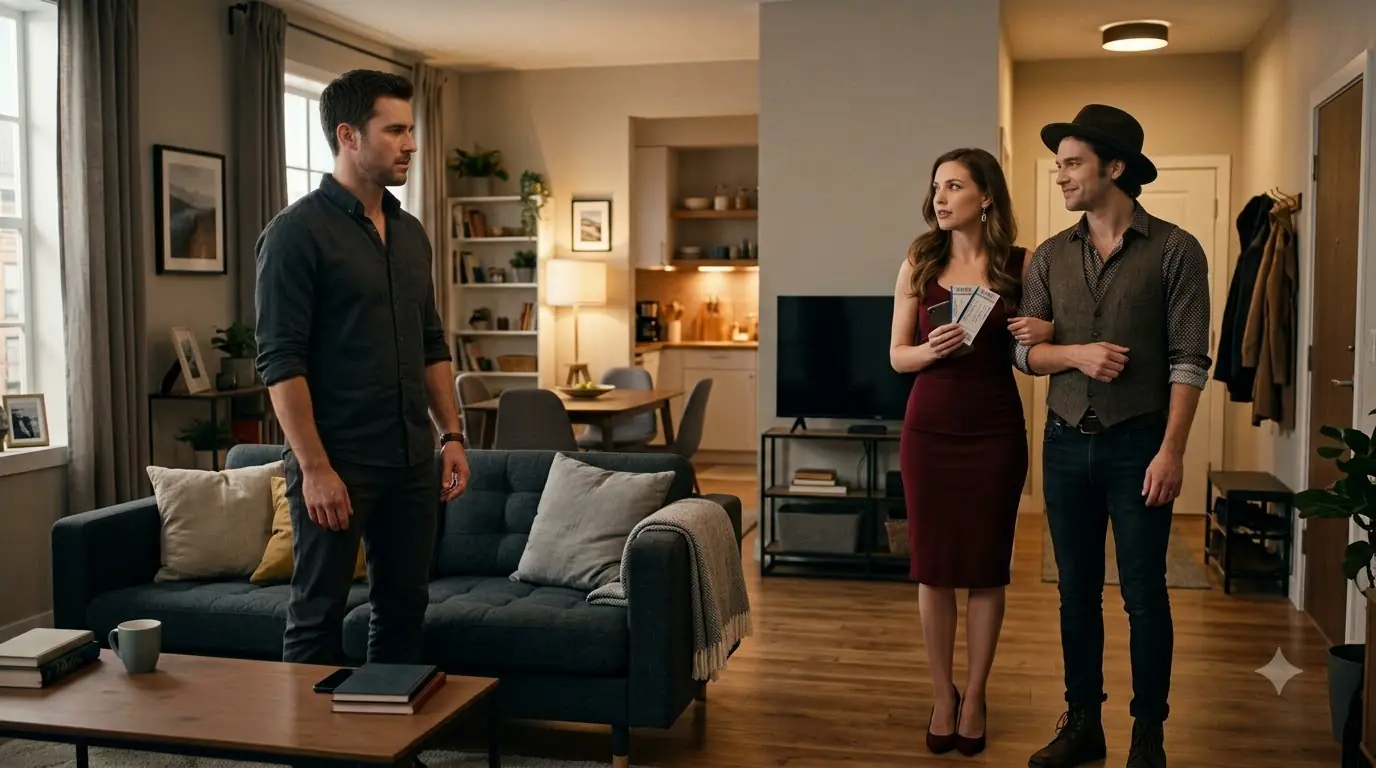
“He needs it more right now.”
I looked at her.
Then at the dishwasher I had been loading.
Then back at her.
The tickets had cost me $1,200.
Two VIP floor seats to Midnight Echo, Elena’s favorite band, one night only in our city.
I had spent a week working contacts through a vendor at my job because the show had sold out almost instantly.
It was supposed to be her birthday gift.
More specifically, it was supposed to be ours.
One memory I could give her that had nothing to do with bills, work schedules, Julian sleeping on our couch, her struggling art career, or the increasingly obvious distance growing between us.
Instead, Elena wanted to take another man.
Her best friend.
The same man who spent more time in our apartment than some paying tenants spent in theirs.
The same man who enjoyed criticizing my career while drinking beer from my refrigerator.
The same man Elena defended every single time I dared suggest that perhaps he could visit slightly less often.
I should have been furious.
I should have argued.
Three years earlier, I probably would have.
Instead, something inside me simply switched off.
“Okay,” I said.
Elena blinked.
“Okay?”
“Take him.”
Relief flooded her face so quickly it almost made me laugh.
She crossed the kitchen and wrapped her arms around me from behind.
“Thank you.”
I stared into the sink.
“You’re seriously the most understanding person.”
“Yeah.”
“I knew you’d get it.”
“I do.”
She did not understand what I meant.
Three nights later, while she and Julian screamed Midnight Echo lyrics from seats I had purchased, I packed my life into a moving truck.
By the time Elena came home, I was gone.
My name is Ethan Brooks.
I was twenty-eight when this happened.
I worked in supply-chain management for a manufacturing company headquartered downtown.
It was not the sort of career anybody made inspirational videos about.
I spent most days managing inventory forecasts, freight delays, supplier failures, customs paperwork, warehouse capacity, and email threads involving seventeen people who all wanted someone else to solve the same problem.
Sometimes the problem was a container stuck in Long Beach.
Sometimes it was a factory in Ohio missing a production component.
Sometimes it was a distributor in Germany threatening penalties because a shipment had been routed through the wrong hub.
My job was essentially organized panic.
I was good at it.
I also earned good money for my age.
Not wealthy.
Stable.
Benefits.
Retirement account.
Savings.
Enough that I could afford a comfortable two-bedroom apartment in the city without panicking every time rent increased.
Elena was twenty-six.
She painted.
Not as a hobby.
She genuinely wanted to build a career around it.
And despite what happened later, she was talented.
When we met three years earlier, her work had stopped me from across a coffee shop.
That was literally how we met.
A small neighborhood café displayed pieces from local artists on one brick wall.
Most were the usual city skylines and abstract color studies.
One painting was different.
A woman standing alone beneath streetlights after rain, her face almost completely hidden, with reflections stretching across the pavement.
I stood staring at it while waiting for coffee.
A voice behind me said:
“You’re looking at it like you hate it.”
I turned.
Elena.
Dark hair tied loosely.
Paint on one thumbnail.
Oversized sweater.
I said:
“I’m trying to figure out whether she’s waiting for someone or just doesn’t want to go home.”
Elena stared at me.
Then smiled.
“That’s mine.”
“The painting?”
“Yes.”
“So which is it?”
“She doesn’t know.”
That answer sold me.
Not the painting.
Elena.
We talked for an hour.
Our first date happened two days later.
Our second lasted until nearly two in the morning.
By the end of six months, we were serious.
Elena was unlike me in almost every obvious way.
I planned.
She improvised.
I saved.
She believed money returned if you trusted abundance.
I wore button-down shirts.
She wore paint-stained overalls to expensive restaurants because she said authenticity mattered more than dress codes.
At first, those differences felt exciting.
She taught me to leave my phone in the car during hikes.
I taught her that automatic bill payment prevented electricity from being disconnected.
She made me less rigid.
I gave her stability.
At least that was the arrangement I thought we had.
When we moved in together, Elena worked part time at a boutique coffee shop while building her portfolio.
Fifteen to twenty hours a week.
Sometimes fewer.
She sold occasional paintings.
A few commissions.
A mural once.
Nothing consistent.
I covered rent.
Utilities.
Internet.
Most groceries.
Insurance on the car we shared.
When her student loans came out of deferment, I helped with minimum payments during slow months.
I never considered it humiliating.
I never called her lazy.
I never told her to give up painting and get a “real job.”
I believed relationships sometimes required one person to carry more while the other built something.
My father had done that when my mother returned to school.
Later, she supported him through a career change.
That was what partnership looked like to me.
You carried the heavier side when it was your turn.
My problem was that I never stopped to ask when Elena believed her turn would begin.
Julian entered our relationship gradually.
He had known Elena since college.
Twenty-seven.
Thin.
Tall.
Dark curly hair.
Always wearing something he described as vintage.
He called himself a multidisciplinary creative.
If you asked what disciplines, the answer shifted depending on the month.
Photography.
Installation art.
Experimental video.
Music production.
Mixed media.
Creative direction.
Once, apparently, furniture design.
He had talent too.
That was part of what made him difficult to criticize.
He was not a complete fraud.
He could draw.
He understood composition.
He knew more obscure music than anyone I had met.
He could spend twenty minutes explaining why a certain album changed independent music forever and make you almost believe him.
He simply lacked any relationship with consistency.
Jobs were temporary because management structures “interfered with his creative process.”
Deadlines were capitalist constructs.
Rent was oppressive.
Credit scores were designed to punish alternative lifestyles.
Somehow, restaurants charging money for food remained acceptable.
The first year Elena and I lived together, Julian visited maybe twice a month.
Then weekly.
Then multiple times a week.
Eventually I would come home from work and find him already inside.
Barefoot.
On my couch.
Eating something.
At first I tried being welcoming.
He was important to Elena.
That meant I made an effort.
I bought beer he liked.
Included him in dinners.
Helped him move once.
Lent him a drill.
Drove him to the airport.
One Saturday, I spent four hours helping him transport canvases to a local exhibition because his car would not start.
He thanked Elena.
Not me.
I noticed.
Did nothing.
Then the jokes started.
Nothing vicious enough to justify an argument.
That was Julian’s skill.
He insulted you in a way that made objecting seem humorless.
I would come home around seven.
Tie loosened.
Laptop bag digging into my shoulder.
Julian would look up.
“Corporate America survives another day.”
I would say:
“Barely.”
He would smile.
“How many souls did you trade for quarterly growth?”
“Six.”
“Slow day.”
Elena laughed.
So did I at first.
Then:
“Ethan, you should really quit and do something you care about.”
“I care about supply chains.”
He stared.
“You cannot honestly say that.”
“I can.”
“You care about security.”
“Correct.”
“That’s different.”
I once asked:
“How?”
Julian leaned back.
“Security is fear wearing a tie.”
Elena loved that.
She repeated it later.
Security is fear wearing a tie.
That sentence would have sounded profound if our rent were being paid by poetry.
Julian’s finances were always unstable.
One month he was waiting on a photography invoice.
Another month he was developing a documentary.
Another he had lost a roommate.
So he stayed late.
Then slept over.
Then asked Elena if he could use the couch “just for two nights.”
Two nights became eight.
I came home on the sixth night and found his laundry hanging over our shower rod.