The wind came howling across the Montana plains like the devil himself was chasing it, carrying snowflakes sharp as broken glass.
Eleanor Hayes pulled her thin woolen shawl tighter around her shoulders and pressed her back against the rough bark of a cottonwood tree, but the cold bit through her worn dress just the same.
Her fingers, already numb inside her patched gloves, fumbled with the clasp of her carpetbag, the only possession she had left in this world worth calling her own.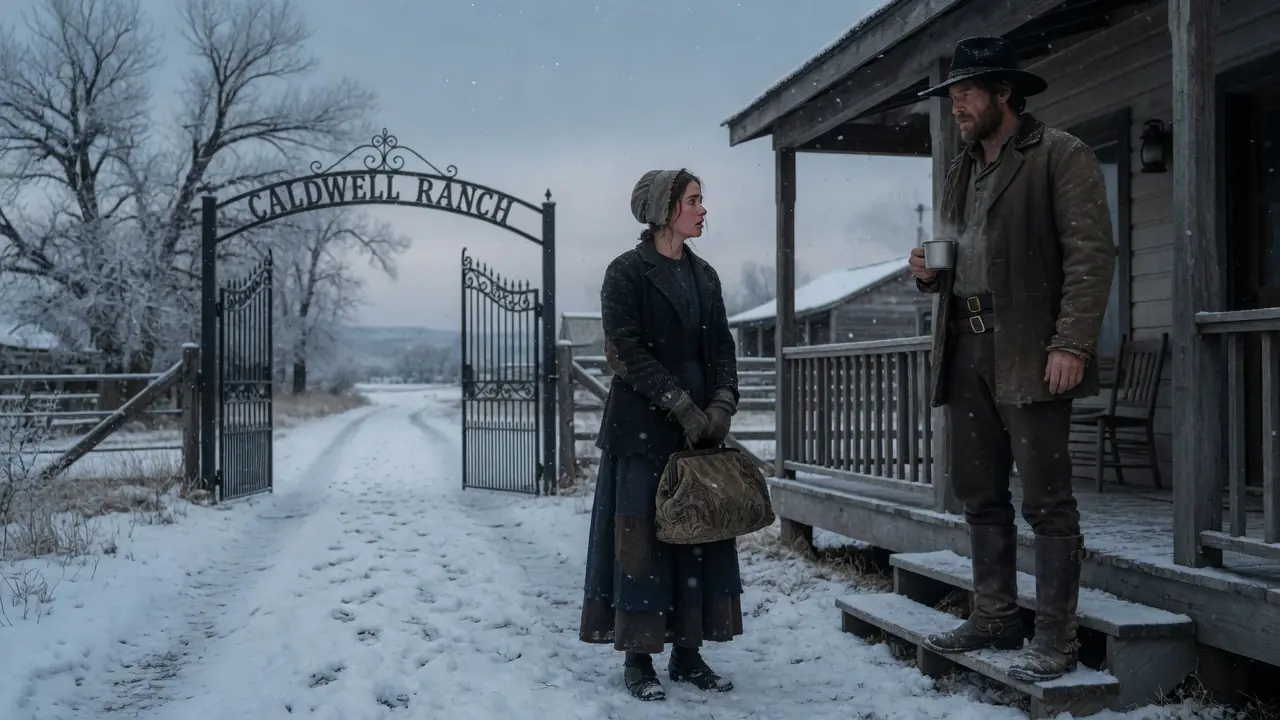
Twenty-five years old and not a soul to turn to.
The thought sat heavy in her chest as she watched the storm clouds gather on the horizon, dark and threatening as her prospects.
Three days ago, she had been Miss Hayes, the schoolteacher, respected if not wealthy. Now she was just another woman with nowhere to go and winter bearing down like a freight train.
The school board had gathered in Miller’s General Store last Tuesday, their faces grim as undertakers.
“Budget’s been cut again,” old Mr. Peterson had said, not meeting her eyes. “Territory can’t afford to keep a teacher through the winter months.”
Just like that, her position was gone.
The room she had rented above the bakery went with it. Mrs. Kowalski needed the space for paying tenants, she had explained with something that might have been sympathy.
Eleanor shifted her weight and felt the three silver dollars in her pocket clink together.
Every cent she had to her name.
Not enough for passage east, even if she had somewhere to go back there. Her family’s farm in Ohio had been sold for debts two years past, and her intended, Harold Wickham, had made it clear that a penniless teacher was no longer suitable wife material for a man of his standing.
The wind picked up again, and she could taste snow in the air.
Real snow.
The kind that buried a person if they were not careful.
She had heard the stories of travelers found come spring, frozen solid as fence posts. The thought made her stomach clench with something beyond hunger.
Through the swirling snow, she could just make out the iron gates of the Caldwell ranch.
Everyone in Bitter Creek knew about Thomas Caldwell’s spread. Biggest in three counties, they said. Cattle by the thousands and a house fine enough for any eastern lady.
She had seen him in town once or twice, a tall man with shoulders broad as an ax handle and eyes the color of winter sky, always polite when he tipped his hat, but distant as the mountains.
Eleanor had heard the whispers, too.
How his wife had died birthing their second boy, and how he had been raising those children on his own ever since. The ladies at church tsked about it regularly, saying it was not proper for a man to tend house and raise babies both.
Of course, none of them had offered to help much beyond delivering the occasional casserole.
She was not sure what drew her feet toward those gates.
Desperation, maybe, or the simple fact that freezing to death under a tree seemed a poor way to end her story.
The wind was howling something fierce now, and she could barely see ten feet ahead. Snow was starting to stick to the ground in earnest.
The gate stood open, unusual for such a prosperous spread, and Eleanor found herself walking up the long drive without quite deciding to do it. Her boots crunched through the thin layer of snow, and she pulled her shawl up over her head as the flakes grew thicker.
The house loomed out of the storm like something from a dream.
Two stories of solid timber with glass windows that caught what little light the gray sky offered. Smoke rose from the chimney, and warm yellow light spilled from the downstairs windows.
It looked like everything she had lost and everything she had never had, all wrapped up in one impossible package.
She was still standing there, carpetbag in hand and snow gathering on her shoulders, when the front door opened.
Thomas Caldwell filled the doorframe like he had been carved from the same timber as his house. Even from thirty feet away, she could see the surprise in his face when he spotted her.
He stepped out onto the covered porch, not bothering with a coat despite the cold.
“You lost, miss?”
His voice carried easily across the yard, deep and steady as bedrock.
Eleanor felt her cheeks burn despite the cold.
What was she doing here?
What could she possibly say that would not sound like begging?
Because that was what she was. A beggar at his gate, hoping for scraps of kindness.
“The storm came up sudden,” she called back, which was true enough, even if it was not the whole truth.
Thomas Caldwell studied her for a long moment, taking in her threadbare coat and the way she clutched that old carpetbag. His eyes were sharp, the kind that missed nothing.
Then he stepped down from the porch and walked toward her, his boots making deep prints in the snow.
“You’re the schoolteacher,” he said when he got close enough to speak without shouting.
It was not a question.
“Was,” Eleanor corrected, lifting her chin despite the way her voice wanted to shake. “Position was eliminated this week.”
He nodded slowly, like this did not surprise him much.
“Figured as much when I saw you walking up the drive with everything you own in that bag.”
Heat flooded her face again.
Was she that obvious?
That pathetic?
“Storm’s getting worse,” Thomas continued, glancing up at the sky. “Be a blizzard before long. You got somewhere to be?”
The simple question hit her like a physical blow.
Somewhere to be.
If only it were that easy.
“Not particularly,” she managed.
They stood there in the falling snow, two strangers taking each other’s measure. Eleanor could see something working behind those winter-blue eyes of his, some calculation she could not read.
When he spoke again, his words came out careful and deliberate.
“I’ve got coffee on the stove. House is warm. Storm like this, a person could freeze to death before making it back to town.”
It was an offer, but more than that, it was acknowledgment of exactly how desperate her situation was. Delivered without pity or judgment, just practical kindness from one person to another.
“That’s very generous, Mr. Caldwell, but I couldn’t impose.”
“You’re not imposing.”
He was already turning back toward the house.
“Come on, before we both turn into ice sculptures.”
Eleanor hesitated for just a moment longer, weighing pride against survival.
Pride was a luxury she could no longer afford.
She followed Thomas Caldwell toward the warm light spilling from his windows, her feet crunching through snow that was falling faster now, erasing her tracks almost as soon as she made them.
The porch was a blessed relief from the wind, and when Thomas opened the front door, the warmth that flowed out felt like salvation itself.
Eleanor stepped inside and immediately understood why the ladies in town spoke of this house with such reverence.
The entryway alone was bigger than the room she had been renting, with polished wood floors and a staircase that curved up to the second floor like something from a picture book.
But it was what she did not see that caught her attention.
No woman’s touch anywhere.
No flowers in vases.
No embroidered cushions on the chairs.
The house was clean enough, but stark, functional, like a barn that happened to have nice furniture in it.
“Boys,” Thomas called out, hanging his hat on a peg by the door. “Come meet our guest.”
The sound of running feet came from somewhere deeper in the house. Soon, two small faces peered around the corner of what looked like a sitting room.
The older boy, seven or eight, Eleanor guessed, had his father’s strong jaw and serious eyes. The younger one, maybe five, had softer features and hair that stuck up in all directions.
“This is Miss Hayes,” Thomas told them. “She’s going to wait out the storm with us.”
The older boy, Daniel, she remembered hearing the name in town, regarded her with open suspicion.
The younger one, Samuel, stepped forward with the fearless curiosity of childhood.
“Are you really a teacher?” Samuel asked, his eyes wide.
“I was,” Eleanor replied, crouching down to his level. “Do you like learning things?”
“Papa says I have to learn my letters, but they’re hard.”
“They are hard at first,” Eleanor agreed. “But once you know them, they open up whole worlds.”
Samuel nodded solemnly, as if this made perfect sense to him.
Daniel remained where he was, watching her like she might steal something if he looked away.
“Coffee’s this way,” Thomas said, gesturing toward what she assumed was the kitchen. “Boys, you get back to your supper.”
The kitchen was easily the largest Eleanor had ever seen, with a cook stove that could have heated half the schoolhouse and cabinets that stretched clear to the ceiling.
But like the rest of the house, it felt empty somehow.
Functional, but not lived in, if that made sense.
Thomas poured coffee from a pot that had seen better days. The liquid was dark as midnight and strong enough to wake the dead.
Eleanor wrapped her cold fingers around the tin cup and breathed in the warmth.
“Storm’s getting worse,” Thomas observed, nodding toward the window, where snow was now falling in thick, heavy flakes. “Roads will be impassable by morning.”
Eleanor stared into her coffee cup, trying to think of something to say that would not sound like the plea it was.
She could not ask to stay the night.
It would not be proper.
And besides, she had nothing to offer in return.
“I heard about the school,” Thomas said after a moment. “Shame. Children need learning.”
“Not enough to pay for it, apparently.”
“Territory’s strapped for cash. Railroads taking their time getting here, and without easy transport for cattle, tax revenues are down.”
He took a sip of his coffee, studying her over the rim.
“What will you do now?”
The question she had been dreading.
Eleanor set down her cup with hands that trembled slightly.
“I’m not sure. Look for another position somewhere, I suppose.”
“Where?”
Such a simple word.
But it laid bare the impossible truth of her situation.
There were no other teaching positions, not within a hundred miles, not for a woman alone with no family connections and no money for travel.
“I don’t know,” she admitted.
Thomas was quiet for a long moment, and Eleanor could hear the wind howling around the house, rattling the windows in their frames. Somewhere in the distance, she heard one of the boys laugh at something.
The sound was bright and warm, a sharp contrast to the storm outside.
“I’ve got a proposition for you,” Thomas said finally.
Eleanor looked up, surprised by the serious tone in his voice.
Eleanor stared at him, certain she had misheard.
“I beg your pardon?”
“A business arrangement,” Thomas continued, his voice steady as if he were discussing the price of cattle. “You need shelter and security. I need help running this place. We could make it work.”
“Mr. Caldwell, I hardly know you.”
“What’s to know? I’m a decent man who pays his debts and keeps his word. I don’t drink to excess or raise my hand to women or children. I own this land free and clear, and I’ve got money in the bank. You’d want for nothing.”
Eleanor felt the world tilt around her.
This could not be happening.
Men did not just propose marriage to women they barely knew, especially not men like Thomas Caldwell.
“The boys need a mother,” he continued. “They’re good children, but they’re running wild without a woman’s influence. And I…”
He paused, seeming to choose his words carefully.
“I need a partner. Someone I can count on.”
Outside, the wind shrieked like something alive and angry.
Eleanor thought of the three silver dollars in her pocket, of the long winter ahead, of the very real possibility that she might not survive it without help.
“It wouldn’t be a real marriage,” Thomas added quickly, as if reading her thoughts. “Separate rooms, separate lives in many ways. Just two people helping each other through.”
Eleanor looked around the kitchen at the empty spaces where a woman’s touch should have been.
Then she thought of the boys in the next room, growing up without softness or gentle guidance.
And she thought of herself standing at those iron gates with snow falling on her shoulders and nowhere else to go.
“Why me?” she asked quietly.
Thomas considered this.
“You’re educated. The boys could use that. You’re alone, which means you’d be committed to making this work. And…”
He paused, then met her eyes directly.
“You’re desperate enough to say yes.”
The brutal honesty of it took her breath away.
No pretty words or false promises.
Just the truth laid out plain as a winter morning.
“I need time to think,” Eleanor said.
Thomas nodded toward the window, where the snow was now so thick they could barely see the barn.
“Storm’s not going anywhere. Neither are you tonight. We can talk more in the morning.”
He was right, of course.
The decision had been made for her by wind and weather and circumstance. She was here for the night whether she liked it or not.
The question was what she would choose come morning.
Thomas showed her to a small room on the first floor that had probably been meant for a housekeeper. It was simple but clean, with a narrow bed and a washstand.
Better than anything she could afford on her own.
As Eleanor sat on the edge of the bed, listening to the storm rage outside, she tried to imagine what her life would be like in this house.
Waking up every morning to cook breakfast for a man who barely knew her name.
Washing clothes and tending children who might never accept her as their mother.
Living as a stranger in a home that would never truly be hers.
But then she thought of the alternative.
The cold.
The hunger.
The very real possibility that winter would kill her before spring came again.
Sometimes survival was the only choice that mattered.
Outside, the storm howled on, and Eleanor pulled the quilts up to her chin and tried to imagine what tomorrow might bring.
Morning came gray and silent, with the kind of stillness that only followed a real storm.
Eleanor woke to the smell of coffee and bacon drifting under her door and the sound of boots moving around the kitchen.
For a moment, she forgot where she was.
Then the events of yesterday came flooding back, and with them the weight of the decision that lay ahead.
She dressed quickly in her one good dress, a navy wool that had seen better days but was still respectable, and pinned her dark hair back as neatly as she could manage.
When she emerged from the small room, she found Thomas standing at the kitchen window, looking out at a world transformed by snow.
“Storm’s blown itself out,” he said without turning around. “Dumped near two feet by the look of it.”
Eleanor joined him at the window and caught her breath.
The entire landscape had been erased and rewritten in white. Drifts rose halfway up the fence posts, and the road, if it could still be called that, was nothing but an unbroken expanse of snow stretching toward town.
“You weren’t exaggerating about the roads being impassable,” she murmured.
“Takes a few days to dig out after a storm like that. Sometimes longer.”
Thomas finally turned to face her, and she could see the question in his eyes.
“Coffee’s fresh. Boys are still sleeping.”
Eleanor accepted the tin cup he offered, grateful for something to do with her hands. The coffee was strong and hot, cutting through the chill that seemed to have settled in her bones.
“I’ve been thinking about what you said,” she began, then stopped.
How did one discuss a marriage proposal that was not really a marriage proposal?
“About your arrangement?”
Thomas nodded, his expression giving nothing away.
“I need to understand what you’re really asking. You say the boys need a mother, but what does that mean exactly? What would you expect from me?”
Thomas leaned against the counter, considering his words.
“The boys need consistency. Someone to make sure they eat proper meals and keep clean. Someone to teach them manners and help with their letters. They’re good children, but they’ve been without a woman’s guidance for two years now.”
“And what about you? What would you expect from a wife?”
The word felt strange on her tongue, speaking of something that had once seemed so far out of reach.
“Someone to manage the household. Make sure there’s food prepared and clothes mended. Someone I can depend on when I’m out working the cattle or handling business in town.”
He paused, studying her face.
“Someone who won’t run off at the first sign of hardship.”
Eleanor set down her coffee cup.
“And in return?”
“Security. A roof over your head and food on your plate. Protection. My name, if that matters to you.” Thomas’s voice was matter-of-fact, as if they were negotiating the price of grain. “You’d be mistress of this house. The boys would be yours to raise as you see fit.”
It was a practical arrangement, nothing more.
No talk of affection or companionship.
Certainly no mention of love.
Eleanor found herself oddly relieved by his directness, even as part of her felt hollow at the clinical nature of it all.
“Separate rooms,” she said, more to clarify than to question.
“Separate rooms,” Thomas confirmed. “You’d have your privacy, and I’d have mine. Unless…”
He trailed off, then seemed to think better of whatever he had been about to say.
“Unless what?”
“Unless someday we decided different. But that’d be a long way off, if ever. And it would be your choice as much as mine.”
Eleanor felt heat rise in her cheeks and looked away.
The practical nature of the arrangement was one thing, but the possibility of something more sometime in the distant future was territory she was not prepared to explore.
Not yet.
The sound of small feet on the stairs interrupted the moment, followed by Samuel’s voice calling for his father.
Thomas moved toward the hallway, but the boy appeared in the kitchen doorway before he could get there, rubbing sleep from his eyes.
“Papa, is the lady still here?”
“Miss Hayes is still here,” Thomas confirmed. “Say good morning.”
Samuel ducked his head shyly.
“Good morning, Miss Hayes.”
“Good morning, Samuel. Did you sleep well?”
The boy nodded, then seemed to remember something important.
“Did you see all the snow? It’s up to the windows.”
“I did see it. Quite a lot, isn’t it?”
“Papa says we might be snowed in for days and days. Will you stay that long?”
The innocent question hung in the air like smoke.
Eleanor felt Thomas watching her, waiting for her answer. She looked down at Samuel’s hopeful face, then past him to where Daniel had appeared in the doorway, still wary but listening intently.
“I might,” Eleanor said carefully. “If your father doesn’t mind the company.”
“Can you really teach us letters?” Samuel asked, bouncing slightly on his toes.
“I can. Would you like me to?”
“Yes. Daniel says letters are stupid, but I think they’re like secret codes.”
“They are very much like secret codes,” Eleanor agreed, smiling despite herself. “Once you learn them, you can decode any book.”
She glanced at Daniel, who was trying to look uninterested but failing.
“What do you think, Daniel? Would you like to learn some secret codes?”
The older boy shrugged, but she caught a flicker of curiosity in his eyes.
“Maybe.”
Thomas cleared his throat.
“Boys, go get dressed. Miss Hayes and I need to finish talking.”
Samuel groaned but obediently headed for the stairs. Daniel lingered a moment longer, his gaze moving between Eleanor and his father with an expression far too knowing for a child his age.
When they were alone again, Thomas poured himself another cup of coffee.
“They like you.”
“Samuel does. Daniel’s reserving judgment.”
“Daniel’s protecting himself. He’s old enough to remember his mother. Old enough to know what it means to lose someone.” Thomas stared into his coffee. “He’s been the man of the house in his own mind since she died. Won’t be easy for him to let someone else take over.”
Eleanor felt a pang of sympathy for the serious little boy.
“And if I stayed, if we went through with this arrangement, what would happen if it didn’t work? If the boys couldn’t accept me, or if we found we couldn’t…” She searched for the right words. “Couldn’t manage together?”
Thomas was quiet for a long moment. When he spoke, his voice was careful and measured.
“I suppose we’d have to figure that out if it happened. But I’m not a man who gives up easy, and I don’t think you are either, or you wouldn’t have survived this long on your own.”
It was not exactly a comforting answer.
But it was an honest one.
Eleanor appreciated that more than pretty reassurances that might prove false.
“The town will talk,” she said. “A marriage this sudden under these circumstances. People will assume.”
“People always assume. Question is whether you care what they think.”
Eleanor had spent her entire life caring what people thought.
It was what proper ladies did.
But proper ladies also did not find themselves penniless and homeless with winter closing in.
“I’d want to continue teaching,” she said suddenly. “The boys certainly, but others too, if any wanted learning. I know the school is closed, but there must be children who could benefit from lessons.”
Thomas nodded.
“House is big enough. Could set up a proper schoolroom in one of the upstairs rooms.”
The casual way he accepted her condition surprised her.
Most men would have balked at their wife working, even if it was only teaching.
“You wouldn’t mind having children coming and going?”
“Might be good for Daniel and Samuel. Give them children their own age to play with.” Thomas set down his cup and looked at her directly. “Anything else you need to know?”
Eleanor felt as if she were standing at the edge of a cliff, looking down into unknown territory.
Every practical instinct told her to accept. She had nowhere else to go, no other prospects, and winter stretching ahead like a death sentence.
But marriage, even a marriage in name only, was not something to enter into lightly.
“If I agreed,” she said slowly, “when would that be? How soon would you want to…”
“Soon as the preacher can get here. Roads should be clear enough in a few days.”
So fast.
Her entire life changed in the space of a week.
It seemed impossible.
Yet here she was, seriously considering it.
“Miss Hayes?” Samuel’s voice came from the stairway. “Can you help me with my buttons?”
Eleanor looked toward the sound, then back at Thomas.
“May I?”
He nodded, and she went to help the boy with his shirt.
Samuel chatted happily as she worked, telling her about his favorite games and asking if she knew any songs. Daniel appeared shortly after, dressed but with his hair sticking up at odd angles.
“Come here, both of you,” Eleanor said, producing a comb from her pocket. “Let’s get you properly groomed.”
She smoothed Daniel’s hair despite his protests and was rewarded with something that might have been the beginning of a smile.
Samuel submitted to having his face scrubbed without complaint, then asked if she could braid his hair like a girl’s.
“Boys don’t wear braids,” Eleanor explained gently. “But I could teach you to tie sailor knots if you’d like.”
“Could you really?”
“I had a brother who loved ships,” Eleanor said, the memory of her lost family bringing an unexpected pang. “He taught me all sorts of useful knots.”
Thomas watched this domestic scene from the kitchen doorway, and Eleanor caught something in his expression that might have been relief or maybe longing.
It was hard to tell.
“I want to learn knots, too,” Daniel announced, apparently forgetting to be suspicious.
“Then I’ll teach you both,” Eleanor promised.
Later, after the boys had been fed and sent to play in the sitting room, Eleanor found herself alone with Thomas again. The weight of the decision pressed down on her like the snow outside, heavy and inescapable.
“You haven’t given me an answer,” Thomas said.
Eleanor looked around the kitchen at the signs of a household that needed a woman’s touch. She thought of the boys upstairs, hungry for attention and guidance.
She thought of the long winter ahead and the very real possibility that refusing this offer meant choosing to die.
But more than that, she thought of the unexpected moment when Daniel had let her fix his hair, and the way Samuel had looked at her like she might be the answer to some unspoken prayer.
“If I said yes,” she said quietly, “it would be for them as much as for me. Those boys need more than I can give them in just a few days.”
Thomas nodded.
“They do.”
“And you’d really let me set up a school?”
“I would.”
Eleanor took a deep breath.
“Then yes. I’ll marry you, Mr. Caldwell.”
The words felt strange coming out of her mouth, but not as strange as she had expected.
Thomas did not smile or show any particular emotion. He just nodded as if she had agreed to help with the harvest.
“I’ll ride to town as soon as the roads clear. Talk to Reverend Morrison about performing the ceremony.”
“What will you tell him about why we’re…”
“I’ll tell him the truth. That we’re two practical people making a practical decision.” Thomas paused. “Unless you’d prefer a different story.”
Eleanor considered this.
A whirlwind romance would be more romantic, certainly more socially acceptable.
But there was something to be said for honesty, even if it was uncomfortable.
“The truth will do.”
Thomas extended his hand, and after a moment’s hesitation, Eleanor shook it. His grip was firm and warm, calloused from years of hard work.
It felt like sealing a bargain, which she supposed it was.
“Welcome to the family, Miss Hayes,” he said.
From the sitting room came the sound of the boys arguing over something, followed by a crash that suggested they had knocked something over.
Thomas winced.
“I should warn you,” he said. “They’re not always as well behaved as they’ve been this morning.”
Eleanor smiled, her first real smile since arriving at the ranch.
“Mr. Caldwell, I’ve spent three years teaching school. I’m not easily shocked by misbehaving children.”
As if summoned by her words, Samuel appeared in the doorway with tears streaming down his face and a red mark on his forehead.
“Papa, Daniel hit me with the wooden horse.”
Thomas sighed and headed for the sitting room to sort out whatever crisis had erupted.
Eleanor followed, already beginning to understand what she had gotten herself into.
It was going to be a long winter, but for the first time in weeks, she felt something that might have been hope.
Three days after the roads cleared, Reverend Morrison arrived at the Caldwell ranch looking like he would rather be anywhere else in Montana Territory.
The elderly preacher sat stiffly in the front parlor, his Bible clutched in weathered hands, casting disapproving glances between Thomas and Eleanor as if they were wayward children who had tracked mud through his church.
“This is highly irregular,” he said for the third time, adjusting his wire-rimmed spectacles. “Marriage is a sacred institution, not a business transaction.”
Eleanor smoothed her hands over her best dress, the same navy wool she had worn the morning after the storm, now freshly pressed and adorned with a simple white collar she had fashioned from an old petticoat.
It was not much of a wedding dress, but it would have to do.
“With respect, Reverend,” Thomas said, his voice patient but firm. “The marriage will be legal and binding. The reasons behind it are our own concern.”
The preacher’s lips pursed like he tasted something sour.
“And the children? What example does this set for young Daniel and Samuel?”
“It sets the example that sometimes practical decisions serve everyone better than romantic foolishness,” Thomas replied.
Eleanor caught a movement in the doorway and saw both boys peering around the corner, Daniel’s expression unreadable and Samuel practically bouncing with excitement.
The younger boy had spent the morning asking if Eleanor would really and truly be his new mama after the wedding ceremony, as he called it.
“Can we start now?” Samuel called out, apparently tired of waiting.
“Boys, go to the kitchen,” Thomas instructed. “Mrs. Murphy will give you some bread and jam.”
Eleanor smiled at that.
Mrs. Murphy was the neighbor woman who had volunteered to witness the ceremony and prepare a simple meal afterward. She was a practical soul who had taken one look at the situation and declared it sensible enough, much to the reverend’s dismay.
Once the boys had reluctantly departed, Reverend Morrison opened his Bible with visible reluctance.
“Very well. But I want it understood that I am performing this ceremony because you have asked it of me, not because I approve of the circumstances.”
“Understood,” Thomas said.
The ceremony itself was mercifully brief.
Eleanor found herself repeating words that felt strange and foreign on her tongue, promising to honor and cherish a man she had known for less than a week. Thomas’s responses were delivered in the same matter-of-fact tone he used to discuss cattle prices, though his eyes never left her face.
When Reverend Morrison pronounced them husband and wife, there was an awkward moment when it became clear he expected Thomas to kiss his new bride.
Thomas looked at Eleanor, a question in his eyes.
She gave an almost imperceptible nod, and he leaned down to press his lips briefly against hers, a chaste, formal kiss that sealed their bargain.
“Well,” Mrs. Murphy said brightly as the reverend packed away his Bible. “That’s done then. Mrs. Caldwell, welcome to the family.”
Mrs. Caldwell.
Eleanor felt a strange jolt at hearing her new name.
She was no longer Eleanor Hayes, the displaced schoolteacher. She was Eleanor Caldwell, wife and mother, mistress of one of the largest ranches in three counties.
The boys burst back into the room before anyone could say more, Samuel launching himself at Eleanor with such enthusiasm that she nearly lost her balance.
“Are you really our mama now?” he asked, his small arms wrapping around her waist.
“I suppose I am,” Eleanor said, smoothing his unruly hair.
Daniel hung back, watching this display with the same wariness he had shown since her arrival.
Eleanor met his eyes over Samuel’s head and saw the challenge there.
Prove yourself worthy, his expression seemed to say.
After Reverend Morrison and Mrs. Murphy departed, the new family found themselves alone together for the first time. The house felt different somehow, as if the brief ceremony had shifted something fundamental in its foundation.
“I’ll show you to your room,” Thomas said.
Eleanor realized that while she had been staying in the small housekeeper’s quarters, her status as wife, even a wife in name only, required different accommodations.
He led her upstairs to a bedroom at the end of the hall, opening the door to reveal a space that was clearly feminine in its furnishings. A delicate writing desk sat beneath the window, and the bed was adorned with a quilt worked in shades of blue and yellow.
It was beautiful, but there was something heartbreakingly still about it, as if it had been waiting for someone to bring it back to life.
“This was…” Eleanor began, then stopped.
“My wife’s room,” Thomas said. “Margaret’s room.”
His voice was carefully neutral.
“I thought you might prefer it to the one downstairs. More privacy up here.”
Eleanor stepped inside, running her fingers along the edge of the writing desk. She could almost feel the presence of the woman who had once sat here, perhaps writing letters or tending to household accounts.
It felt like trespassing.
“I don’t want to disturb anything,” she said quietly.
“The room needs to be lived in,” Thomas replied. “Margaret’s been gone two years. Time it served its purpose again.”
He left her alone to settle in, and Eleanor spent several minutes simply standing in the center of the room, trying to absorb the reality of her situation.
This was her space now.
Her sanctuary.
In a house full of strangers who were now her family.
She unpacked her few belongings, hanging her dresses in the wardrobe beside gowns that had belonged to another woman.
Margaret Caldwell had clearly favored fine fabrics and elegant cuts, silk dresses and wool coats that spoke of comfort and prosperity. Eleanor’s simple cotton and wool garments looked shabby by comparison.
From the window, she could see the barn and the corral where several horses grazed. Beyond that, the land stretched away toward distant mountains, vast and unforgiving.
It was beautiful in its own harsh way, but it also emphasized how isolated they were out here, how dependent on each other for survival.
A soft knock at the door interrupted her thoughts.
“Come in,” she called.
Samuel’s head appeared around the doorframe.
“Papa says supper’s ready. He made beans and bacon.”
Eleanor smiled.
“That sounds wonderful. I’ll be right down.”
She followed the boy downstairs to find the kitchen transformed from the stark, functional space she remembered. Someone, Mrs. Murphy, she assumed, had set the table with proper dishes and had even found a small vase for some late-blooming wildflowers.
It was a small touch, but it made the room feel more welcoming.
Thomas was at the stove dishing up their simple meal with movements that spoke of long practice. He had shed his jacket and rolled up his sleeves, and Eleanor was struck by how domestic he looked.
Nothing like the imposing figure she had first encountered.
“Smells good,” she said, taking a seat at the table.
Daniel was already seated, picking at his food with little enthusiasm. Samuel chatted happily about everything and nothing, clearly delighted by the novelty of having a woman at their table again.
“Mrs. Murphy said you might teach us our letters properly now,” Samuel announced between bites of beans. “She said real teachers know all sorts of things.”
“I do know quite a few things,” Eleanor agreed. “Would you like to start tomorrow?”
“Can we?” Samuel turned to his father with pleading eyes.
Thomas nodded.
“If Miss—if your new mama thinks you’re ready.”
The word mama seemed to catch in his throat slightly, and Eleanor felt a pang of sympathy.
This arrangement was as strange for him as it was for her.
Perhaps stranger.
At least she was only taking on a new role. He was watching his children attach themselves to a replacement for someone irreplaceable.
“I think we could start with simple words,” Eleanor said. “Things you see every day. Horse, barn, sky.”
“What about my name?” Samuel asked eagerly.
“Especially your name.”
Daniel finally looked up from his plate.
“I already know some letters,” he said quietly.
“Do you? That’s wonderful. Perhaps you can help me teach Samuel.”
Something shifted in Daniel’s expression.
Surprise, maybe, that she would acknowledge his knowledge rather than dismiss it.
It was a small crack in his defensive wall, but Eleanor filed it away as progress.
After supper, while Thomas tended to evening chores in the barn, Eleanor found herself alone with the boys in the sitting room. She had brought down one of her few books, a collection of simple stories, and was reading aloud when she became aware of how intently both children were listening.
“You read different than Papa,” Samuel observed when she paused.
“Different how?”
“More like the words have feelings.”
Eleanor smiled.
“Words do have feelings in a way. The trick is learning to hear them.”
“Read more,” Daniel said.
It was the first time he had made a direct request of her.
She continued reading until Thomas returned, stamping snow off his boots and hanging his coat by the door. He stood in the doorway of the sitting room for a moment, watching this domestic scene.
Eleanor wondered what he was thinking.
“Time for bed, boys,” he said finally.
There was the usual chorus of protests and negotiations, but eventually both children were herded upstairs to wash and change into their nightclothes.
Eleanor helped Samuel with his buttons and listened to his prayers, a sweet, rambling conversation with God that covered everything from his new mama to his favorite horse to a request for no more blizzards.
Daniel was more reserved, accepting her help but offering little conversation.
When she tucked the blankets around him, however, he looked up at her with something like curiosity.
“Are you really going to stay?” he asked quietly.
“I really am,” Eleanor promised.
“Even when it gets hard? Papa says winters here are terrible hard.”
Eleanor thought of all the hard things she had already survived.
The loss of her family.
The dissolution of her engagement.
The months of uncertainty and want.
“I think I can manage hard,” she said.
Something in her tone must have convinced him, because Daniel nodded and settled back against his pillow.
“Good,” he said simply.
When Eleanor came back downstairs, she found Thomas in the kitchen cleaning up the supper dishes. She picked up a dish towel and began drying without being asked.
They worked in comfortable silence for several minutes before Thomas spoke.
“They like you.”
“Samuel does. Daniel’s still deciding.”
“Daniel’s been the man of the house too long. He’s forgotten how to be a child.”
Eleanor dried a plate thoughtfully.
“Maybe that’s not entirely a bad thing. Children who’ve had to grow up fast often turn into strong adults.”
“Maybe. But I’d like him to have some childhood left, if possible.”
It was the most personal thing Thomas had shared with her, this wish for his son’s happiness. Eleanor felt something warm unfurl in her chest.
Not romantic feeling exactly, but something like partnership.
Like they might actually be able to do this together.
“I’ll do my best to help with that,” she said.
Thomas nodded, hanging up the dish rag.
“I’ll be up early tomorrow. Cattle need checking, and there’s fence to mend before the next storm hits.”
“What time should I have breakfast ready?”
“Five-thirty, if that’s not too early.”
Eleanor had been rising at five-thirty for years as a schoolteacher.
“That’s fine.”
“Boys usually eat around seven. Samuel likes his eggs soft. Daniel likes his firm. Both of them will eat anything sweet you put in front of them, but don’t let them fill up on it or they’ll be sick.”
These domestic details felt both ordinary and momentous.
She was learning the rhythms of her new family, the small preferences and habits that would shape her days.
“I’ll remember,” she said.
Thomas seemed to realize he was giving her instructions like she was a hired hand rather than his wife, because he paused and looked at her directly.
“Eleanor, Mrs. Caldwell, this is your house now, too. You don’t need permission to change things or do what you think best.”
It was a generous gesture, and Eleanor appreciated it more than she could say.
“Thank you. That means a great deal.”
They stood there in the kitchen for a moment, two people who were now bound together by law and circumstance, trying to figure out how to navigate this strange new territory.
Finally, Thomas cleared his throat.
“I should let you get settled. Tomorrow will be a long day.”
“Good night, Mr. Caldwell.”
“Thomas,” he corrected gently. “We’re married now, after all.”
“Good night, Thomas.”
Eleanor climbed the stairs to her new room, Margaret’s room, and prepared for bed. As she brushed her hair in front of the vanity mirror, she caught a glimpse of her reflection and was surprised by what she saw.
The woman looking back at her did not look defeated or desperate.
She looked determined.
Ready for whatever came next.
Outside, the wind was picking up again, rattling the windows and reminding her of how quickly the weather could change out here. But inside, the house felt solid and warm.
Safe.
She had made her choice and spoken her vows.
Tomorrow would bring new challenges: learning the rhythm of ranch life, winning over a wary little boy, figuring out how to be a wife without truly being a wife.
But tonight, for the first time in months, Eleanor Caldwell fell asleep in a bed that belonged to her, in a house where she had a right to be.
It was not the life she had dreamed of as a girl.
But it was a life.
And maybe, just maybe, it could be a good one.
The first week of Eleanor’s marriage passed in a blur of small discoveries and careful navigation.
She learned that Thomas took his coffee black and strong, that Samuel was afraid of thunderstorms but not blizzards, and that Daniel had taught himself to read simple words by studying the labels on canned goods in the pantry.
She learned that the kitchen stove had a temperamental damper that required coaxing, and that the upstairs floorboards creaked in a specific pattern that could wake the boys if she was not careful walking to her room at night.
What she did not learn was anything meaningful about the woman whose place she had taken.
Margaret Caldwell remained a carefully guarded mystery.
Her clothes still hung in the wardrobe. Her hairbrush still sat on the dressing table with a few strands of auburn hair caught in its bristles.
But no one spoke of her.
It was as if the family had collectively agreed that mentioning the dead would somehow make Eleanor’s presence less legitimate.
The silence around Margaret became more pronounced on the eighth day of Eleanor’s marriage, when she discovered Daniel sitting on the floor of what had once been a nursery, clutching a small wooden horse and staring at a portrait that had been turned to face the wall.
Eleanor hesitated in the doorway, unsure whether to intrude on what was clearly a private moment.
The room was thick with dust and abandonment. Baby furniture was covered with sheets like ghosts of a life that might have been.
“She made this for me,” Daniel said quietly, not turning around.
He held up the wooden horse, its paint worn smooth by small hands.
“Before Samuel was born. She said every boy needed a good horse to ride.”
Eleanor stepped carefully into the room.
“It’s beautiful workmanship.”
“She could make all sorts of things. Toys and quilts, and…”
His voice caught.
“She was making a cradle for the baby that didn’t come.”
The weight of that simple statement settled over Eleanor like a shroud.
Another baby.
Another loss that no one had mentioned.
“She died having Samuel,” Daniel continued, still staring at the overturned portrait. “But there was supposed to be a baby sister, too. They both died.”
Eleanor felt her throat tighten.
She had known that childbirth had claimed Margaret Caldwell, but she had not known about the other child.
The twin loss explained so much.
Thomas’s carefully controlled grief.
The way the boys seemed to carry an extra weight of sadness.
The absolute silence around their mother’s memory.
“I’m sorry,” Eleanor said, settling on the floor beside Daniel. “That must have been very frightening for you.”
“Papa cried,” Daniel whispered, as if confessing a terrible secret. “I wasn’t supposed to see, but I did. He held Mama and cried like the world was ending.”
Eleanor thought of Thomas as she had come to know him, steady, practical, emotionally reserved, and tried to imagine him broken by grief.
The image was almost too painful to contemplate.
“Sometimes even the strongest people need to cry,” she said gently.
Daniel finally turned the portrait around, revealing a woman with kind eyes and auburn hair, holding a baby Samuel, while a younger Daniel stood proudly beside her chair.
Margaret Caldwell had been beautiful in a wholesome, practical way, with laugh lines around her eyes and work-worn hands folded gently in her lap.
“She looks like someone who gave very good hugs,” Eleanor observed.
“She did. She smelled like bread and lavender, and she always had time to listen.”
Daniel’s voice was wistful.
“Do you think she’s watching us from heaven? I mean…”
Eleanor considered her words carefully.
“I think if she is, she’d want you and Samuel to be happy, to grow up strong and good.”
“But what if she doesn’t like that you’re here now? What if she thinks you’re trying to replace her?”
The question hit Eleanor like a physical blow.
It was the fear she had not even admitted to herself, that she was somehow betraying the memory of a woman she had never met, that her presence was an insult to the love Thomas had lost.
“I’m not trying to replace your mother,” Eleanor said firmly. “No one could do that, and I wouldn’t want to. But maybe, maybe there’s room for both of us in your heart. Your mother for the love you’ll always carry, and me for whatever new kind of caring we might build together.”
Daniel studied her face with those serious eyes that seemed too old for a boy of seven.
“You promise you won’t leave, even if it gets hard?”
“I promise.”
The boy seemed to weigh her answer, then carefully placed the wooden horse on a shelf where it could watch over the room.
“Samuel doesn’t remember her much. He was too little. But I tell him stories sometimes so he won’t forget.”
“That’s a good thing to do.”
“Would you…” Daniel hesitated. “Would you maybe let me tell you some of those stories sometime? I’d like you to know about her.”
For the first time since Eleanor had known him, Daniel smiled without reservation.
“I’d like that.”
They left the nursery together, but Eleanor carried the weight of what she had learned.
That evening, after the boys were in bed, she found Thomas in his study, working on account books by lamplight.
“May I come in?”
He looked up, surprise flickering across his features. Eleanor rarely disturbed him in the evenings, respecting the unspoken boundaries of their arrangement.
“Of course.”
She settled in the chair across from his desk, trying to find the right words.
“Daniel showed me the nursery today. He told me about… about the baby sister who didn’t survive.”
Thomas’s pen stilled on the page.
When he looked up, his eyes were carefully blank.
“He shouldn’t have been in that room. I’ve told the boys to stay out of there.”
“He misses her. He misses them both. His mother and the sister he never got to meet.”
“The past is the past,” Thomas said, his voice clipped. “No good comes from dwelling on what can’t be changed.”
But Eleanor could see the tension in his shoulders, the way his hand gripped the pen too tightly.
“Forgetting isn’t the same as healing.”
“I’m not trying to forget.” Thomas set down the pen and leaned back in his chair. “But I can’t live in yesterday, Eleanor. I have today to manage and tomorrow to prepare for. That’s all any of us can do.”
Eleanor understood the sentiment, but she also heard the pain underneath it.
“The boys need to talk about her sometimes. They need to know it’s safe to remember.”
“And what would you have me tell them? That their mother was perfect and wonderful and that nothing I can provide will ever measure up? That every day I wake up knowing I failed to protect the most important people in my life?”
The raw honesty of his words caught Eleanor off guard.
She had never heard such emotion in Thomas’s voice.
Never seen him drop his carefully maintained composure.
“You couldn’t have prevented what happened,” she said quietly.
“Couldn’t I? I should have insisted she go to Denver for the birth, where there were proper doctors. Instead, I listened when she said she wanted the babies born at home. I let sentiment override sense, and it cost her everything.”
Eleanor felt her heart break a little for this man who carried such crushing guilt.
“Thomas, you can’t know that a different choice would have changed anything. And even if it might have, torturing yourself won’t bring her back.”
“No,” he agreed. “It won’t. But it reminds me not to make the same mistakes again.”
The conversation hung heavy between them, full of grief and regret and carefully guarded vulnerability.
Eleanor wanted to reach across the desk to offer some gesture of comfort, but she sensed that Thomas would not welcome the contact.
“The boys need to know they can talk about her,” she said instead. “Not constantly, not in a way that keeps the wound fresh, but sometimes, when the memories come.”
Thomas was quiet for a long moment, staring at the papers on his desk without really seeing them.
“She used to sing to them,” he said finally. “Irish lullabies her grandmother taught her. Samuel’s too young to remember, but Daniel sometimes hums the melodies when he thinks no one’s listening.”
“That’s beautiful.”
“She wanted to teach them to play piano. We were going to buy one when the railroad finally came through and shipping got easier.” Thomas’s smile was sad and brief. “She had all sorts of plans for when the boys got older. Wanted to start a lending library, maybe organize a quilting circle for the women in the area.”
Eleanor felt a pang of something that might have been envy.
Margaret Caldwell had been more than just Thomas’s wife.
She had been his partner in dreams for the future, his companion in building a life that went beyond mere survival.
“She sounds like she was wonderful,” Eleanor said.
“She was.” Thomas met her eyes directly. “She was everything good and gentle in this world, and I need you to understand what we have, what we’ve arranged between us. It’s not the same thing. It can’t be.”
The words stung.
But Eleanor appreciated his honesty.
“I understand.”
“Do you? Because I don’t want you to have expectations that can’t be met. I don’t want you to hope for something that died two years ago.”
Eleanor felt heat rise in her cheeks.
“I’m not hoping for anything beyond what we agreed upon. I know what this arrangement is.”
But even as she said it, she realized it was not entirely true.
Over the past week, as she had watched Thomas with his sons, as she had seen glimpses of kindness and humor beneath his practical exterior, she had begun to hope.
Not for grand romance, but for friendship.
For partnership.
For the possibility that two people thrown together by circumstance might eventually choose to stay together for better reasons.
Now, faced with the full weight of Thomas’s love for his dead wife, those small hopes felt foolish and presumptuous.
“I should let you get back to your work,” she said, rising from the chair.
“Eleanor.”
The use of her name made her pause.
“I’m grateful for what you’re doing. For the boys, for the household. I don’t want you to think I’m not.”
“I know.”
“And if you need anything, if there’s something you want changed or improved, you only have to ask.”
It was a generous offer, but Eleanor could hear the distance in it.
She was the hired help who happened to wear a wedding ring, useful and appreciated, but not truly part of the family’s heart.
“Thank you,” she said simply.
She climbed the stairs to her room, to the space that had been Margaret’s sanctuary, and sat at the writing desk where another woman had once planned her future.
Outside, the wind was picking up again, promising another storm, and Eleanor pulled her shawl tighter around her shoulders.
She had known this would not be easy.
She had accepted Thomas’s proposal with full knowledge that she was entering a marriage without love, a family where she would always be the replacement rather than the first choice.
But hearing him speak of Margaret with such reverence, seeing the depth of his continued devotion, made the reality harder to bear than she had expected.
A soft knock at her door interrupted her melancholy thoughts.
“Come in,” she called.
Daniel peeked around the doorframe, dressed in his nightgown and bare feet.
“I couldn’t sleep.”
“Bad dreams?”
“No. Just thinking too much.”
He came into the room and settled on the small chair by the window.
“I heard you and Papa talking downstairs.”
Eleanor felt a stab of concern.
“What did you hear?”
“Enough.” Daniel’s expression was serious beyond his years. “Papa told you about the baby, didn’t he? About how Mama died?”
“He did.”
“He blames himself. I heard him tell Mr. Murphy that once when he thought I was asleep. But it wasn’t his fault.”
The boy’s loyalty to his father was touching, but Eleanor suspected that Thomas’s guilt ran deeper than outside reassurances could reach.
“Sometimes people blame themselves for things they couldn’t control,” she said carefully. “It’s a way of trying to make sense of senseless things.”
“Do you blame yourself for things?”
The question caught Eleanor off guard with its directness.
“Sometimes.”
“Like what?”
Eleanor considered how much honesty was appropriate for a seven-year-old.
“I used to blame myself for my family losing our farm back in Ohio. I thought if I’d been smarter or worked harder, maybe I could have helped save it.”
“But you were just a girl then.”
“I was. But feelings don’t always make sense.”
Daniel nodded solemnly.
“I used to think that if I’d been better, if I hadn’t fought with Samuel so much or tracked mud in the house, maybe Mama wouldn’t have died.”
Eleanor’s heart clenched.
“Oh, Daniel, your mother’s death had nothing to do with anything you did or didn’t do.”
“I know that now. Mostly.” He looked out the window at the darkening sky. “But sometimes the bad thoughts come back anyway.”
Eleanor wanted to gather this serious little boy into her arms, to promise him that the bad thoughts would go away if she just held him tight enough.
Instead, she said, “That’s normal. Grief is like weather. Sometimes it’s sunny, and sometimes storms blow through. The important thing is to remember that storms always pass.”
“Is that why you married Papa? Because of our storm?”
The boy’s perception was startling.
“Partly,” Eleanor admitted. “We all needed shelter from different kinds of storms.”
Daniel was quiet for a moment, then asked, “Do you think you’ll ever love us? Really love us, not just take care of us?”
The question pierced straight through Eleanor’s carefully maintained composure.
“Oh, Daniel, I already do.”
The words surprised her with their truth.
Somewhere in the past week, between helping with buttons and reading bedtime stories and listening to small confidences, she had indeed begun to love these children.
Not as a replacement for their mother, but as themselves.
Two brave little boys trying to make sense of a world that had taken too much from them too young.
“Really?” Daniel’s eyes were bright with hope. “Even though we’re not really your children?”
“Love doesn’t work that way,” Eleanor said gently. “Love isn’t about sharing blood or even sharing a name. It’s about caring for someone’s happiness and wanting to be part of their story.”
Daniel considered this with the gravity he brought to all important matters. Finally, he nodded.
“I’m glad you’re here, Eleanor. Even if Papa doesn’t love you the way he loved Mama, I’m still glad.”
It was exactly what Eleanor needed to hear.
Not a promise of the love she could not have, but an acknowledgement of the love she could earn.
The love she was already earning, one small moment at a time.
“I’m glad I’m here, too,” she said. “Now, let’s get you back to bed before your father finds us conspiring in here.”
As she tucked Daniel into his bed for the second time that night, Eleanor felt something settle into place inside her chest.
She might never have Thomas’s heart. That belonged to a ghost she could never compete with.
But she could have his respect, his partnership, and the love of his children.
For now, that would have to be enough.
The first test came on a Sunday morning three weeks after the wedding.
When Thomas announced that they would attend church services in town, Eleanor felt her stomach twist with nerves as she helped the boys into their best clothes, knowing that this would be her first public appearance as Mrs. Thomas Caldwell.
She chose her navy dress again, still her finest garment, and pinned her hair back severely, trying to look as respectable as possible.
In the mirror, she saw a woman who looked older than her twenty-five years, marked by recent hardships but determined to hold her head high.
The ride to town was quiet, the wagon wheels crunching through snow that had refrozen overnight into icy ruts. Daniel sat beside his father on the driver’s bench, while Eleanor rode in the back with Samuel, who chattered excitedly about seeing his friends at church.
She wished she could share his enthusiasm.
Bitter Creek’s church was a simple wooden building with a bell tower that could be heard for miles across the prairie. As their wagon approached, Eleanor could see other families arriving, their breath forming clouds in the cold air as they greeted each other with the easy familiarity of people who had known one another for years.
The conversations stopped when the Caldwell wagon pulled up.
Eleanor felt the weight of every gaze as Thomas helped her down from the wagon.
She could hear the whispers starting before her feet even touched the ground, sharp, sibilant sounds that carried on the winter air like the hiss of snakes.
“Quick work, wasn’t it?”
“Poor Margaret not cold in her grave.”
“Schoolteacher thinks she’s landed herself quite a prize.”
Eleanor lifted her chin and took Samuel’s hand, following Thomas toward the church doors. The crowd parted before them like water, conversations resuming in hushed, urgent tones as they passed.
Inside the church, the scrutiny was even more intense.
Eleanor could feel eyes following their every movement as they made their way to the Caldwell family pew, the same pew where Margaret had once sat, holding her babies and singing hymns in a voice that people still remembered fondly.
Mrs. Henderson, the banker’s wife, leaned over to whisper something to Mrs. Patterson, who had taught Samuel before Eleanor’s arrival. Both women glanced pointedly at Eleanor, their expressions ranging from disapproval to barely concealed hostility.
Eleanor sat straight-backed between Thomas and Samuel, trying to focus on Reverend Morrison’s sermon about charity and Christian kindness.
The irony was not lost on her that the same man who had reluctantly performed their marriage ceremony was now preaching about loving thy neighbor.
After the service, the real trial began.
The congregation gathered outside the church for their weekly social hour, and Eleanor found herself the center of attention she had never wanted.
“Mrs. Caldwell.” Mrs. Henderson approached with a smile that did not reach her eyes. “How are you finding married life? Quite different from teaching school, I imagine.”
“Different, yes, but rewarding,” Eleanor replied carefully.
“I’m sure it must be such a lovely home. And of course, the security that comes with marrying so well.”
The emphasis on security made it clear what Mrs. Henderson thought of Eleanor’s motivations.
Other women gathered around, drawn by the promise of gossip. Eleanor recognized most of them from her teaching days, when they had been polite, if not particularly warm.
Now their manner was distinctly chilly.
“It must be difficult,” Mrs. Patterson said with false sympathy, “stepping into dear Margaret’s shoes. She was so beloved by everyone who knew her.”
“Margaret was certainly special,” Eleanor agreed, refusing to take the bait.
“Oh, she was more than special,” Mrs. Jenkins chimed in. “She was practically a saint, the way she cared for everyone in the community. Always bringing soup to the sick and helping with the birthing. Why, when my youngest was born, Margaret sat with me for three days straight, barely sleeping.”
The other women nodded and murmured agreement, their voices taking on the reverent tone usually reserved for discussing actual saints.
Eleanor realized what was happening.
They were testing her, seeing how she would react to being compared to the paragon she could never hope to equal.
“She sounds like a remarkable woman,” Eleanor said quietly. “The boys speak of her with such love.”
“Do they?” Mrs. Henderson’s eyebrows rose. “And how are the poor dears adjusting to having a stranger suddenly thrust into their mother’s place?”
Eleanor felt heat rise in her cheeks.
But before she could respond, a small voice piped up from behind her.
“She’s not a stranger,” Samuel announced, slipping his hand into Eleanor’s. “She’s our new mama, and she teaches us letters and knows how to tie sailor knots.”
The women looked surprised by the boy’s forthright defense, and Eleanor squeezed his hand gratefully.
“Well,” Mrs. Patterson said stiffly, “children do adapt quickly to new circumstances.”
“They do indeed,” said a new voice.
Eleanor turned to see Mrs. Murphy approaching with a determined expression.
“And speaking of adaptation, Eleanor here has done wonders with those boys. You should see how well behaved they are now and how much young Samuel has learned in just a few weeks.”
Eleanor felt a rush of gratitude for the older woman’s support, but Mrs. Henderson was not deterred.
“Oh, I’m sure Mrs. Caldwell is adequate in her domestic duties. It’s just that some of us remember when this family was the heart of our community. Margaret organized the church socials, led the ladies’ auxiliary, coordinated help for families in need. Such big shoes to fill.”
The challenge was unmistakable.
Eleanor was being told in front of half the congregation that she was expected not just to be Thomas’s wife and the boys’ mother, but to take on all of Margaret’s community roles as well.
Roles for which she had no training and even less confidence.
“I’m sure Eleanor will find her own way to contribute,” Mrs. Murphy said firmly. “Every person brings different gifts to a community.”
“Of course,” Mrs. Henderson agreed with a smile sharp as winter wind. “Though we do hope those gifts will be substantial. The Caldwell family has always been so generous with their time and resources.”
Eleanor felt trapped between competing expectations.
If she tried to fill Margaret’s role, she would inevitably fall short and be criticized for it. If she did not try, she would be condemned for being selfish and inadequate.
Either way, she could not win.
“Mrs. Caldwell.”
Reverend Morrison approached, saving her from having to respond immediately.
“Might I have a word?”
Eleanor followed the preacher a few steps away from the cluster of women, grateful for the reprieve, even though she suspected his conversation would not be any more comfortable.
“I wanted to speak with you about the children’s religious education,” he said, his tone carefully neutral. “Margaret was very involved in their spiritual development. I trust you plan to continue that tradition.”
“Of course,” Eleanor replied. “I’ve been reading Bible stories with them in the evenings.”
“Good. Good. And the church school. Margaret had started a Sunday school program for the younger children. The ladies were hoping you might take that on.”
Eleanor felt the weight of expectation settling on her shoulders like lead.
“I’m not sure I’m qualified for that responsibility, Reverend. Perhaps one of the other ladies—”
“But you are a trained teacher,” he pressed. “Surely that makes you the most qualified person in the community for such work.”
Before Eleanor could respond, a commotion near the church steps drew everyone’s attention.
Daniel had apparently gotten into some kind of altercation with Billy Henderson, Mrs. Henderson’s son, and the two boys were facing off with fists raised.
Thomas strode over quickly, taking Daniel by the shoulder.
“What’s going on here?”
“He said my new mama was just a gold digger,” Daniel burst out, tears of anger streaming down his face. “He said she only married you for money and doesn’t really care about us.”
Eleanor felt the blood drain from her face as every conversation in the churchyard stopped.
The silence stretched taut as a bowstring while Thomas looked from his son to Billy Henderson to the ring of adults watching the drama unfold.
“Billy,” Thomas said quietly, his voice carrying clearly in the stillness. “I think you owe my wife an apology.”
“I was just repeating what I heard,” Billy mumbled, glancing nervously at his mother.
“Then perhaps,” Thomas continued, his gaze moving deliberately to Mrs. Henderson, “you need to be more careful about what you listen to.”
Mrs. Henderson’s face flushed red.
“Mr. Caldwell, I hardly think it’s appropriate to blame a child for—”
“I’m not blaming the child,” Thomas cut her off. “I’m suggesting that adults should consider their words more carefully when little ears are listening.”
The rebuke was gentle but unmistakable, and Eleanor saw several people look away uncomfortably.
She realized that Thomas was defending not just her honor, but the family they had built together, fragile though it might be.
Samuel, who had been watching this exchange with wide eyes, suddenly stepped forward.
“My mama does too care about us,” he announced to the assembled crowd. “She makes our breakfast every morning and reads us stories, and she fixed my torn shirt without even being asked, and she promised she won’t leave us, even when things get hard.”
The simple, heartfelt declaration from a five-year-old carried more weight than all the adult posturing. Eleanor saw several faces soften, and Mrs. Murphy wiped what might have been a tear from her eye.
Daniel, apparently inspired by his little brother’s courage, stepped up beside Samuel.
“And she’s teaching us to read properly. And she knows all about numbers and history. And she makes Papa smile sometimes. Real smiles, not just polite ones.”
This last observation seemed to surprise Thomas himself, who looked down at his older son with something like wonder.
Eleanor felt her throat tighten with emotion at the boys’ loyal defense.
Mrs. Henderson, clearly realizing that the tide had turned against her, attempted to salvage the situation.
“Well, of course the children are fond of their new stepmother. Children are naturally adaptable.”
“They are,” agreed Mrs. Wilson, one of the quieter church ladies who rarely involved herself in gossip. “But children are also honest about what they see. If they say Mrs. Caldwell cares for them, then she does.”
Other voices began to murmur agreement, and Eleanor realized that the boys’ spontaneous defense had accomplished what all her careful politeness could not.
They had vouched for her character in terms that no one could argue with.
“Perhaps,” suggested Mrs. Murphy with pointed cheerfulness, “we should be welcoming Mrs. Caldwell to our community instead of making her feel like she has to prove herself worthy of it.”
There were nods and murmurs of agreement from the crowd, and gradually the tension began to dissipate. People started returning to their normal conversations, though Eleanor noticed several women making a point of speaking to her with genuine warmth for the first time.
As they walked back to the wagon, Thomas fell into step beside her.
“I’m sorry about that,” he said quietly. “Some people have too much time and too little sense.”
“It’s all right,” Eleanor replied, though her hands were still shaking slightly from the confrontation. “I expected there would be talk.”
“That doesn’t make it acceptable.”
They rode home in thoughtful silence, broken only by Samuel’s occasional chatter about what he had seen at church.
Eleanor noticed that Daniel kept glancing at her with something like pride, and she realized that their relationship had shifted subtly during the morning’s events.
By defending her, he had claimed her as truly part of the family.
That evening, after the boys were in bed, Eleanor found herself in the kitchen with Thomas, both of them unusually quiet as they completed their nightly routine.
“Thank you,” she said finally. “For standing up for me today. For us.”
Thomas paused in his dish drying.
“You’re my wife. Those are my children. What affects you affects all of us.”
It was a practical statement, but Eleanor heard something warmer underneath it.
“The boys were very brave today.”
“They were. And very honest.” Thomas set down the dish towel and looked at her directly. “Do I really smile more now? Real smiles?”
Eleanor felt heat rise in her cheeks.
“Sometimes. When you’re not thinking about it.”
Thomas considered this.
“Hadn’t realized.”
“It’s not a bad thing,” Eleanor said quickly. “It just means you’re settling into this new life we’re building.”
“We,” Thomas repeated, as if testing the word.
“Yes.”
“I suppose we are building something together, aren’t we?”
Eleanor nodded, not trusting her voice.
It was not love.
Not yet, and maybe never would be.
But it was partnership and respect and the beginning of something that felt like family.
Outside, the wind howled around the house, but inside the warmth held steady.
They had weathered their first real test as a family, and they had come through it together.
That was something to build on.
The trouble started with missing cattle.
Thomas noticed it first during his weekly count. Twenty head short from the north pasture, with no sign of them having wandered off through broken fence or open gates.
The missing animals were some of his best breeding stock, worth more than most families saw in a year.
“Could be wolves,” suggested Jake Morrison, Thomas’s most trusted ranch hand, though his tone suggested he did not believe it himself. “Been a hard winter. Maybe they’re getting desperate.”
Thomas studied the trampled ground where the cattle had been.
“Wolves don’t cut fence wire, Jake. And they don’t drive cattle in organized groups toward the railroad.”
Eleanor overheard this conversation from the kitchen window, where she was preparing the midday meal. A chill that had nothing to do with the February weather settled in her stomach.
She had heard stories about cattle rustlers, about families who lost everything to organized thieves who could disappear into the vast wilderness with stolen herds.
That evening, Thomas called a meeting with his ranch hands. Eleanor listened from the hallway as the men gathered in the front parlor, their voices low and serious.
“It’s not just us,” reported Miguel Santos, a quiet man who handled the horses. “Talked to Henderson’s foreman in town yesterday. They’ve lost cattle, too. And the Johnson place up north. They’re missing near fifty head.”
“Anyone see anything suspicious?” Thomas asked.
“Strangers been asking questions in town,” Jake offered. “Well-dressed fellow claiming to be a cattle buyer, but he was asking mighty specific questions about who owned what land and how many men each ranch employed.”
Eleanor felt her blood chill.
This was not random theft.
It was reconnaissance.
“There’s something else,” Miguel said quietly. “That fellow, he was asking about the railroad survey, too. Wanted to know which route they’d finally decided on.”
Thomas was silent for a long moment. Eleanor could practically hear him thinking, calculating the implications.
“The railroad,” he said finally. “Someone wants our land for the railroad.”
The pieces began falling into place.
The cattle theft was not just about the animals.
It was about weakening the ranch financially, making it harder for Thomas to hold on to his property.
Someone was trying to force him to sell.
“What do we do?” asked young Peter Walsh, barely eighteen and new to ranch work.
“We watch. We wait. And we protect what’s ours,” Thomas replied grimly.
Eleanor retreated to the kitchen before the men emerged, but her hands shook as she cleaned the supper dishes.
She had come here for safety, for security, and now it seemed even this refuge was under threat.
The next morning brought more bad news.
Thomas returned from checking the eastern pastures with a face like granite.
“They hit us again last night,” he announced. “Fifteen more head, and they killed one of my bulls rather than try to drive it.”
Eleanor felt sick.
The senseless cruelty of killing an animal they could not steal spoke to a deeper malice than simple greed.
“Why would they do that?” Daniel asked.
He and Samuel had been listening with the intense attention children paid to adult troubles they did not fully understand.
“To send a message,” Thomas replied carefully. “Some people think they can take what doesn’t belong to them.”
But Eleanor could see the worry in his eyes, the way his jaw tightened when he thought no one was looking.
This was more than cattle rustling.
This was a campaign of intimidation.
The campaign escalated three days later.
Eleanor was in the kitchen preparing bread when she heard shouting from the yard. She looked out to see Jake Morrison stumbling toward the house, his shirt dark with blood, supported by Miguel Santos.
Without thinking, Eleanor ran outside, her heart pounding.
“What happened?”
“Found him by the creek,” Miguel panted. “Shot in the shoulder. Lucky it wasn’t worse.”
They half carried Jake into the kitchen, and Eleanor immediately began assessing his wound with the practical calm she had learned from years of treating cuts and scrapes at the schoolhouse.
The bullet had passed clean through the meaty part of his shoulder.
Painful, but not life-threatening if kept clean.
“I need hot water, clean cloth, and the bottle of whiskey from Thomas’s study,” she instructed Miguel. “And send someone to get Thomas.”
As she worked to clean Jake’s wound, he told his story through gritted teeth.
“Was checking the fence line like Mr. Caldwell asked. Three men, maybe four, cutting wire and driving cattle toward the old mining road. When they saw me, one of them just up and shot me. Didn’t even warn me off first.”
Eleanor’s hands stilled for a moment.
These were not ordinary thieves trying to avoid capture.
They were sending a deliberate message.
Anyone who interfered would be hurt.
“Did you recognize any of them?” she asked, resuming her careful cleaning of the wound.
“One looked familiar. Thought I’d seen him in town, but can’t place where.”
Thomas arrived as Eleanor was bandaging Jake’s shoulder, his face white with controlled fury when he saw the blood on his most trusted employee.
“How bad is it?”
“Clean wound,” Eleanor reported. “He’ll need rest and careful tending, but he should heal fine.”
Thomas’s eyes met hers across the kitchen table, and she saw something new in his expression.
A recognition of her competence under pressure that went beyond managing household tasks.
“Jake, I want you to stay in the bunkhouse for the next few days. No riding alone. No checking fence lines without at least two other men.”
“Mr. Caldwell, I can still work.”
“You can still work when you’re not bleeding,” Thomas cut him off firmly. “These men mean business, and I won’t have anyone else shot on my property.”
That evening, after Jake had been settled in the bunkhouse and the boys put to bed, Thomas and Eleanor sat in the kitchen making plans.
“I’ve sent Peter to town to wire the territorial marshal,” Thomas said. “But it’ll be at least a week before anyone can get here, and that’s assuming the weather holds.”
Eleanor poured coffee for both of them, her mind working through possibilities.
“What do we do in the meantime?”
“We defend what’s ours. I’ve got six good men, counting Jake when he’s healed. And this house is built solid. We can hold out if we have to.”
Eleanor thought of Daniel and Samuel sleeping peacefully upstairs, unaware that their world was under threat.
“What if they come here? To the house?”
Thomas’s expression darkened.
“Then they’ll find out that threatening my family was a mistake.”
The quiet steel in his voice sent a shiver down Eleanor’s spine, not of fear, but of something that might have been pride.
This was a man who would protect what was his, no matter the cost.
“What can I do to help?” she asked.
Thomas looked surprised by the question.
“You? Eleanor, if trouble comes, I need you to take the boys and get to the root cellar. There are supplies there, and it’s the safest place on the ranch.”
“That’s not what I meant.”
Eleanor straightened in her chair.
“I can shoot, Thomas. My father taught me when I was twelve. And I know basic medical care, as you saw today. If there’s going to be trouble, I want to help, not hide.”
Thomas stared at her as if seeing her for the first time.
“You’d do that? Risk yourself for this place?”
“This is my home now,” Eleanor said simply. “These are my children, and you’re my husband. Where else would I be?”
Something shifted in Thomas’s expression, surprise giving way to something deeper and more complex.
For a moment, Eleanor thought he might reach across the table to take her hand.
Instead, he nodded slowly.
“All right. But if things go bad, if it looks like we can’t hold them off, you take the boys and run. Promise me that.”
“I promise.”
The attack came two nights later.
Eleanor woke to the sound of gunfire and men shouting.
For a moment, she lay frozen in bed, hoping it was just a bad dream. Then she heard Thomas’s voice bellowing orders in the yard, and reality crashed over her like cold water.
She threw on her robe and ran to the window.
In the moonlight, she could see muzzle flashes near the barn and dark figures moving between the buildings.
The rustlers had decided to hit the ranch directly.
Eleanor ran to the boys’ room.
Daniel was already awake, sitting up in bed with wide, frightened eyes. Samuel was still asleep, somehow undisturbed by the chaos outside.
“What’s happening?” Daniel whispered.
“Bad men are trying to steal our cattle,” Eleanor said, forcing her voice to stay calm. “Your papa and the ranch hands are fighting them off. I need you to be very brave and help me with Samuel.”
Daniel nodded solemnly, already reaching for his clothes.
Eleanor gently woke Samuel, who began to cry when he heard the gunshots.
“It’s all right, sweetheart,” she soothed, lifting him into her arms. “We’re going to play a game of hiding, just like we practiced.”
She had made it into a game over the past few days, teaching the boys where to go if there was ever trouble. Now she was grateful for that foresight as she led them quickly downstairs to the kitchen.
The root cellar was accessed through a trapdoor in the pantry floor.
Eleanor had prepared it with blankets, water, and food, hoping she would never need to use it.
She lifted the door and saw Daniel’s face pale at the dark opening below.
“I don’t want to go down there,” Samuel whimpered.
“I know, baby, but it’s safe, and Papa will come get us when the bad men are gone.”
Eleanor was about to follow the boys down when she heard a crash from the front of the house.
Someone was trying to break in.
Her blood turned to ice.
If the rustlers got into the house, they would find the boys easily enough. The root cellar was good for hiding from casual searchers, but not from men who had time to look thoroughly.
“Daniel,” she whispered urgently. “Take Samuel and hide in the very back corner. Cover yourselves with the blankets and don’t make a sound, no matter what you hear. I’ll be back soon.”
“Where are you going?” Daniel’s voice was tight with fear.
“To make sure the bad men don’t find you.”
Eleanor closed the trapdoor and quickly rearranged the pantry to hide it. Then she grabbed Thomas’s shotgun from beside the kitchen door, a weapon she had learned to load and fire during her first week on the ranch.
The front door splintered just as she reached the hallway.
Two men burst into the house, both armed and moving with the confidence of people who thought they faced no real opposition.
They froze when they saw Eleanor standing at the end of the hall, shotgun raised and pointed directly at them.
“This is private property,” she said, surprised by how steady her voice sounded. “You need to leave now.”
One of the men laughed.
“Well, look what we have here. Thomas Caldwell’s new bride trying to play soldier.”
“Last warning,” Eleanor said, tightening her grip on the weapon.
The men exchanged glances, and Eleanor saw the calculation in their eyes.
They thought she was bluffing, that a schoolteacher turned rancher’s wife would not actually pull the trigger.
They were wrong.
When the first man took a step toward her, Eleanor fired.
The blast echoed through the house like thunder, and the man went down with a cry, clutching his leg. His companion raised his pistol, but Eleanor was already reloading with movements her father had drilled into her until they were instinctive.
“Next one goes in your chest,” she warned.
The second man hesitated, looking between his wounded companion and the determined woman with the shotgun.
In that moment of hesitation, Thomas appeared in the doorway behind them, his own weapon drawn.
“Smart choice would be to drop your gun,” Thomas advised quietly.
The fight went out of the intruders quickly after that.
The wounded man was groaning and injured, but not critically, and his companion seemed more interested in surrender than heroics.
As Thomas tied them up, Eleanor finally allowed herself to shake.
The adrenaline that had carried her through the confrontation was ebbing, leaving her knees weak and her hands trembling.
“Eleanor.”
Thomas’s voice was soft, wondering.
“Are you all right?”
She nodded, not trusting her voice.
Thomas stepped closer, and for a moment, she thought he might embrace her. Instead, he reached out and gently took the shotgun from her hands.
“The boys?”
“Safe in the root cellar.”
Thomas’s expression was a mixture of pride, gratitude, and something else she could not quite identify.
“You could have hidden with them.”
“They’re my children, too,” Eleanor said simply.
And in that moment, something fundamental changed between them.
Thomas looked at her not as the practical solution to his domestic problems, but as his partner, his equal, his wife in every sense that mattered.
“Yes,” he said quietly. “They are.”
In the days following the attack on the ranch, something shifted in the Caldwell household like ice breaking up on a spring river.
The change was subtle at first.
A hand lingering on a shoulder.
Conversations that lasted longer than necessary.
Glances that held more warmth than mere partnership required.
Eleanor felt it most acutely in the small moments.
When Thomas returned from checking the cattle each evening, he sought her out in the kitchen not just to report on the day’s work, but to ask about her thoughts, her concerns, her plans for the boys’ education.
When she tended to Jake Morrison’s healing shoulder wound, Thomas watched with an attention that seemed to catalog every competent movement of her hands.
“You’ve got a gift for healing,” Thomas observed one afternoon as Eleanor changed Jake’s bandages in the kitchen.
The ranch hand had been staying in the house since the attack, and his shoulder was mending well under her careful attention.
“My mother taught me,” Eleanor replied, securing the clean bandage. “She said every woman should know how to tend wounds and illness. Never knew when you might be the only help available.”
“She was a wise woman,” Thomas said.
Eleanor caught something in his voice that made her look up. He was watching her with an expression she could not quite read. Admiration, perhaps, mixed with something deeper.
Jake cleared his throat, reminding them both of his presence.
“Mrs. Caldwell, I can’t thank you enough. Doc in town couldn’t have done better.”
Eleanor felt heat rise in her cheeks at the praise.
“Just doing what needs doing.”
Later, when Jake had returned to the bunkhouse and the boys were occupied with their evening chores, Thomas approached her again.
“Eleanor,” he said.
The way he spoke her name was different now.
Softer.
More personal.
“What you did that night, when those men broke into the house…”
She paused in her dishwashing.
“I protected my family.”
“That’s just it,” Thomas said, stepping closer. “When did you start thinking of us as your family? Really thinking of us that way?”
Eleanor considered the question seriously, as she did all important matters.
“I’m not sure there was a single moment. It happened gradually, I think. Watching Daniel struggle with his letters and feeling proud when he succeeded. Seeing Samuel’s face light up when I braided friendship bracelets with him. Listening to you talk about your plans for expanding the herd and realizing I cared about those plans succeeding.”
She dried her hands on her apron, not quite meeting his eyes.
“And that night, when I heard those men breaking in, my first thought wasn’t about my own safety. It was about keeping them away from the boys. From you.”
Thomas was quiet for a long moment.
When Eleanor finally looked at him, she saw something in his expression that made her breath catch.
“I’ve been thinking,” he said carefully, “about what this marriage was supposed to be. What we agreed to.”
Eleanor’s heart began to race.
Was he regretting their arrangement?
Had she overstepped by taking such an active role in defending the ranch?
“It was supposed to be practical,” he continued. “A business arrangement that served both our needs.”
“Yes,” Eleanor said quietly.
“But somewhere along the way, it became something else. At least for me.”
Thomas reached out, his fingers brushing hers where they rested on the dish towel.
“Eleanor, I need you to know you’re not Margaret’s replacement anymore. You’re not a solution to a problem. You’re you. And I find myself caring about you in ways I never expected.”
Eleanor felt tears prick her eyes.
“Thomas…”
“I’m not asking for anything you’re not ready to give,” he said quickly. “I know this isn’t what you signed up for. But I needed you to know that what I feel for you, it’s not obligation or gratitude. It’s something real.”
Before Eleanor could respond, the sound of running feet echoed through the house, followed by Samuel’s voice calling for her.
The moment shattered, but the warmth in Thomas’s eyes lingered as they turned to deal with whatever crisis the boys had discovered.
That night, Eleanor lay awake in Margaret’s room, in her room, staring at the ceiling and trying to sort through the tangle of emotions Thomas’s words had unleashed.
She had entered this marriage expecting nothing but security and a roof over her head.
She had not expected to find herself genuinely caring for this stern, practical man who was revealing himself to be far more complex than she had initially believed.
More troubling still, she was beginning to suspect that her own feelings had evolved beyond mere gratitude and partnership.
When Thomas smiled those real smiles Daniel had mentioned, she felt something flutter in her chest. When he praised her competence or sought her opinion, she felt valued in a way she had never experienced.
And when he had stood in the kitchen speaking of caring for her, she had wanted nothing more than to step into his arms and discover what it might feel like to be truly wanted, not just needed.
The realization was both thrilling and terrifying.
Three weeks later, the territorial marshal finally arrived with two deputies to investigate the cattle rustling.
Marshal William Brady was a weathered man in his fifties who listened to their account with the patient attention of someone who had dealt with similar situations before.
“Railroad speculation,” he confirmed when Thomas finished explaining about the land acquisition attempts. “We’ve been tracking a group that’s been operating across three territories. They identify valuable land, then use intimidation and theft to force owners to sell cheap.”
Eleanor served coffee to the lawmen in the front parlor, noting how Thomas unconsciously positioned himself close to her chair.
Not possessively, but protectively.
“What can be done about it?” Thomas asked.
“We’ve got enough evidence to arrest the men you’re holding,” Marshal Brady said. “And they’re talking, hoping for reduced sentences. Seems there’s a main organizer working out of Denver, fellow named Harrison Blackwood, who’s been buying up land options for an eastern railroad syndicate.”
Eleanor felt Thomas tense beside her.
“Blackwood? I know that name.”
“Figured you might. He’s been making inquiries about your property specifically. Seems to think your land is crucial for the railroad route they want to build.”
“And if I don’t want to sell?”
Marshal Brady’s smile was grim.
“Then they’ll keep trying to make you want to sell. This kind of operation doesn’t give up easy.”
The marshal and his deputies stayed for two days, taking statements and gathering evidence. During their visit, Eleanor noticed how naturally she and Thomas had fallen into acting as true partners, finishing each other’s sentences, making decisions together, presenting a united front to the outside world.
On the evening before the lawmen departed, Thomas found Eleanor in the kitchen preparing supper.
“Marshal Brady says they’ll probably send someone to arrest Blackwood within the month,” he reported. “But he warned that we might face more trouble before this is settled.”
Eleanor nodded, not surprised by the news.
“We’ll manage whatever comes.”
“We,” Thomas repeated, just as he had that night weeks ago.
But this time, his voice held a different quality. Not surprise at the concept, but satisfaction with it.
“Thomas,” Eleanor said, setting down her mixing spoon and turning to face him fully. “That night you spoke about your feelings changing. Mine have changed, too.”
Thomas went very still.
“Changed how?”
Eleanor took a breath, gathering her courage.
“I came here expecting to trade my services as a housekeeper and teacher for security and shelter. I thought that would be enough. But living here, being part of this family, it’s awakened feelings I didn’t know I was capable of.”
She saw hope flicker in his eyes and pressed on before she lost her nerve.
“I love Daniel’s serious questions and Samuel’s boundless enthusiasm. I love the way you listen when I talk about setting up a proper school. I love watching you work with the horses, seeing how gentle you are with them despite your strength.”
She paused, her voice dropping to nearly a whisper.
“And I love the man you’ve shown yourself to be. Not just the practical rancher who offered me a marriage of convenience, but the father who carries his children’s pictures in his pocket. The leader who inspires loyalty in his men. The husband who defends his wife’s honor even when he barely knew her.”
Thomas stepped closer, his hand reaching up to cup her cheek.
“Eleanor…”
“I’m not asking you to forget Margaret,” Eleanor said quickly. “I would never ask that. But if there’s room in your heart for someone new, someone different, then I’d like the chance to earn a place there.”
Thomas’s answer was to lean down and kiss her.
Not with the formal politeness of their wedding day, but with the warmth of a man who had found something precious he had thought lost forever.
Eleanor melted into the kiss, her hands finding their way to his shoulders, feeling the solid reality of him under her palms.
When they finally broke apart, both breathing hard, Thomas rested his forehead against hers.
“There’s room,” he said simply. “Margaret will always be part of my past. But you, you’re my present. My future, if you’ll have me.”
“I’ll have you,” Eleanor whispered.
From the hallway came the sound of rapid footsteps, and they sprang apart just as Daniel appeared in the doorway, followed closely by Samuel.
“Papa!” Samuel announced cheerfully. “Miguel says dinner smells so good it could wake the dead.”
Daniel, however, looked between his father and Eleanor with eyes that seemed far too knowing for a seven-year-old.
After a moment, a slow smile spread across his face.
“You were kissing,” he said matter-of-factly.
Eleanor felt her cheeks flame, but Thomas just chuckled and ruffled his son’s hair.
“Indeed, we were.”
“Does that mean you really love each other now?” Samuel asked with the directness of childhood. “Not just married for practical reasons love, but real love?”
Eleanor and Thomas exchanged glances, and she saw her own joy reflected in his eyes.
“Yes,” Thomas said firmly. “Real love.”
Samuel whooped with delight and launched himself at Eleanor, wrapping his arms around her waist.
“I knew it. I told Daniel that Papa’s smiles were getting bigger and that you got a special look on your face when you watched him work.”
Daniel approached more sedately, but Eleanor could see the pleasure in his expression.
“I’m glad,” he said simply. “Mama would have wanted Papa to be happy again.”
The generosity of the statement, coming from a child who had lost so much, brought tears to Eleanor’s eyes.
She knelt down and gathered both boys into her arms.
“I love you both so very much,” she said. “And I promise to take good care of your papa.”
“And we’ll take good care of you, too,” Daniel said solemnly.
That night, after the boys were asleep and the house had settled into quiet, Eleanor and Thomas sat together in the front parlor.
They were not touching.
Propriety still mattered, even between married couples.
But the space between them hummed with new possibility.
“What happens now?” Eleanor asked.
“Now we finish what we started,” Thomas said. “We build a life together. A real one, based on choice rather than necessity.”
Eleanor thought about the journey that had brought them to this moment.
From her desperate arrival during a blizzard to this evening when everything had changed between them, it had not been the romance of storybooks.
But it had been real.
Built on respect and partnership.
Tested by adversity.
Strengthened by the decision to keep choosing each other.
“I’d like that,” she said.
Thomas reached over and took her hand, intertwining their fingers.
“The railroad business isn’t over. There may be more trouble ahead.”
“Then we’ll face it together.”
“Together,” Thomas agreed, bringing her hand to his lips and pressing a gentle kiss to her palm.
Outside, the Montana wind howled across the plains, carrying the promise of another storm.
But inside the Caldwell house, warmth and light pushed back the darkness.
They had found something neither of them had been looking for when they made their practical arrangement. They had found love growing in the space between necessity and choice, taking root in shared purpose and blooming into something that would weather whatever storms lay ahead.
It was not the beginning Eleanor had dreamed of as a young woman, but it was a beginning nonetheless.
And sometimes, she reflected as she sat beside her husband in the glow of the firelight, the best stories were the ones you never saw coming.
Spring came early to Montana Territory that year, arriving with a kind of gentle warmth that made Eleanor believe in new beginnings.
The last of the snow had melted from the pastures, revealing green grass that seemed to shimmer with possibility.
Six months had passed since the arrests of Harrison Blackwood and his associates, and the Caldwell ranch had settled into a rhythm of peace and prosperity that felt almost too good to be true.
Eleanor stood at the kitchen window watching Thomas work with a new colt in the corral while Daniel and Samuel perched on the fence, offering encouragement and advice that the horse ignored with dignified patience.
The scene filled her with such contentment that she had to pause in her bread making simply to absorb it.
“Mama, the school children are here.”
Samuel’s voice carried from the front yard, bright with excitement.
Eleanor wiped her hands on her apron and hurried to greet her students.
The informal school she had started in the upstairs room had grown from just Daniel and Samuel to eight children from neighboring ranches. Their families were grateful for the opportunity to provide proper education without the long journey to town.
The morning lessons proceeded with the usual mixture of eager questions and restless squirming. Eleanor found herself thinking, not for the first time, how different her life had become from the uncertain, desperate woman who had arrived at these gates during a blizzard.
That woman had been seeking mere survival.
This woman, Mrs. Eleanor Caldwell, had found something far richer.
At midday, when the children broke for lunch, Eleanor was surprised to see Thomas approaching the house with an expression she could not quite read.
He had been spending most of his time in the north pasture preparing for the spring calving season.
“Eleanor,” he called. “Could I speak with you for a moment?”
She followed him to the front porch, noting the way he kept glancing toward the road as if expecting someone.
“Is something wrong?” she asked.
Before Thomas could answer, the sound of wagon wheels drew their attention.
A small convoy was approaching.
Not the usual ranch traffic, but something more formal. Eleanor recognized Reverend Morrison’s buggy in the lead, followed by several wagons carrying what appeared to be half the population of Bitter Creek.
“Thomas Caldwell,” Eleanor said slowly. “What is going on?”
Her husband’s serious expression cracked into something that might have been sheepishness.
“Well, you see, I’ve been thinking about something you said months ago, about how our first wedding was more of a business transaction than a real celebration.”
Eleanor’s heart began to race as the wagons drew closer and she could make out familiar faces.
Mrs. Murphy with a covered basket.
The Henderson family, despite their past coolness.
Even Jake Morrison dressed in his Sunday best, despite his still-healing shoulder.
“Thomas,” she began.
“I know we’re already married,” he said quickly. “Legal and binding and all that. But I thought, we thought, that maybe it was time to do it properly. With flowers and music and a celebration that matches what we’ve built together.”
The wagons had reached the house now, and Eleanor could see that they were loaded with food, decorations, and what appeared to be Mrs. Henderson’s prized fiddle.
Reverend Morrison climbed down from his buggy with far more enthusiasm than he had shown for their first ceremony.
“Mrs. Caldwell,” the preacher called cheerfully. “I hope you don’t mind the intrusion, but your husband was quite insistent that we mark this day properly.”
Eleanor looked from Thomas to the gathering crowd, her throat tight with emotion.
“This day?”
“Our six-month anniversary,” Thomas said softly. “The day our contract marriage became something real.”
Samuel came running from the corral with Daniel following more sedately behind. Both boys were grinning with the satisfaction of people who had been keeping a wonderful secret.
“Surprise, Mama!” Samuel shouted, launching himself into Eleanor’s arms. “Papa planned a real wedding for you!”
Daniel approached with his characteristic seriousness, but his eyes were bright with pleasure.
“We helped,” he said proudly. “I picked the flowers, and Samuel helped Papa practice his speech.”
Eleanor felt tears begin to gather as she looked around at the faces surrounding her.
People who had once viewed her with suspicion and distrust were now here to celebrate the love she and Thomas had found together.
“I don’t know what to say,” she whispered.
“Say yes,” Thomas suggested, his own voice rough with emotion. “Say you’ll marry me again. Properly this time. Not because you need shelter or because I need a housekeeper, but because we choose each other. Because we love each other.”
Eleanor’s answer was to throw her arms around his neck, laughing and crying at the same time.
“Yes,” she said. “Oh, yes.”
The next hour passed in a whirlwind of activity.
Mrs. Murphy and several other women whisked Eleanor away to help her prepare while the men set up tables and chairs in the front yard. Someone had even brought wildflowers, early spring blooms that Daniel had carefully gathered from the meadow.
“Now this is more like it,” Mrs. Murphy declared as she helped Eleanor into her best dress, the same navy wool she had worn for their first ceremony, but this time adorned with a collar of delicate lace that Mrs. Patterson had contributed. “A proper wedding for a proper couple.”
Eleanor caught a glimpse of herself in the bedroom mirror and was startled by what she saw.
The gaunt, desperate woman of six months ago had been replaced by someone with color in her cheeks and light in her eyes.
She looked like a woman who was loved and knew it.
When she emerged from the house, Eleanor found the front yard transformed.
Tables groaned under the weight of contributed food. Children ran between the adults with the boundless energy of celebration, and someone had strung lanterns between the trees, even though it was still afternoon.
Thomas stood near the makeshift altar that had been set up under the old oak tree, and Eleanor’s breath caught at the sight of him.
He had put on his best suit, the same one he had worn for their first wedding, but everything about him was different.
Where he had been stiff and formal before, now he was relaxed and smiling. Where his eyes had been careful and guarded, now they were warm with the certainty of a man who knew he was marrying the woman he loved.
As Eleanor walked toward him, she was vaguely aware of the gathered crowd, of Mrs. Henderson’s fiddle playing a sweet melody, of the children’s excited whispers.
But her attention was focused entirely on Thomas and the way he watched her approach, as if she were the most precious thing in his world.
This time, when Reverend Morrison asked if she would take Thomas Caldwell as her husband, Eleanor’s “I will” rang out clear and strong, without hesitation or doubt.
And when Thomas made his vows, his voice carried across the yard with the confidence of a man speaking absolute truth.
“Eleanor,” he said, taking her hands in his. “Six months ago, I offered you a practical arrangement. Today, I’m offering you my heart. You’ve brought laughter back to this house, wisdom to my children, and love to a man who thought he’d never find it again. I promise to cherish you, to stand by you, and to choose you every day for the rest of my life.”
Eleanor’s own vows were simpler, but no less heartfelt.
“Thomas, you gave me shelter when I had nowhere else to go. But more than that, you gave me a family, a purpose, and a love I never dared to hope for. I promise to be your partner in all things, to love your children as my own, and to help you build a future worthy of the dreams we share.”
When Reverend Morrison pronounced them husband and wife this time, Thomas’s kiss was neither hesitant nor formal.
It was the kiss of a man claiming his beloved, and Eleanor responded with the joy of a woman who knew she was truly wanted.
The celebration that followed was everything their first wedding had lacked.
There was music and dancing, laughter and toasts, children playing games while adults shared stories and food.
Eleanor found herself moved to tears repeatedly by Mrs. Henderson’s grudging but genuine congratulations, by Jake Morrison’s toast to the finest lady to ever grace the territory, by the sight of Daniel and Samuel teaching the younger children to tie the sailor knots she had shown them.
As the sun began to set, painting the sky in shades of gold and rose, Eleanor found a moment of quiet with Thomas on the front porch. The celebration continued in the yard below them, but they were briefly alone.
“Thank you,” she said, leaning against his shoulder. “For all of this. For giving me the wedding I never knew I wanted.”
“Thank you,” Thomas replied, his arm tightening around her, “for giving me the family I thought I’d lost forever.”
They sat in comfortable silence for a moment, watching their friends and neighbors celebrate the love that had grown from practical necessity into something beautiful and enduring.
“Do you think Margaret would approve?” Eleanor asked quietly.
Thomas considered the question seriously, as he did all important matters.
“I think she would be happy that her children have a mother who loves them, that her husband has found joy again, and that this house is filled with laughter. Margaret always believed that love wasn’t something finite, that there was always room for more.”
Eleanor felt a weight she had not even realized she was carrying lift from her shoulders.
She would never replace Margaret in the boys’ memories or in the history of this family.
But she had carved out her own place, not as a substitute, but as something new and equally precious.
“Papa! Mama!” Samuel’s voice carried up from the yard. “Come dance with us!”
They rejoined the celebration, and Eleanor found herself swept into a lively reel with Thomas while the children clapped and laughed around them.
She was breathless and dizzy when the music ended, but she could not remember ever feeling so purely happy.
As the evening wound down and the guests began to take their leave, Eleanor was touched by the warmth of their farewells.
These people had truly accepted her now, not as the desperate stranger who had married Thomas for security, but as Eleanor Caldwell, valued member of their community.
When the last wagon had disappeared down the road, and the boys had been put to bed with much excited chatter about the best party ever, Eleanor and Thomas found themselves alone in their kitchen, cleaning up the remnants of their celebration.
“So,” Thomas said, hanging up the dish towel with exaggerated formality. “Mrs. Caldwell, how was your wedding day?”
Eleanor laughed, the sound bright and free.
“Much better than the first one, Mr. Caldwell. Though I have to say, I’m quite fond of how that one turned out in the end.”
Thomas stepped closer, his hands finding their way to her waist.
“Any regrets about the path that brought us here?”
Eleanor thought about it seriously.
About the losses that had driven her to his door.
About the desperate bargain they had struck.
About all the ways their story could have ended differently.
“None,” she said firmly. “Every difficult step led me here, to this life, to this family, to you. I wouldn’t change any of it.”
Thomas’s smile was answer enough, but he spoke anyway.
“Good. Because I intend to spend the rest of my life making sure you never have cause to regret choosing us.”
“Us,” Eleanor repeated, tasting the word.
It still amazed her how naturally they had become an us.
Not just her and Thomas, but all four of them together, a family forged not by blood, but by choice and commitment and love.
Outside, the Montana wind whispered across the plains, carrying the promise of summer warmth and autumn harvests, of years stretching ahead filled with the ordinary magic of shared days and common purpose.
But inside the Caldwell house, warmth and light held steady against any storm.
They had started with a contract, a practical arrangement between two people who needed what the other could provide.
But they had built something far more valuable.
A true family founded on love that had grown slowly and surely, tested by adversity and strengthened by choice.
It was not the beginning Eleanor had dreamed of as a young woman, but it was perfect in its own way.
Because sometimes the most beautiful love stories were not the ones that began with passion and roses, but the ones that began with two people choosing to stay, to work, to hope, and discovering along the way that they had found something worth keeping forever.
In the harsh frontier of Montana Territory, where survival often mattered more than sentiment, Eleanor Caldwell had learned that love did not always arrive with fanfare.
Sometimes it came quietly, wearing work clothes and practical promises.
Sometimes it grew in the space between necessity and choice, taking root in shared purpose and blooming into something that could weather any storm.
And sometimes, if you were very fortunate, it became the foundation upon which you built not just a marriage, but a home, a family, and a future worthy of all the hope you had ever dared to carry.