Texas, 1886.
Will Harding had knocked on a lot of doors in his twenty-eight years. He had knocked on ranch doors and farmhouse doors at hours when decent people were not answering.
He had been turned away more times than he could count and hired enough times to keep moving.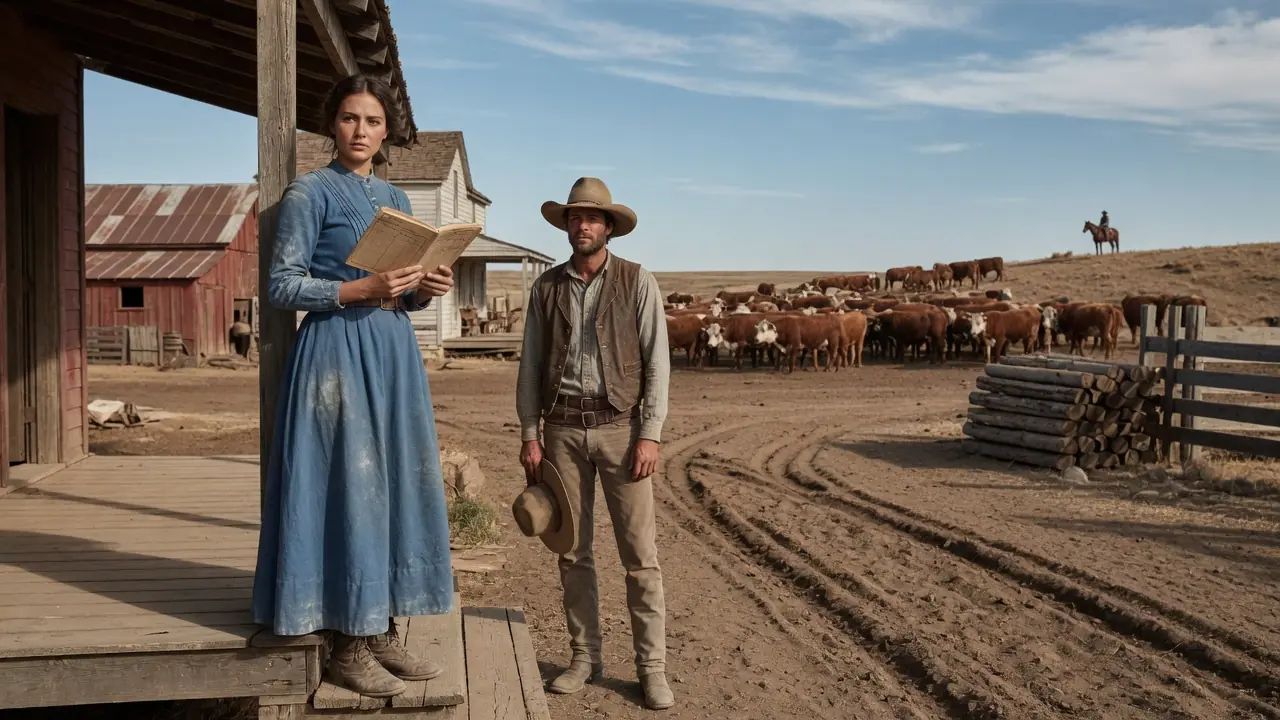
He had spent his whole life working other men’s land, fixing other men’s fences, sleeping in other men’s barns, always useful and never belonging. He had ridden three days from Abilene, following word of a cattle operation outside Mil Haven that was short-handed.
The directions had been vague.
Follow the creek north.
Look for the red barn.
But the barn was where it was supposed to be, and the farmhouse beside it was solid and well kept. The whole property had the look of a place that had once been loved and was currently being held together by someone who refused to let it fall apart.
Will tied his horse at the gate, walked to the porch, and knocked.
The woman who opened the door was not what he expected.
She was twenty-six years old, dark-haired, with direct dark eyes that assessed a situation completely before committing to a response. She was wearing a blue work dress with flour on one sleeve, and she was holding a ledger book, which she did not set down when she opened the door.
She looked at him the way a person looks at a fence before deciding whether to fix it or replace it entirely.
Will took off his hat.
“Ma’am, I heard you might be needing a hand. I’m a good worker. Experience with cattle. I can—”
“I need a husband more than a cowboy,” she said.
Not unkindly.
Just directly.
The way a person states a fact established by arithmetic rather than sentiment.
She looked at him with those assessing dark eyes while he stood on her porch with his prepared speech evaporating.
“Come in,” she said. “I’ll explain.”
Then she turned and walked back inside, still holding the ledger.
Will stood on the porch for a moment.
Then he followed her in, because what else do you do when a woman like that opens a door?
Her name was May Callaway.
Her husband, Daniel, had died eight months earlier, a fever quick and final, leaving her with three hundred acres of good Texas land, sixty head of cattle, two horses, and a debt of four hundred and twenty dollars to the Mil Haven Savings Bank.
Daniel had borrowed the money the previous spring to expand the herd, convinced prices would rise.
They had not risen fast enough.
Under the old laws that still shadowed Texas property rights in 1886, a widow in the months after her husband’s death existed in a legal limbo. The estate was technically in probate. The bank could, and Harlon Briggs at Mil Haven Savings was making it clear that it would, call the note rather than extend new terms to a woman alone.
Not because Briggs was cruel.
Because the law gave him that option.
And he answered to depositors, not to May Callaway’s situation.
She explained all of this at the kitchen table with the ledger open and the matter-of-fact precision of a woman who had done this accounting many times and arrived at the same answer every time.
Without refinancing, the note came due in sixty days.
“I’ve thought about every other option,” May said. “Selling cattle? I’d need to move forty head at current prices to cover it. That leaves me with nothing to run on through winter. Borrowing from family? I don’t have any. Fighting the bank in court? The lawyer in town says I’d lose.”
She closed the ledger.
“I need a husband’s signature on the refinancing documents. That’s all the law requires. A husband’s signature.”
Will looked at the ledger.
“You’re proposing a business arrangement,” he said.
“I’m proposing a marriage that begins as one,” she said. “You’d have a home, forty dollars a month once the debt is refinanced, and a share of the operation. In return, I need your name on the bank documents and your actual work on this property.”
He turned his hat in his hands.
“You don’t know me.”
“No,” she said. “But I know three things. You came here looking for honest work. You took your hat off when I opened the door. And you didn’t laugh when I explained the situation.”
She looked at him steadily.
“That’s more than I can say for the last two men I asked.”
Will looked at her.
“There were others?”
“Two. One laughed. One tried to renegotiate the terms in a direction I found unacceptable.”
She picked up the ledger.
“You have until tomorrow morning to decide. The barn is clean. There’s food in the kitchen.”
Then she walked back to her accounting.
Will sat at the table for a long time after she left the room.
Outside, across the east pasture, a man on horseback sat motionless on the ridge line, watching the farmhouse. Will noticed him.
The man turned his horse and rode east before Will could get a good look.
Will filed it away.
Then he went to the barn.
He slept in the barn that night.
It was a good barn. Dry. The animals were settled and healthy. A neglected farm showed in its animals first, and these animals were not neglected.
Will lay on his back in the hay and thought about May Callaway’s ledger, May Callaway’s dark eyes, and the rider on the ridge.
He had spent his whole life moving because nothing had ever given him a reason to stop.
Not the right reason.
He had worked for men who owned things and gone home at night to bunkhouses. He had wondered, in the particular quiet of other people’s land, what it would feel like to drive a nail into something that was yours.
The echo would sound different.
He had always believed that.
In the morning, he came to the kitchen at six.
May was already up.
Coffee made.
Bacon in the pan.
The ledger open again.
She looked up.
“Yes,” Will said.
She looked at him for a moment.
Something in her face shifted.
Not relief exactly.
The controlled exhale of someone who had been holding a very heavy thing and had just found a second pair of hands.
“Sit down,” she said. “We’ll go to town this afternoon.”
They were married at three o’clock on a Wednesday with the reverend and two witnesses. May wore her good dress. Will wore his clean shirt.
The ceremony took eleven minutes.
Walking back to the wagon, May said, “Thank you.”
Will said, “We should go over the cattle records tonight. I want to know what we’re working with before the week is out.”
She looked at him sideways.
“All right,” she said.
And for the first time since he had knocked on her door, the possibility of a smile crossed her face.
It did not fully arrive.
But it was there.
What was also there, and what Will noticed on the road back through Mil Haven, was Garrett Hollands standing outside the feed store, watching their wagon pass with the stillness of a man who had just learned something and was deciding what to do with it.
Will kept his eyes on the road.
He had fixed enough broken things to recognize the kind of damage that started with a man watching from a distance.
The first weeks were entirely practical.
Will worked from before sunrise until after dark. The cattle. The fences. The barn roof softening on the east side. He asked questions the way a man asks when he is trying to understand a system rather than impress someone.
May answered with the efficiency of someone who had explained this land to herself every day for eight months just to keep going.
Will had worked for other men his whole life.
The work had always felt borrowed.
Someone else’s problem solved.
Someone else’s profit made.
When he drove the first nail into the barn roof, he stopped for a moment and listened to the echo.
It sounded different.
Then he went back to work.
The bank meeting happened on Thursday.
Harlon Briggs, small and precise, with the expression of a man who considered himself reasonable and was frequently not, reviewed the paperwork and asked Will three questions about the property without looking at May.
Will answered from memory without checking with her.
Briggs signed the refinancing.
Walking out, May said, “He looked at you like you’d done something remarkable.”
“What did I do?”
“You answered his questions about my land without looking at me to check.”
“I read the ledger,” Will said. “I know the property.”
She stopped walking.
“You read the entire ledger?”
“Before I decided. I needed to understand what I was working with.”
She looked at him with the expression of a woman recalibrating something.
Then she started walking again.
“The cattle records are in the second drawer,” she said. “I’ll show you the pasture rotation after supper.”
What Will did not tell her, because it was not yet the right moment, was that while reading the ledger, he had found something troubling.
A note in Daniel’s handwriting from the previous April.
Hollands offered again. Land office is showing boundary discrepancy from 1874 survey. Check with Pratt in Abilene before winter.
Daniel had never checked.
Will folded that information away and kept walking.
Mil Haven had opinions.
Of course it did.
Martha Greer at the general store, one of the two witnesses, reported that May Callaway had married a stranger she had known one day, that the stranger knew cattle, and that the whole arrangement was either practical genius or coming disaster.
She had not yet decided.
Garrett Hollands owned five hundred acres to the east and had been watching the Callaway land since before Daniel died. He had made two offers, both refused.
He had mentioned helpfully in June that a woman alone with a debt was in a difficult position.
When May remarried, he had gone quiet in the particular way of a man who had switched strategies rather than abandoned the goal.
He came by the east fence on a Monday.
“You’re the new husband,” he said.
“Will Harding,” Will said.
He kept working.
“Heard May finally found someone to sign the papers.”
“She found a husband,” Will said. “The papers were a side effect.”
Hollands looked at the fence, the posts, the wire, and the methodical precision of a man who intended to be here a long time.
He lit a cigar.
“That land’s been in contention longer than May knows,” Hollands said.
He said it carefully, like a man dropping a stone into water to measure the depth.
“Old survey from ’74 has some irregularities. Bank knows about it, too. Might be worth checking before you put too much work into that east pasture.”
He rode away without waiting for a response.
Will drove the next post into the ground.
Three clean strikes.
Then he stood up and looked at the east fence line for a long time.
He thought about Daniel’s note in the ledger. He thought about Hollands mentioning the bank. He thought about a man who had been waiting years for this land and had just told a stranger exactly what he wanted him to worry about.
Will went back to work.
That evening, he wrote a letter to John Pratt in Abilene.
October arrived, and the arrangement developed complications that were not in the four terms.
Will had grown up moving from ranch to ranch, season to season, always useful and never his own. He had told himself this was freedom.
He was beginning to understand it had been something else.
When he mended harness in the barn, May came in with a supper plate. It was not one of the four terms, just something that had started happening. She set the plate on the workbench and looked at what he was doing.
“That’s the trace harness,” she said. “Daniel kept saying he’d replace it.”
“It can be repaired. The leather’s good. Just the stitching.”
She watched him work.
“He was a good man,” she said. “He just wasn’t careful with money.”
A pause.
“Or with ledgers. Or with land office filings.”
Will looked at the harness.
“The note in the ledger,” he said. “About the ’74 survey.”
She went very still.
“You found that?”
“In October. I’ve been looking into it.”
She sat down on the workbench.
“Why didn’t you tell me?”
“Because I didn’t know what it meant yet,” Will said. “I didn’t want to hand you a problem before I understood the shape of it.”
She looked at him with the dark eyes that had been deciding things since August.
This was different from the man she had expected.
Different from the useful stranger who would sign papers, manage cattle, and occupy the other side of a business arrangement. This was a man who had found a problem in her dead husband’s ledger and spent three weeks learning its shape before saying a word because he did not want to hand her fear before he could hand her a solution alongside it.
“What is the shape of it?” she asked.
“Hollands has known about the surveying error for years,” Will said. “Long enough to use it if he got the right moment. The right moment was always going to be when you were vulnerable enough.”
He set down the harness.
“I wrote to Pratt in Abilene. He’s a surveyor. If the error is real, we get the corrected survey filed before Hollands can move on it.”
She was quiet for a long moment.
“You’ve been planning this since October?”
“Since the east fence.”
She looked at the harness in his hands, and something in her face changed.
The specific shift of a person who has been managing alone for so long that being managed for just once lands differently than expected.
She picked up her plate and set it next to his on the workbench.
They ate supper in the barn without a word.
And it was the most comfortable either of them had been since August.
John Pratt arrived from Abilene in the second week of November.
He spent two days on the east pasture with his theodolite and Will working beside him, not directing, just present. Will learned the methodology and asked the questions of a man who intended to understand what he was paying for.
The result confirmed it.
The 1874 survey had a compass variation error. The eastern boundary had been placed ninety feet west of where it should have been. The forty acres Hollands was preparing to contest were, by correct measurement, unambiguously Callaway land.
The corrected survey was filed with the land office on a Thursday.
On Friday night, someone cut the east fence.
Not one section.
Three sections.
A quarter mile of wire dropped, the posts pulled, and sixty cattle pushed through the gaps into the open land between the Callaway property and Hollands’s eastern boundary, land that belonged to nobody clearly enough to create legal confusion in the dark.
Will discovered it at five in the morning when he went to check the cattle.
He came back to the house and saddled his horse without waking May.
He thought about it for thirty seconds, standing at the barn door in the November dark, his breath misting, the temperature already dropping in the way that meant the first hard weather was close.
Then he went back inside and woke her.
“The east fence is down,” he said. “Three sections. The cattle are out.”
She was up before he finished the sentence.
Dressed.
Boots on.
Rifle from above the kitchen door.
Out to the barn without a word.
Will looked at her.
“You don’t have to.”
“They’re my cattle,” she said.
She was already saddling her horse.
They rode out together into the November dark, and Will thought, This is what it looks like when someone refuses to let a thing fall.
He had never seen anything like it.
He hoped he never stopped seeing it.
They found the cattle spread across a mile of open ground in the dark and cold. Not lost, but pushed deliberately by men who knew what they were doing.
There were tracks, three horses moving the herd east toward Hollands’s boundary, where the legal situation was murky enough to create a dispute about which cattle belonged where.
Come morning, Will read the tracks in the moonlight and understood the plan.
Not theft.
Confusion.
Cattle mixed with Hollands’s herd in the dark. A disputed boundary. A corrected survey not yet forty-eight hours old. By the time it was sorted out legally, Hollands’s lawyer would have filed enough counterclaims to keep them tied up through winter.
The temperature was dropping fast.
The norther that had been building all week was arriving.
May was already moving cattle alone in the dark, cutting off the strays before they reached Hollands’s fence line. She rode like someone who had been doing this since before she could read, which she probably had.
Will pushed east.
He found two of Hollands’s men at the far end. Not cowhands doing regular work. Men sitting on horses, watching the cattle drift and waiting.
Will rode directly at them.
No rifle raised.
No threat made.
Just a man on a horse riding directly at two other men at four in the morning, in the rising wind of a Texas norther, with the specific composure of someone who had decided exactly how far he was willing to go.
One of the men said, “This ain’t your land, friend.”
“It is, actually,” Will said. “Filed with the land office Thursday. You’re welcome to check.”
He held the man’s eye in the moonlight.
“I’m going to move my cattle now. You can help, or you can ride back to Hollands and tell him the survey is filed and the cattle are home. And the next time someone pulls my fence posts in the dark, I won’t come alone.”
A long silence followed.
The wind was picking up.
The second man said something low to the first.
Then both of them turned and rode east.
Will sat on his horse in the November dark until they were gone.
Then he turned and went to help May with the cattle.
By the time they had the herd back through the repaired gaps and the fence temporarily braced, the temperature had dropped fifteen degrees and the first snow was falling.
May looked at the sky.
“Big Die-Up coming,” she said.
“I know.”
“Then we have work to do,” she said.
She was already riding for the barn.
The winter of 1886 hit the Texas plains like a judgment.
The old-timers called it the Big Die-Up, the blizzard that killed hundreds of thousands of cattle across the western ranges. It was the storm that ended the open range era and broke operations that had survived everything else.
In Mil Haven County, the temperature fell to twenty below in January. The creek froze solid. The windmill on the north pasture seized and had to be freed by hand in conditions that burned exposed skin within minutes.
Will and May worked as if sleep were optional.
They lost seven cattle in the first week, unavoidable losses, animals already weakened by the season. They saved eleven more that would have died by bringing them into the barn and the kitchen and feeding them by hand through the worst nights.
Three calves spent forty-eight hours beside the kitchen stove wrapped in blankets while May and Will took shifts keeping them warm.
The kitchen smelled of cattle, woodsmoke, and coffee that was always on.
They did not discuss the four terms.
There was no time to discuss anything except the next problem and the one after that.
On the worst night, with the temperature at twenty-two below and the wind coming in sideways, the barn door needed two people to open against the pressure.
Will came in from the north pasture at midnight with frostbite starting in three fingers. May sat him at the kitchen table and worked on his hands for twenty minutes without saying anything except practical instructions.
Her own hands were steady. Her face wore the look it did when she was managing something serious and refusing to perform the fear of it.
When the worst had passed and color was coming back into his fingers, Will looked at her bent over his hands in the kitchen light and thought, I have been looking for the thing that would make me stop moving.
He had not expected it to look like this.
Like a woman with flour on her dress, a rifle above the kitchen door, and a ledger she carried like a weapon.
But there it was.
“May,” he said.
She looked up.
“Thank you.”
She looked at him for a moment with those dark eyes.
“They’re your hands, too,” she said. “This is your land, too.”
Then she went back to his fingers.
Will looked at the kitchen, the stove, the calves in the corner, the ledger on the table, and the coffee that was always on.
He understood that the echo he had been listening for his whole life was right here.
He had driven the nail.
He had heard it.
He was not going anywhere.
Hollands came by in February after the worst had broken.
He found Will mending the east fence, the same fence that had been cut in November. It was now being rebuilt properly, the posts set deeper and the wire strung tighter.
Hollands sat on his horse and looked at the fence for a long time.
“Lost about thirty head in the die-up,” he said finally.
“Twenty-two on our side,” Will said.
He kept working.
“Heard you lost less than most.”
“We worked harder than most.”
Hollands looked at the corrected boundary stakes, Pratt’s markers now frozen into the ground. He looked at the fence. Then he looked at Will.
“My men that night,” Hollands said.
“Were doing what you told them,” Will said. “Or what you let them do. Same thing.”
“The survey stands,” Hollands said.
“It does.”
“Then there’s nothing more to be said about the east pasture.”
Will set down the fence tool and looked at him directly.
“There’s one thing,” he said.
May Callaway has been on this land her whole adult life. She buried her husband on it. She kept it through a bank that wanted it, a winter that tried to take it, and neighbors who thought a woman alone was an opportunity.”
He picked up the tool again.
“She’s not alone anymore. I’d like us to understand each other on that point.”
Hollands looked at him for a long moment.
The kind of look that takes a man’s full measure and reports what it finds.
Then he nodded once, the nod of a man who had decided to be a neighbor rather than a problem, and had made that decision because he had been given a real reason to.
He rode east.
Will watched him go.
Then he went back to the fence.
The fence needed three more hours of work.
He was going to be here to finish it.
He was going to be here tomorrow, too.
For the first time in twenty-eight years, that was not a compromise.
It was exactly what he wanted.
The debt was on track. The forty-dollar monthly salary Will had been taking, he had been quietly putting back into the operation rather than keeping, a fact May discovered in the February accounts and had not yet addressed.
On a March evening, with the fire going, the accounts finished, and the first real warmth in the air after the long cold, Will said, “The terms.”
May looked up.
“They expired in November,” he said. “We’ve been operating without a contract since before the die-up.”
“I know,” she said.
“I’d like to discuss new terms.”
She set her book down.
He looked at the fire, then at her.
“I’d like the arrangement to be permanent,” he said. “Not because of the land. Not because of the bank or the legal situation or the forty dollars a month I haven’t actually been taking.”
He looked at her directly.
“Because of you. Because of this.”
He gestured at the kitchen, the stove, the ledger, the calves long gone back to the pasture, the coffee that was always on, and the life built in eight months out of necessity and continued out of something else entirely.
“I’d like it to be a marriage,” he said. “A real one.”
May looked at him for a long time.
“Will,” she said, “it became a real one somewhere around the calves in the kitchen.”
He looked at her.
She looked at him with those dark eyes that had assessed him at the door in August and had been deciding things ever since. Through the bank meeting, the east fence, Hollands’s men in the dark, twenty-two below zero, and three calves wrapped in blankets beside the stove.
She stood from the table and crossed the two feet between them.
Then she kissed him.
Not tentatively.
Not as a business arrangement.
But with the complete conviction of a woman who made her decisions carefully and kept them completely.
Will kissed her back with the certainty of a man who had spent twenty-eight years working other people’s land and had finally driven a nail into something that was his.
Outside, the Texas spring was arriving on the land they had decided together to keep.
The east fence was standing.
The herd was building again.
The survey was filed.
The debt was on schedule.
Garrett Hollands was being a tolerable neighbor.
And inside, the kitchen was warm, the coffee was on, and it was, without question, exactly right.
The spring pasture came in strong.
Good grass.
The kind that follows a hard winter, the ground having been broken and turned and forced to renew itself.
Will walked the east fence line in May with May beside him, both of them checking the wire after the thaw. He looked at the land the way he had been looking at it since August, as something that was his to understand and his to keep.
He had written to his father in April, the first letter in three years.
He had not known what to say for three years.
In April, he had known.
The letter said, I found a place. I’m staying.
May had found the letter on the table before he sent it. He was certain because she read everything and had said nothing about it, which was her version of saying everything.
The cattle were rebuilding.
Fifty-three had become fifty-eight by May with the spring calves. The operation was running at a modest profit. Not the expansion Daniel had borrowed for, but something real and sustainable.
The kind of operation built on ground that had been tested and had held.
Harlon Briggs at the bank, who had turned out to be, as Will had suspected, a man trying to do his job in a legal system that made it difficult rather than a man trying to take May’s land, stopped him on the street in April and said the Callaway-Harding account was the most current note in his portfolio.
He said it with the mild surprise of a man revising an expectation.
On a May morning, May was at the kitchen table with the ledger, always the ledger, when Will came in from the east fence and sat across from her.
She pushed the open book toward him without looking up.
He looked at the numbers.
The column she had pointed to was the salary line.
Forty dollars a month.
Five months.
Two hundred dollars.
Beside each entry, she had written in her careful hand, Returned to operation.
He looked up.
She was looking at him.
“You’ve been paying yourself back in,” she said.
“The operation needed it.”
“The operation needed it,” she agreed. “So did I.”
He looked at her.
She was not looking at the ledger anymore.
“You could have left,” she said. “After Hollands. After the die-up. You had every reason.”
He looked at the numbers in the book, the careful accounting of everything they had built and everything it had cost.
“No,” he said. “I didn’t.”
She looked at him for a long moment.
Then she closed the ledger.
Outside, the Texas spring held the land that was theirs, both of theirs completely. The east fence was standing, the herd was growing, and it was, by every measure May Callaway had ever used, exactly right.
May Callaway opened a door in August with a ledger in her hand and told a stranger she needed a husband more than a cowboy.
She had been refused twice before.
She asked anyway.
Will Harding had spent his whole life moving from one borrowed piece of land to another, driving nails into other men’s barns, fixing other men’s fences, and listening for an echo that always sounded the same.
Then he followed a woman he had known for one day into a kitchen in Texas and said yes to the strangest proposition he had ever heard.
He drove a nail into that barn roof in September and stopped to listen.
The echo was different.
That was the whole story.
A woman who asked for what she needed when she had every reason to expect to be refused again. A man who had been looking for a reason to stay and found one before he knew he was looking.
Two people wrote four practical terms on a piece of paper in August and were still at the same kitchen table in March, not because of the terms, but because of everything that had grown between them while the Texas winter tried its best to break them and failed.
The greatest adventure in the West was never the open road.
It was always the moment someone decided to stop and build something.
May asked.
Will followed her inside.
The rest was just the work.
And the work, it turned out, was the whole point.