A seven-year-old girl was curled up in the back seat of a rusted sedan in a gas station parking lot.
A one-eyed teddy bear guarded her pillow, and a library book rested where a seat belt should have been.
When a tattooed biker leaned toward the window, she did not scream or cry.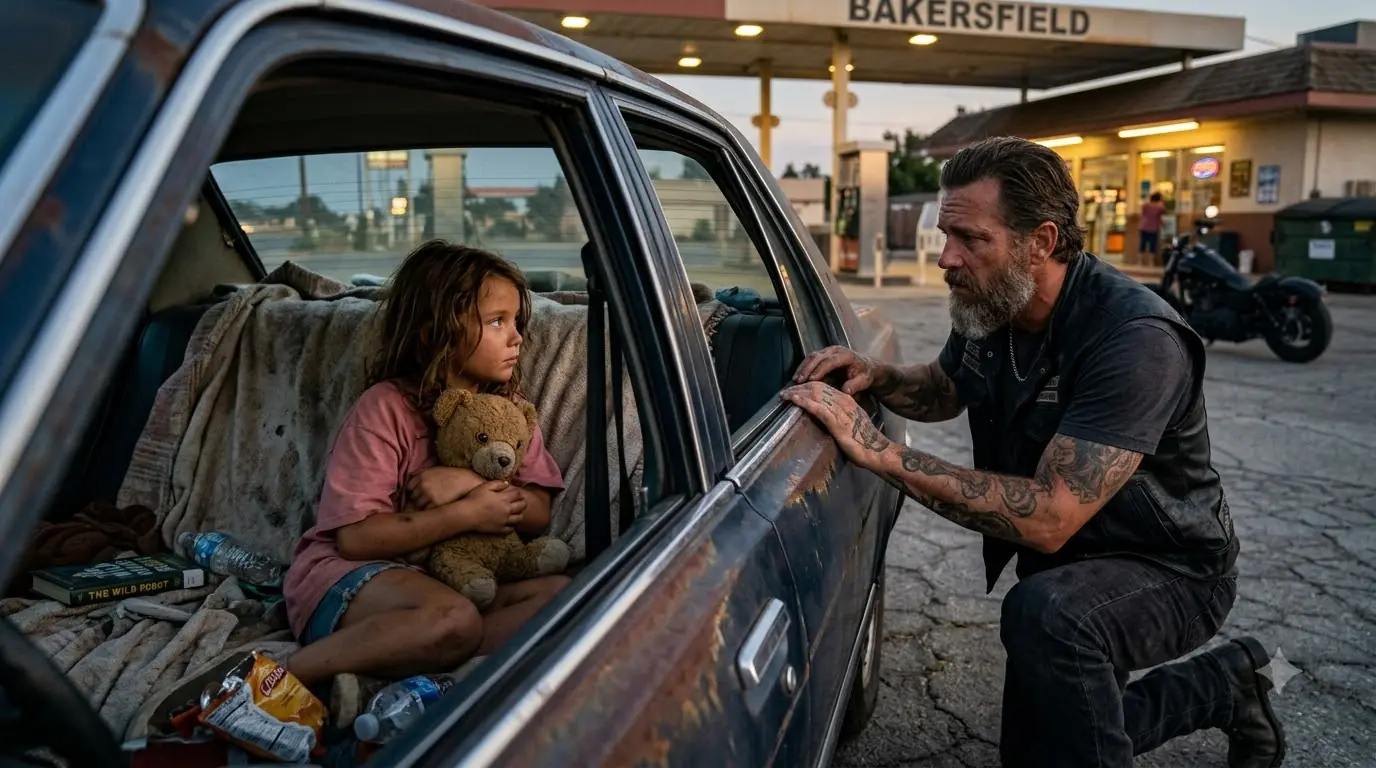
She looked directly into his eyes and said five words that shattered everything he thought he knew about himself.
“There is no room for me.”
What followed brought 450 motorcycles to a courthouse and eventually brought a broken man to his knees. This was the story Marcus Thornton never expected to live.
The August heat in Bakersfield, California, had a way of pressing down on everything. It settled over the cracked asphalt, the sagging power lines, and the faded awnings of gas stations that had not been repainted since the 1990s.
It was the kind of heat that made the air shimmer above the road like something alive, turning the distant horizon almost liquid. Marcus Thornton pulled his motorcycle into the parking lot of Mercer’s Fill ’n Go shortly after nine in the evening.
The sun had finally disappeared, but the ground still radiated heat like an oven with its door left open. Marcus switched off the engine and remained seated for a moment, listening to the ticking of hot metal cooling beneath him.
He was forty-two years old, broad-shouldered, with a beard beginning to turn gray around the edges. Tattoos covered his arms, telling stories most strangers would never ask to hear.
His leather vest carried the patches of the Iron Wolves Motorcycle Club, a riding brotherhood known across the long highways of California’s Central Valley. People crossed streets when they saw men like Marcus approaching. They locked their car doors and pulled their children closer.
Marcus had stopped caring about the judgment of strangers a long time ago.
Inside the gas station, Frank Mercer stood behind the counter as he did almost every evening. He was a thin man with white hair and reading glasses balanced near the end of his nose.
Frank had owned the place for thirty-one years and had watched every kind of traveler pass through. Truck drivers, farmworkers, families on road trips, lost teenagers, and more than a few motorcycle clubs had stopped beneath his lights.
Frank did not judge them. He sold gasoline, poured coffee, and minded his business.
“Evening, Marcus,” Frank said without looking up from his crossword puzzle.
“Frank.”
Marcus took a bottle of water from the cooler, opened it, and drank half in one long pull.
“Quiet night.”
“Always is this time of the week.”
Marcus paid and stepped outside. The parking lot was nearly empty, containing only his motorcycle, Frank’s aging pickup truck, and a rusted sedan parked near the dumpsters at the far end of the property.
He had not noticed the sedan when he arrived. It was the kind of vehicle that disappeared into neglect, with a dented fender, one broken taillight, and a layer of dust thick enough for someone to write their name across the trunk.
The car looked as though it had not moved in several days. Marcus would not have given it another glance if he had not noticed movement in the back seat.
He stopped in the middle of the parking lot.
The sedan’s interior light was off, but the yellow glow from the gas station canopy caught the outline of something small moving behind the glass.
Marcus walked closer, his boots crunching over loose gravel. He bent slightly and looked through the rear window.
A little girl was curled across the back seat.
She could not have been older than seven. Her brown hair was tangled and unwashed, falling across a face marked by dirt.
She wore a faded pink shirt at least two sizes too large and shorts with a torn hem. A thin blanket, the kind commonly found inside inexpensive motel rooms, was gathered around her legs even though the evening temperature remained near eighty degrees.
Her small white sneakers sat on the floor. The soles were beginning to peel away.
Beside them were a half-empty bottle of water and a crushed bag of potato chips.
The girl was awake.
Her large eyes, round and the color of dark honey, stared directly at Marcus.
He straightened.
Marcus was not easily unsettled. He had ridden through violent storms and stood his ground in situations that would have sent many men running.
Something about those eyes tightened his chest.
The girl did not look frightened or surprised. She regarded a large, tattooed stranger staring through the car window at night as though it were only one more unusual thing that happened in her life.
Marcus looked across the parking lot.
No adult was approaching from the gas station. No parent was walking through the darkness. There was nobody near the sedan.
He looked at the girl again.
“Hey,” he said.
His voice sounded rougher than he intended, so he softened it.
“Are you all right in there?”
The girl slowly sat up and pulled the blanket around her shoulders.
She studied Marcus in the direct and unguarded way children examined things they were trying to understand.
“Are you a bad guy?” she asked.
Marcus almost smiled.
Almost.
“No. I am not a bad guy.”
Then, quietly and matter-of-factly, as though explaining what she had eaten for dinner, she said, “I sleep in the car because there is no room for me inside.”
The words landed like a stone dropped into still water.
Marcus felt the ripples move through his chest and stomach before rising into his throat, where they became something he could not swallow.
“Inside where?”
The girl pointed vaguely toward a group of apartment buildings beyond the gas station’s rear fence. They were squat stucco structures with peeling paint and bars across many of the windows.
“My mom’s boyfriend does not want me there,” she said. “He says I take up too much space, so I sleep here.”
Marcus looked at the back seat again.
This time, he truly saw it.
The space had been organized with a desperate kind of neatness. The blanket was folded around the girl, and a small stuffed bear with matted fur and one missing eye sat against the door as though standing guard.
A library book was tucked inside the pocket behind the driver’s seat.
This was not a child who had climbed into a car for an evening adventure.
This was a child who lived there.
“What is your name?” Marcus asked.
“Ellie.”
“Ellie, where is your mother right now?”
The girl shrugged.
It was a small, practiced movement carrying the weight of many unanswered questions.
“Inside. She is always inside.”
Marcus stood beneath the yellow gas station light and felt something shift inside him. It was something that had remained locked away for years behind walls built from grief, distance, and the roar of motorcycle engines on empty highways.
He remembered another little girl with brown hair and eyes that always seemed too wise for her young face.
A girl he had not been able to save.
Marcus removed his phone from his pocket and sat on the curb about three feet from the sedan. He remained close enough for Ellie to see him, but far enough away that she would not feel trapped.
“Ellie, I am going to make certain you are safe. Is that all right?”
She studied him for a long moment.
Then she nodded.
Marcus Thornton had not always been the man sitting on a gas station curb at nine-thirty on a Tuesday evening, calling people he had not spoken to in months.
There had been another life when his world was small, warm, and filled with light. His daughter Grace would climb onto his lap and demand that he read the same picture book four times in succession.
His wife, Linda, would laugh from the kitchen doorway with flour on her apron and tell him he was spoiling their daughter.
Grace had been six years old when a traffic collision took her and Linda.
It happened on a rainy evening along Highway 99. A truck driver had remained behind the wheel for sixteen hours, and within a single heartbeat, Marcus Thornton lost the two people who gave his life meaning.
That had been eight years earlier.
Marcus spent those years filling the silence with the sound of his motorcycle. He surrounded himself with men who understood that some pain could not be discussed and could only be carried across long roads.
The Iron Wolves became his family, not because they replaced Linda and Grace, but because they never asked him to pretend he had not lost them.
Ray Henderson, the club’s vice president and Marcus’s closest friend, had been the man who pulled Marcus from the floor of his apartment three days after the funeral.
Ray put a helmet into Marcus’s hands.
“You are not going to die today, brother,” he said. “Ride with me.”
Marcus rode.
For eight years, he continued riding.
Sitting on that curb with heat still rising from the pavement, Marcus felt something he had not experienced for a long time.
Responsibility.
It was not the kind attached to running a motorcycle club or organizing charity rides. It was the kind that came from looking into a child’s eyes and understanding that if he walked away, nobody else might walk toward her.
Marcus called Ray first.
“I need you to come to Mercer’s station,” he said. “Bring Karen.”
Karen was Ray’s wife and worked as a pediatric nurse at Mercy Hospital.
“What happened?” Ray asked.
“Just come.”
Ray arrived twenty minutes later with Karen sitting beside him in their truck.
By then, Marcus had returned to the gas station and bought Ellie a sandwich, a juice box, and a bag of sliced apples.
She ate with a quiet and focused intensity that told him she had not received a proper meal in some time.
Frank Mercer came outside, examined the situation, and said nothing. He returned to the store and switched on the coffee machine.
Karen approached the sedan as she approached frightened children at the hospital. She moved slowly, kept her voice warm, and avoided sudden gestures.
She knelt near the open door and introduced herself.
Within five minutes, Ellie showed Karen the stuffed bear, whose name was Captain. She also described her library book, a story about a girl who lived inside a garden and spoke to birds.
Karen later joined Marcus near Ray’s truck while Ray remained with Ellie.
“She is undernourished,” Karen said quietly. “Not severely, but enough to concern me.”
Karen looked toward the sedan.
“She has bruising on her arms. It could be from being handled roughly. She needs a medical examination, and somebody has to contact Child Protective Services.”
Marcus nodded.
He already knew it in the way people recognized truths they wished were not real.
“I will handle it.”
“Marcus.”
Karen placed one hand on his arm.
“This does not have to become your fight. CPS will take over.”
“CPS will put her into the system,” Marcus said.
His voice carried the flat certainty of someone who had watched institutions succeed and fail in equal measure.
“She will be placed in a group home or moved between foster families until she becomes a number inside a file.”
“I am not saying you should not call them.”
“I will call them.”
Marcus looked toward Ellie.
“But I am not walking away.”
He went to the apartment complex that night.
The interior looked exactly as the exterior suggested. Hallway lights flickered above stained floors. The air smelled of old cooking, mildew, and cigarette smoke.
Several mailboxes had no doors.
Marcus found apartment 2D on the second floor and knocked.
The woman who answered was thin in a way that suggested choices rather than unavoidable hardship.
Donna Whitfield had the same brown hair as her daughter, but hers was unwashed and held back with a rubber band. Her eyes were glassy and unfocused.
Behind her, the apartment was cluttered, not with the ordinary disorder of family life, but with the remains of a home nobody maintained.
A television played loudly in another room.
The air smelled of cigarette smoke and something chemical Marcus recognized but chose not to name.
“Who are you?” Donna asked cautiously.
“Your daughter is sleeping in a car at a gas station.”
Marcus held her gaze.
“She told me there is no room for her here.”
Donna’s expression shifted between guilt and irritation.
“She is fine. She likes sleeping out there. She has her blanket and her things.”
“She is seven years old, and she is sleeping inside a car.”
Marcus’s voice remained controlled.
“She is not fine.”
A man appeared behind Donna. He was tall and unshaven, wearing a stained undershirt.
He looked at Marcus’s vest and physical size, then wisely remained where he was.
“You need to leave,” the man said.
Marcus looked at him.
He did not raise his voice or issue a threat. He simply held the man’s eyes with a steady and unblinking expression that communicated more than words could have.
“I am leaving,” Marcus said. “But this is not finished.”
He returned to the gas station.
Ray and Karen were still with Ellie.
The girl had fallen asleep in the rear seat of their truck with Captain pressed against her chest. Karen’s jacket covered her like a shield.
Marcus studied her sleeping face and thought of Grace.
Ellie was not a ghost or a replacement.
She was a reflection of everything he once failed to protect, returned to him in a form he had not requested and could not refuse.
Marcus took out his phone and began making calls.
He contacted Child Protective Services and his attorney.
Then he called every chapter president in the Iron Wolves network, every allied motorcycle club, and every rider who had ever appeared when someone needed help.
“I need you,” he said repeatedly to men and women across three states.
“Not for me. For a little girl sleeping in a car because the world forgot about her.”
The following days taught Marcus a form of patience he had never been skilled at practicing.
Patricia Calloway arrived the next morning.
She was a Child Protective Services caseworker with fifteen years of experience, a firm handshake, and eyes that had witnessed too much to be easily surprised.
Patricia was a Black woman in her mid-forties with closely cropped hair and reading glasses suspended from a chain around her neck.
She listened to Marcus’s account.
She interviewed Frank Mercer, inspected the sedan where Ellie had been sleeping, and visited the apartment on the second floor.
Her report was thorough and severe.
Ellie Dawson had attended school inconsistently and missed forty-three days during the previous academic year. Her medical records showed no routine examination for more than two years.
The apartment was declared unsafe due to inadequate food, unsanitary conditions, and evidence of substance misuse.
Donna Whitfield received a formal warning and a court-supervised case plan.
Ellie was placed into emergency foster care.
The foster home was clean and safe. The people working there meant well.
It was still a house filled with strangers.
Ellie slept in a bed that did not belong to her, ate meals she had not chosen, and carried Captain from room to room like a lifeline.
Marcus visited every day the system permitted, which was not every day.
He brought books from the library, usually stories involving gardens and birds because those were the stories Ellie loved.
Marcus sat with her on the foster home’s porch and listened as she described her day in the careful, restrained way of a child who had learned adults did not always want the truth.
“The lady here is nice,” Ellie said one afternoon while picking at the edge of her shirt. “She makes pancakes.”
“That is good.”
“But she is not my mom.”
Marcus looked into her small face and felt the familiar ache return.
“No,” he said. “She is not.”
“Are you coming back tomorrow?”
“If they allow me.”
“What if they do not allow you?”
Marcus did not have an honest answer that would not frighten her.
He offered the only promise he could keep.
“Then I will return the day after.”
The legal process moved more slowly than Marcus expected and was more complicated than he imagined.
Patricia was helpful, but regulations restricted what she could do. Bureaucracy moved according to schedules that did not recognize a frightened child’s need for certainty.
Donna was given the opportunity to enter rehabilitation and attempt to regain custody. The process could require six months or longer.
During that time, Ellie would remain in foster care, subject to reviews, assessments, and the cold arithmetic of a system designed to process children through paperwork.
Marcus hired Brenda Collins, a family-law attorney in downtown Bakersfield.
Brenda wore her hair in a bun pulled so tightly that it appeared uncomfortable. She had a reputation for accepting cases other attorneys refused to touch.
“You want to apply for foster certification?” Brenda asked, looking over the top of her glasses.
She reviewed his information.
“You are a single man with no current parenting history and the president of a motorcycle club.”
“I had a daughter,” Marcus said. “She died.”
His voice remained steady.
“I know how to be a father.”
Brenda studied him for a long time.
“This will be difficult. The court will examine your background, lifestyle, income, home, and support network.”
She closed the file.
“You will undergo interviews, inspections, and background investigations. It may require months.”
“Then we begin today.”
The process was everything Brenda warned him it would be and more.
There were forms asking questions Marcus had never considered.
What was his parenting philosophy?
How would he discipline a child?
What were his plans for education, medical care, activities, and emotional support?
At two in the morning, Marcus sat at his kitchen table beside a cup of cold coffee and stared at one question.
Describe your motivation for becoming a foster parent.
He wrote and rewrote the response six times before creating something honest without being raw enough to alarm a government evaluator.
The home inspection revealed a clean but sparse two-bedroom house.
The second bedroom had remained closed for eight years, untouched since Grace’s death.
The door had stayed shut for so long that the hinges resisted when Marcus finally pushed it open. Air smelling of dust and memory emerged from the room.
Grace’s dresser remained against one wall beneath a fine layer of grit.
A mobile of paper stars Linda had made still hung from the ceiling. Its once-bright colors had faded into soft pastels.
Marcus stood inside the doorway for a long time before entering.
He carefully removed the mobile, folded it, and placed it inside a box stored in his closet.
Then he began transforming the room.
Marcus painted the walls soft yellow and sanded the wooden floor until it shone.
He bought a new bed and chose sheets decorated with butterflies because the woman at the store told him girls liked butterflies.
He placed a small bookshelf beside the window and filled it with the types of stories Ellie enjoyed.
There were books about gardens, animals, birds, and brave girls who found their way home.
The background investigation uncovered a record from twenty years earlier.
Marcus had been involved in a bar fight during his twenties that resulted in a misdemeanor assault charge.
The record had been legally cleared, but remained visible to anyone searching deeply enough.
The court-appointed evaluator noted it in her report with clinical detachment.
The reputation of the motorcycle club created another obstacle.
The Iron Wolves had no criminal associations. For more than a decade, its members organized charity rides, toy drives, fundraising events, and neighborhood projects.
The club’s name and clothing still carried weight inside a courtroom.
Marcus repeatedly explained that a motorcycle club was not a criminal organization.
Its members were mechanics, teachers, military veterans, contractors, nurses, and small-business owners who happened to ride motorcycles together.
Ray Henderson testified for Marcus.
Karen Henderson testified.
Frank Mercer testified.
Three of Marcus’s neighbors appeared in court and described the man they knew.
His pastor also testified.
Reverend David Holbrook had known Marcus for twenty years.
He told the court, in a voice steady as bedrock, that Marcus Thornton was among the finest men he had ever known.
He also said the deaths of Linda and Grace had broken Marcus in ways only love might repair.
Throughout the process, Marcus continued visiting Ellie.
He read to her and helped with homework after she returned to school.
He learned her favorite color was green and that she wanted to become a veterinarian.
He learned she was frightened by thunderstorms but not darkness.
Captain remained on her pillow every night.
One evening, while Marcus prepared to leave the foster home, Ellie ran toward the doorway and took his hand.
“Marcus.”
It was the first time she had addressed him by name.
He turned.
“Are you trying to become my dad?”
Marcus knelt until they were at eye level.
“I am trying to make certain you never sleep in a car again.”
Ellie considered the answer.
“That is the same thing.”
The court hearing was scheduled for November 15, a cool and overcast Tuesday that felt nothing like the hot August night when Marcus first saw Ellie through the sedan’s dusty window.
Three months of applications, inspections, evaluations, and sleepless nights led to that morning.
The hearing would take place before Judge Thomas Ashford in Kern County Family Court.
The future of a seven-year-old girl would be decided by adults wearing suits, most of whom had never watched her sleep in a back seat.
Marcus arrived early wearing a button-down shirt rather than his leather vest.
The concession made him feel as though he had borrowed another man’s clothing.
Brenda Collins met him in the hallway carrying a folder thick enough to hold open a heavy door.
“Donna Whitfield left her rehabilitation program two weeks ago,” Brenda said. “She has not attended a visit with Ellie in six weeks.”
Marcus listened carefully.
“Her attorney requested additional time, but the judge denied the motion.”
“What does that mean?”
“The court will probably terminate her parental rights.”
Hope moved through Marcus, but Brenda immediately continued.
“That does not guarantee Ellie will be placed with you.”
She opened the file.
“There are other applicants. Two certified foster families have expressed interest. Both are married couples with previous experience.”
Brenda held his eyes.
“On paper, they appear stronger than you.”
The words settled across Marcus’s shoulders like physical weight.
He had completed everything the court requested.
He opened his home, his history, and the wound he spent eight years trying to close.
It might still not be enough.
The hearing began at ten in the morning.
Judge Ashford was tall and silver-haired, with a deep voice and the manner of someone who had spent decades listening to the worst days of people’s lives while somehow retaining compassion.
He reviewed the case.
Judge Ashford heard testimony from Patricia Calloway, the temporary foster family, Brenda Collins, and the court-appointed child advocate.
The advocate described Ellie’s progress, her improved school attendance, stronger grades, and increasing confidence.
She also described Ellie’s emotional attachment to Marcus Thornton, a man who visited three times each week and read stories to her about gardens and birds.
Then Judge Ashford called Marcus to testify.
The questions were direct.
How would he support the child financially?
What kind of employment did he have?
Who belonged to his support network?
How would he balance leadership of a motorcycle club with the responsibilities of raising a child?
Marcus answered honestly.
He owned a motorcycle repair shop employing four people and producing a stable income.
His house had no mortgage.
He had friends, neighbors, and community members who already proved they were willing to support him.
As for the club, it was not a liability.
It was a family.
“Mr. Thornton,” Judge Ashford said, leaning forward, “why do you want to foster this particular child?”
Marcus waited.
“You have no biological connection. You met her by chance in a gas station parking lot.”
The judge folded his hands.
“Most people would have contacted the authorities and continued with their lives.”
Marcus remained quiet for several seconds.
The courtroom was still.
He felt everyone watching him.
Brenda.
Patricia.
The other prospective families.
The court reporter with her fingers waiting above the keyboard.
“Eight years ago, I lost my daughter,” Marcus said. “Her name was Grace.”
His voice remained steady.
“She was six years old and represented everything good in my life.”
Marcus looked toward the judge.
“When she died, I believed I would never again enter a room and feel as though I belonged there.”
His hands rested on his knees and trembled slightly.
“I spent eight years riding away from that feeling.”
He paused.
“Then I met Ellie.”
Marcus drew a breath.
“She was sleeping in the back seat of a car with a one-eyed teddy bear and a library book.”
His voice began to tighten.
“She looked at me, a large and frightening-looking stranger, and she was not afraid.”
Marcus continued.
“She told me she slept inside the car because there was no room for her.”
The courtroom remained completely silent.
“I realized I had room inside my house, my life, and my heart, but nobody to give it to.”
He looked directly at Judge Ashford.
“She needs somebody who will not leave.”
Marcus’s hands stopped trembling.
“I am not leaving.”
Judge Ashford studied him for a long moment.
Then the judge looked down at the documents before him.
The ruling would not be announced for another two weeks.
Something had shifted inside the courtroom, however.
Everyone felt it, although nobody could name it.
What happened next was not Marcus’s idea.
Ray Henderson planned it after spending three months contacting motorcycle clubs, riding groups, and independent riders from San Diego to Sacramento.
Karen Henderson coordinated with Patricia Calloway and Brenda Collins to make certain every gathering remained legal and respectful.
Frank Mercer quietly offered his gas station parking lot as a staging area.
On the morning of November 29, Marcus drove to the courthouse to receive Judge Ashford’s decision.
He expected to arrive alone.
Marcus expected to sit inside a waiting room beneath fluorescent lights, drink stale coffee, and listen while a stranger decided whether he was good enough to raise Ellie.
Instead, he heard the sound before he saw anything.
It began as a low rumble, like distant thunder beneath a clear sky.
The vibration reached his chest before his ears understood it.
Marcus stood inside the courthouse parking lot as the first group appeared at the far end of the street.
Motorcycles rode in formation with their headlights illuminated.
Their engines filled the morning with a sound impossible to ignore.
Dozens became hundreds.
They arrived from every direction, moving down Chester Avenue, up Truxtun Avenue, and along California Avenue.
Chrome, leather, and humanity flowed toward the courthouse like a river.
Iron Wolves.
Desert Ravens.
Valley Steel.
Sierra Brotherhood.
Independent riders with no club patch also came because they answered to something larger than any emblem.
There were men and women of every age and background.
All shared one belief.
A little girl who had slept inside a car deserved something better.
Four hundred fifty riders filled the courthouse parking lot, nearby streets, and sidewalks.
They did not chant or carry signs.
They stood beside their motorcycles with helmets in their hands and waited.
Some traveled through the night from Nevada, Arizona, and Oregon.
Others took unpaid days away from work.
Several brought their children, who sat on motorcycles and stared toward the courthouse with wide eyes.
Marcus stood at the center of the gathering, overwhelmed in a way he had never experienced.
It was not the number of people or the sound of their engines.
It was what their presence meant.
Most had never met Ellie.
They had not seen her face or heard her voice.
They came because her story mattered.
Because she mattered.
Ray approached Marcus and placed one hand on his shoulder.
“You said you needed help.”
Marcus looked across the riders.
“This is what help looks like,” Ray said.
Inside the courthouse, Judge Ashford looked through his window at the motorcycles and people filling the streets.
His clerk reported that the riders were peaceful and respectful.
They voluntarily repositioned their motorcycles to keep all emergency routes clear.
Several asked where they could purchase coffee for courthouse employees.
Judge Ashford returned to the bench, reviewed his written ruling one final time, and called the hearing to order.
Thomas Ashford had presided over family court for twenty-two years.
He made decisions that separated children from parents, reunited families divided by hardship, and navigated the difficult distance between what the law required and what justice demanded.
Over the years, he learned that the most important decisions were rarely easy.
He looked at Marcus Thornton.
Marcus had shaved for the occasion and wore the same button-down shirt. He sat with his hands folded on the table, waiting for a ruling that would define the rest of his life.
Judge Ashford examined the file.
It contained inspection reports, background investigations, character testimony, the evaluator’s recommendation, and dozens of letters of support.
The letters did not come only from members of the motorcycle community.
Teachers, neighbors, clergy members, and local business owners described Marcus not as a biker or club president, but as the man who repaired their motorcycles, helped neighbors during emergencies, and once spent an entire Saturday rebuilding a fence for an elderly widow who could not afford a contractor.
Judge Ashford reviewed Patricia Calloway’s report.
In fifteen years of casework, she wrote, she had rarely seen a prospective foster parent demonstrate Marcus Thornton’s level of commitment, consistency, and genuine emotional connection toward a child.
Then the judge read a letter written by Ellie.
The handwriting was careful and uneven on lined paper.
At the bottom, she had drawn a motorcycle, a garden, and a bear with one eye.
Dear Judge,
My name is Ellie. I am seven.
Marcus reads me stories and brings me books about birds. He painted my room yellow.
He said I never have to sleep in a car again.
I believe him.
Can I please go home with Marcus?
Thank you,
Ellie
Judge Ashford removed his glasses.
He cleaned them carefully with the edge of his tie before putting them back on.
“It is the finding of this court that Donna Whitfield’s parental rights are terminated due to sustained neglect and failure to complete the court-ordered case plan.”
Marcus stopped breathing.
“It is further ordered that Ellie Dawson be placed into the foster care of Marcus Thornton.”
The judge paused.
“A review hearing will be scheduled in six months to assess the placement and consider the petition for permanent adoption.”
Judge Ashford looked directly at Marcus.
“Mr. Thornton, I want to be clear about what this means.”
Marcus nodded.
“You are being entrusted with the care, safety, and well-being of a child.”
The judge’s voice remained firm.
“This is not a temporary gesture. It is a commitment that will shape every day of your remaining life.”
He studied Marcus.
“Based on everything I have read and witnessed, I believe you understand that.”
Marcus nodded again.
He did not trust his voice.
“Then this court is adjourned.”
When the ruling reached the riders outside, the sound erupting across downtown Bakersfield was unlike anything the city had heard.
It was not exactly cheering.
It was something deeper, like the collective release of breath from 450 people who had waited, hoped, and believed together.
Motorcycle engines roared.
Horns sounded.
Strangers embraced one another.
Karen cried against Ray’s shoulder.
Frank Mercer had driven from the gas station in his old pickup truck. He remained in the cab and wiped his eyes with a paper napkin.
Marcus walked through the courthouse doors into the November sunlight.
He stood at the top of the steps and looked across the sea of motorcycles and faces.
Marcus raised one hand.
It was not a gesture of victory.
It was gratitude.
The rumble of hundreds of engines answered him.
The sound traveled along the street and echoed between the buildings like a heartbeat amplified by an entire community.
The moment that mattered most came later that afternoon.
Marcus drove to the foster home to collect Ellie.
She waited on the porch beside a small suitcase, the first one she had ever owned. Karen bought it specifically for that day.
Captain rested beneath Ellie’s arm.
Her hair was brushed.
She wore a new green dress because green was her favorite color, along with shoes that finally fit.
Marcus knelt on the porch steps as he always did, bringing them to the same eye level.
“Are you ready to go home?”
Ellie looked at him with the same dark honey eyes that watched him through a dusty car window three months earlier.
There was still no fear in them.
It seemed almost as though she had been waiting for him all along.
“Is there room for me?” she asked.
The question reached into Marcus’s chest and surrounded the place where grief had lived for eight years.
He thought of the empty bedroom, the closed door, and the silence that followed him through every night.
Something gently opened that door and allowed light inside.
“Ellie,” Marcus said.
His voice broke across her name, and he did not attempt to hide it.
“There has always been room for you.”
She stepped forward and wrapped both arms around his neck.
It was a small, fierce, and certain embrace containing no hesitation.
Marcus lifted her.
He held Ellie the way he once held Grace, with one arm beneath her and one hand protecting the back of her head.
For the first time in eight years, the weight Marcus carried felt like something worth holding.
They drove home in his truck.
The motorcycle could wait for another day.
Ellie sat in the passenger seat with Captain on her lap and watched Bakersfield pass beyond the window.
She pointed out everything that caught her attention.
A dog on a leash.
A woman watering flowers.
A bird resting on a telephone wire.
“Marcus,” she said as they turned onto his street.
“Yeah?”
“Can we plant a garden?”
Marcus looked at her.
She was small, resilient, and impossibly brave.
She had slept in a car, read books about birds, and trusted a stranger because she had nobody else to trust.
Marcus smiled.
It was a real smile, one beginning inside his chest and moving upward through years of sorrow until it changed a face that had forgotten how.
“Yeah,” he said. “We can plant a garden.”
The yellow bedroom waited for her.
Butterfly sheets covered the new bed.
The window looked over a small backyard where, during spring, a man and a girl would plant seeds and watch them grow.
They would not do it because they had to.
They would do it because each finally had someone for whom growth mattered.
During the following weeks, the story of Marcus and Ellie spread through Bakersfield and beyond.
The Iron Wolves established a permanent fund supporting children in foster care.
Ray and Karen Henderson began the certification process to become foster parents.
Frank Mercer placed a small collection box on the counter at his gas station.
A handwritten note was attached to the front.
FOR CHILDREN WHO NEED ROOM.
Six months later, Judge Ashford signed the permanent adoption papers.
Marcus brought Ellie to the courthouse wearing another new green dress.
Captain rested beneath one arm, and a library book was held beneath the other.
When the judge asked whether she understood what adoption meant, Ellie nodded.
“It means I have room.”
Judge Ashford smiled.
“Yes,” he said. “It means you have room.”
Outside the courthouse, in the same parking lot where 450 motorcycles once gathered, Marcus lifted his daughter onto his shoulders.
Ellie laughed.
The sound was like bells, rain falling across a garden, and everything Marcus had missed for eight years.
From the highest place she had ever reached, Ellie looked out across the world.
Below her, Marcus Thornton remained steady, solid, and present.
He had finally stopped riding away.