"Turn that pump back on. Now."
"Ma'am, this is my well. I'm just replacing the filter."
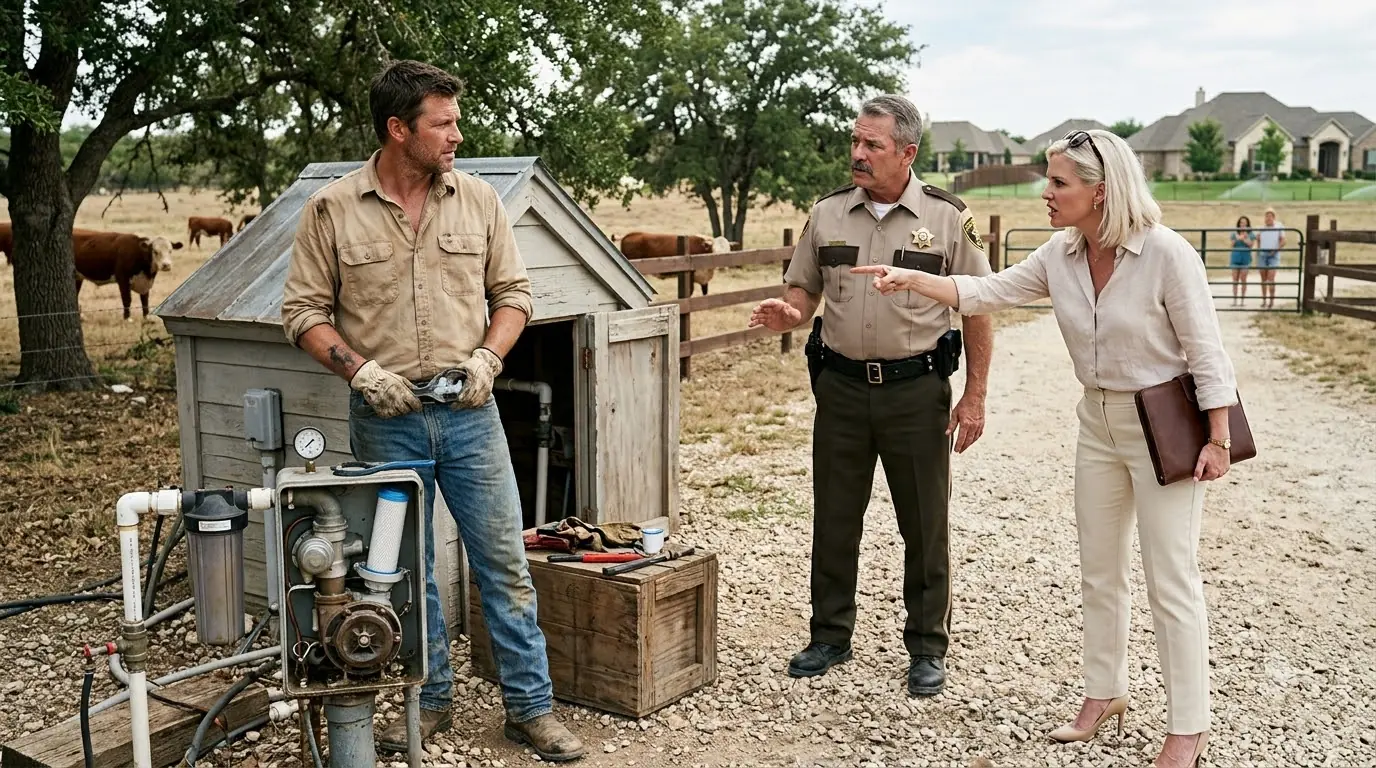
"I don't care. Sixty-two homes have no water because of you. My children can't bathe. My toilets won't flush, and you're standing there in your disgusting boots telling me about filters?"
"It's my property. My well. My pump."
"Your property?"
She laughed like I'd said something pitiful.
"Nobody cares about your sad little ranch. I already called 911. When they get here, you'll turn it on, or I'll make sure you never turn anything on again."
I turned it back on.
And that's when I discovered why sixty-two homes went dry the moment I shut off my own well.
A well they had no contract for.
No legal right to.
And no idea I'd spent ten years tracing stolen water for a living.
But let me back up, because this story doesn't start with a 911 call.
It starts with a well.
The well sat sixty feet behind my house, capped with a steel plate my grandfather welded himself in the summer of 1962.
He was a cattleman named Walter Whitfield who believed two things would outlast everything else in the Texas Hill Country: limestone and good water.
He was right about both.
Grandpa drilled down 312 feet into the Edwards Aquifer and hit a vein so clean the county tested it twice because they didn't believe the numbers.
That well fed our cattle, our garden, our kitchen sink, and every living thing on 1,200 acres of Blanco County ranchland for more than sixty years.
My father Earl built the rest of the system.
A six-inch main line ran north to south along the western ridge, with branch lines feeding every pasture, every trough, and every stock tank.
Dad mapped every foot of pipe by hand on graph paper.
He kept those drawings inside a fireproof cabinet beside his marriage certificate and the deed to the ranch.
That's how seriously he took it.
Water wasn't a utility in our family.
It was inheritance.
I came back two years ago after Dad died.
I'd spent a decade in Austin working as a civil engineer specializing in municipal water infrastructure, pressure systems, flow dynamics, and contamination tracing.
It was the kind of work where you spent your days making sure half a million people could flush their toilets without ever having to think about how the water got there.
I was good at it.
But when cancer took Dad in fourteen months, I drove home, buried him beside Mom beneath the live oaks, and never went back to the office.
The ranch needed me.
The mornings smelled like cedar smoke and wet limestone, and the evenings tasted like dust and diesel from the old tractor Dad had refused to replace.
One hundred eighty head of Hereford cattle needed me.
And Grandpa's well needed someone who understood what sixty years of mineral deposits, shifting aquifer pressure, and Hill Country summers could do to a pump system if you ignored it.
Ridgecrest Estates appeared nine years before I came home.
Sixty-two houses were built across four hundred acres of what used to be the Dawson Ranch next door.
The developer, a man named Glenn Caldwell, bought the property, bulldozed the mesquite, and dropped cookie-cutter houses onto half-acre lots.
There were HOA fees.
A clubhouse.
And a community swimming pool shaped like the state of Texas.
The brochures promised "Hill Country living with modern convenience."
What they didn't mention was where the water came from.
I first met Linda Caldwell on a Wednesday afternoon in March, three weeks after I moved back.
She came up my gravel drive in a white Cadillac Escalade so clean it looked like it had never touched a Texas road.
Linda stepped out wearing a linen sundress, Gucci sunglasses pushed into platinum-blonde hair, and heels that had no business being within a mile of a cattle ranch.
She was beautiful in the way a coral snake is beautiful.
The kind of pretty that makes you stop and look right before it reminds you why bright colors can be a warning.
Linda carried a leather portfolio with the Ridgecrest Estates HOA logo embossed in gold.
She smiled like we were old friends.
Then she opened her mouth.
"Mr. Whitfield, your cattle operation is producing odors that are affecting our residents' quality of life. I'm here to discuss solutions."
She said the word "solutions" the way a surgeon says "options."
Polite.
Clinical.
And carrying the implication that only one of those options involved survival.
I told her my family had been ranching this land since 1958 and the cattle weren't going anywhere.
Linda tilted her head.
Her smile widened, but it never reached her eyes.
She said she understood completely.
Then she clicked her heels back toward the Escalade, climbed inside, and disappeared down the drive in a cloud of limestone dust that settled over her spotless windshield like a warning she didn't bother to read.
The letters started the following week.
Official Ridgecrest Estates HOA stationery.
Cream-colored.
Watermarked.
Printed in a serif font that practically screamed, "We retained a graphic designer before we retained a plumber."
The first letter informed me that my perimeter fence was inconsistent with the aesthetic standards of the surrounding community.
My fence consisted of barbed wire stretched across cedar posts.
It had been there since 1974.
Ridgecrest had existed since 2015.
But Linda Caldwell operated on the principle that whoever printed the letterhead made the rules.
The second letter complained about dust.
According to Ridgecrest, my cattle walking across dry pasture created airborne particulate matter that was "degrading the respiratory environment of Ridgecrest residents."
I read that sentence three times.
I still couldn't decide whether it was a health complaint or a graduate thesis on the dangers of living beside dirt.
The third letter was my favorite.
It stated that my livestock were engaging in what the HOA described as "aggressive visual trespass."
Apparently, my Herefords had been standing near the fence line and looking toward Ridgecrest backyards in a manner several residents found intimidating and unsettling.
I walked into the pasture to investigate.
Fourteen-hundred-pound cows were chewing cud and blinking toward the horizon with the emotional intensity of stuffed animals.
If that was aggression, my herd deserved an award for subtlety.
Linda didn't stop with letters.
She called Blanco County Animal Control and reported my cattle as dangerous and uncontained.
An inspector named Phil drove out.
He walked the fence line, watched my cows eat grass for about four minutes, and told me he'd seen more threat in a church parking lot.
He left without issuing a single citation.
I watched his truck disappear down the caliche road and felt the familiar weight of dealing with somebody who treated petty complaints like artillery shells.
Two weeks later, Linda launched a full petition before the county zoning board.
She requested a livestock-density restriction on all properties adjacent to Ridgecrest Estates.
Linda wanted my herd capped at twenty head across 1,200 acres.
That's one cow per sixty acres.
A ratio so absurd the animal would practically die of loneliness before it found a blade of grass worth chewing.
She got thirty-four signatures.
Linda collected them by walking door to door through Ridgecrest with a bottle of wine in one hand and her leather portfolio in the other, smiling like she could charm a rattlesnake out of its skin.
Most people signed because agreeing with the HOA president was easier than arguing with a beautiful woman carrying Cabernet and a clipboard.
A few genuinely believed cow odor was a constitutional issue.
Almost nobody had actually read the petition.
But old Hank Morrison did.
Hank was my neighbor to the north, sixty-one years old, born on his ranch, still raising cattle the way his grandfather had taught him.
He brought me a copy and tapped signature number nineteen.
Gerald Faulkner.
A Ridgecrest resident who had died two years earlier from a heart attack in his kitchen.
His widow still lived in the house.
Gerald's handwriting did not still sign petitions.
"She forged a dead man's name," Hank said, leaning against my truck with coffee in one hand and sixty years of patience in the other.
"That woman could sell ice to a polar bear and make him feel guilty for not buying more."
I filed the suspected forgery with the county clerk.
Nothing came of it.
The petition itself died before the zoning board because the board had no authority to impose those rules on agricultural land that predated the subdivision by four decades.
Linda's response was a fifth letter.
This one requested that I replace my ranch gate with something "more welcoming to the community aesthetic."
My gate was a steel frame my father welded in 1991.
His initials were still stamped into the crossbar.
I hung Linda's letter on the refrigerator beside a photograph of Dad.
Then I went back to feeding cattle.
But something about the whole campaign bothered me beyond ordinary irritation.
It wasn't even the forged signature.
That was just Linda being Linda, a woman so devoted to control she had apparently drafted the deceased into her voter rolls.
What bothered me was the intensity.