The first frost came early that year, settling over the Jackson farm like a warning no one in town wanted to name out loud.
Mabel Jackson noticed it the way she always noticed things first—quietly, without telling anyone she already understood what was happening.
The orchard trees along the west slope were thinning again. Not dying. Not yet.
But losing something they should have been holding onto.
Water.
Or rather, the lack of it moving the way it should.
She stood at the edge of the north line, boots sinking slightly into damp ground that never quite dried right anymore. Two years now. Two years of watching the same failure repeat itself while men came and went with confident voices and empty answers.
Nelson. Briggs. Others she stopped remembering by name.
All of them had said the same thing in different words.
Bad luck. Hard season. Nothing to be done.
Mabel had stopped arguing with them.
But she had never stopped knowing where the problem lived.
That was the part that stayed with her at night.
The second drainage post on the north line still marked it—just a simple wooden stake now weathered gray, but beneath it, everything went wrong. The soil flattened there, too gentle a slope to carry water onward. Instead, it lingered, sank unevenly, and then left the west field drowning one season and starving the next.
She had dug it twice herself.
Both times alone.
Both times stopping when the trench became too deep, too wide, too impossible for one person to finish.
Both times covering it back up before anyone could see what she had done.
The sound of hooves came down the road late that April morning.
She didn’t look up right away.
Visitors were never good news anymore.
But the horse stopped anyway.
A man dismounted near the fence.
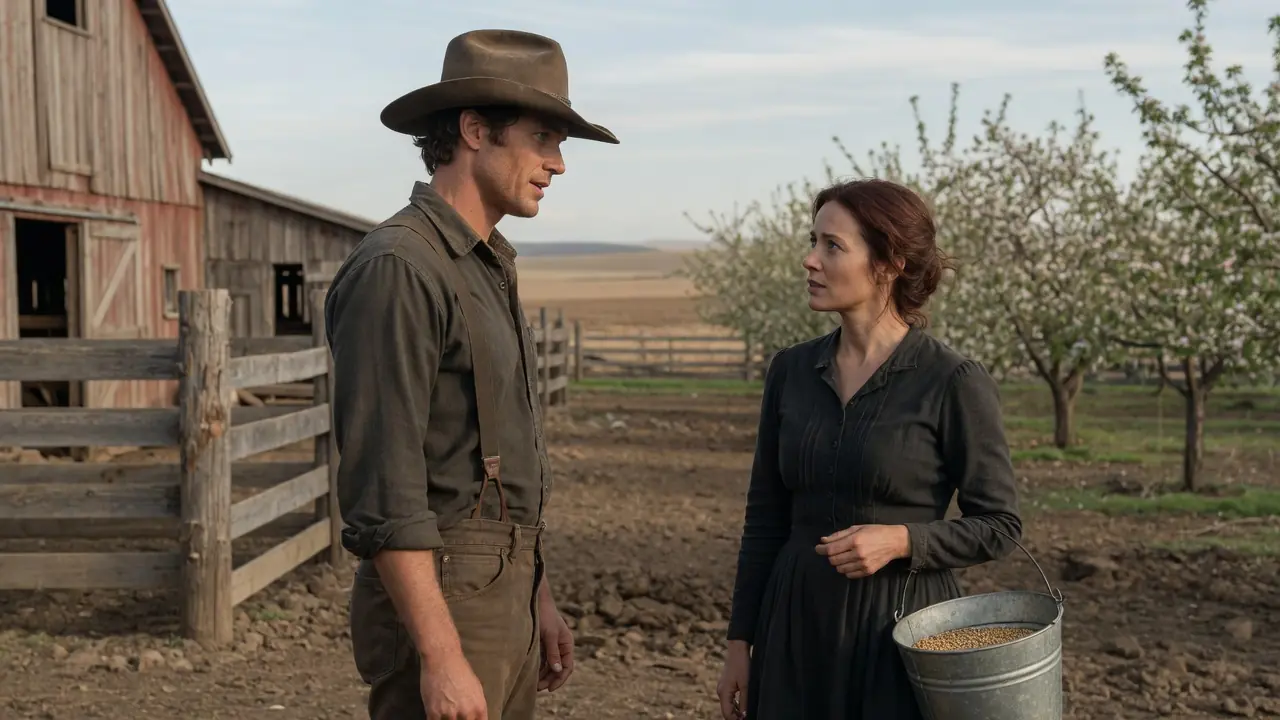
Not dressed like a buyer. Not like a banker. Not like any of the men who had already decided her land was cheaper than it should be.
He removed his hat.
“Name’s David Walker,” he said.
Mabel didn’t move.
“You here to tell me something’s wrong with my farm?”
A faint pause.
“I’m here because something already is.”
That made her look at him properly for the first time.
He wasn’t young, but he wasn’t worn down either. The kind of man who worked with problems instead of talking around them. His eyes didn’t drift across the orchard the way other men’s did. They stayed fixed where she pointed them.
That was new.
“You’ve had others,” he said.
“Yes.”
“And they missed it.”
She didn’t answer that.
Because it wasn’t a question.
David stepped closer to the fence line.
“I rode your north field this morning,” he said. “Water’s backing at the second post. Not guessing. It’s failing there.”
Mabel felt something tighten in her chest—not surprise, not exactly. More like recognition finally spoken out loud.
“That’s where I thought it was,” she said.
“It is.”
Silence stretched between them.
Then she asked, carefully, “What do you want for telling me that?”
He shook his head once.
“I don’t want your land.”
That was enough for her to stop doubting him.
Still, she didn’t open the gate right away.
Behind her, a boy appeared on the porch.
Thin frame. Serious eyes. Watching everything without saying anything.
Will.
David noticed him instantly, but didn’t shift his focus.
“I can fix it,” he said. “If you let me.”
“And then you leave?” she asked.
“That’s usually how it works.”
Something about the way he said it didn’t feel rehearsed.
Like leaving wasn’t the point.
Mabel studied him a long moment longer than was comfortable.
Then she stepped aside and opened the gate.
“You sleep in the barn,” she said. “You don’t ask for anything else.”
A pause.
“Agreed,” he said.
Will walked down from the porch and stopped beside his mother.
He looked at David with the kind of assessment that didn’t belong to a child.
“You know irrigation?” he asked.
David nodded slightly.
“I know enough to be dangerous.”
That earned the smallest flicker of interest from the boy.
“Good,” Will said. “Then you’ll learn faster.”
Mabel almost smiled at that. Almost.
They started work the first week of May.
Cold still clung to the soil in places, like the land hadn’t decided whether to trust spring yet.
David didn’t waste movement. Didn’t overexplain. He dug where Mabel told him to dig and stopped where she told him to stop. And when they reached the second drainage post, he didn’t pretend to search.
He just crouched, pressed his hand into the soil, and nodded.
“There it is,” he said.
Mabel crossed her arms.
“I told them that.”
He looked up at her then.
“You were right.”
That was all.
No correction. No lecture. No dismissal.
Just agreement.
It unsettled her more than any argument would have.
Will started working beside him by the second week, asking questions that David answered fully, without softening anything. Not simplified. Not watered down.
Mabel noticed that too.
Most men spoke to boys like they were fragile.
David didn’t.
He spoke to Will like he expected him to understand.
So Will did.
The north line came back first.
Then the west field followed like it had been waiting for permission to remember how to grow.
By June, water moved correctly again.
By July, the orchard stopped looking like it was holding its breath.
And by August, people in town began to notice.
Not loudly.
Not openly.
Just small shifts in conversation when Mabel walked through the general store. Slight pauses when David’s name came up. The kind of attention that meant people were recalculating what they thought they knew.
One afternoon, Julia from the fabric shop leaned over the counter.
“You’ve got folks talking,” she said lightly.
Mabel didn’t look up from the cloth she was folding.
“People always talk.”
“That man in your barn—”
“He’s fixing what others didn’t.”
Julia hesitated.
“That’s not what they’re saying.”
Mabel finally met her eyes.
“I didn’t ask.”
And that ended it.
But it didn’t stop it.
By harvest season, the orchard carried more fruit than it had in years.
Heavy branches. Clean air. Ground that finally behaved like it belonged to itself again.
Will moved through it like he’d always been part of it, carrying crates, climbing ladders, laughing sometimes when he forgot to be serious.
Mabel saw it once—just once—the way David looked at the boy when he wasn’t paying attention.
Not ownership.
Not distance.
Something steadier.
Like recognition.
After the harvest, David found her on the porch.
He didn’t stand far away like he used to.
“I’m staying,” he said.
Mabel didn’t respond right away.
“You said you’d leave.”
“I said I would when it was done.”
“And it’s done?”
He looked past her toward the orchard.
“For now,” he said.
A pause.
Then quieter:
“I want to stay on. Not as hired help.”
She turned slightly.
Will was somewhere behind the house, working on something he probably didn’t need help with anymore.
David continued.
“This land is stable now. But it needs someone who understands it. And I want to understand it the way you do.”
Mabel studied him carefully.
“You don’t even know me.”
His answer came without hesitation.
“I know your land. That’s enough to start.”
That wasn’t quite what she expected.
But it felt honest.
Still, she didn’t answer him right away.
Not until the wind shifted through the orchard and brought the smell of fruit and earth and something that felt like continuity instead of survival.
“You stay,” she said finally.
That was it.
No ceremony.
No conditions.
Just acceptance.
Months passed.
Seasons adjusted.
The town stopped calling the farm cursed.
Then stopped talking about it altogether.
As if it had never been failing in the first place.
One evening, near the end of the next harvest cycle, Mabel stood at the porch rail and watched Will and David working side by side in the fading light.
The rhythm of it felt familiar in a way she didn’t want to name.
David glanced up at her.
Not asking.
Just noticing.
“You ever regret it?” he asked quietly.
She considered the question.
Then shook her head.
“No,” she said. “I regret waiting so long to fix what I already knew.”
He nodded once, like that made sense.
Will called out from the orchard, asking a question about the east line.
David answered.
Mabel listened to both of them.
And for the first time in a long while, the farm didn’t feel like something she was trying to save alone.
It felt like something that had finally stopped slipping away.