For one suspended heartbeat, the remote Wyoming cabin became quieter than the snow-covered plains surrounding it. The beautiful American Woman stood close enough to feel the Cowboy’s breath, one hand gripping the front of his weathered leather coat while he fought the urge to pull her against him. At forty-two, the handsome American Cowboy was taller and broader than any man she had ever known, with powerful shoulders, a full dark beard, and intense blue eyes that carried years of loneliness. Yet the enormous hands resting stiffly at his sides trembled because he feared touching her far more than he had ever feared another man.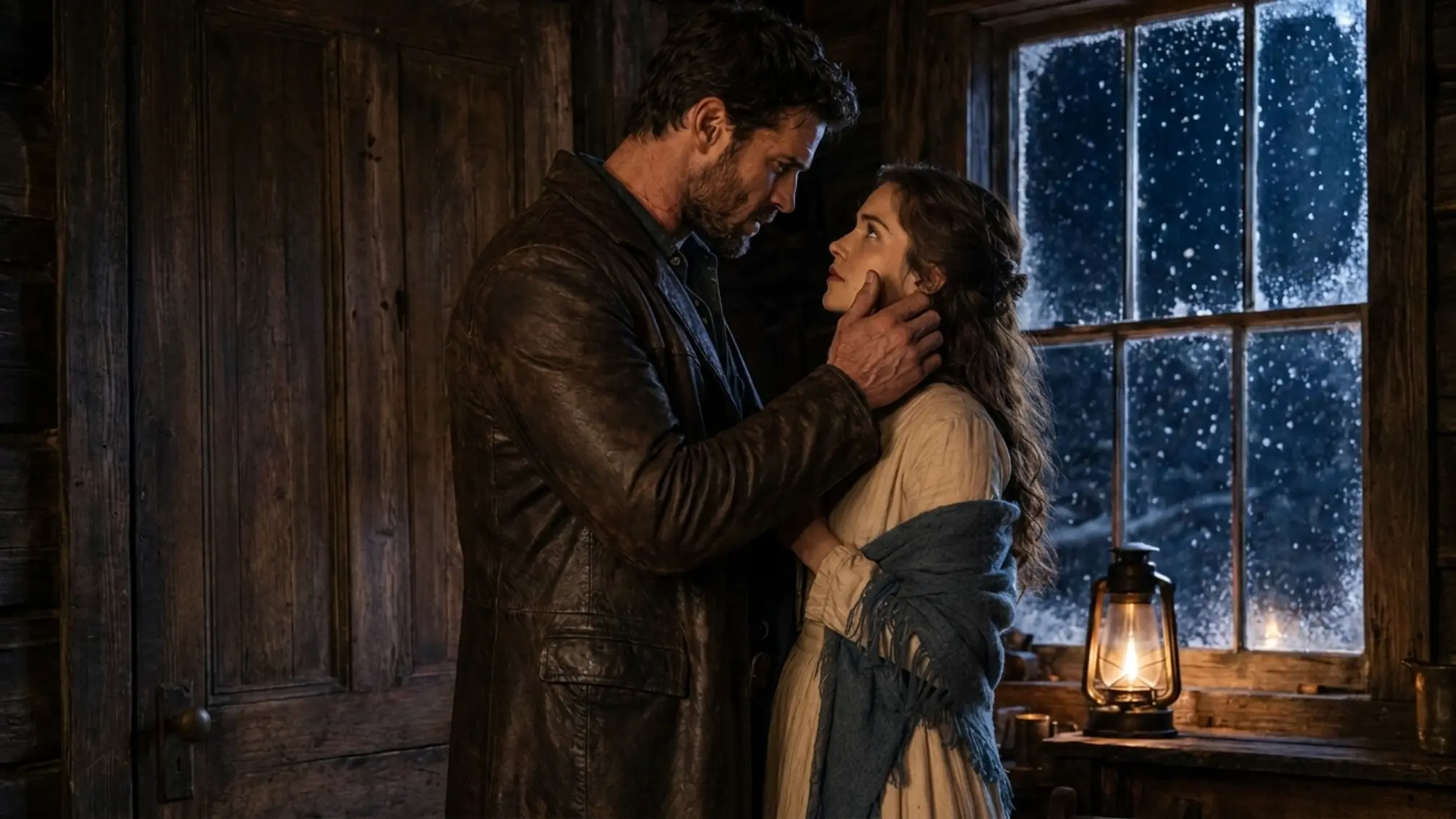
The Cowboy had spent his adult life being treated as a weapon. Ranchers hired him when cattle disappeared, frightened families called for him when criminals crossed the valley, and arrogant men challenged him simply to prove they were not afraid. By the time he became a single father, the frontier had already decided what kind of man he was. Dangerous, useful, and best kept at a distance.
His ten-year-old Son was the only person who had never feared him. The handsome American boy had inherited his father’s blue eyes but not his intimidating size, and he moved through the ranch with a quiet gentleness that reminded the Cowboy painfully of his late wife. She had died during a winter fever five years earlier, leaving father and son alone inside a house built for a family. Since then, the Cowboy had cared for the boy with fierce devotion while refusing to imagine that anyone else might stay.
The Woman arrived in the valley the previous spring to teach at the small frontier school. She was a beautiful twenty-eight-year-old American woman with clear fair skin, expressive hazel eyes, and long chestnut-brown hair that fell in soft waves whenever the wind loosened it from its pins. She possessed a graceful figure and gentle voice, but no one who mistook her kindness for weakness made that error twice. Within a month, she had challenged the town council over unsafe school walls, organized food for three struggling families, and taught the Cowboy’s Son to stop apologizing for speaking slowly when nervous.
The Cowboy first noticed her because his Son began smiling again. The boy came home carrying books, paper animals, and stories about a teacher who never laughed when students struggled. Soon the Cowboy found excuses to repair the schoolhouse steps, replace a broken window, and deliver firewood before winter. He told himself he was helping the entire town, but every visit ended with his eyes searching for the Woman.
She noticed him too.
The town described him as cold, yet she watched him kneel in freezing mud to free a calf trapped beneath a fence. People claimed he had no mercy, but she saw him leave flour outside an Old Widow’s door and ride away before being thanked. Men whispered about fights and scars, yet his voice always softened when speaking to his Son. The Woman understood that the Cowboy’s frightening reputation had been built from moments when he protected people who later found it easier to fear him than understand him.
Their friendship grew slowly. She ate supper at the ranch after tutoring his Son, and the Cowboy began sitting at the table instead of finding chores outside until she left. She repaired the boy’s torn coat, and the Cowboy built shelves for her classroom. Neither spoke openly about the tenderness growing between them, but the silence changed whenever their hands touched.
Three nights before the snowstorm, two drunken ranch hands cornered the Woman behind the general store. They mocked her for refusing one man’s invitation and blocked the narrow passage leading toward the street. Before she could push past them, the Cowboy appeared at the end of the alley. He said only one sentence.
“Move.”
The men laughed until he stepped closer.
No one in town saw exactly what happened after that. They only saw the two men leave with damaged pride, while the Cowboy walked the Woman safely home. He did not touch her, ask for gratitude, or speak of the confrontation. At her gate, he simply told her to lock the door.
The next morning, he avoided her.
He sent his Son to school alone and remained at the ranch despite needing supplies. When she visited that afternoon, he claimed a fence required attention and disappeared before she could question him. By the third day, the Woman understood that he was not ashamed of defending her. He was terrified by how natural it had felt to imagine her as someone he must protect.
That night, the snowstorm trapped her at the ranch after she finished tutoring his Son. The boy went to bed early, leaving the adults near the fire while wind pressed against the walls. The Cowboy stood beside the door and told her that once the storm weakened, she must return east. She deserved a respectable man, he said, someone whose life did not attract danger.
The Woman refused.
She had crossed the room, placed her hand against his chest, and told him that pushing her away was not protection. That was when he warned that he was too large, too rough, and too dangerous for her. He expected fear.
Instead, she said, “Try me anyway.”
Before he could answer, a gunshot exploded outside.
The lantern flame jumped as the bullet struck the wooden sign beside the porch. The Cowboy moved instantly, turning his body between the Woman and the window. He blew out the nearest lamp, pulled her behind the thick interior wall, and reached for the rifle secured above the door.
His Son appeared at the top of the stairs in his nightshirt. “Dad?”
“Back room,” the Cowboy ordered. “Take the Woman with you.”
The Woman refused to move. “Who is outside?”
Another shot struck the porch railing.
The Cowboy kept his voice low. “Men who want me to ride out angry.”
“Why?”
“Because angry men stop thinking.”
He opened the floor compartment beneath the table and handed the Woman a small revolver. She stared at it, surprised not by the weapon but by the trust implied. The Cowboy had never allowed anyone near the hidden compartment.
“Take my Son into the pantry,” he said. “There’s a reinforced door behind the flour shelves. Stay there until I come for you.”
“You said they might use me to reach you.”
“They will not get the chance.”
The Woman placed one hand over his wrist. “Neither will they draw you into the open alone.”
His jaw tightened. “This is not the schoolhouse. You cannot argue danger into behaving.”
“No, but I can recognize a trap.”
A voice called from beyond the porch. The speaker claimed the barn was burning and warned that the cattle would be lost if the Cowboy remained inside. Through the side window, an orange glow flickered against the snow.
The Cowboy started toward the back door.
The Woman caught his coat. “Wait.”
He looked down at her hand.
“The wind is blowing from the north,” she whispered. “Smoke should be crossing the yard.”
There was no smoke.
The orange glow came from a lantern placed behind red cloth near the barn wall. Someone wanted him outside, away from the cabin, while another man entered from the opposite side. The Cowboy looked at the Woman differently. She had seen in seconds what anger nearly made him miss.
A floorboard creaked beneath the rear window.
The Cowboy moved silently through the dark kitchen and waited beside the frame. A gloved hand pushed the window upward. When the intruder leaned inside, the Cowboy seized his coat and pulled him across the sill, dropping him hard onto the floor without firing a shot.
The man reached for a knife, but the Woman stepped from the darkness and pressed the revolver toward the floor beside his hand.
“Do not,” she said.
The intruder froze.
The Cowboy tied his wrists with rope and demanded to know how many men were outside. The captive laughed and said the ranch would belong to someone else by spring whether the Cowboy survived the night or not. That answer revealed more than the threat itself.
These men had not come merely for revenge.
The Cowboy searched the intruder’s coat and found a folded survey map. The northern section of the ranch had been marked in red, including a narrow pass where a railroad company was rumored to be considering a future route. Beside the property line appeared the seal of the county Land Commissioner.
The Woman recognized it immediately.
She had seen the same seal on documents recently delivered to the school board. The Land Commissioner claimed several valley properties had incomplete titles and required new registration fees. Families unable to pay had been pressured to sell their land cheaply to an unnamed buyer.
The Cowboy’s ranch was next.
A third gunshot came from the east side of the house, but this one was followed by hoofbeats moving away. The men outside had realized their partner was captured. The Cowboy wanted to pursue them, yet the Woman reminded him that leaving his Son, the prisoner, and the evidence would give the attackers another opportunity.
He remained inside.
By morning, the storm had weakened. The Cowboy rode to town with the prisoner tied securely behind another horse, while the Woman and his Son followed in the ranch wagon. She carried the survey map inside her coat.
The Town Sheriff met them outside the jail. He was an aging American lawman known for avoiding disputes involving wealthy ranchers and government officials. When the Cowboy explained the attack, the Sheriff looked uncomfortable rather than surprised.
“You have enemies,” he said. “A shot in the night does not prove a land conspiracy.”
The Cowboy placed the intruder’s knife and map on the desk.
The Sheriff barely glanced at them. “Could have been planted.”
The Woman stepped forward. “Then compare the seal with the registration notices in your office.”
The Sheriff’s expression changed. “This does not concern the schoolteacher.”
“It concerns every child whose family may lose a home.”
The Sheriff ordered her to leave the investigation to men. The Cowboy moved beside her, his size filling the room.
“She found the trap, recognized the seal, and stopped me from riding into an ambush,” he said. “You will listen.”
The Sheriff listened.
The seal matched official county records, but the map included private survey details not available to ordinary citizens. Only the Land Commissioner and his contracted surveyor possessed those measurements. The prisoner still refused to identify who hired him, until the Cowboy asked the Sheriff to examine a small silver token found in the man’s pocket.
The token belonged to the largest cattle company in the territory.
Its Owner had spent years buying struggling ranches around the proposed railroad corridor. The Cowboy had refused every offer. If his title could be questioned, his land might be seized through unpaid registration charges, then sold at auction to the cattle company before he could challenge the process.
The Land Commissioner arrived at the jail less than an hour later, claiming he had heard about the attack. He was a handsome, well-dressed American man in his fifties, with polished manners and a smile that never reached his eyes. He expressed concern for the Cowboy and immediately suggested the prisoner was a wandering criminal.
The Woman asked why a wandering criminal carried a confidential survey map bearing his official seal.
The Land Commissioner looked at her as though she were an irritating child. “A woman unfamiliar with legal documents might misinterpret many things.”
“I teach reading,” she replied. “Misinterpretation is not the problem.”
The Cowboy almost smiled.
The Land Commissioner claimed the seal had been forged. He insisted the Cowboy surrender the map for examination, but the Woman had already created a copy before leaving the ranch. She had traced every boundary, number, and notation while the Cowboy secured the prisoner.
When she revealed this, the Commissioner’s calm expression cracked.
That afternoon, the Sheriff searched the county records room. Several original property titles were missing, including the Cowboy’s deed and the deeds of seven families who had recently received registration demands. Replacement documents had been prepared with altered boundaries that transferred valuable land toward the proposed railroad corridor.
The scheme was larger than anyone expected.
The Cattle Company Owner financed the operation. The Land Commissioner altered deeds and created false fees. Men were sent to frighten ranchers into selling, while unexplained barn fires and livestock losses made the properties appear unprofitable. The Cowboy’s reputation created a special problem because intimidation did not work on him.
So they planned to provoke him into violence.
If he killed one of the intruders outside his cabin, witnesses would claim the men had approached peacefully about a land dispute. The Sheriff would be pressured to arrest him, his Son would be left without control of the ranch, and the Commissioner could place the property under temporary administration. The land would then be sold before the Cowboy could defend himself.
The Woman’s observation had prevented the entire trap.
The Cattle Company Owner was arrested two days later while attempting to leave the territory. His office contained copied deeds, payment records, and letters instructing hired men to create “incidents” on properties whose owners refused to sell. The Land Commissioner was removed from office and charged with fraud, conspiracy, and attempted theft of land.
The valley families recovered their original property boundaries.
Yet the Cowboy remained troubled.
The danger he had warned the Woman about had reached his home exactly as he predicted. A bullet had struck his porch while she and his Son stood inside. Instead of proving that she belonged with him, he believed the attack proved she must leave.
Three days after the arrests, he packed her trunk into the wagon.
The Woman found him tightening the straps.
“What are you doing?”
“Taking you back to town.”
“I did not ask to go.”
“You nearly died because of me.”
“No. I nearly faced danger beside you.”
His expression hardened. “You think courage makes you untouchable?”
“I think fear has made you dishonest.”
The Cowboy went still.
She stepped closer. “You are not sending me away because I am unsafe. You are sending me away because I saw you frightened, and now you cannot pretend you need no one.”
“I need my Son.”
“And he needs more than a father who believes love is a weakness enemies can exploit.”
The words struck deep.
His Son had been standing behind the barn door, listening. The boy emerged slowly and looked at his father.
“Is she leaving because of me?”
“No.”
“Because of Mom?”
The Cowboy could not answer.
The boy stepped toward the Woman and took her hand. “She does not make me forget Mom.”
The Cowboy looked away.
“She helps me remember without being sad all the time,” his Son continued. “And you laugh when she is here.”
The Woman’s eyes filled with tears.
The Cowboy removed his hat and pressed one hand across his face. For years, he had believed protecting his child required preserving the life they had before loss. Yet their empty house had not honored the dead. It had only taught the living to remain lonely.
“I am too old to promise I will become gentle overnight,” he said.
The Woman approached until only a breath separated them. “I never asked you to become someone else.”
“I have scars you have not seen.”
“I know.”
“I wake angry some nights.”
“Then wake me.”
“My enemies may not all be gone.”
“Then we face the next door together.”
His hands finally rose toward her waist, stopping before contact. Even now, he waited for permission.
The Woman placed both of his hands against her.
“Try me anyway,” she whispered again.
This time, he did.
He lowered his forehead to hers, then kissed her with a tenderness that contradicted every story the town had told about him. His enormous hands held her as though she were precious, not fragile. The Woman understood then that he had never feared his size.
He feared needing someone enough to be destroyed by losing them.
They married before spring.
The ceremony took place inside the repaired schoolhouse, surrounded by the valley families whose land had been restored. The Cowboy’s Son stood beside his father, holding the rings in a small wooden box. The Woman wore a cream dress and the blue shawl she had worn during the storm.
The Sheriff attended without his badge, ashamed that fear of powerful men had nearly made him ignore the truth. A new county records committee was formed, requiring two independent witnesses before any property boundary could be altered. Copies of every deed were placed in both the courthouse and the schoolhouse safe so no single official could erase ownership again.
The Woman remained the town teacher.
The Cowboy continued protecting the valley, but he no longer accepted every dangerous burden alone. When disputes arose, he brought evidence before strength. When frightened ranchers asked for help, the Woman often noticed the hidden pattern before anyone else.
His Son began calling her “Ma” one quiet evening while they repaired a broken chair together.
She did not ask him to repeat it.
The Cowboy heard from the doorway and turned away long enough to hide the tears in his eyes. Later that night, he thanked her for choosing a life he had tried so hard to deny her.
“I did not choose your danger,” she said. “I chose you.”
Years afterward, people still repeated the story of the winter night when the valley’s most feared Cowboy warned a beautiful schoolteacher that he was too big and too dangerous for her. They told how a gunshot interrupted their first confession and exposed a conspiracy that nearly stole half the valley.
But those closest to them understood the real story.
The Woman did not tame the Cowboy.
She proved he never needed taming.
Beneath the size, scars, and reputation was a devoted American single father who had spent years believing love could only create another target. She showed him that the right partner did not stand behind him waiting to be protected.
She stood beside him, looked directly at everything he feared, and chose him anyway.