The wind came hard across the Wyoming frontier that evening, rattling the shutters of Caleb Hart’s cabin and pushing thin dust under the door. Outside, the last light faded behind the cliffs, leaving the pasture, the corral, and the narrow trail to Cheyenne washed in gray. Caleb stood beside the fire with his rifle still leaning against the wall, his broad shoulders tense beneath a worn brown shirt. Across from him, Clara Whitmore held his heavy wool coat around her body, her pale face calm but her hands still trembling from what had almost happened outside.
Only an hour earlier, three men had ridden up to the cabin claiming Clara owed money to a boardinghouse owner in Cheyenne. They carried a signed paper, but Caleb knew the look of men who used paper as a weapon. Clara had not hidden behind him when they came. She had stepped beside him, lifted her chin, and told them that no contract written with threats could own her future.
Caleb had fired one warning shot into the ground when one of the riders reached for her arm. The horses had reared, the men had cursed, and the valley had swallowed the echo. They left with threats on their tongues, promising to return with more men and less patience. Caleb watched them disappear beyond the ridge, knowing the matter was not finished.
Clara followed him back into the cabin without asking whether she was safe. She already knew safety on the frontier was never a promise; it was something people defended one breath at a time. The fire cracked softly while the storm wind pressed against the walls. Caleb removed his hat and set it on the table, but he did not sit. He looked too large for the room, too restless, too afraid of something that had nothing to do with the men outside.
Clara studied him from near the hearth. Caleb Hart was a rugged American cowboy, built like the mountains behind his land, with weathered hands, tired blue eyes, and a face shaped by work, weather, and grief. Men in town called him strong, but Clara had learned that strength could hide fear just as easily as weakness could. Tonight, she saw the fear clearly.
“You should sleep,” Caleb said without looking at her. Clara almost smiled at the foolishness of it. “You expect me to sleep after men came to drag me back to Cheyenne?” His jaw tightened, and he turned toward the window. “No. I expect you to understand this cabin may not be the safest place for you anymore.”
Clara took one step closer. “You drove them away.” Caleb gave a dry laugh, but there was no pride in it. “For tonight. Next time there may be six. Or ten. Men like that don’t come back with shame; they come back with anger.” His hand flexed once near his side, as if remembering the rifle.
Clara knew this was not only about danger. She had seen the same distance in him before, in quieter moments, when she laughed too close to him or when her fingers brushed his at the table. Caleb would protect her from every man in Wyoming, but he would not let himself believe she might choose him. He was brave against rifles, horses, storms, and hunger, yet terrified of being loved.
“You want me gone,” she said softly. Caleb’s shoulders stiffened. “I want you alive.” Clara moved nearer until the firelight touched both their faces. “That is not the same thing.” He finally looked at her, and the pain in his eyes nearly stole her next breath.
Caleb had found Clara three weeks earlier on the road north of Cheyenne, walking alone with a torn valise and dust on her skirt. She had been hired as a seamstress in a boardinghouse, but the owner had taken her wages, charged her for food, and claimed she owed more than she could ever repay. When Clara refused to sign a longer contract, the woman sent men after her. Caleb had brought Clara to his cabin only because a storm was coming, but one night became three, then ten, then enough time for silence to grow into something neither of them named.
She had cooked in his small kitchen, mended his torn shirts, helped feed the horses, and planted late beans near the south wall because she said even hard land deserved a chance. Caleb had pretended not to care about the beans. But every morning, Clara saw him check the soil before he saddled his horse. He was a man who noticed everything and admitted almost nothing.
Clara had also noticed the way he spoke about himself. Too rough, too old in the soul, too scarred, too used to living alone. He said it as if each word were a fact carved into stone. Clara heard something else beneath it. She heard a man asking permission to remain lonely because hope frightened him more than hardship.
“Clara,” Caleb said, his voice low, “I am not the kind of man a woman dreams about.” She stepped closer again. “You don’t know what I dream about.” His eyes darkened. “I know what I am.” He glanced down at his large hands, scarred across the knuckles from years of work and trouble. “I know what these hands have had to do to survive.”
Clara followed his gaze. Those same hands had covered her shoulders with a blanket when fever took her the first week. They had carved a new handle for her sewing box when the old one broke. They had set bread on her plate first, though he pretended it was only because she was closer to the stove. She had no fear of those hands.
“You think I only see the scars,” she said. Caleb looked away. “You should.” Clara reached out and touched his wrist. His whole body went still. “I see the man who stopped outside Cheyenne because a stranger was walking alone in a storm.”
Caleb swallowed hard. “Any decent man would have done that.” Clara shook her head. “No. Many men passed me that day. You stopped.” Her fingers moved from his wrist to his palm, and he let her turn his hand over as if the choice had left him. “You keep saying you are dangerous, Caleb, but danger has never been what I felt with you.”
His breathing changed. The cabin seemed smaller around them, filled with firelight, wind, and words both of them had avoided for too long. Caleb gently pulled his hand back, not harshly, but like a man saving himself from something he wanted too badly. “You don’t understand what you’re asking.”
“I haven’t asked yet,” Clara said. His eyes lifted to hers. There was surprise there, and something else. Something lonely enough to make her chest ache.
Caleb turned away and paced toward the table. “I’m too big for you,” he said at last, the words rough and strained. “Too rough, too hard, too used to standing between people and trouble. I don’t know how to be soft the way you deserve.” He stopped near the chair by the fire, both hands braced on the back of it. “I don’t want to hurt you, Clara.”
For a moment, Clara said nothing. The words were clumsy, but she understood their shape. He was not speaking only of his body, though he was much larger than her. He was speaking of his life, his grief, his past, his fear that everything about him was too heavy for a woman who still carried gentleness like a flame in both hands.
Then Clara crossed the room. Caleb looked up, startled, when she came close enough to touch him again. He opened his mouth, maybe to warn her, maybe to step away, but she did not give him room to hide. With careful courage, she climbed onto his lap as he sank back into the chair, placing both hands against his chest while his arms hovered uncertainly at her sides.
“Clara,” he breathed, frozen. She looked into his eyes, close enough to feel the unsteady rhythm of his heart. “Try me anyway,” she whispered. The words were soft, but they struck through every wall he had built.
Caleb’s hands remained lifted, afraid to settle on her waist. “You don’t know what loving a man like me will cost.” Clara rested her palm over his heart. “Then let me learn the cost beside you, not from the other side of a closed door.” His eyes searched hers as if he expected to find fear hiding there. She let him look as long as he needed.
The fire popped, sending a small burst of sparks up the chimney. Outside, wind pushed against the cabin, but inside, the room had gone still. Caleb finally lowered his hands, not gripping, not claiming, only holding her carefully as if she were something precious he had no right to touch too quickly. Clara felt the tremor in his fingers and understood that this strong man was afraid of hope.
“I have lived alone a long time,” he said. Clara nodded. “I know.” His voice broke slightly. “Sometimes I don’t know how to talk without sounding like I’m giving orders.” She smiled gently. “Then I’ll tell you when you’re doing it.”
A small sound left him, almost a laugh, almost pain. “You would.” Clara’s thumb brushed his shirt where his heartbeat struck beneath it. “Yes. And you will listen, because you are not as impossible as you pretend.” His mouth softened, and for the first time that evening, the hard line of his face eased.
Caleb lifted one hand to her cheek, stopping just before touching her. Clara leaned into his palm so he would not have to ask permission with words. His hand was rough, but his touch was careful, almost reverent. “I don’t want to be another cage,” he whispered. Clara’s eyes warmed. “You opened the door when I had nowhere else to run.”
His forehead lowered until it rested lightly against hers. Neither of them moved for a long moment. It was not a perfect moment, and it was not without fear. Men were still out there somewhere beyond the ridge, and the world still had teeth. But for the first time, Caleb let himself believe that being loved did not mean being trusted with something fragile; it meant being trusted to stand honestly beside someone strong.
Clara stayed in his lap while the fire burned lower, not because the moment needed to become anything more, but because both of them needed to feel that neither was leaving. Caleb held her with increasing steadiness, one arm around her back, the other hand resting near her shoulder. His chin brushed her hair, and his breathing slowly matched hers. The cabin, which had felt like a hiding place for years, began to feel like a home trying to remember its purpose.
Near midnight, Caleb finally spoke. “If they come back, I want you in the cellar.” Clara lifted her head and gave him a look that made him stop. “We just had this conversation.” His jaw worked, but this time the command did not come. He sighed. “Then at least let me put the heavier bar across the door.”
“That I will allow,” Clara said. He looked at her, and a reluctant smile touched his mouth. It was small, but it changed his face so much that Clara felt suddenly shy.
The next day, they prepared. Caleb reinforced the shutters, stacked water, checked his ammunition, and moved the horses closer to the rock wall. Clara packed food, rolled bandages, sharpened the kitchen knife, and placed the important papers from Cheyenne into a tin box beneath the floorboard. She would not let anyone erase the proof of what had been done to her.
By afternoon, Samuel Reed arrived from the north ridge. He was an older American rider with gray in his beard and the watchful eyes of a man who had seen too many bad contracts enforced with guns. Caleb did not trust him at first, but Samuel brought information, not demands. He told them the boardinghouse owner had hired more men and that the riders planned to come before dawn.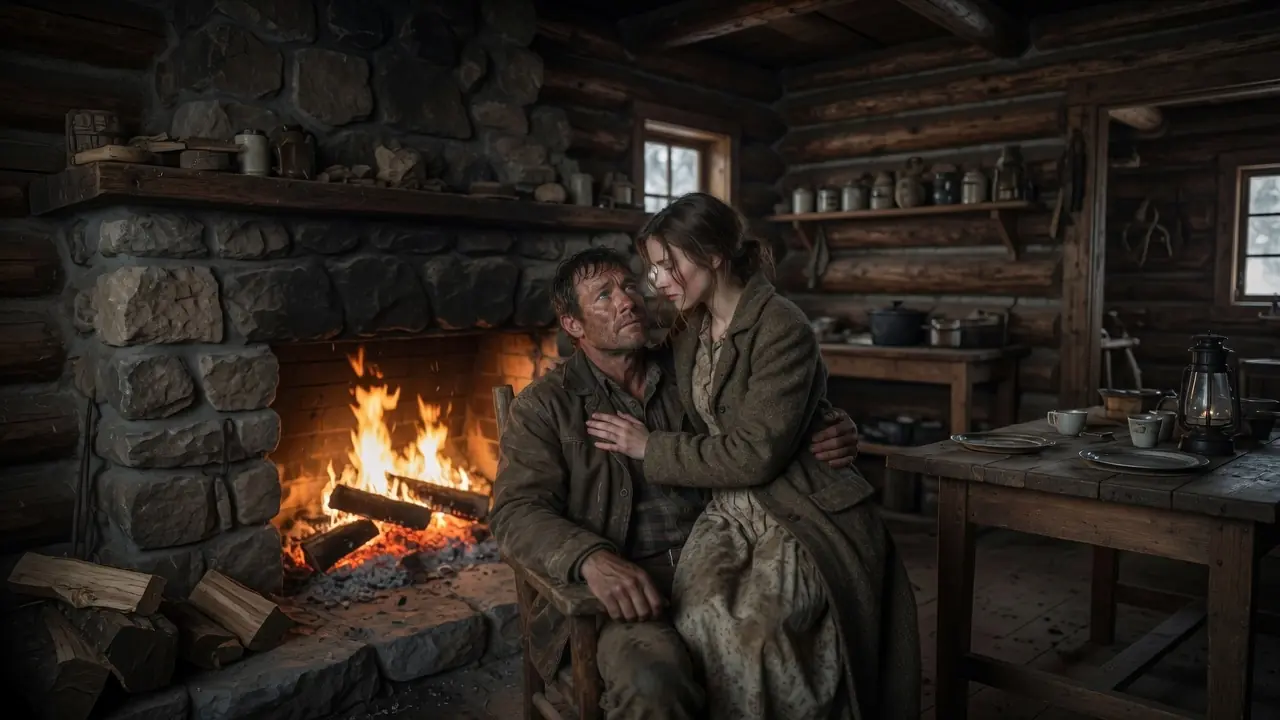
“They’ll expect you to run,” Samuel said, looking at Clara. She tied a strip of cloth around her wrist, keeping her expression calm. “Then they will be disappointed.” Samuel studied her for a long moment, then nodded once. “Good. People like that count on fear doing half their work.”
Caleb leaned against the cabin post, arms crossed. “And what do you get for helping?” Samuel adjusted his hat. “A little balance in a crooked world.” Caleb did not smile. “That sounds expensive.” Samuel shrugged. “So is doing nothing.”
That night, Clara and Caleb sat side by side near the fire. No one spoke of the lap, the whisper, or the way everything between them had changed, but it lived in the space between their shoulders. Clara mended a torn seam in Caleb’s coat while he cleaned the rifle. Once, his hand brushed hers as he reached for a cloth, and instead of pulling away, he let his fingers rest there for one steady second.
Before dawn, the riders came. There were six of them this time, moving through the pale gray light with their hats low and their horses spread wide. Samuel had circled behind them in the dark, cutting off the trail back toward the pass. Caleb watched from the doorway, Clara standing beside him with her coat buttoned and her chin lifted.
The lead rider called out, “Send the girl out, Hart, and nobody has to bleed.” Caleb’s face hardened. Clara stepped forward before he could answer. “I am not a girl. I am not property. And I am not going back.” Her voice carried across the yard with surprising strength.
One rider laughed, but it died quickly when Samuel appeared on the ridge behind them. Caleb raised the rifle, aiming at the ground, not a man. “You heard her.” The leader spat into the dirt. “You think this ends because she found a cowboy to hide behind?”
Clara moved down from the porch until she stood even with Caleb. “I am not behind him.” The words silenced the yard for one sharp second. Caleb did not look at her, but she saw his hand tighten around the rifle. He had heard her, and something in him stood taller.
The fight did not become a massacre. Caleb fired two warning shots, Samuel took one horse loose with a rope, and Clara knocked a burning torch into the mud before it reached the dry woodpile. One man tried to grab her sleeve, but Caleb caught his wrist and twisted him down without drawing blood. Clara stepped close enough to meet the man’s eyes and said, “Tell Cheyenne I do not belong to them.”
The riders broke when they realized the cabin was not frightened. Men who make their living threatening the vulnerable often lose courage when the vulnerable stand together. They cursed, gathered themselves, and rode back toward the pass with Samuel trailing them long enough to make sure they kept moving. When the last hoofbeats faded, the valley seemed to exhale.
Caleb turned toward Clara immediately. “Are you hurt?” She shook her head, though her sleeve was torn and mud streaked her dress. His hands hovered near her shoulders, checking without touching too hard. “You ran toward a torch,” he said, half angry, half terrified. Clara lifted one brow. “You stood in front of a pistol.”
“That is different.” “Only because you were the one doing it.” He stared at her, then let out a rough breath and pulled her carefully against his chest. This time, he did not hesitate.
Clara closed her eyes as his arms wrapped around her. He held her like a man holding onto the first solid thing after years at sea. His chin rested against the top of her head, and she felt him shake once, just once, before he steadied himself. She did not mention it. Some moments deserved protection.
When Samuel returned near noon, he found them repairing the broken gate together. He looked from Caleb to Clara and gave a faint smile under his hat. “Looks like the cabin still stands.” Clara looked at Caleb. “It does.” Caleb met her eyes. “It will.”
Samuel stayed for coffee, then rode out before evening, promising to send word if trouble stirred again. Clara watched him disappear through the trees, then turned back to find Caleb standing near the porch with two small bean sprouts in his palm. The storm had damaged the row she planted, but not destroyed it. He looked almost embarrassed to be holding them.
“They lived,” he said. Clara smiled. “Some things do.” Caleb knelt and replanted them near the wall, pressing soil around the roots with hands large enough to break bones and gentle enough to save a seedling. Clara watched him and thought again of his warning. Too big, too rough, too scarred, too much. She knew now that the truth was different.
Weeks passed, and the men from Cheyenne did not return. Legal word came through Samuel that the boardinghouse owner had fled after another woman spoke up. Clara’s name was cleared, though the paper meant less to her than the life she had already begun building. Freedom, she learned, was not only leaving a cage; it was choosing where to stay.
Caleb changed slowly. He still woke before dawn, still checked the ridge, still spoke carefully when feelings came too close. But he smiled more often, asked Clara what she thought before making decisions, and stopped pretending he did not like when she sat near him by the fire. At night, when wind moved against the shutters, he reached for her hand without apology.
One evening, Clara found him standing outside beside the corral, watching the sunset turn the Wyoming hills a deep rust color. She walked up beside him, and he took her hand naturally, as if he had done it all his life. “I was thinking,” he said. Clara smiled. “That sounds dangerous.”
He looked down at her with a tenderness that still surprised him. “I was thinking the cabin needs another room.” Clara’s breath caught, though she kept her voice light. “For supplies?” Caleb’s thumb moved over her knuckles. “For a future, if you want one here.”
Clara looked at the cabin, the fence, the beans by the wall, and the man beside her who had stopped using fear as an excuse. “I already chose one here,” she said. Caleb turned fully toward her, his blue eyes bright in the fading light. “With me?”
Clara stepped closer, the same way she had on the night he tried to push her away. “With you.” Caleb lowered his forehead to hers, and this time there was no warning, no retreat, no claim that he was too much. There was only a man learning he could be loved, and a woman brave enough to stay while he learned.
By winter, the new room stood against the south side of the cabin. Caleb built the frame, Clara painted the shutters, and together they hung a small shelf for her sewing box and books. The land remained hard, the work remained endless, and danger remained part of frontier life. But inside that cabin, love stopped feeling like a risk and began feeling like a promise they practiced daily.
Years later, when people in the valley told the story, they liked to speak about the riders, the warning shots, and the woman who refused to run. Caleb told it differently. He said the bravest thing he had ever seen was not Clara facing armed men in the snow. It was the night she climbed onto a frightened cowboy’s lap, placed her hand over his heart, and dared him to believe he was worthy of being chosen.
Clara always laughed when he said that, but she never corrected him. She knew the truth of that night better than anyone. Caleb had warned her he was too big, too rough, too broken, and too dangerous for her. And she had answered with the only words strong enough to open the rest of their lives.
“Try me anyway.”