Everyone in Courtroom 4B went quiet when Maya Daniels was brought through the side door in handcuffs.
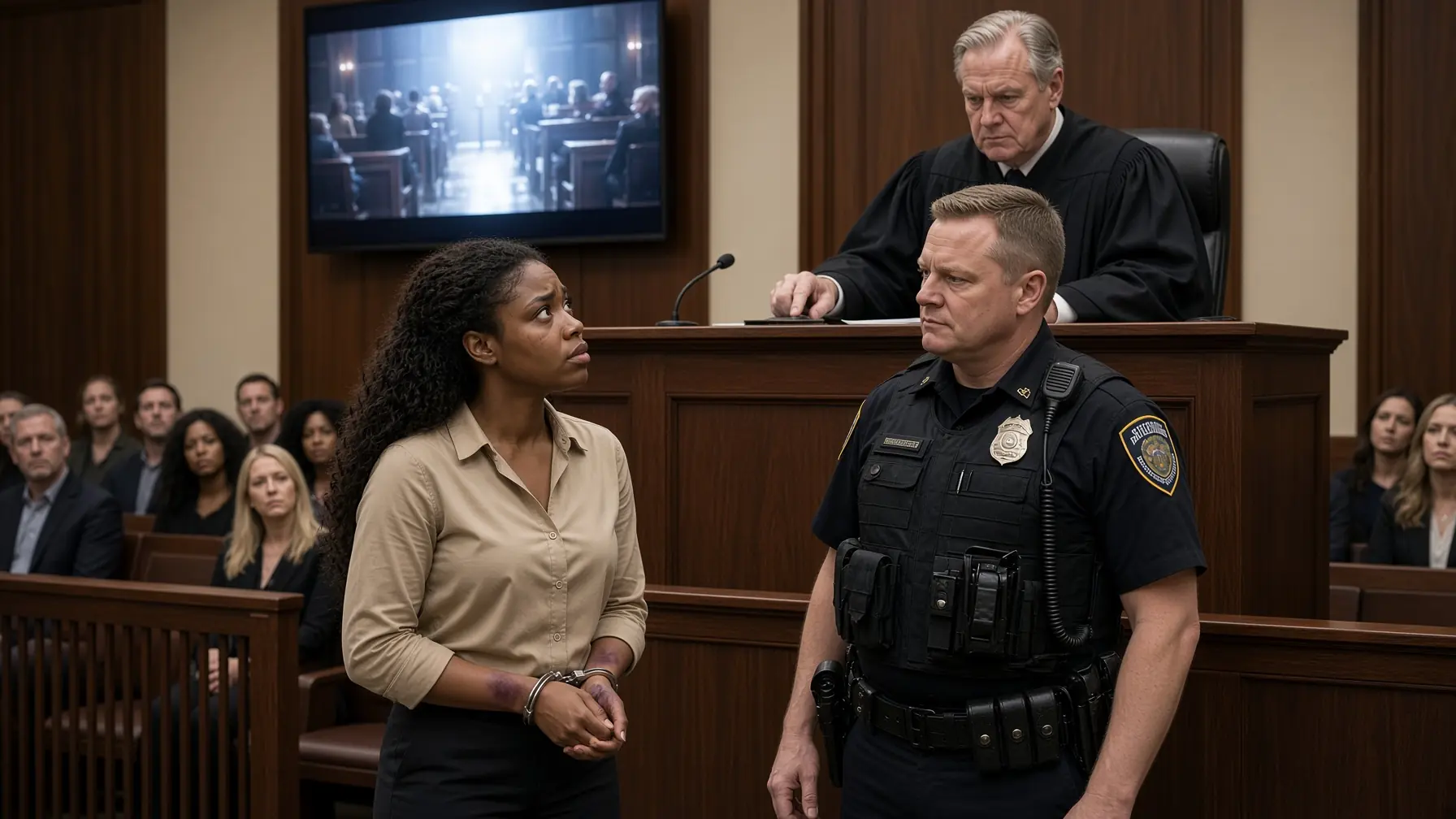
She was twenty-four years old.
Black.
Five-foot-four.
Still wearing the navy scrubs she had put on before sunrise for her shift at St. Matthew’s Hospital cafeteria.
Her hair had been pulled into a neat bun when she left home.
Now loose strands clung to her cheeks.
Her left sleeve was torn at the elbow.
She kept tugging both sleeves lower, trying to hide the marks around her wrists.
It did not work.
Judge Harold Vance saw them.
So did half the gallery.
Purple-red bruises circled both wrists.
One had already begun swelling beneath the metal cuff.
Officer Dale Kirchner stood near the prosecutor’s table.
Forty-three.
Twelve years on the department.
Broad shoulders.
Gray beginning at his temples.
His uniform was immaculate.
He looked relaxed.
Almost pleased.
The charging document accused Maya of resisting arrest and obstructing an officer.
Nothing else.
No theft.
No drugs.
No assault.
No traffic offense.
Just resisting the arrest that apparently existed because she had resisted it.
Judge Vance read the report twice.
Then looked over his glasses.
“Officer Kirchner.”
“Yes, Your Honor.”
“You wrote that Miss Daniels became physically aggressive during a lawful detention.”
“Yes, sir.”
“What was the basis for the detention?”
Kirchner stood straighter.
“She matched the description of a suspicious person reported near several parked vehicles.”
Maya’s head snapped up.
Her public defender, Caroline West, placed a hand gently on her arm.
The judge noticed.
“What description?”
Kirchner replied:
“Black female. Dark clothing. Backpack.”
Maya whispered:
“I didn't have a backpack.”
The courtroom was quiet enough that Vance heard her.
“So I gather.”
Kirchner continued:
“When I approached, she immediately became argumentative.”
“What did she say?”
“She challenged my authority and refused commands.”
Maya’s voice trembled.
“I asked why I was being stopped.”
Caroline stood.
“Your Honor, my client’s position is that she complied throughout the encounter and was taken to the ground after asking the officer to explain the detention.”
Kirchner almost smiled.
“That is not what happened.”
Judge Vance looked at him.
Then at the evidence list.
There were only three entries.
Kirchner’s written report.
A forty-second body-camera clip.
And several still photographs of Maya after booking.
Vance frowned.
“Forty seconds?”
The assistant district attorney, Priya Raman, looked uncomfortable.
“That is what was uploaded to the prosecutor portal, Your Honor.”
Vance turned back to Kirchner.
“Officer, is this your body-camera footage?”
“Yes.”
“The complete recording?”
Kirchner hesitated.
“It’s the relevant portion.”
“That was not my question.”
Silence.
Then:
“There were technical problems with the earlier upload.”
Judge Vance stared at him for several seconds.
Then nodded toward the clerk.
“Play what we have.”
The screen behind the witness stand turned blue.
Then black.
Then the image appeared.
Sidewalk.
Morning sunlight.
A patrol car hood.
Maya standing several feet away with her hands open.
Her voice came through the courtroom speakers.
“Officer, I’m asking why I’m being stopped.”
Kirchner’s recorded voice:
“Stop talking.”
“I’m trying to understand—”
“I said turn around.”
“But what did I—”
Kirchner crossed the distance.
Fast.
His left hand seized Maya’s upper arm.
She stumbled.
“Don't touch me! What are you doing?”
“Stop resisting.”
“I’m not resisting!”
Then he twisted her arm behind her.
Maya cried out.
He drove her downward.
Her knee struck concrete first.
Then her shoulder.
Then her cheek.
A woman in the gallery covered her mouth.