When I woke up after working all night, my marked police cruiser was gone from my driveway.
At first, I honestly thought I was still half asleep.
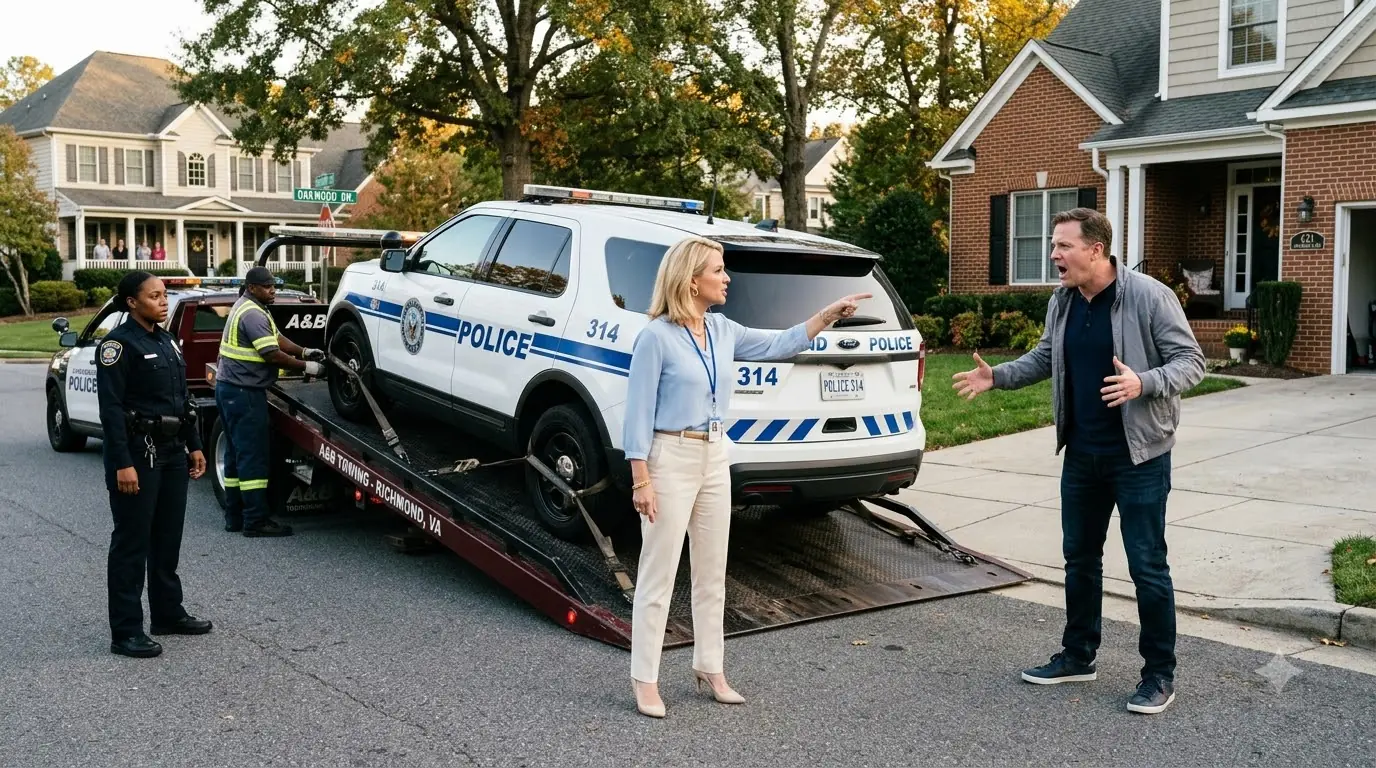
I stood at the upstairs bedroom window looking down at the empty concrete rectangle where unit 3187 should have been parked.
Nothing.
No white Ford Police Interceptor.
No blue Richmond Police striping.
No city seal on the front doors.
No light bar.
No word POLICE stretched across the rear quarter panels.
Just an oil-darkened patch of concrete and two faint tire marks leading toward the street.
I looked at my phone.
3:07 p.m.
No missed call from fleet services.
No message from my sergeant.
No email about maintenance.
No department notification.
I went downstairs barefoot, opened the front door, and walked into the driveway as if the cruiser might somehow become visible from a different angle.
It did not.
My name is Walter Hayes.
I was forty years old and had been a patrol officer for the Richmond Police Department for eleven years when somebody decided to tow a marked city police vehicle out of my own driveway.
That somebody was Karen Stevens.
She had moved into Riverside Gardens three months earlier.
By the time she was finished, one tow truck, one HOA rule, and her absolute certainty that nobody could tell her no would turn a neighborhood parking dispute into a city property investigation, a criminal case, an HOA revolt, and the most expensive lesson she had ever learned about the difference between authority and imagination.
The bizarre part was that none of it needed to happen.
For six years, my patrol vehicle had sat in that driveway without a single complaint.
My department assigned take-home units to certain patrol officers based on shift, assignment, and operational need.
The point was practical.
A marked vehicle already near the officer reduced response time if an emergency callout happened before or after shift.
It increased police visibility.
It also saved unnecessary trips to retrieve equipment when an officer was called in unexpectedly.
My unit was not my personal vehicle.
It belonged to the city.
Fuel card belonged to the city.
Computer belonged to the city.
Radio equipment belonged to the city.
Even the emergency trauma kit in the rear cargo area was inventoried property.
I was simply its assigned operator.
That distinction would become extremely important.
Riverside Gardens was a subdivision on the western side of Richmond consisting of a little over two hundred homes arranged around three curved streets, two retention ponds, a playground, and a small clubhouse that nobody used except during HOA meetings and children’s birthday parties.
The neighborhood had been developed around 2010.
Most of the houses were similar.
Brick fronts.
Two-car garages.
Small fenced yards.
Trees that had finally grown large enough to make the streets look established instead of newly planned.
I bought my house after my divorce.
Nothing extravagant.
Three bedrooms.
Small office.
Enough garage space for my personal pickup and tools.
The patrol car stayed outside because department policy required easy access, and because filling the garage with both vehicles would have required the organizational skills of an aircraft carrier.
Nobody cared.
My neighbor to the left, Harold Greene, was a retired electrician.
His wife, Denise, taught second grade.
Across the street lived James and Monica Alvarez with three children who treated my patrol car like part of the neighborhood scenery.
When their youngest boy was six, he once asked if the blue emergency lights could be turned on for his birthday.
I told him no.
He asked whether red lights were negotiable.
They were not.
The HOA had rules about vehicles.
No semitrailers.
No permanently parked RVs on streets.
No commercial vehicles over a certain weight in residential driveways.
No vehicles with large advertising wraps stored overnight unless they fit inside garages.
The intent was obvious.
They did not want delivery trucks, landscaping dump trucks, or mobile construction equipment becoming permanent neighborhood fixtures.
Emergency and government vehicles were expressly excluded from several provisions, and even where the documents were less explicit, the management company had treated police, fire, utility, and municipal vehicles as exempt for years.
There were two other public employees in Riverside Gardens.
One county utility supervisor occasionally brought home a marked pickup.
A fire captain sometimes parked an official SUV at his house during on-call rotations.
Nobody had ever pretended either was a landscaping truck.
Then Karen Stevens bought 1847 Riverside Gardens Drive.
Four houses down from me.
Karen was fifty-two.
Golden-blonde hair cut into a stiff shoulder-length style.
Large sunglasses.
Perfect lawn.
Perfect shutters.
Perfect front porch that nobody seemed allowed to sit on because sitting might disturb the cushions.
Her husband, Robert, traveled frequently for work and kept mostly to himself.
Karen did not.
Within two weeks of moving in, she attended an HOA meeting.
Within six weeks, she joined the board after one member resigned for health reasons.
Within two months, she had convinced the other directors to make her board president because the previous president, a quiet accountant named Andrew Price, openly admitted he was tired of people emailing him photographs of trash cans.
Most homeowners did not vote.
That was how Karen became president.
Apathy is one of the strongest political forces in suburban America.
Her first project involved trash cans.