In a bustling restaurant, young waitress Lyra was weaving between tables when she suddenly noticed a frail elderly woman near the entrance, mute, confused, and unable to communicate with anyone around her.
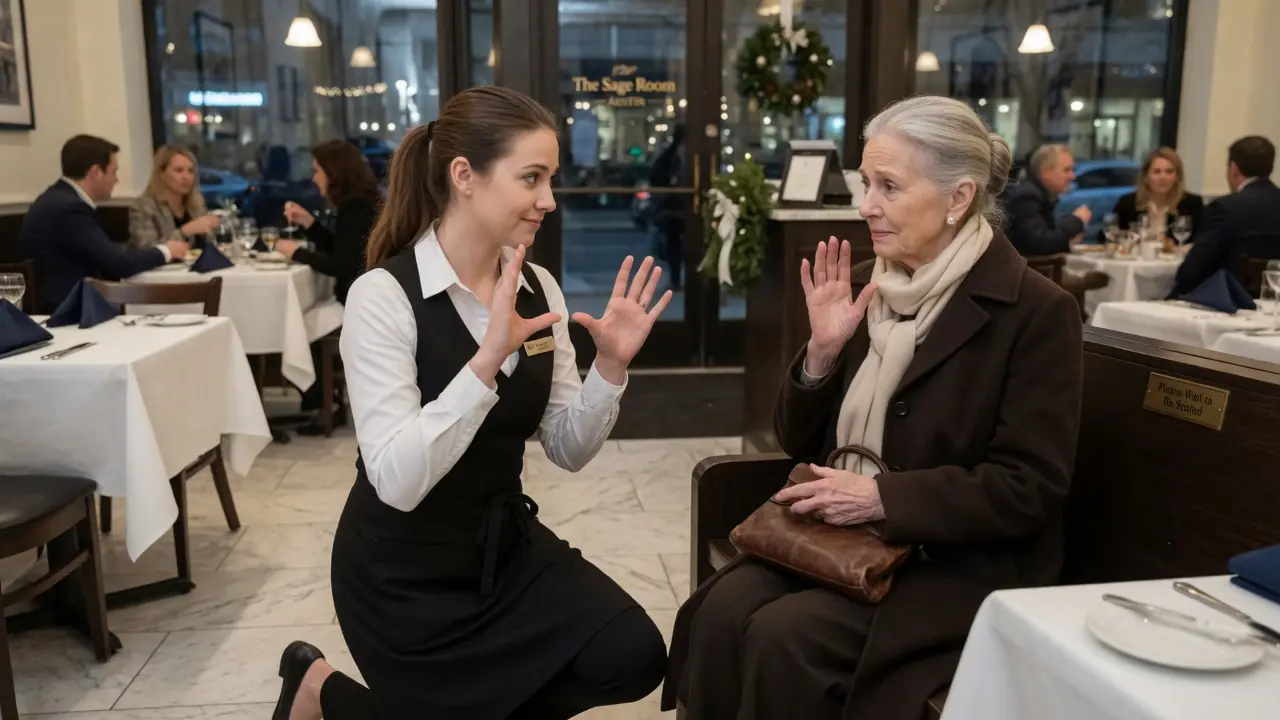
Recognizing her distress, Lyra immediately walked over, knelt beside her, and gently used sign language to speak to her and comfort her with genuine warmth.
That simple act of kindness made the woman smile for the first time that night.
What Lyra didn't know was that only minutes later, the woman's billionaire son would walk in.
And the moment he saw that rare smile, he would make a decision that would change all their lives forever.
The December wind swept through downtown Austin as the glass doors of Leonard's restaurant opened at exactly 5:00 in the evening.
Inside, crystal chandeliers cast soft light across white linen tablecloths and polished silverware.
This was the kind of establishment where reservations were made weeks in advance, where the wine list had its own leather-bound volume, and where a single entree cost more than most people spent on groceries in a week.
Lyra Mitchell had been working at Leonard's for 8 months, and she still felt like an impostor every time she walked through the employee entrance.
At 26, she was the youngest server on staff, hired during a desperate moment when two experienced waiters had quit simultaneously.
She knew the other servers resented her presence.
The girl from the wrong side of town who had somehow slipped past their carefully guarded gates.
"Water refill at table 7," Jessica called from the hostess stand, her tone carrying that particular edge Lyra had learned to recognize.
Not quite rude, but never warm.
"And table 4 needs their check."
Lyra nodded, balancing her tray with practiced efficiency.
Her feet already ached in the cheap black flats she had bought at a discount store, the only professional shoes she could afford.
Around her, the other servers moved with the confident grace of people who belonged in spaces like this.
Brittany wore designer shoes that probably cost more than Lyra's monthly rent.
Josh had the casual arrogance of someone who had never worried about money a day in his life.
She was refilling a water glass when the front doors opened again, letting in another gust of cold air.
A small elderly woman stepped inside, and Lyra's attention caught on her immediately, not because of what she wore, but because of how she stood, uncertain, uncomfortable, clutching a worn purse with hands that trembled slightly.
The woman was perhaps in her early 70s, with silver hair pulled back in a simple bun.
She wore a brown wool coat that had seen many winters, sensible shoes, and carried herself with a dignity that seemed at odds with her obvious discomfort.
Everything about her appearance said she didn't belong here, that she had wandered into the wrong establishment by mistake.
Lyra watched as the woman approached Jessica's hostess stand.
She couldn't hear the exchange from across the dining room, but she could see the woman's mouth wasn't moving.
Instead, her hands lifted in awkward, uncertain gestures, rudimentary sign language that Jessica clearly didn't understand.
"I'm very sorry," Jessica's voice carried across the quiet restaurant, professionally kind but helpless. "Maybe if you just wait here a moment."
The elderly woman nodded and moved to a small bench near the entrance, settling onto it with careful dignity.
Her hands folded in her lap, and even from a distance, Lyra could see the tension in her shoulders.
The way she seemed to be trying to make herself as small and invisible as possible.
Behind the hostess stand, Brittany and Josh leaned close to each other, their voices deliberately low, but not quite low enough.
Lyra had learned to read lips over the years, a skill developed out of necessity when caring for someone who couldn't hear, and she caught fragments of their conversation.
"Think she's in the right place?"
"Look at that coat. Probably can't even afford an appetizer here."
"Can't even talk properly. How did she get in?"
Lyra felt anger rise in her throat.
That familiar surge that came from being dismissed, from being judged as less than because you didn't fit someone's narrow definition of acceptable.
She glanced at her section.
Table 7 was fine.
Table 4 had their check.
Table 12 wouldn't need anything for at least 10 minutes.
The elderly woman sat alone on her bench, and no one was helping her.
Lyra made a choice.
She set down her water pitcher and crossed the dining room, aware of Jessica's surprised expression, aware of Brittany and Josh exchanging knowing looks.
She could practically hear their thoughts.
Of course, Lyra's helping. She probably feels sorry for her. Birds of a feather.
Let them think what they wanted.
She had spent her whole life being judged, being dismissed, being told she didn't belong in places like this.
Maybe that was why she recognized the same expression on the elderly woman's face.
That look of someone who had been made to feel invisible.
Lyra approached slowly, then knelt down, bringing herself to eye level.
It was something her mother had taught her years ago when Maya first lost her hearing.
Never tower over someone who is already feeling small.
The woman's eyes widened in surprise when Lyra's hands moved.
Are you okay? Do you need help?
The transformation was instant.
The woman's entire posture changed.
Her shoulders dropped with relief, her hands flying up with desperate gratitude.
I have a reservation. My son is coming. I tried to tell them, but they don't understand.
Her signing was basic, self-taught, but clear enough.
Lyra felt something sharp and protective bloom in her chest.
I understand. What name is the reservation under?
Cole. Adrien Cole.
The name meant nothing to Lyra.
She had lived in Austin for 3 years and barely knew the names of local celebrities, much less wealthy businessmen.
Rich people existed in a different world, one she passed through as staff, but never inhabited.
Wait here, Lyra signed. I'll check.
She stood and walked to the hostess stand, aware of Jessica's relieved expression.
"You can communicate with her?"
"She uses sign language. The reservation is under Cole. Adrien Cole."
Jessica's fingers flew across her tablet, and Lyra watched her expression shift.
Surprise, then something like alarm.
"Adrien Cole."
She looked toward the elderly woman with new interest.
"We should have seated her immediately. This is bad. If Mr. Cole finds out she was waiting."
"Then let's not make her wait any longer," Lyra said evenly. "I'll take her to her table."
"That's not your section."
"Then switch me or let me help her as a courtesy."
Lyra held Jessica's gaze.
"She's been waiting for almost half an hour. Someone should take care of her."
Jessica hesitated, clearly calculating the risks of breaking protocol against the greater risk of offending an important client.
"Fine, but don't neglect your other tables. And if Mr. Cole complains about anything..."
"He won't."
Lyra didn't know how she knew that, but she did.
She returned to the bench and offered the elderly woman a smile.
Your table is ready. I'm so sorry you had to wait.
Not your fault, the woman signed, then added with unexpected warmth. Thank you for helping.
It is my fault, Lyra signed back firmly. We should have someone here who can communicate with everyone. Come with me.
She led the woman through the dining room, past tables full of animated conversation and clinking glassware, to a corner booth near the windows.
It was the best table in the restaurant, typically reserved for VIPs.
The woman deserved it.
As they walked, Lyra felt eyes following them.
She recognized the trajectory of those gazes, starting with curiosity, moving to judgment, landing on dismissal.
The young server helping the elderly woman in the worn coat.
Charity case helping charity case.
But when Lyra glanced at the woman beside her, she saw something that made her chest tighten.
The woman was holding her head high now, moving with quiet dignity, no longer trying to disappear.
Being seen, really seen, had changed something fundamental in her posture.
Lyra pulled out the chair with care.
Is this table okay?
It's perfect.
The woman's hands moved with more confidence now.
More animation.
You sign beautifully. Where did you learn?
My sister. She's deaf. I grew up learning to communicate with her.
The familiar weight touched Lyra's chest.
Maya was living with their mother in San Antonio, both struggling to make ends meet despite Lyra sending money every month.
ASL became like a second language to me.
She's lucky to have you.
I'm lucky to have her.
Lyra pulled out her order pad.
Can I get you something to drink while you wait? Tea? Water?
The woman signed for hot tea, please, with lemon if possible.
And Lyra felt that sense of purpose settle into her bones.
This.
This was why she had learned to sign.
Why she had spent hours with Maya practicing conversations.
She returned quickly with steaming tea and accompaniments, pouring the first cup with the kind of attention she had learned from watching the senior servers work.
Except she wasn't doing this for a tip.
The woman's worn coat and careful manner told a story Lyra recognized.
This wasn't someone who could afford to leave 20%.
Your son should be here soon, Lyra signed. Is there anything else I can get you?
Just this. Thank you. You've been very kind.
Lyra hesitated, then signed something she had been feeling since the moment she had seen the woman sitting alone.
You're not invisible to me.
The woman's eyes filled with tears, not sad ones, but the kind that came from being seen after a long time in shadow.
She reached up and squeezed Lyra's hand, and Lyra squeezed back before moving to check on her other tables.
"Really, Lyra?"
Brittany appeared beside her at the server station, voice low but cutting.
"You're wasting time on someone who probably can't even afford to leave a tip. Table 12 has been waiting."
"Table 12 is fine. I checked."
Lyra kept her voice even.
"And helping a customer isn't wasting time. It's my job."
"Your job is your assigned section."
Brittany's smile was sharp.
"But I guess you'd know all about relating to people who don't quite fit in here, wouldn't you?"
Josh snickered from nearby.
"Come on, Britt. Lyra's got a bleeding heart. Can't help herself. Probably sees herself in every struggling person who walks through that door."
The words hit exactly where they were meant to.
But Lyra had learned long ago that responding just gave them satisfaction.
She delivered appetizers to table 12, processed a payment, refilled water glasses, and tried to ignore the way her throat felt tight with familiar shame.
Except this time, something was different.
Because every time she glanced toward the corner booth, she saw the elderly woman sitting peacefully, sipping her tea, no longer trying to disappear.
And that mattered more than Brittany's cruelty or Josh's contempt.
At 6:30 in the evening, the front doors opened again, and Lyra felt the temperature in the room shift.
The man who entered was tall, perhaps 6 feet 2 inches, with dark hair silvering at the temples and the kind of presence that made people unconsciously straighten their postures.
He wore dark jeans and a cashmere sweater.
Nothing ostentatious, but everything about him radiated quiet authority.
This was someone accustomed to being listened to, to being obeyed.
Jessica practically ran to greet him.
"Mr. Cole, what an honor. Your mother has been..."
But the man wasn't looking at Jessica.
His attention had locked onto Brittany and Josh, who were still standing near the hostess station, and his expression was absolutely arctic.
Lyra couldn't hear what they were saying, but she could see the color draining from Brittany's face, could see Josh take an involuntary step backward.
Whatever Mr. Cole was saying, it clearly wasn't pleasant.
Then his gaze shifted toward the dining room, scanning until it found the corner booth where his mother sat, and everything about him changed.
The fury that had been building in his shoulders drained away so suddenly that Lyra felt the shift from across the room.
His mother was smiling.
Really smiling.
The kind of smile that transformed her entire face.
And she was looking toward Lyra with obvious affection.
The man stood there for several seconds, just watching his mother's happiness.
And when he finally moved toward the booth, his steps were measured, controlled, like someone who had just talked himself down from doing something he would regret.
Lyra approached the table, her heart hammering.
"Good evening, Mr. Cole. Can I get you something to drink?"
He looked at her, then really looked at her, and she felt the weight of that attention like a physical thing.
His eyes were gray, sharp, and assessing, but not unkind.
"Water is fine. Thank you."
He turned to his mother and his hands moved in careful, deliberate sign language.
Sorry I'm late, Mom. Traffic was terrible.
His signing was competent, but clearly learned rather than native, the movements precise but lacking the fluid grace of someone who had grown up with the language.
His mother responded with rapid, enthusiastic signs that he had to ask her to repeat more slowly.
Lyra hesitated, then made another choice.
Would you like me to interpret? she signed to the elderly woman, so you don't have to slow down for him.
The woman's delighted laugh was silent but unmistakable.
Her son looked up at Lyra with an expression of pure surprise.
"You sign?"
His voice carried wonder and something else.
Respect.
"Yes, sir. My sister is deaf. I grew up learning."
He studied her for a long moment, and Lyra fought the urge to look away from that intense gray gaze.
Finally, he said quietly, "Thank you for helping my mother. For seeing her."
"Everyone should be seen," Lyra replied, then felt her face heat.
That sounded presumptuous, judgmental.
"I just meant..."
"You meant exactly what you said."
He glanced at his mother, who was watching them both with obvious interest.
"And you're right."
The meal proceeded smoothly after that.
Lyra interpreted when needed, though mostly she just made sure both mother and son had everything they required.
She watched them together.
The obvious care.
The careful attention he paid to his mother's signing.
The way she touched his hand with affection that transcended words.
At one point, while she was clearing their appetizer plates, the elderly woman caught Lyra's wrist gently.
Thank you, she signed. You've given me something I haven't had in a long time. Being part of the conversation, not just present for it.
The pleasure was mine, Lyra signed back, meaning it.
When the meal ended, Mr. Cole asked to speak with her privately.
Lyra felt Brittany's eyes burning into her back as she followed him to a quiet corner near the bar.
"I want to thank you properly," he began. "What you did tonight, treating my mother with dignity, communicating with her directly, that's rare. And it meant everything to her."
"I just did what anyone should do."
"But most people don't."
He pulled out a business card.
"My name is Adrien Cole. I run a foundation that supports various causes, and we're planning a gala in 2 weeks. My mother will be there, and I'd like to hire you as her personal interpreter for the evening. Just that one night, but I'd pay you $2,000."
Lyra's breath caught.
$2,000.
That was almost 3 months of rent.
That was enough to help her mother with Maya's care, to finally fix her car, to breathe without the constant pressure of financial desperation.
"I don't know what to say."
"Say yes. My mother deserves to have someone at these events who actually wants to communicate with her, not just someone doing it out of obligation."
He paused.
"And frankly, after seeing how your colleagues treated her tonight, I'd like to make sure you're rewarded for being the only person who bothered to help."
Lyra looked up at him.
This wealthy man who had somehow noticed her in a room full of people trying to be noticed.
"I'll do it. Thank you."
His expression shifted into something warmer.
"Thank you. My assistant will contact you with the details."
As he walked away, Lyra stood there holding his business card, feeling like her entire world had just tilted on an axis she didn't know existed.
Behind her, she heard Brittany's voice, sharp with malice.
"Well, well, looks like someone's moving up in the world. Wonder what she did to earn that private conversation."
Lyra turned to face her.
For 8 months, she had endured Brittany's cruelty in silence, accepting it as the price of keeping this job.
But something had changed tonight.
She had been seen, really seen, by people who mattered.
And suddenly, Brittany's opinion seemed incredibly small.
"I treated a customer with respect," Lyra said quietly. "You should try it sometime."
She walked away before Brittany could respond, feeling something like strength building in her chest.
That night, she told her mother about the opportunity.
Her mother listened with tears in her eyes, then pulled Lyra into a fierce hug.
"You're going to do amazing things, sweetheart," her mother whispered. "I've always known it."
Lyra wanted to believe her, but she had learned long ago that hope was dangerous when you had nothing to fall back on.
Still, for the first time in years, she let herself feel it.
Monday morning arrived with the familiar weight of dread that Lyra had come to associate with work.
She dragged herself out of bed at 4:30 in the morning, dressed in the dark so she wouldn't wake her roommate, and caught the early bus to Leonard's.
Linda, the restaurant manager, was waiting for her when she arrived at 5:00.
The older woman's expression was unreadable, not quite hostile, but far from friendly.
"My office. Now."
Lyra's stomach dropped.
She followed Linda through the quiet restaurant to the cramped office that smelled of old coffee and disappointment.
"Sit."
Lyra sat.
Linda leaned back in her chair, studying Lyra with eyes that had seen too many years in the service industry to be impressed by anything.
"Want to tell me what happened Saturday night?"
"I helped a customer who needed assistance communicating."
"You broke protocol. You took a table that wasn't in your section. You had a private conversation with Adrien Cole that left Jessica concerned about what might have been discussed."
"Nothing inappropriate was discussed."
Lyra kept her voice even.
"Mr. Cole thanked me for helping his mother and offered me a side job interpreting at an event."
"A side job."
Linda's tone made it clear what she thought of that explanation.
"Let me tell you something about men like Adrien Cole. Honey, they don't offer side jobs to servers out of gratitude. There are expectations, requirements, and you might not realize what they are until you're in over your head."
"I appreciate your concern, but I can make my own decisions."
"Can you?"
Linda leaned forward.
"Because from where I'm sitting, you look like a girl who needs money badly enough to accept questionable arrangements from wealthy men she doesn't know."
The accusation hung in the air between them, ugly and insulting.
Lyra felt anger rise in her chest, but she forced herself to breathe through it.
"The job is legitimate. I'll be interpreting for his mother at a charity gala. That's all."
Linda studied her for a long moment, then sighed.
"Fine, but here's what's going to happen. You embarrassed Brittany and Josh Saturday night. Made them look bad in front of an important client. So, you're being reassigned to early morning prep duties in addition to your regular shifts."
"Starting tomorrow, 5:00 a.m. to 8:00 a.m. You'll handle all opening duties, cleaning bathrooms, taking out trash, setting up the dining room. Then you'll work your regular shift. Consider it a reminder about following protocol."
"That's 14-hour days, 6 days a week."
"That's what happens when you break the rules."
Linda's expression was carefully neutral, but Lyra could see the satisfaction behind it.
"Do we have a problem?"
Lyra thought about rent due in 5 days, about her mother's worried phone calls, about Maya's therapy bills.
She thought about having any leverage at all.
"No problem."
"Good. Start tomorrow."
Lyra worked the rest of her shift in a haze of exhaustion and rage.
14-hour days.
It was punishment, pure and simple, designed to break her for daring to step outside her assigned place.
That evening, she got home to find a message from her mother.
Maya's therapy center was increasing their rates again.
They needed an additional $300 a month starting in January.
Lyra did the math in her head.
Even with the $2,000 from the gala, even working 14-hour days, the numbers didn't work.
Something would have to give.
She thought about the business card tucked in her wallet, Adrien Cole's number, a man who had noticed her, who had seen value in what she could do.
But she couldn't ask for more.
Couldn't be the desperate girl proving Linda right.
So she said nothing to her mother about the increased hours, just promised they would figure it out like they always did.
The next 3 weeks were brutal.
Lyra arrived at Leonard's at 5:00 a.m. when the sky was still dark and the streets empty.
She spent 3 hours scrubbing toilets, hauling trash bags that weighed more than she did, setting up tables with hands that cramped from overuse.
Then she worked her regular shift, serving wealthy customers who looked through her like she was furniture.
Brittany and Josh made sure she knew this was punishment.
They would walk past while she was on her knees scrubbing floors, making comments loud enough for her to hear.
"Guess that's what happens when you forget your place."
"Should have kept her mouth shut and focused on her own tables."
"Wonder if Mr. Cole even remembers her name."
Lyra kept her head down and worked.
The gala was in 4 days.
$2,000.
She just had to survive until then.
On Wednesday, Adrien Cole walked into Leonard's unannounced.
The effect was immediate.
Linda appeared from her office within seconds.
Jessica straightened behind her hostess stand, and every server suddenly became very busy looking professional.
Adrien barely acknowledged any of them.
"I need to speak with Lyra Mitchell."
The silence that followed was profound.
Every eye in the restaurant turned to Lyra, who was clearing a table near the windows, her hands full of dirty dishes.
Linda recovered first.
"Mr. Cole, if there's any issue with service, I'd be happy to..."
"I need to speak with Lyra privately, if possible."
Linda's jaw clenched, but she gestured toward the back room.
"You can use the manager's office."
Lyra followed Adrien through the restaurant, aware of every stare, every whispered comment.
Her heart hammered against her ribs.
Had he changed his mind about the gala?
Had someone told him she wasn't professional enough?
Inside the office, Adrien closed the door and turned to face her.
"Are you okay?"
The question was so unexpected that Lyra just stared at him.
"I'm fine."
"You don't look fine. You look exhausted."
His gray eyes were concerned, not accusatory.
"My assistant called to coordinate details for the gala, and your manager mentioned you're now working 14-hour days. Is that because of what happened Saturday?"
Lyra wanted to lie to maintain some dignity, but she was too tired.
"It's fine. Just a schedule change."
"It's punishment for helping my mother."
Adrien's voice went hard.
"That's unacceptable."
"Please don't say anything. I need this job."
The desperation leaked through despite her best efforts.
"I can handle it. Just four more days until the gala."
Adrien was quiet for a long moment.
"Then what if it wasn't just one gala? What if I hired you as my mother's personal companion and interpreter on a regular basis?"
Lyra's world tilted.
"What?"
"My mother hasn't stopped talking about you. She asks every day when she'll see you again. I've watched her struggle with isolation for years. Watched her be ignored at social events because no one bothers to learn sign language. You made her feel seen."
He paused.
"I'd like to hire you to accompany her to appointments, events, anywhere she wants to go. Part-time position to start. 20 hours per week with a rate of $30 per hour."
"That's $2,400 per month, and it won't interfere with whatever other work you choose to do."
$2,400.
Combined with even part-time work elsewhere, that was breathing room, security, a future that didn't involve choosing between rent and food.
"Why would you do this?"
"I'm not doing it for you. I'm doing it for my mother. You're just the person qualified to help her."
Adrien's expression softened slightly.
"But I'd be lying if I said I didn't admire how you've handled everything here. The way you treated my mother with dignity while your colleagues mocked her. The way you're enduring punishment for basic human kindness. That says everything I need to know about your character."
Lyra felt tears threatening.
She blinked them back.
"I'd need to give notice. 2 weeks."
"Of course. My assistant will send over the contract today. Read it carefully. Negotiate anything you're uncomfortable with. This is a professional arrangement, Lyra. Everything documented and proper."
After he left, Lyra sat alone in Linda's office and let herself cry.
Not from sadness, but from the sheer overwhelming relief of finally, finally having a way out.
She gave her notice that same day.
Linda took it with barely concealed satisfaction.
"You'll regret this. Rich people get bored. They'll use you up and throw you away."
"Maybe," Lyra said. "But at least I'll find out on my own terms."
The final two weeks at Leonard's were exactly as miserable as she expected.
But they were also the last.
Every insult from Brittany, every condescending comment from Josh, every 14-hour shift, they all had an expiration date now.
The night before the gala, Lyra came home to find a message from her mother with tears in her voice on the recording.
"Sweetie, something came today from the Adrien Cole Foundation. They've paid Maya's therapy bills. Not just this month. The whole year in full."
Lyra stared at her phone, at the confirmation email her mother had forwarded, and felt something break open in her chest.
She had spent years learning that kindness costs too much, that helping others just left you empty.
But maybe, just maybe, she had been wrong.
Maybe sometimes kindness came back to you.
Not because you had earned it or deserved it, but because someone noticed and decided to care.
The Grand Riverside Hotel stood like a palace against the Austin skyline, its windows glowing gold in the December evening.
Lyra stepped out of the town car that Adrien had sent, another kindness she was still learning to accept, and stared up at the building with her heart hammering.
She had been inside luxury hotels before, but only through service entrances, carrying trays or pushing cleaning carts.
Walking through the front doors as a guest felt like stepping into a world where she didn't speak the language.
The dress Adrien's assistant had delivered fit perfectly.
Deep navy blue that somehow made her look elegant rather than invisible.
Her hair had been professionally styled, swept up in a way that made her neck look longer, more graceful.
The woman in the mirror that morning had been a stranger.
A beautiful stranger, but a stranger nonetheless.
"Miss Mitchell."
A young man in a crisp suit appeared at her elbow.
"I'm James, Mr. Cole's assistant. Mrs. Cole is waiting for you in the Madison suite, if you'll follow me."
The lobby was all marble and crystal, filled with people in evening wear that probably cost more than Lyra made in several months at Leonard's.
She felt eyes tracking her as she crossed toward the elevators, assessing, judging, calculating her worth based on appearance alone.
She lifted her chin and kept walking.
She belonged here.
Adrien had said so.
Margaret had said so.
She needed to start believing it.
The Madison suite was on the 20th floor, and when James opened the door, Lyra found herself in a space larger than her entire apartment.
Floor-to-ceiling windows offered views of the city and the Colorado River winding through it like a ribbon of silver.
Lyra.
Margaret appeared from an adjoining room, arms already outstretched.
She wore an elegant silver gown that complemented her gray hair, and her smile was radiant.
They embraced, and Lyra felt some of her anxiety ease.
This at least was real.
This connection that had somehow formed across decades and social classes.
You look beautiful, Margaret signed when they separated.
You look beautiful, Lyra signed back. Thank you for including me tonight.
Including you? You're working. I'm paying you to be here. Remember?
It doesn't feel like work.
Good, because I want you to enjoy yourself, too.
Margaret's hands moved with emphasis.
Tonight, we have important work to do. Come, let me explain what's happening.
For the next 30 minutes, Margaret walked Lyra through the evening schedule.
Cocktail hour with major donors.
Dinner with board members and special guests.
Adrien's keynote speech about the foundation's expansion plans.
And then a silent auction to raise additional funds.
The donors are mostly good people, Margaret signed. But they're used to talking over me or around me. They mean well, but they don't always know how to include someone who communicates differently. That's where you come in.
I'll make sure everyone knows they should speak directly to you, Lyra promised.
Not just that, Margaret's hands moved with emphasis. I want you to help them understand that I have thoughts, opinions, experience worth hearing. Not just polite conversation, but real dialogue. Can you do that?
Lyra thought about all the times she had watched people talk over Maya, making decisions for her instead of with her.
I can do that.
Adrien arrived 20 minutes later, and Lyra felt her breath catch despite her best efforts to remain professional.
He wore a black tuxedo that had clearly been tailored specifically for him.
And when his eyes found her across the suite, something in his expression shifted.
Surprise, then appreciation.
"Lyra."
He crossed the room, moving with that easy confidence of someone who had been attending events like this his whole life.
"You look very professional."
"Thank you. You look very polished."
"My mother coordinated our colors."
He gestured to his navy bow tie, which matched her dress.
"She's not subtle."
Behind him, Margaret signed with theatrical innocence.
I have no idea what he's talking about.
Lyra laughed, and some of the remaining tension drained from her shoulders.
This was going to be okay.
She was here with people who wanted her here, doing work that mattered.
"Shall we?"
Adrien offered his arm to his mother, then gestured for Lyra to walk alongside them.
"You're part of this event, not just staff."
The ballroom took Lyra's breath away.
Thousands of tiny lights hung from the ceiling like stars, creating the illusion of dining under the night sky.
Round tables draped in ivory linen filled the space, each one centered with elaborate floral arrangements that must have cost hundreds of dollars.
A string quartet played near the windows, which offered spectacular views of downtown Austin lit up against the darkness.
At least 300 people filled the room.
Women in gowns that sparkled with jewels.
Men in tuxedos.
Everyone moving and talking with the easy grace of people who belonged in spaces like this.
Lyra recognized faces from magazines and news broadcasts.
A senator.
A famous tech entrepreneur.
The owner of Austin's professional soccer team.
She felt like an impostor, like someone playing dress-up about to be exposed.
Then Margaret squeezed her hand and signed, Breathe. You belong here just as much as anyone else.
The cocktail hour was a whirlwind.
Adrien introduced them to donor after donor.
A retired judge.
A hedge fund manager.
A philanthropist who had made her fortune in real estate.
Each time, Lyra positioned herself carefully so she could see both the speaker and Margaret, her hands moving constantly to translate.
But she did more than translate.
She facilitated.
When the hedge fund manager, a stern man named Richard Paulson, spoke directly to Adrien about expansion plans, Lyra gently redirected.
"Mr. Paulson, Mrs. Cole actually pioneered many of these programs. She'd love to discuss them with you directly."
Paulson looked startled, then nodded and turned to face Margaret.
"Mrs. Cole, I'd be honored to hear your perspective."
Lyra watched Margaret's face light up as she signed her thoughts about the importance of funding programs that served underrepresented communities.
About making sure inclusion wasn't just a buzzword, but a lived practice.
Lyra translated, and Paulson listened with growing interest.
"You know," he said when Margaret finished, "my daughter teaches at a school for deaf students. She's been saying for years that we need better community integration programs."
"Mrs. Cole, would you be willing to consult on a project I've been considering?"
Margaret's smile could have powered the entire hotel.
I'd be delighted.
This pattern repeated throughout the evening.
Lyra didn't just translate words.
She opened doors, created space for Margaret to be heard, and gradually, the donors stopped seeing her as an obstacle to conversation with Adrien and started seeing her as someone worth listening to in her own right.
During dinner, Lyra sat between Margaret and Adrien at the head table.
Around them, board members and major donors filled the remaining seats.
Powerful people whose decisions affected millions of dollars and thousands of lives.
"This salmon is exquisite," the woman to Lyra's left commented.
She was Barbara Chen, a tech CEO who donated $2 million to the foundation last year.
Lyra translated for Margaret, who responded with enthusiasm about the lemon butter sauce.
Barbara looked surprised, then delighted, and suddenly the two women were having an animated conversation about cooking with Lyra facilitating every exchange.
Adrien leaned close to Lyra during a lull in the conversation.
"Thank you," he murmured. "I've been bringing my mother to these events for 5 years, and this is the first time she's actually been part of them."
"She deserves to be heard."
"Yes, she does, but most people don't bother to make it possible."
His expression carried genuine gratitude.
"You're doing something remarkable tonight, Lyra."
When Adrien stood to give his keynote speech, the ballroom fell silent.
He spoke with the easy authority of someone who had been addressing large audiences his whole career, outlining the foundation's accomplishments over the past year.
Scholarships provided.
Community centers built.
Families supported.
But then his tone shifted, becoming more personal.
"I want to tell you about something that changed my perspective recently," he began. "3 weeks ago, I took my mother to dinner at a restaurant here in Austin."
"My mother, as many of you know, is deaf. She lost her hearing in an accident when I was young, and while she's adapted with remarkable grace, navigating a world designed for hearing people remains challenging."
Lyra saw Margaret sit up straighter, felt her own pulse quicken with anticipation.
"That night," Adrien continued, "my mother sat alone for 30 minutes because the staff didn't know how to communicate with her. They saw her disability first and her humanity second. They treated her as a problem to solve rather than a person to serve."
A murmur rippled through the ballroom.
Disapproval.
Sympathy.
Recognition.
"But then something extraordinary happened. A server named Lyra Mitchell, who is here with us tonight, approached my mother. She knelt down to eye level, signed in ASL, and asked how she could help."
"For the next 2 hours, Lyra ensured my mother was fully included in our dinner conversation. Not out of obligation or duty, but because she genuinely saw my mother as a person worthy of dignity and respect."
Every eye in the ballroom turned to Lyra.
She felt her face flush, felt the weight of all that attention.
But Adrien's voice continued, warm and certain.
"Lyra learned ASL to communicate with her sister, who is deaf. She spent years developing skills that most of us never bother to acquire, not for career advancement or recognition, but out of love for her family."
"That kind of commitment, that dedication to seeing and honoring people who communicate differently, is exactly what this foundation should exemplify."
He paused, and the silence in the ballroom was absolute.
"I'm proud to announce tonight that the foundation is launching a new initiative, the Inclusion Access Program. Over the next three years, we'll invest $5 million in creating pathways for people with disabilities to fully participate in their communities."
"We'll fund ASL training for businesses and schools. We'll provide scholarships for deaf students pursuing any field they choose. We'll create employment opportunities that honor different abilities rather than seeing them as limitations."
The applause that followed was thunderous.
Margaret grabbed Lyra's hand and squeezed it hard, tears streaming down her face.
But Adrien wasn't finished.
"To lead this program, I'm creating a new position, Director of Inclusion Access. This person will design and implement initiatives that ensure everyone, regardless of how they communicate, has access to education, employment, and community engagement."
He looked directly at Lyra, and his expression was proud.
"Lyra Mitchell, if you're willing, I'd like to offer you this position."
The world seemed to stop.
Lyra heard the words, understood them intellectually, but couldn't quite process what they meant.
Director.
$5 million.
Leading a program that would change lives.
"The salary is $60,000 annually," Adrien continued, his eyes still locked on hers. "Full benefits, professional development opportunities, and the chance to build something meaningful. What do you say?"
300 faces turned toward her, waiting.
Margaret's hands signed urgently.
Say yes, you wonderful girl. Say yes.
Lyra stood on trembling legs.
Her voice came out smaller than she had intended, but clear.
"I say yes. Thank you. I'm honored."
The ballroom erupted in applause.
People she had never met were smiling at her, nodding approval, welcoming her into their world.
Margaret pulled her into a fierce hug, both of them crying.
And Adrien.
Adrien was watching her with an expression of unmistakable pride.
The rest of the evening passed in a blur.
Donors approached to congratulate her.
Board members welcomed her to the team.
And somewhere around 11:00 at night, Lyra found herself standing alone on the hotel's terrace, needing a moment to process everything that had just happened.
Her entire life had changed in the space of 3 hours.
She had a career now, not just a job.
Purpose, not just survival.
A future that looked nothing like the past she had been trying to escape.
"Overwhelming?"
Adrien's voice came from behind her.
She turned to find him standing in the doorway, jacket unbuttoned, bow tie loosened, looking more human than the polished professional who had commanded the ballroom earlier.
"Completely overwhelming," she admitted. "I keep waiting to wake up."
"You're not dreaming."
He crossed to stand beside her at the railing, both of them looking out at the city lights.
"You earned this, Lyra. Not because of one act of kindness, but because of who you are. The way you treated my mother tonight, making sure she was heard and respected. That's the foundation of what this program needs to be."
"I'm terrified I'll disappoint you."
"You won't."
"How can you be so sure?"
Adrien turned to face her fully.
And in the soft light from the ballroom, his gray eyes were sincere.
"Because I've watched you handle cruelty with grace. I've seen you work 14-hour days without complaint. I know you learned ASL for family, that you sacrifice constantly for others, that you see people's humanity before their circumstances."
"That's not something that can be taught, Lyra. That's character, and character is what this position requires most."
She felt tears prick her eyes again.
"Thank you for believing in me when I didn't believe in myself."
"Thank me by building something extraordinary."
He smiled.
"Which I know you will."
They stood there in comfortable silence for a few moments, the sounds of the gala continuing behind them, the city sprawling below.
Lyra felt something shift in her chest.
Not attraction, but gratitude.
The sense that maybe, just maybe, she had found where she was meant to be.
"Lyra."
Adrien's voice was soft.
"Can I tell you something?"
"Of course."
"You're remarkable. I hope you know that."
Before she could respond, Margaret appeared in the doorway.
There you two are. Stop hiding and come celebrate. Lyra, the board members want to meet you properly.
As they headed back inside, Adrien touched Lyra's elbow gently.
"This is just the beginning. I hope you're ready."
Lyra smiled, feeling that strength building in her chest again.
"I'm ready."
And for the first time in years, she actually believed it.
Monday morning, Lyra walked into the Cole Foundation headquarters for her first official day of work.
The building was a renovated warehouse in East Austin, all exposed brick and modern glass, filled with natural light and the quiet energy of people who believed in their mission.
Patricia, Adrien's assistant, met her in the lobby with a warm smile.
"Welcome to your first day. Let me show you around."
The tour revealed a space designed for collaboration.
Open work areas with standing desks.
Private meeting rooms with glass walls.
A kitchen stocked with coffee and snacks.
And a quiet room specifically designed for meditation or prayer.
Everything spoke of an organization that valued its people.
"This is your office," Patricia said, opening a door on the second floor.
Lyra stepped inside and felt her breath catch.
It wasn't large, but it had a window overlooking the courtyard.
A solid desk.
Comfortable chairs.
Bookshelves already stocked with resources on disability advocacy, inclusive design, and ASL education.
On the desk sat a welcome basket filled with office supplies, a foundation mug, and a handwritten note from Margaret.
So proud of you. You're going to change the world.
"Adrien wanted you to have space to build your program," Patricia explained. "You'll report directly to him, but you'll have full autonomy over the Inclusion Access initiatives. Budget, hiring, program design. It's yours to shape."
The responsibility felt enormous.
Lyra had gone from scrubbing toilets to directing a $5 million program in the span of 3 weeks.
The impostor syndrome threatened to swallow her whole.
"Breathe," Patricia said gently, reading her expression. "Nobody expects you to have all the answers on day one. Adrien hired you because of your perspective and commitment. The technical stuff you'll learn."
The first week was a crash course in nonprofit operations.
Lyra attended budget meetings, program reviews, and strategy sessions.
She met the other directors, education, healthcare access, community development, all of whom welcomed her warmly and offered support.
She learned about grant writing, impact measurement, and stakeholder engagement.
Her head spun with new information, but gradually patterns began to emerge.
On Friday afternoon, Adrien appeared in her doorway.
"How's the first week treating you?"
"Like drinking from a fire hose," Lyra admitted. "But a good fire hose, if that makes sense."
He laughed.
"It does. Listen, I wanted to invite you to dinner tomorrow. My mother's house. She's been asking about you constantly, and I thought it might be nice to catch up in a less formal setting. We can discuss the program's direction, too."
"That sounds good. Thank you."
Saturday evening found her standing on the porch of a modest house in Travis Heights, holding a bottle of wine she had agonized over choosing.
The neighborhood was old Austin, tree-lined streets, small homes with big character, nothing like the mansion she had half expected.
Margaret answered the door with a squeal of delight, pulling Lyra into a hug before she had even crossed the threshold.
You're here. Come in. Come in. I made enchiladas. Adrien says I make them too spicy, but I think he's just weak.
The house was warm and lived in, filled with photos and comfortable furniture that had clearly been loved for decades.
Nothing matched, but everything belonged together.
It reminded Lyra of home, a space built on memories rather than money.
Adrien emerged from the kitchen wearing jeans and a casual sweater, looking more relaxed than Lyra had ever seen him.
"Fair warning, my mother's enchiladas will burn your mouth. She has no mercy."
Over dinner, they talked about everything except work at first.
Margaret told stories about Adrien as a child, his determination to excel, his fierce protectiveness of her, the way he taught himself to sign because he refused to rely on notebooks.
Adrien, in turn, shared memories of his mother's strength, the three jobs she had worked, the sacrifices she had made.
"I grew up poor," Adrien said.
And the admission felt significant, like he was trusting Lyra with something important.
"My dad left before I was born. Mom worked herself nearly to death keeping us fed and housed. When she lost her hearing in an accident at one of her jobs, a factory floor incident that the company claimed wasn't their fault, we lost the small financial stability we had."
"She couldn't work the same jobs anymore. People wouldn't hire her."
Margaret's hands moved with gentle resignation.
The world isn't kind to people who communicate differently. You know that, Lyra.
I do, Lyra signed back. My mother faced the same thing when Maya was diagnosed. Employers saw her disability first. My mother's commitment to her second.
"Exactly."
Adrien leaned forward, his expression intense.
"That's why this program matters so much. We have the resources to change the infrastructure that makes life harder for people like my mother and your sister. We can train businesses, fund education, create actual pathways to inclusion instead of just talking about it."
The passion in his voice resonated with something deep in Lyra's chest.
This wasn't just a job for him.
It was personal, just like it was for her.
After dinner, Margaret shooed them both out to the small garden while she cleaned up, refusing their help.
You two talk business. I'll bring dessert when it's ready.
The garden was simple but beautiful.
Native Texas plants that required little water.
A small fountain that burbled peacefully.
String lights creating a soft ambiance.
Lyra sat on a bench, and Adrien settled beside her, close enough to have a conversation, but maintaining professional distance.
"Can I ask you something?"
Adrien's voice was quiet.
"What happened at Leonard's? Before you left?"
Lyra had been expecting this question eventually.
She took a breath and told him everything.
The 14-hour days.
Brittany and Josh's cruelty.
Linda's punishment for daring to help Margaret.
She described scrubbing toilets until her hands bled, hauling trash in the pre-dawn darkness, serving wealthy customers who looked through her like she was invisible.
"I kept thinking I deserved it somehow," she admitted. "That this was the price of being someone from my background trying to exist in spaces designed for other people."
Adrien's jaw had clenched tighter with each detail.
"You didn't deserve any of that. That was abuse. Exploitation."
"I know that now, but at the time, I just kept my head down and survived."
She looked at him directly.
"Your job offer saved me, Adrien. Not just financially, but from a situation that was breaking me piece by piece."
"I'm glad I could help. But Lyra..."
He turned to face her fully.
"You would have found a way out eventually. You're too determined to have stayed trapped forever. I just happened to provide one path. You would have found another."
"You have a lot of faith in me."
"Because you've earned it."
They sat in comfortable silence for a while, the evening mild despite being December.
The sounds of the city were distant and unimportant.
Lyra felt something settle in her chest, a sense of belonging she hadn't experienced since childhood, before life became about survival and sacrifice.
"I want to take you somewhere next week," Adrien said suddenly. "There's a school for deaf students about an hour outside Austin. They've requested foundation support, and I thought you might want to see it, start thinking about partnership opportunities."
"I'd love that."
"It'll help you understand the landscape better, what resources already exist, what gaps we need to fill."
He smiled.
"And I think you'll find it inspiring."
Margaret appeared with tres leches cake, Adrien's favorite apparently, and they spent the rest of the evening talking, laughing, sharing stories.
By the time Lyra left at 11:00 at night, her face hurt from smiling, and her heart felt lighter than it had in years.
As she drove home, she thought about how much had changed.
In 3 weeks, she had a career.
A purpose.
People who believed in her.
A chance to build something that mattered.
For the first time in her life, she wasn't just surviving.
She was thriving.
The next 6 months passed in a whirlwind of growth and learning.
Lyra threw herself into building the Inclusion Access Program with the kind of focused determination she had previously reserved for survival.
She researched best practices, connected with disability advocacy organizations, and began designing a comprehensive curriculum for ASL training in businesses and schools.
She also spent increasing amounts of time with Margaret, who had become more friend than employer's mother.
They had lunch together twice a week, visited museums and art galleries, and slowly Margaret shared more of her story.
The isolation she had felt after losing her hearing.
The well-meaning people who tried to help by making decisions for her.
The loneliness of being present but never truly included.
You've given me my voice back, Margaret signed one afternoon while they walked through the botanical gardens. Not literally, but socially. People listen to me now because you've shown them how.
They should have been listening all along, Lyra signed back.
Should have, yes. But they weren't, and you changed that. For me and for all the other people this program will serve.
In March, Lyra got a call from her mother.
Maya had been accepted into a specialized program in Austin, a combination school and therapy center that focused on deaf education.
But it meant Maya would be moving to Austin, living with Lyra.
"Are you sure you can handle it?" her mother asked, worry evident in her voice. "You're just getting established in your career. Having Maya there full-time is a big responsibility."
"Mom, this is perfect. I have a stable job now, a two-bedroom apartment I can actually afford. Maya deserves this opportunity, and I want her here."
Lyra felt certainty settle into her bones.
"This is what everything was for, so we could have chances like this."
Maya arrived in April, 16 years old and nervous about the move, but excited about the new school.
Lyra watched her sister walk through the apartment that first day, signing questions about everything, her hands moving with the rapid-fire enthusiasm of a teenager.
Is this really ours? We can stay here?
We can stay here. This is home now.
That evening, Lyra introduced Maya to Margaret.
The connection was immediate.
Margaret signed with the patient clarity of someone who understood what it meant to navigate the world differently.
And Maya responded with the openness of someone finally meeting an adult who treated her as capable rather than limited.
I like her, Maya signed to Lyra later. She doesn't talk down to me.
That's because she knows you're smart. Everyone should see that.
But most people don't bother to look past the surface.
Having Maya in Austin changed everything.
Lyra's work took on new urgency.
Every program she designed, every partnership she built, she thought about how it would affect her sister's future.
Would there be jobs available for deaf people in 5 years when Maya graduated?
Would businesses know how to communicate with her?
Would she be seen as capable or dismissed as limited?
These questions drove Lyra to work harder, to push the program further.
In May, she hired two staff members.
Marcus, a deaf advocate with 15 years of experience, and Jennifer, a hearing woman who had worked in disability services.
Together, they began implementing ASL training programs in 10 Austin businesses with plans to expand.
The work was exhausting and exhilarating in equal measure.
Some businesses embraced the training enthusiastically.
Others resisted, viewing it as unnecessary expense or political correctness rather than basic accessibility.
Lyra learned to navigate resistance, to make the business case for inclusion while never losing sight of the moral imperative.
"You're good at this," Adrien told her during one of their Friday check-ins. "Better than I expected, and my expectations were already high."
"I'm learning as I go."
"Aren't we all?"
He smiled.
"But you have something that can't be taught. You genuinely care about the people this program serves. That makes all the difference."
In June, Lyra was invited to speak at a regional disability advocacy conference.
The thought of public speaking terrified her, but Adrien encouraged her to accept.
"You have a story people need to hear," he said. "And you'll inspire others who think they don't have the qualifications to make a difference."
The presentation was nerve-wracking.
Lyra stood in front of 200 people and told her story.
Growing up with a deaf sister, watching Maya be dismissed and underestimated.
Learning that systems of exclusion were designed to benefit some while marginalizing others.
She talked about the intersection of poverty and disability, about how her work at Leonard's had taught her what dignity looked like, about building programs with communities rather than for them.
When she finished, the applause was enthusiastic.
Three people approached her afterward asking how to replicate the program in their cities.
"You were magnificent," Adrien said on the drive home. "Authentic and articulate. Everything they needed to hear."
"I was terrified."
"You were brave. There's a difference."
By August, the Inclusion Access Program was operating in 12 Austin-area businesses and had trained over 200 employees in basic ASL.
They had established partnerships with three schools for deaf students and created a job placement program that had successfully placed eight deaf individuals in positions they couldn't previously access.
The impact was measurable and meaningful, but it was the personal stories that kept Lyra going.
The deaf teenager who got his first job at a coffee shop where the staff could communicate with him.
The elderly woman who could finally attend community events with interpretation support.
The parents who no longer had to advocate alone for their deaf children because systems were beginning to change.
In September, Maya started at her new school.
Lyra drove her on the first day, watching her sister walk through those doors with more confidence than she had ever had before.
Thank you, Maya signed before getting out of the car. For making this possible.
You make it possible, Lyra signed back. By being exactly who you are.
That evening, Lyra attended a foundation board meeting where the Inclusion Access Program's six-month outcomes were presented.
The board members were impressed with the results.
The program was ahead of schedule, under budget, and exceeding impact projections.
"This is exceptional work," one board member commented. "Miss Mitchell, you've proven that community-led programs can be both effective and efficient."
Constance Whitmore, a board member who had been skeptical of Lyra's hiring, spoke up.
"I want to acknowledge that I had concerns about Miss Mitchell's qualifications when she was hired. I was wrong. These results speak for themselves."
The admission was grudging but sincere.
Lyra nodded in acknowledgement.
After the meeting, Margaret pulled Lyra aside.
I'm proud of you, not just for the program's success, but for how you've handled the doubters. You didn't let them make you small.
I had good examples, Lyra signed, smiling at Margaret. Women who refused to be diminished.
As fall arrived, Lyra felt something she had never quite experienced before.
Security.
Not just financial security, though her stable salary helped, but deeper security.
The knowledge that she was doing work that mattered, that she had people who believed in her, that she had built a foundation strong enough to weather challenges.
She still worked long hours.
Still worried about money sometimes.
Still felt impostor syndrome creeping in during difficult moments.
But those feelings no longer defined her.
They were part of her experience, not the entirety of it.
In October, Adrien called her into his office with an unusual request.
"I want to expand the program," he said without preamble. "Not just Austin, but statewide. I'm proposing we double the budget to 10 million over 3 years. But that means you'd need to hire more staff, develop training materials that can be scaled, create a franchise model that other cities can adopt. It's a significant increase in responsibility."
Lyra felt excitement and terror in equal measure.
"That's a big leap."
"You can handle it. The question is whether you want to."
She thought about Maya, about Margaret, about all the people still invisible in systems designed to exclude them.
She thought about the difference they had already made in 6 months and multiplied that by a factor of 10.
"I want to. Let's do it."
Adrien's smile was warm with approval.
"I'll take the proposal to the board next month. Start thinking about who you'd want to hire and what structure would serve the expansion best."
As Lyra left his office, she felt that familiar mix of determination and doubt.
This was bigger than anything she had attempted.
The stakes were higher.
The opportunity to fail was significant.
But so was the opportunity to succeed, to change systems, to make the world more accessible for Maya and thousands like her.
She was ready.
The board approved the expansion in November, and suddenly Lyra found herself managing a program with resources beyond anything she had imagined.
The first challenge was hiring.
She needed four additional staff members, each bringing different expertise.
She hired carefully, prioritizing deaf individuals and people with direct experience in disability advocacy.
By January, her team had grown to six people, all committed to the mission of creating genuine inclusion rather than performative accessibility.
"This is what leadership looks like," Marcus told her during a team meeting. "Building a team that reflects the communities we serve. Most organizations talk about it. You actually did it."
But expansion brought new challenges.
Not every city welcomed the program as Austin had.
Some business owners resisted, viewing ASL training as unnecessary expense.
Some schools claimed they were already doing enough for deaf students.
Some community leaders questioned whether the program was needed at all.
Lyra learned to navigate resistance without losing her core conviction that inclusion was a right, not a privilege.
In February, she encountered her first major setback.
A partnership with a major retail chain fell through when their corporate leadership decided the training was too expensive.
It was a significant loss, both financially and symbolically.
"I should have negotiated differently," Lyra told Adrien in their Friday meeting, frustration evident in her voice. "I pushed too hard on comprehensive training when I should have started smaller."
"Maybe," Adrien said. "Or maybe they weren't ready to do the actual work of inclusion. Sometimes failures are about them, not you."
"But it's my job to make it work."
"Your job is to create opportunities for inclusion. You can't force organizations to care."
He paused.
"What did you learn from this?"
Lyra considered that.
"I need different approaches for different organizations. Some need handholding. Some need the business case spelled out in detail. Some won't move until they see competitors doing it. One size doesn't fit all."
"Exactly. That's valuable knowledge. Apply it to the next partnership."
The next partnership was with a hospital system.
Lyra adjusted her approach, starting with pilot programs in two clinics, demonstrating measurable improvements in patient satisfaction, building internal champions before pushing for systemwide adoption.
It worked.
Within 3 months, the hospital committed to comprehensive ASL training for all patient-facing staff.
In March, Maya had her first job interview at a bookstore whose staff had completed the foundation's training program.
Lyra sat in the car outside, nervous on her sister's behalf, knowing how much this meant.
When Maya emerged 30 minutes later, her face was radiant.
I got it. They asked when I could start.
Watching her sister's joy, Lyra felt vindication for every difficult moment of the past year.
This was why the work mattered.
Not abstract policy change, but concrete opportunities for people to participate fully in their communities.
In April, Lyra was invited to testify before a state legislative committee considering a bill that would require ASL interpretation in public services.
She spent two weeks preparing, working with Marcus to craft testimony that balanced personal story with policy recommendations.
The day of the hearing, Lyra sat in the capitol building, feeling the weight of responsibility.
Her words would influence whether thousands of deaf Texans gained better access to government services.
When her turn came, she spoke clearly and passionately about why interpretation wasn't a luxury but a necessity.
She told Maya's story, the barriers her sister had faced, the opportunities that opened when systems changed.
She presented data showing that communities with better accessibility had higher employment rates among deaf residents.
"Inclusion isn't charity," she concluded. "It's justice, and it's economically smart. When we create accessible systems, everyone benefits."
The committee chair thanked her for her testimony.
Two weeks later, the bill passed out of committee.
It wasn't law yet, but it was progress.
In May, the foundation hosted its second annual gala.
This time, Lyra wasn't just Margaret's interpreter.
She was a featured speaker, presenting the program's impact data to 500 donors.
She had come a long way from the nervous girl in the borrowed dress.
As summer arrived, the program was operating in eight Texas cities, had trained over 1,500 employees, and had successfully placed 43 deaf individuals in jobs they couldn't previously access.
The numbers were impressive, but Lyra knew they represented individual lives changed.
People who could now support themselves, contribute their talents, participate fully.
In June, she received a call from a journalist at Texas Monthly.
They wanted to profile her and the program for a feature article.
"I don't want it to be about me," Lyra told the reporter. "The program is about the people it serves."
"But your story is part of it," the reporter insisted. "How you went from restaurant server to program director. That's compelling."
The article ran in August with a photo of Lyra and Maya on the cover.
The headline read, The Power of Being Seen: How One Woman's Experience Changed Accessibility in Texas.
Lyra winced at the focus on her personal journey, but the article's impact was undeniable.
Inquiries poured in from other states wanting to replicate the program.
National disability advocacy organizations reached out for partnerships.
The visibility was uncomfortable but useful.
In September, Margaret's health took a sudden turn.
A minor stroke landed her in the hospital for 3 days.
When Lyra visited, Margaret's signing was slower, less fluid than before.
I'm scared, Margaret admitted. What if I lose more? What if I can't communicate at all?
Then we'll find new ways, Lyra signed gently. Communication is about connection, not specific methods. We'll adapt.
Sitting beside Margaret's hospital bed, Lyra felt the fragility of everything they had built.
The relationships, the programs, the progress, all of it dependent on continued effort and care.
Margaret recovered, but the scare reminded Lyra that nothing was permanent.
That fighting for inclusion was ongoing work, not a problem that could be solved once and for all.
In October, Lyra was invited to speak at a national disability conference in Chicago.
The opportunity was significant, a chance to share their model with leaders from across the country.
The conference was overwhelming in the best way.
Lyra met advocates who had been doing this work for decades, learned about programs more established than hers, and gained perspective on how much farther the movement needed to go.
During a panel discussion, an audience member asked, "How do you handle burnout when the problems seem so systemic and overwhelming?"
Lyra considered before answering.
"I focus on what I can control. I can't fix ableism in society overnight, but I can train this business. I can place this person in a job. I can change this system. Small victories accumulate, and when I feel overwhelmed, I think about my sister and all the Mayas out there who deserve better. That keeps me going."
The response resonated.
Several people approached her afterward to share their own strategies for sustaining advocacy work.
On the flight home, Lyra reflected on how much she had grown.
Two years ago, she had been scrubbing toilets and believing she had nothing to offer.
Now she was speaking at national conferences, influencing policy, building programs that changed lives.
The transformation still felt surreal sometimes, but increasingly it also felt earned.
By the program's second anniversary in December, the Inclusion Access Program was operating in 20 Texas cities and had trained over 5,000 employees.
The impact data was compelling.
Businesses with trained staff reported higher deaf customer satisfaction.
Schools with ASL programs saw improved deaf student outcomes, and employment rates for deaf individuals in participating cities had increased by 18%.
But success brought new challenges.
With 20 cities came 20 different sets of local politics, community dynamics, and implementation barriers.
Lyra found herself spending more time managing the program infrastructure and less time doing direct advocacy work.
"I miss the hands-on parts," she admitted to Adrien during a January check-in. "The training sessions, the direct work with businesses. Now I'm in meetings about meetings, reviewing reports, managing budgets."
"That's the price of scale," Adrien said. "But maybe we need to think about restructuring. What if we hire a chief operating officer to handle the administrative pieces, freeing you up to focus on program development and advocacy?"
The idea was appealing.
Lyra loved building relationships, designing interventions, and problem-solving barriers to inclusion.
She was less enthusiastic about budget spreadsheets and personnel management.
They hired Daniel Park in February, an experienced nonprofit COO who could handle operations while Lyra focused on programmatic work.
The shift was immediate and positive.
Lyra felt like she could breathe again, focusing her energy where she was most effective.
In March, the program received unexpected recognition.
The National Association for Deaf Advocacy awarded the Inclusion Access Program its Innovation Award, citing the program as a model for community-led disability inclusion work.
Lyra flew to Washington, D.C., to accept the award.
Standing on stage, looking out at an audience of advocates who had inspired her own work, she felt the weight of responsibility and pride in equal measure.
"This award belongs to my team," she said during her acceptance speech. "To Marcus, Jennifer, Daniel, and everyone who has believed that inclusion is possible."
"It belongs to my sister Maya, who taught me what it means to navigate a world that isn't designed for you. It belongs to Margaret Cole, who showed me what dignity looks like."
"And it belongs to every deaf person who has been told they're not qualified, not capable, not worth the accommodation. You are. And this program exists to prove it."
The standing ovation was gratifying, but more important were the conversations afterward.
Advocates from 12 states approached her about bringing the program to their communities.
A federal grant officer mentioned funding opportunities that could support national expansion.
Back in Austin, the team celebrated with dinner at Margaret's house, a tradition they had established for major milestones.
Margaret, now 74 and still sharp despite occasional health challenges, signed her congratulations with evident pride.
I knew that first night you were special, she signed to Lyra. I just didn't know how much you'd accomplish.
We accomplished, Lyra corrected. None of this happens without you believing in me.
In April, Maya graduated from her specialized program with honors and college acceptance letters from three universities.
Watching her sister walk across that stage, Lyra felt emotion overwhelm her.
This was what everything had been for.
Not awards or recognition, but creating a world where Maya could thrive.
That evening, Maya made an announcement.
I want to be a teacher for deaf students because I had teachers who believed in me, and I want to be that for someone else.
Lyra felt tears stream down her face.
Her sister, who had been told she would never accomplish much, that her disability limited her potential, was choosing a career centered on lifting others up.
You're going to be an amazing teacher, Lyra signed. The kind of teacher I wished we'd had when you were little.
In May, Lyra received a surprising call from Linda Brennan, her former manager at Leonard's.
She hadn't heard from Linda since leaving the restaurant 2 and a half years earlier.
"I saw your article in Texas Monthly," Linda said without preamble. "I wanted to apologize for how I treated you. I was wrong. You weren't taking advantage of anyone. You were just trying to survive while helping others."
Lyra was quiet for a moment.
The apology felt inadequate given the cruelty she had endured, but she also recognized that it took courage to make the call.
"I appreciate you saying that," Lyra said finally. "I hope you've learned something from it."
"I have. I'm not managing restaurants anymore. I'm working with a nonprofit that does job training for low-income workers, trying to be less of what I was."
After hanging up, Lyra felt a strange mix of satisfaction and sadness.
Linda's apology didn't erase the harm she had caused, but it suggested that change was possible.
Even people who had been cruel could learn to be better.
In June, the foundation board approved another expansion, $15 million over 5 years to take the program national.
Lyra would need to hire regional directors for different parts of the country, develop training materials that could work across diverse communities, and build partnerships with national organizations.
The scale was daunting, but Lyra had learned that daunting didn't mean impossible.
She spent the summer recruiting regional directors, prioritizing deaf individuals with strong connections to their local disability communities.
By September, she had assembled a team of seven regional directors, each bringing expertise in their areas.
"This is what movement building looks like," Marcus told her during a team retreat. "Not one person trying to do everything, but a network of people each contributing their piece."
In October, Maya left for college, the University of Texas at Austin.
Close enough for regular visits, but far enough for independence.
Lyra helped her move into the dorms, feeling the bittersweet ache of watching her sister begin her own journey.
Thank you, Maya signed before Lyra left. For everything you've done to make this possible.
You made this possible, Lyra signed back. By being brilliant and determined. I just removed some barriers.
Driving home from campus, Lyra thought about her mother, who had raised them both with so little, who had sacrificed constantly to ensure Maya had opportunities.
She called her mother that evening.
"Maya is settling in well. I think she's going to thrive there."
"Because you made sure she could," her mother said, voice thick with emotion. "You gave her chances I couldn't afford to give. I'm so proud of you, sweetheart."
"I love you, Mom. None of this happens without everything you taught me."
As the year drew to a close, Lyra reflected on how far they had come.
The program that had started as a $5 million local initiative was now a national effort reaching hundreds of communities.
They had trained over 10,000 employees, placed nearly 200 deaf individuals in meaningful employment, and influenced policy in eight states.
The impact was measurable and significant.
But more important than numbers was the cultural shift she was beginning to see.
Businesses that once viewed accessibility as a burden were now seeing it as opportunity.
Communities that had excluded deaf residents were beginning to include them.
Systems were changing slowly, but surely.
There was still so much work to do.
Ableism was deeply embedded in societal structures.
Audism was deeply embedded in societal structures.
Many deaf people still faced barriers to education, employment, and full participation.
The fight for inclusion was far from over, but progress was real, and Lyra was determined to keep pushing forward.
Three years into the program's national expansion, Lyra found herself reflecting on what success actually meant.
The numbers were impressive.
Programs in 140 cities across 35 states.
25,000 employees trained.
Over 800 deaf individuals placed in meaningful employment.
Policy changes in 12 states requiring improved accessibility in public services.
But Lyra had learned that systemic change wasn't just about scale.
It was about depth, about truly shifting how society valued and included people with disabilities.
In January, she received a call from the University of Texas at Austin.
Would she be interested in teaching a course on community-led program design?
They had heard about her work and thought students would benefit from her perspective.
"I don't have a teaching credential," Lyra pointed out.
"You have expertise that matters more than credentials. We can make this work if you're interested."
She was very interested.
Teaching meant another opportunity to multiply impact, to train the next generation of advocates and program designers.
The first night of class in late January, she stood in front of 25 students and felt that familiar flutter of nerves.
Then she saw a young deaf woman in the third row signing to her friend, and something clicked into place.
"Good evening. My name is Lyra Mitchell, and 4 years ago, I was working 14-hour days as a restaurant server, scrubbing toilets at 4:30 in the morning, and wondering if I'd ever do anything that mattered."
"Today, I direct a national inclusion program and teach at this university. Let me tell you how that happened and why your background, whatever it is, might be exactly the qualification you need to change the world."
She told her story.
All of it.
The poverty, the struggle, the discrimination, the kindness that changed everything.
The students listened, riveted.
Several were crying by the time she finished.
"This course isn't about theory," Lyra continued. "It's about understanding that the people most affected by social problems are often the best equipped to solve them. Your job isn't to save anyone. It's to create space for communities to save themselves."
Teaching filled something in her she hadn't known was empty.
Every class reminded her why this work mattered, why fighting for inclusion was worth every difficult moment.
In March, Maya completed her first year of college with a 4.0 grade point average and was elected president of the campus deaf students association.
When she told Lyra the news, her pride was evident.
I'm going to make sure deaf students on this campus are included in everything. No more being left out of activities because there's no interpretation. No more being told we can't participate fully.
You're going to be incredible at it, Lyra signed. I'm so proud of you.
Watching her sister step into leadership, Lyra felt the circle of impact complete.
Maya wasn't just benefiting from the systems Lyra had helped change.
She was becoming an advocate herself, using her experiences to create opportunities for others.
In April, Margaret celebrated her 76th birthday with a garden party at her house, surrounded by friends and community.
She looked healthy and happy despite the health challenges of recent years.
I want to thank you all for being here, Margaret signed, with Lyra translating aloud for hearing guests. And I want to especially thank Lyra, who gave me back my voice in the world. Because of her, I'm not just present in spaces. I'm heard. That's the greatest gift anyone could give.
The gratitude in Margaret's signs made Lyra's eyes sting.
Their friendship had evolved over the years into something like family, chosen family, built on mutual respect and shared commitment to inclusion.
In June, Lyra was invited to speak at a White House summit on disability inclusion.
The event brought together advocates, policymakers, and business leaders to discuss strategies for improving accessibility nationwide.
Presenting in the old executive office building, Lyra felt the surreal weight of how far she had come.
Four and a half years ago, she had been invisible.
Now she was advising federal policymakers on disability inclusion.
"The key to real inclusion," she told the summit attendees, "is centering the voices of people with disabilities in every decision. Not talking about them, but talking with them. Not designing for them, but designing with them."
"When we shift power to communities rather than assuming we know what they need, remarkable things happen."
After her presentation, a senior adviser to the president approached her.
"We're developing a national accessibility initiative. Would you be willing to serve on the advisory committee?"
Lyra agreed.
The opportunity to influence policy at the federal level was significant, but she also knew that real change happened locally, in individual communities committed to doing the work.
In August, the foundation celebrated 5 years of the Inclusion Access Program.
They held a conference in Austin, bringing together all regional directors, partner organizations, and hundreds of program participants.
Lyra opened the conference by acknowledging everyone who had made the program possible.
"This work succeeds because of partnerships, because businesses decided accessibility mattered, because deaf advocates shared their expertise, because communities chose inclusion over exclusion. We've accomplished a lot in 5 years, but there's so much more to do."
The keynote speaker was a young deaf man named Carlos, who had been placed in his first job through the program 3 years earlier.
He now managed a team of 15 employees at a tech company and was pursuing his master's degree.
"Four years ago, I'd applied to 173 jobs," Carlos signed, with interpretation provided. "I was qualified for all of them, but companies saw my deafness and decided I wasn't worth the trouble."
"Then I connected with this program. They trained businesses to see my abilities instead of assuming my limitations. Now I'm not just employed. I'm thriving. And I'm hiring deaf employees myself, making sure the next generation doesn't face the same barriers I did."
Stories like Carlos's reminded Lyra why the work mattered.
Every statistic represented a person whose life had changed, whose opportunities had expanded, whose dignity had been recognized.
In October, Lyra received unexpected news.
Her former colleague from Leonard's, Jessica, reached out asking for help.
Her daughter had recently lost her hearing in an accident, and the family was struggling to navigate this new reality.
"I remembered how you helped Mrs. Cole," Jessica said. "And I wondered if you might have resources for us. I know I wasn't always kind to you back then, but I'm asking anyway."
Lyra felt the familiar tension between past hurt and present compassion.
Jessica had participated in the mockery at Leonard's, had stood by while Lyra was punished.
But her daughter needed help.
"I'll connect you with resources," Lyra said. "The foundation has family support programs for exactly this situation. Let me send you some information."
After hanging up, Lyra thought about how people changed when disability touched their own lives.
Jessica had dismissed deaf customers as inconvenient until her own daughter lost hearing.
It was a reminder that advocacy often required helping people who hadn't shown you kindness.
In December, as the year drew to a close, Lyra found herself taking stock of what they had built.
The program had grown beyond her wildest expectations.
They were influencing policy, changing business practices, creating employment opportunities, and shifting cultural attitudes toward disability.
But she also recognized the work's limitations.
They had made progress in accessibility for deaf individuals, but many other disability communities still faced significant barriers.
The program's model could be adapted to other disabilities, but that required additional resources and expertise.
At the foundation's year-end board meeting, Lyra proposed expanding their scope beyond deaf inclusion to encompass broader disability justice work.
"We've proven that community-led programs work," she told the board. "Now we need to apply those lessons to supporting people with other disabilities, mobility limitations, cognitive differences, chronic illnesses. We need to build coalitions across disability communities rather than staying in our single lane."
The proposal was ambitious.
It would require doubling their budget and staff.
But the board, impressed with 5 years of demonstrated impact, approved an exploratory phase.
As Lyra left the meeting, Adrien caught up with her in the hallway.
"That was a bold proposal," he said. "Expanding the mission is risky."
"So is staying narrow," Lyra countered. "We've built infrastructure and expertise. We should use it to help more people."
Adrien smiled.
"I agree. Just wanted to make sure you're ready for the challenge."
"I'm ready. I've been preparing for this my whole life."
The next two years were intense as the program expanded its scope.
Lyra hired specialists in different disability communities, advocates for people with mobility limitations, experts in neurodiversity, professionals supporting people with chronic illnesses.
The team grew to 35 people, each bringing deep expertise in their areas.
The expansion wasn't without challenges.
Different disability communities had different needs, different communication preferences, different historical relationships with advocacy organizations.
Building coalitions required navigating complex dynamics and power structures.
"We can't just replicate what worked for deaf inclusion," Marcus warned during a strategy session. "Each community needs tailored approaches."
"Agreed," Lyra said. "But we can apply the core principles. Center community voices. Build with rather than for. Create sustainable infrastructure. Those translate across contexts."
By the program's 7th anniversary, they were operating comprehensive inclusion initiatives in 215 cities across 43 states.
They had trained nearly 70,000 employees across multiple industries.
They had influenced policy in 20 states, creating stronger accessibility requirements and protections.
The impact was national in scope, though Lyra knew there were still countless communities where nothing had changed.
Where people with disabilities still faced the same barriers they always had.
In March of that year, Maya graduated from college with her degree in deaf education.
She had already secured a teaching position at a school in Austin, starting in August.
I'm going to be the kind of teacher I needed when I was a kid, Maya signed at her graduation party. The kind who sees potential instead of limitations.
Watching her sister step into her calling, Lyra felt the profound satisfaction of knowing their struggles had created opportunities.
Maya would teach dozens of deaf students over her career, each one benefiting from a teacher who truly understood their experience.
In April, Margaret's health declined more seriously.
Another stroke, more severe than before.
She spent two weeks in the hospital, and when she came home, her signing was slower, less precise.
I'm scared I'm losing myself, she signed to Lyra during a visit.
You're not losing yourself. You're adapting, Lyra signed back gently. That's what you've always done, and I'll be here to help however you need.
Over the following months, Lyra adjusted her work schedule to spend more time with Margaret, helping her navigate rehabilitation and supporting her through the frustration of physical limitations.
It was a reminder that fighting for inclusion wasn't abstract policy work.
It was about ensuring individuals had dignity and support throughout their lives.
In September, Lyra received a call from a major publishing house.
They wanted her to write a book about building inclusive communities.
"Your story is compelling, but more importantly, your framework for community-led change is something practitioners need."
Writing the book took 18 months.
Lyra worked early mornings before her regular job, documenting not just what the program had accomplished, but the lessons learned, what worked, what failed, how to build sustainable change.
She interviewed team members, program participants, and community partners, ensuring the book reflected collective wisdom rather than individual perspective.
The book, titled Seen: A Framework for Authentic Inclusion, was published in March of the program's ninth year.
It became required reading in several university disability studies programs and was cited in policy discussions across the country.
But more gratifying than professional recognition was hearing from readers who said the book helped them see possibilities they hadn't imagined before.
In June, Maya announced her engagement to a fellow deaf educator she had met through work.
Watching her sister plan a future built on love and shared values, Lyra felt the weight of everything they had overcome.
I'm so happy for you, Lyra signed at a family celebration. You deserve all of this.
So do you, Maya signed back. When are you going to let yourself have a personal life instead of just working constantly?
It was a fair question.
Lyra had poured herself into the program so completely that she had never made space for romance or partnership.
Work had filled all the available space.
Maybe someday, she signed. Right now, this feels like enough.
In September, Margaret passed away peacefully in her sleep.
She was 79 years old and had lived to see the program she had helped inspire reach national scale.
The funeral was attended by hundreds.
Foundation staff, board members, community advocates, and countless individuals whose lives Margaret had touched.
Adrien gave a eulogy that made everyone cry, talking about his mother's strength, her determination to live fully despite barriers, her commitment to ensuring others wouldn't face the same exclusion she had experienced.
When it was Lyra's turn to speak, she signed so deaf attendees could follow, with voice interpretation provided.
"Margaret Cole saw me when I was invisible. She believed in me when I didn't believe in myself. She taught me that dignity isn't given. It's recognized. And she showed me that one person treating another with genuine respect can change everything."
Lyra's hands trembled slightly.
"I'll miss her every day, but I'll honor her by continuing the work we started together, building a world where everyone is seen."
After the funeral, Adrien found Lyra standing alone near the receiving line.
"Thank you for what you said about my mother," he said quietly. "You understood her better than almost anyone."
"She was family," Lyra replied simply. "I loved her."
"She loved you, too. She told me near the end that you'd exceeded even her wildest hopes for what you'd accomplish. She was so proud."
They stood in comfortable silence for a moment, united in grief and gratitude for the remarkable woman who had brought them together.
A decade after that first night at Leonard's restaurant, Lyra stood in the same Grand Riverside Hotel where she had attended her first gala.
But this time, she was keynoting a national disability justice conference attended by over 2,000 people.
At 36 years old, she had become a recognized leader in the disability advocacy world.
The Inclusion Access Program she had built was now an independent organization separate from the Cole Foundation, operating in all 50 states with a staff of 280 people and an annual budget of $45 million.
But more important than organizational success was the cultural shift they had helped create.
Accessibility was increasingly seen as basic design practice rather than special accommodation.
Deaf individuals and people with other disabilities were being hired not out of charity, but because organizations recognized their talents.
Systems were slowly, imperfectly, but genuinely changing.
"10 years ago," Lyra began her keynote, "I was a restaurant server who thought my job was to be invisible, to not take up space, to accept that people like me, poor, without traditional credentials, from a family affected by disability, didn't belong in certain spaces."
The audience was silent, attentive.
"Then I met an elderly deaf woman who had been waiting alone because no one bothered to learn how to communicate with her. I made a choice to help. And that single choice changed everything."
She told the story they had gathered to hear.
How one moment of recognition had sparked a movement.
How one program had grown to national scale.
How individual acts of inclusion could compound into systemic change.
"But here's what I want you to understand," Lyra continued. "This work isn't about heroes or saviors. It's about all of us deciding that everyone deserves to be seen, to be heard, to participate fully. That's not a special favor. That's basic human dignity."
She talked about the challenges.
The resistance from businesses.
The ongoing policy battles.
The reality that progress was slower than any of them wanted.
She acknowledged that despite a decade of work, many people with disabilities still faced significant barriers.
"We've come far, but we're nowhere near done. True inclusion requires ongoing commitment, constant adaptation, and willingness to share power with communities rather than making decisions for them. That's uncomfortable for institutions accustomed to control, but it's the only path to authentic change."
When she finished, the standing ovation lasted several minutes.
But more meaningful were the conversations afterward.
Advocates sharing their own stories.
Community organizers asking for guidance.
Young people saying they felt inspired to enter this field.
That evening, Lyra had dinner with Adrien, who had remained a close friend and trusted adviser even as their professional roles evolved.
The Cole Foundation still partnered with her organization on various initiatives, and Adrien served on her board of directors.
"My mother would be so proud of you," Adrien said over dinner. "Of what you've built, how you've led, the difference you've made."
"I think about her constantly," Lyra admitted, "especially when things get hard. I ask myself what Margaret would do, how she'd handle a challenge. She's still teaching me."
"She'd tell you to keep pushing forward while also taking care of yourself."
Adrien's expression turned concerned.
"Are you taking care of yourself, Lyra? You give so much to this work."
"I'm okay."
"Really?"
Lyra smiled.
"I have Maya nearby, teaching and thriving. I have work that fulfills me. I have community. That's more than I ever thought I'd have."
Two weeks later, Lyra received a letter that made her cry.
It was from a woman named Sarah who had attended Lyra's keynote in Chicago.
Dear Miss Mitchell, it read. I'm a deaf woman who spent 20 years working minimum wage jobs because employers saw my disability before my capabilities.
Last year, I completed training through your program and got hired as an accountant, my actual field of study.
I make enough now to support my two kids comfortably.
But more than the money, I finally feel like I have dignity in my work.
My co-workers communicate with me. My boss values my contributions. I'm seen as competent rather than limited.
You gave me that. Thank you.
Lyra saved the letter in a file she kept of testimonials from program participants.
On difficult days, when she felt exhausted or discouraged, she would read through those letters and remember why the work mattered.
In November, Maya gave birth to her first child, a daughter she named Margaret, after the woman who had helped make so many opportunities possible.
Holding her niece for the first time, Lyra felt the continuity of generations.
The way fighting for justice created ripples that extended far beyond individual lives.
She's going to grow up in a better world than we did, Maya signed one-handed while holding the baby. Because of the work you've done.
Because of the work we've all done, Lyra corrected. You're teaching the next generation. That matters just as much as policy change.
As the year ended, Lyra reflected on a decade of transformation.
She had gone from invisible to recognized, from powerless to influential, from surviving to thriving.
The journey had been harder than anything she had imagined, but also more rewarding.
She thought about the girl she had been at 26, scared, exhausted, convinced she had nothing to offer the world.
If she could go back and tell that girl what was coming, she wouldn't believe it.
But that girl had possessed something essential.
The willingness to see another person's dignity, even when showing kindness had a cost.
Everything else had built from that foundation.
Five more years passed.
The Inclusion Access Program continued expanding its reach and deepening its impact.
Lyra hired her successor as executive director, a brilliant deaf woman named Kesha, who had been one of the program's first participants and had risen through the organization's ranks.
Lyra transitioned to a role as board chair and senior adviser, stepping back from day-to-day operations to focus on policy advocacy and strategic vision.
At 41, she had finally learned to balance work with other parts of life.
She had started dating someone she had met through advocacy work, a civil rights attorney who shared her commitment to justice.
She had bought a house with a garden, traveled to places she had never imagined seeing, and made space for joy alongside struggle.
Maya's daughter was 5 years old now, attending a bilingual school where ASL and spoken English were equally valued.
Watching her niece sign and speak with equal fluency, Lyra felt hope for the future.
This generation would grow up in a world more inclusive than the one she had known.
Adrien had remained a close friend through everything.
He had remarried a few years after Margaret's death, a kind woman who worked in education policy, and had become a father to twin girls.
The family spent holidays together, celebrating the bonds that had formed through shared commitment to inclusion.
One evening in late spring, Lyra stood in her garden watching the sun set over Austin.
Her phone rang.
A young woman was calling to say she had been hired as an engineer at a major tech company after completing training through the program.
"I just wanted to thank you," the woman said through the video phone interpreter service, "for building something that made this possible, for fighting so people like me could have chances."
After the call ended, Lyra felt that familiar mix of gratitude and determination.
They had accomplished extraordinary things in 15 years, but there was still so much work to do.
Ableism remained deeply embedded in cultural structures.
Many people with disabilities still faced barriers to education, employment, and full participation.
The fight for inclusion was far from over, but progress was real.
And Lyra was determined to keep pushing forward for as long as she had strength to push.
She thought about that December night 15 years earlier when she had knelt down to help an elderly woman who everyone else had ignored.
Such a small moment.
Such profound consequences.
It had taught her something.
That seeing another person's humanity, really seeing them, could change everything.
Not just for them, but for you, for entire communities, for the world.
That lesson had become her life's work.
And she would keep teaching it through programs, through policy, through personal example, for as long as she could.
Because everyone deserved to be seen.
Not despite their differences, but with them.
That wasn't charity.
It wasn't even kindness.
It was justice.
And justice was worth fighting for.