At two in the morning, the children’s hallway of Mercy General Hospital in Louisville, Kentucky, was almost empty.
The bright ceiling lights hummed softly. A cleaning cart stood near the nurses’ station. Somewhere behind a closed door, a machine beeped in a steady rhythm. Rain tapped against the tall windows at the end of the corridor, turning the city lights outside into blurry yellow dots.
Seventy-seven-year-old Helen Morris sat alone on a plastic chair with a paper cup of tea cooling in her hands.
She had come to the hospital because her neighbor, Mrs. Alvarez, had slipped in her kitchen and needed someone to sit with her until her son arrived from Cincinnati. Helen had stayed for six hours, holding Mrs. Alvarez’s purse, calling relatives, and reminding the nurses that her neighbor was allergic to a certain antibiotic. When Mrs. Alvarez’s son finally arrived, he thanked Helen again and again, then told her to go home and rest.
But Helen did not leave right away.
Her knees ached. Her back was stiff. Her gray hair had slipped loose from its bun, and her blue cardigan smelled faintly of hospital soap. She told herself she only needed a few minutes before calling a taxi.
That was when she saw the boy.
He sat on the floor outside Room 218, his knees pulled to his chest, a small backpack beside him. He looked about nine years old, with messy blond hair, pale skin, and tired eyes that kept drifting toward the closed door. His sneakers were untied. His sweatshirt was too thin for the cold hallway. In one hand, he held a stuffed rabbit with one missing ear.
No adult sat beside him.
Helen watched for a minute.
A nurse passed by and smiled sadly at the boy, but she was pulled away by a call light before she could stop. The boy looked down at the floor and pressed the rabbit against his chest.
Helen slowly stood, carrying her tea, and walked toward him.
“Hello, sweetheart,” she said gently. “Are you waiting for someone?”
The boy looked up quickly. His eyes were red.
“I’m not in the way.”
“I didn’t say you were.”
“I can move.”
“You don’t need to move.” Helen lowered herself carefully into the chair beside him. “My name is Helen Morris.”
The boy stared at her, unsure.
After a moment, he whispered, “I’m Noah.”
“Noah,” Helen said. “That’s a strong name.”
He looked back at the closed door.
“My mom is in there.”
Helen’s heart tightened. “Is she sick?”
He nodded.
“Is anyone here with you?”
“My aunt was supposed to come.” He looked at the clock on the wall. “She said she was coming.”
“How long ago?”
Noah shrugged.
Helen knew that kind of shrug. It meant long enough to hurt.
“Have you eaten anything?”
He shook his head, then seemed to remember pride and said, “I’m not hungry.”
His stomach answered for him with a low growl.
Helen smiled softly. “Your stomach disagrees.”
Noah lowered his face, embarrassed.
Helen stood again. “Stay here. I’ll be right back.”
“I don’t have money.”
“I didn’t ask for money.”
At the vending machine near the waiting room, Helen bought crackers, a bottle of water, and a small packet of peanut butter cookies. It took nearly all the cash she had left for a taxi, but that did not matter. She returned and placed the food beside him.
Noah stared. “That’s too much.”
“It is a hospital vending machine,” Helen said. “Nothing here is too much except the prices.”
He blinked, then gave the smallest laugh.
That laugh lasted less than a second, but it changed his whole face.
He opened the crackers carefully and ate like a child trying not to seem desperate. Helen looked away to give him dignity. When he finished, he held the cookie packet but did not open it.
“For later?” she asked.
“For Mom,” he whispered. “When she wakes up.”
Helen looked at the closed door.
“What is your mother’s name?”
“Rebecca.”
“Is she going to be all right?”
Noah’s face went still.
“The doctor said they’re doing everything.”
Helen closed her eyes for a moment.
She had heard those words before.
Her husband, Frank, had died in a hospital room fourteen years earlier after a stroke. Her daughter, Anne, had died five years after that from cancer that had moved too fast for prayers to catch. Helen knew the language of hospitals. She knew the phrases people used when they were trying not to break a heart all at once.
She looked at Noah again, sitting alone on the floor with a broken rabbit.
No child should wait alone in that kind of uncertainty.
“Would you like to sit in a chair?” she asked.
He shook his head. “If Mom wakes up and calls me, I want to hear.”
Helen nodded.
So she lowered herself carefully onto the floor beside him.
Noah looked startled. “You don’t have to sit down here.”
“I know.”
“It’s hard for old people to get up.”
Helen raised an eyebrow. “That is true, but not polite.”
His eyes widened. “Sorry.”
She smiled. “Apology accepted.”
They sat in silence for a while.
Rain slid down the windows. A doctor walked by, glanced at them, then continued. The hospital seemed too large for such a small boy.
Finally, Noah whispered, “My aunt isn’t coming.”
Helen turned her head slightly. “Why do you say that?”
“Because she doesn’t like Mom.”
“Why not?”
“She says Mom makes bad choices.”
Helen stayed quiet.
Noah continued, his voice low. “Mom works at a diner. She got sick last week, but she kept working because rent is due. Then she fell at work, and the ambulance came.”
Helen felt anger rise inside her, not at Rebecca, but at a world where a sick woman had to keep serving plates until her body gave out.
“Does your mother take care of you by herself?”
Noah nodded. “My dad left when I was little.”
“Do you have grandparents?”
“My grandma died. I don’t know my other ones.”
Helen looked down at her hands.
For years, she had lived in a small house filled with silence. She had lost her husband, her daughter, and the dream of grandchildren who might come running through her kitchen. She told people she was fine. She volunteered at church. She brought soup to neighbors. She kept busy.
But there were nights when the quiet felt like a locked room.
Now, beside her, was a child who had no one to sit with him.
Maybe loneliness had led her to this hallway for a reason.
The door to Room 218 opened.
A doctor stepped out.
Noah jumped to his feet.
Helen tried to stand too, but her knees protested. Noah instinctively reached out and helped her up, small hand gripping her sleeve.
The doctor looked at them both. “Noah?”
“Is my mom awake?”
The doctor’s face softened. “Not yet. She’s very sick. We’ve moved her to the ICU so we can watch her closely.”
Noah’s fingers tightened around the rabbit.
“Can I see her?”
“Soon. A nurse will come get you.”
The doctor looked at Helen. “Are you family?”
Helen opened her mouth.
Noah answered first.
“She’s with me.”
The words struck Helen deeply.
The doctor nodded. “All right. Stay near the nurses’ station, both of you.”
When the doctor left, Noah sat again, but this time he chose the chair beside Helen.
Hours passed.
Helen called her neighbor’s son and explained she would not be home until morning. Then she called the church office and left a message asking if anyone could bring her car from home later. She did not call a taxi. She did not leave.
At dawn, a nurse brought Noah a blanket and Helen a fresh cup of tea.
“You’re still here?” the nurse asked kindly.
Helen looked at Noah, now asleep with his head against her arm.
“Yes,” she said. “I am.”
Rebecca did not wake that morning.
Or that afternoon.
Helen stayed.
By the second day, Noah’s aunt finally arrived. Her name was Caroline. She came wearing a beige coat, expensive perfume, and a face full of irritation trying to disguise itself as concern.
“Noah,” she said, “why didn’t anyone call me sooner?”
Noah looked down.
Helen stood slowly. “He said you were already called.”
Caroline looked at her. “And you are?”
“Helen Morris.”
“A relative?”
“No.”
Caroline’s eyes moved over Helen’s worn cardigan, her tired face, her sensible shoes. “Then I’ll handle things from here.”
Noah stepped closer to Helen.
Caroline noticed and frowned. “Noah, don’t be rude.”
Helen kept her voice calm. “He’s scared.”
“We’re all scared,” Caroline replied. “That doesn’t mean we cling to strangers.”
Noah’s face turned red with shame.
Helen looked at Caroline steadily. “Sometimes strangers are the only ones who stay.”
The words landed hard.
Caroline’s mouth tightened, but before she could respond, a nurse came to say Rebecca had briefly opened her eyes.
Noah ran.
Helen followed as far as the ICU doors, then waited outside.
Caroline went in with him, but returned after only ten minutes, talking on her phone about work, schedules, inconvenience. Noah came out later looking smaller than before.
“Mom asked where you were,” he told Helen.
“Me?”
He nodded. “I told her you stayed.”
Helen pressed a hand over her heart.
Rebecca survived.
Barely.
The infection that had spread through her body kept her hospitalized for weeks. She would need long recovery, medication, follow-up visits, and rest she could not afford. Caroline offered to take Noah for a few days, then changed her mind when she realized “a few days” might become longer. Social workers became involved, not because Rebecca was a bad mother, but because poverty had made her illness dangerous and her support system thin.
Helen stepped in where she could.
She visited every day.
She brought Noah clean clothes from Rebecca’s apartment. She made sure he ate. She helped him with homework in the hospital cafeteria. She sat beside Rebecca’s bed and listened when the young mother cried from shame and fear.
“I don’t even know you,” Rebecca whispered one evening.
Helen smiled. “That’s true.”
“Why are you doing this?”
Helen looked at Noah sleeping in the chair nearby, the stuffed rabbit tucked beneath his chin.
“Because he needed someone,” she said. “And I had room in my heart that was going unused.”
Rebecca covered her face and cried.
When Rebecca was discharged, she was too weak to return to work. The rent was already late. Her apartment was up three flights of stairs, impossible for her recovery. Caroline refused to help beyond one grocery card and several judgmental remarks.
Helen made a decision.
“You and Noah will stay with me,” she said.
Rebecca immediately shook her head. “No. Mrs. Morris, that’s too much.”
“Helen.”
“I can’t impose.”
“You can recover.”
“I can’t pay you.”
“I didn’t ask.”
Rebecca’s eyes filled. “I don’t want Noah to feel like we’re charity.”
Helen looked at her gently. “Then let him feel like you both have family.”
The word hung in the room.
Family.
Noah, who had been pretending not to listen, looked up.
Two days later, Helen’s quiet house changed forever.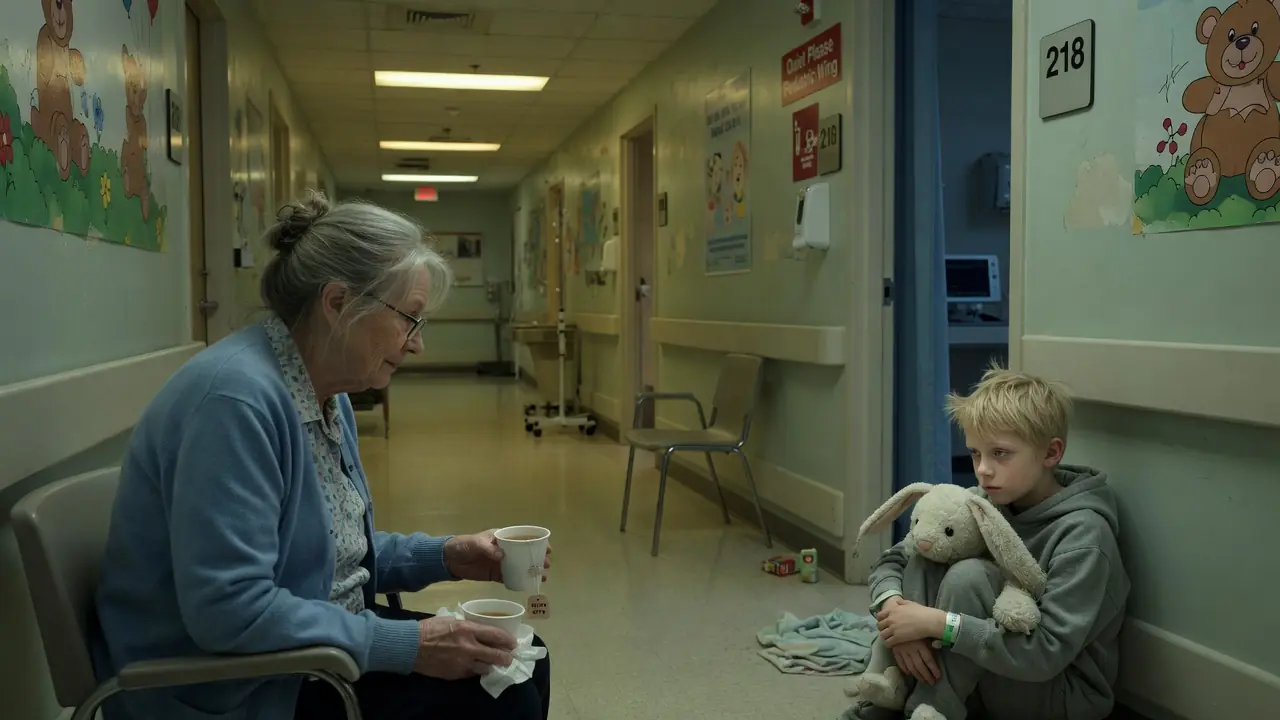
Noah’s shoes appeared by the back door. Rebecca’s medicine bottles lined the kitchen counter. The guest room became Rebecca’s room, and Helen turned the small sewing room into a bedroom for Noah. She found old quilts, cleared drawers, and bought a secondhand desk from a church sale.
Noah stood in the doorway of the room, staring.
“This is mine?”
“For now,” Helen said.
He touched the desk. “I never had a desk.”
“Well,” Helen said, “every great homework complaint deserves a proper desk.”
He smiled.
Recovery was not simple.
Rebecca was frustrated by weakness. Noah became anxious whenever she coughed. Helen learned medication schedules, drove them to appointments, cooked soft meals, and reminded Rebecca that healing was work even when it looked like resting.
At night, after Noah slept, Rebecca sometimes sat at the kitchen table with Helen.
“I used to think if I just worked hard enough, we’d be okay,” Rebecca said.
“Work matters,” Helen replied. “But no one survives on work alone.”
Rebecca stared into her tea. “I don’t know how to accept help.”
“Most of us learn badly and late.”
Rebecca smiled faintly. “You speak like a fortune cookie.”
“My late husband said the same thing.”
Over the months, Rebecca grew stronger. She found part-time office work through a church contact, then a better position at a medical billing company. Noah returned to school and began to thrive. He was bright, careful, and deeply observant. He asked questions about everything: medicine, hospitals, insurance, why some people got help quickly and others waited too long.
At ten, he said he wanted to become a doctor.
Rebecca laughed softly. “That’s a lot of school.”
Noah looked serious. “Then I’ll do a lot of school.”
Helen believed him.
Years passed.
Rebecca and Noah eventually moved into a small apartment nearby, but every Sunday they came to Helen’s house for dinner. Noah mowed her lawn as he got older. Rebecca took her grocery shopping. Helen attended every school event, every science fair, every award ceremony.
Noah began calling her Grandma Helen by accident when he was twelve.
He froze afterward.
Helen only said, “Pass the potatoes, dear.”
After that, the name stayed.
Noah became exactly the kind of young man Helen had suspected he would become: disciplined, compassionate, and unable to ignore suffering. He volunteered at hospitals in high school. He earned scholarships. He studied biology, then medicine. Every time he came home, he visited Helen first.
When he graduated from medical school, Helen sat in the front row beside Rebecca, both of them crying so hard they ran out of tissues.
Dr. Noah Ellis.
Helen whispered the name like a prayer.
After the ceremony, Noah placed his graduation hood around Helen’s shoulders for a picture.
“This belongs to you too,” he said.
She shook her head. “No, sweetheart. You earned it.”
He looked at her with shining eyes. “I survived long enough to earn it because you stayed.”
Helen could not answer.
As Noah’s life grew larger, Helen’s grew smaller.
Her steps slowed. Her arthritis worsened. The old house needed repairs. The porch railing loosened. The roof leaked near the hallway. Medical bills arrived after a fall that left her with a fractured wrist.
She told no one how bad the money had become.
Rebecca noticed some of it and helped when she could, but Helen was skilled at hiding need. She had spent years being the helper. Being helped felt like wearing clothes that did not fit.
One winter morning, Helen fainted in her kitchen.
She woke in the hospital, confused and frightened, with Noah sitting beside her bed in a white coat.
For one strange second, she saw the boy from the hallway again, clutching a broken stuffed rabbit.
Then he leaned forward.
“Grandma Helen,” he said, voice shaking, “you scared me.”
She blinked. “You’re supposed to be at work.”
“I am at work. You chose my hospital.”
“That was considerate of me.”
He laughed, but his eyes were wet.
The diagnosis was manageable, but serious. She needed better nutrition, safer living conditions, medication adjustments, and someone checking in regularly. Noah reviewed everything with the fierce tenderness of a man who had once been a scared child in a plastic chair.
When Helen was discharged, he did not take her back home immediately.
He took her to a newly renovated building on the east side of Louisville.
“Noah,” she said from the passenger seat, “where are we?”
He smiled nervously. “Somewhere important.”
The building was brick, with wide windows and a small garden near the entrance. A sign was covered with a blue cloth. Rebecca stood outside with several nurses, doctors, neighbors, and children holding handmade cards.
Helen looked confused. “What is this?”
Noah helped her from the car and guided her to the entrance.
“This clinic opens next month,” he said. “It will serve working families who avoid care because of cost, transportation, fear, or shame. Evening hours. Sliding scale. Child support services. Recovery care for parents. A place where no one has to work through sickness until they collapse.”
Helen stared at him.
He nodded to Rebecca.
She pulled the cloth from the sign.
THE HELEN MORRIS FAMILY CLINIC
Because No One Should Wait Alone.
Helen stopped breathing for a moment.
“No,” she whispered.
Noah turned to her. “Yes.”
“Noah, my name should not be on a building.”
“It should be on this one.”
She shook her head, tears already falling. “I didn’t do anything like this.”
“You sat with me in a hallway when everyone else had somewhere else to be,” he said. “You fed me crackers. You stayed through the night. You gave my mother a place to heal. You gave us a home when we had none. Every patient who walks through this door will receive the kind of help you gave us before anyone asked whether we deserved it.”
Helen covered her face.
Rebecca wrapped an arm around her.
“You saved both of us,” Rebecca whispered.
The opening ceremony was small but full of feeling. Noah spoke briefly, though his voice broke twice.
“When I was nine,” he said, “I sat outside my mother’s hospital room with no one beside me. I was terrified. I thought being brave meant not crying. Then Helen Morris sat on the floor beside me and taught me that bravery sometimes means letting someone stay.”
Helen cried openly.
Noah continued, “This clinic exists for every child waiting in a hallway, every parent working through illness, every family too tired to ask for help. My grandmother Helen taught me that medicine begins before the doctor enters the room. It begins when someone notices.”
Years later, Helen spent many afternoons in the clinic garden. Children came to know her as Grandma Helen. Some brought her drawings. Some sat beside her while their parents saw doctors. Some asked if she was the boss.
She would smile and say, “Absolutely not. I simply sit here and give opinions.”
Noah visited her between patients whenever he could.
Sometimes, she watched him kneel beside frightened children and speak gently, just as she once had. He never rushed them. He never spoke over them. He always asked who was waiting with them.
And if the answer was no one, he stayed a little longer.
On Helen’s eighty-seventh birthday, the clinic staff surprised her with a party in the waiting room. There was cake, flowers, and a framed photograph on the wall.
It showed Helen years earlier, sitting in the hospital hallway beside Noah, both of them half-asleep in plastic chairs. A nurse had taken it after Rebecca stabilized, thinking they looked like family before anyone had named it.
Beneath the photo were the words:
SHE STAYED.
Helen touched the frame with trembling fingers.
“I looked so tired,” she said.
Noah laughed through tears. “You were.”
“So were you.”
He took her hand. “Not alone, though.”
That evening, after the party, Noah drove Helen home. Her house had been repaired by then, arranged and modified so she could live safely. Rebecca had moved into a house two streets away. Noah visited every week. The quiet no longer felt like abandonment. It felt like rest between arrivals.
At the front door, Helen paused.
“I thought my life was over before I met you,” she said softly.
Noah looked at her. “Why?”
“Frank was gone. Anne was gone. I thought all the love I had left had nowhere to go.”
He squeezed her hand.
“You gave it to us.”
“And you gave it back,” she whispered.
Noah shook his head. “We passed it on.”
Inside, the house smelled of soup and lavender soap. A fresh drawing from a child at the clinic sat on the table. Rebecca had left a casserole in the refrigerator. Noah’s old stuffed rabbit, repaired years ago by Helen’s careful hands, rested on a shelf in the hallway.
Helen looked at it and smiled.
Long ago, in a hospital hallway at two in the morning, an old woman had noticed a frightened boy waiting alone. She had bought crackers, sat on the floor, and refused to leave.
She had thought it was one night of kindness.
But one night became a home.
A home became a future.
A frightened boy became a doctor.
And a quiet old woman who believed her best years had passed lived long enough to see her love become a clinic where no child, no parent, and no tired soul had to wait alone again.