Wade Mercer was finishing his second cup of coffee inside a roadside diner along Route 12 when the little boy approached his booth. The child could not have been older than ten, yet he walked with the deliberate caution of someone who had learned that attracting attention could be dangerous. His bright blue hoodie was zipped to his chin, his jeans were ripped at both knees, and his oversized sneakers had been double-knotted to keep them from slipping off. He stopped several feet from the table, glanced toward the parking lot, and forced himself to speak.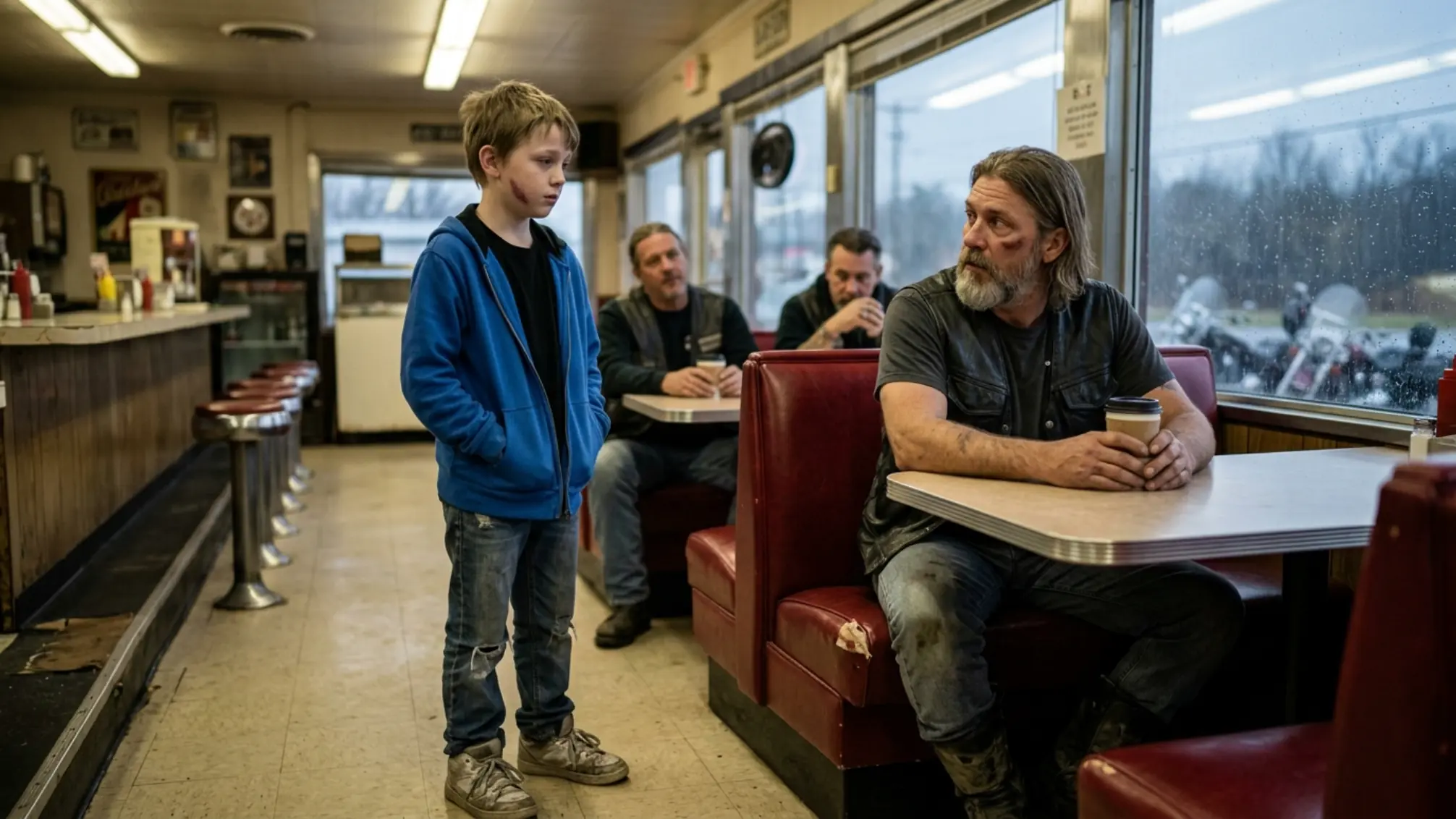
“Excuse me. Can you tell me how to get to the police station?”
Wade lowered his mug and studied the boy’s face. A dark bruise ran along the child’s jaw, partly hidden beneath the hood, while another reddish mark disappeared beneath his left sleeve. Connor and Travis, the two bikers sitting beside Wade, stopped talking without needing to be told. The boy’s question sounded ordinary, but nothing about the way he asked it was ordinary.
“There’s a station four miles east,” Wade said. “Straight down Route 9.”
“Thank you, sir.”
The boy turned toward the door. Wade watched him take three careful steps, moving quietly as though he had spent years avoiding floors that creaked. Outside, the autumn sky had darkened to the color of steel, and the wind carried the promise of an early snow. No ten-year-old dressed like that should have been walking four miles alone.
“Hey,” Wade called.
The boy stopped but did not turn immediately. His shoulders rose, preparing for whatever might come next, before he finally looked back. Wade had seen that reaction before in soldiers, prisoners, and children who expected kindness to become a trap. He pointed toward the empty side of the booth.
“You planning to walk there?”
“Yes, sir.”
“That’s four miles.”
“I know.”
“Sit down for a minute.”
The boy looked toward the diner entrance, then at the three broad men wearing black leather motorcycle vests. He was calculating risk, deciding whether remaining near strangers was more dangerous than going back outside. After several seconds, he sat at the very edge of the booth, keeping his body angled toward the door. Wade noticed that his hands remained inside his pockets.
The waitress, Maria, had worked the diner long enough to recognize trouble before anyone explained it. She brought a mug of hot chocolate without being asked and placed it gently before the boy. He stared at the steam rising from it but did not drink. His attention remained fixed on the gray parking lot beyond the window.
“What’s your name?” Wade asked.
“Ethan.”
“How old are you?”
“Ten.”
“Where do you live?”
Ethan hesitated. “Sycamore Street.”
“That’s about a mile from here.”
“Yes, sir.”
Wade leaned back without taking his eyes from the boy. “You walked one mile to ask directions to a station another four miles away.”
Ethan nodded.
“Why didn’t you call from home?”
“We don’t have a phone I can use.”
“The diner has one.”
The boy’s jaw tightened. “I didn’t want to call from somewhere he could find out.”
The table became silent. A pickup truck entered the parking lot, and Ethan’s eyes locked onto it immediately. His body remained perfectly still until a heavyset man in a work coat climbed out, walked into the diner, and sat at the counter without looking toward them. Only then did Ethan’s shoulders loosen.
“Who are you afraid will find out?” Wade asked.
Ethan wrapped both hands around the hot chocolate. “My mom’s boyfriend.”
“What’s his name?”
“Gary.”
“And Gary is why you need the police?”
The boy stared into the mug. “My brother’s still in the house.”
Connor leaned forward. Travis placed his coffee down with careful control. Wade kept his voice calm because the boy had clearly built his courage around the hope that no adult would become loud too quickly.
“How old is your brother?”
“Seven. His name is Danny.”
“Where’s your mother?”
“She’s there too.”
“Can she leave?”
Ethan’s expression changed. It was not the simple sadness Wade expected from a child discussing his mother. It looked older and more complicated, shaped by disappointment repeated so often that the boy had learned not to expect rescue from the person who should have protected him.
“She says we’ll leave,” Ethan whispered. “Then Gary says he’s sorry, and she believes him.”
Wade nodded slowly. “What happens when he gets angry?”
The boy pulled his left sleeve lower. “He gets loud first.”
“And after that?”
“He gets quiet.”
Ethan looked up for the first time and met Wade’s eyes directly. “The quiet is worse.”
Wade had spent twenty-three years riding with the Iron Haven Motorcycle Club, though the word club barely described what the men had become to one another. Many were veterans, mechanics, construction workers, fathers, and grandfathers. Several had grown up in homes where anger arrived behind closed doors, and none needed Ethan to provide more details than he could bear.
Travis slipped away from the booth and called the county dispatch line. Connor searched the address on his phone while Wade remained with Ethan. Maria returned and refilled the hot chocolate, pretending not to notice that the boy had barely touched it. Ethan looked at the fresh drink as though casual generosity confused him more than suspicion would have.
“When did you leave the house?” Wade asked.
“About an hour ago.”
“Did Gary see you?”
“No. He went to the back room.”
“Why didn’t Danny come with you?”
“He wanted to.”
Ethan’s fingers tightened around the mug. “I told him to stay because I didn’t know how far the police station was. He can’t walk as fast as me.”
The simple explanation hurt more than anything else Ethan had said. He had left his little brother behind not because he lacked courage, but because he believed the safest choice was to carry the danger alone. At ten years old, Ethan had already accepted the responsibility of making decisions no child should face.
Travis returned and sat beside Connor. “Dispatch has a prior call from the address. Eight months ago. No charges.”
“How long for a unit?” Wade asked.
“Fifteen or twenty minutes. They’re handling something across the county.”
Ethan pretended not to listen, but his eyes moved between the men.
Wade turned toward him. “Your brother is still inside with Gary?”
“Yes.”
“And Gary notices when something changes?”
“He checks every room when he gets suspicious.”