The summer heat shimmered above Route 9 as ten-year-old Isaiah Foster pushed his old bicycle toward the only gas station outside Cedar Hollow, North Carolina. His front tire had gone soft again, and the chain clicked unevenly beneath a frame patched with electrical tape and rust. A faded gray T-shirt hung loosely from his narrow shoulders, one knee showed through his worn jeans, and a blue plastic lunchbox swung from his hand. He had planned to eat beneath the oak trees behind the elementary school, but three exhausted bikers sitting against the gas station wall made him forget his own hunger.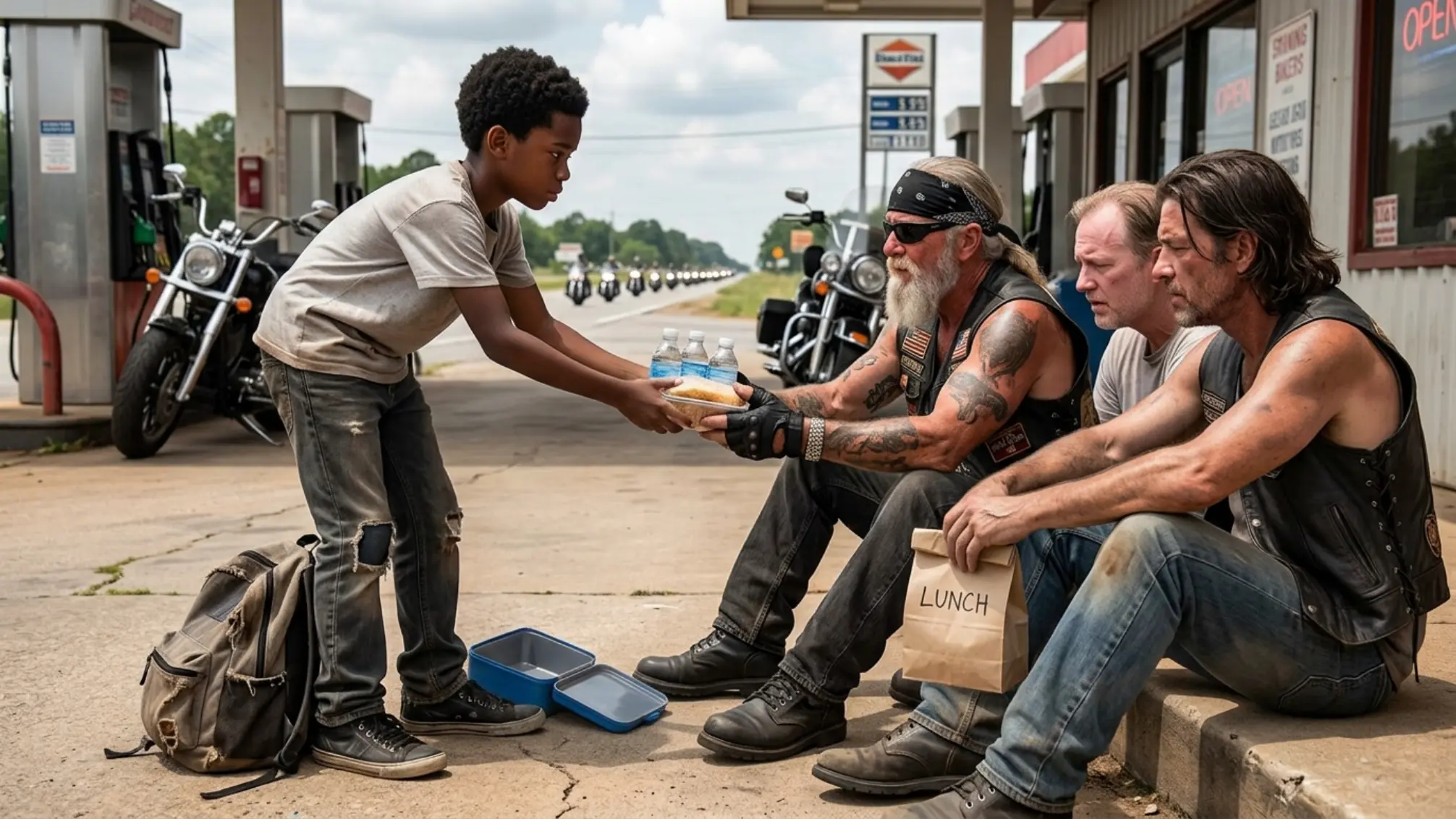
Their motorcycles stood beside the fuel pumps, dusty and silent beneath the afternoon sun. The largest rider was a fifty-eight-year-old white American man with weathered skin, tattooed arms, a long silver beard, black sunglasses, and a leather vest covered with military and charity patches. Beside him sat a pale forty-three-year-old biker whose hands shook uncontrollably around his knees, while the third man, a broad forty-nine-year-old with shoulder-length dark hair and heavy stubble, searched through empty saddlebags for something that was no longer there.
Isaiah did not understand the last sentence. He thought the biker was trying to make him smile, the way adults sometimes promised impossible things when they were embarrassed to accept help from a child. He placed the lunchbox on the curb, opened the scratched blue lid, and revealed a chicken sandwich wrapped in wax paper, a bruised apple, three peanut-butter crackers, and a small bottle of orange juice. It was all his mother had been able to pack before leaving for another twelve-hour nursing shift.
The trembling biker was named Tommy Brooks. He had type 1 diabetes, and his glucose had been falling since a leather saddlebag tore loose from his motorcycle nearly forty miles earlier. The missing bag contained his insulin supplies, wallets, phones, cash, and the emergency snacks the three men carried during long charity rides. They had spent the past hour asking strangers for help, but the gas station clerk had refused to give them food without payment.
“Store policy,” the clerk had said through the open doorway. “No money, no food.”
The silver-bearded rider, Duke Callaway, had explained that Tommy could collapse. He offered to leave his motorcycle title, military identification, and expensive watch until someone from their riding club arrived with money. The clerk looked at Duke’s leather vest and tattoos, shook his head, and threatened to call the police if the bikers continued bothering customers. Duke finally guided Tommy outside and sat him in the narrow shade along the wall.
Isaiah had heard most of the argument while using the free air pump beside the building. He knew what hunger looked like because he had seen it in his own kitchen. He knew what fear sounded like because his mother used the same calm voice whenever a bill arrived that she could not pay. Most importantly, he knew that the pale biker was not merely hungry; he was in danger.
“Eat the crackers first,” Isaiah said, kneeling beside Tommy. “My teacher keeps some in her desk when her sugar gets low.”
Tommy tried to open the package, but his fingers shook too badly. Isaiah tore the wrapper carefully and handed him one cracker at a time. The third biker, Ray Bennett, unscrewed the orange juice and steadied Tommy’s wrist while he drank. Duke watched the boy work with the focused tenderness of someone who had learned compassion from necessity rather than instruction.
“You should keep the sandwich,” Duke said. “You’re still growing.”
Isaiah divided it into three uneven pieces. “My mom made dinner before she left. I can eat when I get home.”
That was not entirely true.
The Foster house had half a box of noodles, two eggs, and enough canned beans for one meal. Isaiah’s mother, Ellen, had left the sandwich because she knew he would be biking across town to the public library. She had even cut it diagonally, the way Isaiah liked, though she had eaten nothing herself before leaving for work. He understood what giving away the lunch meant, but Tommy’s shaking made the decision simple.
Duke removed his sunglasses. His eyes were red from heat, exhaustion, and something he would not allow to become tears in front of the others.
“What’s your name, son?”
“Isaiah Foster.”
“Where do you live?”
“Maple Street.”
“Your mother know where you are?”
“She knows I’m going to the library.”
Duke nodded toward the boy’s bicycle. “You ride that all the way into town?”
“It’s only four miles.”
Ray examined the taped handlebars, cracked seat, and worn tires. “That bike’s older than you are.”
“It belonged to my dad.”
The three men fell silent.
Isaiah’s father, Marcus Foster, had worked on a roofing crew until a support beam failed at a commercial building three years earlier. He fell more than twenty feet and died before reaching the hospital. The construction company blamed a subcontractor, the subcontractor blamed defective materials, and the insurance companies spent months arguing while Ellen tried to keep the electricity connected.
The settlement barely paid for the funeral and overdue rent. Ellen moved Isaiah into a two-bedroom bungalow at the end of Maple Street and accepted night shifts at St. Francis Hospital. She left home before sunset, returned after dawn, and still woke before noon to cook, clean, or help Isaiah with schoolwork before resting again.
Isaiah had learned to recognize the days when his mother claimed she had already eaten. He had learned that “We’ll buy it next week” usually meant “We cannot afford it.” He never asked for new clothes, school trips, or birthday parties. When his bicycle chain slipped, he repaired it with instructions from an old library book because taking it to a shop might cost more than their weekly grocery budget.
Yet Ellen never allowed hardship to become cruelty.
“If you see someone hurting,” she often told him, “you do not have to solve their whole life. Just do the kind thing that is in front of you.”
At the gas station, the kind thing was a sandwich.
Tommy finished the crackers and juice. Color slowly returned to his cheeks, and the trembling in his hands weakened. Ray gave him one piece of the sandwich while Duke saved another in the wrapper. Isaiah offered the apple too, but Duke placed it back inside the lunchbox.
“This part stays with you,” he said firmly.
Isaiah started closing the lid. “Are you going to be okay?”
Duke looked toward the empty highway. “Our people are coming.”
“How far away?”
Duke glanced at the borrowed phone Ray had managed to charge inside the station before the clerk forced them out. A message from Wheels for Hope showed that their nearest regional ride had just finished a fundraising event forty miles east. Duke had sent one brief request before the phone died.
Three riders stranded. One diabetic emergency. Route 9 station near Cedar Hollow.
The response had arrived less than a minute later.
Hold position. All chapters moving.
Duke looked back at Isaiah. “About an hour.”
The boy smiled politely but did not believe five hundred people could appear because three men needed food. He shook Duke’s hand, lifted his lunchbox, and pushed his bicycle toward the road.
“Wait,” Tommy called.
Isaiah turned.
“You may have saved my life.”
The boy looked embarrassed. “I just shared lunch.”
Then he climbed onto the bicycle and pedaled toward Cedar Hollow, unaware that Duke was memorizing every detail: the patched knee, the loose backpack strap, the taped handlebars, and the way the rear wheel wobbled each time Isaiah pushed down on the pedals.
Duke watched until the boy disappeared beyond a line of pine trees.
Ray sat beside him. “Five hundred?”
“That was the last chapter count.”
“You told the kid they were coming to thank him.”
“They are.”
“We didn’t tell them about him.”
Duke picked up the dead phone. “Not yet.”
The gas station clerk, Phil, stepped outside with his arms folded. He looked at the empty wrappers near Tommy and then toward the road where Isaiah had vanished.
“You people need to move those bikes if you’re not buying fuel.”
Duke stood slowly.
He was not an aggressive man, despite his size and appearance. Three military deployments had taught him that anger wasted energy when precision would accomplish more. He picked up every wrapper, placed the trash in the bin, and looked through the window at shelves filled with food that Phil had refused to extend on credit even when a man’s health was failing.
“We’ll be gone soon,” Duke said.
Phil shrugged. “Good.”
Duke smiled without warmth. “You may want to clear your parking lot.”
Exactly fifty-eight minutes after Isaiah left, the first distant engine appeared as a low vibration beneath the pavement. Ray felt it through his boots before he heard it. Tommy lifted his head, and Duke turned toward the eastern horizon. A thin line of headlights emerged from the heat haze, stretching across the highway in disciplined rows.
The sound grew from a murmur into thunder.
Motorcycles came over the hill in groups of four, chrome flashing beneath the sun. Black, red, silver, and deep-blue machines filled the road behind one another, their riders wearing patches from veterans’ organizations, charity clubs, rescue groups, and regional motorcycle chapters. The formation continued beyond the hill until the line seemed endless.
Phil stepped outside again. “What the hell is this?”
Duke put on his sunglasses. “My people.”
The first riders turned into the gas station. Others filled the shoulder, the gravel lot behind the building, and the access road beside an abandoned feed store. Within minutes, five hundred motorcycles surrounded the property without blocking traffic or touching anything that was not theirs.
At the front rode Maria Alvarez, a fifty-two-year-old retired Army medic who led the southeastern chapter of Wheels for Hope. She parked, removed her helmet, and went directly to Tommy with a medical kit. Behind her, riders unloaded glucose tablets, bottled water, sandwiches, fruit, emergency insulin coolers, tools, and fuel.
Maria checked Tommy’s blood sugar and looked sharply at Duke. “How long was he without food?”
“Too long.”
“Who helped him?”
Duke pointed toward the road Isaiah had taken. “A ten-year-old boy with one sandwich.”
The riders closest to them stopped speaking.
Duke told the story exactly as it had happened. He described Isaiah listening from the air pump, opening the lunchbox, feeding Tommy, and dividing the meal without hesitation. He explained that the boy’s bicycle was barely holding together and that the food had likely been his only lunch.
Maria looked at the apple still inside the blue lunchbox. Isaiah had accidentally left the container beside the curb.
“What’s his name?” she asked.
“Isaiah Foster. Maple Street.”
One rider searched the town map on his phone. Cedar Hollow had only one Maple Street, ending three miles west of the gas station.
Maria turned toward the waiting formation. “We came for three brothers. Now we have one more person to find.”
Five hundred engines started again.
Isaiah reached Maple Street just after three in the afternoon. His bicycle chain had slipped twice, and the soft front tire made steering difficult. Ellen’s car was not in the driveway because she was still at the hospital. Isaiah leaned the bike against the crooked porch railing and sat on the steps with the bruised apple Duke had insisted he keep.
He took one bite.
Then the windows began to shake.
At first, Isaiah thought a storm was approaching. Birds burst from the dogwood tree, and Mrs. Patterson stepped onto her porch across the street. The sound rolled closer until it became unmistakable—the deep synchronized roar of hundreds of motorcycle engines.
Isaiah stood.
The first motorcycles turned onto Maple Street, followed by another row, then another. Riders filled the block from curb to curb before spreading carefully onto the empty grass lot at the end of the road. Neighbors appeared at windows and doorways as the entire street transformed into a sea of chrome, leather, and headlights.
Duke rode at the front.
He parked beside Isaiah’s broken bicycle, removed his sunglasses, and held out the blue lunchbox.
“You forgot something.”
Isaiah stared beyond him. “Are all these people with you?”
“Five hundred of them.”
“You really called them?”
“I told you they were coming.”
“But why are they here?”
Duke looked at the riders standing silently along the street. “Because you fed three hungry men when everyone else looked away.”
Isaiah lowered his eyes. “It was only lunch.”
“No,” Duke said gently. “It was the only lunch you had.”
The front door of the Foster house opened behind Isaiah. Ellen had returned early after a supervisor sent her home to rest. She stood in powder-blue scrubs, dark hair pulled into a tired bun, confusion spreading across her face as she saw hundreds of strangers surrounding her property.
She rushed down the steps and placed one hand protectively on Isaiah’s shoulder.
“What happened?”
Duke removed his leather gloves. “Mrs. Foster, my name is Duke Callaway. Your son found three of us stranded at a gas station. One of my men was going into a diabetic emergency.”
Ellen looked at the empty lunchbox in Duke’s hand.
“He gave you his lunch?”
“Yes, ma’am.”
She turned to Isaiah. “The sandwich?”
Isaiah nodded.
“The chicken I packed this morning?”
“Yes.”
Ellen pressed her lips together, caught between pride and fear. “Baby, that was all you had.”
“He needed it more.”
Duke’s voice softened. “That is exactly why we came.”
A delivery van moved slowly through the motorcycles and stopped beside the curb. Riders opened its rear doors, revealing boxes of groceries, bottled water, medical supplies, school clothes, and household products. Another truck carried lumber, roofing material, white paint, a new washing machine, and a professionally repaired bicycle with polished wheels and a blue frame.
Isaiah’s mouth fell open.
Duke pointed toward the bicycle. “That one belongs to you.”
“I can’t take that.”
“You can.”
“My mom can’t pay for it.”
“It has already been paid for.”
Ellen shook her head. “Mr. Callaway, we appreciate what you’re trying to do, but we cannot accept hundreds of people buying things because Isaiah shared one meal.”
Maria stepped forward from the crowd. “Ma’am, nobody here is buying kindness. We are answering it.”
Tommy approached next. He looked strong now, his blood sugar stabilized and his hands steady. He knelt so that he and Isaiah were at eye level.
“You asked why we were hungry,” Tommy said. “Most people walked past without even looking. You looked.”
Isaiah shifted nervously. “My mom says you should help when you can.”
Tommy smiled. “Your mother raised a remarkable young man.”
Duke took a folded envelope from inside his vest and offered it to Ellen.
She did not reach for it. “What is that?”
“A receipt.”
“For what?”
“The past-due amount on your mortgage.”
The street went silent.
Ellen’s face changed. “How do you know about that?”
Mrs. Patterson covered her mouth across the road.
Duke answered carefully. “One of our riders called the county clerk after we found your address. The foreclosure filing was public. We contacted the lender and paid the overdue balance before riding here.”
Ellen stepped backward. “You paid my mortgage?”
“We brought it current.”
“No.”
“Mrs. Foster—”
“No, you don’t understand.” Her voice cracked. “That is thousands of dollars.”
“Fourteen thousand, three hundred and eighty-two.”
Ellen sat heavily on the porch step.
For three years, she had hidden notices beneath cookbooks, worked double shifts, skipped meals, and calculated every purchase down to the dollar. She had expected the bank to take the house before winter. She had not told Isaiah because she could not bear to make a child afraid of losing another home after he had already lost his father.
Now five hundred riders stood in her street because that child had given away a sandwich.
Tears slid down her cheeks.
Isaiah sat beside her and wrapped both arms around her shoulders. “Mom?”
She pulled him close. “I’m okay.”
Duke lowered himself onto the step below them. “Take all the time you need.”
No one cheered. No cameras were pushed into Ellen’s face, and no rider demanded gratitude. Five hundred men and women simply waited while a tired mother cried against her son’s shoulder.
After several minutes, Ellen looked at Duke. “Why would strangers do this?”
“Because your boy reminded us who we are supposed to be.”
The riders went to work.
Carpenters repaired the porch railing. Roofers replaced damaged shingles. Electricians inspected outlets that had sparked during rainstorms. Mechanics tuned Ellen’s old sedan and repaired the heating system before she could object. Maria and two other retired nurses organized the groceries, filling cupboards that had been nearly empty that morning.
Isaiah helped Ray assemble his new bicycle. The boy carefully transferred a strip of electrical tape from his father’s old handlebars to the new frame.
Ray noticed. “You want to keep that?”
“It reminds me of Dad.”
“Then it stays.”
By sunset, the Foster house had fresh white paint across the porch, a secure railing, repaired gutters, and enough food for several months. The new washing machine hummed in the small laundry room. Isaiah’s bicycle stood beside his father’s old one, both sharing the same piece of black electrical tape.
Duke sat with Ellen at the kitchen table while riders worked outside.
“There’s one more thing,” he said.
Ellen looked exhausted by generosity. “I don’t think my heart can survive one more thing.”
Duke placed a document on the table. Wheels for Hope had created the Marcus Foster Kindness Scholarship, funded by donations collected during the riders’ journey. The scholarship would cover Isaiah’s school expenses through high school and provide tuition support if he later attended college or trade school.
Ellen touched her husband’s printed name.
“He would have loved this,” she whispered.
“What kind of man was he?”
“The kind who stopped on highways to change strangers’ tires.”
Duke smiled. “Then Isaiah comes by it honestly.”
As darkness settled over Cedar Hollow, the riders prepared to leave. Engines started in waves, but Duke remained beside Isaiah near the curb.
The boy held the blue lunchbox against his chest.
“Are you coming back?” Isaiah asked.
Duke fastened his gloves. “Try keeping five hundred bikers away from a kid who fed their brothers.”
Isaiah smiled.
Duke pointed toward the new bicycle. “Next time, we ride together.”
The motorcycles pulled away in rows, their red taillights stretching down Route 9 like a river of fire. Neighbors stood along Maple Street watching until the final engine faded into the distance. The house became quiet again, but it was a different silence from the one that had lived there that morning.
Ellen stood beside Isaiah on the repaired porch.
“You gave away your whole lunch,” she said.
Isaiah looked worried. “Are you mad?”
She knelt and held his face between her hands. “I have never been prouder of anything in my life.”
“But you always say there’s enough.”
“There wasn’t enough today.”
Isaiah glanced toward the road where the riders had disappeared.
“There was after I shared it.”
Ellen hugged him tightly.
Years later, Isaiah would still remember that afternoon whenever he saw someone sitting alone, hungry, frightened, or invisible. He would remember three strangers on a curb, a trembling hand reaching for a cracker, and five hundred motorcycles appearing beneath the Carolina sun. Most of all, he would remember that kindness did not begin with having plenty.
It began when a little boy opened the only lunchbox he had.