“There are four of us. We haven’t eaten in two days. Just one sandwich, please.”
“No money, no food.”
“He’s diabetic. He’s shaking right now.”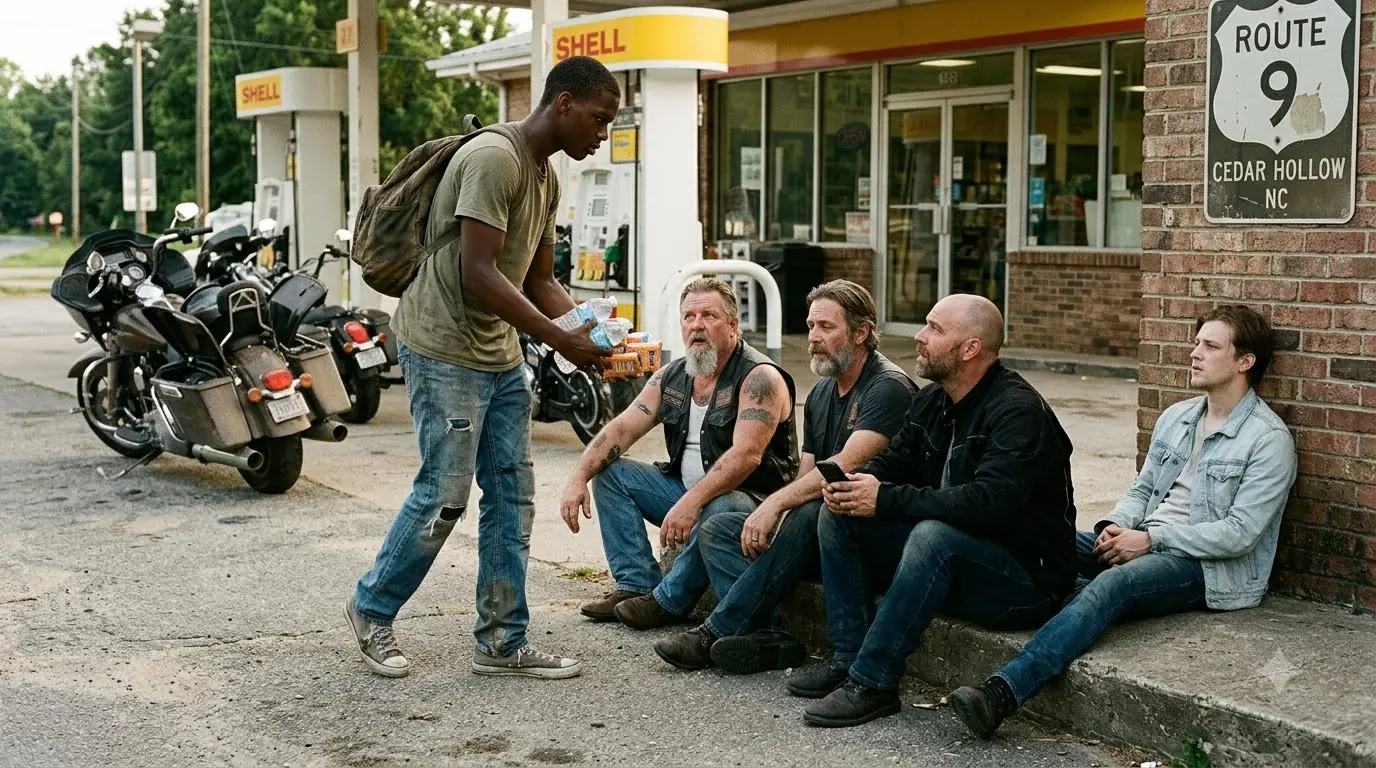
“Not my problem.”
“You would let a man collapse on your floor?”
“Call 911.”
Four bikers were stranded at a gas station off Route 9 while traveling on a charity ride for homeless children, and they could not even afford to feed themselves.
Duke Callaway had completed three military tours, built a charitable foundation from nothing, and traveled thousands of miles to help strangers. That afternoon, he could not buy his crew a sandwich or even a bottle of water.
Outside the gas station, nineteen-year-old Liam Foster sat beside his bicycle with the school lunch his mother had awakened at five that morning to prepare. He was Black, one of only a few Black students from that side of town, and the meal in his backpack was almost everything his family could spare.
Liam walked inside and used what he had to feed the four men.
“Here,” he said. “Take mine.”
Liam had no idea what that simple act was about to begin.
Cedar Hollow was not the kind of town that appeared on the evening news.
Its population was approximately four thousand and shrinking. It had one traffic light, a Family Dollar, a post office, and a diner called Rosie’s that still had a payphone attached to the wall beside the restroom.
The Foster house stood at the dead end of Maple Street. It was a two-bedroom bungalow with white paint that had faded into uneven patches of gray and a porch railing that leaned as though it had grown tired of standing.
The mailbox beside the curb displayed the name Foster in adhesive letters. The second letter had peeled away two winters earlier, and nobody had replaced it.
Inside, the kitchen smelled of coffee and dish soap.
Ellen Foster moved through the room the way she moved through everything, quickly, quietly, and with the efficiency of someone who had learned not to waste a single minute.
She was forty-four, although she looked older.
Night shifts at St. Francis Hospital had carved permanent lines around her eyes. No amount of sleep could have erased them, mostly because sleep was something Ellen rarely received.
Her scrubs for that evening were already laid across the bed.
Powder blue.
Size small.
They were the same scrubs she had worn three times that week because the clothes dryer stopped working in March. Since then, she had washed and wrung out nearly everything by hand.
At the kitchen counter, Ellen packed a lunchbox.
She added rice left from the previous night, a piece of chicken thigh she had trimmed from her own dinner plate, boiled greens, and one apple.
It was the final apple in the bag.
A bruise darkened its left side, so Ellen placed it inside the lunchbox with the damaged area facing down.
She sealed the lid and placed the container beside the front door.
It was the same routine every morning.
Five o’clock.
Ten minutes before Liam’s alarm rang.
Liam Foster was nineteen years old.
The Fosters were the only Black family on Maple Street and one of only a handful in Cedar Hollow.
Liam was a first-year student at Cedar County Community College, where he studied mechanical engineering. His father had possessed a natural talent for working with his hands, and Liam believed that ability had to have gone somewhere.
He was lean.
Not athletic lean.
It was the kind of thinness that came from missing meals and refusing to discuss it.
His hair was cut close, and his face was quiet. He was the type of young man most people would overlook in a crowded room unless they deliberately paid attention.
Most residents of Cedar Hollow had stopped paying attention to the Foster family a long time earlier.
Liam’s father, Greg Foster, had worked in construction as part of a framing crew.
He had been good at his job.
The foreman often said Greg could install a door perfectly straight in complete darkness.
Three years earlier, a scaffold support failed at a commercial construction site in Henderson.
Greg fell twenty-two feet onto a concrete surface.
He died before the ambulance crossed the river.
The family received a settlement of fourteen thousand dollars.
At first, that amount sounded significant.
Then the funeral cost six thousand.
The remainder disappeared into overdue rent and a water heater that failed during the same month, almost as though the house understood that something essential had broken.
After Greg’s death, Ellen accepted night shifts at St. Francis Hospital.
She worked twelve hours at a time, three or four nights each week.
From seven in the evening until seven the following morning, she remained on her feet, checking vital signs, changing dressings, and cleaning after patients.
Some patients shouted at her.
Others held her hand and cried.
Liam found work at Quick Mart, the convenience store on Route 9, half a mile east of the gas station.
He worked from five in the afternoon until eleven at night, stocking shelves and operating the register for $9.25 an hour.
After closing, he swept the parking lot for an additional fifteen minutes without pay.
His manager, Dale, had once suggested that employees who went beyond their assigned duties were more likely to remain on the schedule.
On Saturdays, Liam knocked on doors and offered to mow lawns for ten dollars each.
Most residents agreed out of pity.
Others closed the door before he finished asking.
Inside a dresser drawer, Liam kept a folded envelope containing small amounts of cash taken from his tips.
Whenever he collected several five-dollar or ten-dollar bills, he secretly placed them inside his mother’s purse.
Ellen never mentioned the extra money.
Liam never mentioned the foreclosure notice she had hidden beneath the telephone directory on the kitchen counter.
The amount due was $12,400.
They were three months behind.
A red stamp across the top read:
“FINAL WARNING.”
Mother and son were careful with each other.
They moved like two people carrying the same heavy object through a narrow doorway, each pretending the weight was not destroying them.
Every morning, Liam picked up the lunchbox beside the door.
Every morning, he said the same thing.
“Thanks, Mom.”
Ellen always smiled.
“There’s plenty.”
There was not.
The experience of being poor and Black in a small, predominantly white town carried a particular kind of silence.
Everyone knew the Foster family was struggling, but almost nobody spoke about it directly to them.
Instead, people discussed it behind their backs in the cereal aisle at Family Dollar, in the church parking lot after Sunday services, or in the quiet voices that stopped whenever Liam or Ellen entered Rosie’s Diner.
Liam once overheard two women speaking through the open window of Mrs. Patterson’s kitchen while he mowed her lawn.
“Three months? Lord.”
“That boy works every night at the convenience store. Have you seen him walking home at eleven?”
“Eleven at night, on foot, in the dark.”
“Somebody should do something.”
Nobody did.
At college, Liam sat in the back row.
It was not because he was a poor student. His grades were solid, mostly B’s, with an A in applied mechanics.
The back row was where he sat because his jeans had a patch across the left knee and the zipper on his backpack had been broken since September.
It was where a person sat when classmates invited everyone to Chili’s after Thursday laboratory sessions and he claimed he had already eaten.
Usually, the last thing inside Liam’s stomach was a granola bar from the Quick Mart break room, one Dale allowed employees to take only after it passed its sell-by date.
Liam borrowed his textbooks from the public library rather than purchasing them from the campus bookstore.
Mrs. Gaines kept a shelf of donated college books behind the reference desk.
Most were two editions out of date.
Liam did not care.
Calculus had not changed very much.
His computer was borrowed too.
It was a scratched Chromebook from the college loan program. He returned it every Friday and collected it again every Monday.
Liam completed his assignments in the campus library between classes because the Foster house did not have internet access.
Ellen canceled the service eight months earlier.
It had been one of the first expenses removed from the household budget, after cable television and before the landline.
Hunger was not the most difficult part.
Liam knew how to endure hunger.
He drank water before class.
He chewed gum during the afternoon decline in energy.
He ate his lunch slowly, taking one small bite at a time so the meal appeared to last longer.
During weeks when Ellen worked additional shifts and did not have time to buy groceries, he ate damaged packages of instant noodles from Quick Mart.
Dale sold them to employees for twenty cents each because they could not be placed on the shelves.
The hardest part was pretending.
Pretending he was not exhausted when he entered his eight o’clock thermodynamics lecture after closing Quick Mart at eleven and walking forty minutes home in darkness.
Pretending he did not see the foreclosure notice when Ellen pushed it beneath the telephone directory.
Pretending he did not hear the neighbors whispering.
Pretending his shoes were not held together with superglue where the left sole had split near the ball of his foot.
Most of all, Liam pretended he was not angry.
He was never angry with Ellen.
His mother was already doing everything one person could reasonably do, and then doing more.
He was angry at the scaffold support that failed.
He was angry at the contractor who received an eleven-thousand-dollar safety fine after Greg died.
Eleven thousand dollars.
The penalty made his father’s life seem worth less than a used truck.
Liam was angry at the attorney who kept thirty percent of the settlement.
He was angry at the water heater, dryer, roof, porch railing, damaged mailbox, and the entire collapsing structure of a life that constantly demanded money the family did not possess.
Liam did not speak about anger.
He spoke about engineering.
“If you understand how something breaks,” he once told his laboratory partner, “you can learn how to keep it standing.”
The other student thought Liam was discussing bridge loads.
He was not.
The one thing Liam never failed to carry was the lunchbox.
Every morning, he collected it from the kitchen counter while the food was still warm and placed it carefully inside his backpack.
The food itself was ordinary.
Rice.
Chicken.
Greens.
An apple, when they had one.
What mattered was the act.
Ellen stood in the kitchen at five in the morning, exhausted after a life that rarely allowed her to rest, and packed food for the son she might not see again until the following day.
Their work schedules moved in opposite directions like two trains traveling the same track without ever meeting.
The lunchbox was the only conversation they shared on most days.
It said that Ellen was still there.
She still cared.
They were still a family.
Every morning, Liam carried that conversation to college.
He ate alone on a bench outside the engineering building, where nobody could see how slowly he chewed.
It was a Friday afternoon in late September.
The summer heat had not yet released the town.
Liam pedaled his bicycle along Route 9 with his backpack striking lightly against his spine and the empty lunchbox rattling inside it.
His Quick Mart shift began in two hours.
That gave him enough time to reach home, shower, change, and walk back.
The bicycle was a ten-speed model purchased at a yard sale for fifteen dollars.
Its chain slipped whenever he changed into third gear.
The rubber handlebar grips had rotted away, so Liam replaced them with several layers of electrical tape.
He stopped at the gas station to add air to the front tire.
The pump was free.
It was one of the few things remaining in Cedar Hollow that did not cost money.
That was when he noticed the four motorcycles.
They were parked in an uneven row beside the building.
Two Harley-Davidsons.
An Indian Scout.
A Honda Gold Wing with its saddlebags open and empty.
Dust covered the chrome, and the tires showed the wear of a long journey.
The riders sat on the concrete curb beneath the narrow shade created by the awning.
Duke Callaway was the largest of them.
He was fifty-five, broad across the shoulders, with sun-weathered skin and a silver beard that covered half his chest.
Patches on his leather vest represented three military tours.
Two in Afghanistan.
One in Iraq.
A patch above his heart read:
“WHEELS FOR HOPE.”
Duke founded the charity six years earlier to raise money for homeless young people.
He began without grants, sponsors, or an office.
There had been only Duke at the kitchen table of his two-bedroom Atlanta apartment, making telephone calls, organizing rides, collecting donations, and personally transporting supplies to shelters when nobody else volunteered.
During the previous year, Wheels for Hope delivered eleven thousand dollars to shelters in nine states.
Duke paid the fuel costs from his military pension.
Ray Bennett sat beside him.
He was forty-eight and had once taught automotive repair at a public high school in Virginia.
Budget cuts eliminated his position.
When Ray lost the job and nearly everything connected to it, he found the open road.
His skin was burned by the sun from his collar to his wrists.
His eyes remained half closed, and he appeared too exhausted to speak.
Sal Whitmore was forty-two.
He had a shaved head and a compass rose tattoo on his left forearm.
Sal co-owned a small construction company in North Carolina called Brooks and Whitmore Residential Framing.
Every year, he volunteered two weeks of his time for Duke’s charity rides.
That afternoon, Sal sat cross-legged on the pavement and stared at his powerless phone.
Tommy Brooks was the youngest rider at thirty.
He sat apart from the others with his back against a trash container and his knees pulled toward his chest.
His face was pale and covered with perspiration.
His hands trembled with a continuous movement that he attempted to hide by placing them beneath his arms.
Tommy had Type 1 diabetes.
His insulin and medical supplies were inside the saddlebag that had fallen from Ray’s motorcycle after they struck a deep pothole somewhere along Interstate 40.
The same bag contained their wallets, cash, bank cards, and two days of food.
The group had been riding from Atlanta toward Second Chance House, a shelter in Cedar Falls that served approximately two hundred young people each year.
It was the kind of shelter that ran out of blankets every December.
This was the second day of a three-day ride.
The men had not eaten for fourteen hours.
Tommy had not checked his glucose level for six.
Duke had watched Tommy’s hands for the previous hour.
The trembling began at approximately ten movements per minute.
Then fifteen.
Eventually, it became constant.
Duke understood the progression.
Another hour, perhaps two, and the situation could become critical.
He had already spoken to the gas station clerk twice.
“I need food for my men. We lost everything along the highway. I can send payment tonight through any service you use.”
The clerk was a thin man wearing a red polo shirt and a name tag that read Phil.
He looked at Duke’s leather vest and military patches.
“No. Store policy.”
Duke tried once more.
He kept his voice controlled while explaining Tommy’s diabetes and the purpose of the charity ride.
Phil picked up the telephone and threatened to call the police.
Duke returned outside and sat on the curb.
Their support van was six hours behind them.
Tommy’s tremors were becoming more severe.
Ray had stopped speaking an hour earlier.
Sal’s telephone had no power.
Liam stood beside the air pump and pretended to check his tire pressure.
Through the open entrance, he had heard the entire conversation.
Duke’s calm, controlled explanation.
Phil’s flat refusal.
Liam looked toward the four men.
Then he looked at his backpack.
The lunchbox inside was empty.
However, the backpack’s front pocket contained a twenty-dollar bill folded into a square and sealed with a piece of masking tape.
Ellen placed it there on the first day of the semester.
She wrote a message across the tape in blue ink.
“Only if you really need it.”
Liam had carried the money for six weeks.
He carried it through his midterm examinations.
He carried it through a week when the kitchen contained nothing except instant noodles and canned corn.
He carried it through the night his shoe split open and he repaired it with a tube of superglue from Quick Mart.
He carried it through every moment that felt like a genuine emergency but did not quite reach the level of impossible.
Liam had learned the difference between difficult and impossible.
He was saving the twenty dollars for impossible.
He looked at Tommy Brooks trembling beside the trash container in ninety-degree heat.
This was impossible.
Liam opened the front pocket.
He removed the taped bill and read his mother’s handwriting once more.
Then he walked inside.
He passed Phil without looking at him.
He walked beyond the candy display, motor oil, and empty rotating hot dog grill.
At the cold-storage case near the rear of the store, Liam selected four bottles of water.
Two dollars each.
Eight dollars.
Then he went to the snack aisle and collected four packages of peanut butter crackers.
One dollar and fifty cents each.
Six more dollars.
Fourteen dollars.
Almost an entire day of work at Quick Mart.
Liam placed everything on the counter.
Phil looked at the water, then the crackers, and finally at Liam.
“Fourteen dollars and eighteen cents with tax.”
Liam placed Ellen’s twenty-dollar bill on the counter.
A piece of masking tape remained attached to one corner.
The blue handwriting faced upward.
“Only if you really need it.”
Phil gave Liam $5.82 in change.
He dropped the coins onto the counter rather than placing them in Liam’s hand.
He always did that when Liam entered the store.
He did not do it with other customers.
Liam collected the change without reacting.
Then he carried the water and crackers outside.
Duke remained seated on the curb.
He watched Liam approach with both arms full.
For several seconds, he said nothing.
He looked at the young man with the expression people wore when the world did something they had nearly stopped believing it could do.
Liam placed the bottles and crackers on the pavement.
“Here,” he said. “It isn’t much.”
Nobody moved at first.
Then Tommy reached for a bottle with both trembling hands.
He opened it and drank half the water without stopping.
His eyes closed.
A sound escaped him that was not quite a word.
It was pure, involuntary relief, like a person finally releasing a breath he had held for too long.
Ray opened one package of crackers and ate all of them in three bites.
There was no conversation.
No attempt at politeness.
Only a person feeding a body that had demanded nourishment for hours while being repeatedly told to wait.
Sal broke his crackers into two portions.
He ate one half and wrapped the other inside the plastic before placing it in his vest pocket.
It was an old habit.
The habit of someone who understood that a person should not consume everything at once when the next meal was uncertain.
Duke ate last.
He opened the package slowly and chewed each cracker while looking at Liam.
“What is your name?” Duke asked.
“Liam. Liam Foster.”
“Duke Callaway.”
He extended his hand.
Liam shook it.
Duke’s palm was warm and rough, nearly twice the size of Liam’s hand.
Years of repairing engines, setting up charity tents, and shaking hands with people who trusted him had formed hard calluses across his knuckles.
“Do you attend school around here, Liam Foster?”
“Cedar County Community College. I study mechanical engineering.”
“Engineering.”
Duke nodded.
“You’re a smart young man.”
“I just like understanding how things work.”
Duke looked toward Liam’s bicycle.
He noticed the electrical tape around the handlebars, the loose chain, the broken backpack zipper, and the safety pin holding one strap together.
Then he saw Liam’s shoes.
The left sole had been visibly glued back into place.
Duke glanced toward the gas station entrance.
Phil watched through the glass with his arms crossed.
“That twenty-dollar bill,” Duke said quietly. “Was that your money?”
“My mother’s.”
“Emergency money?”
“Yes.”
Duke placed his remaining crackers beside him.
“Liam, I have ridden forty-two thousand miles for charity during the last six years. I have met many people.”
He paused.
“Good people. People who say they care.”
His mouth tightened.
Duke looked away for a moment, then returned his gaze to Liam.
“I have never seen someone give away something they could not afford to lose.”
Liam did not know how to answer.
He said what his mother always said.
“There’s plenty.”
Duke studied him.
“No, there isn’t,” he replied. “That is exactly why it matters.”
Tommy’s hands had stopped shaking.
Color slowly returned to his face.
He looked up from the curb.
“Thank you, man. Seriously. Thank you.”
“You’re welcome.”
Liam picked up his bicycle and swung one leg over the seat.
There was $5.82 in his pocket.
An empty lunchbox remained inside his backpack.
He was already eleven minutes behind schedule for preparing for work.
Liam began pedaling toward Maple Street.
He did not look back.
Duke removed his telephone.
Three percent battery remained.
He opened the notes application and typed two words before the screen became dark.
Maple Street.
The support van reached the gas station at eleven that night.
By then, Tommy’s glucose level had stabilized.
Ray had fallen asleep while sitting upright.
Sal borrowed the driver’s phone and called his wife.
He told her that he loved her for no particular reason.
Duke had spoken very little since Liam departed.
For five hours, he remained on the curb thinking about a twenty-dollar bill sealed with masking tape and a young man whose bicycle was held together with electrical tape.
Liam had given the money away and ridden home without looking back.
The support van’s driver was a retired trucker named Hank.
He distributed sandwiches and water.
“Is everyone all right?”
“No,” Duke said. “I need to find someone.”
The following morning, Duke returned to Cedar Hollow alone.
He did not ride his Harley.
He borrowed Hank’s pickup truck because what he intended to do required more than two wheels.
Duke visited the gas station first.
Phil was behind the counter wearing the same red polo shirt and the same uninterested expression.
“I’m looking for a young man named Liam Foster. He lives on Maple Street.”
Phil shrugged.
“I know him. He comes here to use the air pump. He works at Quick Mart down the road.”
“What do you know about his family?”
“His mother is a nurse. His father died a few years ago. They’re behind on the house.”
Phil delivered the information casually, like a weather report from a place where he did not live.
Duke left without purchasing anything.
He found Maple Street.
It ended in a dead end.
The Foster home was the final house on the left.
Duke parked across the street and remained inside the truck for several minutes.
The house was in worse condition than he imagined.
It did not appear abandoned.
It looked lived in, which made its condition more difficult to witness.
The porch railing leaned, but somebody had recently scrubbed it.
The window curtains were thin and faded by sunlight, yet they had been carefully ironed.
The yard was overgrown, but someone maintained a neat path between the sidewalk and the front steps.
A damaged push mower rested beside the house near a garden hose coiled carefully around a nail.
These were people who continued trying.
That was what affected Duke most.
They were not surrendering.
They were losing slowly, a little more each month, but they continued fighting.
A yellow notice was attached to the inside of the front door.
Duke could not read it from the truck.
He had seen enough similar notices to recognize it.
Foreclosure.
Final stage.
Duke crossed the street and knocked on Mrs. Patterson’s door.
She opened it while drying her hands on a dish towel.
The older woman looked at the biker on her porch with the cautious politeness small-town residents often offered unfamiliar men in leather.
“I’m looking for the Foster family. Can you tell me about them?”
“Are you collecting a bill?”
“No, ma’am. I’m a friend.”
Mrs. Patterson studied him.
Then she leaned against the doorframe and spoke for twenty minutes.
She told Duke about Greg Foster and the broken scaffold.
She described the settlement that barely paid for the funeral.
She told him about Ellen’s night shifts and double shifts.
One morning, Mrs. Patterson found Ellen asleep inside her car in the driveway because she had been too exhausted to walk to the front door.
Then she spoke about Liam.
“That young man mows nearly every lawn on this street for ten dollars. He never complains and never asks for help.”
She shook her head.
“He walks to work and home every night. Forty minutes each way, in darkness. I offered him a ride once, but he said he did not want to inconvenience me.”
Mrs. Patterson paused.
“He secretly puts money in his mother’s purse. I saw him through their kitchen window one morning. Five-dollar and ten-dollar bills from his own wages.”
Duke returned to the truck and remained there for a long time.
Then he took out his phone and began a video call with Ray, Sal, and Tommy.
The screen divided into four sections.
Ray sat on his couch in Virginia.
Sal was at his kitchen table.
Tommy was in bed with an intravenous line attached to his arm after receiving glucose treatment at an urgent care center in Cedar Falls.
“That young man from the gas station is Liam Foster,” Duke said. “He is nineteen years old and works while attending college.”
He continued.
“His father is dead. His mother works nights. They are about to lose their home.”
Nobody spoke.
“He gave us his mother’s emergency money. Her final twenty dollars.”
Duke looked toward the Foster house.
“Then he told me there was plenty.”
Tommy wiped his face with the back of his hand.
“What do we do?” Ray asked.
Duke leaned toward the camera.
“We ride.”
Duke shared the story that night on the Iron Brotherhood Network.
It was a private online forum with members across forty states.
Bikers.
Veterans.
Mechanics.
Truck drivers.
Retired police officers.
Men and women who did not share stories unless they genuinely meant something.
Duke’s post was simple.
There was no exaggeration and no request for sympathy.
He described four bikers stranded at a gas station in North Carolina.
They had lost their money and supplies along the highway.
They had gone nearly two days without a proper meal.
Tommy’s glucose level was dropping dangerously.
The gas station clerk refused to provide even a package of crackers with a promise of repayment.
Then a nineteen-year-old student arrived.
He was thin, his bicycle was held together with tape, and his shoes were repaired with glue.
Liam Foster used the emergency twenty-dollar bill his mother had placed inside his backpack to buy water and peanut butter crackers for four strangers.
Afterward, he returned to his bicycle and rode away.
He asked for no reward.
He did not even ask who they were.
Duke explained that Liam’s mother worked night shifts as a nurse.
His father had died three years earlier.
The family was about to lose its house on Maple Street in Cedar Hollow.
Duke published the post at 10:47 that night.
By midnight, it had two hundred comments.
By morning, it had four thousand.
By Monday, screenshots had moved from the private forum to Facebook, Instagram, and online motorcycle communities.
Group conversations from Montana to Miami shared Duke’s words.
Someone created a short video containing a voice reading the story over an image of an empty gas station at sunset.
It received three million views in two days.
The comments repeated the same emotion in thousands of different ways.
“We ride for our own.”
“This young man is one of us.”
“My son is nineteen. I cannot imagine him going hungry so his mother can eat.”
“I’m in Texas. How far is Cedar Hollow?”
“I will ride.”
“Tell me where to send money.”
A retired Marine named Cliff Walker lived in San Antonio.
He created an online fundraising page titled:
“Ride for Liam.”
The description contained one sentence.
“A young man gave four strangers his final meal. Let’s make sure he never has to go without one again.”
The campaign collected eight thousand dollars during the first twelve hours.
Twenty thousand by Wednesday.
Forty-five thousand by Friday.
Sal Whitmore called his construction partner and requested two weeks away from work.
“I need to repair a house.”
His partner asked no questions.
Ray Bennett drove to a hardware store in Virginia.
He filled his truck with lumber, roofing nails, and five gallons of exterior paint.
The color was white.
The way the Foster house was supposed to be.
Tommy Brooks recorded a video from his hospital bed.
There was no prepared script.
He sat against the pillows with the intravenous line still attached to his arm and looked directly into the camera.
“I am alive because a nineteen-year-old young man I had never met spent his mother’s last twenty dollars on peanut butter crackers.”
Tommy took a breath.
“He did not know I was diabetic. He did not know my glucose level was falling. He saw someone trembling and decided to help.”
He shook his head.
“That is the entire story.”
The video received nine hundred thousand views.
Riders from fourteen states began calling Duke.
They did not send messages.
They called directly.
Voice to voice.
Old-fashioned communication.
The way their brotherhood operated.
“When do we ride?”
“Saturday,” Duke answered. “One week from today. Maple Street in Cedar Hollow. Arrive by seven in the morning.”
“How many people do you expect?”
Duke paused.
He hoped for fifty.
Perhaps one hundred if the story continued spreading.
“I don’t know,” he said. “Enough.”
He had no idea what was coming.
Ellen Foster slept through nearly all of it.
She returned home at seven each morning, ate one piece of toast while standing, and went directly to bed.
Liam never mentioned what happened at the gas station.
He attended classes, completed his work shifts, and ate each lunchbox alone on the bench.
He rarely used the internet because the Foster home did not have access.
A storm was approaching Maple Street.
Neither Ellen nor Liam knew.
At 6:48 on Saturday morning, Ellen pulled into the driveway after a twelve-hour shift.
Her hands still smelled of latex gloves and sanitizer.
She remained inside the car for a minute.
It was not exactly rest.
The vehicle was simply the only place where nobody expected anything from her.
Then she heard a distant, low sound.
At first, she assumed it was construction equipment.
The coffee inside her cup holder began to vibrate.
Ellen opened the door and stepped into the driveway, still wearing her scrubs.
At the far end of Maple Street, motorcycles appeared.
They turned onto the road in rows of four, headlights glowing and chrome reflecting the first morning light.
More followed.
Row after row.
The street filled first.
Then the shoulders.
Then the surrounding grass and the vacant lot beside Mrs. Patterson’s house.
There were fifteen hundred motorcycles.
Riders had traveled from fourteen states.
Their vests carried patches from clubs Ellen had never heard of.
Iron Brotherhood.
Desert Wolves.
Granite Ridge Motorcycle Club.
Steel Saints.
There were elderly men riding restored Harley-Davidsons and young women on sport motorcycles.
A man in his seventies arrived on a 1978 Shovelhead.
Every one of them had come for the same reason.
The noise awakened Liam.
He came through the front door wearing a T-shirt and shorts, barefoot, with a glass of water still in his hand.
He stopped on the porch.
His mouth opened.
No sound came out.
Duke Callaway dismounted first.
He wore the same vest and carried the same silver beard.
His face looked different.
It appeared lighter, like the face of a man preparing to place down a burden.
Duke crossed the cracked path and climbed the creaking porch steps.
He stopped in front of Liam.
“Good morning, Liam.”
“Duke?”
“I told you my name was Duke Callaway.”
He smiled.
“I did not tell you what I do when someone feeds my crew.”
Behind him, riders began removing items from their motorcycles and vehicles.
Coolers filled with food.
Bags of groceries.
Gift cards.
Envelopes.
Sal’s pickup truck carried lumber, cans of paint, roofing materials, and a new front door still wrapped in plastic.
“What is all this?” Liam asked.
“This is what happens when a young man shares his lunch.”
Ellen ran around the side of the house.
Her hair had come loose, and she was still wearing her hospital scrubs.
She stopped at the edge of the yard and stared.
“Liam, what is happening?”
Duke stepped toward her.
“Ma’am, my name is Duke Callaway. One week ago, your son found me and my crew stranded at a gas station.”
He removed his sunglasses.
“We had not eaten properly in two days. Your son purchased food for us with money I believe you gave him.”
Ellen looked at Liam.
Liam looked toward his bare feet.
“He used the twenty dollars,” she said quietly.
“Yes, ma’am.”
Duke turned toward the motorcycles filling the street.
“I came to repay it.”
He gestured toward the fifteen hundred people who had traveled through the night because one teenager opened his backpack.
“We all did.”
Tommy Brooks approached while carrying a white envelope.
His hands were steady.
There was color in his face.
He offered the envelope to Ellen with both hands, as though presenting something sacred.
“This is from the fundraiser,” Tommy said. “Fifty-two thousand dollars.”
Ellen accepted it.
She opened the envelope and stared at the check.
Then she looked at Liam, Duke, and the fifteen hundred strangers standing across her yard, street, and sidewalks.
For three years, many people in Cedar Hollow had whispered about the Foster family.
That morning, nobody whispered.
Ellen sat on the porch steps and began to cry.
It was not quiet crying.
It rose from a place so deep that she had not known it existed until something broke it open.
Three years of night shifts.
Three years of foreclosure notices.
Three years of preparing lunch at five in the morning and saying there was plenty when there was not.
Every hidden fear escaped at once on a Saturday morning in front of people she had never met.
Liam sat beside her.
He placed an arm around her shoulders.
He said nothing.
He simply held on.
Duke remained on the walkway and waited.
Behind him, fifteen hundred riders stood beneath the morning sun and waited too.
Nobody hurried Ellen.
Nobody interrupted.
They allowed her to feel everything.
Then, one by one, they went to work.
Riders who worked as carpenters removed their tool belts from trucks.
Electricians inspected the wiring.
People without specialized training began carrying lumber and clearing debris.
Sal Whitmore climbed onto the roof with a pry bar and began removing rotten shingles.
Ray Bennett took the damaged front door from its hinges and replaced it with the new one.
Donna Wells, a member of the Steel Saints chapter in Georgia and a retired professional painter, opened the first can of white paint.
She began working on the porch railing.
By noon, the Foster home barely looked like the same building.
Mrs. Patterson stood in her front yard with a pitcher of lemonade.
Tears ran down her cheeks while she poured drinks for strangers who called her “ma’am” and cleaned their boots before walking across her grass.
The neighbors gradually emerged from their homes.
Every one of them.
The same people who had whispered for three years now carried water, sandwiches, folding chairs, and extension cords.
Nobody whispered anymore.
A Channel 7 news crew arrived at two in the afternoon.
The reporter, Angela Cross, walked through the crowd in a pressed blazer while carrying a microphone.
She looked as though she had entered another world.
Riders wearing leather vests and tool belts moved aside for her like a sea of chrome.
Duke gave the interview in front of the house.
Fresh paint glistened behind him.
“This young man had almost nothing,” he said. “Yet he gave us everything he possessed.”
Duke looked toward the roof.
“He did not help because he expected a reward. He saw someone suffering and understood that he was capable of doing something.”
He faced the camera.
“That is the whole story.”
Angela asked to speak with Liam.
He was on the roof beside Sal, holding shingles in place.
Sweat covered his shirt, and roofing tar stained his hands.
“He is busy,” Duke said.
The report aired at six that evening.
By midnight, someone uploaded Duke’s statement with a caption.
“This man is not crying. He is remembering what kindness looks like.”
The video reached twelve million views within four days.
The story moved from local news to regional coverage and then to national programs.
A morning television producer contacted Duke and offered to fly Liam to New York for an interview.
Duke asked him.
Liam declined.
He had a thermodynamics examination on Tuesday.
The consequences of his act continued spreading without him.
Cedar County Community College responded first.
Dr. Patricia Hollis, dean of the engineering program, opened Liam’s academic record.
Grade point average: 3.4.
Attendance: perfect.
Financial assistance: fully utilized and still insufficient.
One telephone call reached the scholarship committee.
By Wednesday, an envelope waited inside Liam’s campus mailbox.
It awarded him a full four-year scholarship.
Tuition.
Books.
A monthly living stipend.
Liam read the letter three times while standing outside the engineering laboratory.
Then he folded it, placed it inside his back pocket, and went to class.
He told Ellen that evening at the kitchen table.
She held the letter with both hands as though it were made of glass.
She read it twice before trusting herself to speak.
St. Francis Hospital acted next.
Dr. Alan Jeffries, head of nursing, had watched the local report in the hospital break room while Ellen worked two floors above him without knowing.
He opened her employment file.
Twelve years of service.
Three commendations.
No sick days during the previous eighteen months.
Then he examined her hospital billing record.
Ellen carried $8,200 in medical debt.
Copayments.
Deductibles.
An emergency-room visit from the year Greg died that she continued paying at forty dollars per month.
Dr. Jeffries authorized the debt to be forgiven.
All of it.
Then he approved Ellen’s request to transfer to the day shift.
She had submitted it nine months earlier.
The form had remained beneath a stack of documents on his desk, one of the tasks he repeatedly intended to complete later.
Ellen learned about the decision on a Tuesday morning.
She sat inside Dr. Jeffries’s office.
This time, she did not cry.
“Thank you,” she said. “Can I begin Monday?”
Her mind was already calculating what the change meant.
Day shifts meant being home when Liam was home.
Dinner together.
Packing his lunchbox without setting an alarm for five in the morning.
The mortgage was the final problem.
The online fundraiser had reached fifty-two thousand dollars.
The overdue balance was $12,400.
Ellen paid it in full.
The remaining $39,600 was placed into a savings account at the credit union on Main Street.
It was the first savings account Ellen had maintained since Greg died.
The yellow foreclosure notice was removed from the front door.
Nobody placed another one there.
One month later, Duke called Liam.
“Are you free tonight?”
“I have a shift at…”
Liam stopped.
He no longer worked at Quick Mart.
The scholarship stipend covered his basic expenses.
He had submitted his resignation two weeks earlier.
Dale shook his hand and said, “Good luck, kid.”
It was the kindest thing Liam had ever heard Dale say to anyone.
“Yes,” Liam told Duke. “I’m free.”
“Bring your mother. Ray will collect both of you at six.”
Duke’s garage occupied a converted warehouse on the southern side of Atlanta, approximately three hours from Cedar Hollow.
The building had sheet-metal walls and a concrete floor stained with motor oil.
Workbenches were covered with wrenches and coffee cans containing bolts organized by size.
That evening, the motorcycles had been moved toward the walls.
Someone set up rows of folding chairs.
String lights hung from the rafters, glowing softly against the metal ceiling.
Two hundred riders filled the warehouse.
Sal stood beside the entrance with a smile he could not hide.
Ray sat in the front row wearing a clean flannel shirt.
It was the first time Liam had seen him in one.
Tommy stood near the back, healthy and steady, holding a drink while speaking to a woman wearing a Granite Ridge vest.
She repeatedly punched his shoulder while laughing.
Ellen sat in the second row wearing a blue dress she purchased that afternoon.
It was the first new clothing she had bought for herself in two years.
She repeatedly smoothed the fabric over her knees.
Her gaze moved around the warehouse, studying the bikers, patches, and tattoos.
She was not yet certain what to make of a room filled with strangers who appeared to understand her son in ways she had not expected.
Duke stood at the front.
There was no microphone or podium.
He carried something draped across one arm.
The room became quiet.
“Most of you understand why we are here,” Duke said. “But I am going to tell the story again because certain stories need to be spoken aloud.”
He began with the charity ride from Atlanta.
The missing saddlebag.
Phil’s refusal.
Tommy trembling on the curb.
The young man with electrical tape wrapped around his handlebars.
He described Liam opening the backpack and removing the twenty-dollar bill his mother had taped inside for emergencies.
He told them how Liam spent it on four strangers he had never met.
“I have been riding for thirty years,” Duke said. “More than forty thousand miles on charity runs.”
He looked across the audience.
“I have met generous people. People who write large checks. People who would give away the shirt they were wearing.”
Duke paused.
“But I have never met anyone who gave away something they could not afford to lose.”
His eyes found Liam.
“Then he looked at me and said there was plenty.”
Duke unfolded the object across his arm.
It was a new black leather vest.
The Wheels for Hope patch covered the back.
Above the front left pocket, a name had been stitched in gold thread.
“LIAM ‘LUNCHBOX’ FOSTER.”
The warehouse erupted.
People whistled.
Boots struck the floor.
Two hundred riders applauded inside a metal building where every sound returned from the walls like thunder.
Someone in the last row placed two fingers inside his mouth and produced a whistle louder than everything else.
Duke held out the vest.
“This makes you one of us.”
He smiled.
“Not because you ride. You do not even own a motorcycle.”
Laughter moved through the room.
“Brotherhood is not about the machine,” Duke continued. “It is about what a person carries here.”
He touched his chest.
Liam accepted the vest.
His hands trembled.
It was not the dangerous shaking Tommy experienced at the gas station.
It was the trembling that came when something felt too large to hold and a person tried anyway.
Liam put on the vest.
It was slightly too wide across his shoulders.
He did not care.
“My father used to tell me something,” Liam said.
His voice broke.
He cleared his throat and tried again.
“He said the smallest thing you do might be the biggest thing in someone else’s day.”
Liam looked toward Duke, Tommy, Ray, Sal, and the two hundred people watching him.
“I did not understand that when I was younger.”
He lowered his eyes briefly.
“I only shared my lunch.”
Ellen cried again.
This time, the tears were quiet.
They were the good kind.
She reached toward the woman sitting beside her, a stranger wearing a Steel Saints vest.
The woman took Ellen’s hand without hesitation, as though they had known one another for years.
Duke reached into his vest pocket and removed a folded document.
“There is one more thing.”
He handed the paper to Liam.
“The community established a scholarship fund carrying your father’s name.”
Liam unfolded it.
“The Greg Foster Memorial Fund for Children of Construction Workers.”
Duke continued.
“The first recipient will begin school next fall.”
Liam stared at his father’s name in print.
Greg Foster.
The man who could hang a door perfectly straight in darkness.
Liam folded the document carefully.
He placed it inside the vest pocket directly above his heart.
Outside, one motorcycle engine started.
Then another.
Then another.
Two hundred motorcycles came to life in sequence.
A moving wave of sound shook the string lights and rattled the coffee cans across the workbenches.
The riders were not leaving.
It was simply the way their brotherhood said welcome.
Liam was twenty years old the following year.
He was in his second year of college, studying mechanical engineering and maintaining a place on the dean’s list.
His backpack had a functioning zipper.
His shoes were new.
The bicycle had proper handlebar grips.
He kept the electrical tape around the left handle.
Duke told him never to forget where he began.
Liam had not forgotten.
Every morning, Ellen continued packing a lunchbox.
She no longer needed to set an alarm.
Her day shift began at seven, but years of habit still woke her at 5:30.
She packed rice, chicken, greens, and sometimes a folded note beneath the lid.
“Have a good day.”
Other mornings, she drew a small heart with a blue pen.
Liam continued eating on the same bench outside the engineering building.
He no longer ate slowly.
On Saturdays, he rode his bicycle to the gas station along Route 9.
Phil no longer worked there.
Liam parked near the air pump and left a brown paper bag on the bench beside the entrance.
A sandwich.
A bottle of water.
Peanut butter crackers.
There was no message and no name.
He had left a bag there every Saturday for one year.
Liam never remained to see whether anyone collected it.
The Foster house looked different.
Fresh white paint covered the walls.
The porch railing stood straight.
The roof was new.
The mailbox displayed the complete name Foster, all six letters securely attached.
A garden grew beside the house.
Tomatoes.
Basil.
Sunflowers taller than the fence.
On the mantel, beside Greg’s photograph, stood a framed image of Liam wearing a leather vest still too large across the shoulders.
Two hundred bikers surrounded him.
Liam smiled as though someone had handed him the world.
Perhaps they had.
A three-dollar lunchbox.
Four strangers.
Fifteen hundred motorcycles.
One young man who proved that the smallest thing a person does may become the largest thing in someone else’s life.