“Don’t open that door.” Seven-year-old Lily Carter stretched both arms across the peeling wooden entrance of the farmhouse as if her tiny body could stop three grown bikers from stepping inside. Her oversized pink T-shirt hung almost to her knees, her bare feet were black with dust, and strands of messy light-brown hair stuck to her tear-streaked cheeks. The biker kneeling in front of her slowly lifted his hands away from the doorknob. “Who’s in there?”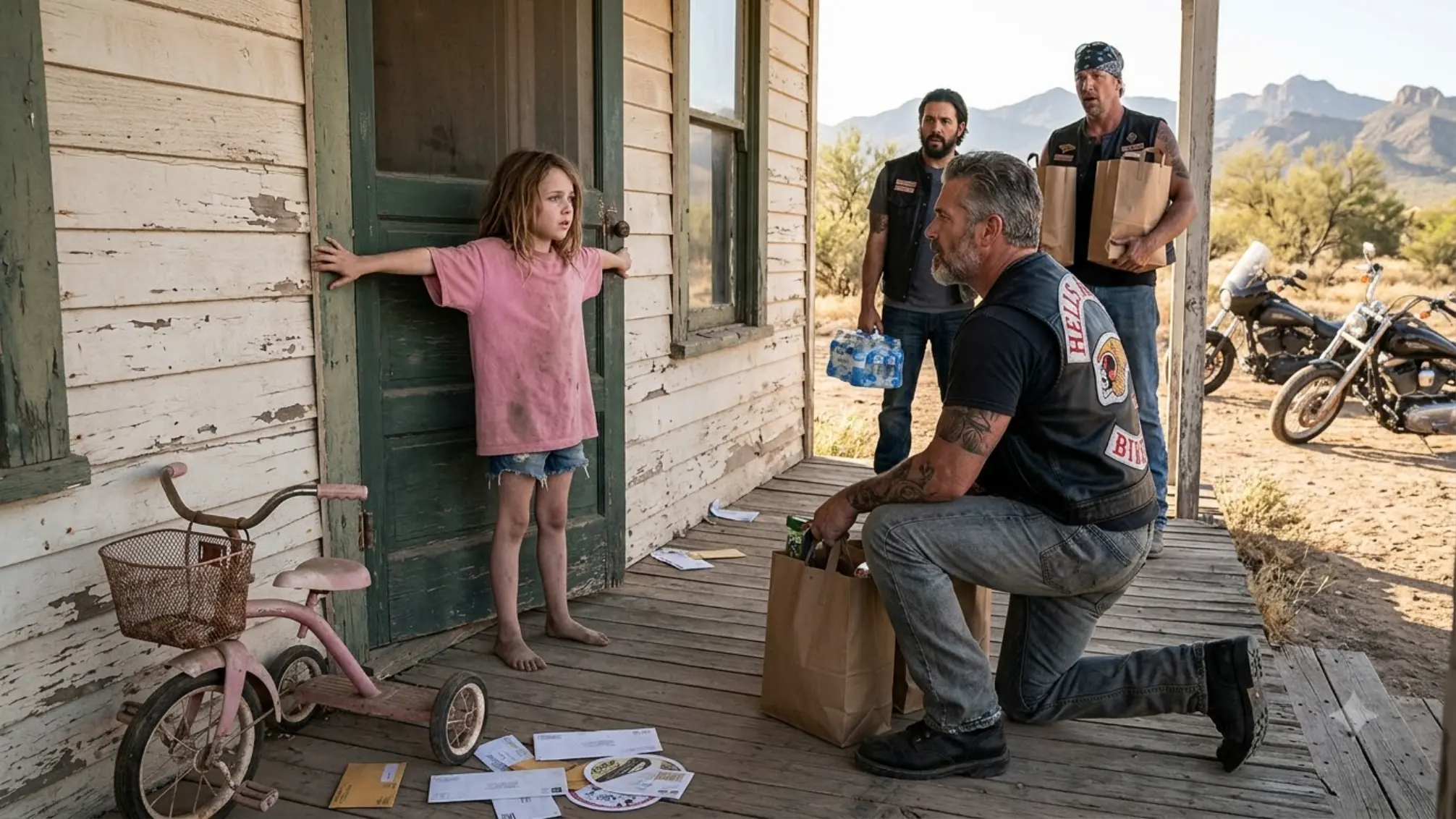
Lily swallowed hard and pressed her back against the wood. “Please… if he sees you, he’ll hurt me again.” The biker’s expression changed so quickly that the two men behind him stopped moving. Forty-five-year-old Mason Cole rose from one knee, looked toward the dark windows, and quietly said, “Call everybody… because whatever she’s hiding in there is only the beginning.”
Mason had not come to the abandoned-looking farmhouse expecting trouble. He and two members of his motorcycle group had stopped because they noticed a little girl standing barefoot beside the highway almost four miles from the nearest store. She had been dragging a plastic grocery bag with one torn handle, and when Mason asked whether she needed help, she immediately ran toward the old house rather than answering. Something about the way she kept looking behind her made him follow.
The farmhouse sat on twenty dry acres outside Red Mesa, Arizona, surrounded by sunburned brush, rusted fencing, and an empty cattle pen that looked as though nothing had moved through it in years. Two broken children’s bicycles lay beneath the porch, one missing a front wheel, while an old pink tricycle rested beside a washing machine that had been pushed outside because the laundry room floor had partially collapsed. Envelopes covered the porch boards, most carrying red notices or collection stamps. The place did not look abandoned once Mason noticed the small shoes lined carefully beside the door.
He had brought groceries because Lily finally admitted she had been walking toward town for food. Mason bought bread, canned soup, cereal, milk, fruit, bottled water, and enough easy meals to last several days, expecting to hand them to a parent and leave. Instead, Lily became more frightened the closer they came to the house. By the time Mason reached for the front door, she threw herself between him and it.
A heavy crash suddenly sounded from inside. Lily flinched so violently that Mason’s hands curled into fists without conscious thought. The second biker, Ray Donnelly, put down the grocery bags and slowly turned toward the windows while the third, Noah Briggs, moved several steps away to get a clearer view of the side yard.
“Lily,” Mason said gently, “is your mom inside?” The little girl nodded. Mason asked whether her father was there too, and Lily shook her head so quickly her hair whipped across her face. “Not Daddy.”
“Who, then?” Lily stared at the floor. Her tiny fingers squeezed the hem of the pink shirt. “Mommy’s friend.”
Another sound came from inside, this time something scraping heavily across the floor. Mason crouched again so his eyes were level with hers. “Has Mommy’s friend hurt you?”
Lily did not answer. She pulled one sleeve upward instead. A dark yellow bruise marked the inside of her upper arm.
Mason’s face went completely still. Ray saw it and immediately took out his phone. Mason said, “Call the sheriff. Tell them there’s a child here and possible domestic violence.”
“No!” Lily grabbed Mason’s wrist. “They came before.”
Mason stopped. “The sheriff came here?”
“A man came.” Lily looked toward the dusty road. “He talked to Gary. Then he left.”
Mason exchanged a look with Ray. “Gary is Mommy’s friend?” Lily nodded.
“What happened after the man left?” Mason asked. Lily’s mouth trembled. “Gary got mad because Mommy called.”
The front door moved behind her. Not opened fully, just enough for the latch to click. Lily spun around and pressed both hands against it.
A male voice came through the wood. “Lily?”
The girl froze. Mason stepped beside her.
“Who’s out there?” the voice demanded.
Lily did not answer. The door pushed again, but Mason planted one heavy boot against the bottom edge without forcing it open. He kept his voice controlled.
“My name’s Mason. We found Lily near the highway.”
Silence. Then the man inside laughed.
“She wanders. Send her in.”
Mason looked down at Lily. Her face had gone pale.
“She doesn’t want to go in.”
The man’s voice hardened. “She’s seven. She doesn’t decide.”
Mason’s jaw tightened. “Today she does.”
The door slammed from the other side. Lily jumped and backed into Mason. Ray was already speaking to emergency dispatch several yards away while Noah watched the side window.
“Sir,” Mason called through the door, “police are coming. Nobody needs to make this worse.”
The response was immediate. “Get off my property.”
Mason glanced around. “Your property?”
No answer came. That mattered. Lily whispered, “It was Grandpa’s.”
Mason looked at her. “Where’s Grandpa?”
“He died.”
“And your mother owns the house?”
Lily nodded.
Another crash sounded. This time a woman cried out.
Mason’s entire posture changed. “Lily, step away from the door.”
She clung to him. “He’ll hurt Mommy.”
“That’s why you need to stand behind Ray.”
Mason did not storm inside. He had enough experience with bad situations to know that charging blindly through a door could make everything worse, especially with a child present. Instead, he moved Lily behind the porch railing, kept himself between her and the entrance, and waited for the sheriff while listening carefully for anything indicating immediate danger.
Noah returned from the side of the house. “Woman in the kitchen. She’s standing.”
“Gary?”
“Couldn’t see him.”
Mason nodded. “Good. Nobody goes inside unless somebody’s life is in immediate danger.”
Lily stared at him as if she had expected something very different from three leather-vested strangers. “You’re not scared of him?”
Mason looked toward the door. “Being scared and leaving are two different things.”
She seemed to consider that. Then she whispered, “He has a gun.”
Every man on the porch became still. Mason immediately raised one hand toward Ray, who relayed the information to dispatch. He guided Lily farther behind the corner of the house and told everyone to stay low and away from windows.
The sheriff’s department arrived seven minutes later with three cruisers. Deputies approached carefully after Mason explained what Lily had said, and the bikers moved completely out of their way. The lead deputy, Elena Ruiz, spoke briefly with Lily before attempting contact with the man inside.
“Gary Mercer,” Ruiz called from behind cover, “come outside with your hands visible.”
Nothing happened. Ruiz repeated the command.
A curtain moved. Then the front door opened slowly.
Gary stepped onto the porch. He was thirty-seven, thin, sunburned, and wearing dirty jeans with no shirt. His hands were empty, but the anger in his face looked almost physical when he saw Lily standing beside Mason.
“That kid lies,” Gary shouted immediately.
Deputy Ruiz ordered him to turn around. He hesitated.
Mason saw Lily start shaking.
Gary looked directly at her. “You did this?”
Lily moved behind Mason’s leg.
Deputy Ruiz’s voice sharpened. “Eyes on me, Gary.”
He ignored her. “After everything I do for you and your mother?”
Mason took one step sideways, completely blocking Lily from his view.
Gary sneered. “What are you supposed to be, her new daddy?”
Mason said nothing.
That silence seemed to bother Gary more than any insult could have. He stepped off the porch.
Two deputies immediately moved toward him. Gary started arguing, then tried pulling away when they reached for his arms.
The confrontation ended quickly. Deputies restrained him without anyone being seriously injured, and Ruiz entered the house with another officer after confirming no other threat was present. Several minutes later, they brought Lily’s mother outside.
Twenty-nine-year-old Sarah Carter looked exhausted beyond her age. One cheek was swollen, a cut marked her lower lip, and she held one arm tightly against her ribs. When she saw Lily, she ran toward her.
The little girl hit her mother so hard with the hug that both nearly fell. “Mommy!”
Sarah collapsed onto her knees. “Baby, where did you go?”
“To get food.”
Sarah began crying.
“I told you not to leave.”
“We didn’t have any.”
That sentence silenced everyone.
Sarah looked toward the grocery bags Mason had placed beside the porch. Her face crumpled. She pulled Lily tighter against her chest.
Mason turned away because some grief felt private even when it happened six feet in front of you.
The investigation revealed that Sarah’s situation had been deteriorating for nearly a year. Her father had left her the farmhouse after his death, but unpaid property taxes, medical bills, and repairs had drained what little money remained. Gary Mercer had moved in eight months earlier after promising to help with expenses.
At first he paid utilities and brought groceries. Then he lost his construction job and began drinking heavily. He gradually controlled Sarah’s phone, truck keys, money, and contact with neighbors.
When she tried asking him to leave, Gary reminded her that she could not afford the property taxes alone. He claimed he had paid enough into the house to own part of it. The claim was false, but Sarah did not know enough about property law to challenge him.
Two months earlier, she called law enforcement after an argument. A deputy arrived, found no visible injury, and left after Gary insisted the dispute was verbal. Sarah did not tell the deputy what had happened because Gary stood ten feet away.
That night he broke her phone. Afterward, she stopped calling anyone.
Lily saw more than Sarah realized. She learned to stay quiet when Gary was drinking and to hide food inside a shoebox beneath her bed because sometimes he ate everything before she and her mother woke.
The morning Mason found her, Lily opened the refrigerator and found half a bottle of ketchup, mustard, and one spoiled carton of milk. Sarah had a fever and could barely stand after Gary shoved her into the kitchen counter the previous night. Lily took a plastic bag and started walking toward town because she remembered seeing free crackers beside the coffee machine at a gas station.
She was seven years old. Four miles of desert highway stood between her and those crackers.
Mason listened to that story outside the hospital later that evening and had to walk away before speaking because anger was making his hands shake. Ray followed.
“Don’t do anything stupid,” Ray said.
Mason stared across the parking lot. “She walked four miles for crackers.”
“I heard.”
“She’s seven.”
“I know.”
Mason finally looked at him. “We have fifteen hundred people in our contact list.”
Ray understood immediately.
“No.”
Mason frowned.
Ray continued. “We are not sending fifteen hundred angry bikers to a farmhouse where deputies are investigating a domestic violence case.”
Mason’s anger cooled enough for reason to return. “I didn’t mean that.”
“Yes, you did.”
Mason exhaled. “For about three seconds.”
Ray nodded. “Three seconds is why I followed you outside.”
Mason looked through the hospital doors. Lily was sitting beside her mother wearing hospital socks because nobody had remembered shoes.
“What can we actually do?”
Ray smiled slightly. “Now that is the right question.”
Mason was a regional coordinator for a large motorcycle association that included riders from several states. The group had a reputation built partly on its intimidating appearance, but most members spent far more time organizing charity rides than fighting anyone. Every year they raised money for children’s hospitals, funeral expenses, domestic violence shelters, and families facing medical crises.
Mason sent one message that night.
Seven-year-old girl. Mother escaping abuse. House nearly lost. Need food, repairs, legal help, and people who know how to keep promises. No drama. No confrontation. Who’s in?
His phone did not stop vibrating for three hours.
By midnight, eighty-seven riders had responded. By morning, more than three hundred. Someone knew an attorney specializing in protective orders.
Another rider owned a roofing company. One had a plumbing business. A retired accountant volunteered to review Sarah’s tax notices.
A woman from the Phoenix chapter worked for a nonprofit helping domestic violence survivors. She drove two hours to the hospital before lunch.
The biggest problem was the farmhouse. Sarah owed nearly $8,400 in property taxes and penalties. The roof leaked, the water heater barely worked, and one bedroom wall had suffered mold damage after a pipe burst.
Selling seemed like the obvious answer. Sarah refused.
“It was my father’s house.”
Mason understood. “Then we fix the numbers first.”
The accountant discovered something useful. Sarah qualified for a hardship payment program that could reduce penalties and spread delinquent taxes over several years.
The domestic violence advocate helped her obtain emergency financial assistance. Riders raised enough money to cover the remaining immediate balance without forcing Sarah to surrender ownership.
Sarah initially refused the money.
“I can’t owe all these people.”
Mason sat across from her in the hospital cafeteria. “You don’t.”
“Nobody gives strangers thousands of dollars.”
Mason glanced toward Lily coloring beside them. “Your daughter stepped in front of a door because she thought she had to protect you alone.”
Sarah looked down.
“Let us prove her wrong.”
She began crying quietly.
Gary remained in custody while prosecutors reviewed assault, unlawful restraint, child-endangerment allegations, and other evidence collected from the home. Investigators found Sarah’s broken phones, threatening messages, and documents showing Gary had attempted to convince her to sign paperwork transferring an interest in the property.
The case would take months. Mason told everyone in the riding group the same rule: nobody contacted Gary, his relatives, witnesses, or anyone connected to the prosecution.
“If you care about Lily,” he said, “don’t give his lawyer a reason to say she has a motorcycle gang intimidating people.”
The message worked. Not one rider broke the rule.
Instead, they focused on the house.
Three weeks later, Sarah and Lily returned home after Gary’s belongings had been lawfully removed and a protective order established. They expected to find the same broken farmhouse.
What they found was sixty motorcycles parked along the road.
Sarah stopped the car. “Oh my God.”
Mason stood beside the gate.
Lily rolled down her window. “Are they all your friends?”
“Some.”
“How many friends do you have?”
Mason smiled. “Apparently too many.”
The first work weekend transformed the property. Roofers replaced damaged sections.
Electricians repaired unsafe wiring. Plumbers installed a functioning water heater.
Carpenters replaced rotten porch boards. Volunteers hauled away broken appliances, weeds, scrap metal, and trash.
Someone repaired Lily’s pink tricycle. Another rider brought a small bicycle with training wheels but left it beside the porch without attaching a name.
Sarah spent most of Saturday walking around asking people how she could repay them. Nobody gave her a useful answer.
By Sunday afternoon, the farmhouse looked alive again. Fresh white paint covered the worst exterior damage while the original weathered wood remained where it was structurally sound.
Lily stood on the porch wearing a new pink shirt and sneakers. The front door behind her had been repaired.
She kept looking at it. Mason noticed.
“You okay?”
Lily nodded.
“Don’t like the door?”
She thought for a moment. “I do now.”
Mason sat beside her.
“Why?”
“Because when it opens, good people come in.”
He had no answer for that.
The story spread through rider chapters. More people wanted to help than the farmhouse could physically hold, so organizers scheduled a benefit ride one month later in Red Mesa.
They expected perhaps two hundred motorcycles.
Nearly five hundred arrived.
The line stretched from the highway into the fairgrounds, engines rumbling beneath the morning sun while residents stepped outside stores to watch. Riders came from Arizona, New Mexico, Nevada, Utah, and California.
Lily stood beside Sarah near the entrance wearing pink sneakers and hearing protection Mason bought specifically for the event. When the motorcycles began rolling in, her mouth opened.
“Are all those for us?”
Sarah shook her head. “For you.”
Lily immediately looked frightened. “Why?”
Mason crouched beside her.
“Remember when you told me not to open the door?”
She nodded.
“You thought you were alone behind it.”
Another hundred motorcycles rolled through the gate.
“You weren’t.”
Lily stared at them. Then she hugged Mason around the neck.
The benefit raised enough money to repair the remaining house damage, create a small emergency fund for Sarah, pay for counseling not fully covered through assistance programs, and establish a modest education account for Lily.
Sarah refused anything beyond those needs. Extra donations went to the domestic violence organization that had helped her.
The riders applauded that decision.
Gary eventually accepted a plea agreement after prosecutors assembled medical records, witness testimony, digital evidence, and photographs. He received a custodial sentence followed by supervision and was prohibited from contacting Sarah or Lily.
The result did not magically erase what happened. Lily had nightmares for months.
She sometimes woke screaming that someone was opening the front door. Sarah struggled with guilt because she believed protecting her daughter should have meant leaving Gary much earlier.
Therapy helped both of them understand recovery was not a single brave moment. Some mornings were good.
Others were terrible.
Mason visited occasionally but deliberately refused to become the center of Lily’s life. He wanted her to build safety around her mother, school, neighbors, counselors, and ordinary routines rather than believing one biker had rescued everything.
Still, Lily called him whenever something important happened.
First day of school.
First lost tooth after the farmhouse repairs.
First bicycle ride without training wheels.
Mason answered every time.
One year after they met, the motorcycle association returned to Red Mesa for another charity ride. This time the fundraiser supported other families leaving abusive homes.
Lily stood on a small stage beside her mother. She wore a pink dress and held a handwritten note.
Sarah asked if she wanted help reading it.
Lily shook her head.
She stepped toward the microphone.
The crowd became quiet.
“When I met Mason,” she began, “I thought he was scary.”
Hundreds of bikers laughed.
Mason crossed his arms.
Lily continued. “Then I told him not to open my door.”
The laughter disappeared.
“He listened.”
That single sentence hit Mason harder than every thank-you he had received during the previous year.
Lily looked toward the crowd. “Sometimes grown-ups don’t listen when kids say they’re scared.”
Sarah wiped tears from her face.
“But he did.”
Lily folded the paper.
“So now when kids say something is wrong, you should listen too.”
Nobody needed to add anything.
Years later, people around Red Mesa exaggerated the story. Some claimed five hundred bikers surrounded Gary Mercer’s house and dragged him outside.
That never happened.
The sheriff arrested Gary before any motorcycle group gathered. The riders never threatened him or interfered with the investigation.
Five hundred bikers did eventually come to Red Mesa, but they arrived carrying donation envelopes, building tools, grocery gift cards, and enough motorcycles to make every gas station in town run short on premium fuel.
The truth was less violent and far more powerful.
A seven-year-old girl stood barefoot against a broken farmhouse door because she believed her tiny body was the last thing protecting her mother. Three strangers stopped instead of ignoring her.
One of them listened.
That was where everything changed.
Not when police arrived. Not when hundreds of motorcycles filled the highway.
Not when money was raised or the roof was repaired.
It changed when Mason heard a frightened child say, “Don’t open that door,” and decided her fear mattered before he knew whether she could prove it.
Years afterward, the old farmhouse still stood outside Red Mesa. The porch had been rebuilt twice, the pink tricycle eventually disappeared into storage, and the bicycle beside it became far too small for Lily.
The front door remained.
Sarah painted it blue.
Mason asked why.
Lily, now nearly thirteen, answered before her mother could.
“Because pink was getting embarrassing.”
Mason laughed.
Then Lily became serious.
“But we kept the door.”
Mason looked at her.
She rested one hand against the wood that she had once tried to hold shut with her entire body.
“I used to think doors were for keeping bad people out.”
Mason waited.
“Now I think they’re also how you let the right people in.”
From the road came the distant sound of motorcycle engines.
Lily smiled before the bikes even appeared.
She no longer backed against the door.
She opened it.