“That badge could have come from anywhere.”
Sergeant Kenneth Iverson barely glanced at the federal credentials extended toward him on the sidewalk outside Ray’s Diner in Delwood County, Georgia. Instead, he brushed the identification aside and reached for the handcuffs on his duty belt. The badge struck the pavement beside fifty-two-year-old Arnold Parson’s running shoes.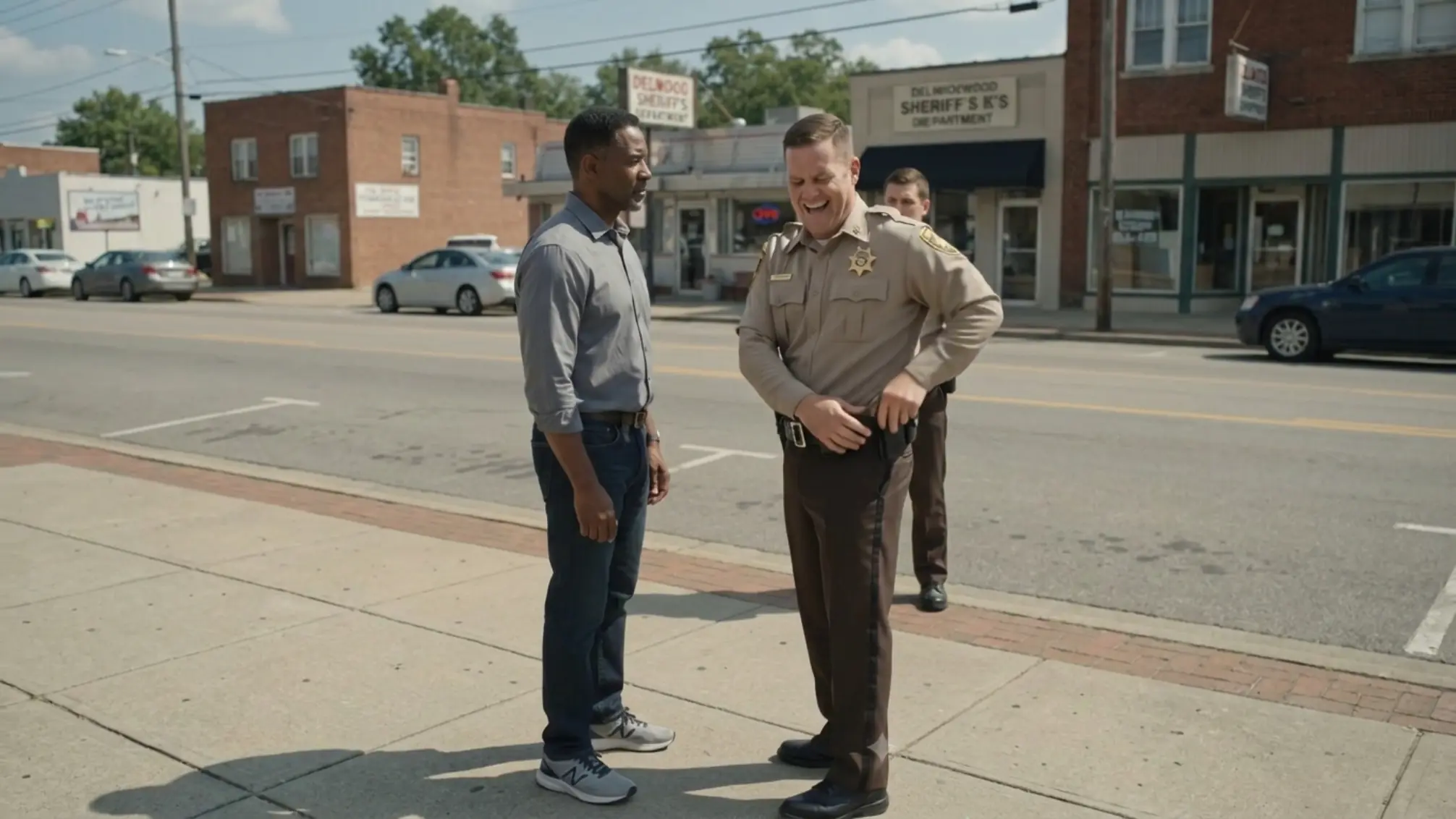
Arnold did not reach for it.
He stood beneath the bright Saturday sun in a gray button-down shirt, dark jeans, and no visible weapon. His deep-brown face remained composed, but his steady eyes never left Iverson’s. Twenty-four years with the Federal Bureau of Investigation had taught Arnold that the person most eager to dominate an encounter was often the person most afraid of questions.
“I’m advising you once,” Arnold said quietly. “Call the Atlanta field office and verify my credentials.”
“You can explain yourself after processing,” Iverson replied.
The second deputy, Lance Wilen, picked up the badge and examined it. He was twenty-nine, younger and less certain than his sergeant. His eyes moved across the seal, photograph, identification number, and security markings that would have taken an expert to imitate.
For a moment, Wilen appeared ready to speak.
Iverson held out his hand.
“Give it to me.”
Wilen surrendered the credentials.
Iverson placed them in his pocket without reading the name printed across the front.
“Turn around.”
Arnold slowly presented his wrists.
The handcuffs closed with a metallic click that carried across Delwood’s main street. An elderly man lowered the newspaper he had been reading outside the barber shop. A woman leaving the hardware store stopped with a paper bag held against her chest.
Neither said anything.
Arnold looked across the street at the square brick building housing the Delwood County Sheriff’s Department. The second-floor blinds were angled downward, exactly as they had been throughout his six days in town. Someone could watch the sidewalk without being seen clearly from below.
He had noticed that on his first morning.
Now he understood that someone behind those blinds had noticed him too.
Iverson guided him toward the sheriff’s building.
“You just made the defining mistake of your career,” Arnold said.
The sergeant laughed.
“You people always think you know the system.”
Arnold did not answer.
In thirty-eight minutes, he was scheduled to call his partner at the Atlanta field office. He had never missed a check-in during six years of working with Special Agent Patrice Oslo.
When the call did not come, the system would begin looking for him.
The investigation that brought Arnold to Delwood had started eighteen months earlier with numbers that refused to make sense. The county sheriff’s department had reported seizing more than two million dollars in cash, vehicles, and property during traffic stops and criminal investigations. Most of those seizures involved Black residents.
The paperwork appeared technically complete.
The money did not.
Funds left the evidence room but never reached official county accounts. Vehicles were sold without documented deposits. Cases involving large seizures were quietly dismissed while the property remained under department control.
Individually, each irregularity looked like poor recordkeeping.
Together, they looked deliberate.
Arnold had entered Delwood posing as a construction contractor interested in bidding on a road-resurfacing project. He spent six days asking dull questions about gravel prices and drainage systems while watching who entered the sheriff’s building, which vehicles arrived after business hours, and when the second-floor office lights remained on.
He had been sitting inside Ray’s Diner when Iverson and Wilen approached.
There had been no dispatch call, no marked cruiser, and no concerned citizen pointing him out. The deputies came directly from around the corner and positioned themselves on both sides of the diner entrance.
Arnold identified himself before they could invent a reason to question him.
That should have ended the encounter.
Instead, it confirmed his investigation had been discovered.
Inside the sheriff’s department, the air smelled of floor cleaner and burnt coffee. A desk sergeant looked up as Iverson brought Arnold toward the processing counter.
“Possible fake federal credentials,” Iverson announced. “Hold him for verification.”
Arnold faced the desk sergeant.
“My name is Special Agent Arnold Parson, FBI Atlanta Field Office. Call the published office number and ask for Agent Patrice Oslo.”
The desk sergeant reached toward the telephone.
“Give us a minute,” Iverson said.
The man withdrew his hand.
A side door opened, and Deputy Chief Francis Palmer entered with the relaxed expression of someone pretending to encounter an unexpected problem. At fifty-eight, Palmer had silver hair, a heavy build, and a small American flag pin attached to his uniform collar.
His smile appeared practiced rather than welcoming.
“What seems to be the confusion?”
“This individual was watching the building,” Iverson said. “Claims he’s federal.”
Palmer studied Arnold.
Arnold saw no surprise in his face.
That mattered.
“I presented valid identification,” Arnold said. “I want one telephone call to my field office.”
“Of course,” Palmer replied pleasantly. “We’ll sort this out.”
He lifted the desk telephone and dialed a number from memory. He listened to a single ring, disconnected the call, and shook his head.
“No answer in Atlanta.”
Arnold stared at him.
The FBI’s main field-office number did not ring once and disconnect. It moved through an automated system, even on weekends. Palmer had not called Atlanta.
He had performed for the people in the room.
“Place him in holding,” Palmer ordered. “We’ll try again later.”
“You know who I am,” Arnold said.
Palmer’s smile weakened.
“I know what you claim to be.”
The holding cell contained a metal bench, a concrete floor, and two other detainees who avoided eye contact. Arnold sat with his forearms resting on his knees and began counting time.
He did not shout.
He did not demand special treatment.
He simply waited for the minute Patrice would recognize his silence.
At the Atlanta field office, Patrice Oslo watched the check-in time pass on her computer. Three minutes became five. She dialed Arnold’s mobile telephone twice and reached voicemail both times.
Arnold had once completed a scheduled check-in while suffering food poisoning in a motel bathroom. He had called during storms, delayed interviews, broken vehicle situations, and emergency operations.
He did not forget.
Patrice entered his number into the location system authorized for Operation Delwood Ledger. His final signal had disappeared inside the sheriff’s department he was investigating.
She became still for four seconds.
Then she moved.
Patrice contacted Arnold’s wife, Rosalie, only long enough to confirm he had planned to observe the building that afternoon. Next, she called Assistant United States Attorney Vanessa Butler.
“Arnold missed his check-in,” Patrice said. “His telephone went dark inside the Delwood County Sheriff’s Department. I need a federal order and a recovery team.”
Vanessa answered without hesitation.
“Give me fifteen minutes.”
She needed twelve.
Within half an hour, Patrice was driving south with three FBI agents, a federal marshal, and an emergency court order. Nobody inside the vehicles discussed what they might find.
An undercover agent’s device going silent inside the target of his investigation was not a coincidence.
It was a message.
Fifty-four minutes after Arnold missed his call, the federal convoy stopped in front of the sheriff’s department. Patrice entered first, carrying the court order inside a manila folder.
Three agents spread out behind her.
The federal marshal remained near the door.
Vanessa walked directly beside Patrice.
The desk sergeant saw the federal badges and placed both hands flat on the counter.
Palmer emerged from the hallway wearing the same pleasant expression he had used with Arnold. This time, it survived only seconds.
“Deputy Chief Palmer,” Patrice said. “I am Special Agent Patrice Oslo. This is Assistant United States Attorney Vanessa Butler.”
Vanessa placed the court order on the desk.
“This authorizes the immediate release of Special Agent Arnold Parson.”
Palmer glanced at the document.
“There has been a misunderstanding.”
“Where is he?” Patrice asked.
“My deputies encountered someone whose identity could not be—”
“Where is my partner?”
The friendliness left Palmer’s face.
“Cell three.”
“Take me to him.”
Arnold looked up when the holding-area door opened. Patrice stood outside the cell with Vanessa and the federal marshal behind her.
He checked the clock.
She had arrived within the time he calculated.
The cell opened, and Arnold walked out without complaint. Patrice handed him his badge and identification, which had been recovered from Iverson moments earlier.
Arnold placed them in his pocket.
Palmer waited near the front desk as they returned.
“Agent Parson, I want to apologize personally for the confusion,” he began. “My officers were following procedure.”
Arnold stopped.
He looked at Palmer for five silent seconds.
Then he turned away and walked outside.
The refusal to argue disturbed Palmer more than anger would have. Arnold had not accepted the explanation, but he had not challenged it either.
He was saving the conversation for evidence.
Outside, Patrice opened a laptop on the hood of a federal vehicle.
“The department’s call records arrived while we were driving,” she said.
A call had been placed from Palmer’s private office to Iverson’s personal mobile telephone six minutes before the deputies appeared outside the diner. No citizen had contacted emergency dispatch. No patrol unit had reported suspicious behavior.
Palmer had seen Arnold and personally ordered Iverson to intercept him.
Arnold examined the record twice.
“So it was targeted.”
Patrice nodded.
“Federal obstruction.”
Vanessa returned inside with Sheriff Luis Underwood, who had been called away from home. She placed the telephone record, Arnold’s credentials, and the court order across the conference table.
Underwood read each page slowly.
His face appeared to age while he processed what his deputy chief had done inside the department he supposedly controlled.
“Bring Palmer and Iverson in,” he ordered.
The two men entered together.
Neither was offered a seat.
Sheriff Underwood stood behind the table.
“Badges and service weapons.”
Palmer stared at him.
“Luis, let me explain.”
“Place them on the desk.”
Iverson’s hand shook as he removed his badge. The metal struck the wood harder than he intended.
Palmer removed his own more carefully.
Vanessa informed both men that they were suspended pending federal investigations into obstruction and civil-rights violations. Their access to department files, personnel, and computer systems was revoked immediately.
Through the conference-room window, Palmer could see Arnold standing in the parking lot.
Their eyes met.
Palmer looked away first.
Three hours after Iverson closed handcuffs around Arnold’s wrists, he and Palmer left the sheriff’s department without badges.
But Arnold knew their suspension was only the beginning.
Operation Delwood Ledger had uncovered sixty-one questionable seizures. Forty-seven involved Black residents, and at least $2.3 million remained unaccounted for. The records suggested Palmer’s department had transformed civil asset forfeiture into a private revenue system.
Several days after Arnold’s release, a seventy-one-year-old Black American pastor named Reverend Dexter Randall arrived at the federal courthouse carrying a cardboard box.
“I heard what happened to you,” Randall told Arnold. “I’ve been waiting nine years for someone to listen.”
The box contained complaints from fourteen Delwood families. Every file had been dated, copied, and submitted through official channels.
None had received a meaningful response.
Arnold opened the first folder.
A widow named Dorothy Elias described how deputies seized four thousand dollars she had been carrying to pay for her husband’s funeral. No criminal charge was ever filed, but the money was never returned.
Another folder involved a business owner whose work van disappeared into county custody after a traffic stop. Without transportation, he lost his contracts and closed his company.
A young renter lost eleven hundred dollars he had saved for an apartment deposit.
To the department, the cases were numbers.
To the families, they were years of work, transportation, housing, funerals, and futures.
“We use every file,” Arnold said.
The investigation soon encountered powerful resistance.
A six-term congressman named Philip Hogan held a press conference accusing federal authorities of attacking dedicated local officers. He never mentioned Arnold’s badge, the false verification call, or the millions missing from county accounts.
Financial investigators discovered that a political committee linked to Hogan had recently paid an expensive attorney to represent Palmer and Iverson. Palmer had assisted Hogan’s political organization for years by managing local problems before they reached state attention.
“This isn’t a friend helping a friend,” Patrice said. “This is someone protecting an investment.”
A state administrative judge later reinstated Iverson, claiming the department had not followed proper suspension procedures. Witnesses began withdrawing after unfamiliar vehicles appeared near their businesses and inspectors suddenly visited their properties.
Nobody issued direct threats.
They did not need to.
The message was that federal agents would eventually leave, while Delwood’s residents would remain.
Arnold visited Margaret Tremble, one of the witnesses considering withdrawal. Family photographs covered her living-room wall.
“You mean well,” Margaret told him. “But my son works nearby, my granddaughter waits for the school bus on this road, and my business license comes up for renewal soon. When this ends, you’ll return to Atlanta. I will still live here.”
Arnold did not promise safety he could not guarantee.
“You are right,” he said. “And you have every reason to protect your family.”
The case needed evidence that did not depend on frightened residents placing themselves at further risk.
That evidence came from inside the sheriff’s department.
Lance Wilen, the younger deputy present during Arnold’s arrest, agreed to meet privately at Reverend Randall’s church. He arrived after sunset in his personal truck and sat behind the wheel for two minutes before stepping outside.
“I have a wife and an eight-month-old daughter,” he said immediately. “I can’t lose my job.”
“I’m only asking you to tell the truth,” Arnold replied.
Wilen described arriving at the department on the morning of the arrest and overhearing Iverson speaking on his private telephone.
“The guy from the diner,” Iverson had said. “Palmer says make it clean.”
Before they approached Arnold, Iverson warned Wilen to remain silent and follow his lead.
Then Wilen produced a text message Iverson had sent several nights later.
If this becomes federal, I only did what H told me. You were there.
“Will you provide a signed statement?” Arnold asked.
Wilen looked toward the illuminated church windows.
“My mother has attended this church for thirty years.”
That was his answer.
Wilen’s statement led investigators to Iverson’s personal communication records. Those records revealed something even larger.
During a brief assignment as a liaison to the federal task force, Iverson had accessed a confidential procedural file. Hours later, he emailed a scanned copy to an account connected to Palmer’s attorney.
That stolen document had been used to freeze parts of the federal investigation on a technical issue.
Vanessa contacted Iverson’s attorney.
“We have the access record, the email, the attachment, and the destination server,” she said. “Your client can cooperate, or he can explain all of it at trial.”
Iverson accepted a cooperation agreement minutes before the deadline.
During a three-hour interview, he confirmed Palmer ordered Arnold’s detention. He described how seized money moved through unofficial accounts and into a political committee connected to Hogan’s organization.
He also identified judges and county officials who received benefits for protecting the operation.
The investigation reopened completely.
A federal grand jury returned seventeen charges against six defendants. Marshals arrested Palmer at his home at six the following morning.
He answered the door fully dressed, as if he had known the moment was approaching. When agents read the charges, he placed his hands behind his back without speaking.
Iverson entered guilty pleas to obstruction and unlawful disclosure of federal information. His career ended not because Arnold destroyed it, but because the evidence documented every choice he made.
Two judges and a county commissioner were indicted.
Disciplinary proceedings began against the attorney who used the stolen federal file.
Most importantly, the government began reviewing every questionable Delwood seizure and conviction connected to Palmer’s department.
One case belonged to Darius Moran.
At twenty-five, Darius had been pressured into signing a confession for a crime he did not commit. He served four years in prison and carried the resulting record for nine more. That record cost him jobs, housing applications, and relationships.
He was eating cereal alone in his Atlanta apartment when a letter arrived.
His conviction had been vacated.
The state would begin reviewing compensation.
Darius read the letter twice, placed both hands over his face, and cried at the kitchen counter. For thirteen years, doors had closed when employers and landlords saw his record.
For the first time, one had opened toward him.
Several weeks later, Arnold attended Sunday service at Reverend Randall’s church. He entered quietly and sat in the final pew.
The sanctuary was full.
Randall lifted the cardboard box of complaints and placed it on the altar.
“For nine years, our families wrote names, dates, and facts,” he said. “For nine years, we filed everything properly and waited for someone to listen.”
He looked toward the back of the church.
“Someone finally did.”
Arnold lowered his eyes.
He had not solved the case alone. Patrice noticed the missed call. Vanessa secured the orders. Randall protected years of evidence. Wilen found the courage to speak, and residents preserved documents long after institutions ignored them.
Justice had required all of them.
Back in Atlanta, the field-office director offered Arnold a promotion to a supervisory position. It included regular hours, administrative authority, and the corner office many agents considered the reward for surviving a long career.
Arnold returned the papers.
“I appreciate it, but I’m staying in the field.”
“You’ve earned something easier.”
“That doesn’t mean the work is finished.”
Three more Georgia counties had already been flagged for similar forfeiture patterns.
Arnold left the director’s office and walked toward the operations floor. His badge rested beneath his jacket, no longer on a Delwood sidewalk where someone could dismiss it without looking.
He remembered Iverson’s first words.
“That badge could be anything.”
The sergeant had been wrong.
The badge meant Arnold had sworn to investigate without fear or favor. It meant a missed telephone call could mobilize people who understood that silence was evidence. It meant the authority of local officials ended where constitutional rights began.
But the badge had never been the strongest part of the case.
The strongest part was the cardboard box Reverend Randall carried for nine years.
It was Wilen’s saved text message.
It was Patrice noticing one missed call.
It was every person who preserved the truth when powerful people assumed nobody would ever ask for it.
Iverson believed handcuffing Arnold would stop the investigation.
Instead, that single decision exposed exactly how frightened the department was of being watched.
And when the federal agents finally entered Delwood, they did not arrive only to recover one of their own.
They came for every name inside the box.