The manager noticed the dress first.
Cream.
Elegant.
Expensive-looking.
But not one she recognized.
That bothered her.
The woman wearing it stood beside the private diamond counter beneath a crystal chandelier, one hand resting lightly on a metallic-gold clutch.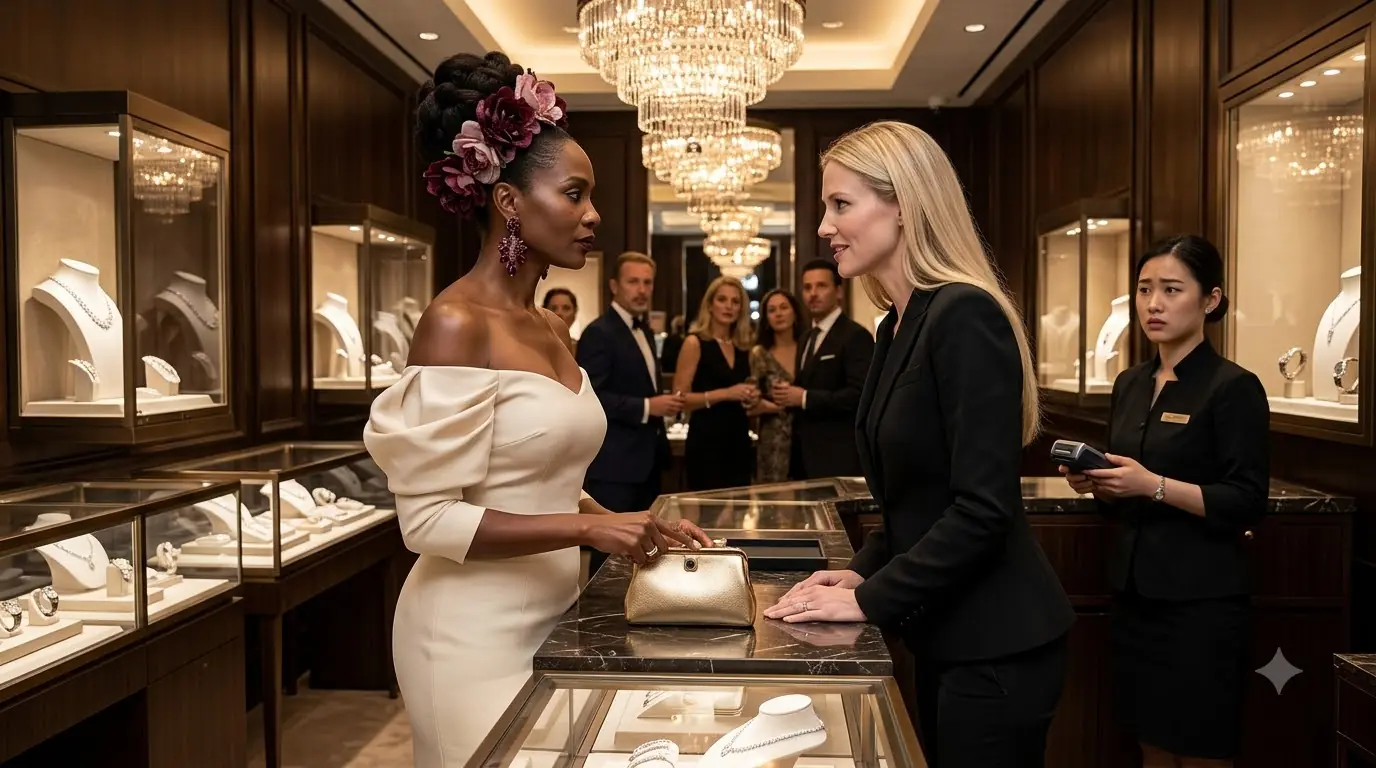
She was forty-four.
Tall.
Composed.
Deep-brown skin illuminated warmly beneath the jewelry salon lights.
Her hair rose into an elaborate sculpted updo woven with dark burgundy and pink floral accents.
Large matching earrings framed her face.
Nothing about her looked uncertain.
Nothing about her looked impressed either.
That was unusual.
People entering the flagship usually reacted.
Their eyes moved first toward the chandeliers.
Then the marble.
Then the glass cases.
Then the private staircase leading to the appointment suites upstairs.
They noticed the guards without appearing to notice them.
They noticed the clients.
They noticed the watches.
Most importantly, they noticed the prices even when price cards were not displayed.
The boutique had been designed around one idea.
Exclusivity should be felt before it was explained.
The manager considered herself part of that architecture.
Thirty-six years old.
Blonde hair falling straight over the shoulders of a perfectly tailored black blazer.
Black trousers.
Fine gold earrings.
No visible logo beyond the boutique pin fastened near her lapel.
She had managed the Manhattan flagship for nearly four years.
Before that, she worked luxury retail in Paris, Los Angeles, and Chicago.
She knew clients.
Or believed she did.
Old money behaved one way.
New money another.
Collectors asked certain questions.
Influencers asked different ones.
Tourists photographed everything.
Serious buyers rarely talked about price first.
People who could afford the private collection often arrived with assistants, stylists, security, drivers, family offices, or at minimum appointments.
The woman in cream had arrived alone.
No appointment under the name she initially provided.
No assistant.
No sales history the manager immediately recognized.
And she had asked to see one of the rarest pieces in the building.
That was enough for the manager to begin making decisions.
The Asian American sales associate behind the marble counter had been speaking with the woman for less than two minutes when the manager stepped in.
The associate was in her early thirties.
Black boutique uniform.
Hair tied neatly behind her head.
Payment terminal still in one hand.
She had smiled when the customer approached.
Asked what brought her in.
The woman answered simply.
“I’d like to view the Aurelia necklace.”
The associate paused.
The Aurelia was not displayed in the main case.
It belonged to the private collection.
Fancy yellow diamonds.
Colorless accent stones.
Historic design archive.
Just over seven figures.
The associate had not laughed.
Had not challenged her.
She had only said:
“Certainly. Let me confirm availability.”
That was when the manager heard.
She turned from a conversation near the watch salon.
Looked at the customer.
Then at the associate.
Then walked over.
“I can take this.”
The associate looked slightly surprised.
“Of course.”
The customer remained still.
The manager smiled.
“Good evening.”
“Good evening.”
“You’re interested in the Aurelia?”
“Yes.”
“Beautiful piece.”
“I agree.”
“Have you viewed it before?”
“No.”
“Do you have an appointment?”
“No.”
The manager’s smile changed by half a degree.
Anyone less experienced might not have noticed.
The customer did.
“No appointment.”
the manager repeated.
“No.”
“Are you working with one of our private client advisors?”
“Not currently.”
The manager nodded slowly.
“I see.”
The associate looked down at her terminal.
Something about the exchange already made her uneasy.
The customer asked:
“Is the necklace available?”