“I’m not pretty, August. I warned you in my letter because I didn’t want to see disappointment in your eyes.”
“You are to me—and I have never mistaken a woman’s worth for what strangers happen to see.”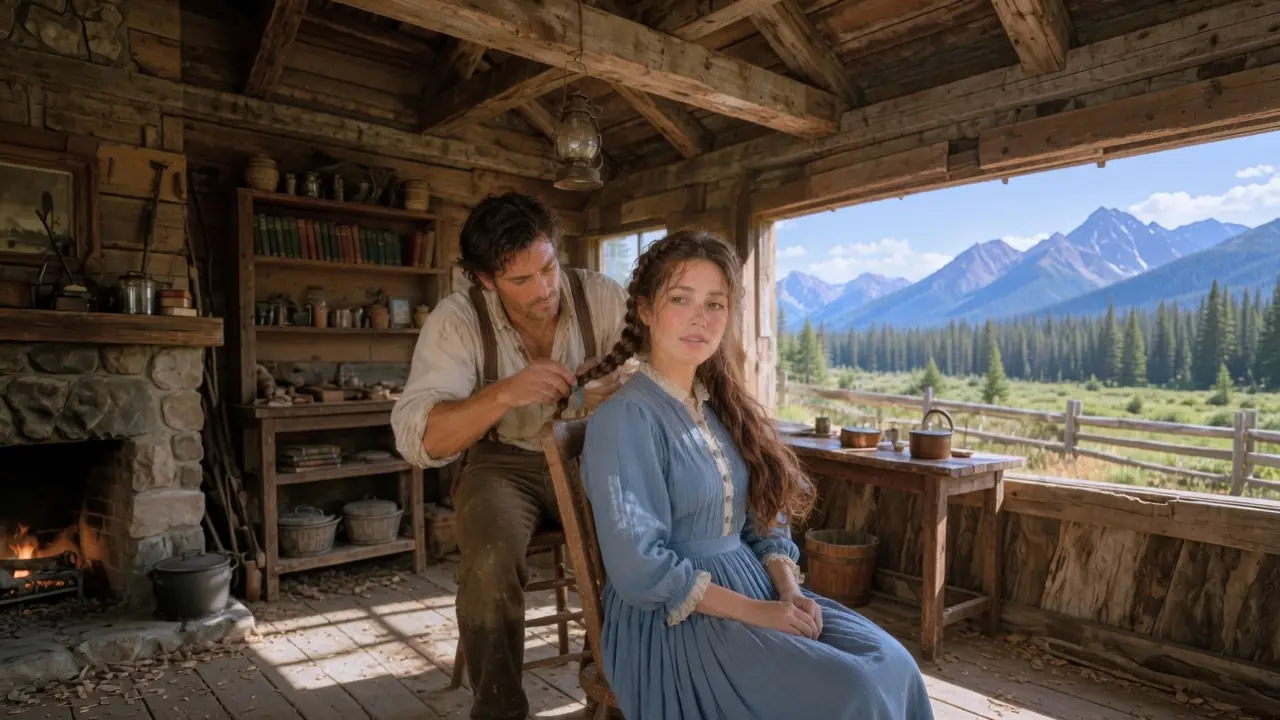
Viola Marsh sat rigidly on a handmade chair in the center of August Brennan’s cabin while his rough fingers separated her long chestnut hair into three careful strands. Clear mountain daylight entered through the open windows, touching the cream ruffles of her dusty-blue dress and the nervous freckles across her cheeks. Beyond the cabin stood three hundred acres of Wyoming meadow and pine forest, but Viola could think only of the man behind her and the tenderness with which he handled something she had always considered ordinary.
“You don’t have to marry me out of kindness,” she whispered. “I would rather leave than become someone you only learned to tolerate.”
August continued weaving the braid slowly, as if every crossing of hair required his full attention. “Then stay, Viola—because I’m not choosing you from pity. I’m choosing the woman who already feels like home.”
He tied the end with a narrow blue ribbon and rested the finished braid over her shoulder. Viola touched it with trembling fingers, unaware that August had cut the ribbon from the cloth that once bound together every letter she had sent him. To him, the act was not decoration; it was a promise made without witnesses.
Six months earlier, Viola had been a school librarian in Garfield, Ohio, where she had spent most of her life being described with words such as capable, sensible, and useful. No one had called her beautiful, not even when they were attempting kindness. At twenty-nine, she had watched younger women marry men who entered the library only to ask where she kept the newspapers.
Viola did not resent them, but she had grown tired of pretending she did not understand why no man ever waited for her after closing time. Her face was narrow, her freckles darkened in summer, and her serious expression made strangers think she was displeased with them. She owned no fashionable gowns and possessed none of the delicate helplessness men in Garfield seemed eager to protect.
What Viola did possess was an unusually disciplined mind. She could read English, French, German, Latin, Spanish, and enough Greek to recognize when a professor had translated something carelessly. She could repair a hand pump, balance an account ledger, preserve vegetables, and organize a room full of unruly children without raising her voice.
Those qualities had earned her respect, but respect was not companionship. Every evening, she returned to a rented room above a dressmaker’s shop and ate supper beside a window overlooking the town square. She had begun to fear that she would remain useful to everyone and necessary to no one.
The advertisement appeared in a Cincinnati newspaper in October of 1870.
Wyoming homesteader, thirty-seven, seeks practical wife willing to build a life in mountain country. Comfortable cabin, productive land, honest work. No interest in fashionable society. Intelligence and steadiness valued above ornament.
Viola read it three times.
The wording lacked the false romance common in matrimonial advertisements. The man did not promise wealth, luxury, or effortless happiness. He offered land, work, and the possibility of being valued for the very things her neighbors treated as substitutes for beauty.
She wrote to him that night.
His name was August Brennan. He had come west from Philadelphia in 1866 with a mule, carpenter’s tools, and enough money to file a homestead claim in the Laramie Range. His family had expected him to enter his father’s furniture business, but August preferred building houses to selling chairs to wealthy customers who complained about the grain of walnut.
He had spent five years shaping his property into something that could support more than one person. He cut timber, raised a cabin, dug irrigation channels, fenced meadowland, planted an orchard, and added a second bedroom he pretended was for guests. Yet each winter, when snow closed the mountain trail, the silence inside the cabin became harder to ignore.
August had exchanged letters with several women through a matrimonial agency. Their replies described themselves as pretty, gentle, accomplished, and eager for adventure, but their questions focused mostly on the size of his house and the distance to the nearest town. One woman stopped writing when he explained that winter travel could become impossible for weeks.
Then Viola’s letter arrived.
She did not praise herself. She told him she was a librarian, could read six languages, understood bookkeeping, and had once repaired the schoolhouse pump when the town council took two months to approve a plumber. She explained that she wanted a life she could help build, not one arranged for her comfort.
In the third paragraph, she wrote the sentence August remembered word for word.
I am not pretty, and I think you should know this before we go any further.
August stood at the Laramie post office counter for several minutes after reading it. He imagined a woman alone in an eastern room, forcing herself to place that sentence on paper before a stranger could use it against her. Then he borrowed ink from the postmaster and wrote his reply immediately.
I have read your letter. Come anyway.
He added details about the cabin, the climate, and the work. He warned her that the mountains were beautiful but unforgiving, that the nearest neighbor lived four miles away, and that bears occasionally came near the orchard. He told her to bring warm boots, practical dresses, any books she could not bear to abandon, and nothing too fragile to survive a wagon journey.
They wrote for five months.
Viola told him about the library children, her widowed landlady, and the town councilmen who ignored every suggestion until a man repeated it. August described elk crossing the northern meadow, the sound pine trees made in deep snow, and the bench he was building beneath the western window.
Neither used the word love.
Their letters became increasingly important without either of them naming what was happening. August began measuring time by the arrival of the post, while Viola stopped feeling invisible whenever she saw his handwriting waiting at the library desk.
In March, August asked whether she would consider coming to Wyoming.
He did not demand marriage upon arrival. He offered to pay for her journey and promised she could stay in the second bedroom until both of them were certain. If she wished to return east, he would pay for that journey as well.
Viola accepted before fear could disguise itself as practicality.
She sold most of her furniture, packed two trunks with books, clothing, sewing supplies, and tools, then resigned from the library. The head librarian warned her that frontier advertisements were written by desperate men who expected women to become unpaid servants. Viola replied that respectable eastern marriages often required the same service with less honesty.
The journey lasted nearly three weeks.
She traveled by train as far as possible, then continued by stagecoach through country so wide that it unsettled her sense of distance. Towns became smaller, roads rougher, and mountains rose at the horizon like walls built by another world.
August waited beside the Laramie station wearing a brown coat and holding his hat in both hands. He was taller than Viola expected, with dark wind-tossed hair, a weathered face, and the guarded posture of a man more comfortable confronting storms than women.
Viola stepped down from the coach and saw his eyes settle on her face.
That was the moment she had dreaded since leaving Ohio.
She waited for the hesitation, the polite rearrangement of disappointment, or the false smile of a man calculating how long he must endure an awkward obligation. August simply took her heaviest trunk and asked whether she was hungry.
“I suppose you expected someone different,” Viola said as they loaded her belongings onto the wagon.
“I expected the woman who wrote the letters.”
“And have you found her?”
August met her eyes. “I believe so.”
The ride to his homestead took two hours. Viola watched the town disappear behind them as the wagon climbed through pine-covered hills. August pointed out streams, grazing land, and places where winter snow became dangerous, speaking with the quiet precision of a man who never used more words than necessary.
His cabin stood in a meadow beneath the mountains. It was larger than Viola had imagined, built from heavy pine logs with a stone chimney and a porch facing west. Inside, she found polished wooden floors, sturdy furniture, shelves awaiting her books, and a second bedroom containing a newly made bed.
August had placed a vase of dried wildflowers on the windowsill.
“They were the only flowers I could find in March,” he said.
Viola touched one brittle purple petal. “No one has ever prepared a room for me before.”
August looked away, suddenly uncomfortable. “You traveled a long distance. You ought to have a place that belongs to you.”
For the first week, they lived carefully around each other. August rose before dawn to tend the animals, while Viola organized the kitchen and unpacked her books. He never entered her room without permission and never treated her presence as payment for the cost of her journey.
She discovered that he cooked badly but cleaned immediately afterward. He discovered that she hummed while reading and became fierce whenever anyone handled a book with dirty hands.
They ate supper together each evening. Their conversations began with practical matters but soon wandered into subjects neither had discussed with anyone else. Viola told him why she had left college when her mother became ill, and August explained that his father considered the homestead an act of rebellion.
On the tenth day, a frozen pipe stopped the kitchen pump.
August fetched his tools, but Viola was already kneeling beside the mechanism with her sleeves rolled up. She dismantled the valve, removed a shard of mineral buildup, and had the water moving again before he returned.
“You really can fix a pump,” he said.
“I considered lying about everything else, but not that.”
August laughed so unexpectedly that Viola stared at him. His entire face changed when he smiled, losing the severity that mountain weather had carved into it.
“You ought to do that more often,” she said.
“Repair pumps?”
“Laugh.”
He obeyed more often after that.
Yet Viola remained uncertain about marriage. August treated her with respect, but respect was familiar territory. She feared he valued her as a capable partner while forcing himself to overlook the absence of beauty.
Her doubts worsened when they attended a spring gathering at the Carter ranch.
Mrs. Carter was friendly, but her unmarried niece Clara looked Viola over with open curiosity. Clara was twenty-three, golden-haired, and effortlessly lovely in the way Viola had always believed frontier wives must be.
“So you are August’s mail-order lady,” Clara said. “I expected someone younger.”
Viola answered calmly. “So did I, but I have learned to survive the disappointment.”
Several women hid their smiles.
Clara flushed, then recovered. “August could have chosen anyone. Half the unmarried women in the territory wondered why he sent east.”
“Perhaps he wanted someone who knew how to answer a letter.”
Across the yard, August had not heard the exchange, but he noticed Viola’s silence during the wagon ride home. She insisted she was tired. That evening, she remained in her bedroom until long after he had gone to sleep.
The following morning, August found her splitting kindling with more force than necessary.
“Did someone say something to you yesterday?”
“No.”
“Viola.”
She struck the log again. “A young woman merely reminded me that you did not need to send east for a bride.”
“I did not need to.”
The axe stopped.
August continued, “I wanted to.”
“That is not the same thing.”
“To me, it is.”
Viola left the axe buried in the block and walked toward the cabin before he could see the tears forming in her eyes.
Two days later, a late spring storm trapped them indoors.
Rain struck the roof, and wind shook the shutters hard enough to loosen one hinge. Viola spent the morning sewing while August repaired a chair beside the stove.
Her hair repeatedly fell over her shoulder and caught beneath her elbow. She tried to braid it herself, but her cold fingers struggled with the thick strands.
“My mother used to braid it,” she said. “She claimed loose hair invited unnecessary trouble.”
August set aside the chair leg. “I can try.”
Viola looked at him in surprise. “You know how?”
“I used to braid rope. Hair cannot be more difficult.”
“It is attached to my head, which raises the consequences of failure.”
“I will proceed carefully.”
She sat before him, heart beating much faster than the situation justified. August gathered her hair with both hands, his touch so gentle that she almost asked him to stop. Not because she disliked it, but because tenderness made her feel more vulnerable than insult ever had.
He divided the hair into three strands.
That was when Viola whispered, “I’m not pretty.”
August’s hands paused.
She continued before courage deserted her. “I warned you in my letter because I didn’t want to see disappointment in your eyes.”
“You are to me,” he said. “And I have never mistaken a woman’s worth for what strangers happen to see.”
Viola stared toward the rain-covered window. “You don’t have to marry me out of kindness. I would rather leave than become someone you only learned to tolerate.”
August resumed the braid. “Then stay, Viola—because I’m not choosing you from pity. I’m choosing the woman who already feels like home.”
He tied the blue ribbon around the end.
Viola turned in the chair. “Where did that come from?”
August picked up a small wooden box from the table. Inside lay every letter she had sent him, wrapped in the remaining length of blue cloth.
“I used it to keep your letters together on the ride from town,” he explained. “I thought part of it ought to stay with you.”
Viola touched the ribbon. No man had ever preserved her words as though they were precious objects. August had not simply read her letters; he had carried them home, protected them, and built space in his life for the woman who wrote them.
“Why did you write ‘come anyway’?” she asked.
“Because you said you were not pretty as if it were a warning.”
“It was.”
“To whom?”
“To any man expecting a beautiful wife.”
August knelt beside her chair. “I had read letters from beautiful women. None of them made me wonder what they thought about while the world was quiet. None made me ride through snow to reach the post office a day early.”
Viola’s breath caught.
He continued, “You wrote about fixing pumps, translating poems, and wanting to build something that had not existed before you arrived. By the time you stepped off that coach, I already knew the part of you I needed most.”
“And if my face had been worse than you imagined?”
“I would still have asked whether you were hungry.”
Viola laughed through her tears.
August took her hand. “I will not ask you to marry me today if you are not ready. But I will ask you to believe that I see you clearly.”
“I am trying.”
“Then I can wait while you learn.”
The storm ended by evening, but something between them had changed. Viola no longer flinched when August looked at her. He no longer hid his affection behind practical conversation.
They began preparing the homestead together.
Viola designed a better system for recording livestock expenses and crop yields. August built shelves across an entire cabin wall for her books. Together, they repaired the orchard fence and planted vegetables beside the southern window.
One afternoon, August returned from the timberline with his arm bleeding after a fallen branch struck him. Viola cleaned the wound, stitched it, and scolded him for attempting to move a damaged tree alone.
“You sound like a wife already,” he said.
“I sound like a woman who does not wish to explain your foolish death to the authorities.”
“Would you miss me?”
“Terribly.”
The word escaped before she could restrain it.
August looked at her with such quiet happiness that Viola lowered her eyes. He touched the braid she had begun wearing every day.
“I would miss you too,” he said.
Summer arrived, turning the meadow green and filling the mountains with wildflowers. Viola found herself learning the rhythms of the land: when to open the irrigation gate, where deer entered the orchard, and which clouds carried hail.
She also began teaching three neighboring children in the cabin twice each week. By July, the number had grown to eight. August built desks from pine while Viola turned one corner of the main room into a small school and lending library.
News of her ability spread.
People who once referred to her as August’s mail-order woman began visiting for help with letters, legal notices, and account books. She translated a German immigrant’s property document and discovered an error that would have cost him forty acres.
Clara Carter came one afternoon carrying a letter written in French.
“My brother sent this from New Orleans,” she said quietly. “No one in our family can read it.”
Viola translated the letter without mentioning their earlier conversation. Clara listened as Viola explained that her brother was healthy and returning home before winter.
At the door, Clara hesitated.
“I was cruel to you.”
“Yes.”
“I thought you believed yourself better than us.”
“I was afraid you believed me beneath you.”
Clara lowered her gaze. “Perhaps I did.”
“Then we were both mistaken about something.”
The two women never became close friends, but Clara never insulted her again.
In August, August Brennan asked Viola to walk with him to the western ridge.
From there, the entire homestead lay below them: the cabin, orchard, meadow, and stream reflecting the evening sky. He carried no flowers because Viola had once told him she preferred useful gifts.
Instead, he gave her a small brass key.
“What does it open?” she asked.
“The front door.”
“I already use the front door.”
“But the cabin is still recorded only in my name.” August unfolded a document from his coat. “I filed papers in Laramie this morning. After marriage, half the homestead will belong legally to you.”
Viola stared at him. “You did not need to do that.”
“I know.”
“Then why?”
“Because I am not asking you to become part of my life while remaining a guest inside it.”
August lowered himself onto one knee.
“Viola Marsh, I cannot promise easy winters or perfect harvests. I can promise that I will listen when you speak, honor the work of your hands, and never ask you to make yourself smaller so I may feel larger.”
Her vision blurred.
He continued, “Will you build this life with me?”
Viola touched the braid resting over her shoulder. The blue ribbon had faded from daily use, but she refused to replace it.
“Yes,” she whispered. “But you must stand up before you ruin your good trousers.”
They married two weeks later in the meadow.
There was no church nearby, so a traveling minister performed the ceremony beneath two tall pines. The Carter family attended, along with the children Viola taught and several neighbors who brought food.
Before the ceremony, August asked Viola to sit on the porch.
In full view of everyone, he braided her hair.
He moved slowly, crossing each strand with the same care he had shown during the storm. When he tied the faded blue ribbon at the end, no one laughed or questioned the meaning of the act.
It was their ceremony before the ceremony.
August was not preparing a bride to be admired by strangers. He was honoring the woman whose letters had crossed a continent and taught him that home could begin as ink on paper.
The years that followed were not effortless.
There were blizzards, failed crops, sick livestock, and one spring flood that carried away half the orchard fence. Viola suffered a miscarriage during their second year of marriage and spent months believing her body had failed them.
August sat beside her bed each night and read aloud from the books she had once packed in Ohio. He never told her to stop grieving and never suggested that another child would replace the one they lost.
Two years later, they adopted an orphaned brother and sister whose parents died during a winter epidemic. Viola taught them to read, while August taught them to build, mend, and survive.
Their cabin expanded again.
The second bedroom became a room for the children, while August built a new bedroom beside the eastern wall. Viola’s school moved into a proper building raised by neighboring families.
By 1885, she had established the first lending library in that part of the territory. Shelves built by August held books in six languages, though most borrowers still preferred adventure stories and farming manuals.
People traveled miles to seek Viola’s advice.
Yet her favorite hour remained early evening, when lessons ended and the children ran toward home. She would sit on the porch while August stood behind her and braided her hair, even after silver began appearing among the chestnut strands.
One evening, many years after her arrival, Viola found the first letter she had sent him.
The paper had softened along the folds, but the words remained clear.
I am not pretty, and I think you should know this before we go any further.
August read the sentence over her shoulder.
“You were wrong,” he said.
“About being pretty?”
“About thinking it was something I needed to be warned about.”
Viola smiled. “And you were reckless.”
“How?”
“You told a strange woman to cross the country after reading one letter.”
“I read the entire letter.”
“That does not improve your defense.”
August lifted her braid and kissed the faded blue ribbon.
“It brought you here.”
Viola looked across the meadow where their children were returning from the stream. The cabin windows glowed behind them, and books filled shelves that had once stood empty.
She had spent years believing beauty was the admission price for being chosen.
August had never tried to convince her that every stranger would see what he saw. He had given her something better: a life in which strangers’ judgments no longer determined her worth.
Viola reached for his hand.
“Do you still think I’m pretty?”
August looked at the woman who had repaired his pump, saved his accounts, built a school, raised their children, and transformed his solitary homestead into a place where half the valley gathered.
“You are to me,” he said.
The answer had not changed.
Neither had the care with which he braided her hair.