Margaret Caldwell did not cry when Nathaniel Brooks dropped the gold coin into the dust.
That surprised even her.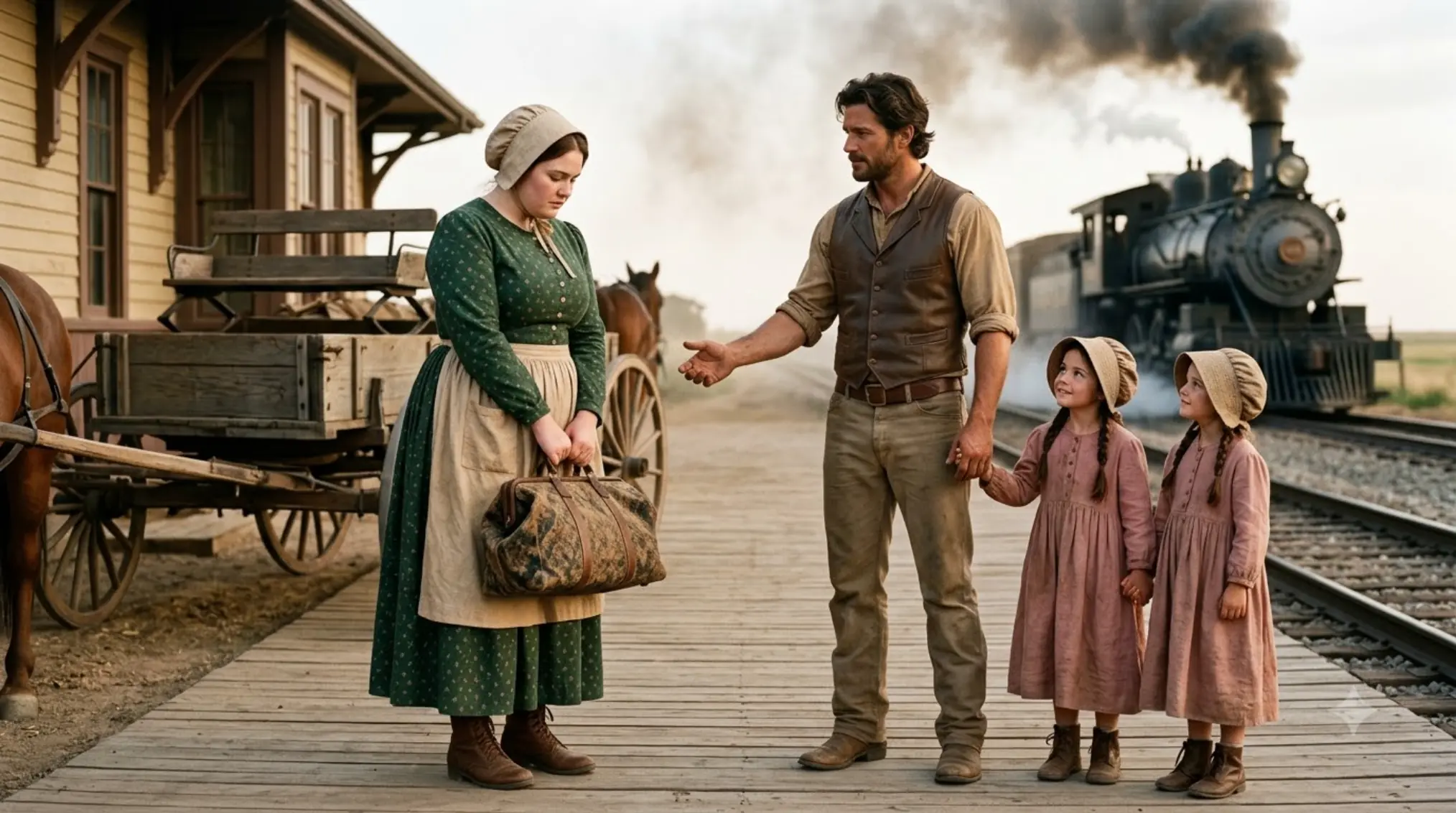
She had imagined many versions of her arrival at Silver Creek Depot during the six hundred miles between Ohio and Kansas. In some, Nathaniel smiled the instant he recognized her. In others, he awkwardly offered flowers, stumbled over his words, then admitted the fourteen letters they had exchanged had already made him feel as though he knew her.
Never once had Margaret imagined standing beneath the blazing Kansas sun while fifty strangers watched a man decide she was too large to become his wife.
Nathaniel glanced at the coin near her boots.
“That should cover most of your return fare.”
Margaret looked at him.
She was twenty-six, fair-skinned, round-faced, and fuller through the waist and hips than fashionable women were supposed to be. Her dark-brown hair had been carefully tucked beneath a bonnet before the train arrived, though the journey had loosened several strands around her damp temples.
She wore the best dress she owned.
Deep green.
Tiny floral pattern.
Cream apron.
Sturdy boots polished before leaving Ohio.
Nathaniel had described himself honestly in every letter.
So had she.
That was the part that hurt.
“You knew what I looked like,” Margaret said.
Nathaniel shifted uncomfortably.
“You said you were plain.”
“I said I was large.”
“Margaret—”
“I said I had broad shoulders from farm work. I said I wasn't delicate. I said I wasn't the sort of woman men stared at across a ballroom.”
A few passengers slowed nearby.
Nathaniel noticed them.
His face tightened.
“I have a position in this county.”
“So?”
“People talk.”
Margaret understood immediately.
Not attraction.
Not compatibility.
Not even disappointment.
Cowardice.
Nathaniel Brooks was afraid of what other people might think if he brought her home.
Margaret looked at the coin again.
Then raised her eyes.
“Keep your money.”
“You'll need it.”
“I said keep it.”
Nathaniel exhaled sharply.
“I’m trying to be fair.”
“No.”
Her voice remained quiet.
“You're trying to leave without feeling like the man who asked a woman to cross six hundred miles and abandoned her because strangers might laugh.”
Someone near the ticket office coughed.
Nathaniel’s face reddened.
He turned.
One of the men waiting with him whispered something.
The other laughed.
That laugh hurt more than the rejection.
Nathaniel walked away.
Margaret did not pick up the coin.
The train hissed behind her.
Steam rolled across the platform.
Within ten minutes, the depot began emptying.
Families disappeared into wagons.
Travelers collected trunks.
Railroad workers shouted to one another.
Margaret remained beside her worn patterned travel bag with thirty-seven cents inside her purse and nowhere to sleep that night.
She finally sat on the edge of the wooden platform.
Not because she had surrendered.
Because her knees were beginning to shake.
She opened her handbag and counted the coins again.
Thirty-seven cents.
She had two dresses.
Her mother’s Bible.
A sewing kit.
One good shawl.
And a jar of blackberry preserves she had prepared because some magazine had claimed a mail-order bride should arrive carrying something homemade.
Margaret almost laughed.
Six hundred miles for a man who had thrown money at her feet.
And she had brought him preserves.
“Ma’am?”
Margaret looked up.
A man stood several yards away holding his weathered hat.
He was perhaps thirty-six.
Tall.
Broad through the shoulders.
Lightly tanned from years outdoors.
Wavy dark-brown hair fell untidily over his forehead, and a short beard covered a face that looked serious without looking hard.
Behind him stood two little girls.
Twins.
About six years old.
Both wore dusty-pink prairie dresses and little brown boots.
They held hands.
Both were staring at Margaret.
The man cleared his throat.
“My name's Cole Bennett.”
Margaret waited.
Cole shifted his hat between his hands.
“I saw what happened.”
“Apparently everybody did.”
“I’m sorry.”
“I don't need pity.”
“I know.”
That answer made her look at him more carefully.
Cole stepped closer but stopped far enough away to avoid crowding her.
“I wasn't going to offer pity.”
“What were you going to offer?”
He glanced at the two girls.
Then back at Margaret.
“An honest proposition.”
Margaret nearly laughed again.
“Today appears to be full of those.”
Cole accepted the sting.
“My wife died two years ago.”
Margaret’s expression softened despite herself.
“These are Lily and Emma.”
The girls watched her solemnly.
Cole continued.
“I have a ranch twelve miles northeast. Eight hundred acres. Cattle. A good house that has been too quiet for too long.”
Margaret said nothing.
“My Twins Need a Mother.”
The words came gently.
Not as an order.
Not even as a proposal.
Something closer to an admission.
Cole looked toward his daughters.
“But I think their father needs someone too.”
Margaret stared at him.
“You don't know me.”
“No.”
“Then why would you ask something like that?”
“I didn't ask you to marry me.”
Cole gave the smallest hint of a smile.
“Not yet.”
Margaret's eyebrows rose.
He continued quickly.
“I’m offering you a room, wages for household work, and enough time for all four of us to decide whether this arrangement makes sense.”
“You expect me to trust a stranger?”
“No.”
That answer surprised her again.
“I expect you to watch me until you decide whether I'm trustworthy.”
Cole looked toward the place Nathaniel had disappeared.
“I watched a man reject you because he cared more about gossip than character.”
His brown eyes returned to hers.
“I don't run my ranch by committee.”
Margaret looked at the twins.
Lily, though Margaret did not yet know which was which, stared directly back.
The other girl hid partially behind her sister.
“What would you expect from me?”
Cole answered immediately.
“Work honestly.”
“I can do that.”
“Treat the girls kindly.”
“I can do that.”
“Tell me when I'm being foolish.”
Margaret almost smiled.
“How often does that happen?”
“Depends who you ask.”
One of the twins giggled.
The sound loosened something inside Margaret.
Cole extended his hand.
Not insistently.
Simply offering it.
Margaret looked at his palm.
Then at his face.
“Mr. Bennett, I have thirty-seven cents, one suitcase, and a jar of blackberry preserves.”
Cole nodded solemnly.
“That sounds like more than I had when I first came west.”
“I can cook.”
“Useful.”
“Keep books.”
“Very useful.”
“Repair clothing, manage a garden, tend animals, teach children basic reading and arithmetic, and solve household problems without needing applause.”
Cole’s mouth curved.
“That might be the strongest employment application I've ever heard.”
Margaret hesitated.
“What happens if I decide to leave?”
“I take you back to town.”
“No argument?”
“No.”
“No guilt?”
“None.”
“No coin thrown at my feet?”
Cole’s expression darkened.
“Never.”
Margaret slowly placed her hand in his.
“Then take me home slowly.”
Cole closed his fingers around hers.
“And give me time to believe you.”
“I can do that.”
The twins immediately moved closer.
Cole crouched.
“Girls, this is Miss Margaret Caldwell.”
Lily studied her.
“Are you staying?”
Margaret crouched too.
“I don't know yet.”
The girl’s face fell slightly.
“But I'm going to try.”
That seemed acceptable.
Lily nodded.
Emma reached forward and touched Margaret’s green sleeve with two cautious fingers.
Then pulled away.
Margaret smiled.
“That's enough for today.”
The Bennett ranch was not impressive from a distance.
Margaret noticed that immediately.
The house needed paint.
Two fence sections leaned.
One barn door hung slightly crooked.
The kitchen garden had become mostly weeds.
Yet nothing appeared abandoned.
The buildings were sound.
The cattle looked healthy.
The land stretched farther than Margaret could see beneath an enormous Kansas sky.
This was not a failed place.
It was a tired one.
Margaret understood tired things.
Cole carried her bag inside.
“I prepared the back room.”
The room was small.
Narrow bed.
Wooden dresser.
Wash basin.
One east-facing window.
Fresh blanket.
Margaret ran her fingers across the quilt.
“You did this?”
“The girls helped.”
Lily immediately announced, “I picked the blanket.”
Emma whispered, “I washed the window.”
Margaret looked at them.
“Then it's the finest room I've had in months.”
Both girls smiled.
That evening, Margaret opened the pantry.
Flour.
Cornmeal.
Salt pork.
Dried beans.
Two onions.
Some potatoes.
A small jar of lard.
She rolled up her sleeves.
Cole appeared in the doorway.
“You don't have to work tonight.”
Margaret glanced over.
“Are you hungry?”
“Yes.”
“Are they hungry?”
Two heads appeared around his waist.
“Yes.”
“Then I’m cooking.”
Within an hour, the kitchen smelled of biscuits, fried potatoes, onions, and salt pork.
The transformation startled Cole.
Not because the meal was elaborate.
Because the house suddenly smelled inhabited.
He sat across from his daughters.
Emma ate half a biscuit before quietly saying, “This is good.”
Margaret smiled.
“Thank you.”
Lily stared at her.
“You're going to be here tomorrow?”
“Yes.”
“And the next day?”
Margaret paused.
“Probably.”
Cole watched the girls’ faces change.
He did not say anything.
But Margaret noticed.
She woke before dawn.
Habit.
Farm life had taught Margaret that daylight was too valuable to greet from bed.
She started the stove.
Made coffee.
Mixed biscuits.
Emma appeared first.
Barefoot.
Hair loose.
Nightgown wrinkled.
The child stood silently in the doorway.
Margaret continued working.
“There’s a stool beside the stove if you want somewhere warm.”
Emma crossed the room and sat.
Neither spoke for several minutes.
Finally Emma asked, “Why didn't you take the gold coin?”
Margaret paused.
Children always noticed what adults hoped they had missed.
“Because taking it would have felt like agreeing with him.”
“Agreeing with what?”
“That he had decided my value.”
Emma frowned.
“He can't do that.”
Margaret looked at her.
“No.”
“Only you can.”
Margaret smiled slowly.
“You're a very clever girl.”
Emma shrugged.
“I listen.”
“I noticed.”
Cole entered from morning chores and stopped.
Margaret stood at the stove.
Emma sat nearby.
Coffee boiled.
Biscuits browned.
For one instant his expression became painfully unguarded.
Margaret understood.
He remembered another woman in that kitchen.
She did not pretend not to notice.
She simply poured him coffee.
Lily ran in moments later.
“You stayed!”
Margaret laughed.
“I told you I would.”
Lily sat.
“I told Emma.”
Emma looked at her sister.
“You said maybe.”
“I meant probably.”
Margaret exchanged a glance with Cole.
His mouth twitched.
That was the first time she saw him trying not to laugh.
Days became weeks.
Margaret did not transform the Bennett ranch by magic.
She transformed it by noticing.
A crack beside the stove needed sealing.
The pantry records made no sense.
Flour was being ordered too frequently.
The girls’ schoolbooks sat unused inside a trunk.
The chicken coop wasted feed.
A kitchen garden could easily be restored behind the south fence.
Margaret handled each problem one at a time.
She never asked Cole permission to be useful.
That confused him at first.
One evening he found three columns of figures written neatly across brown paper.
“What’s this?”
“Your household expenses.”
“My household expenses?”
“They're ours if I'm managing them.”
Cole stared.
Margaret pointed.
“You're paying a carrying charge at the dry-goods store.”
“I've always paid it.”
“That doesn't make it sensible.”
She tapped another number.
“And your cattle buyer is paying eighteen percent below the Ellsworth market rate.”
Cole frowned.
“Whitfield has bought from me six years.”
“Then he's underpaid you six years.”
“You sure?”
Margaret pushed the ledger toward him.
“Numbers usually are.”
Cole read silently.
Then again.
“How did you get Ellsworth prices?”
“I asked.”
“Who?”
“Three people.”
“You went around town asking about cattle prices?”
“Yes.”
Cole sat down.
Margaret watched him carefully.
“Is there a problem?”
“No.”
He rubbed his jaw.
“I’m beginning to think asking you to cook may have undersold the arrangement.”
Margaret folded her arms.
“There is one thing I cannot do.”
Cole looked intrigued.
“What?”
“Play piano.”
He waited.
Margaret remained serious.
“I have tried repeatedly. My hands simply refuse civilization.”
Cole laughed.
A real laugh.
Deep and sudden.
Lily and Emma ran from the other room to see what happened.
Margaret found herself laughing too.
It was the first time she realized she had begun to feel safe.
Town gossip reached her eventually.
Margaret knew it would.
People referred to her as “the rejected bride.”
Some wondered why Cole had brought her home.
Others said he must be desperate.
One afternoon at the dry-goods store, Margaret heard a well-dressed woman whisper:
“Unfortunate.”
Her companion laughed.
Cole stopped walking.
Margaret continued another step before realizing he had turned around.
“Mrs. Hartwell.”
The woman stiffened.
“Mr. Bennett.”
Cole’s voice stayed quiet.
“I believe you know Miss Caldwell.”
“Everyone does.”
“Good.”
He looked around the store.
“Then everybody should also know that Miss Caldwell manages my household and business account here. Any discourtesy shown to her becomes discourtesy shown to me.”
Mrs. Hartwell's smile disappeared.
Cole continued.
“If that's difficult, Ellsworth has stores.”
Silence.
Margaret stared at him afterward.
“You didn't need to do that.”
“No.”
“Then why?”
Cole picked up a sack of flour.
“Because I wanted to.”
On the wagon ride home, Lily leaned over the seat.
“Mrs. Hartwell is mean.”
Margaret turned.
“How do you know?”
“She called us ragamuffins once.”
“What did you say?”
“I said ragamuffins are still people.”
Margaret nodded.
“Exactly right.”
Emma sat beside her sister.
“Are you staying longer now?”
Margaret looked toward Cole.
He kept his eyes on the road.
“I’m working on it.”
That answer seemed enough.
For now.
The first real change between Margaret and Cole came during a thunderstorm.
Not because either confessed anything.
Because Cole came inside soaked after repairing a gate, and Margaret found blood running from his hand.
“Sit.”
“It’s nothing.”
“Sit.”
He obeyed.
Margaret cleaned the cut.
Cole watched her.
“You order people around a lot.”
“Only when they're being foolish.”
“Am I foolish often?”
“Alarmingly.”
He smiled.
Margaret wrapped his hand.
Her fingers lingered against his palm.
For a moment neither moved.
Cole’s expression changed.
Margaret felt it too.
The warmth.
The dangerous awareness that this arrangement had stopped feeling temporary.
She withdrew her hands.
“There.”
Cole looked at the bandage.
“Thank you.”
Margaret nodded.
Neither mentioned what almost happened.
Their romance grew through moments like that.
A cup of coffee left beside her ledger before dawn.
Cole repairing the loose floorboard outside her bedroom because he noticed it bothered her.
Margaret sewing the tear in his favorite work shirt.
Cole bringing home two books because she had mentioned wanting harder lessons for Lily and Emma.
Nothing grand.
Nothing rushed.
Trust assembled itself from ordinary things.
Then came the storm.
Cole noticed the cattle first.
Restless.
Pacing.
Looking west.
Margaret saw the bruised horizon.
“Bring more wood inside.”
Cole nodded.
By midnight the wind struck.
The house groaned beneath it.
Sleet hammered the windows.
Cole pulled on his coat.
“North fence.”
Margaret looked at him.
“How bad?”
“If the post line goes, we lose half the herd.”
“I’ve got the girls.”
“I’ll be back.”
“Go.”
Lily and Emma came into the kitchen wrapped in blankets.
Emma immediately pressed against Margaret.
Lily tried to pretend she was not afraid.
“Mama died in winter.”
The words stopped Margaret.
Lily stared at the stove.
“Papa was outside.”
Margaret sat beside her.
“I can't promise nothing bad will ever happen.”
Lily looked up.
“But I can promise that right now, you're safe. Your father knows this land. And I’m here.”
Two hours passed.
Cole did not return.
Margaret calculated distance.
Weather.
Fence location.
Something was wrong.
She banked the fire.
Wrapped both girls in blankets.
“You stay together.”
Lily’s eyes widened.
“Where are you going?”
“To find your father.”
“No.”
Margaret crouched.
“I am coming back.”
“You said nobody can promise.”
Margaret held her gaze.
“Then I promise this: every step I take will be aimed toward this house.”
She took Cole’s heaviest coat.
A rope.
Lantern.
She tied one end of the rope to the back-door post and disappeared into the storm.
The wind nearly knocked her down.
She counted steps.
Reached the barn.
Tied another rope section.
Continued north.
“Cole!”
Nothing.
“COLE!”
The wind swallowed her voice.
Then she heard something.
A groan.
Margaret dropped.
Cole lay near a broken fence post.
His right leg twisted beneath him.
“Maggie?”
“I’m here.”
“You shouldn't—”
“Save it.”
She checked his ankle.
Badly injured.
Probably not broken.
“Can you stand?”
“No.”
“Then you're going to lean on me.”
“Maggie, I'm twice—”
“Cole Bennett, if you finish that sentence, I will leave you here long enough to reconsider your manners.”
Despite the pain, he laughed.
They rose together.
Cole leaned heavily against her.
Margaret followed the rope.
One step.
Another.
Another.
She fell twice.
Got up twice.
When the kitchen door finally appeared through the sleet, Emma was standing inside.
“Papa!”
Margaret got Cole into a chair.
Lily reached him first.
Emma hugged his neck.
Margaret stood beside the stove breathing hard.
Cole looked at her over his daughters.
“You came looking.”
“You were late.”
His eyes remained on her.
Something settled between them.
Something neither could pretend was merely practical anymore.
Cole stayed off his leg nine days.
Margaret ran the ranch.
Not perfectly.
Competently.
That mattered more.
She rode the north pasture.
Managed feed.
Organized neighbors to repair fencing.
Kept accounts.
Taught the twins.
Prepared meals.
By the fourth day, Tom Perkins from the neighboring ranch found her replacing a post.
“You need help?”
“The post forty yards north needs replacing.”
Tom climbed from his horse.
They worked together silently.
When they finished, Tom studied Margaret.
“Bennett know what he's got?”
Margaret smiled.
“I think he's beginning to.”
Nathaniel Brooks returned the morning after the storm.
Margaret saw him from the kitchen window.
Fine horse.
Clean coat.
Two men behind him.
Cole tried to stand.
His injured ankle stopped him.
“I’ll go.”
“Maggie—”
“I handled him before.”
She put on her coat.
“And now I know more.”
Nathaniel smiled when she stepped outside.
“Maggie.”
“Mr. Brooks.”
“You look well.”
“I am.”
“I've heard things.”
“I assumed so.”
“The Bennett ranch is improving.”
“Yes.”
“They say you're responsible.”
“I helped.”
Nathaniel looked toward the house.
“I made a mistake.”
Margaret waited.
“I judged too quickly.”
“Yes.”
He seemed irritated by the simplicity.
“I have a larger ranch.”
Margaret almost laughed.
“Better water rights. More cattle. A larger house.”
“Congratulations.”
“I’m asking you to reconsider.”
“No.”
“I haven't finished.”
“You already did.”
Nathaniel stared.
Margaret continued.
“You rejected me because you thought people would laugh at you.”
His face tightened.
“You came back because those same people now say I’m useful.”
“That isn't fair.”
“It is exact.”
Nathaniel looked toward the Bennett house.
“Bennett can’t give you what I can.”
Margaret smiled.
“He already did.”
“What?”
“Respect before he had anything to gain.”
Nathaniel went quiet.
Margaret stepped closer.
“You looked at me on that platform and saw embarrassment.”
She pointed toward the house.
“Cole saw a woman standing alone.”
Her voice softened.
“That difference is everything.”
Nathaniel lowered his eyes.
“You've built something here.”
“Yes.”
“I suppose Bennett is lucky.”
Margaret shook her head.
“So am I.”
She turned.
Nathaniel called after her.
“Maggie.”
She looked back.
“I am sorry.”
For the first time, he sounded sincere.
Margaret nodded.
“I believe you.”
His expression softened.
“But forgiveness isn't the same thing as returning.”
She went inside.
Cole sat near the window.
“What did he want?”
“To discover whether he'd mispriced something.”
Cole almost smiled.
“And?”
“He had.”
Margaret removed her coat.
“I told him I'm already where I want to be.”
Cole’s expression became very still.
“Maggie.”
“Yes?”
“When this leg works again, I want to talk to you.”
She looked at him.
“About?”
“You know.”
Margaret did.
“All right.”
Nine days later, Cole walked into the kitchen without his makeshift crutch.
Margaret looked at his ankle.
“You're pushing it.”
“Probably.”
“Sit.”
He did.
She closed the ledger.
Cole put both hands on the table.
“I've practiced this.”
Margaret raised an eyebrow.
“That worries me.”
He laughed once.
Then grew serious.
“I want you to marry me.”
Margaret said nothing.
“Not because you need somewhere to live.”
He continued.
“Not because the girls need somebody.”
Still she waited.
“Not because you're good at accounts or cattle or cooking or pulling foolish men out of storms.”
“Very flattering.”
“I’m trying.”
“Poorly.”
Cole smiled.
Then his expression opened completely.
“I love you.”
Margaret stopped teasing.
“I love the way you walk into a problem and make it smaller.”
He leaned forward.
“I love the way Lily argues less when you explain something instead of ordering her. I love how Emma stopped waking every night because she knows you're down the hall.”
His voice grew quieter.
“I love that this ranch became home again after you arrived.”
Margaret’s eyes burned.
Cole continued.
“And somewhere along the way, you became the person I look for when I walk through the door.”
Margaret looked down.
“You understand I'm not going to become smaller.”
Cole frowned.
“Why would I want you to?”
“I’m not becoming prettier for town people.”
“I don't care.”
“I will disagree with you.”
“Constantly, apparently.”
“I will interfere with bad accounting.”
“I’m counting on it.”
Margaret finally smiled.
“Yes.”
Cole stopped breathing.
“Yes?”
“Yes, Cole.”
He laughed.
Then reached across the table.
Margaret placed her hand in his.
The gesture reminded her of the depot.
Only now she did not need time to believe him.
She already did.
They told the twins after supper.
Lily immediately asked, “Does that make Margaret our mother?”
“Stepmother,” Cole explained.
Lily considered.
“What do we call her?”
Margaret answered.
“Whatever feels right.”
Lily looked deeply serious.
“Mama Maggie.”
Margaret swallowed.
“All right.”
Emma stood.
Walked around the table.
And wrapped both arms around Margaret’s neck.
No words.
Margaret held her.
Cole watched quietly.
The family had decided before the wedding ever happened.
The ceremony merely waited for the adults to catch up.
Their wedding took place three weeks later beside the Bennett house.
Small.
Simple.
No ballroom.
No expensive dress.
Margaret sewed her own cream-colored gown.
Cole wore his best shirt and dark vest.
Lily and Emma wore dusty-pink dresses.
Before they walked outside, Emma found Margaret alone in the kitchen.
“Are you different today?”
Margaret turned.
“What do you mean?”
“You'll be Mrs. Bennett.”
Margaret crouched.
“The name changes.”
Emma waited.
“Nothing else?”
“What we have doesn't need a ceremony to become real.”
Emma touched Margaret’s cheek.
“Okay.”
Lily entered behind her.
“I decided something.”
Margaret smiled.
“That sounds serious.”
“I’m dropping Maggie.”
“What?”
“From Mama Maggie.”
Margaret froze.
Lily lifted her chin.
“I’m calling you Mama.”
Emma nodded.
“Me too.”
Margaret covered her mouth.
For the first time since arriving in Kansas, she cried.
Not from rejection.
Not humiliation.
Not loneliness.
From receiving something she had stopped believing life might give her.
Belonging.
Cole found her afterward in the barn.
“You okay?”
Margaret wiped her eyes.
“Your daughters ambushed me.”
“Terrifying criminals.”
“They changed my name.”
Cole understood.
He walked closer.
Margaret looked up.
“You nervous?”
“A little.”
“Why?”
“I want to get this right.”
She smiled.
“You already are.”
Cole took her hand.
“When I saw you on that platform, I thought you looked like somebody who had been treated unfairly.”
Margaret listened.
“Then you told me about the thirty-seven cents and blackberry preserves.”
He laughed.
“And I thought, that's a woman taking inventory instead of falling apart.”
Margaret’s eyes softened.
“I knew you were worth knowing.”
He squeezed her hand.
“I was right.”
Margaret leaned toward him.
“The preserves were a good idea after all.”
Cole kissed her.
Gentle.
Unhurried.
No audience needed.
The ceremony lasted less than twenty minutes.
When the preacher asked Cole whether he would take Margaret as his wife, he looked directly at her.
“I will.”
Margaret answered the same way.
“I will.”
The girls stood beside them.
Lily held Margaret’s hand.
Emma pressed close against her arm.
Afterward, everyone crowded around the kitchen table.
There was roast beef.
Fresh bread.
Cake.
Coffee.
And the jar of blackberry preserves Margaret had carried from Ohio.
She opened it.
Cole tasted some.
He nodded thoughtfully.
“Worth six hundred miles.”
Margaret laughed.
“No preserves are worth six hundred miles.”
“These might be.”
Lily demanded two spoonfuls.
Emma asked whether they could save the jar after it was empty.
Margaret looked at her.
“Why?”
“So we remember.”
Margaret’s expression softened.
“Then we'll keep it.”
And they did.
Years later, the empty jar remained on a shelf in the Bennett kitchen.
By then, the ranch had expanded.
Margaret’s accounting system had doubled their profitability.
Cole added better breeding stock.
The north fence became one of the strongest on the property.
Lily grew into a fierce reader.
Emma became a gifted teacher.
And Margaret eventually built the small school she once mentioned while sitting beside Cole beneath the Kansas stars.
Nathaniel Brooks married someone else.
He and Margaret rarely spoke.
When they did, there was no bitterness.
He had given her one painful lesson.
Cole had given her something more valuable.
The chance to learn that rejection did not determine destination.
Sometimes it merely changed the road.
One evening, years after their wedding, Margaret stood on the porch watching Cole return from the pasture.
Two teenage girls followed him on horseback.
Lily was arguing about something.
Emma was laughing.
Cole dismounted.
Looked toward Margaret.
Even after all those years, his face still changed when he saw her.
Not surprise.
Recognition.
Home.
He climbed the porch steps.
Margaret handed him coffee.
“Long day?”
“Lily thinks she runs the north herd.”
“She probably does.”
“I knew marrying you would eventually turn them against me.”
Margaret smiled.
“You said your twins needed a mother.”
Cole put one arm around her waist.
“They did.”
He kissed her temple.
“So did their father.”
Margaret rested her head against him.
Across six hundred miles, she had traveled believing she was going to Kansas to become someone’s bride.
She had been wrong.
She came to Kansas to become herself.
A rancher.
A wife.
A mother.
A teacher.
A woman whose opinion mattered inside her own home.
The gold coin Nathaniel dropped was probably picked up by some stranger minutes after the train departed.
Margaret never learned who.
She never cared.
That coin represented the price another man had tried to put on her humiliation.
She had left it exactly where it belonged.
In the dirt.
What she picked up instead was Cole Bennett’s hand.
Two frightened little girls.
A struggling ranch.
A second chance no one could guarantee would work.
And from those uncertain things, Margaret built a life worth infinitely more than the coin she refused to touch.
Years earlier, Cole had stood on the platform and told her:
“My Twins Need a Mother.”
He had been right.
But the truth turned out to be larger.
The twins needed Margaret.
Cole needed Margaret.
The ranch needed Margaret.
And after a lifetime of being treated as though usefulness was the only reason anyone might keep her, Margaret finally discovered something she needed too.
A family that did not merely need what she could do.
A family that loved who she was.