“Hey. Where do you think you are going?”
A man wearing a plain Henley shirt looked up from the reception desk.
Coffee splashed across his chest.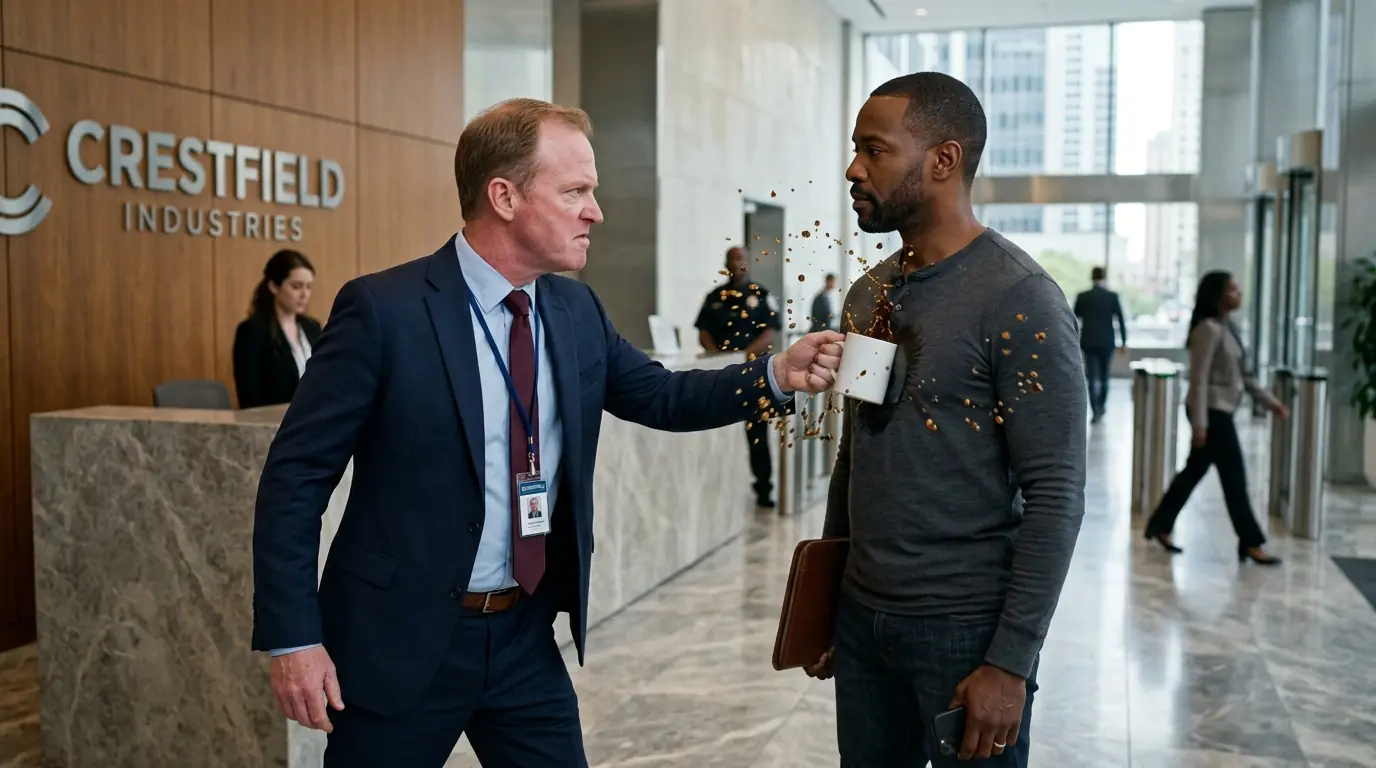
The white manager had pushed the cup toward him deliberately. He slammed the empty mug onto the counter and looked at the man with open contempt.
“An uneducated fool like you has no business here. Get out.”
The man looked down at the coffee soaking through his shirt.
Then he raised his eyes.
“You should reconsider what you are doing.”
His voice was barely above a whisper.
The manager’s lips curled.
“Reconsider what? Calling the police? That is what happens to people like you when they refuse to leave.”
He leaned closer.
“People like you make my skin crawl.”
The lobby became silent.
Twenty people watched.
Nobody moved.
The manager had no idea that within minutes, the arrogance covering his face would disappear. He did not know that the man he had drenched in coffee possessed the authority to change his life permanently.
Three hours earlier, before the coffee, the insults, and the moment the corporate lobby became a courtroom, Byron Ingram woke at 5:30 in the morning.
He did not require an alarm.
His body had followed the same rhythm for twenty years.
Byron swung his legs over the side of the bed and placed his feet against cool hardwood flooring. Beyond the floor-to-ceiling windows, the city skyline was turning pink and gold beneath the early light.
His penthouse was quiet.
Clean lines.
Warm wood.
A single framed photograph rested on the nightstand.
The picture showed Byron’s late mother standing outside the barber shop she operated for thirty-one years. It stood in a neighborhood most residents of Byron’s current postal code had never driven through.
Byron entered the kitchen and ground his own coffee beans.
He poured the water slowly and filled a plain white mug.
There was no housekeeper moving silently through the rooms, no personal chef preparing breakfast, and no assistant waiting beside the door with a schedule.
That was Byron.
He possessed the kind of wealth that did not require an audience.
He sat at the kitchen island and opened The Wall Street Journal on his tablet. He checked three emails, reviewed two market reports, and then opened the document he had spent six months waiting to see.
The final acquisition agreement for Crestfield Industries.
On paper, Crestfield looked impressive.
It was a midsize logistics and commercial real estate company with approximately twelve hundred employees across three states. Its downtown headquarters occupied a gleaming tower with a polished marble lobby and a corporate logo nearly the size of a vehicle.
Behind the polished glass, however, the company was failing.
Crestfield had reported losses for two consecutive years.
Its operations were outdated.
Systems that should have been replaced years earlier remained in use because nobody wanted responsibility for the disruption.
Senior leaders appeared more interested in protecting corner offices than in repairing the business.
The board recognized the situation and quietly began searching for a buyer.
They found Byron Ingram.
His company, Apex Venture Capital, managed a portfolio valued at more than eight hundred million dollars.
Byron had not inherited a single cent.
He was a scholarship student who attended a state university. His first position after graduation involved answering telephones at a brokerage firm where almost nobody looked like him.
Twenty years later, he owned the firm that had rejected his first employment application.
At 6:45 that morning, Byron signed the final documents from his kitchen island.
The transfer was confirmed.
Every share of Crestfield Industries now belonged to him.
Every floor.
Every desk.
Every building.
Every contract.
Byron closed the tablet and took a long drink of coffee.
The acquisition was complete.
He did not immediately telephone the board.
He did not send a companywide announcement.
He did not arrive at Crestfield surrounded by attorneys, cameras, executive assistants, or security personnel.
Instead, Byron decided to enter the building alone.
He wore no suit.
There was no entourage or name badge.
Only a dark Henley shirt, clean jeans, casual shoes, and a watch that would be recognized only by people who understood expensive watches.
Byron wanted to see Crestfield as it truly operated.
Not the performance prepared for a new owner.
He wanted the Tuesday-morning version of the company, when employees believed nobody important was watching.
At least, when they believed nobody important was watching.
Byron drove into the parking garage at 8:15.
He took the elevator to the ground floor and entered the lobby.
It contained everything corporate America enjoyed displaying.
Polished marble floors reflected the overhead lights like still water.
A reception desk extended across the room, wide enough to resemble a small stage.
Behind it, the Crestfield logo appeared in brushed silver letters, each nearly the size of a dinner plate.
The morning rush was underway.
Employees moved through the turnstiles with access badges swinging from lanyards.
They carried coffee cups, laptop bags, and phones.
Small conversations echoed beneath the high ceiling.
Byron entered calmly.
He carried no badge or briefcase.
A slim leather portfolio rested beneath one arm.
He approached the reception desk.
Patricia Coleman looked up from her computer.
She was in her late forties, with polished nails and reading glasses resting across her nose.
Her smile was professional.
Her eyes performed a rapid inspection.
Henley shirt.
Jeans.
skin.
The smile remained, though it became tighter.
“Good morning. How may I help you?”
“I am here to see Elliot Graves. He is expecting me.”
Patricia entered the name into her system.
Then she frowned.
“I do not see an appointment. Could you spell your surname?”
“Ingram. I-N-G-R-A-M.”
Patricia searched again.
The appointment had been entered under a confidential acquisition code that she did not possess clearance to view.
“I am sorry, sir. Let me contact Mr. Graves’s office. Would you mind waiting?”
Byron nodded.
“Of course. Take your time.”
He stepped away from the counter and stopped near the tall windows.
His hands rested inside his pockets.
He stood patiently while the movement of the lobby passed around him like a river around a stone.
Then the elevator doors opened.
Derek Lawson stepped out as though the building belonged to him.
A telephone was pressed against one ear, and his voice was loud enough for the entire lobby to hear. He carried a coffee mug in the other hand.
Derek was the kind of manager who turned every entrance into an announcement.
He ended the call in the middle of a sentence because something had caught his attention.
A man.
Casual clothing.
No visible access badge.
Standing alone inside the lobby.
Derek’s eyes narrowed.
His jaw tightened.
His chin rose.
Then he walked directly toward Byron.
Derek did not introduce himself.
He did not ask Patricia for an explanation.
He did not slow as he approached.
He moved toward Byron like a man confronting a stray animal that had entered his property.
“Who allowed you inside?”
Byron turned toward him.
“Good morning. I am waiting to see Mr. Graves.”
Derek examined him slowly.
His gaze moved from Byron’s Henley to the jeans, down to the casual shoes, and then back to his face.
“Mr. Graves does not meet with people like you.”
The words cut across the marble lobby.
Two employees near the turnstiles stopped speaking.
Patricia’s fingers froze above the keyboard.
The noise inside the room dropped noticeably.
Byron did not blink.
“He is expecting me. The receptionist is confirming the appointment.”
Derek stepped closer.
Byron could smell old coffee on his breath.
The distance between them was no longer professional.
It had become physical.
“Let me make something clear.”
Derek spoke slowly.
“I have worked in this building for nine years. I recognize every face that belongs here.”
His eyes remained on Byron.
“Yours does not.”
He pointed toward the glass entrance.
“The exit is there. Use it.”
Byron remained where he stood.
“I would prefer to wait until the receptionist finishes confirming the appointment.”
Color spread across Derek’s neck.
A vein moved at his temple.
He was not accustomed to hearing refusal, particularly from someone he had already classified as powerless.
Derek turned toward Patricia.
“Pat, did you schedule this?”
Patricia looked up from her screen.
Discomfort covered her face.
Her eyes moved between Derek and Byron as though she were watching a collision develop too slowly to prevent.
“He says he has an appointment with Mr. Graves, but I have not found it yet. I was about to telephone upstairs.”
“Then he does not have one.”
Derek faced Byron again.
A thin smile appeared.
“The system says no. That means no.”
“The system has not completed the verification,” Byron replied. “That is not the same thing.”
Something moved across Derek’s face.
It was not simple anger.
It was colder than anger.
It was the satisfaction of a man who had already decided how the interaction would end and was enjoying the path toward it.
“I need identification.”
Derek raised his voice deliberately.
“Right now.”
Employees near the turnstiles turned their heads.
People beside the coffee cart and elevator bank began watching.
This was not a normal security request.
It was a performance.
Derek was not merely asking Byron to identify himself.
He was demonstrating who held power in the room.
Byron paused for one second.
Then he reached into his pocket and removed his driver’s license.
He offered it between two fingers.
Derek snatched it from his hand.
He held the card beneath the light like a nightclub employee examining suspicious identification.
Derek tilted it left.
Then right.
He compared the photograph to Byron’s face.
Then he examined it again, more slowly, as though searching for a reason to reject it.
“Byron Ingram.”
He read the name loudly enough for everyone nearby to hear.
Derek did not return the license.
He lowered it to his side and held it there.
“I am going to keep this.”
Byron’s jaw tightened slightly.
It was the first visible break in his composure.
“That is my personal property.”
“And this is my building.”
Derek smiled.
“You may collect the license from security while leaving.”
The lobby was watching now.
Really watching.
A woman wearing a gray blazer stood near the elevator with a coffee cup held halfway toward her mouth.
Two junior analysts whispered behind the turnstiles.
An older man wearing a pinstriped suit looked at the floor and continued walking, pretending he had seen nothing.
Nobody spoke.
Nobody stepped forward.
Derek turned his back on Byron.
Then he whistled.
He actually whistled in the manner someone might use to summon a dog.
“Glenn. Come here.”
Officer Glenn Tucker stood near the far wall beside an emergency exit.
He was in his mid-forties, with a stocky build, short hair, and both hands clasped in front of his uniform.
Glenn approached with the reluctant pace of a man who already understood that something was wrong but lacked the courage to say it.
“What is happening, Derek?”
Derek pointed a thumb toward Byron.
“Watch this one. No appointment, no badge, and no legitimate business inside the building.”
His voice became lower.
“Something is wrong with him.”
Glenn looked at Byron.
Byron returned the gaze.
Their eyes met for several seconds.
Glenn saw what Derek refused to acknowledge.
A calm man standing with his hands visible at his sides.
No aggression.
No threatening movement.
No raised voice.
Glenn did not say any of that.
“Yes, sir.”
He moved into a position two feet behind Byron.
Like a shadow.
Like a guard.
Byron felt the presence behind him.
The weight of being monitored and treated as suspicious.
Not because of anything he had done.
Not because of anything he had said.
Because of how he looked while standing inside a marble lobby in clothing Derek considered inappropriate.
Byron had experienced it before.
A different building.
A different city.
Another man standing before him.
The same script.
Derek was not finished.
He turned toward Byron and crossed both arms.
His feet remained wide apart, creating the posture of a man constructing a wall with his body.
“Who sent you here? Are you a delivery worker? A courier?”
Derek gestured toward the desk.
“If someone gave you an envelope, leave it with Patricia and go. That is how things operate here.”
“I am not making a delivery.”
“Then what are you?”
“I told you. I have a meeting with Elliot Graves.”
Derek laughed.
The sound was short, harsh, and designed to reduce Byron in front of the room.
“Elliot Graves is the chief executive of a four-hundred-million-dollar corporation.”
Derek looked at Byron’s clothing again.
“He does not meet with men who walk in from the street looking like they were hired to repair the plumbing.”
The words echoed from the marble walls.
A young woman standing near the coffee cart slowly placed her cup on the counter.
Her hand trembled.
Not from fear.
From anger she had learned to keep sealed behind her teeth.
Near the service corridor, a mailroom employee in his early thirties gripped the handle of his delivery cart.
His jaw was clenched so tightly that the muscles in his neck were visible.
He had seen Derek behave this way before.
The person was different.
The method was identical.
Patricia remained behind the reception desk with one hand near the telephone.
She could have contacted Elliot’s office immediately.
One call could have ended the scene within thirty seconds.
Derek was part of senior management.
He outranked Patricia’s direct supervisor.
She hesitated.
Derek continued.
“You know what, Patricia? Do not call upstairs. I have seen enough.”
He stepped close to Byron again.
Their chests were nearly touching.
“I do not know what kind of scheme you are attempting. Perhaps you are studying the building. Perhaps you intend to steal someone’s laptop.”
His breath struck Byron’s face.
“Perhaps you are simply lost.”
Derek pointed toward the entrance.
“I am going to explain this slowly enough for you to understand.”
His eyes became cold.
“You do not belong in this lobby, on this floor, or anywhere inside this building. Take your folder, turn around, and return to wherever you came from before I have Glenn place you in restraints and remove you in front of everyone.”
Byron did not move.
He did not flinch or lower his eyes.
He absorbed every word with the restraint of someone standing in heavy rain and deliberately allowing the water to pass over him.
Not because Byron lacked the power to react.
Because he was already several steps ahead.
Derek Lawson did not realize he was participating in a confrontation he had already lost.
The clock behind Patricia read 8:24.
Byron had been inside the building for nine minutes.
The worst part of the morning had not yet begun.
Derek should have left the situation alone.
Any reasonable person would have.
Byron showed identification.
He clearly stated his purpose.
He stood quietly inside a public corporate lobby without disturbing anyone.
Derek was not acting reasonably.
He was territorial.
Byron had not become nervous, apologetic, or submissive.
That refusal to show fear was consuming Derek from inside.
He escalated again.
“What is inside the bag?”
Byron looked at the slim leather portfolio beneath his arm.
“Personal belongings.”
“Open it.”
“No.”
The single word remained in the air.
Two employees near the elevator exchanged worried glances.
Behind Byron, Glenn shifted his weight.
The leather of his duty belt creaked in the silence.
Derek’s nostrils widened.
He moved forward.
“I told you to open it. We have had theft inside this building. Company laptops have disappeared. Equipment has been taken from supply rooms.”
Derek pointed toward the portfolio.
“You appear without an access badge or confirmed appointment carrying a bag nobody can verify. Do you understand how that appears?”
Byron’s voice remained level.
“You have no lawful authority to search my belongings, and you know that.”
“I have every authority to protect company property.”
“It is not your property.”
Something dangerous appeared behind Derek’s eyes.
His face tightened.
He turned to Glenn and snapped his fingers as though summoning a waiter.
“Standard procedure. Search the bag.”
Glenn hesitated.
The conflict showed clearly across his face.
He swallowed.
One hand trembled slightly as he reached forward.
Glenn knew it was not a standard procedure.
There was no policy authorizing him to search a visitor’s belongings merely because a manager disliked the person’s appearance.
Derek stared at him with a silent promise.
Follow the order or become the next problem.
Glenn stepped closer.
“Sir, I apologize. Would you mind allowing me to take a brief look?”
Byron studied him.
He saw the conflict inside Glenn’s eyes.
He saw the shame beneath the pressed uniform and polished badge.
After a long moment, Byron unzipped the portfolio and held it open.
Inside were a tablet, a pen, and a leather notebook secured by a silver clasp.
Nothing else.
Glenn examined the contents.
Then he looked again.
His shoulders lowered slightly.
“There is nothing improper here, Derek.”
“Give me the tablet.”
Before Byron could respond, Derek reached past Glenn and pulled the device from the portfolio.
He held it with both hands and turned it over slowly.
Derek examined the tablet like stolen merchandise placed on a pawnshop counter.
“This is a twelve-hundred-dollar device.”
He looked at Byron.
“Would you like to explain where you obtained it?”
The temperature in the lobby seemed to fall.
The accusation was no longer implied.
Derek had said it openly before everyone.
Byron stole it.
Byron’s eyes did not move.
“It belongs to me. I purchased it. Return it.”
“How do I know that?”
Derek lifted the tablet.
“How does anyone here know you did not enter one of our offices and take whatever was not secured?”
“Because I have not been upstairs.”
Byron gestured toward the lobby.
“I have remained in this location in front of the receptionist, the security officer, and approximately twenty witnesses for the past ten minutes.”
His voice became slightly colder.
“You know I did not steal anything. You simply do not care.”
Derek’s grip tightened.
For one brief moment, it appeared he might throw the device onto the marble floor.
Instead, he dropped it into the portfolio with a heavy impact.
Patricia flinched.
“Do not become clever with me, boy.”
Byron closed the portfolio.
His hands remained steady.
Someone observing closely might have noticed the muscle along his jaw tightening in a slow, controlled motion.
It was the only visible indication that pressure was building beneath the calm surface.
Derek turned toward the lobby and raised his voice.
“I apologize for the disruption. We are dealing with an unauthorized visitor who refuses to cooperate with building security.”
He spoke like a pilot addressing passengers during light turbulence.
Measured.
Professional.
Almost bored.
“We will resolve the situation shortly.”
Byron was not a disruption.
He was a person being publicly stripped of dignity inside a room filled with people who understood exactly what was happening.
Almost all of them continued staring toward the floor.
Derek faced Byron again.
This time, he closed the final distance.
Chest to chest.
Derek used his height to tower over him.
“I have shown patience beyond what you deserve.”
Byron did not retreat or raise his chin.
He met Derek’s eyes at close range.
“You consider this patience?”
“I consider it a courtesy.”
Derek’s voice dropped.
“Where I come from, when a man tells you to leave, you leave. Perhaps people where you come from were never taught that kind of respect.”
“Where do you believe I come from?”
Derek smiled.
It was the ugliest expression Byron had seen that morning.
The lips moved and the teeth showed, but it contained no warmth.
“Somewhere without a dress code.”
Derek thrust the coffee mug toward Byron’s chest.
The movement was sharp.
Deliberate.
The lid came loose.
Hot coffee splashed across Byron’s Henley, reaching his collarbone, running down the portfolio, and collecting on the polished marble between their shoes.
The lobby gasped.
Twenty people appeared to inhale at once.
Patricia rose so quickly that her reading glasses slipped down her nose.
Glenn moved one step forward.
Then he froze.
He remained trapped between duty and cowardice.
The young woman at the coffee cart covered her mouth with both hands.
The mailroom employee’s knuckles became white around the handle of his cart.
His entire body was rigid with anger he could not afford to release.
Derek looked at the dark stain spreading across Byron’s shirt.
Then he examined the liquid gathering on the marble.
Finally, he looked at Byron’s face.
A smirk appeared.
“Oops.”
One mocking word.
No apology.
No concern.
No shame.
Only satisfaction.
“Perhaps that would not have happened if you had left when I instructed you.”
Byron looked down.
Coffee fell from his shirt onto the marble.
One drop.
Then another.
Then a third.
Each struck the stone with a small sound that seemed unusually loud in the silent room.
Byron raised his eyes.
He said nothing.
He drew one slow breath through his nose and released it through slightly parted lips.
The entire lobby appeared to breathe with him.
One detail mattered more than Derek understood.
In the upper corner of the ceiling, behind a dark glass dome, a security camera recorded the lobby.
It had captured the interaction from the moment Derek raised his voice.
Every accusation.
Every gesture.
Every insult.
Every drop of coffee.
The recording was stored in high definition with a running timestamp.
Derek never looked toward the camera.
Not once.
Byron noticed it within thirty seconds of entering.
Byron Ingram did not simply react to problems.
He documented them.
He moved three feet to one side, removed his phone, and dialed one number.
He spoke quietly enough that Derek could not understand the full conversation.
“Naomi, I am inside the Crestfield lobby. Bring the complete acquisition file. Every document.”
Byron watched Derek while speaking.
“Contact Elliot Graves immediately. Tell him we are moving the announcement forward.”
He ended the call and returned the phone to his pocket.
Derek watched with his arms folded.
He was still enjoying the satisfaction of the coffee incident.
He assumed Byron had telephoned for transportation.
Perhaps a friend was coming to collect him.
Perhaps a local attorney would later send an angry letter nobody intended to read.
Derek’s assumptions were completely wrong.
He turned to the other employees and waved one hand.
“Return to work. The situation is handled.”
Derek adjusted his tie.
He breathed deeply and gave Glenn a grin, as though the two of them had successfully completed an unpleasant task together.
A young white employee stood beside the water fountain.
She had been with the company for less than a year and held a laptop bag tightly against her chest.
She looked at Byron.
Then Derek.
Then Byron again.
Her mouth opened.
No words came out.
She closed it.
That silence, the silence of someone who understood what had happened but still chose not to speak, echoed more loudly than anything Derek had shouted.
The clock behind Patricia showed 8:31.
In less than ten minutes, Byron’s quiet telephone call would reach the lobby with extraordinary force.
Derek Lawson’s world was about to disappear beneath him.
At exactly 8:38, the glass entrance doors opened.
Everyone turned.
A woman entered with the presence of someone who owned the air around her.
Naomi Davis was a woman in her mid-thirties. Her hair was pulled back, and she wore a charcoal suit tailored with sharp precision.
A leather briefcase rested in her left hand.
Her expression suggested that she already knew what happened and had no intention of allowing it to disappear quietly.
Naomi crossed the marble floor in five strides.
She did not stop at reception.
She did not slow beside the turnstiles.
She walked directly to Byron.
“Mr. Ingram.”
Her voice was controlled and firm.
“I have everything. Elliot is coming downstairs.”
Naomi opened the briefcase in the center of the lobby.
She removed a thick bound document.
The Crestfield Industries logo appeared on the cover in embossed gold letters.
Beneath it was a title printed in .
Acquisition Agreement, Final Execution Copy.
Naomi placed it in Byron’s hands.
Derek watched from approximately ten feet away.
His smirk had vanished.
In its place was a nervous uncertainty.
He stepped forward and lifted his chest, attempting to recover authority that was already slipping from him.
“Excuse me, ma’am. Visitors must check in at reception before…”
Naomi did not look at him.
“I am Mr. Ingram’s chief legal counsel. Move aside.”
“I do not care who you claim to be.”
Naomi turned her head.
“I said move aside. Now.”
The words stopped Derek.
His mouth opened.
Nothing came out.
For the first time that morning, Derek Lawson had no insult or answer.
Only a widening sense of dread.
Then the elevator sounded.
The soft chime crossed the lobby like a church bell.
Every person turned toward the polished steel doors.
They opened.
Elliot Graves stepped out.
He was sixty-two, with silver hair combed backward, a navy suit, white pocket square, and shoes polished to a mirror finish.
Elliot was the outgoing chief executive of Crestfield Industries.
His name appeared on the boardroom wall.
Every employee recognized him from company emails, quarterly meetings, and annual events.
Derek knew him immediately.
Elliot crossed the lobby with the unhurried stride of a man who had already decided what needed to happen.
His eyes examined the room.
He saw Byron.
He saw Naomi and the acquisition documents.
Then he saw the coffee stain across Byron’s shirt.
Elliot’s face became rigid.
He extended one hand.
“Byron, I am deeply sorry that you were kept waiting.”
Byron shook it briefly.
“Elliot.”
Elliot looked at the stained Henley again.
His voice became quiet.
Dangerously quiet.
“What happened?”
Byron glanced toward Derek.
Only a brief, almost casual look.
“Mr. Lawson welcomed me in his own manner.”
Elliot turned completely toward Derek.
His shoulders squared.
The expression on his face could have cracked stone.
“Derek, do you understand who this man is?”
Derek began speaking before his thoughts became organized.
“He did not have a badge. He refused to identify himself properly. I was only following security protocol.”
“This is Byron Ingram.”
Elliot spoke the name as though announcing a verdict.
“As of 6:45 this morning, Mr. Ingram is the sole owner of Crestfield Industries.”
Derek stopped breathing for a moment.
“He purchased the company in its entirety.”
Elliot gestured around the lobby.
“Every floor. Every office. Every desk. Every contract in our system.”
His eyes remained fixed on Derek.
“Including yours.”
Elliot allowed the words to settle.
“The man you humiliated in this lobby is the new owner of Crestfield Industries.”
He continued.
“He is my employer.”
A pause.
“As of three hours ago, he became yours.”
The silence that followed was not ordinary quiet.
It was an emptiness that swallowed every sound in the room.
No footsteps.
No conversations.
No coffee cups striking counters.
Patricia covered her mouth.
Glenn stepped backward twice.
All color left his face.
The young employee beside the fountain released a sound between a gasp and a sob, then covered it with one hand.
Derek stood in the center of the marble floor.
His arms were rigid at his sides.
His mouth remained half open.
The blood had drained from his face until he resembled a man watching his own funeral.
He blinked rapidly.
His lips moved.
No words appeared.
The arrogance, confidence, and open contempt that filled the lobby only moments earlier vanished at once.
Every trace of it was gone.
Byron watched him.
There was no visible rage.
No triumph.
Only calm.
Complete and unshakable calm.
“I came here this morning to meet the people who operate this company.”
Byron addressed the lobby, though his eyes remained on Derek.
“I intended to listen, learn names, and shake hands.”
He paused.
“Instead, I was interrogated, searched, accused of theft, insulted, and covered in coffee inside my own building.”
Byron stepped closer to Derek.
Only one step.
“We will now have a very different conversation.”
Derek moved forward with both hands raised.
It was the motion of a man trying to stop an approaching train with his palms.
“Mr. Ingram, sir, I did not know. This is a misunderstanding.”
His voice shook.
“I was protecting the building. I was doing my job. I had no way of knowing.”
“Knowing what?”
Byron’s voice remained low.
Every word was placed with precision.
“Knowing that a man standing inside your lobby might own the company?”
Derek’s mouth opened and closed.
“The possibility never occurred to you.”
Derek struggled to answer.
“The coffee was an accident. My hand slipped.”
“Your hand slipped.”
Byron repeated the words slowly.
Everyone could examine them.
“After you demanded my identification.”
He continued counting the events.
“After you kept my license. After ordering security to search my bag. After accusing me of stealing my tablet.”
Byron tilted his head.
“After telling me that I did not belong and should return to the place I came from.”
His expression did not change.
“That is a remarkable number of accidents for one morning.”
Derek’s face collapsed.
The mask disappeared.
The authority disappeared.
Twenty minutes earlier, he had crossed the lobby with the confidence of a king.
Now his shoulders curved inward.
His eyes searched the room for one sympathetic face.
He found none.
Byron turned toward Naomi.
“Preserve the recordings from every camera inside this lobby immediately.”
Naomi removed her phone.
“Every angle and every frame beginning at eight o’clock. Nothing deleted, overwritten, or altered.”
“Already being handled,” Naomi replied. “The legal preservation notice will be completed before lunch.”
Byron looked toward Elliot.
“Derek Lawson is suspended from all duties effective immediately.”
Elliot nodded.
“Begin a complete internal investigation. Human resources, legal, and compliance.”
Byron’s voice remained precise.
“Retrieve every complaint ever filed against him.”
“Done,” Elliot said.
He faced Derek.
“You are relieved of your position effective now.”
Elliot held out one hand.
“Your access badge.”
Derek reached for the lanyard around his neck.
His fingers shook.
The clip did not release on the first attempt.
Or the second.
On the third, the badge came free.
It was the same badge Derek had used as a symbol of who belonged inside the building.
It fell onto the marble desk with a hard sound.
Like a gavel.
“Glenn,” Elliot said.
The security officer straightened.
“Escort Mr. Lawson outside.”
Glenn stepped forward.
He was the same man Derek had summoned with a whistle.
The same guard ordered to stand behind Byron.
The same person who searched the portfolio despite knowing the demand was wrong.
Now Glenn held the entrance open for Derek.
Derek walked slowly across the lobby.
He passed Patricia, who sat behind the desk with tears gathering near her eyes.
He passed the turnstiles he had guarded like a private gate.
Employees lined the corridor in silence.
They watched the man who had dominated the lobby move toward the exit with lowered head and empty hands.
The glass doors opened.
Morning sunlight reached Derek’s face.
Glenn stood beside the frame and watched him step outside.
The doors closed with a soft, final click.
Byron allowed the silence to remain for several seconds.
Then he faced the employees.
“This morning did not happen the way any of us expected.”
His voice carried clearly throughout the lobby.
“What occurred here should never happen.”
He looked toward the doors.
“Not to me and not to anyone else who enters this building.”
Byron continued.
“This company will be built upon respect for every person beginning today.”
Several employees nodded.
The mailroom worker who had gripped his cart during the entire confrontation looked across the room.
Byron met his eyes.
He gave the man a small nod.
It was a quiet acknowledgment between two people who understood what happened without requiring an explanation.
Patricia walked from behind the reception desk.
Her voice was barely audible.
“Mr. Ingram, I am sorry.”
It broke near the end.
“I should have spoken. I should have called upstairs as soon as he started. I froze.”
Byron looked at her without anger.
There was no judgment in his face.
Only understanding.
“You can make a different choice next time.”
Patricia wiped her eyes.
“For the next person who stands where I stood.”
She nodded and returned to the desk carrying a weight she would not quickly put down.
The incident lasted approximately twenty minutes.
The consequences continued for months.
Each one struck Derek Lawson with increasing force.
The first step was the investigation.
Within forty-eight hours of Derek’s suspension, Byron’s team began a complete audit of Crestfield’s human resources records.
What they discovered made the coffee incident appear like the opening of a much larger problem.
Derek Lawson had three previous complaints in his file.
All came from employees or contractors of color.
All had been buried.
The first complaint was filed two years earlier.
A delivery driver arrived at the loading area with a scheduled shipment.
Derek intercepted him at the service entrance.
He refused to examine the shipping manifest and contacted the police.
Derek told the dispatcher that a suspicious individual was attempting to enter the building.
The driver remained restrained on the curb for forty-five minutes.
His dispatcher finally contacted Crestfield’s logistics department and verified the delivery.
Derek offered no apology.
There was no meaningful incident report.
The driver filed a formal complaint with human resources.
The complaint was marked resolved within seventy-two hours.
No further action was taken.
The second complaint came eighteen months before Byron’s arrival.
Renee Castillo, a Latina account executive, applied for a senior promotion.
She possessed more than enough experience and had consistently strong performance reviews.
Derek served on the selection committee.
Inside an internal email he never expected anyone outside the committee to read, he wrote six words that ended the discussion.
“Not the right cultural fit here.”
Renee did not receive the promotion.
A white colleague with two fewer years of experience was selected.
Renee submitted a discrimination complaint.
It disappeared into a filing cabinet.
Nobody reopened it.
The third complaint was the most recent.
Eight months before Byron entered the lobby, a young information technology contractor worked late on the fourth floor.
Derek found him inside a hallway.
He asked no meaningful questions.
He did not examine the contractor’s identification or access authorization.
Derek contacted security and ordered the man removed.
The contractor possessed a valid access pass throughout the incident.
He filed a complaint the following morning.
Human resources responded with one paragraph.
Management had acted within its discretion.
Three complaints.
Three people of color.
Three occasions when the system chose not to see what was directly in front of it.
Byron sat inside his new office with the files spread across the desk.
Naomi stood opposite him.
He closed the final folder slowly.
“This was not one bad morning.”
“No,” Naomi said.
“This is a pattern.”
She nodded.
“And the company protected him every time.”
Then the security footage became public.
Nobody initially knew who released it.
The internal investigation later identified a midlevel information technology employee with access to the security server.
By then, the source no longer mattered.
The recording was everywhere.
Forty-three seconds of high-definition lobby footage.
Derek taking Byron’s identification.
The confrontation.
The coffee mug moving into Byron’s chest.
The splash.
The smirk.
The overhead microphone captured one sentence with perfect clarity.
“People like you make my skin crawl.”
The video reached social media on Wednesday afternoon.
By Thursday morning, it had received six million views.
By Friday, every major national news network carried the footage.
Local journalist Renee Foster reported the story first.
Her headline appeared across television screens and news websites.
“New Owner Humiliated by His Own Manager on First Day.”
Interview requests arrived quickly.
Civil rights attorneys examined the video frame by frame during television panels.
Workplace discrimination specialists explained how similar events happened every day inside corporate offices and lobbies.
Most never appeared on camera.
Former Crestfield employees began speaking publicly.
First one.
Then several.
Eventually, groups of people who worked beneath Derek for years described what they had experienced.
They had never possessed enough authority or protection to speak before.
Now they had both.
Derek retained an attorney.
Through counsel, he released a public statement describing the incident as an unfortunate misunderstanding exaggerated by social media.
He claimed the coffee spill was accidental.
He claimed he followed standard security procedures.
He repeated that he did not know Byron’s identity.
The footage contradicted him.
The public had no interest in the excuses.
The legal consequences followed.
Naomi led Byron’s legal team in filing a formal criminal complaint.
The coffee incident had been recorded clearly from several angles.
The contact appeared deliberate.
Authorities charged Derek with simple assault.
He was arrested at home on a Tuesday morning.
News cameras waited outside because someone connected to the courthouse had informed the press.
At the same time, Naomi coordinated a civil lawsuit for the three earlier victims whose complaints had been buried.
The suit named Derek individually.
It also named members of Crestfield’s former human resources leadership for institutional negligence.
The court proceedings lasted eleven weeks.
Derek’s attorney attempted several defenses.
The complaints were exaggerated.
The video lacked context.
Derek had maintained an excellent professional record before the incident.
The judge was not persuaded.
Derek was found liable on every civil count.
He was ordered to pay compensation to each of the three previous victims.
The criminal matter resulted in a suspended sentence, two hundred hours of community service, and eighteen months of court-ordered anti-bias education.
Crestfield terminated Derek for cause.
He lost his severance package.
His stock options.
His pension benefits.
Nine years of accumulated compensation disappeared with the ruling.
Searching Derek’s name online produced the video within the first results.
No major company in the logistics industry was willing to hire him.
The career he built through nine years of authority behind marble desks and glass turnstiles ended.
Byron did not stop with Derek.
Punishment without reform was only revenge.
Byron wanted something larger.
He dismantled Crestfield’s human resources structure and rebuilt it.
Every employee would complete anti-discrimination training each quarter.
There were no exceptions based on title or seniority.
An independent ombudsman office was created with direct reporting access to the chief executive.
Complaints would no longer be buried inside the same department they were meant to challenge.
A confidential whistleblower system guaranteed protection against retaliation.
Byron promoted Renee Castillo to senior vice president of client operations.
It was the role she should have received eighteen months earlier.
He hired a new chief human resources officer from outside Crestfield.
She had fifteen years of experience in civil rights law, employment policy, and corporate reform.
Her first act was reopening every unresolved complaint in the company’s history.
The effects reached beyond Crestfield.
Three competing logistics companies began internal reviews of their own reception procedures, security policies, and visitor rules after the footage became public.
Two hired external investigators to audit their complaint systems.
That autumn, Byron was invited to deliver the keynote speech at the National Business Leadership Conference.
The subject was corporate accountability, implicit bias, and the cost of looking away.
Byron accepted.
Not because he wanted public attention.
He understood something many powerful people never learned.
Changing one person’s behavior accomplished little if the institution that protected that behavior continued operating unchanged.
Byron did not merely punish Derek Lawson.
He dismantled the system that enabled him.
Six months later, the Crestfield lobby looked different.
It had not only been renovated.
It had been transformed.
The marble floors remained, but the walls were no longer cold and empty.
Local artwork appeared in clean frames along both sides.
Paintings.
Photographs.
Mixed-media pieces created by artists throughout the city, many of them artists of color.
Warm lighting replaced the harsh fluorescent fixtures.
A living wall of plants extended behind the reception desk.
Green leaves softened the hard edges of the room.
The lobby no longer felt like a fortress.
It felt like an entrance.
Byron walked through it on a Tuesday morning.
The same time.
The same doorway.
A different company.
Employees greeted him by name.
Not because they were required to.
Because they wanted to.
A young analyst waved from the coffee cart.
Patricia looked up from the reception desk and smiled.
This time, it was genuine.
There was no tension at the corners of her mouth.
Near the service corridor, a man stood beside a new desk.
The nameplate read:
Terrence Moore, Operations Coordinator.
Terrence was the former mailroom worker who had gripped his delivery cart throughout the confrontation.
Byron remembered the expression in his eyes.
He personally recommended Terrence for the promotion.
Byron stopped beside the desk.
They shook hands.
“How is the new position treating you?”
Terrence smiled.
“Like I finally belong somewhere, sir.”
Byron nodded.
“You always did.”
He entered the elevator and traveled to the highest floor.
The corner office contained floor-to-ceiling windows overlooking the skyline he had once observed from his penthouse kitchen.
The desk was clean and organized.
A framed photograph of Byron’s mother rested beside his coffee cup.
There was another item inside the office that few visitors ever noticed.
In the bottom drawer of his desk, folded carefully inside a clear garment bag, was the Henley shirt.
Coffee stained.
Unwashed.
Preserved exactly as it appeared on the morning Derek Lawson attempted to humiliate Byron out of his own building.
Byron did not keep it as a trophy.
He kept it as a compass.
It reminded him that the way people behave when they believe someone is powerless reveals everything about their character.
Derek completed his two hundred hours of community service at a nonprofit employment center on the south side of the city.
He completed the required anti-bias program without incident.
His attorney negotiated settlements with all three previous victims.
During the eighteen months following his termination, Derek applied to eleven companies.
None hired him.
His name had become permanently connected to forty-three seconds of footage the internet would never forget.
The last confirmed report placed Derek at a regional shipping company two states away.
He worked as a midlevel logistics coordinator.
No direct reports.
No management title.
No marble lobby.
Nobody needed to celebrate his decline.
Nobody needed to pity him.
It was simply consequence.
The kind that arrives when cameras are recording and a person’s own words become evidence.
The true question was never whether this kind of discrimination occurred.
It was what people did when they witnessed it.
Byron did not prevail merely because he was wealthy.
He possessed attorneys, influence, and an enormous investment portfolio, but those things did not create the truth.
The truth was already present.
Byron had the patience to allow injustice to reveal itself in full daylight.
Not everyone possesses the same power.
Not everyone has a Naomi to call.
Not every lobby contains a camera preserving each word.
That is why the treatment of an unknown person matters.
A person whose history is unfamiliar.
Whose name carries no influence.
Whose accomplishments are invisible.
The way someone treats another human being before learning what that person can do for them reveals the truth.
Someone kind to a chief executive but cruel to a cleaner has already shown enough.
Someone smiling toward a client while shouting at a receptionist has shown enough.
Someone who respects only those capable of advancing their interests has revealed everything necessary.
The opinion of a cruel person does not define the value of the person receiving that cruelty.
It defines the character of the person delivering it.
What Derek saw when he looked at Byron said nothing about Byron’s worth.
It said everything about Derek.
Respect should not depend upon discovering that the stranger inside the lobby owns the building.
It should have been present from the beginning.
Not because anyone might secretly be important.
Because every person already is.