Marcus Holloway stood beneath the awning across from Harrington & Vale for nearly three minutes before entering the building he had spent half his life creating. Fifth Avenue moved around him in polished black cars, hurried pedestrians, hotel doormen, delivery vans, and tourists holding shopping bags from stores where a scarf could cost more than someone’s monthly rent. Nobody paid much attention to the older Black man in the torn coat standing beside a newspaper box with a white rose in his hand.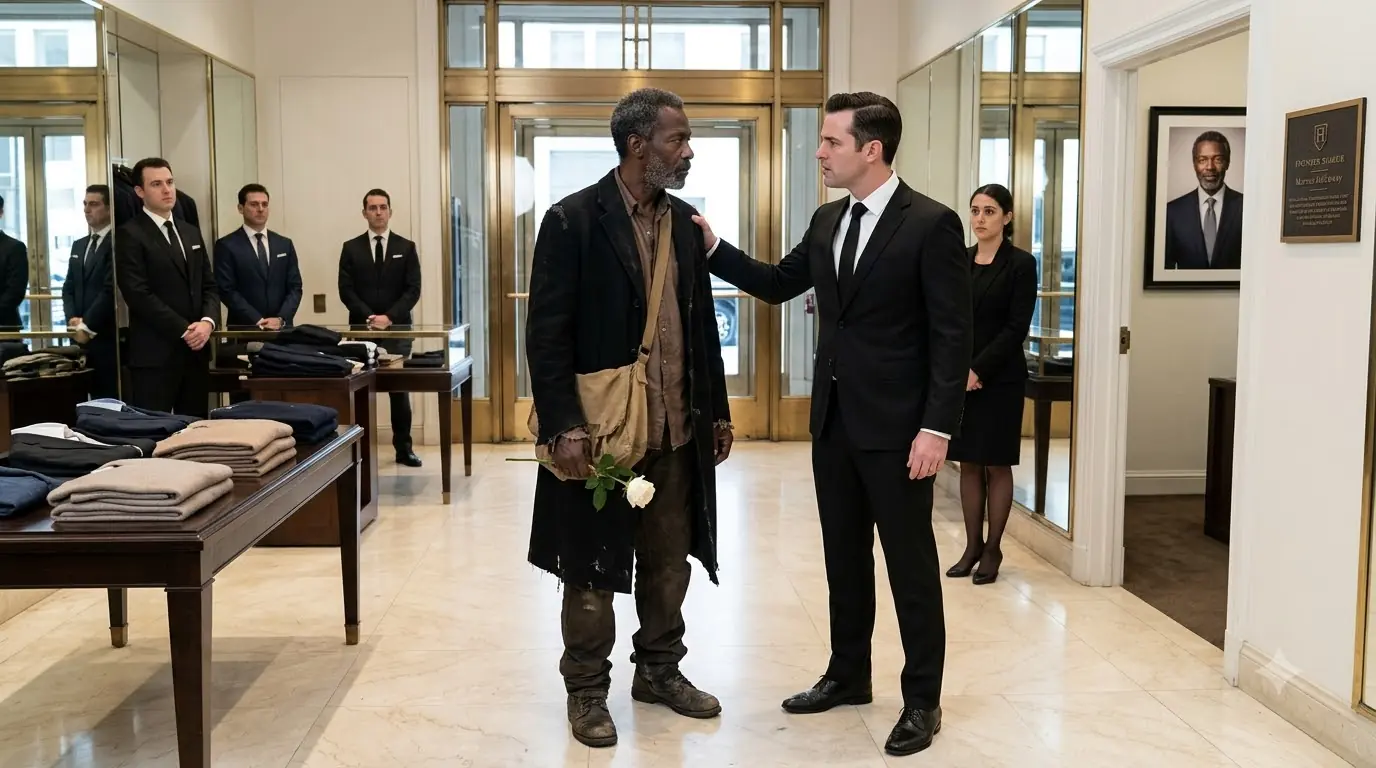
That was exactly what Marcus wanted.
His long black overcoat had once belonged to an actual customer of a homeless shelter supported by the Holloway Foundation. The coat was scheduled for disposal because the hem had split and both sleeves were badly worn, but Marcus asked to borrow it instead. He had added dusty trousers, old boots, a faded brown shirt, and a battered canvas crossbody bag that made his appearance complete without turning poverty into a costume designed for entertainment.
Marcus hated the word disguise.
He preferred test.
Three months earlier, his assistant had delivered a confidential report containing twenty-seven customer complaints from Harrington & Vale locations across New York, Boston, Chicago, and Los Angeles. Most were categorized as minor service concerns, but Marcus saw something repeating beneath the corporate language. Customers said they had been followed, ignored, redirected toward cheaper merchandise, asked whether they were “just browsing,” or told certain areas were appointment-only when no such policy existed.
The Fifth Avenue store appeared most often.
That bothered Marcus because Fifth Avenue was not simply another location.
It was the flagship.
The store occupying the cream limestone building had become the public face of Harrington & Vale, but Marcus still remembered when the company had no public face at all. Thirty-one years earlier, he and his wife Eleanor rented six hundred square feet in Harlem and sold custom men’s coats sewn by three tailors who accepted payment whenever Marcus could manage it.
They almost failed the first winter.
Then a lawyer bought a coat.
That lawyer told another lawyer.
Within five years, Harrington & Vale had three stores.
Within twelve, twelve.
Then womenswear.
Leather goods.
Cashmere.
Accessories.
International licensing.
And eventually Fifth Avenue.
Marcus had become extremely wealthy somewhere in the middle of that growth, although he could never identify the exact day his life changed from worrying about rent to worrying about capital allocation.
Eleanor noticed first.
“You’ve stopped looking at price tags,” she told him one evening.
Marcus disagreed.
She pointed toward the restaurant bill.
“You just ordered sparkling water for fourteen dollars without becoming angry.”
“That doesn’t mean anything.”
“It means money has damaged you.”
He laughed.
She was right.
Eleanor was usually right in ways Marcus found irritating until several years later.
She died of ovarian cancer four years before the morning Marcus stood across from the flagship carrying one white rose.
Every August, on the anniversary of their first store opening, he placed a white rose beneath her portrait in the executive suite. He normally arrived through the private entrance after employees had been notified. That year he decided not to.
The complaints changed his mind.
Marcus wanted to see the company before the company saw him.
He crossed Fifth Avenue.
The brass-and-glass entrance doors opened automatically.
Warm air reached him.
Then silence.
Not complete silence.
The store had soft instrumental music playing.
Customers spoke quietly.
Employees moved between displays.
But the social atmosphere changed the moment Marcus entered.
He felt it immediately.
Two sales associates looked toward him.
One looked away.
The other watched longer.
A security officer standing near the entrance touched the radio clipped beneath his jacket.
Marcus walked forward.
Nobody greeted him.
That was the first data point.
Harrington & Vale training required every entering customer to receive acknowledgment within fifteen seconds when staffing allowed.
Marcus knew because he approved the revised hospitality standards eighteen months earlier.
Twenty seconds passed.
Thirty.
A white couple entered behind him.
“Good morning. Welcome to Harrington & Vale.”
Marcus did not turn.
He simply kept walking.
One of Eleanor’s favorite sayings came back to him.
People reveal hierarchy most clearly when they believe nobody important is watching.
Marcus reached a display table covered with folded navy cashmere sweaters.
He touched one lightly.
The fabric was excellent.
At least product quality survived.
A young sales associate approached from his left.
She appeared to be in her mid-twenties, Asian American, dark hair tied neatly behind her head, black suit, white blouse, gold name badge.
LENA PARK.
“Good morning, sir.”
Marcus looked at her.
“Morning.”
“Is there anything I can help you find?”
Marcus noticed the security officer watching behind her.
“Maybe.”
Lena smiled.
“Take your time.”
She seemed nervous but polite.
Marcus appreciated that.
Then a man’s voice came from across the floor.
“Lena.”
She turned.
The man walking toward them moved with the fast, controlled irritation of someone interrupting a mistake.
Grant Keller.
Marcus recognized him from personnel files.
Thirty-nine.
Flagship general manager for fourteen months.
Before Harrington & Vale, Grant worked at two luxury European houses and a premium hotel group. His revenue performance was excellent, shrinkage had decreased eight percent under his leadership, and high-value client appointments had increased substantially.
His employee-retention numbers were terrible.
Marcus already knew that too.
Grant stopped beside Lena.
“I’ve got this.”
She hesitated.
“Mr. Keller, he was just—”
“I said I’ve got it.”
The smile disappeared from her face.
She stepped backward.
Marcus watched.
Grant looked him over.
Not subtly.
Shoes.
Trousers.
Coat.
Bag.
Rose.
Then face.
“What do you need?”
Marcus said:
“I’m looking around.”
Grant’s jaw tightened slightly.
“This is a private retail establishment.”
Marcus glanced around.
Customers stood openly browsing.
“So?”
“So we don’t permit solicitation.”
“I haven’t solicited anyone.”
“Loitering either.”
“I walked in thirty seconds ago.”
Grant glanced toward the entrance.
“Sir, there are shelters and public facilities several blocks downtown.”
Marcus stared at him.
The insult was wrapped carefully.
Not explicit.
Designed to sound helpful if repeated in a complaint.
Marcus asked:
“Did I ask for a shelter?”
Grant sighed.
“You know what I mean.”
“No.”
Marcus’s voice remained calm.
“Explain.”
Several employees were listening now.
Grant noticed.
His face hardened.
“We have paying customers here.”
Marcus looked toward the cashmere.
“So do you require payment before people enter?”
“That’s not what I said.”
“Then what are you saying?”
Grant stepped closer.
“You’re making customers uncomfortable.”
Marcus glanced around.
A woman twenty feet away had stopped examining a coat and was watching Grant instead.
Marcus looked back.
“Which customer complained?”
Grant said nothing.
Marcus waited.
Grant finally answered:
“I don’t need a complaint.”
“Then you are uncomfortable.”
Grant’s face reddened.
The distinction irritated him.
“Look, I’m trying to be respectful.”
Marcus almost smiled.
“Are you?”
Grant’s voice lowered.
“You need to leave.”
Marcus did not move.
“Why?”
“Because management is asking you to.”
“Based on what policy?”
Grant looked toward Lena.
She immediately lowered her eyes.
Marcus saw fear again.
Grant said:
“I don’t owe you a policy explanation.”
Marcus nodded slowly.
“Interesting.”
“What?”
“I founded a company once.”
Grant laughed.
That surprised Marcus.
Not because the statement was absurd given his clothing.
Because Grant seemed genuinely entertained.
“Did you?”
“Yes.”
“What company?”
Marcus looked around the room.
“Harrington & Vale.”
Silence.
Lena’s head came up.
Grant stared at Marcus.
Then laughed harder.
Two nearby employees exchanged looks.
Marcus remained expressionless.
Grant shook his head.
“Okay.”
Marcus waited.
“That was funny.”
“I wasn’t joking.”
Grant’s amusement disappeared.
“Enough.”
He stepped toward Marcus.
“You need to get out.”
Marcus lifted the white rose slightly.
“I have business upstairs.”
That changed Grant’s posture.
The executive level above the showroom required staff access.
“Absolutely not.”
“I’m expected.”
“By who?”
Marcus thought about the answer.
His wife, perhaps.
Memory.
Tradition.
The company.
Instead he said:
“Someone who has been waiting longer than you’ve worked here.”
Grant looked disgusted.
“Sir, stop.”
Marcus turned toward the staircase.
Grant grabbed his shoulder.
Hard.
Everything inside Marcus changed.
Not fear.
Stillness.
Grant did not know him.
Did not know his history.
Did not know Marcus boxed competitively in college or that even at sixty-two his instinct when physically grabbed was immediate and unpleasant.
Marcus ignored that instinct.
He looked down at Grant’s hand.
Then up.
“Remove it.”
Grant stared.
“Excuse me?”
“Your hand.”
Something in Marcus’s voice made Lena step forward involuntarily.
Grant removed his hand.
Marcus adjusted the worn coat.
“Never touch someone because you believe they cannot object.”
Grant laughed bitterly.
“You come into my store looking like this—”
Marcus’s eyes sharpened.
“Your store.”
“Yes.”
Second mistake.
Grant continued.
“And now you’re threatening me?”
“No.”
Marcus shook his head.
“I’m educating you.”
Grant stepped into his space.
“Get your filthy ass out before real customers start wondering why we let beggars wander through here.”
Silence fell across the nearest section.
Even Grant seemed to realize after saying it that the line could not be wrapped in corporate language later.
Marcus looked directly into his eyes.
“Interesting.”
Grant breathed heavily.
Marcus continued:
“Is humiliating people part of company policy?”
“No.”
“Or something you invented?”
Grant pointed toward the doors.
“You’ve got ten seconds.”
Marcus looked toward the private office behind the main counter.
The door stood open.
Inside, visible from his angle, hung a framed photograph.
Marcus.
Thirty years younger.
Black tuxedo.
Eleanor beside him in an ivory gown.
Opening night of the first Fifth Avenue flagship.
Grant did not notice Marcus looking.
Lena did.
Her eyes moved from the photograph.
To Marcus.
Back to the photograph.
Her face changed.
Marcus saw recognition arrive slowly.
Grant continued:
“Security!”
The officer approached.
Marcus looked toward Grant.
“Call everyone upstairs first.”
Grant frowned.
“What?”
“I want the entire management team here.”
Grant laughed.
“You want management?”
“Yes.”
“Fine.”
Grant spread his hands.
“I am management.”
Marcus looked toward the photograph again.
Then back.
“No.”
His voice became colder.
“You’re about to become a management problem.”
Lena stepped forward.
“Mr. Keller.”
Grant spun.
“What?”
She pointed uncertainly toward the office.
“Can I speak to you?”
“No.”
“I really think—”
“Not now.”
Marcus watched her.
Lena looked at him again.
Then said:
“Sir…”
Grant snapped:
“Lena!”
She stopped.
Marcus saw the same pattern he had read in employee exit interviews.
Challenge.
Correction.
Silence.
He filed it mentally.