The most dangerous document Laura Ashwell had ever held was not the letter from her husband's solicitor explaining the debts.
It was not the notice from the bank, or the inventory of assets that would need to be liquidated, or the list of creditors arranged in the order of their patience, which turned out to be shorter than anyone had represented.
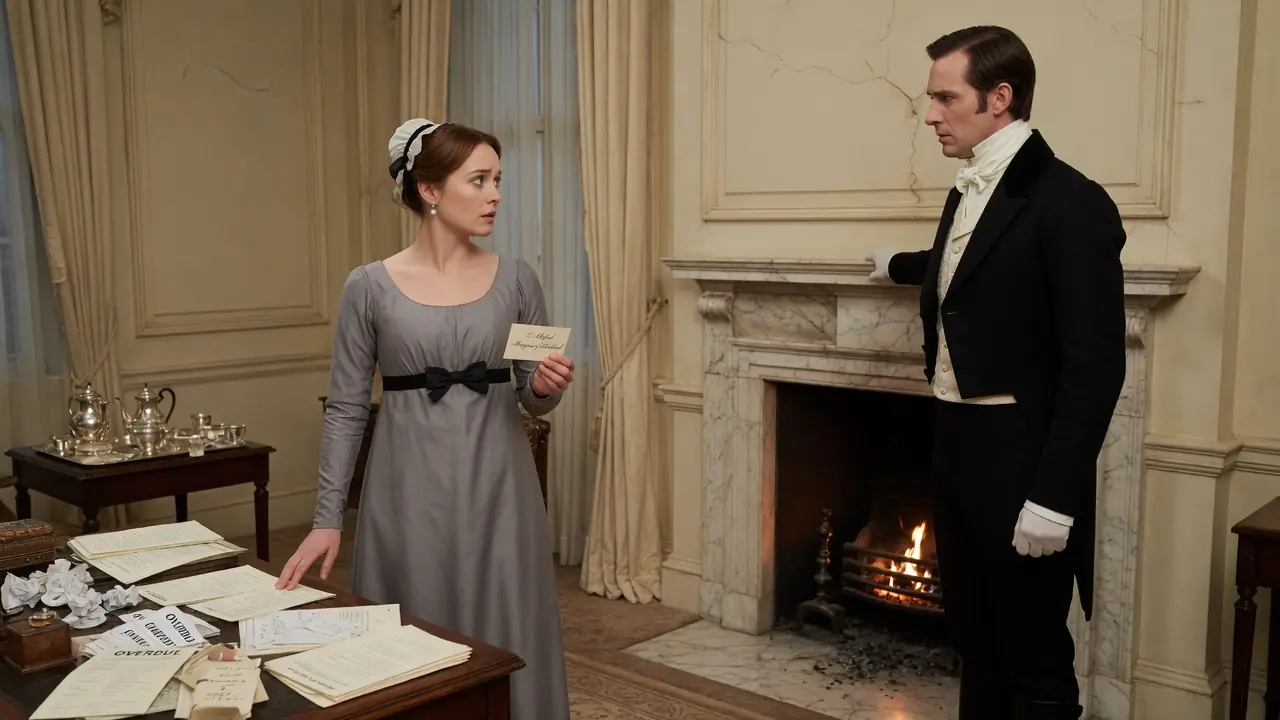
The most dangerous document was the one she was holding now, a single card, cream-colored, engraved with a name she recognized and a request written beneath it in a hand so precise it looked like a legal instrument.
I would like to speak with you about a matter of mutual benefit.
T. Ashford, Marquess of Blackwell.
She had been a widow for 4 months.
She had been nearly ruined for three.
She had been pretending with the focused energy of someone whose survival depends on the quality of their performance that neither of these things was true for all of them.
The card had arrived on a Tuesday morning while she was in the middle of calculating for the fourth time in a week whether the sale of the Hartfield silver could be managed quietly enough that it would not reach the ears of Lady Cavendish, whose ears were the primary receiving station for everything in London that anyone wished to keep private.
The calculation was not going well.
The silver was significant.
Significant things were noticed.
Noticed things were discussed.
Discussed things became, in the specific alchemy of London society, fact.
And fact, in Laura's current situation, was the one thing she could not afford.
She set the card down on the desk beside the silver inventory.
She picked it up again.
Thomas Ashford, Marquess of Blackwell, was not a man she knew well.
She knew him the way one knows all figures of sufficient prominence in London society, by reputation, by observation across drawing rooms, by the accumulated second-hand testimony of people who had encountered him and formed opinions.
The opinions were consistent.
He was intelligent, implacable, and possessed of a quality of attention that made people feel simultaneously seen and assessed.
He had no enemies that anyone mentioned, which she had always found more interesting than if he had had many, because the absence of declared enemies usually meant either that everyone liked you or that no one considered you safe to oppose.
She did not know which applied to Thomas Ashford.
She was not sure the distinction mattered.
She wrote back, "I am available Thursday at 3:00. Lady Ashwell."
She posted the letter before she could reconsider, which was, she had learned in 4 months of widowhood, the only reliable method for making decisions she was afraid of.
He arrived at 3:00 precisely, which told her something.
People who arrive precisely on time had decided that punctuality was a form of communication, not merely a social convention.
It said, "I take this seriously. I take you seriously. I have allocated exactly the time I said I would."
She received him in the drawing room, the one room in the Ashwell townhouse that she had maintained at full standard, because the drawing room was where visitors formed impressions, and impressions were currently the primary currency she had left.
The flowers were fresh.
The fire was adequate.
The silver tea service on the side table was the one piece she had specifically decided not to sell, because a drawing room without a proper tea service communicated something she was not prepared to communicate.
Thomas Ashford was tall.
She had known this from across drawing rooms, but had not fully accounted for what it meant in a normal-sized room.
He was perhaps 35, with the kind of face that had been handsome in its youth and had become, with age and whatever experiences had shaped it, something more interesting than handsome.
Angular, precise, with dark eyes that confirmed everything the second-hand testimony had suggested about the quality of his attention.
He bowed.
She inclined her head.
"Lord Blackwell," she said.
"Lady Ashwell," he said. "Thank you for receiving me."
"You indicated a matter of mutual benefit," she said. "I find I have a present interest in mutual benefit."
The corner of his mouth moved, a fractional shift that was not quite a smile and was more informative than a smile would have been.
"Yes," he said, "I was aware of that."
She gestured to the chair across from her.
He sat.
She poured tea with the composure of someone who has been doing this for 15 years, and whose hands have been steady through considerably worse than a conversation with a marquis.
"Then, I will not waste your time with preliminary courtesy," he said. "I will say what I have come to say, and you may respond as you see fit."
"Please," she said.
He looked at her steadily.
"I am aware of your current financial situation," he said. "Not in detail. I'm not in the habit of acquiring information about people's private affairs without cause, but in its general shape, which is visible to anyone paying attention, and I pay attention."
He paused.
"I am also aware that the situation is more urgent than you have allowed society to understand, and that the margin between your current position and a public collapse of your circumstances is considerably narrower than it appears."
She did not confirm or deny this.
She waited.
"I am in need of a wife," he said. "Not for the conventional reasons. My reasons are specific, and I will explain them if you decide to hear more. What I am proposing is a legal marriage, a genuine one, registered, acknowledged, conducted with full propriety, that would provide you with my name, my financial resources, and whatever protection my position affords, in exchange for your presence in my household, and your assistance with a specific situation that I am not yet able to fully describe."
The room was very quiet.
"So, you are proposing," Laura said, "that I marry you."
"Legally," he said. "Yes."
"You said that word specifically," she said. "Legally, as distinct from what?"
"As distinct from arrangements that appear to be marriages and are not," he said. "I want to be clear. I am proposing a real marriage, not a performance, not an agreement that can be dissolved when it becomes inconvenient. A marriage."
He paused.
"The emotional content of it is something I cannot promise and will not pretend to, but the legal and material substance of it I am prepared to commit to fully."
Laura set down her teacup with the careful precision of someone buying time to think.
She had been married once to Edward Ashwell in a ceremony that had been everything a marriage of her station was supposed to be.
The correct family, the correct settlement, the correct social acknowledgement.
Edward had been pleasant and unremarkable and genuinely kind, and she had been fond of him in the specific way of someone who has been given exactly what they were told to want and has accepted it without fully examining whether it was what they actually needed.
He had died 14 months ago of a fever, and the grief she had felt was real, and the financial disaster his death had revealed was also real.
The combination had produced a quality of attention to the actual mechanics of her situation that the previous years had not required.
She was 28 years old.
She was intelligent, capable, and almost ruined.
She was being offered a solution by a man she did not know, for reasons he had not yet explained, on terms that were simultaneously more honest and more alarming than anything she had expected when she wrote her reply on Tuesday.
"You said your reasons are specific," she said. "I would like to hear them."
He looked at her for a moment, the dark eyes doing their assessment.
"I have a ward," he said. "A girl of 12, my late cousin's daughter, who is in my care and has been for 3 years. She is intelligent and somewhat..."
He paused, selecting the word with care.
"Unconventional. The situation she is in requires a household that can present itself as stable and properly constituted to the relevant authorities, who are currently being pressed by another branch of the family to challenge my guardianship on the grounds that a single man's household is not a suitable environment for a girl of her age."
He looked at her steadily.
"A married household would resolve this challenge. My ward's stability and future are not negotiable. I will do what is required to secure them."
Laura looked at him.
"You are doing this for a 12-year-old girl," she said.
"Yes," he said.
"That is either the most selfless thing I have heard in some time," she said, "or the most effective possible way to make your proposal sympathetic."
"It is both," he said without any defensiveness. "I am not going to pretend I don't understand the effect of saying it, but it is also simply true."
She looked at him for a long moment.
"Tell me about the girl," she said.
Her name was Clara.
Thomas described her with the specific affectionate precision of someone who has spent 3 years paying close attention to a person and has arrived at a comprehensive understanding of them, their particular qualities, and their particular difficulties.
The things they needed and the things they refused.
The ways they were exceptional and the ways they were simply 12 years old and uncertain of their place in the world.
Clara was clever in the mathematical way, numbers and patterns and the particular logic of things that worked according to rules, which she found reassuring in a life that had, since her parents' deaths 3 years ago, contained a significant amount of the opposite.
She was also, Thomas said, entirely honest in a way that had caused several of his staff to find her simultaneously wonderful and exhausting, because Clara's assessment of any situation was accurate and unfiltered and delivered with the completeness of someone who had not yet learned that precision and tact were sometimes in tension.
"She sounds remarkable," Laura said.
"She is," Thomas said. "She is also currently being used as a piece in a legal dispute by people who do not particularly care about her welfare and care very much about the trust that was established in her parents' will."
He paused.
"I will not allow her to be moved to a household run by people who see her as an asset. I will not allow that."
The force of this, quiet, contained, entirely without performance, was the most informative thing he had said since he walked through the door.
Laura thought about Clara, who was 12 and mathematical and honest and living in the household of a man who had just described her to a stranger with more precise affection than most parents used to describe their own children.
She thought about what it would mean to be 12 and have your future decided by adults in drawing rooms who were conducting negotiations about you.
"I would like to meet her," Laura said.
Thomas was quiet for a moment.
"Before you decide?" he said.
"Yes," she said. "Before I decide."
He nodded.
"That is fair," he said, and meant it.
Clara Ashford was 12 years old, 4 feet 9 inches tall, and possessed of the specific quality of attention that Laura had previously encountered only in adults who had spent years developing it and in very young children who had not yet learned to look away from things.
In Clara, it appeared to be simply natural, an orientation toward the world that registered everything and concealed very little of what it registered.
She met Laura in the morning room of Blackwell House on a Saturday, in the presence of Thomas, who sat to one side in the particular posture of someone who is observing without directing.
Clara sat across from Laura with her hands in her lap and looked at her with the focused assessment of someone conducting a serious evaluation.
"You are the widow," Clara said.
"I am," Laura said.
"Thomas says you are intelligent," Clara said. "He does not say that about most people."
"That is a considerable recommendation," Laura said. "What does he say about most people?"
"He says they are adequate," Clara said, "or sufficient. Sometimes he says they are well-meaning, which is his least complimentary assessment because it implies that their intentions are better than their execution."
Laura glanced at Thomas, who had the expression of a man who has been accurately described and has decided that the accurate description is not something he is going to contest.
"What does he say about you?" Laura asked Clara.
"He says I am exceptional," Clara said without self-consciousness. "He also says I am occasionally exhausting, which I believe is accurate, and that my honesty would be more effective if I developed patience alongside it, which I am working on."
She paused.
"I am better at the honesty than the patience."
"Most people are," Laura said.
Clara looked at her steadily.
"Are you going to marry him?" she said.
"I am considering it," Laura said.
"Why are you considering it?" Clara said. "Not the reasons you would give socially. The real ones."
Laura looked at this 12-year-old girl who had asked with perfect precision exactly the question that needed asking and decided that the only appropriate response was the truth.
"Because I am in a difficult situation that this marriage would resolve," she said. "And because the terms your guardian has offered are honest ones, and because..."
She paused.
"Because I have met very few people who would do what he is doing for the reason he is doing it, and that tells me something about who he is that I find worth knowing more about."
Clara considered this with the focused attention she brought to everything.
"That is a good answer," she said. "It is honest and it does not pretend to more than it is."
She looked at Laura for another moment.
"I would like you to marry him," she said. "I think you are the kind of person who pays attention to what is actually happening rather than what is supposed to be happening. I find that useful."
Thomas, in his chair to the side, said nothing, but Laura, glancing at him, saw in his expression something she had not yet seen there.
A softening, fractional and brief, that was not sentiment exactly, but was what sentiment looks like in a person who has learned to keep it very controlled.
"I will consider it seriously," Laura told Clara. "That is the most honest thing I can offer you right now."
"It is enough," Clara said. "Serious consideration is more than most people give anything."
She agreed on Monday.
She sent a note to Blackwell House that was brief and direct in the manner she had decided was the correct register for all communication with Thomas Ashford.
I accept the terms as discussed. I would like to meet with your solicitor this week to understand the legal specifics.
L.A.
His reply arrived within the hour.
Thursday at 10:00. I will be present if you wish it or absent if you prefer to conduct the meeting without me.
T.A.
She wrote back, Present, please.
And then, because she had decided that honesty was going to be the only viable foundation for whatever this was, added, I find I make better decisions when I understand who I am dealing with, and I understand you better in person than through legal documents.
His reply to this was a single line.
As do I.
The solicitor meeting was on Thursday as arranged and lasted two hours, and covered the legal dimensions of the proposed marriage with a thoroughness that Laura appreciated because it left no room for misunderstanding.
Her debts would be absorbed by the Blackwell estate.
The Ashwell townhouse, which she had been intending to sell, would be retained as a property under the marriage settlement, secured against the possibility of future need.
She would have her own accounts managed independently with a quarterly settlement sufficient to maintain genuine financial autonomy.
The arrangement was not charity dressed as a contract.
It was a contract that happened to resolve her immediate crisis, which was precisely the distinction she had needed to have confirmed before she could agree to it in good conscience.
Thomas sat beside her through the meeting and said very little, because the solicitor was competent and the documents were clear and unnecessary speech was apparently not something he engaged in.
Occasionally he asked a question, sharp, specific, directed at a point she had not yet noticed needed addressing, and she observed the quality of his legal mind with the focused interest she brought to things that were genuinely impressive.
Afterward, when the solicitor had gone, they sat in the meeting room with the documents between them, and Thomas said, "Are you certain?"
"I am," she said. "Are you?"
"I decided before I sent the card," he said. "I do not make proposals I am uncertain about."
"Why me?" she said. "Specifically, there are other widows in London in difficult circumstances. Why Laura Ashwell?"
He was quiet for a moment.
That was not evasion, but genuine consideration.
"Because you responded to an unexpected proposal from a man you did not know by asking to meet the child at the center of it," he said, "before you asked about the financial terms, before you asked about the social implications."
He looked at her.
"Most people would have asked about the financial terms first."
"The financial terms were recoverable information," she said. "What kind of person you were was not recoverable from a document."
"No," he said. "It is not."
They looked at each other across the solicitor's table with the marriage documents between them and a great deal of unknown territory ahead, and Laura thought, "I do not know this man. I am going to marry him anyway, and I find against all reasonable expectation that this does not feel like a mistake."
She was not yet ready to say that aloud, but she held it privately as a piece of information worth keeping.
They were married on a Wednesday in March in a ceremony that was designed to communicate exactly what they needed it to communicate.
Legal, genuine, appropriate in every social dimension, and conducted with the quiet efficiency of people who have agreed on what the occasion requires and are not inclined to perform more than is necessary.
Laura wore gray, a deliberate choice that positioned her correctly as a widow not yet out of half mourning, which was both socially accurate and useful because it communicated a seriousness of purpose that the occasion required.
Thomas wore what Thomas always wore, which was clothing of extreme quality and absolute correctness that managed to look like it had been put on without consideration, which she was beginning to understand was a carefully maintained effect.
Clara attended in a dress that Mrs. Whitfield, the housekeeper, had clearly spent considerable effort on, and which Clara had clearly spent considerable effort not thinking about because clothes were not among the things Clara considered worth her attention.
She stood beside Thomas during the ceremony with the focused composure of someone who understands the significance of what they are witnessing and is taking it seriously.
When the ceremony concluded and they were legally and properly the Marquess and Marchioness of Blackwell, Clara looked at Laura with the direct assessment she brought to all significant evaluations.
"It is done," Clara said.
"It is," Laura agreed.
"Are you frightened?" Clara said.
Laura considered this honestly.
"A little," she said. "Are you?"
Clara thought about it.
"I am uncertain," she said, "which is different from frightened. Frightened is when the outcome is likely to be bad. Uncertain is when you don't know yet what the outcome will be."
She paused.
"I prefer uncertain to frightened."
"So do I," Laura said.
Thomas, who had been within earshot of this exchange, said nothing.
But when he offered Laura his arm to walk from the church, the gesture had the quality of something deliberate, not performed but chosen.
She took his arm.
They walked out into the March light.
Blackwell House was larger than she had expected and considerably more inhabited than its reputation as the residence of a cold and implacable marquess had led her to anticipate.
The coldness she discovered in her first week was a description generated by people who had encountered Thomas Ashford in social or professional contexts where he had no reason to be warm and who had interpreted the absence of performed warmth as the absence of warmth itself.
What she found in a household that contained Clara and a staff of 20 and a library that occupied most of the east wing was something considerably more complex.
Mrs. Whitfield, the housekeeper, had been with the household for 18 years and ran it with the affectionate precision of someone who considers the people in her care a genuine responsibility rather than a professional obligation.
The cook produced food of a standard that suggested someone in this household cared about it, not the elaborate production of a house that entertained for social display, but the daily quality of a house where meals were taken seriously because the people who ate them were taken seriously.
And Clara, Clara Laura discovered over the first 2 weeks, was the organizing principle of Blackwell House in a way that Thomas had perhaps not fully articulated and possibly did not fully recognize.
The household's routines, she observed, had arranged themselves around Clara's requirements, her study hours, her particular need for quiet in the mornings and permission for noise in the afternoons, the specific quality of attention she required when she was working through a problem, and the different quality of attention she required when she was not.
Thomas had built, without apparent awareness that he was doing so, a household designed to allow one 12-year-old girl to become fully herself.
Laura found this, as she found most things about Thomas Ashford, considerably more than she had been prepared for.
The challenge to Thomas's guardianship was filed in April, 6 weeks into the marriage, by a man named Robert Ashford, a cousin twice removed who had, by all accounts, never shown particular interest in Clara's welfare and had shown a great deal of interest in the trust established by her parents' will.
Thomas told Laura about it on a Tuesday evening in the library with the direct economy he brought to all significant information.
He explained the legal situation, the nature of the challenge, the timeline, and what it would require from both of them in terms of demonstrating the stability and propriety of their household.
He was, she noted, entirely calm.
"You expected this," she said.
"I expected something like it," he said. "The timing is slightly earlier than I anticipated. The grounds are the ones I predicted."
"You planned for it," she said. "The marriage, it was not reactive. You saw this coming and you prepared."
"Yes," he said.
"How long ago?" she said.
"Eight months," he said. "When Robert Ashford's solicitor made the first informal inquiry, I began at that point to consider what resources I had available and what I would need."
He paused.
"I want to be clear. I chose you for reasons I described honestly, but I chose you when I did because the timeline was becoming urgent."
Laura absorbed this.
"Eight months ago," she said, "you began planning a marriage to resolve a legal challenge, and you selected me on the basis of what, exactly? A widow in financial difficulty seemed convenient?"
"A widow who in the four months since her husband's death had managed her situation with a precision and composure that told me she was someone capable of exactly what this arrangement would require," he said. "And who had done this without apparent self-pity or the kind of public collapse that would have made her unsuitable."
He held her gaze.
"I observed you for two months before I sent the card. I was not selecting a convenient solution. I was identifying the right person."
The silence that followed was a particular kind.
The silence of someone receiving information that is both more and less reassuring than they expected.
"You watched me for two months," she said.
"I paid attention to what was publicly observable," he said. "Your conduct, your decisions, the quality of your management of an impossible situation. I did not intrude on anything private."
"And what did you conclude?"
"That you were the most capable person I had encountered in the relevant context," he said, "and that the arrangement I was proposing would not break you."
This last phrase landed with a weight she had not anticipated.
"So that was your criterion?" she said. "That I would not break?"
"It was one of them," he said. "The others were more specific."
He looked at her directly.
"I concluded that you were someone who would understand what the arrangement required without needing it explained in ways that simplified its complexity. I concluded that you would be honest with me, and I concluded..."
He stopped.
"What?" she said.
"That you were the kind of person who asks to meet the child before asking about the financial terms," he said, "and that this, more than anything else, was the quality I needed."
Laura was quiet for a long moment.
"You could have told me this from the beginning," she said.
"I could have," he said. "I chose not to because I was not certain how it would be received. The complete picture, that I had been watching you, that the timing was deliberate, that the challenge was already in progress, might have made the proposal appear more calculated than it was."
"It was calculated," she said.
"The execution was calculated," he said. "The reasons were not, or not entirely."
He paused.
"I find I am not entirely certain anymore where the calculation ends."
She looked at him, the dark eyes that were conducting their usual assessment, but with something different in them now.
Something that had not been there in the solicitor's office or the drawing room conversations or the evenings in the library.
Something that looked, if she was reading it correctly, like a man who has made a plan and is discovering that the plan has developed dimensions he did not include in his calculations.
"Tell me about the challenge," she said. "Everything. What Robert Ashford is claiming and what he actually wants and what we need to demonstrate and by what date."
He told her.
She listened with the full analytical attention she brought to financial documents, asking questions at the precise points where the picture required clarification, building a complete understanding of the situation from the legal framework outward.
When he finished, she set down her teacup, which had gone cold because 2 hours had passed, and said, "The household visit is the critical point. The examiner's assessment of whether this is a stable and appropriately constituted environment for Clara will carry more weight than the legal arguments on either side."
"Yes," he said.
"Then we need to prepare for it as we would prepare for any significant presentation," she said. "Not a performance, an accurate and complete account of what this household actually is, presented in the way that is most legible to the examiner's criteria."
She looked at him.
"What are the examiner's criteria?"
"Stability," he said. "Evidence of consistent care, appropriate female influence in the household, Clara's demonstrated well-being."
"Clara's well-being will speak for itself," Laura said. "She is the most clearly well-tended child I've encountered in a long time, and anyone with eyes will see it."
She paused.
"The female influence is why you needed the marriage."
"Yes," he said.
"Then I need to understand this household thoroughly before the visit," she said. "Not to perform understanding, to actually have it. What Clara's days look like, what she cares about, what she is working toward, what the staff's relationship with her is, what the house's routines are, and why they are what they are."
She held his gaze.
"I have been here 6 weeks. I know the surface. I need to know the substance."
Thomas looked at her for a long moment.
"How long do you need?" he said.
"3 weeks," she said. "If you give me access to everything."
"You have access to everything," he said.
And the way he said it, simply, without qualification, communicated something beyond the legal dimensions of a wife's access to a marital household.
She understood it as something more than that, and she held it, as she had held other things, privately, as a piece of information worth keeping.
The 3 weeks before the household examination were the most instructive of Laura's life, and she had had an education that most women of her station would have considered thorough.
She learned the household by living in it fully, not as a guest or a new arrival, managing her presence in someone else's space, but as someone who had decided that full engagement was the only appropriate response to the situation.
She spent mornings with Mrs. Whitfield, understanding the domestic architecture that supported the house's daily operation.
She spent afternoons with Clara, studying with her, walking with her, sitting in the same room while Clara worked through mathematical problems with the focused silence of someone engaged in serious labor, and Laura read or corresponded or managed the estate papers that Thomas had, without fanfare, begun including in her daily work as a matter of course.
Clara taught her things she had not expected to be taught.
"You are trying to understand the household," Clara said one afternoon, without looking up from the proof she was working through, "to document it for the examiner."
"Yes," Laura said.
"You should know that what I care about most is not the house," Clara said. "It is Thomas."
Laura set down her pen.
"Tell me," she said.
Clara looked up.
"When my parents died," she said, "I was sent to three different households before Thomas. Each one was adequate. Each one managed the requirements of my care correctly. None of them..."
She paused with the particular precision of someone selecting the right words for something important.
"None of them knew me. Thomas knows me."
She looked at Laura steadily.
"He learned me. He paid attention to what I actually was, rather than what a 12-year-old girl was supposed to be. He adjusted the household to fit me, rather than adjusting me to fit the household."
She paused.
"That is unusual. I want the examiner to understand that."
"How do I help them understand it?" Laura said.
"By knowing me, too," Clara said. "So that when you speak about this household, you speak about what is actually here, not what a well-constituted household is supposed to contain, but what this specific household contains."
She returned to her proof.
"You are already doing that. I have been observing."
Laura looked at this 12-year-old girl who had been assessed and moved and managed by adults for 3 years and had arrived, through the specific grace of one man's attention, at a place where she could say, "Thomas knows me," with the matter-of-fact confidence of someone whose most fundamental need has been met.
"He is a better guardian than he knows," Laura said.
"He knows," Clara said. "He simply does not say it because he does not consider it a thing requiring acknowledgement. It is simply what he does."
She paused.
"You are similar in that respect. You do not explain yourself. You simply act."
"Is that a criticism?" Laura said.
"It is an observation," Clara said. "I find it efficient."
She and Thomas had a conversation in the library on the Thursday of the second week that was not, strictly speaking, about the household examination at all.
It began as a conversation about the legal strategy, which expert testimony would be most useful, which aspects of the household record should be emphasized, and became something else in the way that conversations between people who have been living in close proximity for 6 weeks sometimes become something else.
Gradually, without a clear point of departure, arriving somewhere neither of them had planned to go.
"Clara told me something," Laura said, "about the households before yours."
"Three of them," he said, "in 8 months."
"She said none of them knew her."
"No," he said. "They were adequate. They followed the requirements. They did not..."
"Pay attention," Laura said.
"Yes," he said.
"Why did you?" she said. "You could have been adequate. Most people would have been adequate and considered it sufficient."
He was quiet for a moment.
That was not evasion.
"My father," he said, "was a man who provided adequately for his household in every material respect and was entirely absent from it in every other. I grew up in a house where the requirements were met and nothing else was. I understand from the inside what a child in that situation feels and what it costs."
He paused.
"I was not going to do that to Clara."
Laura absorbed this.
"The coldness," she said, "that the reputation describes."
"I am not warm with people I do not know," he said. "I have not found performed warmth useful and I do not engage in it. People interpret the absence of performance as coldness."
He paused.
"With Clara, I am not cold."
"With Clara, you are entirely yourself," Laura said.
He looked at her.
"Yes."
"I have noticed," she said, "that you are increasingly yourself with me."
The silence that followed this was the kind that a person produces when they have heard something precise and true and are deciding what to do with it.
"I find," he said carefully, "that I have less inclination to maintain a useful distance in this marriage than I anticipated."
"Is that a problem?" she said.
"It was not in the original terms," he said. "The original terms specified legal and material commitment. They did not specify..."
He stopped.
"What?" she said.
"This," he said, which was not specific and was also, she understood, the most specific thing he could say.
She looked at him across the library table, the angular face and the dark eyes, and the man who had built a household around a 12-year-old girl's need to be known, who had watched a widow manage her impossible situation for 2 months before sending a card, who had said, "I find I am not certain anymore where the calculation ends," and had not retreated from the admission.
"The terms," she said, "can be renegotiated."
He was very still.
"Can they?" he said.
"They are our terms," she said. "We made them. We can add to them if both parties agree."
She held his gaze.
"I am telling you that I would agree."
The fire did what fires do.
Outside, the April evening was making its seasonal adjustments, the particular quality of spring light that changes the atmosphere of a room in ways that are difficult to describe but impossible to miss.
"Laura," he said, her name without the title, for the first time.
"Thomas," she said.
The household examiner arrived on a Thursday morning in May, a man of 50 named Mr. Caldwell, with the careful neutrality of someone who has conducted many such assessments and has learned not to form impressions before the evidence is complete.
Laura received him in the drawing room, which she had prepared not as a performance, but as an accurate presentation of what the room actually was, lived in, maintained, and inhabited by people who used it rather than preserved it.
The flowers were from the garden, arranged by Clara, who had decided 2 days ago that the drawing room flowers were her responsibility and had discharged this responsibility with the focused attention she brought to things she considered worth doing.
Thomas was present, as he had always been present for significant occasions, directly, without performance, contributing exactly what was required and not more.
Mr. Caldwell conducted his assessment with the methodical thoroughness of someone who has a list of criteria and is working through it honestly.
He observed the household's physical environment, spoke with Mrs. Whitfield and two other members of the staff who had been with the household for more than 5 years, reviewed the records of Clara's education and health and daily life that Laura had compiled with the analytical precision she brought to all documents, and then he spoke with Clara.
Laura was not present for this conversation by Clara's request.
"I would prefer to speak with him alone because I speak more accurately when I am not managing anyone else's reaction."
And she sat in the adjacent room with Thomas and waited.
Thomas was very still.
"She will be honest," Laura said.
"I know," he said. "That is what I am relying on."
"Her honesty is the most compelling argument available," Laura said. "Anyone who speaks with Clara for 20 minutes understands exactly what this household has given her. There is no performance there to deconstruct. It is simply the truth."
He looked at her sideways.
"You have learned her," he said.
"I paid attention," she said. "I had a good example."
The corner of his mouth moved, not quite a smile, more than the fractional shift she had first observed in her drawing room four months ago, something fuller, something that reached his eyes.
The conversation with Clara lasted 40 minutes.
When Mr. Caldwell emerged, his expression had the particular quality of a man who has heard something that has settled his assessment beyond further deliberation.
"She is," he said to no one in particular, "a remarkable child."
"Yes," Thomas said, "she is."
Mr. Caldwell looked at him, then at Laura, then back at the notes in his hand with the expression of someone who has already reached his conclusion and is confirming the paperwork.
"I will file my report by the end of the week," he said. "I do not anticipate it will present any difficulty for the current guardianship arrangements."
He left.
Thomas stood in the entrance hall for a moment after the door closed, very still, the particular stillness of someone who has been holding something tightly for a long time and is carefully releasing it.
Laura stood beside him.
Clara appeared at the top of the stairs.
"Well?" she said, with the direct expectation of someone who has done their part and wants the results.
"Well," Thomas said, and his voice, saying that single word, had in it something she had not heard there before.
A warmth that was not performed and was not contained, simply present.
Clara looked at him for a moment with her clear assessing eyes.
Then she came down the stairs and hugged him briefly with the matter-of-fact efficiency of someone who has decided that the occasion requires physical expression and is providing it.
Then she stepped back and looked at Laura.
"Thank you," she said, "for learning me."
Laura felt something she had not felt in four months of managing an impossible situation with focused composure, the specific, unguarded warmth of someone who has been seen by someone they have also been seeing.
"Thank you for letting me," she said.
Robert Ashford's challenge was dismissed in June.
The examiner's report was, as Mr. Caldwell had indicated, unambiguous in its findings, and the legal process concluded with the efficiency of a case that had been decided by the evidence rather than the arguments.
Thomas told Laura over breakfast with the same quiet directness he had used to tell her everything else significant.
He read her the relevant paragraph from his solicitor's letter.
He set the letter down.
"It is done," he said.
"Yes," she said.
Clara, who had been informed the previous evening, had apparently processed the information overnight and arrived at breakfast in a state of settled completion.
Not relief, exactly, because relief implies that the outcome had been uncertain, and Clara had apparently decided somewhere around the time of Mr. Caldwell's visit that it was not going to be uncertain.
"I knew," she said when asked how she felt.
"You knew the outcome before the examination?" Thomas said.
"I knew the outcome when Laura agreed to marry you," Clara said. "The examination was a formality."
She returned to her toast.
"I pay attention."
Thomas looked at her, then at Laura, then at his solicitor's letter, then very briefly at the ceiling with the expression of a man who has been accurately described by a 12-year-old and is simultaneously exasperated and entirely charmed.
Laura pressed her lips together to contain something.
"You are both," Thomas said, "entirely too perceptive for comfortable living."
"You selected us both," Clara said serenely. "This is a consequence of your own judgment."
The summer brought changes that were not dramatic.
Nothing about Thomas Ashford operated dramatically, but that accumulated with the steady logic of things that have been building since the right conditions were established and are now simply becoming what they were always going to become.
The household that had been constituted for legal purposes became, in the way of all genuine things, something else.
A place where three specific people had found a specific configuration that worked for all of them, that produced daily life of a quality that none of them had fully expected and all of them had, in their different ways, needed.
Laura managed the household with the precision she brought to all organizational challenges and the growing understanding of it that living in it fully had given her.
She managed it the way she managed everything.
Not by imposing a system, but by understanding what was already there and making it more of itself.
Mrs. Whitfield, who had been running the household for 18 years and had not expected to find in the new marchioness anything other than an additional management challenge, revised this assessment within a month and told the cook that Lady Blackwell had the most useful quality a mistress could have.
She asked questions before she made changes.
Thomas managed the estate and his parliamentary business and his legal affairs with the focused efficiency she had observed from the beginning.
But she noticed, she always noticed, that the managing had a different quality now.
Less of the particular containment she had identified in their first weeks.
Less the impression of a man who had arranged everything to require as little from him personally as possible.
More presence, more engagement with the household rather than alongside it.
Clara noticed too.
"He laughs more," Clara said one afternoon, without particular emphasis, as if this were a meteorological observation.
"Does he?" Laura said.
"Since you came," Clara said. "He laughed before, but it was careful, like he was allocating a specific quantity."
She paused.
"Now it is less allocated."
Laura looked at the proof Clara was working through, which appeared to involve a level of mathematical reasoning she was not going to pretend to follow.
"Is that good?" she said.
Clara looked at her with the clear amber assessment that had not changed since the first Saturday in the morning room.
"It is excellent," Clara said. "He deserves to laugh without calculation."
It was August when Thomas told her about his father, not as a confession or a revelation, simply as a thing he had been carrying for long enough that it had become ordinary weight and that he had decided, in the specific way he made decisions, to set down.
They were in the garden in the evening, in the particular quality of August light that makes English gardens look like something from a more idealized world.
He told her about a man who had been present in the household in the way that furniture is present, occupying space, fulfilling function, not engaged.
A man who had managed his title and his estate and his social obligations with efficiency and had managed his relationships with his wife and his son with the same disengaged competence, as if they were also obligations requiring management rather than people requiring actual engagement.
"I understood very young," Thomas said, "that the performance of the role was what was required of me. The actual content of the role, what I thought, what I felt, what I wanted, was secondary to the maintenance of the performance."
He looked at the garden.
"I became very good at the performance. I became, over time, uncertain about what was underneath it."
"And now?" Laura said.
"Now," he said, "I find the performance increasingly unnecessary."
He looked at her.
"In this household, with you and with Clara."
He paused.
"I find I do not want to perform. I find I want..."
He stopped.
"What?" she said, with the same question she had asked him in the library in April, in a conversation that had arrived somewhere neither of them had planned.
"This," he said. "What is actually here. What is..."
It was not, she acknowledged privately, the most elaborate declaration she had ever imagined receiving.
It contained no particular poetry.
It did not promise things that could not be delivered.
It was simply and entirely honest, and she had been in London long enough and married long enough and had difficult enough months to understand that honesty in the particular form that Thomas Ashford practiced it was rarer and more valuable than any elaboration.
"Thomas," she said.
"Laura," he said.
"I came to this marriage," she said, "as a transaction, a solution to an impossible situation. I was clear-eyed about what it was, and I did not allow myself to expect more than the terms specified."
She looked at him steadily.
"I find that the terms as I originally understood them are no longer an accurate description of what this marriage is."
"No," he said, "they are not."
"What is it?" she said. "In your assessment? What is this?"
He was quiet for a moment.
Not the evasive quiet of someone avoiding the question, but the honest quiet of someone who has arrived at a conclusion and is certain of it and is choosing words that are equal to the conclusion.
"It is the best decision I have made in 35 years," he said, "including the ones I made deliberately and especially the one I made by sending a card to a widow in a difficult situation and discovering that she was the kind of person who asks to meet the child first."
He held her gaze.
"It is also..."
He paused.
"I believe it is love. I am not a person who has had reliable access to that word, but I believe that is what this is."
The garden was very quiet.
Laura looked at him, at the angular face and the dark eyes that were for the first time in her observation of them conducting an inventory that was entirely personal rather than analytical, and felt something she had not felt in a very long time and had not expected to feel in a marriage arranged in a drawing room over tea and a cream-colored card.
"I believe it is love," she said, "also in my assessment."
He reached for her hand, the same deliberate chosen gesture with which he had offered her his arm at the church in March, the gesture that communicated intention rather than performance.
She took his hand.
In the house behind them, through the library window, a light was burning where Clara was working on a problem she had described at dinner as possibly the most interesting thing she had encountered in 3 weeks, which was saying something because Clara encountered interesting things frequently.
"She will want a full account," Laura said.
"She already knows," Thomas said. "She told me in June that it was inevitable and that I was taking longer than necessary to arrive at the obvious conclusion."
"What did you say?" Laura said.
"I said I was being thorough," he said.
"And what did she say?"
"She said that thoroughness and cowardice were sometimes difficult to distinguish from the outside."
He paused.
"She was accurate."
Laura laughed fully without any management, and Thomas beside her made the sound she had first heard in her drawing room in January and had been, in the months since, collecting with the particular attention of someone who understands the value of rare things.
He laughed too, actually and without allocation.
In the library, Clara looked up from her proof toward the garden window and allowed herself a small satisfied expression that she would not have deployed in front of either of them because it was, she acknowledged, a little smug.
She was 12 years old and mathematical and honest, and she had known since January.
A year after a cream-colored card arrived on a Tuesday morning while a widow was calculating whether the sale of silver could be managed quietly, Laura Ashwell Ashford, Marchioness of Blackwell, sat in the library of Blackwell House on a September evening and conducted an inventory of her own.
She had acquired the habit from Thomas.
The systematic, honest assessment of what was actually present rather than what was supposed to be.
She applied it to financial matters and household logistics and social situations with the precision he had deployed it before her.
She was applying it now to the contents of her life.
Present, a house that had become her house in the genuine sense, not the house she had been placed in, but the house she understood and contributed to and had shaped in the particular way of someone who brings themselves fully to a space and finds it changed by the bringing.
Present, Clara, who was 13 now and had advanced her mathematical work to a level that had prompted Thomas to arrange a correspondence with a professor at Cambridge, who after three exchanges had written back saying he had not encountered this quality of mathematical reasoning in a student of any age and would like to continue the correspondence indefinitely.
Clara had received this information with the composure of someone who had considered it possible and was pleased to have it confirmed, and had then asked Laura to help her compose a reply that was appropriately professional without being either falsely modest or accurately immodest, which was a more complex stylistic challenge than it appeared.
Present, Thomas, who was in the room reading in the chair that was his chair in the library that was their library, and who had been present in the full sense of the word for a year now in a way that the man she had met in January had perhaps not yet been, and that the man in front of her had become so completely that she sometimes forgot it had been otherwise.
And present, the specific quality of daily life that results when two people who are both fundamentally honest and fundamentally capable decide to apply those qualities to each other and to the life they are building together.
The quality that cannot be negotiated into a contract or secured by legal instrument or produced by any arrangement, however well constructed, but that grows steadily and on its own terms when the conditions are right.
Thomas looked up from his book.
"You are thinking," he said.
"I am conducting an inventory," she said.
"Of what?"
"Of what is actually here," she said, "as opposed to what was in the original terms."
He set his book down.
The dark eyes doing their assessment, arriving somewhere that was entirely familiar to her now.
"What does the inventory find?" he said.
She looked at him, at the man who had sent a card and explained his terms with complete honesty, and built a household around a child's need to be known, and said, "I believe it is love," in a garden in August with the careful precision of someone who does not say things they are not certain of.
"Considerably more than was specified," she said, "and considerably better."
He smiled, the full smile, the one that had taken months to appear and that had become, in her private accounting, one of the most significant things she had.
"The inventory concurs," he said.
Outside, the September evening was doing what September evenings do, making the light golden and the air clear and the general quality of being alive in a specific place at a specific time feel like something worth noting.
Clara, who had gone to bed an hour ago in the theoretical sense of the word, was almost certainly still reading because Clara considered the designation bedtime a suggestion rather than an instruction when she was in the middle of something interesting.
Laura and Thomas were in the library, in their chairs, in their house, with a life that had begun as a transaction and had become, through the specific alchemy of two honest people paying genuine attention to each other and to the child who had been waiting for both of them, something that neither of them would have thought to plan and both of them would have been impoverished without.
The card that had started it was in the desk drawer in Thomas's study.
Laura had found it there in March and had not commented on it because some things are said clearly enough by the fact of their preservation.
It said, "I would like to speak with you about a matter of mutual benefit."
It had been, in the end, considerably more mutual and considerably more beneficial than either party had anticipated, which was, when she thought about it, the best possible outcome for any arrangement entered into honestly and carried out with genuine attention to what was actually there.
Which was, in Thomas Ashford's experience and in Laura Ashwell's experience and in Clara's 12-year-old mathematical certainty, exactly what had happened.
She came to him as a solution and became the answer to a question he had not known he was asking.
He came to her as a contract and became the safest thing she had ever been given.
And the girl who had been waiting to be known by someone watched both of them arrive at what she had already calculated and found the result entirely consistent with her working.
Some arrangements begin in necessity and end in grace.
Some contracts entered into honestly turn out to contain considerably more than their terms specify.
And some cream-colored cards sent on a Tuesday morning to a widow calculating the value of silver turn out to be the most important correspondence either person ever received.
Pay attention.
The mutual benefit is frequently larger than it first appears.
Author's note: What Clara knew.
There is a postscript to this story that belongs to Clara.
Three years after the household examination, when Clara was 15 and her mathematical correspondence with the Cambridge professor had produced a paper that he had submitted, with her permission and with full credit to her, to a journal of mathematical science, the first paper published under a female name in that journal's 40-year history, she was asked by a journalist who had heard about it and wanted to write something what had made it possible.
She thought about it with the honest attention she brought to all significant questions.
"I had a guardian who knew me," she said, "and then a guardian who learned me. And when you are known, genuinely known, not managed or administered, but actually seen, you can become what you actually are because there is someone to see it."
The journalist wrote this down.
"And what are you?" he asked.
Clara looked at him with the clear amber eyes that had been assessing the world accurately since before anyone had given her sufficient credit for it.
"A mathematician," she said. "Apparently."
She went home and told Thomas and Laura what she had said because she told them everything significant and had since she was 12 and intended to continue.
Thomas said that was exactly right.
Laura said, "We are very proud of you."
Clara said, "I know. That is one of the things that made it possible."
She went to her study to work on the next problem.
Thomas and Laura sat in the library, in their chairs, in the evening quiet, and did not need to say anything at all because some things are communicated entirely by the fact of being present together in the same warm room on the right side of every decision that had brought them there.
The cream-colored card was still in the desk drawer.
The mutual benefit had turned out to be, as Laura had concluded in her September inventory, considerably larger than it first appeared, which was, she had decided, the most reliable thing she knew about honest arrangements entered into by people who were paying genuine attention, which was everything.