After defeating some of California’s most experienced mechanics, the forty-year-old Harley-Davidson FXR seemed completely beyond saving.
Grown men became uneasy when Jim Mercer, a feared motorcycle-club enforcer, arrived demanding that the machine be repaired.
Then, breaking the tense silence, a scrawny eight-year-old boy emerged from the shadows of the garage.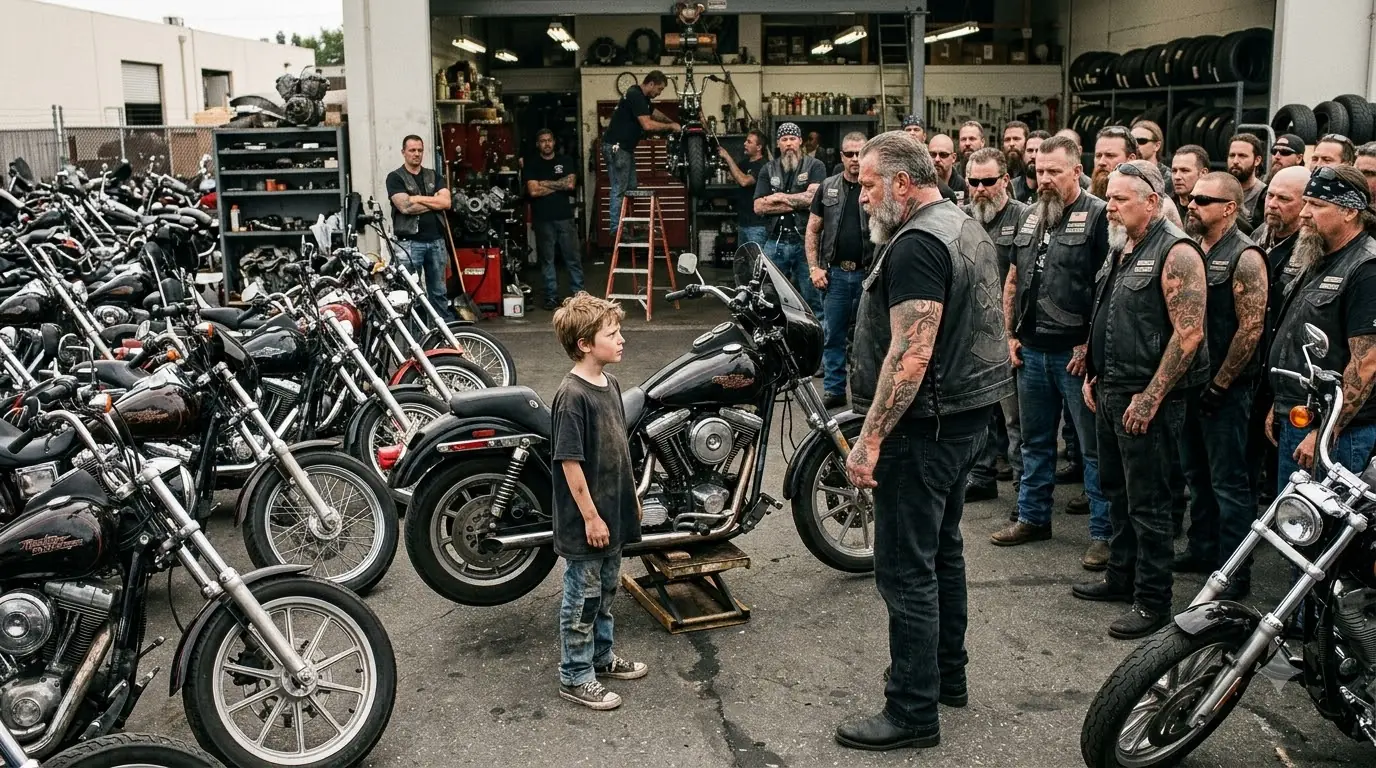
“I will fix it,” he said.
The midday sun beat mercilessly against the cracked asphalt of Oakland, California.
Heat waves rising from the pavement made the approaching motorcycles resemble phantoms emerging from the earth, but the deep rumble of their unbaffled V-twin engines confirmed that they were very real.
It was Tuesday afternoon, and the local chapter of the Hells Angels Motorcycle Club was descending upon Apex Iron Works, the most respected custom-motorcycle garage in the Bay Area.
At the front of the procession rode Jim Mercer, a mountain of a man with a beard the color of steel wool.
Jim was a veteran enforcer for the club.
His weathered leather vest carried the club’s familiar winged-skull patch and an insignia representing decades of unwavering loyalty and a life lived entirely on his own terms.
That day, however, Jim was not looking for a confrontation.
He was looking for a miracle.
Behind him, secured to the bed of a heavy-duty flatbed truck, was the reason for the intimidating procession.
It was a 1986 Harley-Davidson FXR.
To the untrained eye, it appeared to be nothing more than an old, damaged motorcycle with chipped black paint and rusted chrome.
To the men wearing the winged skull, the machine was a sacred relic.
It had belonged to Dutch Sullivan, the club’s legendary former chapter president, who had died three months earlier.
The club was organizing a massive memorial run, a procession of nearly one thousand motorcycles traveling down the California coast to honor Dutch.
Tradition required Dutch’s motorcycle to lead the pack.
There was only one problem.
The FXR was dead.
It was not merely mechanically broken.
The motorcycle appeared almost cursed.
The caravan rolled into the parking lot of Apex Iron Works.
The heavy bay doors had already been raised, and the shop’s owner and head mechanic, a man everyone called Rusty, stood near the entrance wiping his greasy hands on a rag.
Rusty was a master of his profession.
He had built custom motorcycles for celebrities, wealthy collectors, and men who lived far outside ordinary society.
If an engine required air, fuel, and spark, Rusty could normally make it roar.
As Jim Mercer shut down his engine and stepped from his motorcycle, Rusty’s face turned pale.
“Tell me she is breathing, Rusty,” Jim said.
His voice was a low, gravelly rumble that barely carried above the ticking sounds of cooling exhaust pipes.
Rusty swallowed and tossed the dirty red rag onto a nearby workbench.
He looked toward the flatbed and then back at Jim.
“Jim, I am going to speak honestly because I respect you and your club.”
He drew a breath.
“I have had three of my best mechanics working on that FXR for two weeks.”
“We rebuilt the carburetor, replaced the ignition system, removed the old wiring harness, and changed the stator, rotor, and coil.”
Rusty pointed toward the motorcycle.
“We even opened the top end and checked the compression. Everything is perfect.”
He shook his head helplessly.
“Mathematically and mechanically, that engine should start.”
“I do not want a science lesson,” Jim interrupted, taking a step forward.
The half-dozen bikers behind him mirrored the movement and folded their heavily tattooed arms.
“I want to hear Dutch’s motorcycle turn over.”
“It will not,” Rusty admitted.
His voice cracked slightly.
“Every time we press the starter, the engine cranks, but it refuses to ignite.”
“When we try to kick-start it, it kicks back so violently that it nearly injured one of my apprentices.”
Rusty rubbed one hand across his forehead.
“Then there is the electrical drain. It makes no sense.”
“There must be a fault hidden somewhere inside the machine, but we cannot find it.”
Rusty looked toward the floor.
“I am sorry. We gave up.”
He forced a nervous smile.
“You need something beyond an ordinary mechanic.”
A heavy silence settled over the garage.
The air felt thick with gasoline, sweat, and growing tension.
Jim stepped into the shop, his heavy boots echoing against the concrete floor.
He approached the FXR and rested one scarred hand on the leather seat that still carried the shape of his deceased friend.
“Dutch built this chapter,” Jim said quietly.
In the silence of the garage, every man heard him.
“He pulled me out of the gutter in 1994.”
Jim’s fingers tightened against the seat.
“This motorcycle leads the memorial run on Saturday. If it does not, people will see it as disrespect toward his legacy.”
Jim slowly turned toward Rusty.
The sorrow in his eyes hardened into something cold.
“I paid you five thousand dollars in advance because I trusted you.”
He looked around the shop.
“If the great Apex Iron Works is surrendering to a forty-year-old piece of American steel, perhaps people have overestimated this garage.”
Rusty stepped backward and raised his hands.
“Jim, please. We tried everything.”
“It is a dead machine.”
“I will give you until Friday,” Jim said.
His voice contained no emotion.
“If I return and that engine does not start, I am taking the motorcycle and recovering the money I paid.”
The warning hung heavily in the air.
Rusty understood that the failure could destroy his reputation and possibly his business.
He had a wife, a mortgage, and a garage he had spent years building.
He stared at the motorcycle, a black monument to iron and frustration, and felt completely helpless.
“You are checking the wrong timing marks.”
The voice was small, barely louder than a whisper.
Still, it cut through the tension like a razor.
Jim snapped his head toward the sound.
Rusty blinked in shock.
The bikers turned almost in unison.
Standing inside a shadowy corner of the garage was a boy holding a push broom nearly twice his height.
He could not have been more than eight years old.
The child was painfully thin and wore a faded, oversized T-shirt hanging from his narrow shoulders.
His jeans were patched at both knees.
Engine grease covered parts of his face, but his bright blue eyes stared directly at the massive biker.
The boy’s name was Leo.
“Leo, close your mouth and return to sweeping,” Rusty barked.
His panic increased.
The last thing he needed was a child provoking a group of already frustrated bikers.
Leo did not move.
He tightened his grip on the wooden broom handle and stepped out of the shadows.
He walked directly into the center of the standoff.
Jim stared down at the scrawny boy.
For several moments, the absurdity of the situation appeared to confuse him.
“Who is this kid?” Jim demanded.
“He is nobody,” Rusty answered quickly.
He hurried forward and reached for Leo’s arm.
“His father rented a bay in the back before he died.”
“His mother works three jobs to keep a roof over their heads, so I let the boy sweep the shop for a little money and a hot meal.”
Rusty tried to guide him away.
“He does not know what he is talking about. Come on, Leo. Go into the back.”
Leo pulled his arm free with surprising strength.
He did not look at Rusty.
His attention remained fixed on Jim.
“I know what I am talking about,” Leo said.
His voice was remarkably steady for a child standing before a man known throughout the city for his intimidating reputation.
“Mr. Rusty and his mechanics are connecting the motorcycle to computers and reading manuals for a standard 1986 Evolution engine.”
Leo pointed toward the FXR.
“But that motorcycle is not standard.”
One of the younger bikers, a prospect named Bobby, laughed openly.
“Listen to the little expert.”
He shook his head.
“Go play with toy motorcycles, kid. Adults are talking.”
Jim raised one large hand.
Bobby became silent immediately.
Jim narrowed his eyes and looked from Leo to the motorcycle.
“What did you say?”
Leo pointed a grease-covered finger toward the timing cover on the right side of the engine.
“They timed the ignition using the factory marks for an Evolution engine.”
He shook his head.
“But those marks are a trap.”
Jim’s expression changed slightly.
“My father told me about this motorcycle,” Leo continued. “He said Mr. Dutch was a madman when it came to engines.”
Jim’s breath caught at the mention of his friend.
“Continue.”
“My dad said Mr. Dutch destroyed the bottom end of this engine during a race in Reno in 1992.”
Leo stepped closer to the machine.
He traced his fingers across the brushed aluminum surface of the cam cover.
“Mr. Dutch did not have enough money for new factory parts.”
“So he took parts from a damaged 1978 Shovelhead and modified the cam gear to fit this engine case.”
Leo looked toward Rusty.
“The timing marks on the flywheel are off by exactly twelve degrees.”
“If you attempt to ignite it using the factory mark, the spark occurs while the intake valve is still open.”
“That is why it kicks back and tries to injure the person starting it.”
The garage fell completely silent.
Rusty stood frozen with his mouth slightly open.
Several mechanics who had been listening from the rear of the shop slowly emerged from behind their tool cabinets.
“What about the battery drain?” Jim asked.
His voice had become quiet, and the earlier aggression had disappeared.
“It is not an ordinary electrical fault,” Leo replied. “It is a hidden security switch.”
“Mr. Dutch was afraid someone would steal his motorcycle.”
“He installed a secondary ignition bypass into the frame beneath the fuel tank.”
Leo pointed toward the left side of the motorcycle.
“If you do not activate a hidden switch beneath the left fuel tank before turning the key, the circuit grounds the ignition system.”
“The starter still turns, but the motorcycle cannot receive the spark it needs.”
“The battery loses its power within ten minutes.”
Jim stared at the boy.
He remembered Reno in 1992.
He remembered Dutch laughing in a motel parking lot, covered in oil and bragging about the strange engine he was constructing from mismatched parts.
“What was your father’s name?” Jim asked softly.
“Arthur Hayes.”
For the first time, Leo lowered his eyes toward the floor.
Jim slowly removed his sunglasses.
“Arty Hayes,” he murmured.
He turned toward the other bikers.
“Arty was the only mechanic outside the club Dutch truly trusted.”
Jim nodded toward Leo.
“That man could repair anything.”
“He died from lung cancer two years ago.”
Jim looked at Rusty.
“Did you inspect the engine for a Shovelhead cam gear?”
Rusty swallowed.
Sweat gathered across his forehead.
“Jim, you cannot seriously expect someone to combine a Shovelhead gear with an Evolution bottom end.”
“The tolerances are completely different.”
Rusty shook his head.
“It would create a mechanical nightmare.”
“Did you inspect it?” Jim demanded.
His voice echoed beneath the metal roof.
“No,” Rusty admitted quietly. “We followed the service manual.”
Jim looked down at Leo again.
The boy was dirty and underfed.
His shoes had holes near the toes.
Still, Jim saw in Leo’s bright eyes the same mechanical intelligence Arthur Hayes had possessed.
“Do you believe you can repair it?” Jim asked.
Rusty stepped forward quickly.
“Jim, be reasonable.”
“He is eight years old.”
Rusty gestured toward the motorcycle.
“He does not have the strength to tighten major engine components, much less retime a custom V-twin.”
“If the valve timing is wrong, the internal components could collide and destroy the engine.”
“I asked the boy,” Jim said coldly.
He did not take his eyes from Leo.
Leo looked up.
“I cannot lift the heavy tools, sir.”
“Mr. Rusty is right about that.”
He glanced toward the mechanics.
“But if I tell them exactly what to do, and if they allow me to guide them, I can make the motorcycle run.”
Jim nodded slowly.
Then he turned toward Rusty and pointed one thick finger at the owner’s chest.
“You heard him.”
“The boy is now directing this repair.”
“You and your mechanics will be his hands.”
Jim’s gaze hardened.
“You follow every instruction he gives you. Every bolt, wire, and timing adjustment.”
Rusty looked horrified.
“Jim, if this child damages Dutch’s engine—”
“If it fails, the responsibility belongs to me,” Jim interrupted.
“But if I return tomorrow at noon and the motorcycle is still dead, Apex Iron Works will lose more than this repair.”
Jim reached into his leather vest and removed a crisp one-hundred-dollar bill.
He pressed it into Leo’s small, greasy hand.
“Buy yourself and your mother a proper meal.”
He looked toward the motorcycle.
“You will need your strength.”
“You begin working on the Widowmaker at sunrise.”
The bikers returned to their motorcycles.
Their engines roared to life before they left the parking lot in a cloud of exhaust.
Leo remained inside the garage, holding the hundred-dollar bill in one hand and the oversized broom in the other.
He looked toward the black 1986 FXR.
For a moment, he could almost feel his father’s hand resting on his shoulder.
The real work was about to begin.
The sun had barely appeared above Oakland’s industrial skyline when Leo entered Apex Iron Works through the side door on Wednesday morning.
He looked different.
His face had been washed clean.
Although his clothing remained worn and oversized, he carried himself with quiet purpose.
He had used part of Jim’s money to buy the best meal he and his mother had shared in months.
Now he was prepared to earn it.
Rusty and his three best mechanics were already gathered around the black FXR.
Big Dave was a heavily tattooed giant who could lift an engine block without assistance.
Tommy was a thin, restless mechanic who specialized in carburetors and fuel systems.
Old Man Pete was the shop’s electrical expert.
All four men appeared exhausted and deeply skeptical.
“All right, kid,” Rusty said, crossing his arms.
He looked like a man attempting to defuse a bomb.
“Jim Mercer practically placed my entire business in your hands.”
Rusty stepped aside.
“We are yours to direct. Where do we begin?”
Leo did not hesitate.
He walked directly toward the right side of the motorcycle.
“Remove the cam cover, Mr. Dave.”
He pointed underneath the engine.
“Drain the oil first, unless you want it all over your boots.”
Big Dave grunted and slid a drain pan beneath the motorcycle.
For the next three hours, a strange mechanical dance unfolded inside the garage.
Grown men with decades of experience followed the precise, quiet instructions of an eight-year-old boy.
When the cam cover was finally removed, the complex collection of gears became visible beneath the harsh workshop lights.
Leo climbed onto a plastic milk crate so he could see inside the engine.
He removed a battered flashlight from his pocket and directed its beam toward the flywheel.
“There.”
Leo pointed with a tiny, grease-stained finger.
“Look at the pinion gear. Do you see that timing mark?”
Rusty leaned forward and narrowed his eyes.
His expression changed.
“I cannot believe it.”
He moved closer.
“That is not an Evolution mark. It is stamped with a V.”
Rusty looked at Leo.
“It is a Shovelhead gear.”
“You were right.”
Leo nodded calmly.
“Mr. Dutch was a genius, but he also avoided spending money whenever he could.”
“He connected the Shovelhead gear to the Evolution cam.”
Leo directed the flashlight toward the marks.
“You must advance the timing exactly twelve degrees beyond the position shown in the factory service manual.”
“If you do not, the spark reaches fuel that has not been properly compressed.”
“That is what caused the kickback and damaged the pushrods.”
Tommy suddenly turned pale.
“The pushrods?”
He hurried toward a nearby workbench where the motorcycle’s internal rods rested on a shop towel.
Tommy placed one on the flat steel surface and rolled it.
The rod wobbled noticeably.
“Rusty, they are bent.”
He checked another.
“The repeated kickback warped them, and we never noticed.”
Cold sweat formed across Rusty’s forehead.
“You have to be joking.”
He looked toward the open engine.
“This is a hybrid motor.”
“Standard Evolution pushrods will not match the geometry of the modified cam.”
“Shovelhead rods will be too short.”
Rusty stared at the damaged components.
“Dutch must have had these custom-machined.”
“We cannot order replacements from an ordinary catalog.”
The mechanics became silent.
They had finally discovered the central problem, but without the custom parts required to rebuild the valve system, the engine remained useless.
It was already Wednesday afternoon.
They had less than forty-eight hours.
“We are finished,” Big Dave muttered.
He dropped a heavy wrench against the concrete floor with a deafening clang.
“Jim will destroy this garage’s reputation.”
Leo climbed down from the milk crate.
He did not appear frightened.
He walked toward the workbench, lifted one of the bent steel rods, and examined it closely.
“My father was Mr. Dutch’s mechanic,” Leo said quietly.
“Mr. Dutch damaged things constantly because he rode too hard.”
“My father knew that.”
Leo looked toward Rusty.
“Does Apex Iron Works still have the basement storage lockers from before you purchased the building?”
Rusty blinked.
The sudden question confused him.
“Yes. They are beneath the paint booth.”
He shrugged.
“The basement is damp and filled with old junk.”
“Why?”
“Locker forty-two,” Leo said. “My father rented it.”
He placed the damaged rod on the bench.
“When his cancer became worse, we could no longer afford the rent.”
“The old landlord locked the storage space.”
Leo looked toward the motorcycle.
“But my father said he never threw away custom parts.”
“He used to say that if you built a mechanical monster from different machines, you should always keep spare body parts.”
Ten minutes later, Rusty stood inside the dim and damp basement holding a pair of bolt cutters.
Leo, Dave, Tommy, and Pete waited beside him.
Rusty cut through the rusted padlock securing locker forty-two.
The heavy metal door opened with a long squeal.
Inside were cardboard boxes covered in dust and spiderwebs.
They contained old motorcycle magazines, worn tools, faded manuals, and engine parts wrapped in paper.
Near the back rested a heavy wooden crate secured by a simple brass latch.
Leo knelt in the dust and opened it.
Inside, meticulously wrapped in oil-treated canvas, were neatly organized engine components.
Leo unfolded one of the canvas layers.
Four pristine, custom-machined pushrods lay beneath it.
A faded strip of masking tape was attached to them.
Written across the tape in black marker were the words:
DUTCH’S WIDOWMAKER. SPARES.
Rusty stared at Leo.
A mixture of wonder and disbelief moved across his face.
“Your father was a saint.”
“He was a mechanic,” Leo corrected gently.
He wrapped the rods again and lifted them carefully.
“Let us repair the motorcycle.”
Thursday was consumed by the electrical system.
Following Leo’s directions, Old Man Pete traced the mysterious battery drain.
It was exactly where Leo said it would be.
A thick secondary wire had been hidden inside the ignition harness and routed along the motorcycle’s frame.
The wire ended at a tiny toggle switch recessed beneath the left side of the fuel tank.
The switch was almost impossible to see unless someone already knew where to look.
When the switch remained open, the starter could still turn the engine.
The ignition coil, however, remained grounded to the frame and could not produce a spark.
The battery slowly lost its charge without the engine ever starting.
By eleven on Thursday night, the engine had been completely reassembled.
Arthur Hayes’s custom pushrods were installed.
The valves had been adjusted.
The ignition timing had been set twelve degrees beyond the ordinary factory position.
A fully charged battery sat inside the motorcycle.
Big Dave placed one hand near the ignition key.
“Should we start it?”
“No,” Leo said from his place on the milk crate.
The boy looked exhausted.
Dark circles had formed beneath his bright blue eyes, and grease had stained his hands almost completely black.
“Mr. Mercer paid to hear the engine start.”
Leo shook his head.
“If we start it now and something fails, we may not have enough time to repair it.”
“We wait.”
Friday morning arrived with agonizing slowness.
The atmosphere inside the garage felt heavy with expectation.
The 1986 FXR stood in the center of the main bay.
Its body had been cleaned and polished, making it resemble a dark predator waiting to be released.
At exactly 11:45, the ground began to vibrate.
A low rumble approached from the distance.
It grew steadily louder until it became a wave of mechanical thunder.
The Hells Angels had returned.
This time, there were not only six riders.
A group of twenty motorcycles rolled into the parking lot, creating a wall of leather, steel, chrome, and intimidation.
Jim Mercer shut down his engine and lowered the kickstand.
He stepped from the motorcycle wearing an unreadable expression.
Jim entered the garage, his heavy boots echoing across the quiet floor.
The other club members followed and formed a line behind him.
Their attention remained fixed on Dutch’s black FXR.
Rusty stood beside a tool cabinet, sweating despite the cool morning air.
Big Dave, Tommy, and Pete waited behind him like men facing a final judgment.
Only Leo stood close to the motorcycle.
He held his oversized broom and looked up at the towering enforcer.
“Friday,” Jim said.
“Noon.”
His deep voice cut through the silence.
Jim looked toward Rusty.
“Is it a motorcycle, or is it scrap metal?”
Rusty swallowed.
His throat had become painfully dry.
He stepped aside and gestured toward Leo.
“It all depends on the boy.”
“We followed every instruction he gave us.”
Jim slowly turned toward Leo.
Then he walked to the FXR.
He ran one hand across the leather seat and gripped the handlebars.
Jim swung one leg over the motorcycle and lowered himself into the saddle.
He turned the ignition key.
The headlight flickered to life.
Jim looked down at Leo.
“Moment of truth.”
He pulled the clutch lever, drew a breath, and pressed the starter button.
Click.
The starter motor turned.
The engine rotated cleanly, but it did not ignite.
There was no spark and no combustion.
Only the empty, discouraging sound of a dead engine turning over.
Rusty felt his heart sink.
Big Dave closed his eyes.
The bikers behind Jim shifted uneasily, and a dangerous murmur moved through the group.
Jim removed his thumb from the starter.
He did not look angry.
He looked deeply disappointed.
He slowly shook his head.
“You forgot,” Leo said.
The small voice silenced the room.
Jim looked down at the boy.
His brow tightened.
“Forgot what?”
Leo stepped closer and pointed toward the left side of the fuel tank.
“You forgot Mr. Dutch’s trick.”
He pointed beneath the tank.
“The switch under the left side.”
Jim froze.
Recognition moved across his weathered face.
He reached one hand beneath the curve of the fuel tank.
His thick fingers searched the narrow space.
Then he felt it.
A tiny metal toggle switch hidden from view.
Click.
Jim pulled his hand back.
He looked toward Leo and then gripped the handlebars again.
Jim pressed the starter button.
The engine caught.
The FXR erupted into life with a violent explosion of sound.
It did not merely start.
It awakened.
The straight exhaust pipes released a deafening rhythmic thunder that shook dust from the rafters and rattled tools inside their metal cabinets.
The heavily modified, high-compression V-twin produced a distinctive, uneven idle.
It sounded like an angry animal finally released from confinement.
Jim twisted the throttle.
The engine roared, sending a wall of mechanical force through the garage.
Rusty and his mechanics raised their hands toward their ears.
Brief flashes appeared at the exhaust outlets as the motor settled into its powerful rhythm.
The sound was perfect.
Jim allowed the motorcycle to return to its heavy, steady idle.
For a long moment, he sat without moving.
He felt the engine’s vibration beneath him.
Unexpected tears formed at the corners of the old enforcer’s eyes.
It was the exact sound of his deceased friend.
It was the sound of 1992.
It was the sound of brotherhood.
Jim reached down and shut off the engine.
The garage descended into a stunned silence, broken only by the ringing left in everyone’s ears.
Jim slowly climbed from the motorcycle.
He approached Rusty and reached inside his leather vest.
Jim removed a thick envelope and pressed it against Rusty’s chest.
“That contains the five thousand dollars for the repair,” he said.
“There is another two thousand for completing it under pressure.”
Rusty accepted the envelope with trembling hands.
“Jim, I did not solve it.”
He looked toward Leo.
“I only turned the tools.”
“It was all him.”
Jim turned toward the boy.
Leo leaned against his broom with a small, exhausted smile.
Jim knelt on one knee, ignoring the grease covering the concrete floor.
For the first time, he and Leo were at eye level.
“Your father, Arty, was the finest mechanic I ever knew,” Jim said softly.
“I thought his knowledge disappeared when he died.”
Jim shook his head.
“I was wrong.”
He reached toward his neck and removed a heavy silver chain.
A small winged-skull medallion hung from it, an object carried by men who had earned the club’s deepest trust.
Jim placed the chain around Leo’s neck.
The silver medallion rested against the boy’s oversized T-shirt.
“You keep this,” Jim said.
His voice carried the weight of a serious promise.
“If you or your mother ever face trouble, bring it to the people who gave you this.”
“You tell them that Jim Mercer promised your family would not stand alone.”
Leo looked down at the silver pendant.
His eyes widened.
“Thank you, sir.”
Jim stood, once again towering over him.
Then he turned toward Rusty.
“The boy works here officially from now on.”
“Give him a real apprenticeship appropriate for his age, make sure his education comes first, and pay his family fairly for the work he is permitted to do.”
Jim pointed toward the tools.
“You teach him how to use his hands safely so they can eventually match what is already inside his mind.”
He looked toward Leo.
“When he is old enough for college, the club will pay his engineering tuition.”
Jim returned his attention to Rusty.
“Do we understand one another?”
Rusty nodded immediately.
“Yes, Jim.”
He looked toward Leo with new respect.
“We would be honored to teach him.”
Jim turned toward the restored FXR.
A genuine smile transformed his intimidating face.
“All right, brothers,” he called to the group.
“Load her carefully.”
“Dutch has a memorial ride to lead tomorrow.”
The bikers cheered and moved toward the flatbed truck.
Leo remained near the workbench, tracing the shape of the silver medallion resting against his chest.
Big Dave passed him and paused.
The giant mechanic gently ruffled the boy’s hair with one calloused hand.
For weeks, the motorcycle had been known as the ghost of Apex Iron Works.
Experienced mechanics armed with computers, manuals, and decades of training had failed to make it run.
In the end, it was not repaired by technology alone.
It was saved by an eight-year-old boy carrying his father’s memories, a forgotten storage key number, and grease on his hands.