The nearly forty-year-old Harley-Davidson FXR had defeated some of the best mechanics in the Bay Area. To everyone at Apex Iron Works, the machine seemed cursed, a dead relic that refused to come back to life no matter how much time, money, and expertise they threw at it.
The tension around it only grew when Jim Mercer, a feared senior member of the Red Canyon Riders motorcycle club, arrived with several riders and made it clear that the bike had to be running before the club's memorial ride. 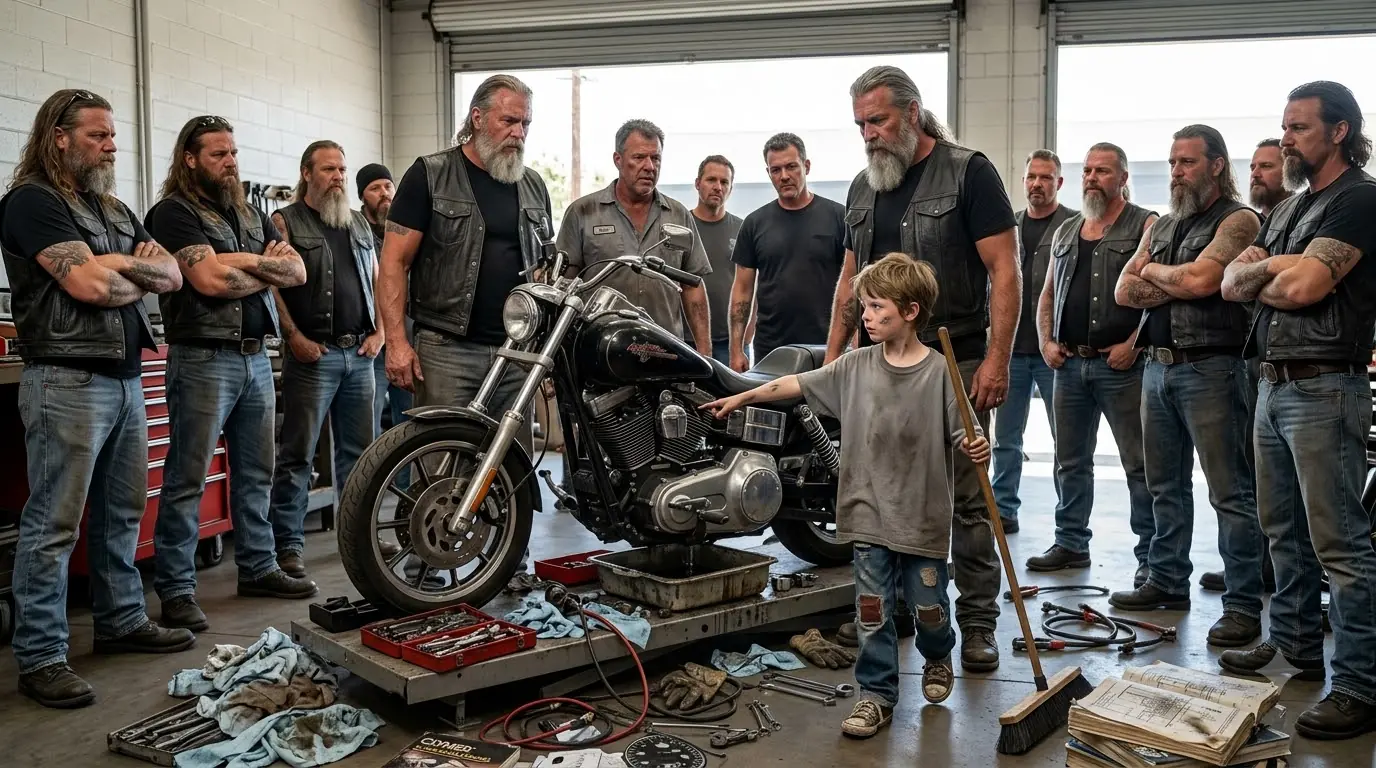
Then, breaking the silence in the garage, a scrawny eight-year-old boy stepped out of the shadows with a broom in his hands and said, "I'll fix it."
The midday sun beat down mercilessly on the cracked asphalt of Oakland, California. Heat shimmered over the pavement as a pack of motorcycles rolled toward Apex Iron Works, the most respected custom motorcycle shop in that part of the Bay Area.
Their engines announced them long before they reached the garage, a deep mechanical rumble that made workers inside stop what they were doing and look toward the open bay doors.
At the front rode Jim Mercer, a huge man with a steel-gray beard, weathered face, and the heavy presence of someone who rarely had to repeat himself.
His leather vest carried the colors of the Red Canyon Riders, a fictional California motorcycle club with a long history and an equally long memory. Jim was not there looking for trouble. He was there because the club had a problem that had become deeply personal.
Behind the riders, secured to the bed of a flatbed truck, sat a 1986 Harley-Davidson FXR. To anyone who did not know its history, it was simply an old black motorcycle with chipped paint, faded chrome, and decades of hard miles written into every surface. To the Red Canyon Riders, however, it was a memorial piece.
The bike had belonged to Dominic "Dutch" Sullivan, a former chapter president who had died three months earlier. Dutch had spent decades with the club, and many of the older riders considered him family. A massive memorial run was planned for Saturday, a long procession down the California coast, and the club wanted Dutch's FXR to lead the ride exactly as he had led them so many times before.
There was only one problem.
The motorcycle would not start.
The flatbed rolled into the lot and stopped outside the main bay. Rusty, owner and head mechanic of Apex Iron Works, stood near the entrance wiping his hands on a faded shop rag. He had built custom motorcycles for collectors, racers, celebrities, and people who treated motorcycles like sacred objects. If a machine could be repaired, Rusty usually found a way.
But that afternoon, his face was pale.
Jim shut off his motorcycle and walked toward him. "Tell me she's breathing, Rusty."
Rusty swallowed. "Jim, I'm going to be straight with you because I respect Dutch and I respect what this bike means to all of you. I've had three of my best mechanics on that FXR for two weeks. We've checked the fuel system, ignition, wiring, charging system, compression, and everything else we can reasonably test. On paper, that engine should run."
Jim's expression did not change. "But it doesn't."
"No," Rusty admitted. "It doesn't."
He glanced toward the old FXR. "Every time we try to start it, the engine turns but refuses to catch. Sometimes it pushes back hard enough to make us stop immediately. The battery also keeps losing power for reasons we can't trace. We've replaced parts that looked suspicious and tested systems over and over. Nothing makes sense."
One of Rusty's mechanics stood near the tool cabinets with his arms crossed, saying nothing. Another stared at the floor.
Rusty sighed. "I hate saying this, but we've reached the point where every normal answer has been eliminated."
Jim walked slowly toward the FXR and rested one large hand on the worn leather seat. His expression softened for only a moment.
"Dutch pulled me out of a bad place when I was young," he said. "He taught me how to stand on my own feet. This machine was part of him. It leads the ride Saturday."
He turned back toward Rusty. "You told us you could handle it."
"I believed I could."
"Then don't quit yet."
The atmosphere in the garage tightened. No one wanted an argument, and no one wanted to be the person who told a grieving motorcycle club that their late friend's most cherished machine was beyond repair.
Jim finally spoke again. "You have until Friday at noon. If it still doesn't run, I'll take it somewhere else, and we'll settle the bill afterward. But I need one final honest attempt."
Rusty nodded reluctantly.
Then a small voice came from the shadowed corner of the garage.
"You're checking the wrong timing setup."
Every head turned.
Near a stack of tires stood a boy holding a push broom almost twice his height. He could not have been more than eight years old. He was painfully thin, wearing an oversized faded T-shirt, patched jeans, and worn sneakers. Grease marked one cheek, and his bright blue eyes were fixed on the motorcycle rather than the men surrounding it.
Rusty's eyes widened. "Leo, not now. Keep sweeping."
The boy did not move.
Jim looked from Rusty to the child. "Who is he?"
"His name's Leo Hayes," Rusty said quickly. "His father used to rent a work bay in the back before he got sick. Leo's mother is trying to hold things together on her own, so I let him sweep the shop after school and give him a few dollars and something to eat. He's a good kid, but he's eight."
Leo tightened both hands around the broom. "I know that bike."
One of the younger riders laughed under his breath. Jim silenced him with a glance.
"What do you mean you know it?" Jim asked.
Leo stepped closer. "My dad talked about Dutch's FXR all the time. He said it wasn't built like a normal one anymore."
Rusty shook his head. "Leo, we've had experienced mechanics on this motorcycle for two weeks."
"That's why they're stuck," Leo replied. "They're treating it like a normal bike."
The answer drew another silence.
Jim crouched slightly so he could hear the boy better. "Tell me what your father said."
Leo pointed toward the engine. "He said Dutch broke the original setup years ago during a hard ride near Reno. My dad helped rebuild it using parts and custom pieces from different generations. He said the finished engine looked normal from the outside, but the internal timing wasn't standard anymore. If you follow the factory book exactly, you'll keep chasing the wrong problem."
Rusty's expression changed.
Leo continued. "My dad used to call it Dutch's Frankenstein motor. He said Dutch was always changing things and then forgetting to tell anyone what he changed."
Jim stared at Leo.
"What was your father's name?"
"Arthur Hayes."
Jim removed his sunglasses.
"Arty Hayes?"
Leo nodded.
Jim looked over his shoulder at the older riders. Several of them reacted immediately.
"Arty was one of the few mechanics Dutch trusted," Jim said quietly. "He could listen to an engine for ten seconds and tell you what was wrong."
Leo's eyes dropped. "He died two years ago."
"I know," Jim said. "I'm sorry."
For the first time since arriving, Jim's voice had lost every trace of pressure.
He looked at Rusty. "Did you know Arty worked on this bike?"
Rusty shook his head. "No. If I had known the engine was that heavily modified, I wouldn't have relied so heavily on factory references."
Jim looked back at Leo. "You think you know what's wrong?"
Leo nodded. "Some of it. My dad made me memorize weird things because he said nobody remembers the important details after the person who built something is gone."
Rusty let out a breath, almost laughing from disbelief.
"And the battery problem?" Jim asked.
Leo hesitated. "My dad told me Dutch had a hidden anti-theft trick. He never explained the exact setup to me because he didn't want me messing with motorcycles alone. But he said if the bike ever kept losing battery power while everything tested fine, there was one hidden control that had probably been left in the wrong position."
Rusty stared at the FXR as though it had just changed shape in front of him.
Jim asked, "Can you help them find it?"
Leo looked at the mechanics. "I can't do the heavy work. I'm too small. But I can tell them what my dad told me and where he said to look."
Rusty immediately objected. "Jim, he's a child. I'm not putting an eight-year-old in charge of dangerous mechanical work."
"Neither am I," Jim said. "You and your mechanics stay in charge of safety. Leo tells you what he remembers. You decide how to test it professionally. No one lets him near anything dangerous or running."
Rusty's shoulders loosened slightly.
That was a very different proposition.
Jim reached into his pocket and handed Leo a crisp one-hundred-dollar bill.
Leo stared at it. "What's this for?"
"Food," Jim said. "And because if your memory saves Dutch's bike, you've already earned more than sweeping money."
Leo looked uncertain.
Jim nodded toward the door. "Go home. Eat with your mother. Come back tomorrow morning if she says it's all right."
Leo closed his fingers around the bill.
For the first time, he smiled.
As the riders left, Rusty watched Leo staring at the old FXR.
"You really know something we don't, don't you?" Rusty asked.
Leo nodded. "My dad loved that bike because it never stayed the same for long."
The next morning, the sun had barely risen over Oakland's industrial skyline when Leo walked through the side door of Apex Iron Works. His face was scrubbed clean. His clothes were still worn, but his posture was different. For once, someone had asked him to come to the garage because what he knew mattered.
Rusty and his three most experienced mechanics were already waiting. Big Dave handled fabrication and heavy mechanical work. Tommy specialized in fuel systems and tuning. Pete, the oldest of the group, had spent decades tracing electrical problems other mechanics could not solve.
The black FXR sat in the center of the bay.
Rusty crossed his arms. "All right, Leo. We do this safely. You explain what your father told you. We verify everything before touching anything. Nobody takes shortcuts."
Leo nodded seriously.
"First thing," he said, "stop assuming the marks you can see mean what the manual says they mean. My dad said Dutch changed enough inside this motor that the outside references became misleading."
For the next several hours, the garage became one of the strangest classrooms any of them had ever seen. Leo never touched the dangerous machinery. Instead, he stood on a milk crate when he needed a better view and repeated pieces of information his father had drilled into him years earlier.
The mechanics did the actual disassembly, measurement, inspection, and repair work.
When the relevant engine components were exposed, Rusty stopped and stared.
"Well, I'll be damned."
The internal parts were not arranged like a standard factory setup. Several pieces had clearly been modified or custom-fitted many years earlier.
Leo leaned forward from a safe distance. "That's what Dad meant."
Big Dave studied the parts. "Someone built this thing from different generations."
"Arty," Jim's voice seemed to echo in Rusty's memory. The only wrench Dutch trusted.
The mechanics carefully verified the relationship between the custom components and discovered that the engine had indeed been set up using nonstandard internal references. The incorrect assumption had caused the previous starting attempts to happen at the wrong point in the engine's cycle.
That explained the violent kickback.
It also explained why replacing perfectly good parts had never solved the problem.
Tommy carried several rods to the workbench and rolled them across the flat surface.
One wobbled.
Then another.
"We've got another problem," he said.
Repeated failed starting attempts had damaged several custom components in the valve train. Standard replacement parts did not match the unusual geometry of Dutch's engine.
Rusty rubbed both hands over his head. "These aren't catalog parts. Somebody made these specifically for this motor."
Big Dave let out a long breath. "So we finally understand the problem, and now we can't put it back together."
Leo climbed down from the milk crate.
He did not look worried.
"My dad kept spares."
Rusty turned toward him. "What?"
"He said if you build something weird, you keep duplicates of anything that can't be bought."
Leo pointed toward the rear of the building. "Do you still have the old basement storage lockers?"
Rusty frowned. "Under the paint booth? Yeah. Most of them are full of junk left from the previous owner."
"Locker forty-two was my dad's."
Rusty stared at him.
"When he got sick, Mom couldn't keep paying for the storage space," Leo explained. "The old landlord locked it. Dad told me he left his custom parts there."
Rusty immediately pulled the old property records from a filing cabinet. The locker was still listed under Arthur Hayes's name, along with several years of abandoned contents that had never been cleared.
Rather than breaking into it, Rusty contacted the property owner and Leo's mother. By late morning, permission was documented and the old lock was removed properly.
The basement smelled of damp concrete and dust. Locker forty-two creaked open to reveal cardboard boxes filled with motorcycle magazines, old tools, notebooks, and one heavy wooden crate.
Leo knelt beside it.
His fingers trembled as he opened the lid.
Inside were engine components wrapped carefully in oil-preserved cloth. Rusty lifted one bundle and unfolded it.
A complete set of custom-machined parts rested inside.
A strip of faded masking tape was still attached.
DUTCH - WIDOWMAKER SPARES.
Rusty stared at the handwriting.
"Your father really did think of everything."
Leo smiled faintly. "He said Dutch broke things faster than normal people could buy replacements."
For a moment, none of the men spoke.
Then Rusty gently closed the crate.
"Let's bring his work upstairs."
The rest of Wednesday was spent measuring, comparing, and confirming that the stored parts matched the pieces inside the FXR. They did.
For the first time in two weeks, Rusty believed the motorcycle might actually run.
Thursday was devoted to the electrical mystery.
Pete traced the battery drain using normal diagnostic methods while Leo described what his father had told him about Dutch's unusual anti-theft habits. Eventually, Pete discovered a concealed old custom circuit integrated into the motorcycle decades earlier. It had been designed as an improvised immobilizer, but age and the forgotten control position were causing the electrical system to behave in ways that looked like a mysterious fault.
Pete laughed when he finally understood it.
"No wonder we couldn't find it. We were looking for damage. This was intentional."
Leo nodded. "Dad said Dutch didn't trust locks."
"Apparently he didn't trust mechanics either," Pete replied.
By Thursday night, the damaged custom components had been replaced with Arthur's preserved spares. The mechanics carefully set the engine according to the verified custom configuration rather than the standard factory reference. Pete repaired the aging electrical connections around Dutch's old anti-theft system and made sure the motorcycle could be operated safely without revealing unnecessary details about the original hidden mechanism.
At nearly eleven o'clock, the FXR was back together.
Big Dave looked toward the ignition. "Should we try it?"
Everyone looked at Leo.
The boy was sitting on the milk crate, exhausted, with dark circles beneath his eyes.
He shook his head.
"Jim said he wanted to hear it Friday. If something unexpected happens tonight, we might not have enough time to fix it. Check everything again and wait."
Rusty slowly smiled.
"Kid's got nerves."
Friday morning arrived with painful slowness.
The FXR stood in the center of the garage, cleaned and polished. The old black paint still carried scars from decades on the road, but the motorcycle no longer looked abandoned. It looked ready.
At 11:45 a.m., the ground outside began to vibrate.
Motorcycles approached from the street.
This time, nearly twenty Red Canyon Riders rolled into the lot. Jim Mercer entered first, followed by several older members who had known Dutch personally.
Nobody was smiling.
Rusty stood near the toolbox. Big Dave, Tommy, and Pete waited behind him.
Leo stood beside his broom.
Jim checked the clock.
"Friday. Noon."
He looked at the FXR. "Is it a motorcycle again?"
Rusty swallowed. "We found things none of us knew were there. The kid was right about his father working on it. We verified every step ourselves and rebuilt it safely."
Jim's gaze moved to Leo.
"Moment of truth?"
Leo nodded.
Jim walked to Dutch's motorcycle and rested both hands on the handlebars. For a second, the intimidating club veteran looked less like a feared biker and more like a grieving friend standing beside a memory.
He swung onto the saddle.
The shop went silent.
Jim turned the key and pressed the starter.
The starter motor spun.
The engine did not fire.
Rusty's stomach dropped.
Big Dave closed his eyes.
A murmur moved through the riders behind Jim.
Jim released the button.
He looked devastated rather than angry.
Then Leo spoke.
"Mr. Mercer, you forgot Dutch's trick."
Jim turned toward him.
Leo pointed toward the left side of the motorcycle. "The old anti-theft control."
Jim froze.
Memory crossed his face.
He had seen Dutch perform that little ritual hundreds of times without ever thinking about it. A hidden motion before starting the bike. Something everyone had assumed was just another one of Dutch's habits.
Jim carefully reached beneath the tank area and found the old control Pete had restored.
A soft click followed.
Jim looked at Leo.
Then he pressed the starter again.
The FXR came alive.
The engine caught with a deep, uneven thunder that filled the entire garage. Tools rattled in drawers. Dust drifted from the rafters. The sound was raw, old-fashioned, and unmistakably alive.
Rusty shouted in disbelief.
Big Dave threw both hands into the air.
Tommy laughed so hard he had to lean against the workbench.
Pete simply stared at the motorcycle as though it had returned from the dead.
Jim sat motionless on the saddle.
His hands tightened around the grips.
The sound of the engine was not simply mechanical noise to him. It was Reno in the early 1990s. It was long highways, bad coffee, roadside repairs, and Dutch laughing at everybody who told him his homemade modifications would never work.
Jim's eyes filled with tears.
He let the motorcycle idle for several seconds, then shut it down.
The sudden silence rang in everyone's ears.
Jim climbed off the FXR and walked toward Rusty.
He pulled out an envelope and handed it to him.
"That's the balance I owe you and extra for the rush work."
Rusty took it but immediately shook his head. "Jim, my guys did the labor, but we would still be lost if Leo hadn't known what his father changed."
Jim turned toward the boy.
Leo was leaning against the broom, exhausted and smiling.
Jim crouched on one knee until they were eye level.
"Your dad was one of the finest mechanics I ever met," Jim said. "Dutch trusted him for a reason. I thought when Arty died, all that knowledge died with him."
Leo looked down. "He made me listen even when I didn't want to."
Jim laughed softly. "Sounds like Arty."
Instead of giving Leo club insignia or promising retaliation against anyone who bothered him, Jim reached into his pocket and handed him a small metal memorial token bearing Dutch's initials and the year of the ride.
"This doesn't make you part of any club," Jim said. "It means you helped us bring back something that mattered to people who loved Dutch. Keep it."
Leo turned the token over in his hand.
"Thank you."
Jim stood and looked at Rusty.
"The kid shouldn't be sweeping floors forever."
Rusty nodded. "I know."
"Set up something legal with his mother. Age-appropriate shop learning, supervised, safe, whatever the rules allow. Pay him fairly for the work he is actually allowed to do. When he's older, give him a real apprenticeship if he still wants it."
Rusty smiled. "I already planned to call her today."
Jim glanced toward Leo. "And when he's old enough for college, I'm starting a scholarship fund in Arty and Dutch's names. Engineering, mechanics, whatever direction this brain of his wants to go."
Leo's eyes widened.
"You don't have to do that."
"I know," Jim said. "That's why it means something."
One of the riders near the door nodded toward the FXR. "Dutch finally gets his ride."
Jim looked back at the black motorcycle.
A genuine smile transformed his face.
"Yeah. He does."
The riders cheered as the crew prepared the FXR for transport. This time, the mood in the garage had nothing to do with fear. The impossible job had become a shared victory.
Big Dave walked past Leo and gently ruffled his hair.
"Foreman," he joked.
Leo rolled his eyes. "I'm eight."
"Best foreman we've had all month."
Rusty laughed.
The following morning, Dutch Sullivan's black FXR rolled at the front of the memorial procession exactly as the club had hoped. Jim rode it slowly along the California coast while hundreds of motorcycles followed behind. The old engine ran steadily, carrying the sound of a friendship that had survived even after one of the men was gone.
Leo did not ride with them.
He stood safely with his mother and Rusty near the starting point, watching the procession leave. His mother had tears in her eyes, not because she understood every mechanical detail, but because for the first time since Arthur died, she could see a future in which her son's obsession with engines might become more than a reminder of what they had lost.
At Apex Iron Works, things changed quietly afterward.
Leo still swept floors because someone had to sweep floors, but he was no longer treated like invisible help. Rusty began teaching him basic, age-appropriate principles using disconnected parts, diagrams, old engines that were not running, and plenty of supervision. Pete taught him how to read electrical diagrams without letting him work around live systems. Tommy showed him how fuel and airflow affected combustion using safe classroom examples. Big Dave taught him measurement, patience, and the importance of checking work twice.
Most importantly, nobody encouraged him to prove himself through danger.
Arthur Hayes had already given his son the rarest part of the education: curiosity.
The rest could come with time.
Months later, Rusty mounted a framed photograph on the wall of the garage. It showed Dutch's FXR on the morning of the memorial ride, Jim standing beside it and Leo near the front tire, holding his broom like a flagpole.
Under the photograph, Rusty placed a small metal plate.
It read: KNOWLEDGE DOESN'T CARE HOW OLD YOU ARE. WISDOM KNOWS WHEN TO LISTEN.
Leo pretended the sign embarrassed him.
He secretly loved it.
The supposedly cursed motorcycle had never needed an exorcist. It had needed someone who remembered the human story hidden inside the machine. A room full of experienced mechanics had the tools and strength to repair it, but Leo carried the missing map left behind by his father.
That was why the bike finally ran.
And that was why, long after the memorial ride ended, the people at Apex Iron Works remembered the morning an eight-year-old boy stepped out of the shadows, looked at a machine every adult had given up on, and quietly said he knew where to begin.