The truck came through the gate without slowing.
Old cedar boards split beneath the blue bumper. One hinge tore from its post and spun into the ditch. The other dragged twenty feet under a rear tire before the driver braked in the middle of Winterfred Hayes’s entrance.
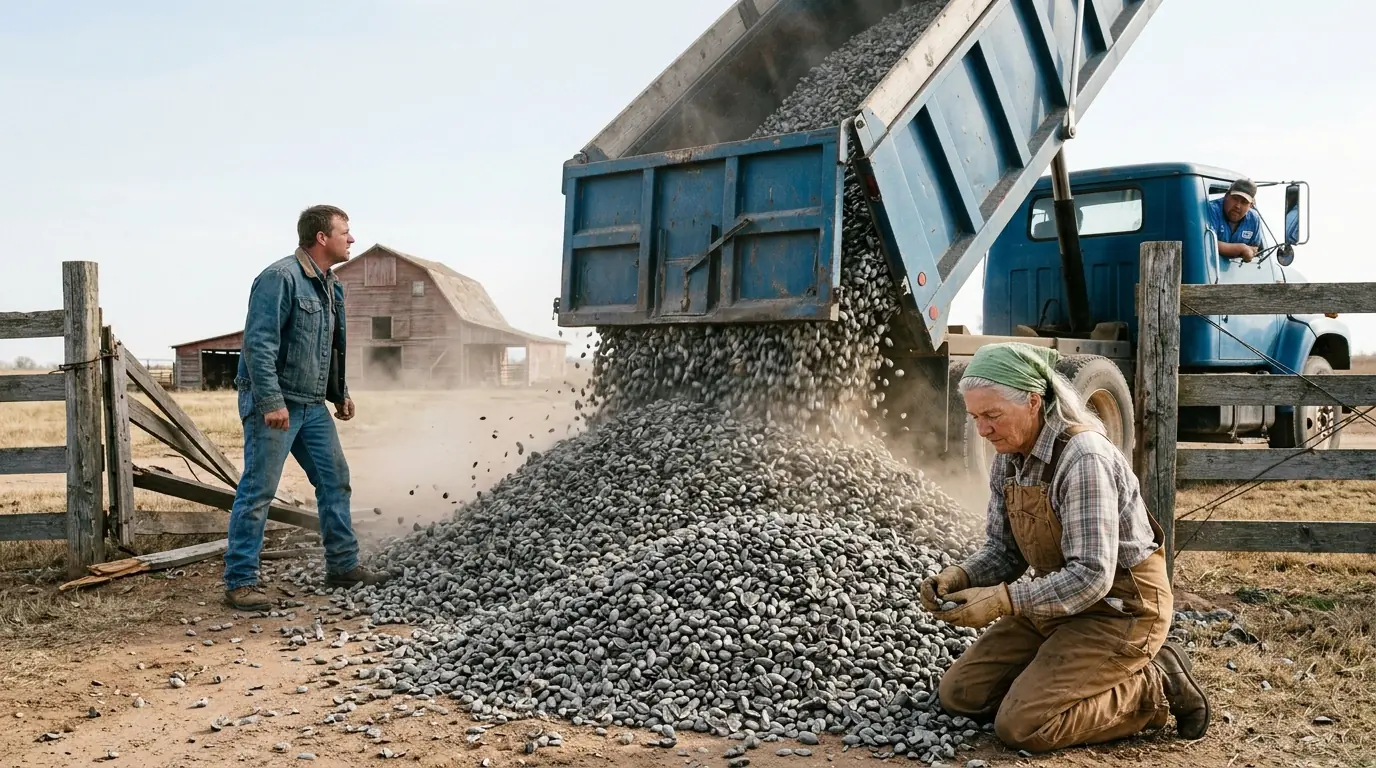
Dust rolled across the farm.
Winterfred stood beside the machinery shed with a wrench in one hand and watched the truck’s hydraulic bed begin to rise.
Her son Wendell came out of the barn at a run.
“What are you doing?” he shouted.
The driver leaned from the cab window. He was a heavyset man near fifty, with a stained blue company shirt, a trucker cap, and the satisfied expression of someone performing an insult for an audience. Another worker sat in the passenger seat laughing.
The company name painted on the door read RED RIVER NUT & FEED MILL.
The bed lifted higher.
Thousands of gray shells rushed toward the open tailgate.
They hit the driveway with a roar like hard rain on a metal roof. Dust burst outward. Shell fragments bounced toward the weathered red barn and piled against the destroyed gate. Within seconds, the only road wide enough for farm equipment disappeared beneath a growing ridge.
“Here’s something useful for that worthless farm!” the driver called.
Wendell strode toward the cab. At forty-four, he carried his father’s broad shoulders and none of the older man’s patience for humiliation.
“I’m calling the sheriff.”
Winterfred saw his right hand close.
“Wait.”
One word stopped him three paces from the truck.
It did not stop the dumping.
The hydraulic pump whined. Shells slid faster, forming an enormous mound across the entrance. The passenger slapped the dashboard and laughed as the last heavy wave crashed onto the pile.
Winterfred walked into the dust.
She was seventy-two, lean from work that had never asked whether age made it reasonable. Silver hair hid beneath a faded green headscarf. Her plaid shirt and brown canvas overalls had been patched more often than replaced. A support seam in one muddy boot had split that morning, which was why she had been standing near the shed with a wrench instead of checking the south field.
The driver expected shouting.
Winterfred knelt.
She picked up three shells in her leather glove. They were not oyster shells, gravel, or the ash-gray slag Wendell first imagined. They were pecan shells, cracked into irregular halves and quarters, with powder clinging to their ridges.
She broke one between her fingers.
The shell snapped dry and clean. Its interior showed no oily stain, paint, or chemical residue. A trace of nutmeat remained along one groove. Another piece smelled faintly sweet beneath the dust.
Winterfred looked beyond the truck.
Her wheat stubble lay low and exhausted under the Oklahoma sun. The south pasture had lost topsoil in every hard wind that spring. Near the barn, a test bed of vegetables struggled in soil that crusted after rain and cracked after heat.
She looked back at the shells.
Not waste.
Not yet useful either.
Potential required proof.
The driver saw her expression change. His laughter weakened.
“What are you smiling at?”
Winterfred rose with shell fragments in her palm.