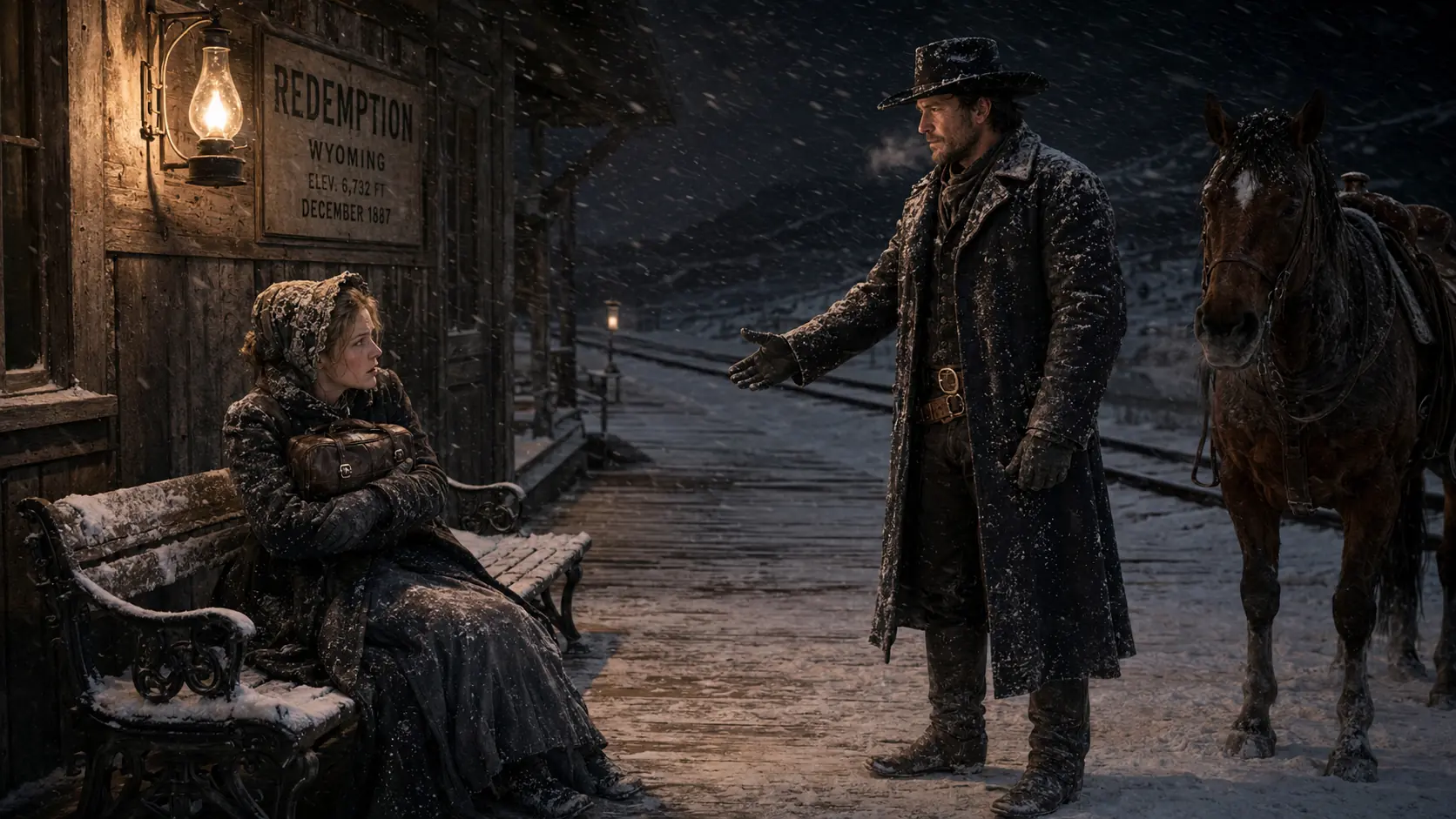
Clara Burnett collapsed onto the frozen bench with her nurse’s bag clutched against her chest like a shield.
The train’s whistle faded into the Wyoming night. Gone. The last train west. And with it, her last hope.
Her fingers were losing feeling, and she did not know if that was mercy or cruelty. December of 1887 had teeth.
The wind off the mountains bit through her wool coat, the good one from Philadelphia, now useless against frontier cold.
Snow began to fall, soft at first, then harder. The station’s single oil lamp flickered like a dying heartbeat. Clara tried to stand, but her legs buckled beneath her.
This was how it ended, she thought. Not in a hospital where she belonged, not beside a patient, not with purpose in her hands, but on a forgotten platform in the middle of nowhere.
Her ticket was stolen. Her money was gone. Pride was all she had left.
And pride could not start a fire.
Then hoofbeats broke through the wind.
Clara lifted her head through the snow and saw a rider moving toward the platform, tall in the saddle, his dark coat dusted white. He reined in a massive bay horse that snorted steam into the frozen air. The man dismounted and came toward her with slow, deliberate steps.
“The station’s closed,” Clara said, hating how badly her voice shook.
“I can see that,” he replied.
His voice was deep and careful. He stopped a few feet away, studying her without rushing closer.
“You waiting for someone?”
“The train.”
“It left.”
“I know.”
“Last one went an hour ago.”
“I know.”
He looked at her for a long moment. In the lamplight, she could barely make out his face. Weathered. Maybe thirty-five. Eyes that had seen too much. There was money in the cut of his coat, but not softness. Not foolishness.
“I don’t need pity,” Clara said.
“Good,” he answered. “I don’t give any.”
He held out his hand.
“But I won’t leave you to freeze either.”
Clara looked at his hand, then at the empty darkness behind him. She looked down at her own fingers, blue-tinged in the lamplight.
Then she took his hand.
He pulled her up with surprising gentleness and steadied her when she swayed.
“James Coleman,” he said. “People call me Cole.”
“Clara Burnett.”
He lifted her onto his horse as if she weighed nothing, then swung up behind her. His coat came around her shoulders without asking.
As they rode into the mountains, Clara looked back once. The empty station disappeared into the snow. Everything she had been running toward vanished behind her.
But the warmth at her back was real.
Just this once, she allowed herself to lean into it.
Clara woke to firelight and the smell of coffee.
For one confused moment, she thought she was back in the hospital dormitory. Then she saw the bearskin rug, the rough-hewn ceiling beams, and the stone fireplace.
The cowboy. The ride through darkness. Strong arms lifting her down.
She sat up too fast, and the room tilted.
“Easy.”
His voice came from the doorway. Cole stood there holding a tin cup.
“You were hypothermic,” he said. “Another hour and—”
He stopped himself and stepped inside.
“Coffee.”
Clara took inventory. She was still dressed. Her boots were beside the cot. Her medical bag sat on the table, untouched. The room was small but warm, with a window showing predawn gray.
“Where am I?”
“Foreman’s cabin on my ranch,” Cole said. “Moses retired, but I kept it maintained. You’re safe.”
Safe.
That word sounded unfamiliar.
She accepted the coffee and let the heat seep into her palms.
“I’ll be gone by morning.”
“It is morning.”
“The next train, then.”
“Three days.”
Clara’s chest tightened. Three days of charity. Three days of owing. Three days of being the pitied woman.
“I’ll work for room and board,” she said quickly. “I’m a surgical nurse. Your ranch hands get injured. I can help.”
Cole leaned against the doorframe.
“You don’t have to.”
“I’m not a charity case, Mr. Coleman.”
Something shifted in his expression. Respect, maybe.
“Just Cole,” he said. “And if you’re offering, I won’t refuse. This ranch is dangerous work.”
As if summoned, shouting erupted outside.
Cole moved fast.
Clara grabbed her bag and followed him into the frozen yard. Three ranch hands were struggling to hold down a fourth.
“Pablo!” someone shouted. “Caught his arm on barbed wire!”
Blood soaked the man’s sleeve and dripped into the frozen mud.
Clara did not ask permission. She knelt, opened her bag, and took control.
“Hold him still. Someone get me clean water. You—” she pointed at Cole, “whiskey.”
Her hands moved with practiced efficiency. She cut away the sleeve, assessed the damage, cleaned the wound, stitched it, and wrapped it tightly. The laceration was deep, but there was no arterial bleeding.
Twelve minutes later, Pablo’s breathing steadied.
The ranch hands stared at her as if she had performed a miracle.
Clara stood, wiped her hands on her skirt, and met Cole’s eyes.
“Three days,” he said quietly. “You work. You stay. No charity.”
“No charity,” she agreed.
That evening, an old man came to the cabin. He had a gray beard, kind eyes, and weathered hands.
Moses.
He looked at Clara through the window, then turned to Cole on the porch.
“Boss,” he said softly, “the town’s going to talk. A woman that pretty, that young, staying here.”
“They always do,” Cole replied.
But his hand gripped the porch rail so tightly his knuckles went white.
Inside, Clara pretended not to hear.
She had heard whispers before. In Philadelphia, whispers had destroyed her. She would not let them destroy her again.
The next morning, the buckboard creaked to a stop in front of Harmon’s General Store.
Clara had forgotten what it felt like to be watched by dozens of eyes at once.
No, she remembered. That was why she had run west.
Redemption, Wyoming, was not much. False-front buildings. Frozen mud streets. Mountains looming like judgment. But it had everything Philadelphia had.
People. Gossip. Conclusions drawn before facts were known.
Cole helped her down.
“You need a proper coat,” he said. “Boots, too.”
“I can’t afford them.”
“Consider it wages.”
He was already inside before she could argue.
The store smelled of dried goods and wood smoke. Mrs. Harmon, the proprietor, smiled too widely, her eyes calculating.
“Mr. Coleman,” she said. “How lovely. And this must be your guest.”
“Miss Burnett works for me,” Cole said evenly. “She needs outfitting.”
He held up a heavy wool coat, deep blue and well-made. Clara touched the fabric and hesitated.
Taking things felt like sinking.
Then the bell over the door chimed.
Mrs. Eleanor Harris swept in like winter itself. She was in her fifties, finely dressed, with eyes as sharp as ice picks. The banker’s wife. The town’s self-appointed moral authority.
“James Coleman,” she said, her voice carrying. “How generous of you to take in strays. One does wonder what services she has provided in exchange.”
The store went silent.
Clara’s face burned.
Here it was. Philadelphia all over again. Different town. Same cruelty.
Cole could have stayed silent. He could have let it pass.
Instead, he stepped beside Clara. His hand rested briefly on her shoulder, a public and deliberate gesture.
“Miss Burnett is a surgical nurse,” he said. “She saved my ranch hand’s arm yesterday. My ranch is safer with her there.”
Then he turned directly to Mrs. Harris.
“Your husband’s bank nearly foreclosed on the Johnsons last month over fifty dollars. Glass houses, Eleanor.”
Mrs. Harris’s face reddened.
“Really, Mr. Coleman,” she said stiffly. “People will talk.”
“Let them.”
Cole paid for the coat and handed it to Clara.
“I’ve got work to do.”
Outside, Clara breathed hard as snow began falling again. Always snow. Endless and cold.
“You didn’t have to do that,” she said.
“Yes, I did.”
“I’m leaving in two days anyway.”
Cole loaded supplies into the wagon. A long pause passed between them.
Too long.
“What if you didn’t?” he asked.
Clara looked at him then. Really looked. She saw something in his eyes that terrified her.
Hope.
The kind that got crushed.
“What are you saying?”
He did not answer.
The train station was visible in the distance, its platform empty and accusing. Neither of them moved toward it.
“One more week,” Clara heard herself say. “Just to be sure Pablo’s arm heals properly.”
Cole nodded once.
“One more week.”
But they both knew it was a lie. The kind people told themselves before they let someone matter.
Two weeks became three.
Clara told herself it was professional responsibility. Pablo’s wound healed clean, but there were others. A broken finger. A horse kick to the ribs. A fever that needed watching.
She told herself it was not about the way Cole looked at her when he thought she was not watching.
January froze the world solid.
The mare was dying.
Cole knew it the moment he stepped into the barn and saw Sable lying on her side, breathing shallowly.
Clara was already there, kneeling in the straw, her hands gentle on the horse’s distended belly.
“Twisted intestine,” Clara said. “Without surgery, she’ll be dead by morning.”
Cole’s face turned to stone.
Sable had been Sarah’s horse. His wedding gift to his wife seven years ago. One of the last things he had left of her.
“Can you save her?”
“I can try,” Clara said. “But I’ve never operated on a horse. I need you to hold the lantern. Keep it steady.”
For two hours, Cole held the lantern while Clara worked.
He watched her hands move steady and sure, covered in blood, sweat, and absolute focus. She worked like someone who had made peace with impossible choices.
The mare lived.
Dawn broke gray and cold. They sat outside the barn, exhausted, steam rising from their coffee in the frozen air.
Cole spoke first.
“My wife, Sarah, died three years ago. Consumption. The doctor didn’t arrive in time.”
Clara said nothing. She simply waited.
“I keep thinking if I’d ridden harder to fetch him, if I’d known sooner…” His voice cracked. “I couldn’t save her.”
“You can’t carry that,” Clara said quietly.
“Can’t I?”
She looked at him.
“I made the right medical choice in Philadelphia. I chose the man who could survive over the one who couldn’t. The poor man over the councilman’s son. It was right.”
She paused.
“But right doesn’t pay rent or buy respect. I lost everything.”
“You saved a life.”
“So did you,” Clara said. “Just now. You held the light steady for two hours. You saved Sable because you trusted me.”
Cole was quiet for a long time.
“Then why did you really run west, Clara?”
“Because I’m tired of being punished for doing good.”
He understood. She saw it in his eyes.
Later, Moses found Cole fixing the cabin window, adding a bookshelf, and carrying extra firewood inside.
“You’re courting her,” Moses said.
“I’m making repairs.”
“Sure you are, boss.”
Moses grinned.
“That woman’s got a spine of steel and a heart she’s afraid to use. Don’t waste this.”
Cole said nothing.
That night, Clara watched from her window as he walked toward the main house. He stopped halfway, turned, and looked back at her lit window. He stood there a full minute, then continued on.
Clara touched the cold glass.
The loneliness was worse now, because she knew what it felt like to almost not be lonely.
The blizzard hit at dusk, turning the world white in minutes.
Cole had come to secure the cabin shutters and got caught in the storm. Now he stood by the door, snow-covered and looking trapped.
“You can’t leave,” Clara said. “Visibility is zero. You’ll die before you reach the main house.”
“I shouldn’t stay.”
“Stay.”
She met his eyes.
“Propriety can go to hell. I’m not letting you freeze.”
They sat on opposite sides of the fire. The space between them was charged with everything unsaid. Wind howled like wolves. The cabin creaked and groaned around them.
“I haven’t visited Sarah’s grave in six months,” Cole said suddenly. “Feels like betrayal.”
Clara poked the fire.
“She’d want you to live. That’s not betrayal. That’s honoring her love.”
“How do you know?”
“Because I’d want the same. If I loved someone, I’d want him to survive me. To find joy again.”
Her voice softened.
“You’re allowed to heal.”
Cole stared at the fire.
“I don’t know if I remember how.”
“Neither do I.”
The temperature dropped lower. The fire was no longer enough.
Clara made the decision. Survival dictated it, she told herself. Just survival.
She moved beside him and wrapped them both in blankets. Cole’s arm came around her shoulders, hesitant and careful. Her head fit perfectly in the hollow of his shoulder.
They sat like that for an hour, then two, not speaking, just breathing together.
“Clara.”
She looked up.
His eyes asked permission. Hers gave it.
The kiss was gentle, tentative, two people afraid to break.
When they pulled back, both were shaking, and not from cold.
“I don’t know how to do this again,” Cole whispered.
“Neither do I.”
“So we’ll figure it out together. Or fail together.”
“I’m not planning on failing.”
They slept wrapped in each other, the fire burning low while the storm raged outside.
Morning came clear and brutal.
Cole prepared to leave. They had not spoken about the kiss. Maybe words would make it real, and real things could be destroyed.
At the door, Clara said, “This can’t happen again. Not unless you’re prepared for what the town will do.”
Cole turned back to her.
“I’m prepared.”
But his hand trembled on the door handle.
Outside, in the distance, a figure on horseback watched through the trees. Mrs. Harris’s stable boy, delivering supplies after the storm.
He had seen Cole leave the cabin. He had seen how long Cole had stayed.
The boy turned his horse toward town.
The secret was out.
A week later, Clara stood at the front of Redemption Church with twenty pairs of eyes boring into her like nails.
She had been summoned.
Town meeting. Urgent.
When she arrived, they were waiting. Reverend Thompson’s face was sympathetic, which was worse than contempt. Sympathy meant pity.
Mrs. Harris stood front and center, righteous fury wrapped in silk.
“We’re concerned,” the reverend began, “for your welfare, Miss Burnett, and for the moral character of our community.”
“Concerned?” Clara repeated flatly.
“You’ve been living on Mr. Coleman’s property for over a month,” Mrs. Harris said. “Alone. Unwed. People have seen.”
“What have they seen?”
“Impropriety. A woman of your situation taking advantage of a grief-stricken widower.”
“Taking advantage?” Clara’s voice cut like a scalpel. “I’ve set bones, delivered babies, and saved lives, including your cattle hand when he had pneumonia, Mrs. Harris. What exactly am I taking advantage of?”
“Your personal life is your concern,” Reverend Thompson said gently. “But when it affects the community’s moral fabric—”
“My personal life is my own,” Clara interrupted. “I’ve harmed no one.”
The church doors opened.
Thomas Coleman strode in, Cole’s younger brother. Slick suit. Ambitious eyes. He had been in Denver for weeks, and his timing was suspiciously perfect.
“Miss Burnett,” Thomas said smoothly, “I’m afraid this situation has become untenable. My brother’s grief has clouded his judgment. For everyone’s sake, you’ll need to leave the Coleman property by week’s end.”
Clara’s face went white.
“Cole knows about this?”
“I’m the co-owner of the ranch. I have authority.”
The doors opened again.
Cole entered.
He took in the scene instantly. Clara surrounded. Thomas playing judge. The whole town watching.
His eyes met Clara’s.
One second. Two.
He hesitated.
Clara saw it. She saw him calculate the cost. His reputation. His brother’s approval. The town’s judgment.
She saw him falter.
That was all she needed.
She walked toward the door, head high, and passed him without looking at him.
“Clara,” he said. “Don’t.”
She disappeared into the winter afternoon.
Cole stood frozen.
Thomas smirked.
“You did the right thing, brother.”
Cole did not answer.
He walked out, got on his horse, and rode to the cabin.
It was empty.
Her medical bag was gone. The coat he had bought her lay folded on the cot, left behind like a returned gift.
Moses found him there an hour later, sitting in the dark.
“You hesitated,” Moses said quietly. “In that room, you hesitated. She saw.”
For the first time since Sarah died, Cole wept.
Clara’s hands were raw from washing dishes in the saloon kitchen.
Two weeks in Redemption proper. Two weeks living in a boarding house that smelled of mildew and broken dreams. The town kept its distance, polite enough but cold. She was marked now.
At least no one could accuse her of impropriety.
At least she was alone.
Like she was meant to be.
Then a scream came from outside the saloon.
Clara ran.
Emma Harris, sixteen years old, lay collapsed on the boardwalk, clutching her side, her face gray with pain.
Appendicitis.
“Get her inside,” Clara commanded.
Mrs. Harris arrived within minutes. She took one look at her daughter, then at Clara.
“What’s wrong with her?”
“Appendicitis. I need to operate now or she dies.”
“You’re not a doctor.”
“I’m all you have,” Clara said. “Choose.”
Mrs. Harris looked at her daughter’s gray face.
Then she nodded once.
Clara operated on the saloon kitchen table. Whiskey for anesthetic. A butcher knife sterilized in boiling water. Two saloon girls held the lantern steady.
Thirty agonizing minutes later, the girl lived.
Mrs. Harris sat with Emma afterward, holding her hand.
Clara cleaned blood from her arms and packed her bag.
“Thank you,” Mrs. Harris said without looking at her.
“She needs rest. Watch for fever.”
Clara walked out.
No payment. No credit.
Just the work.
Just like Philadelphia.
At the Coleman ranch, Cole was falling apart.
He did not shave. He barely ate. The ranch hands exchanged worried looks. Thomas kept pushing.
“Sell the ranch. Start over. Forget the nurse.”
Cole rode to Sarah’s grave drunk.
“I’m sorry,” he told the headstone. “Sorry I’m such a coward. You deserved better. Clara deserved…”
His voice broke.
“I did it again. I failed again.”
Moses found him there.
“Your wife died, boss. That was tragedy. But you’re alive, and you’re choosing death anyway. That’s just waste.”
“What if I lose Clara too?”
“You already did,” Moses said, gripping his shoulder. “But maybe she’d let you earn her back.”
Sunday morning, Cole rode into town.
Moses handed him Clara’s coat.
“Go get her.”
Snow began to fall.
Cole walked toward the church doors. Inside, hymns rose softly. Outside, his heart hammered.
He pushed the doors open mid-verse.
Cole Coleman walked down the center aisle like a man walking to his own hanging.
Every head turned. The hymn died. Reverend Thompson stopped speaking, his mouth open.
In the back corner, Clara looked up.
Her heart leaped.
Traitor.
“I need to say something,” Cole said. “You can listen or you can throw me out, but I’m saying it.”
No one moved.
“Two weeks ago, I stood silent when this town judged Clara Burnett. I hesitated when she needed courage. I was afraid. Afraid of losing again. Afraid of gossip. Afraid of being seen as foolish.”
He looked directly at Clara.
“But if you want to judge someone’s morality, judge mine. Clara saved Sable when no one else could. She saved Emma Harris last week, operating in a saloon kitchen without payment. In Philadelphia, she lost her career because she chose to save a poor man’s life over a rich man’s son.”
Mrs. Harris shifted uncomfortably.
“She is the best person I know,” Cole said. “And I was too much of a coward to say it when it mattered.”
Then he walked toward Clara.
“Miss Burnett,” he said, “I’m standing here in front of everyone who hurt you and asking, will you marry me? Not to make you respectable, but because I don’t want to spend another day pretending I can live without you.”
Silence.
Complete, suffocating silence.
Clara stood slowly and walked down the aisle. Every eye followed her. She stopped in front of him.
“You hesitated before.”
“I did.”
“I won’t again,” he said. “Not ever.”
Clara looked at him for a long moment.
“Then yes.”
The church erupted in gasps, whispers, and shocked exclamations.
Moses stood.
“I stand with them.”
Pablo stood.
“Me too.”
One by one, the ranch hands stood. Then Mr. Harmon. Then, slowly and reluctantly, Mrs. Harris nodded once.
Defeat.
But also acceptance.
Reverend Thompson cleared his throat.
“Well,” he said, “I suppose we could do this wedding right now, if you’re both certain.”
Clara laughed, her first genuine laugh in weeks.
“Right now works.”
The reverend married them on the spot.
No flowers. No fancy dress. Just two broken people choosing each other in front of everyone who had tried to tear them apart.
As Cole kissed his bride, someone began clapping. Then another. Then the whole church.
Even Mrs. Harris. Barely. Begrudgingly.
Clara whispered, “This is insane.”
Cole smiled.
“Welcome to marriage.”
Outside, snow fell soft and clean. The mountains stood witness.
And for the first time in three years, Cole felt warm.
April came to Wyoming like a promise kept.
The cabin, no longer truly a cabin, stood with new walls, new windows, and a real porch. Wildflowers Clara had planted bloomed purple and gold around the foundation. Inside, the smell of fresh bread mixed with wood smoke.
This was what home smelled like.
Clara ran a small clinic from the added room. Everyone was welcome. The town called her Doctor Coleman now, and she did not correct them.
Respect was respect, however it came.
Thomas had left for Denver and never reconciled. Moses lived in the main house and helped Cole run the ranch. The land prospered.
One afternoon, Mrs. Harris visited. She arrived stiff but genuine, carrying preserves.
“Thank you for saving Emma,” she said. “I should have said it then.”
Clara nodded.
“You’re saying it now. That’s enough.”
Some things did not need full redemption. Just acknowledgement.
That evening, Clara stood on the porch with one hand resting on her pregnant belly. Six months along. The baby kicked, strong and insistent.
Cole came up behind her and wrapped his arms around her.
Together, they looked out over the land. The barn where Sable grazed with her new foal. The fields gone green. The mountains purple in the distance.
“You know what I realized?” Clara said.
“What?”
“I spent so long running from judgment, I forgot to build toward anything. And now…”
She touched her belly.
“Now I’m building everything.”
The coat Cole had bought her that first week hung by the door, waiting for the child who would wear it someday.
A hand-me-down hope.
Somewhere in town, the train whistle blew. The same train that had left Clara behind six months ago.
But she did not turn her head.
She did not even notice.
She was already where she belonged.
Moses walked out of the barn and tipped his hat to them, smiling. In the distance, a wolf howled, not threatening, just singing to the spring moon.
Cole leaned close and whispered, “Welcome home, Mrs. Coleman.”
Clara’s hand rested on her belly as new life moved beneath her palm.
She looked at the wildflowers, beauty growing from hard ground, roots deep, blooming despite the winter that came before.
“I’ve been home for a while now,” she said.
The mountains turned purple with twilight. Somewhere, a nightbird called. The land breathed, alive and healing.
And in a small house on the frontier, two people who had survived their separate darknesses stood together, watching their future bloom.