“You want money, kid? Here’s my offer. Play something worth listening to at my gala next week, and I’ll adopt you. But when you fail, and you will fail, don’t ever dare show your face near my building again.”
What happens when a heartless millionaire’s cruel mockery becomes the stage for the most extraordinary revelation of his life?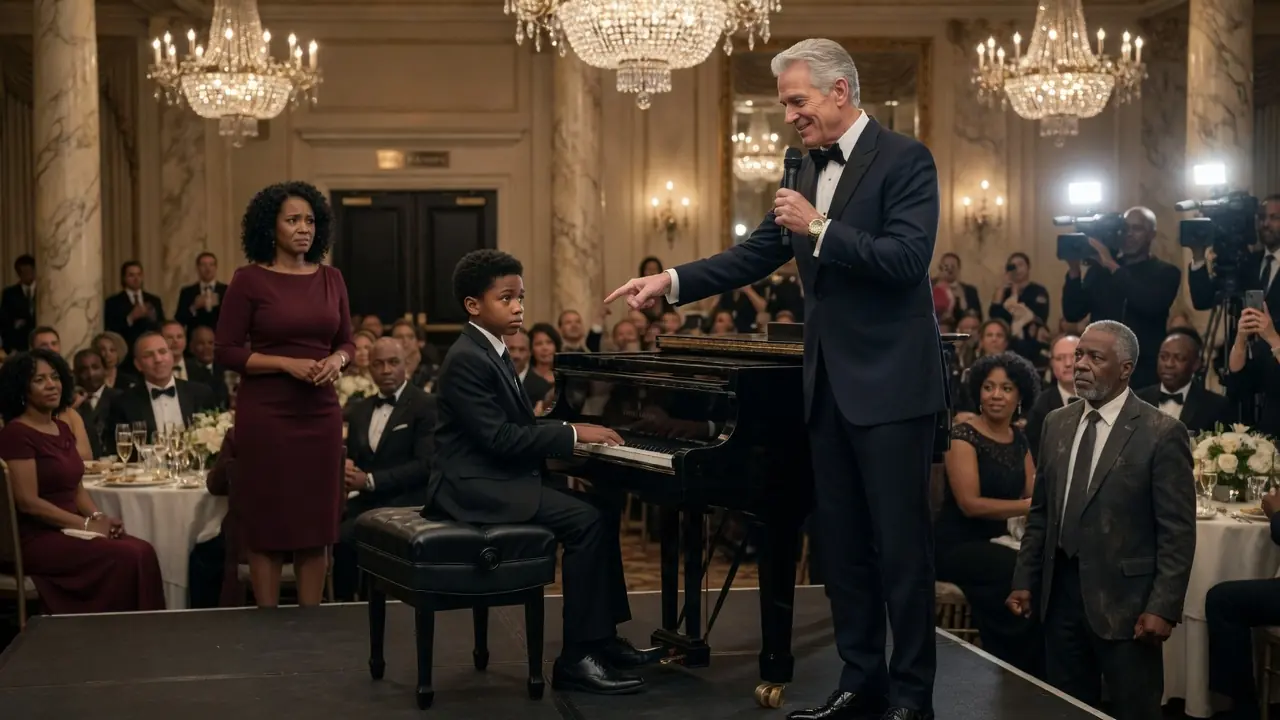
When twelve-year-old Marcus Thompson, a homeless boy with nothing but a broken keyboard and a dream, accepted a challenge meant to humiliate him, nobody expected what came next.
This is the story of how one song, just one haunting melody, shattered every prejudice, every assumption, and every cold heart in a room full of Chicago’s elite.
The November wind cut through downtown Chicago like a knife, but Marcus Thompson barely noticed anymore.
His twelve-year-old fingers, stiff from the cold, danced across the keys of his battered Casio keyboard, coaxing out a melody that seemed too beautiful for such worn equipment.
The corner of Madison and LaSalle had become his stage, a piece of cardboard beneath him his only barrier against the frozen concrete.
“Silent Night, Holy Night,” he played.
Christmas was still weeks away, but holiday shoppers hurried past anyway, some dropping coins into his open keyboard case, most pretending not to see the young Black boy in the oversized coat that had seen too many winters.
Marcus had been playing for three hours, earning exactly seven dollars and forty-three cents, enough for maybe one hot meal if he was careful.
His stomach growled, but he kept playing.
Music was the only thing that made sense anymore, the only connection to the life he had before everything fell apart.
The gleaming doors of Whitmore Tower burst open, and Richard Whitmore himself emerged, flanked by his executive assistant, Victoria Chen, and two imposing security guards.
At fifty-nine, Whitmore commanded attention. Silver hair, perfectly styled. A navy suit that probably cost more than most people’s cars. And an expression of perpetual disdain that had become his trademark in Chicago’s business circles.
“Mr. Whitmore, the car is waiting,” Victoria said softly.
But Richard had stopped, his attention caught by the melody floating through the air.
Marcus did not notice the group at first. He was lost in his music, eyes closed, body swaying slightly as he played a complex arrangement he had taught himself by ear.
The security guards moved to clear a path, but Richard held up a hand.
“Well, well,” Richard’s voice boomed, causing Marcus to jump and hit a wrong note. “What do we have here? Another street performer contaminating the air with noise.”
Marcus’s eyes snapped open, meeting the cold gaze of the millionaire.
He had seen Richard Whitmore’s face on magazines in the library where he sometimes went to stay warm. The man who owned half of downtown, who had built his fortune in real estate and tech investments.
“I’m just playing music, sir,” Marcus said quietly, his hands still resting on the keys.
Richard laughed, a harsh sound that drew the attention of passing pedestrians.
Several stopped to watch, sensing drama unfolding.
“Music? You call that music? That’s just noise pollution, boy. Real music requires training, education, culture, things clearly beyond your circumstances.”
The small crowd grew larger.
Someone pulled out a phone and began recording.
Victoria touched Richard’s arm gently.
“Sir, we should go. The merger meeting.”
“Tell me, boy,” Richard interrupted, stepping closer to Marcus. “How much do you make doing this? Twenty dollars a day? Thirty on a good day?”
“Sometimes,” Marcus answered honestly, his chin lifting slightly. “It’s enough.”
“Enough?”
Richard pulled out his wallet and extracted a crisp hundred-dollar bill. He held it up, making sure the growing crowd could see.
“You want this? You want real money?”
Marcus’s eyes widened despite himself.
A hundred dollars meant food for a week, maybe even new gloves so his fingers would not go numb while playing.
“Here’s my offer,” Richard announced loudly, playing to his audience. “There’s a charity gala at my ballroom next Saturday. Five hundred of Chicago’s finest will be there. You show up, play something actually worth listening to, not this street garbage. And if you can impress even one person, I’ll adopt you myself. Give you a real home, real education, everything.”
The crowd gasped.
Victoria’s eyes widened in shock.
“Mr. Whitmore.”
“But,” Richard continued, his smile turning cruel, “when you fail, and you will fail because what could a street kid possibly know about real music, you never show your face near my building again. Ever. You take your noise pollution somewhere else.”
Marcus stared at the hundred-dollar bill still in Richard’s hand.
The crowd was silent, waiting.
He could feel their mixture of pity and curiosity. Some hoping he would accept. Others hoping he would tell the rich man off.
“Keep your hundred dollars,” Marcus said quietly, his voice steady despite his racing heart. “I’ll take your challenge.”
Richard laughed again, tossing the bill into Marcus’s case anyway.
“Saturday, eight p.m. sharp. The doorman will have your name, though I doubt you’ll actually show up. People like you rarely follow through on anything.”
“Mr. Whitmore,” Victoria protested.
But he was already walking toward his waiting Bentley.
“One week, boy,” Richard called over his shoulder. “Come prepared to embarrass yourself or don’t come at all.”
As the Bentley pulled away, Marcus sat frozen on his cardboard mat.
The crowd slowly dispersed, some dropping money into his case out of sympathy, others shaking their heads at what they had witnessed.
An elderly Black woman stopped and pressed a five-dollar bill into his hand.
“Don’t let him break you, baby,” she whispered. “Men like that, they think they own the world.”
Marcus nodded, unable to speak.
He looked down at the hundred-dollar bill in his case, Benjamin Franklin’s face staring up at him like a challenge of its own.
One week.
One chance.
One song that could change everything or destroy the only corner in the city where he felt safe.
As the wind picked up again, Marcus packed his keyboard carefully into its duct-taped case. His fingers found the photo tucked inside.
His mother, smiling, sitting at the piano in their old apartment.
“Real music requires culture,” Richard had said.
If only he knew.
Marcus stood, slinging the keyboard case over his shoulder.
One week to prove that music was not about money or breeding or the color of your skin.
It was about soul.
About stories that needed to be told.
About the human heart speaking when words were not enough.
The question was, would anyone really listen?
The St. Mary’s homeless shelter on the South Side was already crowded when Marcus arrived, his keyboard case banging against his hip with each step.
The hundred-dollar bill felt like it was burning a hole in his pocket. He had hidden it in his shoe, knowing that flashing that kind of money there could be dangerous.
“Marcus, there you are.”
Angela Robinson’s warm voice cut through the chaos of the dinner line.
The thirty-five-year-old social worker had been looking out for Marcus ever since he first showed up at St. Mary’s two years ago, a ten-year-old boy clutching his mother’s keyboard like a lifeline.
“Hey, Miss Angela,” Marcus said.
He managed a small smile, but she knew him too well.
“What’s wrong, baby? You look like you’ve seen a ghost.”
She guided him to a quieter corner past the long tables where dozens of men, women, and children were eating their evening meal. Soup and sandwiches tonight, same as every Tuesday.
Marcus set his keyboard case down carefully and told her everything.
As he spoke, Angela’s expression shifted from concern to anger to deep worry.
Around them, the shelter bustled with its usual evening activity. Three other kids Marcus knew from the youth section, Trey, Diamond, and Little Jose, were doing homework at a nearby table while volunteers helped them with math problems.
“Richard Whitmore,” Angela said the name like it tasted bad. “That man’s foundation gives us funding, but I’ve heard stories. He likes his tax write-offs and his PR photos, but actually caring about people? That’s not in his vocabulary.”
“But what if he’s serious?” Marcus asked, his voice barely above a whisper. “What if this is my chance to get out of here?”
Angela took his hands in hers, noticing how cold they were despite the shelter’s heating.
“Baby, I know how hard this life is. I see you out there every day playing your heart out for spare change. But men like Whitmore, they don’t make offers like this to help. They do it for entertainment. To make themselves feel superior.”
“Then I’ll surprise him,” Marcus said with sudden determination. “I’ll play something that’ll make him eat his words.”
“Kid, I worked security for one of Whitmore’s events once. Man treated us like we were invisible, except when he wanted to complain about something. You sure you want to put yourself through that?”
“What choice do I have?” Marcus’s voice cracked slightly, showing his age. “You know what tomorrow is?”
Angela’s face softened.
She knew.
November fifteenth.
Two years since Marcus’s mother had died, leaving him completely alone. No father in the picture. No relatives who could or would take him in.
“She was a music teacher,” Marcus continued, his eyes distant. “At Lincoln Elementary. Piano, voice, even some violin. She taught me everything. Said music was in our blood going back generations. My great-grandfather played jazz in the Cotton Club. Did you know that?”
“You never told me that,” Angela said softly.
“Mama didn’t like to talk about the past much. Said we needed to focus on moving forward. But she made sure I knew about the music. Made sure I could read it, write it, feel it.”
He touched his keyboard case gently.
“This was hers. It’s all I have left.”
Diamond, a ten-year-old girl with bright eyes despite her circumstances, had wandered over.
“You going to play for some rich folks, Marcus?”
“Maybe,” Marcus replied.
“Play that song you wrote,” she said eagerly. “The one about the trains. That one always makes me cry.”
“You wrote a song?” Angela asked, surprised.
Marcus shrugged, embarrassed.
“A few. Mama taught me composition. Said anyone could play other people’s music, but creating your own, that was how you talk to God.”
The shelter’s dinner hour was winding down. Volunteers were starting to clear tables, and people were settling in for the night.
St. Mary’s had beds for fifty, but on cold nights like this, they would squeeze in seventy or more.
Marcus had a cot in the youth section, a small area separated by curtains where they tried to keep the kids somewhat sheltered from the harder realities of adult homelessness.
“Marcus,” Angela said carefully, “if you’re serious about this, you need to prepare properly. A charity gala isn’t a street corner. These people, they expect certain things. Classical pieces probably. Mozart, Beethoven, that kind of thing.”
“I know classical,” Marcus said quietly. “Mama made sure of that. But that’s not what I want to play.”
Carl laughed, not unkindly.
“Kid’s got guts. I’ll give him that. You really think you can make Richard Whitmore listen to something you wrote?”
“I have to try,” Marcus said. “What’s the worst that can happen? I’m already sleeping in a shelter, eating donation food, wearing donation clothes. He said I can never play near his building again. Fine. Chicago’s a big city.”
But even as he said it, Marcus knew it was not that simple.
That corner had become his spot, the one place where he felt connected to something larger. The acoustics were perfect, the foot traffic steady, and sometimes, just sometimes, people actually stopped and listened.
Really listened to what he was playing.
Jose, only eight, tugged on Marcus’s sleeve.
“Will you be on TV? Rich people parties are always on TV.”
“I don’t know,” Marcus admitted.
“If you get adopted, will you still come see us?” Diamond asked, and there was real fear in her voice.
Marcus was one of the older kids who looked out for the younger ones, made sure they got their fair share at meals, helped them with homework when he could.
“I’m not going anywhere,” Marcus promised.
But the words felt hollow.
Wasn’t that exactly what he was hoping for?
To go somewhere.
Anywhere but here.
The lights flickered, the shelter’s signal that it was time to prepare for lights out.
Marcus gathered his things, heading for the youth section.
As he passed the small office where Angela did her paperwork, she called out to him.
“Marcus, wait.”
She pulled something from her desk, a folder thick with papers.
“If you’re really doing this, you should know something. I’ve been trying to track down your father.”
Marcus froze.
“What?”
“Your mother listed a name on your birth certificate. James Wilson. I’ve been searching for two years, and I think I might have found him. He owns a music store on the North Side.”
The world seemed to tilt.
“My father is alive, and he’s here in Chicago?”
“I don’t know for certain it’s him. But Marcus, if it is, maybe you should talk to him before you pin your hopes on Richard Whitmore’s cruel game.”
Marcus took the folder with trembling hands.
Inside was an address, a photo of a storefront, Wilson’s Music and More, and a grainy picture of a Black man, maybe sixty, standing behind a counter full of instruments.
“Why didn’t she ever tell me?” Marcus whispered.
“I don’t know, baby. Sometimes adults make complicated choices.”
Angela squeezed his shoulder.
“But Marcus, promise me something. Whatever happens Saturday, don’t let that man break your spirit. Your music is a gift. Don’t let anyone, no matter how rich or powerful, tell you otherwise.”
That night, Marcus lay on his cot, staring at the water-stained ceiling while around him other kids coughed, cried, or whispered to each other in the dark.
The folder Angela had given him was hidden under his pillow, the address burning in his mind.
A father he had never known existed.
A millionaire’s challenge that felt like both opportunity and trap.
In one week, everything would change one way or another.
Wilson’s Music and More sat wedged between a dry cleaner and a Dominican restaurant on North Halsted, its windows dusty but filled with gleaming instruments.
Marcus stood outside for twenty minutes Thursday morning, the folder Angela had given him clutched in his sweaty hands.
His keyboard case felt heavier than usual on his shoulder.
Through the window, he could see the man from the photograph, older now, his hair completely gray, wearing a worn cardigan over a jazz festival T-shirt.
He was tuning a guitar, his fingers moving with practiced ease.
Marcus’s heart hammered.
Could this really be his father?
And if it was, why had he never come looking?
The bell above the door chimed as Marcus finally entered.
The store smelled of wood polish and old paper. Sheet music was stacked everywhere, and instruments hung from every available surface. A Louis Armstrong poster watched from the wall next to signed photos of musicians Marcus did not recognize.
“Help you, young man?”
James Wilson looked up, his fingers still on the guitar strings. His eyes were kind but tired, the eyes of someone who had seen too much.
“I…”
Marcus’s voice failed him.
He cleared his throat.
“I need to practice for a performance. I can pay.”
He pulled out the crumpled hundred-dollar bill.
James’s eyebrows rose.
“That’s a lot of money for a kid your age to be carrying around. You in some kind of trouble?”
“No, sir. I earned it. Well, kind of.”
The story tumbled out before Marcus could stop himself. Richard Whitmore. The challenge. The gala.
As he spoke, he watched James’s face carefully, looking for any sign of recognition. Did he see his own features reflected there? The same nose, maybe? The same way of tilting his head when listening?
“Whitmore,” James said slowly, setting down the guitar. “That man came in here once five years ago. Wanted to buy my entire vintage collection for his office like they were decorations instead of instruments with souls. I refused. He tried to buy the building to force me out.”
A small smile played at his lips.
“Lucky for me, the owner’s my friend and told Whitmore where he could put his offer.”
Despite his nerves, Marcus smiled too.
Then, gathering courage, he said, “I’m Marcus Thompson. My mother was Denise Thompson.”
The change in James was instant.
All the color drained from his face. The guitar pick fell from his fingers, clattering on the wooden floor.
“Denise?” he whispered.
Then louder.
“You’re Denise’s boy?”
“You knew her.”
James moved around the counter slowly like he was in a dream.
Up close, Marcus could see it clearly. They had the same eyes. The same long fingers made for piano keys.
“I knew her,” James said quietly. “Lord, help me. I knew her.”
“And you? You’re…”
“I’m your son,” Marcus finished. “Aren’t I?”
A customer chose that moment to enter, a teenage girl with her mother looking at violins.
James quickly wiped his eyes.
“Give me a moment,” he told them, his voice unsteady.
Then to Marcus, he said, “Come to the back. We need to talk.”
The back room was a workshop full of instruments in various states of repair.
James sat heavily on a stool, gesturing for Marcus to do the same.
“I met your mother at a jazz club in 1999. She was playing piano, and I swear I had never heard anything like it. We were together for two years. Happy years.”
“Then what?”
“I wasn’t ready to be a father,” James admitted, shame heavy in his voice. “I was drinking too much, running with the wrong crowd. Your mother, she was going places. Had a teaching job lined up. A future. I was just a jazz musician with more dreams than sense. When she told me she was pregnant, I panicked. I left.”
Marcus felt something hard form in his chest.
“You just left.”
“Worst mistake of my life. I got clean a year later. Came back to find her, but she had moved. Changed her number. I hired someone to look for you both, but Denise had covered her tracks well. I’ve been searching ever since.”
He pulled out his wallet, and Marcus gasped.
Inside was a photo.
His mother, young and radiant, at a piano.
“She died,” Marcus said flatly. “Two years ago. Cancer.”
James’s shoulders shook.
“I know. I found the obituary six months ago. By then, you had disappeared into the system. I’ve been trying to find you, but the foster system, the shelters, they don’t give out information easily.”
“I’ve been at St. Mary’s,” Marcus said. “Playing music on the streets. Surviving.”
“Oh, God.”
James buried his face in his hands.
“Your mother must have hated me.”
Marcus thought about it.
“She never mentioned you. Not once. But she made sure I knew music. Said it was in my blood.”
“Can you play?”
Instead of answering, Marcus opened his battered keyboard case. He set it up on James’s workbench and began to play one of his mother’s favorite pieces, a Debussy prelude she had taught him when he was seven.
His fingers flew across the keys, the small keyboard somehow producing sounds that seemed too big for its speakers.
James watched, transfixed.
When Marcus finished, tears were streaming down the older man’s face.
“You play like her,” James whispered. “But there’s something else there too. Something that’s all you.”
“I write my own pieces,” Marcus admitted.
“Show me.”
Marcus played a composition he had been working on, a piece about the city at night, about loneliness and hope existing in the same space.
It was complex, with jazz influences mixed with classical structure, something entirely his own.
“That’s extraordinary,” James breathed. “You wrote that?”
Marcus nodded.
“I want to play it at the gala. Not what Whitmore expects, but this. My truth.”
James was quiet for a long moment.
“Then that piano in the corner is a Steinway Model B. Seven feet of perfection. I’ve been restoring it for three years. If you’re going to play for those people, you need to practice on something real, not that keyboard.”
“I can’t afford—”
“You’re my son,” James interrupted. “You never have to pay for anything in this store. Ever.”
The words hung between them, heavy with meaning.
The customer at the front called out, asking for help.
“Damn,” James muttered. “Look, can you come back tonight after I close? We’ll work on your piece. Make sure it’s ready. And Marcus, after this gala, whatever happens, we need to talk about your future. You shouldn’t be on the streets. You have family now.”
“Family?”
The word felt foreign in Marcus’s mouth.
“Why should I trust you? You left once.”
“Because I’ve spent twelve years regretting it,” James said simply. “Because your mother never let me make it right, and maybe she had good reason. But you’re here now, and I’m here. Maybe that’s God giving me a second chance I don’t deserve.”
That evening, Marcus returned.
The store was closed, but James was waiting.
They worked for hours, James teaching Marcus techniques his mother had not, showing him how to pull emotion from keys in ways that could make grown men weep.
An off-duty security guard named Mike, James’s friend who sometimes watched the store, stopped by. He listened to Marcus play, shaking his head in wonder.
“Kid’s got it,” Mike said. “Whatever it is, he’s got it in spades.”
“He’s playing for Richard Whitmore’s charity gala,” James explained.
Mike whistled low.
“That prejudiced bastard. Good luck, kid. Man wouldn’t recognize real talent if it bit him.”
“Maybe,” Marcus said, his fingers never stopping their practice. “Or maybe he just hasn’t heard the right song yet.”
As the night wore on, James taught Marcus about performance, about commanding a room, about making every note count.
“Your mother,” he said at one point, “could make a room full of people hold their breath. You have that same power. Don’t let anyone tell you different.”
When Marcus finally left, it was past midnight.
James walked him to the door, then did something unexpected.
He hugged him.
Quick.
Awkward.
Genuine.
“Saturday,” James said. “I’ll be there in the audience. You won’t be alone.”
Marcus nodded, unable to speak past the lump in his throat.
As he walked back to the shelter, his keyboard case felt lighter somehow.
He had a father.
A complicated, flawed, guilt-ridden father, but a father nonetheless.
And in two days, he would show Richard Whitmore and all his rich friends what real music sounded like.
The kind that came from pain and joy.
Loss and discovery.
The kind that told the truth even when the truth was hard.
The question was, would they be able to hear it?
Or were their hearts too closed and their prejudices too strong?
Saturday would tell.
Richard Whitmore’s corner office occupied the entire fortieth floor of Whitmore Tower, its floor-to-ceiling windows offering a view of Chicago that made visitors feel like gods looking down on mortals.
Friday morning, the day before the gala, Richard stood at those windows, his reflection superimposed over the city he had helped build and destroy, depending on who you asked.
“The quarterly reports, Mr. Whitmore.”
Victoria Chen placed a folder on his massive mahogany desk, her movements precise and careful.
She had worked for Richard for five years. She had seen him destroy careers with a phone call, but something about this week felt different.
Meaner.
“Not now, Victoria. Call in the board members. We need to discuss tomorrow’s entertainment.”
Within minutes, four board members filed in.
Harrison Pierce, a thin man who had made his fortune in pharmaceutical patents.
Sandra Kellerman, whose family owned half the shopping centers in Illinois.
Judge Marcus Blackwood, the only board member who had fought his way up from the South Side to become a federal judge.
And Jennifer Walsh, thirty-five and ruthless, being groomed as Richard’s successor.
“Gentlemen, lady,” Richard began, pouring himself scotch despite it being barely ten in the morning. “Tomorrow’s gala will be memorable for more reasons than just our charitable contributions.”
“About that,” Judge Blackwood said carefully. “I heard a disturbing story about you propositioning a homeless child.”
“Offering opportunity,” Richard corrected smoothly. “The boy claims to be a musician. I’m giving him a platform. When he fails, and he will, perhaps it will motivate him to pursue more realistic ambitions. Education, perhaps a trade.”
“You mean you’re setting him up for humiliation?” Blackwood said flatly.
Sandra laughed, a tinkling sound that grated on everyone’s nerves.
“Oh, Marcus, don’t be so dramatic. It’s character building. Besides, imagine the press. Whitmore gives homeless child chance of a lifetime. We’ll spin it positively regardless of outcome.”
“I’ve invited Channel Seven and the Tribune,” Richard confirmed. “They’ll want to document my generosity.”
Victoria could not stay silent.
“Sir, what if he’s actually good?”
The room went quiet.
Richard turned slowly to face his assistant.
“Good? A street child, Victoria? I’ve heard him play. It’s noise. Untrained, undisciplined noise. The kind of thing bleeding hearts mistake for talent.”
“Still,” Harrison Pierce interjected, adjusting his wire-rimmed glasses, “shouldn’t we have a contingency if by some miracle—”
“There will be no miracle,” Richard cut him off. “I’ve seen his type before. They learn a few chords, play by ear, think that makes them musicians. Real music, classical music, requires breeding, education, culture accumulated over generations. You can’t just pick that up on the street.”
Jennifer Walsh was scrolling through her phone.
“There’s already buzz online. Someone posted a video of your interaction with the boy. The comments are mixed.”
“Let them comment,” Richard shrugged. “After tomorrow, they’ll see I was right. The boy will be exposed as a pretender, and perhaps some bleeding-heart family will take pity and adopt him. Either way, I win.”
“And if he doesn’t show?” Blackwood asked.
“Then I win even faster. We’ll tell everyone I tried to help, but people like him can’t even follow through on opportunities handed to them on a silver platter.”
“People like him?” Blackwood’s voice was dangerously quiet.
Richard did not even blink.
“The poor, Marcus. I meant the poor. Don’t make everything about prejudice.”
The two lawyers Richard kept on retainer chose that moment to enter.
“Mr. Whitmore, we need to discuss liability issues. If the child performs poorly and suffers emotional distress—”
“He’s a street child,” Richard interrupted. “What’s he going to do? Sue me? With what money? Besides, I have witnesses. He accepted the challenge willingly.”
“Actually,” one lawyer said nervously, “he’s represented by someone named Angela Robinson from St. Mary’s shelter. She called asking for written terms of your offer.”
Richard laughed.
“A social worker. How terrifying. Tell her the terms are simple. The boy plays. He impresses my guests. I adopt him. He fails. He stays away from my property. End of story.”
Victoria’s phone buzzed.
She glanced at it, her eyes widening.
“Sir, there’s something you should see. Someone named James Wilson just posted on social media. He says he’ll be attending tomorrow’s gala as a guest of the Murphy family. He’s claiming to be the boy’s father.”
Richard’s glass stopped halfway to his lips.
“Wilson? The music store owner who refused to sell to me?”
“The same,” Victoria confirmed.
For the first time, uncertainty flickered across Richard’s face.
Then it hardened into something crueler.
“Perfect. He can watch his son fail in person. Make sure security knows he’s only allowed in the main ballroom, nowhere else.”
“This is getting out of hand.”
Judge Blackwood stood.
“Richard, I’ve watched you do questionable things for profit, but this? This is just cruelty.”
“This is reality,” Richard shot back. “That boy needs to learn his place in the world. Better he learns it now, when he’s young enough to adjust his expectations.”
“His place?” Blackwood’s voice rose. “And what place is that exactly?”
“Not in my ballroom playing for people who’ve earned their positions through generations of hard work and refinement.”
“I grew up ten blocks from where that boy probably sleeps,” Blackwood said quietly. “Are you saying I don’t belong in your ballroom either?”
“You’re different,” Richard said dismissively. “You pulled yourself up. You educated yourself. You became one of us.”
“One of you?” Blackwood corrected. “I never became one of you, Richard. I just learned to speak your language. There’s a difference.”
He left without another word.
The others shifted uncomfortably.
“Should we be concerned about his reaction?” Jennifer asked.
“Marcus Blackwood knows which side his bread is buttered on,” Richard said confidently. “He’ll be there tomorrow, smiling for the cameras like always. They all will, because at the end of the day, money talks louder than conscience.”
Sandra stood, smoothing her designer dress.
“Well, I for one am looking forward to tomorrow. It’s been ages since we’ve had any real drama at these things. Usually, it’s just the same boring speeches about tax-deductible generosity.”
“Harrison, make sure the piano is perfectly tuned,” Richard ordered. “I want no excuses when the boy fails. Jennifer, coordinate with the media. I want this framed correctly. Benevolent businessman gives unfortunate child a chance.”
“And if the narrative shifts?” Jennifer asked.
“It won’t. I control the narrative. I always have.”
As the board members filed out, Victoria remained behind.
“Mr. Whitmore, may I speak freely?”
“You may not, but I sense you’re going to anyway.”
“This feels wrong. That boy, he’s just a child. Whatever point you’re trying to make—”
“The point, Victoria, is that society has forgotten natural order. We pretend everyone is equal. That talent is distributed randomly across economic lines. It’s not. Excellence breeds excellence. Poverty breeds poverty. That boy needs to understand his limitations.”
“What if you’re wrong?”
Richard turned back to his window, looking down at the city below.
“I’m never wrong about people like him. They’re all the same. Full of false hope, thinking they’re special, thinking they deserve more. Tomorrow, I’ll do that boy a favor. I’ll show him the truth.”
Victoria gathered her papers and left, but not before sending a text to a number she had saved but never used.
Angela Robinson at St. Mary’s shelter.
It read simply, “He’s expecting your boy to fail. Make sure Marcus knows what he’s walking into.”
Down on the street forty floors below, Marcus stood at his usual corner, not playing, just looking up at Whitmore Tower.
Somewhere up there, people were planning his humiliation.
But they did not know about the hours with James.
They did not know about the song he had perfected.
They did not know about the fire that burned in his chest.
Tomorrow would come, and with it either triumph or devastation.
But Marcus had survived worse than rich men’s mockery.
He had survived loss, abandonment, and nights when the cold seemed like it might kill him.
Whatever happened tomorrow, he would survive that too.
The question was, would Richard Whitmore survive being wrong?
Friday night, Wilson’s Music and More was officially closed, but lights spilled from the back room where Marcus sat at the restored Steinway, his fingers moving across keys that felt like silk compared to his battered keyboard.
James Wilson sat nearby, not instructing now, just listening.
Angela Robinson had arrived an hour ago with Chinese takeout that sat mostly untouched, everyone too nervous to eat.
“Play it again,” James said softly. “But this time, remember, you’re not just playing notes. You’re telling them your story.”
Marcus closed his eyes, his mother’s face appearing in his mind.
The piece he had written started soft, almost fragile, a child’s lullaby, simple and pure.
Then it began to evolve. Complexity creeping in like shadows at dusk. The melody fractured, reformed, became something that spoke of loss so profound it could hollow you out and leave you gasping.
“Jesus,” whispered Mike, the security guard who had stopped by again. He had been standing in the doorway, frozen. “Kid, that’s something else.”
“It’s about Mom,” Marcus said quietly, his fingers never stopping. “About the day she died. She was humming this melody, something she made up when I was a baby. She couldn’t speak anymore. The cancer had taken that, but she could still hum. And then she couldn’t even do that.”
The music shifted, grew stronger.
Not happy, but defiant.
Resilient.
It spoke of a boy who refused to break, who found music in the darkest corners of the city, who survived when survival seemed impossible.
“The transition here,” James said, pointing to a particularly complex passage. “That’s jazz influence, but structured like Bach. How did you—”
“Mom had recordings,” Marcus explained. “Old vinyl she’d saved from her father. Art Tatum, Oscar Peterson, but also Glenn Gould playing Bach. She’d play them side by side. Show me how jazz and classical weren’t enemies, but cousins. ‘All music is conversation,’ she’d say. ‘The only question is what story you’re telling.’”
Angela’s phone rang. She stepped away to answer, her face growing concerned.
“That was Victoria Chen, Whitmore’s assistant. She wants us to know Richard’s turned this into a circus. Media, full coverage. He’s billing it as charity meets reality TV.”
“Let him,” Marcus said with sudden fierceness. “Let them all come. They want a show. I’ll give them one.”
“Marcus,” Angela warned, “these people, they’re not coming to appreciate music. They’re coming for blood sport. Rich people watching a poor kid fail. That’s their entertainment.”
“Then they’re in for disappointment.”
Marcus turned back to the piano.
“Mr. Wilson. Dad.”
He stumbled over the word, still not used to it.
“Will you show me that fingering technique again? For the crescendo?”
James moved to sit beside him on the bench, their hands side by side on the keys.
“See how my wrist stays level? Power comes from your whole arm, not just your fingers. Your mother knew this. She had perfect technique.”
“Tell me about her,” Marcus asked suddenly. “From before. When you knew her.”
James’s hands stilled.
“She was fire,” he said simply. “Walked into Buddy Guy’s Legends one night, asked if she could sit in. The regular pianist laughed. This properly dressed teacher wanting to play blues. Then she started playing, and nobody laughed anymore. She played like her soul was trying to escape through her fingers.”
“That’s how you met?”
“I was playing saxophone that night. Badly.”
James smiled at the memory.
“She made everyone sound better just by being there. After the set, I asked her to teach me piano. Three lessons in, I was in love. Three months in, we were planning a future.”
“So what happened?”
Marcus’s question held no accusation now, just curiosity.
“I was an addict,” James said bluntly. “Functional, I told myself. Just pills to stay awake, alcohol to come down. Your mother, she tried to help. But when she told me about you, about being pregnant, I panicked. Thought I’d ruin you both. So I ran.”
His voice broke.
“Stupidest, most cowardly thing I ever did.”
“But you got clean.”
“Too late. By then, she had vanished, and she was right to keep you from me. I wasn’t fit to be anyone’s father then.”
James looked at Marcus.
“But now, if you’ll let me…”
The front door chimed.
Everyone tensed.
The store was clearly closed.
Angela peered out, then gasped.
“It’s Judge Blackwood from Whitmore’s board.”
The distinguished Black man entered, looking uncomfortable but determined.
“I apologize for the intrusion. I looked up your shelter, Miss Robinson, and they said you might be here.”
His eyes found Marcus.
“You’re the young man playing tomorrow.”
Marcus nodded wearily.
“I came to warn you,” Blackwood said simply. “Richard Whitmore is planning to humiliate you. He’s told everyone you’ll fail. Made bets on how quickly you’ll run from the stage.”
“We know,” Angela said.
“Do you know he’s also arranged for someone to play after you? A prodigy from the Chicago Symphony Youth Orchestra to show, and I quote, what real talent looks like.”
Marcus felt his stomach drop.
James stood, angry.
“That bastard.”
“Which is why,” Blackwood continued, “I’ve arranged for something else. Three professional musicians will be in attendance. Personal friends of mine. They’ll be listening with educated ears, not prejudiced ones. Whatever happens, you’ll get a fair hearing from someone.”
“Why?” Marcus asked. “Why do you care?”
Blackwood was quiet for a moment.
“I grew up in Englewood. Poorest of the poor. I know what it’s like to walk into rooms where everyone’s already decided you don’t belong. I can’t stop Whitmore’s game, but I can make sure it’s not entirely rigged.”
He pulled out a card.
“This is my personal number. After tomorrow, regardless of what happens, call me. There are scholarship programs, opportunities, real ones, not cruel games.”
After he left, the room was silent.
Finally, Mike spoke.
“Kid’s got more people in his corner than he knows.”
“It won’t matter if I choke,” Marcus said, sudden fear creeping in. “What if I get up there and freeze? What if—”
“Then you’ll be human,” James said firmly. “But you won’t freeze. You know why? Because you’re not playing for them. You’re playing for your mother, for yourself, for everyone who has ever been told they don’t belong. That’s more powerful than their money will ever be.”
Angela checked her phone.
“It’s nearly midnight. Marcus needs sleep.”
But Marcus turned back to the piano.
“One more time. I need to play it one more time.”
This time when he played, it was different.
Fuller.
He was not just playing his story anymore.
He was playing for every kid at the shelter. For James’s lost years. For Angela’s tireless fight. For Judge Blackwood’s lonely climb.
The music held all of it, transformed it into something beautiful and terrible and absolutely true.
When the last note faded, there were tears on every face in the room.
“They’re not ready for you,” James said quietly. “They think they know what poverty sounds like, what struggle looks like. They have no idea what’s coming.”
As they prepared to leave, Marcus carefully closed the Steinway’s lid, running his hand along its surface.
Tomorrow, he would be playing a different piano in a different world.
But the music would be the same.
His truth.
His mother’s legacy.
His father’s redemption.
All woven into notes that would either change everything or change nothing.
Through the store window, Chicago’s skyline glittered.
Whitmore Tower stood tallest of all, a monument to one man’s power.
But tomorrow, for ten minutes, maybe less, a twelve-year-old boy with nothing but talent and courage would hold that power in his hands.
The question was, what would he do with it?
The Whitmore Grand Ballroom was a temple to excess.
Crystal chandeliers cast golden light over five hundred of Chicago’s elite, their jewels and watches worth more than most people’s homes.
Ice sculptures shaped like swans slowly melted into pools beside expensive champagne.
The piano, a nine-foot Bösendorfer Imperial grand, sat on a raised platform like an altar, waiting.
Marcus stood at the service entrance, Angela beside him, both of them staring at the “No Admittance” sign.
He wore his best clothes, a suit from Goodwill that Angela had spent hours altering to fit. Shoes donated to the shelter pinched his feet, but they shined after extensive polishing.
His hands shook slightly.
“Deep breaths,” Angela whispered. “You’ve got this.”
A security guard appeared. Not one of the usual crew, but someone who looked like he would rather be anywhere else.
“You the kid?”
Marcus nodded.
“Mr. Whitmore says to wait here. He’ll call you when it’s time.”
The guard’s expression softened slightly.
“Bathrooms down the hall if you need it. Sometimes helps with nerves.”
Through a crack in the service door, Marcus could see the crowd.
Richard Whitmore held court near the piano, a glass of champagne in hand, his silver hair gleaming.
Victoria Chen stood nearby, her face unreadable.
The media crews were setting up. Three different news stations, photographers from the Tribune and Sun-Times.
“Ladies and gentlemen,” Richard’s voice boomed suddenly, and the crowd quieted. “Before we begin our auction for charity, I have a special treat for you. Last week, I encountered a young street musician who claimed he could play. I offered him a bargain. Perform for you tonight, and if he can truly play, I’ll personally ensure his future. If not, well, perhaps he’ll learn the value of honest work instead of sidewalk begging.”
Uncomfortable laughter rippled through the crowd.
Marcus saw Judge Blackwood near the back, his face tight with anger.
James Wilson stood with an elderly couple, the Murphys, who had gotten him in. His father’s hands were clenched into fists.
“So without further ado,” Richard continued, his smile sharp as a blade, “I present Marcus Thompson, age twelve, currently residing at St. Mary’s homeless shelter. Let’s see if the streets have taught him anything worth knowing.”
The service door opened.
“You’re on, kid,” the guard said, not unkindly.
Marcus walked through the crowd, feeling five hundred pairs of eyes on him.
Someone whispered, “So young.”
Another whispered, “This is cruel.”
But most watched with the detached interest of people viewing a circus act.
The piano loomed before him.
Marcus had never played a Bösendorfer. They cost more than most houses. Its keys gleamed like teeth.
He sat on the bench and adjusted it carefully.
The crowd grew quieter, expectant.
“Well,” Richard called out, “we’re waiting. Or have you forgotten how to play when it matters?”
Marcus placed his hands on the keys.
They were cold.
Perfect.
Waiting.
He closed his eyes, and suddenly he was not in the ballroom anymore.
He was five years old, sitting beside his mother at their old upright piano.
“Music isn’t about them,” she whispered in his memory. “It’s about truth. Tell your truth, baby.”
The first note rang out, pure and solitary.
Then another.
The melody began simple, that lullaby his mother had hummed even as cancer stole her voice.
Then his left hand joined in, adding complexity and depth.
The lullaby became a conversation.
Then an argument.
Then a cry.
The ballroom fell absolutely silent.
Marcus’s fingers began to move faster, the jazz influences creeping in. Art Tatum’s lightning runs transformed into something classical, yet entirely new.
The melody fractured into three parts, each telling a different story.
The mother dying.
The son surviving.
The city that swallowed them both but could not digest their music.
A woman near the front gasped as Marcus hit a passage of such technical difficulty that her hired piano teacher had once told her it would take years to master. But Marcus played it like breathing, his small hands somehow spanning intervals that should not have been possible.
The music built layer upon layer.
It spoke of nights so cold that sleep meant maybe not waking up. Of days when the only meal came from a stranger’s pity. Of a mother’s last breath that sounded like a song.
But underneath the pain, something else grew.
Defiance.
Beauty.
The absolute refusal to let the world’s cruelty win.
Richard Whitmore’s champagne glass trembled in his hand.
This was not possible.
The boy was playing techniques that took conservatory students decades to master, but playing them with a rawness, an emotional truth that no conservatory could teach.
Near the back, one of Judge Blackwood’s professional musicians, a principal violinist with the Chicago Symphony, turned to his companion.
“Dear God,” he whispered. “Do you hear what he’s doing in the development section? That’s not just playing. That’s composition at a master level.”
Marcus reached the climax of the piece, his hands flying across the keys in a passage that seemed to require more than ten fingers.
The melody soared above, pure and heartbreaking, while beneath it, the bass told a different story, urban, modern, angry.
Jazz and classical collided, fought, then suddenly merged into something that had never existed before.
A tear rolled down Victoria Chen’s cheek. She quickly wiped it away, but others were less discreet.
A woman in diamonds worth a fortune was openly weeping. A man who had not cried since his father’s funeral found his vision blurring.
The music began to quiet, but it was not a peaceful ending.
It was exhaustion, the kind that comes after fighting for your life and winning, but knowing you have to fight again tomorrow.
The last notes were questions, not answers.
What happens to boys like Marcus?
What happens to talent born in the wrong zip code?
What happens when society’s structures are designed to ensure failure?
The final note hung in the air for what felt like forever.
Marcus kept his hands on the keys, his head bowed, breathing hard as if he had run a marathon.
The silence stretched.
Five seconds.
Ten.
Fifteen.
Then from the back, Judge Blackwood began to clap slowly, deliberately.
James Wilson joined him.
Then the professional musicians.
Then, like a dam breaking, the entire room erupted.
But Marcus was not done.
He raised his head, his young face streaked with tears he had not realized he had shed, and looked directly at Richard Whitmore.
“That was for my mother,” he said, his voice carrying in the silence that followed the applause. “She died two years ago, but she made sure I could speak her language. Music isn’t about money or breeding, Mr. Whitmore. It’s about truth. And the truth is you’re scared of kids like me because we prove your whole worldview is a lie.”
The ballroom remained frozen as Marcus’s words hung in the air.
Then, before Richard Whitmore could respond, Marcus turned back to the piano.
“I’m not finished,” he said quietly.
This time, he did not close his eyes.
He watched his hands as they began a different piece, not composed, but improvised.
It started with a motif from the street, the rhythm of the L train rattling overhead, the cadence of footsteps on broken sidewalks. His left hand created a baseline that sounded like the city’s heartbeat, irregular but insistent.
“Is he improvising?” someone whispered.
The principal violinist from the Chicago Symphony leaned forward.
“Not just improvising. He’s creating a spontaneous sonata. The structural complexity… this is impossible.”
But Marcus continued, weaving in fragments of conversations he had overheard.
A mother singing to her baby in Spanish at the shelter. An old man humming blues on Lower Wacker. The particular silence that falls over the city at three a.m. when even the desperate are asleep.
His right hand found melodies in these fragments and transformed them into something that sounded like Chicago itself was singing.
James Wilson stood transfixed, recognizing elements of jazz theory he had spent years studying, but transformed into something entirely new.
His son.
He could barely think the word without his chest tightening.
His son was creating a new musical language in real time.
Victoria Chen moved closer to the stage, her phone recording, despite knowing Richard would probably fire her for it.
This needed to be documented.
History was happening in this room full of people who collected art they did not understand and supported charities they never visited.
The improvisation shifted, became more personal.
Marcus played his father’s absence, thirteen years of empty space that music could not quite fill.
He played Angela’s exhaustion, the way she smiled even when the shelter was overcrowded and underfunded.
He played the other kids.
Diamond’s nightmares.
Jose’s hunger.
Trey’s anger at a world that had decided he did not matter before he was even born.
“Stop.”
Richard Whitmore’s voice cut through the music.
“Stop this immediately.”
Marcus’s hands stilled.
He turned on the bench to face the millionaire, who had gone pale, his champagne glass forgotten on a nearby table.
“You said play something worth listening to,” Marcus said calmly. “I’m playing. Are you listening?”
“This isn’t what we agreed to. You were supposed to play a piece, not whatever this is.”
“This is music,” Judge Blackwood interjected, stepping forward. “Something you apparently can’t recognize when it’s not wearing a European name.”
The crowd stirred, uncomfortable with the confrontation, but unable to look away.
The media crews were capturing everything, their cameras swinging between the small boy at the piano and the billionaire who looked increasingly undone.
“Mr. Whitmore,” one of the professional musicians spoke up.
It was Dr. Sarah Chen, no relation to Victoria, but one of the most respected music theorists in the country.
“That child just performed two pieces that would challenge musicians with decades of training. The composition he played first is graduate-level work. The improvisation he just demonstrated shows a theoretical understanding that most PhD candidates don’t possess.”
“That’s impossible,” Richard sputtered. “He’s a street child. He has no training, no education.”
“I had training,” Marcus interrupted. “My mother was a music teacher. She started teaching me when I was three. She had a master’s degree from Northwestern. But you wouldn’t know that, would you? You just saw a Black kid with a keyboard and made assumptions.”
Angela entered the ballroom then, having been kept outside by security until Judge Blackwood intervened.
She walked to Marcus’s side, placing a protective hand on his shoulder.
“Mr. Whitmore,” she said clearly, her voice carrying the authority of someone who had fought bigger battles than this. “Marcus has been homeless for two years, yes, but homelessness doesn’t erase talent. Poverty doesn’t diminish genius. The only thing being diminished here tonight is your credibility.”
The crowd was murmuring now, some angrily, others excitedly.
Several people were livestreaming on their phones, the story already spreading beyond the ballroom’s walls.
“This is a setup,” Richard said desperately. “You all planned this. Wilson’s probably been training him for years.”
“Six days,” James Wilson said, stepping into the circle that had formed. “I met my son six days ago for the first time since before he was born. I’m a mediocre jazz musician who runs a struggling music store. I couldn’t teach him what he just played if I had six years.”
“Your son?” Richard’s eyes widened. “This is definitely a setup then. You refused to sell to me, and now—”
“Now nothing,” James said firmly. “I didn’t know Marcus existed until this week. His mother, Denise, kept him from me. And she was right to. I was an addict, Mr. Whitmore. An addict who got clean too late to be a father. But even as an addict, I had more integrity than you’re showing tonight.”
Jennifer Walsh, Richard’s protege, stepped forward with her tablet.
“Mr. Whitmore, we’re trending. Hashtag Let Marcus Play. The video has half a million views already.”
Richard looked around the room, seeing faces that had always shown him deference now displaying something else.
Doubt.
Disgust.
Even pity.
His empire, built on the certainty that he was better than others, that his success was deserved while others’ failures were earned, was cracking.
“Play,” he said suddenly to Marcus. “Play your little songs. It doesn’t matter. Tomorrow you’ll still be in a shelter, and I’ll still be—”
“Human,” Marcus finished. “You’ll still be human, just like me. The only difference is, I know it.”
He turned back to the piano for the third time.
This piece was different again.
Neither composed nor improvised, but remembered.
It was a duet his mother used to play with him, a simple melody that two people could share, each part incomplete without the other.
But Marcus played both parts, his hands crossing and uncrossing, creating the illusion of four hands on the keys.
It was technically impressive, but emotionally devastating.
A child playing both parts because the other person was gone.
When he finished, the silence was complete.
Then, from somewhere in the crowd, someone began to sing.
An elderly Black woman in a server’s uniform had been clearing glasses, but had stopped to listen.
She sang words to Marcus’s melody, words in a language older than Chicago, older than America, a spiritual transformed.
Marcus smiled, his first real smile of the evening, and began to play along with her singing, improvising harmony to her melody.
Other servers, mostly Black and Latino, began to hum along.
The divide in the room became visible: those who understood what they were witnessing, and those who only saw their world order being challenged.
The elderly woman’s voice faded, but its echo seemed to linger in the crystal and gold of the ballroom.
Marcus sat at the piano, his small hands finally still as the room held its breath.
Then Dr. Sarah Chen stepped forward, her presence commanding immediate attention.
“Ladies and gentlemen,” she announced, her voice cutting through the tension. “I need you to understand what you just witnessed.”
She pulled out her phone, showing a recording she had made.
“This passage here,” she said, playing a segment of Marcus’s first piece, “requires what we call extended technique. The hand positions alone typically take years to develop without injury.”
A man in the crowd called out, “Are you saying this kid is some kind of prodigy?”
“I’m saying,” Dr. Chen replied carefully, “that this young man possesses a level of musical understanding I’ve rarely encountered in my thirty years of teaching at the Chicago Conservatory. More importantly, he’s not just reproducing learned pieces. He’s creating. That improvisation wasn’t random. It followed complex theoretical structures while maintaining emotional authenticity.”
Another professional musician, elderly and wearing the pin of the Vienna Conservatory, stood up.
“I must agree with my colleague. The harmonic progressions in the development section, particularly the use of quartal harmony transitioning into extended jazz voicings, this is doctoral-level theoretical application.”
Richard Whitmore’s face had gone from pale to flushed.
“This is ridiculous. You’re all being swept up in sentimentality. He’s a street performer who learned a few tricks.”
“Then explain this,” Dr. Chen interrupted.
She pulled up something on her tablet, projecting it onto one of the ballroom screens typically used for auction items.
It was a musical score, complex and dense with notation.
“This is a transcription of the first thirty seconds of his improvisation. I’ve been documenting it in real time. Mr. Whitmore, can you read music?”
“That’s not relevant.”
“Can anyone here read this?”
Dr. Chen looked around the room.
A few hands raised tentatively.
“This is what your street performer created spontaneously. The mathematical relationships between these passages, the way he developed the thematic material. This isn’t tricks. This is genius.”
Victoria Chen had moved to the media section, ensuring every camera was capturing this.
Her job was probably over anyway. She might as well make sure the truth got out.
“I’ve seen this before,” the elderly violinist said suddenly. “Not this piece, but this phenomenon. Arthur Rubinstein played a concert in 1952 where he improvised an entire sonata. I was seven. My parents took me. It changed my life, knowing that music could be created in the moment, that it wasn’t all dead composers and dusty scores. This boy, Marcus, he has that same gift.”
“But Rubinstein had training,” Richard protested desperately. “The best teachers, the finest instruments.”
“And Marcus had his mother,” Angela said firmly. “A woman who earned her master’s degree while working two jobs, who taught in public schools because she believed every child deserved music. Just because she died poor doesn’t mean she died without leaving a legacy.”
James Wilson stepped forward again.
“You want to know about training, Whitmore? Marcus’s mother, Denise, could have played with any symphony in the country. But she chose to teach. She chose to give kids who looked like Marcus a chance to find their voice through music. And when she was dying, when cancer was eating her alive, she still taught him every day until she couldn’t anymore.”
Marcus stood up from the piano bench, facing the crowd.
When he spoke, his voice was steady, but tears ran down his cheeks.
“My mom used to say that music was proof that God loved us. That no matter how bad things got, we could create beauty. She died in a charity ward, Mr. Whitmore. The kind your foundation donates to for tax breaks. But even there, even dying, she hummed. She hummed until she couldn’t anymore.”
He walked closer to Richard, the crowd parting to let him through.
“You said I’d fail because I don’t have breeding, education, culture. But I do have those things. My breeding comes from generations of people who sang through hardship, who created jazz from suffering, who built America’s original art form while being told they were less than human. My education came from a mother who valued knowledge over money, who taught me that brilliance isn’t about what you can afford, but what you can imagine.”
Marcus gestured to the servers, the security guards, the few Black and brown faces in the crowd.
“And my culture is survival. It’s making beauty from nothing. It’s proving every single day that we matter, even when people like you try to convince us we don’t.”
The ballroom erupted.
Some guests were applauding. Others were arguing.
The media crews were practically fighting each other for the best angles.
Richard stood in the center of it all, looking smaller, somehow diminished.
Judge Blackwood’s voice rose above the chaos.
“Mr. Whitmore, you made a public promise. If Marcus impressed your guests, you would adopt him. I’d say he’s done more than that. So what’s it going to be?”
Richard’s mouth opened and closed like a fish gasping for air.
Around him, his carefully constructed world was crumbling.
The narrative he had built, that success came from superiority, that the poor deserved their poverty, was being demolished by a twelve-year-old boy with secondhand clothes and firsthand genius.
“This isn’t… this wasn’t…”
“What you expected?” Marcus asked quietly. “No, it wasn’t. Because you never actually saw me. You saw a stereotype, a caricature, a point to prove. But I’m real, Mr. Whitmore. And so was my mother. And so are all the kids at St. Mary’s who go to sleep hungry but wake up hopeful.”
Sandra Kellerman, who had been silent until now, spoke up.
“Richard, honor your word. The boy clearly has exceptional talent.”
“It was a joke,” Richard exploded. “A publicity stunt. You can’t seriously expect me to adopt a child because of some ridiculous challenge.”
“Then you lied,” Marcus said simply. “In front of everyone. In front of the cameras you invited. You’re a liar, Mr. Whitmore, and everyone knows it now.”
The truth of it seemed to physically strike Richard.
He staggered backward, his hand reaching for something to steady himself on.
The media crews pressed closer, shouting questions.
The carefully controlled environment of his charity gala had become a circus, and he was the main act.
Jennifer Walsh stepped forward, ever the opportunist.
“Mr. Whitmore, perhaps we should discuss this privately.”
“No,” Judge Blackwood interrupted. “This stays public. Richard made his offer publicly, mockingly, cruelly. He doesn’t get to hide now.”
Dr. Chen had been writing something on her phone.
She looked up.
“I’ve just sent an email to the admissions board at the Chicago Conservatory. We have a full scholarship program for exceptional talents. Marcus, regardless of what happens here tonight, you have a place with us if you want it.”
The crowd murmured approval.
Other offers began to come.
A youth symphony conductor offered a position.
A recording studio executive talked about demo opportunities.
A wealthy philanthropist mentioned a foundation for gifted children.
But Marcus raised his hand, and surprisingly, everyone quieted.
“Thank you,” he said softly. “All of you. But this isn’t about me getting rescued. It’s about all the kids who won’t get this chance, who have talent but no platform, voices but no microphone.”
He turned back to the billionaire.
“Mr. Whitmore, you could change lives with your money. Real change, not tax-deductible token gestures. But you won’t, will you? Because that would mean admitting that kids like me deserve the same chances as kids like yours.”
The ballroom felt smaller somehow, as if Marcus’s truth had compressed the space, forcing everyone closer together, making the divisions between them more visible.
Richard Whitmore stood isolated in the center, his usual circle of sycophants having unconsciously stepped back, leaving him alone under the weight of five hundred gazes.
“You manipulated this situation,” Richard said, his voice thin. “All of you. This was planned.”
“The only plan,” Judge Blackwood interrupted, “was yours to humiliate a child for entertainment. What happened instead is that the child revealed who you really are.”
The media crews were broadcasting live now, the story spreading across Chicago and beyond.
Jennifer Walsh showed Richard her tablet.
The hashtag had evolved.
Marcus Plays The Truth was trending nationally.
Videos of his performance had millions of views. Comments poured in from professional musicians worldwide, many offering to teach Marcus, some calling his performance one of the most remarkable they had ever witnessed.
Victoria Chen stepped out of the shadows where she had been coordinating with the media.
“Mr. Whitmore, I’ve worked for you for five years. I’ve watched you destroy competitors, crush small businesses, and treat human beings like game pieces. But this, using a homeless child for sport, this is where I draw the line.”
She pulled off her Whitmore Industries badge and let it fall to the marble floor.
The sound seemed enormous in the tense silence.
“Victoria, you’re emotional,” Richard said desperately. “Think about your career.”
“I am thinking about it,” she replied. “I’m thinking about what it’s cost me to enable someone like you.”
She turned to the boy.
“Marcus, you asked if Mr. Whitmore would change. He won’t. But you’ve changed this room tonight. You’ve changed me.”
More badges hit the floor.
Two security guards.
A junior executive.
Even Sandra Kellerman’s assistant.
The sound was like rain, each badge a small rebellion against the world Richard represented.
Marcus walked back to the piano, running his hand along its surface.
“My mother saved for six months to buy me a keyboard. It was used, some keys stuck, but it was mine. She went without meals so I could have it. That keyboard is worth more to me than this entire room full of jewels and champagne.”
He looked directly at Richard.
“You asked if I could play something worth listening to, but you weren’t really listening, were you? You never intended to. You just wanted to see me fail to prove that people like me don’t belong in places like this.”
“You don’t belong here,” Richard exploded, his composure finally shattering completely. “None of you understand what it takes to build something like this, to create wealth, to matter in this world.”
“To matter?”
Angela Robinson laughed, but it was not a happy sound.
“Mr. Whitmore, I hold dying children in my arms. I help families find food when there is none. I watch kids like Marcus fight for dignity in a world that tells them they have none. You think your money makes you matter? Your buildings? Marcus matters. Those kids at the shelter matter. His dead mother matters. They matter because they’re human, not because of what they own.”
James Wilson had been silent, but now he moved to stand beside his son.
“You know what I realized this week, Whitmore? I spent thirteen years hating myself for abandoning my family. But at least I knew I was wrong. You abandon humanity every day and call it success.”
Dr. Sarah Chen had been writing furiously.
She looked up.
“I’ve just received confirmation. The Chicago Conservatory is prepared to offer Marcus not just admission, but a full scholarship, including housing, meals, and a stipend. Additionally, three major symphonies have expressed interest in having him as a youth performer.”
The offers kept coming, each one making Richard’s cruelty more apparent.
But Marcus seemed overwhelmed, shrinking back against Angela.
“Stop,” he said quietly.
But his voice carried.
“Please stop. This isn’t… I don’t want to be your charity case. I don’t want to be your feel-good story. I just wanted to play music.”
Judge Blackwood understood.
“Everyone, please give the young man space.”
He looked at Marcus.
“Marcus, what do you want? Forget the offers. Forget the cameras. What do you want?”
Marcus was quiet for a long moment.
Then he said, “I want to go to school. Real school. Where I can learn everything, not just music, but math and science and history. I want a home where I can practice without worrying about the cold. I want to help other kids like me find their voices.”
He looked at James.
“And I want to know my father.”
“That can all be arranged,” Judge Blackwood said gently, “without any of this circus.”
Richard laughed bitterly.
“So the boy gets his fairy-tale ending. How heartwarming. And I’m the villain in this little morality play.”
“You made yourself the villain,” someone called from the crowd. “He just played the music.”
The elderly woman who had sung earlier stepped forward again. She had removed her server’s uniform jacket, revealing a simple but elegant dress beneath.
“My name is Dorothy Henderson,” she said. “I’ve worked events in this building for twenty years. I’ve served you all champagne and stayed invisible just how you like it. But tonight, this child reminded me of something I had forgotten.”
She moved to the piano, placing a weathered hand on its surface.
“I was a singer once. Performed at the Green Mill back when jazz meant something. But life happens. Bills need paying. Dreams get smaller. Mr. Whitmore, you talk about building things. This boy built a bridge tonight between your world and mine, between what is and what could be. That’s worth more than your entire fortune.”
The media had captured everything.
Tomorrow, Richard’s face would be on every news outlet, not as the philanthropist he had tried to portray, but as the man who tried to break a child and was broken instead.
“Marcus,” Richard said suddenly, his voice different now.
Older.
Defeated.
“Play something else.”
Everyone tensed.
Was this another trap?
“Why?” Marcus asked.
Richard struggled for words.
“Because I want to actually listen this time.”
Marcus studied him for a long moment.
Then he sat back down at the piano.
This time he played something simple. A hymn his mother used to sing while cooking, while cleaning, while dying.
“Amazing Grace,” but transformed, made complex, and then simple again, like forgiveness itself.
As he played, Richard Whitmore, billionaire, mogul, man who had never admitted weakness, began to cry.
Not the dignified tears of the wealthy, but the broken sobs of someone seeing himself clearly for the first time.
The music continued, filling the space with something that was not quite hope, but not despair either.
It was possibility.
The chance that even the worst of us could change, that even the hardest hearts could break open.
When Marcus finished, he stood and walked over to Richard.
“My mother would have forgiven you,” he said quietly. “She forgave everyone. But I’m not her. I’m just a kid you tried to hurt, and I’ll remember that. We all will.”
He turned to Judge Blackwood.
“I want to go home now. Not the shelter. I know I have to go back there tonight, but someday I want a home.”
“You’ll have one,” Blackwood promised. “I’ll make sure of it.”
As Marcus walked toward the exit, the crowd parted like a sea.
Some reached out to touch his shoulder, to offer words of encouragement. Others simply stared, trying to reconcile what they had witnessed with what they had believed about the world.
Six months later, the auditorium at the Chicago Conservatory was packed beyond capacity.
The spring showcase typically drew a modest crowd of parents and music enthusiasts, but tonight was different.
Everyone wanted to see Marcus Thompson perform again, the boy who had changed everything that night at the Whitmore Grand Ballroom.
Marcus stood backstage, adjusting his new suit, bought with money he had earned from three performance bookings, not charity.
Through a gap in the curtains, he could see the audience.
Angela sat in the front row, tears already threatening her makeup.
Beside her, James Wilson held a program with shaking hands, still sometimes unable to believe this was real.
Judge Blackwood was there, having become something between a mentor and an uncle.
Dr. Sarah Chen sat with the conservatory faculty, proud of her newest student, who had already surpassed what most learned in years.
The kids from St. Mary’s shelter, Diamond, Jose, Trey, and twelve others, occupied two rows, dressed in their best clothes courtesy of a fund Marcus had started with his first performance fee.
And in the back, trying to remain unnoticed, sat Richard Whitmore.
He was different now.
Thinner.
His hair no longer perfectly styled.
The empire remained, but the emperor had abdicated in all but name.
Victoria Chen, who had started her own foundation, had told Marcus that Richard watched the video of that night repeatedly, like a man studying his own crime scene.
“Five minutes,” the stage manager called softly.
Marcus nodded, taking deep breaths.
So much had changed.
He lived with James now in an apartment above the music store. It was not fancy, but it was home, the first real home he had had since his mother died.
Every morning, he woke to the sound of his father playing scales badly but persistently, trying to make up for lost time.
The conservatory had been everything Dr. Chen promised and more.
But Marcus had insisted on one condition.
For every lesson he received, he would teach one to kids from the shelter.
The program had grown beyond anyone’s expectations. Thirty kids now came weekly to learn not just music, but that their voices mattered.
“Marcus.”
A small voice interrupted his thoughts.
Diamond stood there in her new dress, clutching a single rose.
“We all pitched in to get you this. Even used our allowances.”
The rose was slightly wilted, probably from being held too tightly by nervous hands.
It was perfect.
“Thank you,” Marcus said, hugging her. “How’s your piano practice going?”
“Mr. Wilson says I’m getting better. He’s teaching me that song you wrote, the one about trains. You’re going to play it someday when I’m brave enough.”
“You’re already brave,” Marcus assured her. “Braver than most adults I know.”
The stage manager appeared again.
“It’s time.”
Marcus walked onto the stage to thunderous applause.
The Steinway grand, donated by an anonymous benefactor everyone knew was Judge Blackwood, waited for him like an old friend.
He sat, adjusted the bench, and looked out at the sea of faces.
“Six months ago,” he began, his voice clear and strong, “a man tried to use me to prove a point about worth, about who belongs and who doesn’t. Tonight, I want to tell you what I learned from that experience.”
The audience quieted.
“I learned that talent isn’t enough. Talent without opportunity is just potential energy with nowhere to go. I learned that bridges between worlds aren’t built with good intentions, but with deliberate action. And I learned that changing one life is meaningless if we don’t change the systems that create the need for change.”
He placed his hands on the keys.
“This piece is new. I wrote it for someone I thought I’d never forgive. Mr. Whitmore, I know you’re here.”
A spotlight found Richard in the back row.
He looked like he wanted to disappear, but he stood, acknowledging Marcus’s recognition.
“You asked me once to play something worth listening to,” Marcus continued. “This piece is called ‘Redemption in B Minor.’ It’s about the possibility that even the worst of us can change, that even the most broken things can be rebuilt. It’s not forgiveness. I’m not there yet. But it’s a beginning.”
Marcus began to play.
The piece was complex, starting with dissonance, harsh jangling chords that spoke of arrogance and cruelty.
But slowly, almost imperceptibly, harmony began to creep in.
The melody evolved, showing the long, difficult journey from ignorance to awareness, from cruelty to comprehension.
It told Richard’s story, but also Marcus’s.
The anger of an abandoned son.
The grief of losing a mother too young.
The fear of hoping for better.
The courage it took to sit at that piano in the Whitmore Grand Ballroom.
And finally, tentatively, the possibility of moving forward.
As he played, Marcus thought about the Whitmore Music Education Foundation that Richard had established with half his fortune, not for tax breaks this time, but with genuine intent.
Three hundred kids across Chicago now had access to instruments and teachers. Richard attended every recital, sitting in the back, listening.
The piece built to its climax, not triumph, but transformation.
The sound of walls breaking down.
Of hearts opening despite themselves.
Then it quieted to a simple melody, almost like a children’s song, suggesting that perhaps the most profound truths were the simplest ones.
That every person had worth.
That talent existed everywhere.
That music could speak when words failed.
The last note faded into silence.
Then the audience erupted, not just applause, but a standing ovation that seemed to go on forever.
Marcus stood bowing, but his eyes found Richard’s.
The older man was crying again, but differently this time.
He nodded once.
Acknowledgment.
Gratitude.
A promise to keep trying.
After the concert, as people mingled in the lobby, Marcus found himself face to face with Richard for the first time since that night.
“Thank you,” Richard said simply. “For the music. For the chance to change.”
“I didn’t do it for you,” Marcus replied honestly. “I did it for every kid who’s been told they don’t matter. You just happen to be the one listening.”
“I’m still listening,” Richard said. “I’ll keep listening.”
Marcus nodded and turned to where his father was waiting with Angela, Judge Blackwood, and the kids from St. Mary’s.
His family.
Not by blood alone, but by choice, by struggle, by love.
Diamond ran up to him.
“Marcus, Marcus, Mr. Wilson says I can perform at the next showcase. Will you help me practice?”
“Every day,” Marcus promised.
As they walked out into the Chicago night, the city lights twinkling like earthbound stars, Marcus thought about his mother.
She had been right.
Music was proof that God loved humanity.
But more than that, it was proof that humanity could love itself, could bridge any gap, could transform any heart willing to truly listen.
Behind them, Richard Whitmore stood alone in the emptying auditorium, staring at the piano.
Tomorrow, he would visit St. Mary’s shelter for his weekly volunteer shift, teaching basic business skills to teenagers aging out of the system.
It was not enough.
Nothing would ever be enough to undo his past cruelties.
But it was something.
And sometimes, Marcus had taught him, something was everything.
The piano stood silent on the stage, waiting for the next young hands to find their voice, to tell their truth, to prove once again that talent has no zip code, genius has no color, and music, real music, belongs to everyone brave enough to play it.
Every child deserves the chance to discover their gift, whether it is music, art, science, or any other passion that lights the soul on fire.
Talent does not choose based on wealth, race, or circumstances.
It exists everywhere, waiting for opportunity to unlock it.
There are countless young Marcus Thompsons in the world, brilliant children whose potential remains hidden simply because they lack resources, not ability.
They deserve attention, investment, and most importantly, belief.
Greatness is not born from privilege alone.
It rises from the human spirit’s refusal to be diminished.