“Why doesn’t my plate have any food?”
Margaret Whitmore’s question was quiet, but it stopped every fork around the long mahogany table. A roasted chicken sat in the center beside bowls of mashed potatoes, glazed carrots, green beans, and fresh rolls, yet the white porcelain plate before the sixty-eight-year-old widow remained completely empty. Across from her, her two grandchildren lowered their eyes while her son Daniel stared at his wineglass as though the answer might be hiding inside it.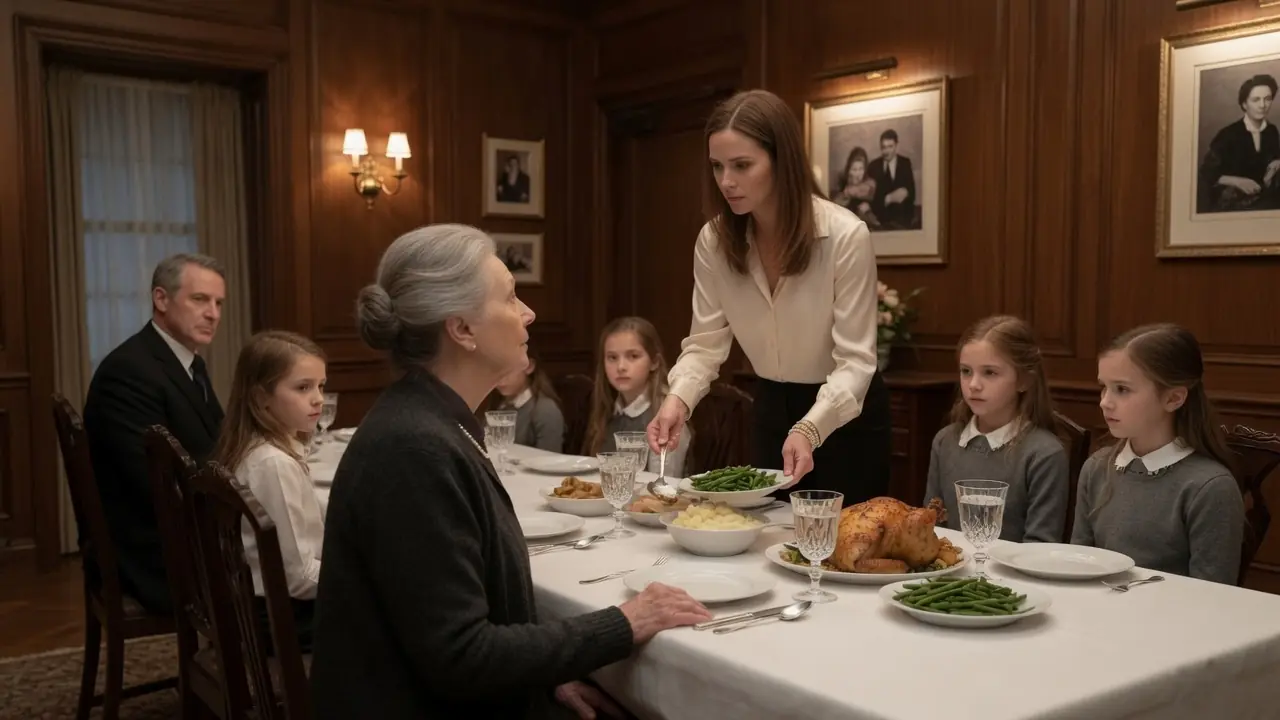
Vanessa Whitmore stood beside the table holding a silver serving spoon. Her cream satin blouse looked flawless, her chestnut hair fell neatly against her shoulders, and the pearls around her wrist caught the dining-room light whenever she moved. She had served herself, Daniel, and both children generous portions before deliberately walking past Margaret’s place.
Vanessa set the serving spoon down with a sharp metallic sound.
“Because my family comes first,” she said coldly. “You’re always last, so stop acting like you belong at this table.”
Margaret felt her heart tighten, but her face remained calm.
Daniel finally looked up. “Vanessa, that’s enough.”
“No, it isn’t,” Vanessa replied. “Your mother has been controlling this family for years. She shows up whenever she pleases, gives advice nobody asks for, and expects everyone to treat her like she owns the place.”
Margaret slowly turned toward her son.
Daniel said nothing.
That silence hurt more than Vanessa’s words.
Margaret had arrived at the house two hours earlier carrying two bottles of wine, a chocolate cake from the grandchildren’s favorite bakery, and a small envelope containing money for their upcoming school trip. She had expected a warm Sunday dinner, not gratitude or celebration, only a place at the table with the family she had spent years protecting.
Instead, Vanessa had greeted her with a tight smile and asked why she had come so early.
Margaret had almost laughed at the question.
The house belonged to her.
She had purchased it six years earlier after Daniel lost his job and the young family faced eviction from their apartment. Margaret used part of the life-insurance payment left by her late husband, Charles, to buy the four-bedroom home outright. Daniel and Vanessa were supposed to remain there for one year while rebuilding their finances.
Six years later, they were still living there without paying rent.
Margaret also covered the property taxes, insurance, utilities, private-school tuition, two vehicle payments, and several household credit cards. Every month, nearly twelve thousand dollars left her accounts to preserve the comfortable life Vanessa proudly called her own.
Margaret had never demanded repayment.
She believed family helped family.
But as she sat before the empty plate, she began to understand that generosity without boundaries did not always create gratitude. Sometimes it created entitlement so complete that the person receiving everything began to resent the giver for existing.
Vanessa crossed her arms.
“You come here and make everyone uncomfortable,” she continued. “The children feel judged. I feel judged. Daniel feels trapped between us.”
Margaret glanced at her grandchildren.
Eleven-year-old Sophie looked frightened. Thirteen-year-old Andrew stared at his plate with his jaw clenched.
“Do you feel judged by me?” Margaret asked them gently.
Neither child answered.
Vanessa stepped between Margaret and the children. “Don’t drag them into this.”
“I asked a question.”
“This is exactly what I mean. You challenge me in my own home.”
Margaret looked around the wood-paneled dining room. Family photographs hung in gold frames on the wall, including portraits paid for with her money. The curtains had been custom-made, the chandelier imported, and the table itself had once belonged to Margaret’s parents.
“In your home,” Margaret repeated.
Daniel finally spoke. “Mom, maybe we should all calm down.”
Margaret turned toward him. “Do you think I am the one who needs to calm down?”
He shifted uncomfortably. “Vanessa has been under pressure.”
“From what?”
“The children, the house, planning the charity gala.”
Vanessa gave him an irritated look, as though his explanation did not sound impressive enough.
Margaret rested one hand beside her untouched silverware. “Interesting. She has a housekeeper three days a week, a gardener, private-school transportation, and no job outside this home.”
Vanessa’s face reddened. “There it is. The judgment.”
“That was arithmetic, not judgment.”
“You always have to remind us what you pay for.”
Margaret almost smiled at the absurdity. “I have never mentioned it until tonight.”
“You don’t have to. Your money is always hanging over us.”
“Then perhaps you should stop accepting it.”
The room became completely silent.
Daniel’s head snapped toward his mother.
Vanessa gave a short, humorless laugh. “You would never do that.”
Margaret studied her daughter-in-law’s face.
There was no fear there.
Vanessa truly believed the money would continue no matter how she behaved. She believed Margaret’s love for Daniel and the children made her incapable of saying no. Every mortgage payment, tuition transfer, and credit-card bill had taught Vanessa that disrespect carried no consequence.
Margaret pushed back her chair and stood.
“You are right about one thing,” she said.
Vanessa lifted her chin.
“This is your family,” Margaret continued. “From now on, you may support it.”
Daniel rose immediately. “Mom, what does that mean?”
Margaret collected her handbag from the chair beside her. “It means I have suddenly lost my appetite.”
“Don’t be dramatic,” Vanessa said.
Margaret looked at the untouched food, then at the woman who had intentionally left her hungry in the house she owned.
“I am not being dramatic, Vanessa. I am finally paying attention.”
She walked toward the hallway.
Sophie stood so quickly that her chair scraped against the floor. “Grandma, wait.”
Margaret stopped and faced her granddaughter.
Sophie’s eyes were wet. “You can have my dinner.”
The offer nearly broke Margaret’s composure.
She crossed the room, kissed the girl’s forehead, and whispered, “Keep your dinner, sweetheart. None of this is your fault.”
Andrew looked toward his mother with open anger. “Why didn’t you give Grandma food?”
Vanessa’s expression hardened. “This is an adult issue.”
“No,” Andrew said. “It’s mean.”
Daniel finally seemed to realize how ugly the moment appeared through his children’s eyes. He stepped toward Margaret, but she moved away before he could touch her arm.
“Mom, please stay. I’ll fix you a plate.”
“You should have spoken before your daughter had to offer me hers.”
His face fell.
Margaret walked into the foyer, took her coat from the rack, and opened the front door. Behind her, Vanessa started complaining that the entire evening had been ruined.
Daniel did not follow his mother outside.
Margaret crossed the rain-darkened driveway and entered her black sedan. She placed her handbag on the passenger seat, shut the door, and sat silently with both hands resting on the steering wheel.
Through the windshield, she could see Vanessa standing in the doorway.
Daniel appeared behind his wife but remained inside.
Margaret’s chest hurt.
For thirty-nine years, she had protected her son from every hardship she could reach. When he failed a college course, she paid for summer classes. When his first business collapsed, she covered his debts. When Vanessa wanted a wedding far beyond their budget, Margaret wrote the check because Daniel said it would make his bride happy.
Each rescue had seemed like love.
Now Margaret wondered whether she had protected him so completely that he had never learned to protect anyone else.
She started the engine but did not drive away.
Instead, she pressed the call button on the steering wheel.
Her bank manager answered on the third ring.
“Good evening, Mrs. Whitmore. Is everything all right?”
“No, Mr. Collins. But it will be.”
Margaret picked up the folder she always kept inside the center console. It contained property documents, account summaries, and a list of recurring transfers her financial adviser had encouraged her to review months earlier.
She had ignored his warning.
Tonight, she finally understood it.
“I need you to cancel every automatic payment connected to Daniel Whitmore’s household,” she said.
There was a pause.
“Mrs. Whitmore, do you mean the discretionary transfers?”
“All of them. The utilities, school tuition, vehicle payments, credit cards, insurance, property maintenance, and monthly allowance.”
Mr. Collins sounded careful. “That will leave the family responsible for all outstanding expenses beginning tomorrow.”
“Exactly.”
“The mortgage account is unusual because the property is in your name.”
“There is no mortgage. I own the house outright.”
“Yes, ma’am.”
“Freeze their access to the household reserve account. No withdrawals, no transfers, no new charges.”
“May I ask whether this is temporary?”
Margaret watched Vanessa through the windshield.
Her daughter-in-law had stepped into the rain now, still holding a napkin from the dinner table. Daniel remained several feet behind her, looking worried but unwilling to approach the car.
“No,” Margaret answered. “Vanessa said her family comes first. From now on, she can pay for it.”
Mr. Collins confirmed the instructions and promised to send written documentation before midnight.
Margaret made a second call to her attorney, Evelyn Shaw.
“I want the Whitmore house listed for sale,” Margaret said.
Evelyn hesitated. “Daniel’s family is still occupying it.”
“They will receive proper legal notice.”
“Has something happened?”
“My daughter-in-law reminded me that I am not part of their family.”
Evelyn understood immediately.
“I’ll prepare the documents in the morning.”
Margaret ended the call.
Vanessa reached the driver’s window and knocked sharply on the glass.
Margaret lowered it only a few inches.
“What are you doing?” Vanessa demanded.
“Leaving.”
“You called someone.”
“My bank manager.”
For the first time that evening, uncertainty entered Vanessa’s face.
“Why?”
“I canceled the payments.”
“What payments?”
“Every payment that makes your life possible.”
Vanessa stared at her.
Margaret raised the window before another word could be spoken and drove away.
Her hands trembled for the first mile.
She expected guilt to overwhelm her, but something else gradually replaced it: relief.
For years, she had confused financial support with emotional closeness. She had believed that paying Daniel’s bills kept the family connected. In reality, it had allowed him and Vanessa to avoid responsibility while treating Margaret as an inconvenience attached to an endless bank account.
At home, Margaret removed her pearls, changed into a soft robe, and made herself scrambled eggs with toast.
It was a simple meal.
It tasted better than anything on Vanessa’s table.
At seven the following morning, Daniel called.
“Mom, what did you do?”
Margaret poured coffee before answering. “Good morning, Daniel.”
“The cards aren’t working. Vanessa tried to pay the school deposit, and the transaction was declined.”
“Yes.”
“The electric company emailed us saying automatic payment was canceled.”
“Yes.”
“She says you threatened to sell the house.”
“I did not threaten. My attorney is listing it.”
Daniel’s breathing became uneven. “You can’t sell our home.”
“It is my home.”
“We’ve lived here for six years.”
“And paid nothing for six years.”
“That was your choice.”
“You are correct. I am making a different choice now.”
Daniel lowered his voice. “Are you really doing this because Vanessa didn’t serve you dinner?”
Margaret closed her eyes.
“No, Daniel. I am doing this because she humiliated me and you watched. The empty plate simply made the truth impossible to ignore.”
“I told her she went too far.”
“When?”
“After you left.”
“Courage that arrives after the victim leaves is merely comfort for the coward.”
Daniel fell silent.
Margaret heard Vanessa shouting in the background.
“She wants to speak to you.”
“I do not want to speak to her.”
“Mom, please. The children’s tuition is due this week.”
“Then you and your wife should pay it.”
“We don’t have that kind of money.”
“You earn one hundred and twenty thousand dollars a year.”
“We have expenses.”
“You have luxuries.”
“This affects Sophie and Andrew.”
“The school has already received tuition through the end of the current semester. You have three months to make different arrangements.”
Daniel seemed surprised. Margaret had canceled future payments without harming the children’s immediate education.
“You planned this carefully,” he said.
“I made two phone calls.”
“Mom, you are destroying our family.”
“No. I have stopped financing the destruction that was already happening.”
She ended the call.
By noon, Vanessa had telephoned thirteen times.
Margaret ignored every attempt.
That afternoon, Evelyn arrived with the property documents. She explained that Daniel and Vanessa had legal occupancy but no ownership interest. They would receive ninety days to leave before the house was listed publicly.
Margaret signed the papers.
“What do you intend to do with the money?” Evelyn asked.
“Create education trusts for Sophie and Andrew. The rest will remain mine.”
“And Daniel?”
“He is thirty-nine years old.”
Evelyn smiled faintly. “That is not an answer.”
“It is the only answer he needs.”
Three days later, Daniel appeared at Margaret’s front door alone.
He looked exhausted.
His navy shirt was wrinkled, dark circles surrounded his eyes, and the confidence he normally wore had disappeared. Margaret allowed him inside but did not offer food or money.
He sat across from her in the living room.
“Vanessa says you’ve always hated her.”
“I never hated Vanessa.”
“She says you made her feel inferior.”
“I purchased her home, paid for her wedding, funded her children’s education, and covered every household expense she placed before me.”
“She says that was how you controlled us.”
Margaret leaned back. “Did I ever tell you where to work?”
“No.”
“Did I choose the children’s school?”
“No.”
“Did I enter the house without calling?”
“No.”
“Did I demand repayment?”
Daniel lowered his eyes. “No.”
“Then describe the control.”
He could not.
Margaret continued. “Vanessa wanted the benefits of my money without the discomfort of respecting the person who earned it.”
Daniel rubbed his hands together. “She’s panicking.”
“She should be.”
“She doesn’t know how we’ll afford everything.”
“That is because she never had to learn.”
“We can’t keep the house on my salary.”
“Then rent something you can afford.”
“The children will have to change schools.”
“Perhaps. Children survive smaller houses and public schools. What damages them is watching their father remain silent while their mother humiliates their grandmother.”
Daniel looked toward the family photographs on Margaret’s wall.
“I should have defended you.”
“Yes.”
“I was afraid Vanessa would explode.”
“So you allowed her to explode at me.”
He winced.
Margaret had spent years avoiding harsh truths with her son. She always softened disappointment, forgave quickly, and solved problems before he felt their full weight.
She would not do that again.
“Why did you let her treat me that way?” Margaret asked.
Daniel swallowed. “Because you always forgive me.”
The honesty hurt, but it also clarified everything.
“You believed losing my respect was safer than upsetting your wife.”
“Yes.”
“And now?”
“Now I think I may have already lost both.”
Margaret remained silent.
Daniel looked at her. “Is there anything I can do to stop the sale?”
“No.”
“Anything?”
“You can find a home you can afford and become the father your children need.”
“What about Vanessa?”
“That is your decision. But she will never again live on my money.”
Daniel nodded slowly.
Before leaving, he paused near the front door.
“I’m sorry about the dinner.”
Margaret met his eyes. “You are sorry about the consequences.”
He had no answer.
Two weeks passed.
The household collapse was faster than Vanessa expected.
Both luxury vehicles were leased through accounts funded by Margaret. Daniel surrendered one and kept the less expensive car. The housekeeper stopped coming when Vanessa could not pay her. The gardener canceled service, and the private credit cards were closed.
Vanessa began selling designer handbags online.
She blamed Margaret for every loss.
At dinner one evening, Andrew asked why his grandmother had been expected to pay for a house where she was not even given food. Vanessa ordered him to leave the table.
Daniel stopped her.
“No,” he said. “He asked a fair question.”
Vanessa turned toward her husband. “You’re taking her side now?”
“I should have taken the right side that night.”
“My family comes first.”
Daniel looked at the two children.
“So does mine.”
“You mean your mother.”
“I mean anyone in this family who is treated cruelly.”
Vanessa pushed back her chair. “She manipulated you with money.”
“No. She removed the money, and I finally saw what was underneath.”
Vanessa threw her napkin onto the table.
“You expect me to apologize?”
“I expect you to take responsibility.”
“For what? Wanting one dinner without her judging me?”
“For leaving an elderly woman without food at a table inside the house she bought for us.”
Vanessa stared at him.
Daniel continued before fear could silence him again.
“She paid for this house, our cars, the children’s school, our vacations, and your credit cards. You still treated her like a burden because you believed she would never stop.”
“She did it to control us.”
“Then why are you so desperate to keep taking it?”
Vanessa’s face changed.
For once, she had no prepared answer.
The argument lasted until midnight.
By morning, Vanessa had packed two suitcases and gone to her sister’s home. She expected Daniel to call, apologize, and promise to persuade Margaret to restore the accounts.
He did not.
Instead, Daniel began searching for an affordable apartment.
He sold expensive furniture they could not fit into a smaller home and used the money to settle outstanding bills. He contacted the children’s school and arranged for them to finish the semester before transferring to a public school near their future apartment.
For the first time in years, he knew exactly what his family cost.
The experience frightened and humbled him.
A month after the dinner, Daniel invited Margaret to meet him at a modest restaurant near her neighborhood. She nearly refused, but he said Sophie and Andrew wanted to see her.
When Margaret arrived, both children ran toward her.
Sophie hugged her first. “I’m sorry Mom didn’t give you dinner.”
“You did nothing wrong.”
“I should have said something sooner.”
“You offered me your plate. That was more courage than most adults showed that night.”
Andrew embraced her next.
“We’re moving,” he said.
“I heard.”
“Our new place is smaller, but Dad says we can paint our rooms.”
“That sounds wonderful.”
Daniel approached carefully.
He wore an inexpensive shirt Margaret had never seen and carried no request for money. They sat together, ordered simple meals, and spoke cautiously at first.
Vanessa had not returned home.
She wanted Daniel to challenge the sale and had threatened divorce when he refused. Daniel told Margaret he no longer knew whether the marriage could survive.
“I don’t want you to leave her because of me,” Margaret said.
“I’m not. I’m deciding whether I can stay married to someone who believes love means everyone obeys her.”
Margaret nodded.
When the food arrived, Daniel waited until the server had placed a meal before every person at the table.
Then he looked at his mother.
“You have everything you need?”
The question was small.
Margaret understood what it meant.
“Yes,” she said. “Tonight, I do.”
The Whitmore house sold four months later.
After taxes and fees, Margaret placed a portion of the money into protected educational trusts for Sophie and Andrew. Neither Daniel nor Vanessa could borrow against them, withdraw from them, or redirect them.
Margaret invested the remaining funds for her retirement.
She also canceled the monthly allowance permanently.
Daniel moved with the children into a three-bedroom apartment. He learned to cook, compare grocery prices, pay utilities, and say no when he could not afford something.
The children adjusted more easily than he expected.
Sophie liked living closer to school. Andrew enjoyed sharing household responsibilities with his father. Their lives became less polished but more honest.
Vanessa returned briefly, hoping Daniel would ask Margaret for another chance.
He refused.
When Vanessa demanded to know whether he was choosing his mother over his wife, Daniel finally answered without fear.
“I’m choosing a life where nobody has to be humiliated to keep you comfortable.”
They separated soon afterward.
Margaret did not celebrate the end of their marriage. She knew loss would touch the children no matter how carefully the adults handled it.
But she also knew peace built on another person’s silence was never real peace.
Six months after the empty-plate dinner, Daniel invited Margaret to his apartment for Sunday lunch.
The dining room was small, the chairs did not match, and the table had a scratch running across one corner. Daniel roasted a chicken himself, slightly overcooking it, while Sophie prepared mashed potatoes and Andrew made a salad.
Margaret sat at the head of the table only because the children insisted.
Daniel served her first.
Her plate held chicken, potatoes, green beans, and a warm roll.
He took his seat across from her.
“I’m sorry,” he said.
Margaret looked at him. “You have apologized before.”
“I know. But before, I wanted forgiveness so I could stop feeling guilty. Now I understand that you may never trust me the way you did.”
“That is true.”
“I’m still sorry.”
She reached across the table and placed her hand over his.
Trust would not return because of one meal. It would return through months and years of different choices.
But this was a beginning.
Sophie raised her glass of apple juice. “To Grandma.”
Andrew lifted his glass. “And to everyone getting food.”
They laughed.
Margaret looked around the modest apartment at the family eating food they had purchased, prepared, and served themselves. Nothing on the table was expensive, yet it felt richer than the elegant dinner where her empty plate had revealed the truth.
She had once feared that withdrawing her money would destroy the family.
Instead, it forced them to discover whether anything remained when the money disappeared.
Daniel learned responsibility.
The children learned that respect mattered more than luxury.
And Margaret learned that love did not require her to remain last in a family she had placed first for decades.
After lunch, Daniel walked her to the car.
“Do you regret selling the house?” he asked.
Margaret glanced back at the small apartment window, where Sophie and Andrew waved from behind the glass.
“No.”
“Do you regret helping us for so long?”
She considered the question.
“I regret helping in ways that prevented you from growing. But I will never regret loving you.”
Daniel’s eyes filled with tears.
Margaret entered her car and started the engine.
On the passenger seat rested a container of leftover chicken Sophie had packed for her. Her plate had been filled before everyone else’s, but that was not what mattered most.
What mattered was that no one at the table had been deliberately forgotten.
Margaret drove home peacefully, knowing her bank accounts were secure, her home was her own, and her love was no longer being confused with permission to mistreat her.
Vanessa had once declared that Margaret would always come last.
She had been wrong.
Margaret had finally placed herself first—and doing so had taught her son how to become a man worthy of sitting at her table again.