Hannah knew the bowl had fallen before she heard it hit the floor.
For one suspended second, she felt it slipping through her fingers.
Then came the sound.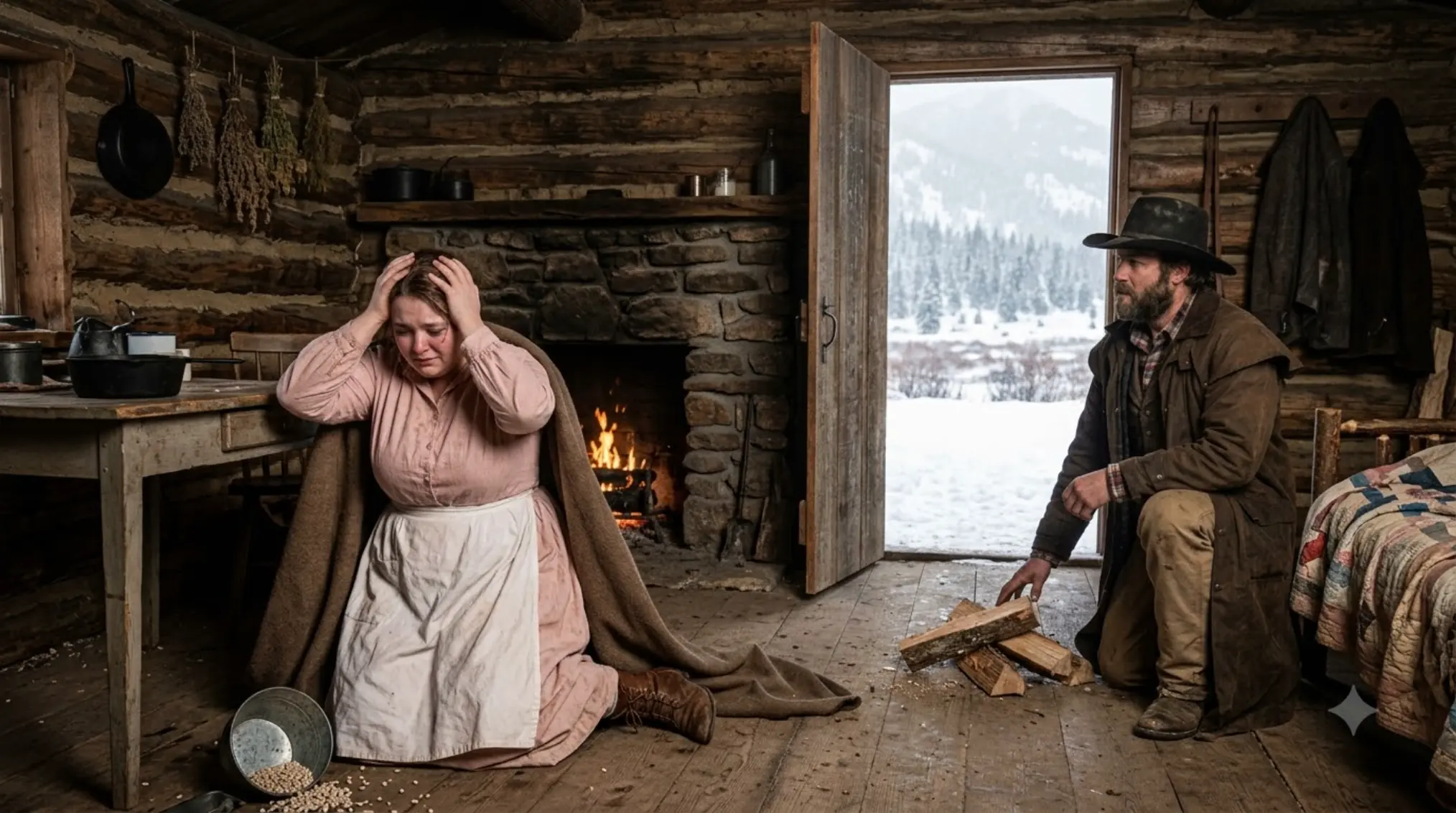
CLANG.
The tin bowl struck the wooden boards beside the kitchen table, bounced once, and rolled toward the stone fireplace.
Hannah stopped breathing.
The cabin door opened at almost the same moment.
Cold mountain air rushed inside.
Cole stood in the doorway carrying an armful of split pine.
Snow clung to his dark coat and shoulders. His black hat sat low above tired brown eyes, and his beard was dusted white around the edges from the frozen wind.
One piece of firewood slipped from his arms.
It struck the floor.
Hannah did not see his confusion.
She saw only a man standing behind her after she had made a mistake.
And her body remembered before her mind could stop it.
She dropped to her knees.
Both hands flew over her head.
Her shoulders curled inward.
“Please.”
Cole froze.
Hannah squeezed her eyes shut.
“I’ll clean it.”
He said nothing.
“I swear I’ll clean it.”
Still nothing.
Her voice broke.
“Just don’t hurt me.”
The silence inside the cabin changed.
Cole slowly lowered the rest of the firewood onto the floor.
He did not step closer.
“Hannah.”
She flinched.
His face tightened.
Not with anger.
With something far worse for a man like Cole to feel.
Understanding.
He finally understood why she had slept in her clothes for four nights.
Why she never turned her back when he entered a room.
Why she apologized whenever she ate a second helping.
Why she woke before sunrise and tried to complete every chore before he could ask.
Why she startled when he raised an ax outside.
Why she studied his hands whenever his voice became even slightly louder.
Cole removed his hat.
He lowered himself to one knee several feet away.
Not close enough to touch her.
“Hannah.”
She kept her arms over her head.
“A broken bowl will never make me raise a hand to you.”
Her breathing remained shallow.
Cole glanced at the harmless tin bowl beside the fireplace.
“It isn't even broken.”
Hannah slowly moved one arm.
She looked through strands of chestnut hair.
Cole remained exactly where he was.
Hands open.
Hat on the floor.
No belt removed.
No fist clenched.
No anger.
“Look at me,” he said quietly.
Her hazel eyes finally met his.
Cole swallowed.
“You don't have to hide your face in this house.”
Hannah stared at him as though he had spoken in another language.
Then she whispered the question that had been living inside her since the day he took her from town.
“Why?”
Cole frowned.
“Why what?”
“Why are you doing this?”
“Doing what?”
“Being kind.”
The question struck him harder than the accusation would have.
Hannah lowered her hands completely.
Tears had already streaked her face.
“You paid for me.”
Cole’s jaw tightened.
“I paid Martha to release whatever claim she believed she had over you.”
“You handed her three gold coins.”
“Yes.”
“So you bought me.”
“No.”
“That’s what she said.”
“She was wrong.”
Hannah looked at the floor.
“I belonged to her before.”
“You never belonged to her.”
“She fed me.”
“She worked you until your hands split.”
“She gave me somewhere to sleep.”
“She made you sleep beside the kitchen stove.”
Hannah’s eyes lifted sharply.
Cole had noticed more in one afternoon at the boarding house than most people had noticed in years.
He continued.
“She called you lazy while you were scrubbing clothes on your knees.”
Hannah said nothing.
“She called you worthless while taking every cent your work earned.”
His voice remained low, but something hard had entered it.
“I gave that woman gold because gold was the only language she respected.”
Hannah’s lips trembled.
“Then what did you buy?”
Cole looked at her for a long moment.
“Your way out.”
Four days earlier, Hannah had believed Cole was buying something else entirely.
The alley behind the boarding house had smelled of soap, mud, and old cooking grease.
Hannah knelt beside a wash tub.
Her hands were red and cracked from winter water despite the fact that spring had technically arrived.
Martha stood behind her.
“Faster.”
Hannah scrubbed harder.
“You eat enough for two people and work like half of one.”
Hannah kept her eyes lowered.
She had learned long ago that answers created consequences.
Martha was not truly her mother, although Hannah had called her that since childhood.
Her actual mother died when Hannah was seven.
Martha, her mother’s older sister, took her in.
For the first year, she was almost kind.
Then Hannah began growing.
By fourteen, she was taller and heavier than most girls her age.
By sixteen, every conversation seemed to involve her body.
Too large.
Too hungry.
Too slow.
Too embarrassing.
No man would want her.
She should be grateful Martha kept her.
Hannah learned to make herself smaller without actually becoming smaller.
She spoke softly.
Ate slowly.
Never requested seconds.
Avoided mirrors.
Worked until exhaustion looked like virtue.
By twenty-seven, she had become excellent at disappearing while standing directly in front of people.
Cole changed that accidentally.
He entered the alley carrying a bundle of pelts.
His boots crunched across the gravel.
Martha looked up.
“You're making enough noise to wake the dead.”
Cole stopped.
He was known throughout the town, though not well.
He came down from the Montana mountains roughly once a month.
Sold pelts.
Bought flour.
Coffee.
Salt.
Ammunition.
Lamp oil.
Then disappeared again.
Children whispered stories about him.
Some claimed he had killed a bear with a knife.
Others insisted he had once survived three weeks beneath an avalanche.
Cole denied none of it because Cole rarely talked enough to deny anything.
That afternoon he looked past Martha.
At Hannah.
Her sleeves were wet to the elbows.
One hand had started bleeding through a cracked knuckle.
Cole frowned.
“She looks exhausted.”
Martha laughed.
“She always looks that way.”
Hannah scrubbed faster.
Martha continued.
“Lazy people get tired doing anything.”
Cole’s eyes narrowed.
“She doesn't look lazy.”
“You interested?”
Martha’s tone turned cruelly playful.
Hannah stopped scrubbing.
Cole looked at her.
Not at her waist.
Not at her hips.
Her hands.
Then her face.
Martha laughed again.
“You want her, mountain man?”
Cole looked toward Martha.
“How much does she owe you?”
Hannah’s head snapped up.
Martha’s expression changed.
“Owe?”
“You tell everyone she costs you money.”
“Well, she does.”
“How much?”
Martha thought quickly.
“Five years of food. Lodging. Clothing.”
Hannah stared.
Most of Hannah’s clothing had been repaired so many times the original fabric hardly existed.
Cole reached inside his coat.
He removed a leather pouch.
Dropped it into the dirt.
Martha opened it.
Three gold coins.
Her eyes widened.
Cole said, “Take them.”
“For Hannah?”
“For whatever story lets you sleep tonight.”
Martha looked toward Hannah.
Then back at the gold.
“You seriously want her?”
Cole’s face hardened.
“I want you to stop talking about her like livestock.”
Martha picked up the pouch.
“She eats plenty.”
Cole stepped closer.
“She looks hungry.”
“She’s enormous.”
“She’s exhausted.”
Martha shrugged.
“You'll bring her back.”
Cole looked at Hannah.
“No.”
Something in the certainty of that word made Hannah’s throat tighten.
He turned toward her.
“Get your things.”
Hannah remained frozen.
Martha shouted, “You heard him!”
Hannah stood.
She owned almost nothing.
One faded shawl.
A comb.
Her mother’s small Bible.
Two dresses.
She packed them inside a cloth bag.
When she returned, Cole was waiting beside his horse.
He did not touch her.
He pointed toward the wagon.
“You can ride.”
Hannah stared at him.
“What do you want me to do?”
“Right now?”
“Yes.”
“Sit down.”
She obeyed immediately.
Cole’s expression changed.
He climbed into the wagon beside her.
They left town.
Hannah looked backward only once.
Martha stood in the alley counting the gold.
The mountain journey lasted almost six hours.
Cole asked very little.
Hannah volunteered less.
At midday he stopped beside a creek.
He handed her bread, cheese, and smoked meat.
Hannah ate half.
Then wrapped the rest.
Cole noticed.
“You don't like it?”
“I do.”
“Then eat.”
“I’ve had enough.”
Her stomach growled loudly.
Hannah turned red.
Cole pretended not to hear it.
He handed her another piece of bread.
“Eat.”
She stared.
That single word frightened her more than an insult.
Martha used food as punishment.
Hannah had spent years hearing that every extra bite explained why nobody would want her.
Now a stranger was putting food in her hand.
No joke.
No disgust.
No price.
She finished everything.
Later, the wind became brutal.
Hannah started shaking.
Cole removed the buffalo-hide coat from his shoulders and placed it around hers.
She immediately tried returning it.
“You’ll freeze.”
“I won't.”
“You need it.”
“So do you.”
He kept driving.
Hannah held the coat closed.
It smelled of smoke, leather, pine, and cold air.
No man had ever given her clothing because she was cold.
That fact should not have been extraordinary.
To Hannah, it was.
The cabin appeared near sunset.
Small.
Built from thick logs.
Stone chimney.
Woodpile stacked under a lean-to.
A narrow porch overlooking a valley of snow-covered pine.
Hannah expected dirt.
Chaos.
Perhaps animal skins thrown everywhere.
Instead, the cabin was simple but carefully maintained.
One bed in a back alcove.
A second smaller sleeping space separated by a heavy curtain.
Kitchen table.
Iron stove.
Stone fireplace.
Shelves.
Tools.
Books.
Cole carried her bag inside.
“This room is yours.”
Hannah stared at the small separate sleeping space.
“Mine?”
“Yes.”
“Where do you sleep?”
“There.”
He pointed toward the opposite side.
Hannah hesitated.
“When do you want me to start?”
“Start what?”
“Working.”
“Tomorrow if you feel like it.”
“If?”
Cole frowned.
“You're tired.”
Hannah stared at him.
“I can cook.”
“So can I.”
“Clean?”
“Cabin isn't that dirty.”
“I can mend your clothes.”
“Probably useful.”
She waited.
Cole filled two bowls with stew simmering over the stove.
He placed one in front of her.
“Eat.”
Hannah sat.
That was his first order.
Not scrub.
Not wash.
Not obey.
Eat.
She cried halfway through the bowl.
Quietly enough that Cole pretended not to notice.
During the first week, Hannah tried to earn every minute she existed in the cabin.
She woke before Cole.
Swept.
Made breakfast.
Carried water.
Scrubbed floors.
Washed clothes.
Organized shelves.
By the third morning, Cole caught her moving a heavy sack of flour.
“What are you doing?”
“Putting it closer to the stove.”
“I can move it.”
“I can too.”
“I know.”
Hannah paused.
That answer confused her.
Martha always treated help as evidence Hannah was incapable.
Cole could offer help without turning it into judgment.
He lifted the sack.
Hannah moved the shelf.
Together they placed it.
No comment.
No lecture.
No debt created.
Hannah began learning the cabin.
Which floorboard squeaked.
How much wood the stove needed overnight.
Where Cole stored traps.
Which cup had a cracked handle.
What time sunlight reached the east window.
She also learned Cole.
He woke at five.
Preferred coffee black.
Read before bed.
Rarely raised his voice.
Whistled badly when sharpening knives.
Always left the largest portion of meat on Hannah’s plate and pretended it happened accidentally.
One evening she caught him.
“You gave me more.”
Cole looked at both plates.
“Did I?”
“Yes.”
“Must have slipped.”
Hannah almost smiled.
“You always slip.”
“Clumsy man.”
It was the first joke she made in his presence.
Cole looked at her.
Then smiled.
Hannah immediately looked away.
But something had begun.
The bowl incident happened on the tenth day.
After Cole knelt beside her, Hannah remained on the floor.
He waited.
Minutes passed.
Finally she asked:
“If I don't belong to you, can I leave?”
“Yes.”
“Now?”
“If you want.”
“How?”
“I’ll take you wherever you choose when the weather clears.”
“Even back to town?”
“If that's what you want.”
She studied his face.
“You paid three gold coins.”
“I know.”
“And you'd just let me go?”
“Yes.”
“Then why?”
Cole looked toward the fire.
For once, the mountain man seemed uncomfortable.
“I saw someone being treated badly.”
“That’s all?”
“At first.”
Hannah noticed the final words.
“At first?”
Cole looked back at her.
“I don't know you yet.”
“No.”
“But I want to.”
Hannah’s heart moved strangely.
Cole continued.
“That's different from owning someone.”
She wiped her face.
“What if you don't like what you learn?”
“Then we'll know.”
“And if I don't like you?”
Cole smiled faintly.
“Then I'll try not to take it personally.”
A small laugh escaped her.
Hannah covered her mouth.
Cole smiled wider.
The broken bowl remained on the floor between them.
Neither cared.
The following weeks changed her slowly.
Not dramatically.
Fear rarely disappears because someone gives one good speech.
It retreats through repetition.
Cole dropped a cup.
Nobody screamed.
Hannah burned biscuits.
Cole ate them.
She tore one of his shirts accidentally.
He asked whether it could be repaired.
When she said yes, the matter ended.
She overslept one morning.
Instead of anger, she woke to coffee already made.
Each ordinary response contradicted something she had learned about the world.
Hannah began eating until she was full.
The first time she requested another biscuit, her hand trembled.
Cole simply passed the basket.
No comment.
Her cheeks gained color.
Her cracked hands began healing.
Her shoulders stopped curling forward.
One morning Cole noticed her humming while kneading bread.
He leaned against the doorway.
Hannah stopped.
“What?”
“Nothing.”
“Why are you looking at me?”
“You were singing.”
“I was not.”
“You were.”
“I was humming.”
“Very loudly.”
She threw a flour-covered cloth at him.
Cole ducked.
Hannah froze afterward, shocked by herself.
Then Cole laughed.
Hannah laughed too.
The sound filled the cabin.
And for one perfect moment, she forgot to be afraid.
Spring reached the mountains late.
Snow retreated from the valley.
Streams widened.
Cole began preparing traps farther north.
Hannah planted herbs beside the cabin.
One afternoon she found him repairing a fence.
“Could grow potatoes there.”
Cole looked toward the patch she indicated.
“Too rocky.”
“No.”
“Yes.”
Hannah put both hands on her hips.
“My father grew potatoes in worse soil.”
“You farmed?”
“Until he died.”
Cole stopped working.
Hannah rarely discussed her past.
She continued.
“We had twelve acres.”
“What happened?”
“Martha sold them.”
“Were they hers?”
“No.”
Cole stared.
Hannah shrugged.
“She said a woman couldn't manage the farm.”
“Could you?”
“Yes.”
No hesitation.
Cole looked across his own rough clearing.
“How many potatoes?”
Hannah blinked.
“What?”
“How many could we grow?”
Her eyes narrowed.
“Are you asking my opinion?”
“I believe so.”
“Dangerous habit.”
“I’m learning.”
That evening they planned the garden together.
For the first time since childhood, Hannah felt useful without feeling used.
The distinction changed everything.
Then Martha came.
Cole was splitting wood when he heard horses.
Three riders appeared.
Martha sat in a wagon with a thin-faced man wearing a good coat.
Hannah came outside.
The moment she saw Martha, color disappeared from her face.
Cole noticed immediately.
He set down the ax.
Martha smiled.
“There you are.”
Hannah did not answer.
The man beside Martha climbed down.
“Cole?”
“Yes.”
“My name's Peterson. Martha says there's been a misunderstanding.”
Cole looked at Hannah.
“What misunderstanding?”
Martha answered.
“She wants Hannah back.”
Hannah’s eyes widened.
“I don't.”
Martha glared.
“Be quiet.”
Cole’s entire posture changed.
“Don't speak to her like that.”
Martha scoffed.
“She belongs with family.”
Hannah whispered, “You sold me.”
Martha’s face hardened.
“That arrangement wasn't legal.”
Cole nodded.
“Good.”
Martha blinked.
“What?”
“Then nobody bought anyone.”
He stepped beside Hannah.
“She stays if she wants. Leaves if she wants.”
Martha turned toward Hannah.
“You think this man actually wants you?”
Hannah stiffened.
Cole saw the old wound open instantly.
Martha continued.
“He'll tire of feeding you.”
Cole’s jaw clenched.
Hannah’s eyes lowered.
Martha smiled because she recognized her old power returning.
“You'll come crawling back.”
Hannah remained silent.
Cole wanted to answer.
He wanted to destroy every cruel word.
Instead he looked at Hannah.
Because this decision belonged to her.
“Hannah?”
She slowly raised her head.
Martha said, “Come.”
Hannah looked toward the cabin.
Garden.
Woodpile.
Window.
Door that had never been locked against her.
Then she looked at Cole.
He said nothing.
No pressure.
Hannah turned toward Martha.
“No.”
Martha’s smile disappeared.
“What?”
“No.”
“You ungrateful—”
“No.”
Hannah stepped forward.
Her voice shook.
But it existed.
“You spent twenty years telling me nobody would want me.”
Martha stared.
“You were wrong.”
Cole looked at Hannah.
She continued.
“And even if he didn't want me tomorrow, I still wouldn't go with you.”
Something powerful changed in her face.
“Because I want myself now.”
Silence.
Martha had no answer.
She left.
Hannah watched the wagon disappear.
Then her knees weakened.
Cole caught her elbow.
She did not flinch.
That was when both of them realized how much had changed.
That evening Hannah sat beside the fireplace.
Cole brought tea.
She looked at him.
“You could have answered her.”
“I know.”
“Why didn't you?”
“Because she was asking about your life.”
He handed her the cup.
“You get to answer.”
Hannah studied him.
“You really meant that.”
“What?”
“That I can leave.”
“Yes.”
She looked toward the window.
“I don't want to.”
Cole became very still.
Hannah continued before courage disappeared.
“I thought I would.”
He sat across from her.
“And now?”
“Now this feels like home.”
Cole swallowed.
“Good.”
Hannah laughed softly.
“That's all?”
“No.”
He rubbed his beard.
“I’m trying not to ruin this.”
Her smile grew.
“Cole.”
“Yes?”
“Say what you're trying not to say.”
He looked at her.
For a man capable of surviving blizzards alone, the request appeared terrifying.
Finally:
“I want you here.”
“I know.”
“Not because the cabin needs cleaning.”
“I know.”
“Not because I need cooking.”
“I know.”
“Not because I paid Martha.”
Hannah’s expression softened.
Cole leaned forward.
“I want you here because mornings are better when you're in them.”
Hannah’s eyes filled.
He continued.
“Because I hear you singing when you think I’m outside.”
“Humming.”
“Very loud humming.”
She laughed through tears.
“Because you argue about potatoes.”
“Someone has to.”
“And because when I imagine this cabin empty again…”
He stopped.
Hannah waited.
“I don't want it.”
She looked at him for a long time.
Then quietly:
“Neither do I.”
They did not kiss that night.
That mattered to Hannah.
Cole did not turn confession into payment.
He let the words exist.
Weeks later, the kiss happened beside the garden.
Hannah had dirt on her cheek.
Cole pointed.
“You've got something.”
“Where?”
He reached toward her.
Stopped.
“May I?”
Hannah looked at his hand.
Months earlier, the movement would have frightened her.
Now she nodded.
Cole gently brushed dirt from her cheek.
His fingers lingered.
Hannah looked at him.
“So?”
“So what?”
“You going to stand there staring?”
Cole smiled.
“I’m waiting.”
“For?”
“Permission.”
Hannah stepped closer.
“Kiss me, Cole.”
He did.
Slowly.
Gently.
One hand resting against her cheek.
Hannah cried afterward.
Cole immediately worried.
“Did I—”
“No.”
She laughed.
“No.”
“Then why are you crying?”
“Because I wanted it.”
Cole understood.
Perhaps not completely.
But enough.
By autumn, Hannah had transformed the clearing.
Potatoes.
Onions.
Carrots.
Herbs.
Two chickens became eight.
Cole built another storage shed because Hannah’s preserving jars occupied half his shelves.
She also began keeping his trading accounts.
One evening she discovered he had been accepting poor prices from a fur buyer for three seasons.
“You're being cheated.”
Cole stared at the ledger.
“By how much?”
“Enough that I’m offended personally.”
He laughed.
They renegotiated.
Winter came again.
This time when the first snow fell, Hannah stood outside beside Cole.
She wore his old buffalo coat.
He looked at her.
“Cold?”
“Yes.”
“Inside?”
“In a minute.”
She watched the flakes settle across the trees.
A year earlier, winter meant fear.
Now it meant firewood stacked high.
Food preserved.
Someone beside her.
Safety had become ordinary.
That was the miracle.
Cole proposed during the first heavy storm.
No ring.
No kneeling theatrically.
They were sitting at the kitchen table.
Hannah was repairing his glove.
Cole said:
“Marry me.”
Hannah looked up.
“That was romantic.”
“I’ve been practicing.”
“You should have practiced longer.”
Cole grinned.
Then became serious.
“I don't want to own you.”
“I know.”
“I don't want gratitude.”
“I know.”
“I don't want you saying yes because I gave you somewhere safe.”
Hannah put down the glove.
“Cole.”
He stopped.
“You didn't give me a life.”
His expression changed.
“You gave me enough peace to discover I still had one.”
Cole’s eyes lowered.
Hannah reached across the table.
She placed her hand over his.
“And I choose this one.”
He looked at her.
“With me?”
“With you.”
“That's a yes?”
Hannah smiled.
“Yes.”
Cole kissed her hand.
No gold exchanged.
No bargains.
No witnesses required.
They married in the spring.
Small ceremony.
A preacher rode up from town.
Two neighboring families attended.
Hannah wore a pale-pink dress she had sewn herself.
Cole wore a clean dark coat and looked more nervous than she had ever seen him.
Before the ceremony, Hannah stood alone inside the cabin.
Her eyes landed on the place beside the table where the tin bowl had fallen months earlier.
She remembered herself kneeling there.
Hands above her head.
Waiting for pain.
That woman felt both distant and terribly close.
Cole appeared in the doorway.
He did not cross it immediately.
“You ready?”
Hannah smiled.
“Yes.”
Then she walked toward him.
Not because he ordered her.
Not because somebody paid.
Not because she had nowhere else to go.
Because she chose every step.
Cole extended his hand.
Hannah placed hers inside it.
Years later, travelers occasionally stopped at their cabin.
Some had heard stories about the mountain man who once paid three gold coins for a woman everyone else dismissed.
Hannah hated that version.
“You didn't pay for me.”
Cole would answer:
“I know.”
“You paid Martha to disappear.”
“Best purchase I ever made.”
Hannah would glare.
Cole would laugh.
Then she would too.
The three gold coins became part of local legend.
People focused on them because gold made a better story.
But Hannah knew the important part happened later.
A bowl falling.
A man entering.
A frightened woman dropping to her knees.
And nothing happening.
No blow.
No insult.
No punishment.
Only a man kneeling several feet away and saying:
A broken bowl will never make me raise a hand to you.
That sentence changed more than the gold ever could.
Because Hannah had spent years believing kindness always carried a price.
Cole taught her something different.
Real kindness did not demand repayment.
Real love did not require fear.
And home was not the place where someone agreed to keep you.
Home was the place where you were finally safe enough to stop asking whether you deserved to stay.
One winter evening, years after their wedding, Hannah accidentally knocked another tin bowl from the table.
It hit the floor.
CLANG.
She froze.
Only for a second.
Cole looked over from the fireplace.
Hannah looked at him.
Then at the bowl.
Then back at him.
Cole raised an eyebrow.
“Planning to leave that there?”
Hannah put both hands on her hips.
“You have legs.”
Cole laughed.
She laughed too.
And the sound filled the cabin where fear had once lived.
That was how Hannah knew she had finally become free.