“Take off everything now.”
Abigail Hart froze in the open doorway of the mountain cabin, snow blowing against her back and melting into the torn sleeves of her dress. Her hair clung wetly to her cheeks, her lips were blue from the cold, and her hands tightened over the front of her soaked bodice as if she could hold herself together by force. Across the room, Silas Boone stood beside the iron stove, broad-shouldered, bearded, and covered in snow, his dark coat dripping onto the rough floorboards.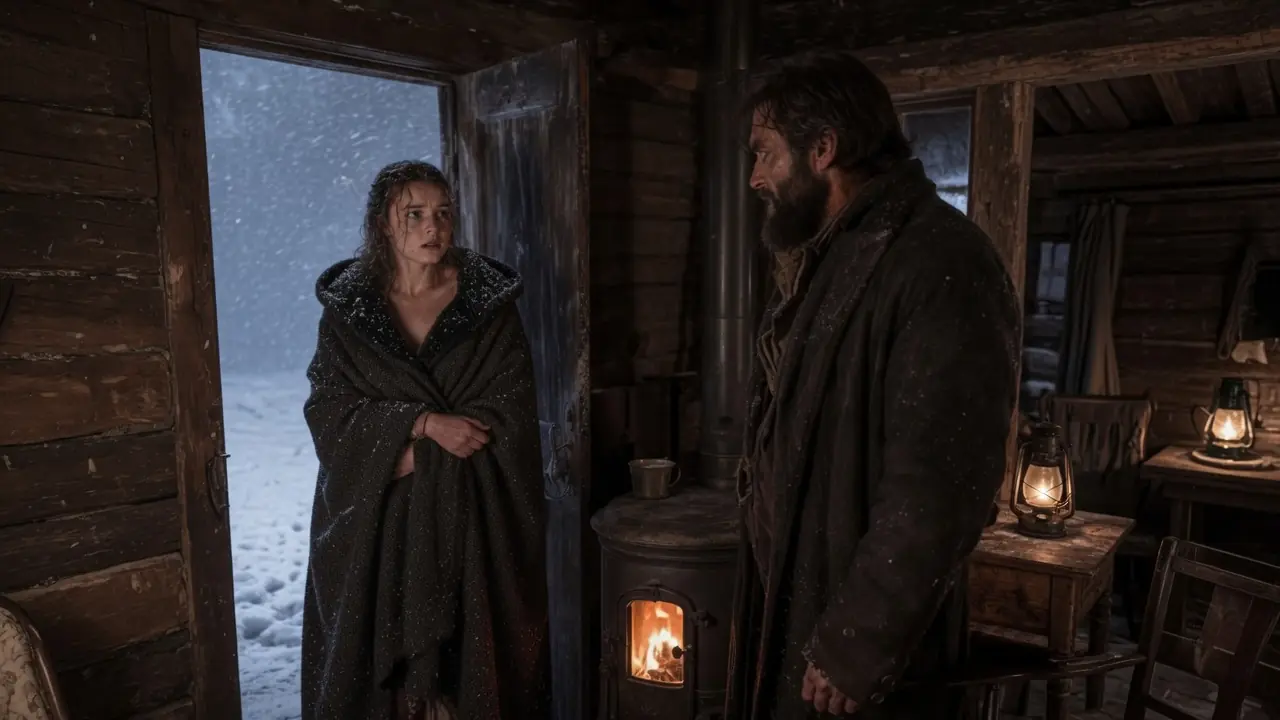
To Abigail, he looked exactly like the monster Red Hollow had promised he was. The mountain man. The hermit. The man children whispered about when the sun went down. And now he was standing between her and the storm, telling her to take off everything.
“Please,” she whispered, backing against the doorframe. “Don’t touch me.”
Silas’s jaw tightened, but he did not step closer. For one terrible second, Abigail thought anger would come next. That was what men in Red Hollow always did when a woman did not obey fast enough. They raised their voices, raised their hands, or smiled in a way that made fear crawl beneath the skin.
Instead, Silas turned away.
He crossed the room, grabbed a thick wool blanket from a peg near the wall, and tied it between two beams so it hung like a curtain across the cabin. Then he took a bundle of dry clothes from a wooden chest and placed it on a chair near the stove. His movements were rough, but careful, like a man handling something fragile without wanting anyone to notice.
“I ain’t touching you,” he said, his voice low. “Those clothes are wet through. You stay in them, you’ll freeze dead before morning.”
Abigail stared at the blanket. Then at the dry clothes. Then at him.
On the table beside the chair, Silas placed a heavy iron key and an old rifle. He set both down slowly, making sure she saw them. “Door locks from the inside,” he said. “Gun is loaded. You know how to use one?”
Her throat worked, but no sound came out.
Silas nodded once, as if her silence was answer enough. “Point the barrel at what scares you. Don’t close your eyes.”
Abigail’s eyes filled with tears. “Why are you giving me that?”
Silas looked toward the open door, where the blizzard screamed across the mountain in white sheets. “Because I didn’t buy you to own you.”
The words landed strangely, almost without meaning at first. Buy. Own. Her whole body recoiled from them because that was what had happened in Red Hollow, no matter how politely they had dressed it. An auction in the town square. A debt notice pinned to the post. Men pretending it was charity while looking at her like something that could be measured, priced, and carried away.
Silas pulled his hat lower and stepped toward the doorway.
Abigail’s voice broke. “Where are you going?”
“Outside,” he said. “Until you believe this cabin is yours before it is mine.”
Then Silas Boone walked out into the blizzard and shut the door behind him.
For a long time, Abigail did not move. The stove crackled softly, throwing orange light against the cabin walls. Snow hissed against the door. The blanket curtain stirred slightly in the draft. On the chair lay a clean wool shirt, a pair of trousers, thick socks, and a folded quilt.
The key and rifle remained on the table.
Abigail stared at them until her knees nearly gave out.
That morning, she had belonged to no one. By noon, Red Hollow had decided otherwise. By nightfall, the most feared man in the territory had given her a locked door, a weapon, and the first choice anyone had offered her in months.
Her teeth began to chatter so violently that she could no longer think. She stumbled behind the blanket, fingers clumsy as she worked at the buttons of her wet dress. The fabric stuck to her skin like cold hands. Every movement hurt, but beneath the fear came something else, something practical and stubborn.
Survive first.
Understand later.
She changed as quickly as she could, keeping her eyes on the blanket, half expecting Silas to return. He did not. The dry clothes were too large, clearly his, but warm and clean. She wrapped the quilt around her shoulders and sat near the stove, still trembling, still watching the door.
The rifle sat within reach.
Outside, Silas Boone stood under the narrow porch roof with his back against a post, snow gathering on his hat and shoulders. He had spent years in storms worse than this, but age and loneliness had a way of making cold bite deeper. He crossed his arms and stared into the white dark, listening for any sound from inside the cabin.
He knew what she thought of him. He had seen it in her eyes the moment he won the bidding in Red Hollow. Not won. That word made his stomach twist. He had paid the highest price because no one else in that crowd had looked at Abigail Hart like a person.
The town had gathered after the noon bell, pretending the matter was legal. Her late father’s debt to the mercantile. Her mother’s medical bill. The boardinghouse account. The mayor called it “contracted service,” but everyone knew what it meant. A woman without family could be handed to whoever paid enough, and the town would call it settlement.
Abigail had stood on the platform in a faded brown dress, chin lifted though her hands shook. Men who had never offered a crust of bread when she was hungry suddenly laughed about how useful she might be. One rancher said he needed kitchen help. Another said his bunkhouse could use cleaning. A third, old enough to be her grandfather, asked if she was strong enough to bear winter work.
Then Silas Boone had ridden into town.
He had not meant to stop. He came only for nails, salt, lamp oil, and coffee. He heard the laughter before he saw the platform. Then he saw Abigail, pale but unbowed, standing before the crowd like a deer surrounded by wolves.
The mayor tried to smile when Silas dismounted. “Boone. Didn’t expect to see you here.”
Silas looked at Abigail, then at the paper in the mayor’s hand. “What’s this?”
“A debt settlement.”
“That ain’t what I asked.”
The crowd grew quiet because Silas Boone did not speak often, and when he did, men listened despite themselves. He had earned his name in the mountains through silence, strength, and stories no one could fully prove. Some said he had killed three men in a mining camp fight. Some said he had buried his own family and gone mad with grief. Some said wolves left his cabin alone because even wolves knew better.
The mayor cleared his throat. “Miss Hart owes the town. Since she cannot pay, her service is being assigned to a lawful household.”
Silas’s eyes moved over the men near the platform. “Looks more like buzzards waiting on a weak animal.”
A few men bristled. None stepped forward.
The bidding began anyway.
Silas waited until the old rancher made his offer. Then he doubled it. When another man tried to raise, Silas raised again. By the time the crowd realized the mountain man intended to take her, the mood had shifted from amusement to discomfort.
Abigail stared at him with horror.
That expression had followed him all the way up the mountain.
Now, standing outside his own cabin while the storm carved through his coat, Silas wondered if saving someone always felt this much like becoming the villain in her eyes. Maybe it did. Maybe a man like him could only offer safety through a shape that looked too much like danger.
Inside, Abigail slowly warmed enough to think. The cabin was rough but not filthy. Firewood was stacked by the stove. Dried herbs hung from a beam. A small table held two tin cups, a loaf of bread, and a pot of stew cooling near the fire. There were no chains, no locked interior doors, no signs that a woman had been trapped there before.
Still, she did not trust it.
She picked up the key first. It was heavy and iron-black, cold in her palm. She crossed to the door, slid the bolt, turned the lock, and tested it. The door held. Then she lifted the rifle, awkwardly at first, surprised by its weight. She had fired a gun only twice in her life, both times under her father’s watch when she was fifteen.
Point the barrel at what scares you. Don’t close your eyes.
She sat with the rifle across her lap until the stew smell reached her. Hunger, long ignored, woke inside her with painful force. She had eaten nothing since dawn except a heel of bread she stole from her own pantry before the creditors entered the house.
Her house. No longer hers now.
The Hart cabin in Red Hollow had been small, but it had once held music. Her father played fiddle on Sundays. Her mother sang while kneading dough. Abigail used to press flowers between pages of old books and dream of becoming a schoolteacher in a town where no one knew how poverty could stain a name.
Then fever took her mother. Debt took her father’s peace. A winter fall took her father’s life. After that, the town took everything else.
She ate the stew slowly, hating herself for needing it and hating Red Hollow more for teaching her to feel shame over hunger. The food was plain, thick with beans, rabbit, and potatoes, but it warmed her from the inside until her hands stopped shaking.
An hour passed.
Then another.
At last, guilt began to gnaw at her. Silas was still outside.
Abigail told herself she did not care. He had bought her. He had carried her away while the whole town watched. He had frightened her with his first command, even if he had meant it differently. But the storm was worsening, and even feared mountain men could freeze.
She rose, keeping the rifle in one hand, and opened the door a crack.
Snow burst inward.
Silas stood beside the porch post, head bowed, beard white with ice. He looked over slowly. “You warm?”
Abigail swallowed. “You’ll freeze out there.”
“Maybe.”
“Come inside.”
“Door locks from your side.”
“I know.”
He waited.
Abigail understood then that he would not enter unless she chose it. That choice, small as it seemed, shook her more deeply than any force could have. She stepped back from the doorway, rifle still in her grip.
“You can come in,” she said. “But stay by the stove.”
Silas entered carefully, bringing cold with him. He shut the door, stomped snow from his boots, then held both hands away from his sides so she could see he meant nothing sudden. He moved to the stove and crouched before it, feeding in two split logs.
For several minutes, neither spoke.
Abigail stood near the table wrapped in the quilt, the rifle angled downward but ready. Silas kept his back partly turned, warming his hands over the fire. The cabin felt smaller with him inside, but not in the way she had feared. His silence made space rather than taking it.
Finally, she said, “Why did you do it?”
Silas did not look back. “Because no one else was going to.”
“That’s not an answer.”
“It’s the only one I’ve got.”
“You paid money.”
“I had money.”
“For me.”
“For your debt.”
Abigail’s voice sharpened. “And what do you expect in return?”
Silas turned then, slowly. His eyes were dark, tired, and clearer than she expected. “Nothing you don’t offer freely.”
She almost laughed because the words were too clean for a world so dirty. “Men say things.”
“Yes,” he said. “They do.”
“Then why should I believe you?”
“You shouldn’t. Not yet.”
That answer unsettled her. A lying man usually demanded trust quickly. Silas seemed prepared to live without it.
He reached into his coat and pulled out a folded paper. Abigail stiffened, but he placed it on the table and slid it toward her with two fingers. “Debt paper. Mayor signed it over when I paid.”
She did not touch it. “What does it say?”
“Says your debt is settled.”
“And my service?”
Silas’s mouth tightened. “I made him cross that part out.”
Her eyes snapped to his face.
He nodded toward the paper. “Read it yourself.”
Abigail picked it up. Her hands trembled as she unfolded it. The legal words swam at first, but she found her name, the amount, the mark of payment, and a dark line scratched firmly through the sentence about assigned service. Beneath it, in the mayor’s hand, was written: Debt satisfied in full. No further claim.
For the first time since the platform, Abigail felt the floor beneath her feet.
“You paid all that to cross out a sentence?” she whispered.
Silas looked back at the fire. “That sentence was the part that needed killing.”
Her throat burned. “Why didn’t you say so in town?”
“Would you have heard me over everyone laughing?”
She looked down.
No. She would not have. Shame had roared too loudly. Fear had made every face into a threat. She had seen him bid, seen the mayor hand him the paper, seen the crowd part as if she were already gone from herself. She had not seen the line crossed out.
Silas stood and took a tin cup from the shelf. “There’s coffee if you want it. I’ll sleep in the barn when the storm eases.”
“You live here.”
“So?”
“So where am I supposed to go?”
He looked at her then, as if the question hurt. “Wherever you decide. Stay here until spring if you need. I’ll sleep in the barn or build another room. Come thaw, I can take you west to Fort Laramie, east to Cheyenne, or back to Red Hollow if you’ve a mind to spit in their eyes.”
Abigail stared at him. “You’d let me leave?”
“I gave you the key.”
The answer should have comforted her. Instead, it broke something open. She turned away before he could see her face, but the tears came fast, hot and humiliating. She pressed one hand to her mouth, trying to stop them.
Silas did not move toward her.
That was the kindness that undid her completely.
She cried for her mother, her father, the house lost to debt, the platform, the laughter, the cold, and the terrible relief of not being touched when she had prepared herself to endure anything. She cried until her knees weakened, and she sat heavily on the chair near the table.
Silas poured coffee into a cup and placed it within reach, then retreated to the stove.
“You got kin?” he asked after a long while.
“No.”
“Friends?”
She wiped her cheeks with the sleeve of his too-large shirt. “Not anymore.”
“Red Hollow good at that,” he muttered.
“You know them?”
“I know enough.”
His voice carried a history she did not yet understand. Abigail looked at him through swollen eyes. “Why do they fear you?”
Silas added another log to the stove. “Because they can’t use me.”
“That’s all?”
“No. But it’s enough for most folks.”
Later, when the storm softened from a scream to a low moan, Silas gathered a bedroll from the corner. Abigail watched him, confused. “Where are you going?”
“Barn.”
“You’ll freeze.”
“Barn’s warmer than outside.”
She glanced toward the single narrow bed against the wall. He had not gone near it. Not once. Something heavy shifted in her chest.
“You can sleep by the stove,” she said.
Silas paused. “You sure?”
“No.”
A rough sound escaped him, almost a laugh but not quite. “Fair.”
He lay down near the stove, boots still on, coat folded beneath his head. Abigail kept the rifle beside the bed and the key under her pillow. She expected to stay awake until dawn, but exhaustion pulled her under before the fire burned low.
She woke once in the night to find Silas placing another log in the stove. He saw her eyes open and lifted both hands slightly. “Just the fire.”
She nodded and closed her eyes again.
In the morning, the world outside was buried in white. Sunlight struck the snow so brightly it hurt to look at. Abigail woke beneath heavy quilts, warm for the first time in days. The cabin smelled of coffee and fried cornmeal.
Silas was outside chopping wood.
For a few minutes, Abigail lay still and listened. Chop. Split. Stack. The rhythm was steady, ordinary, almost peaceful. Then she remembered she was wearing his clothes, sleeping in his cabin, holding a key to a door he had allowed her to lock against him.
She sat up quickly.
On the table, beside breakfast, was a note written in blocky letters.
You are free to leave. Storm buried the road. Best not to try today. Rifle loaded. Coffee hot. — S.B.
Abigail read it three times.
No one had ever written her freedom down before.
She ate breakfast slowly, then found her dress hanging near the stove, dry but stained beyond repair. She touched the fabric and remembered the platform. The dress had been her mother’s once, altered after her death. Red Hollow had watched her stand in it while men bid over her future.
She folded it carefully, then set it aside.
Silas returned with an armload of wood. He stopped when he saw her standing near the stove. “Morning.”
“Morning.”
His shirt sleeves were rolled despite the cold, and snow melted in his beard. In daylight, he looked less like a monster and more like a tired man who had spent years speaking mostly to weather. His hands were scarred, his eyes watchful, and his presence filled the cabin without crowding it.
“I need work,” Abigail said.
He blinked. “Work?”
“If I stay, I work.”
“You’re not a hired hand.”
“I won’t be charity.”
Silas studied her for a moment, then nodded. “Can you cook?”
“Yes.”
“Read?”
“Yes.”
“Count?”
“Well enough to know Red Hollow cheated me.”
A faint smile touched his mouth. “Then you can help me sort accounts. Trap lines, supply debts, trade credits. I hate paper.”
“I can do paper.”
“Good.”
So began the strangest arrangement Abigail had ever known. She stayed in the cabin while winter sealed the mountain roads. Silas slept near the stove at first, then in a small storage room after he cleared it out and built a rough bunk for himself. He never asked her to cook, but he thanked her when she did. He never entered the cabin without knocking if he had been outside more than a few minutes.
That habit nearly made her cry the first time.
Days formed slowly around work. Abigail repaired torn shirts, counted supplies, cooked beans, swept snow from the porch, and wrote ledger entries in a neat hand that made Silas stare as if she had performed magic. Silas chopped wood, checked traps, tended the mule, and brought back rabbits and news from the lower trail.
He also began teaching her to shoot properly.
“Don’t fight the rifle,” he said one clear afternoon behind the cabin. “Hold it like you mean to be steady.”
Abigail pressed the stock to her shoulder. “I am steady.”
“No,” Silas said. “You’re angry.”
She lowered the rifle and glared at him.
He nodded. “There. That’s anger.”
“I have reason.”
“I didn’t say you didn’t.”
She looked toward the targets he had set on a stump. “Then why shouldn’t I be angry?”
“Be angry,” he said. “Just don’t let anger aim for you.”
That sentence stayed with her.
Weeks passed, and Abigail learned pieces of Silas Boone in the same way one learned the shape of a mountain through morning light, storm shadow, and thaw. His wife, Martha, had died in childbirth years earlier, along with the child. Red Hollow had blamed him for taking too long to fetch the doctor, though the doctor had been drunk and unwilling to ride into snow. Silas had struck the doctor in the street after the funeral, then left town and never returned except for supplies.
“They called me beast after that,” he said one evening.
Abigail sat across the table, mending a glove. “Were you?”
Silas considered. “For a while.”
“And now?”
“Now I’m tired.”
She understood that better than any grand confession.
By late winter, Red Hollow sent a man up the mountain.
His name was Elias Crutch, the mercantile owner who had held most of Abigail’s debt. He arrived with two riders and a legal notice folded inside his coat. Silas met them outside before Abigail could step onto the porch.
“She’s got no business here,” Crutch called. “Debt paper may be settled, but she took household goods from the Hart place that belonged against the estate.”
Abigail knew then they meant to drag her back, not for goods, not for debt, but because the town could not bear the shame of losing control over someone it had publicly discarded.
Silas stood between them and the cabin. “Estate was settled.”
“Not fully.”
The riders shifted in their saddles.
Abigail stepped onto the porch with the rifle in her hands.
All three men looked at her.
She was wearing a dark wool dress Silas had traded for from a passing peddler, her hair tied back, her face pale but steady. The rifle was pointed at the ground, but her finger rested near the trigger. “Name one item,” she said.
Crutch frowned. “What?”
“Name one household good I took that your paper claims.”
“That ain’t how this works.”
“It is now.”
Silas did not look back, but she saw his shoulders ease slightly.
Crutch’s face reddened. “You forget yourself, girl.”
Abigail lifted the rifle just enough for the message to be clear. “No. I remembered myself after you failed to sell me.”
The wind moved across the yard. One rider muttered that they should go. Crutch tried to stare her down, but the mountain was not Red Hollow, and there was no crowd behind him laughing her into silence. At last, he spat into the snow and turned his horse.
“This ain’t over,” he said.
Abigail’s voice was cold. “It is for me.”
When they rode away, her hands began shaking so violently she nearly dropped the rifle. Silas turned and gently took it from her, not as a man taking power, but as a friend taking weight.
“You did good,” he said.
She laughed once, breathless. “You always say that when someone nearly collapses.”
“Usually true.”
Spring came slowly. The snow retreated from the slopes, water ran under ice, and the mountain began showing brown earth and stubborn grass. Abigail could leave now. Silas said so plainly one morning while they repaired a fence.
“Road’s open,” he said. “I can take you wherever you choose.”
She kept working the wire. “You want me gone?”
“No.”
The answer came too quickly, surprising them both.
Silas looked away. “But wanting ain’t claiming.”
Abigail stopped. The wind lifted a strand of hair across her cheek. She thought of Red Hollow, her lost house, the platform, the crossed-out sentence, the key, the rifle, the way Silas stepped into the blizzard so she could breathe. She had spent months waiting for safety to reveal its price.
It never had.
“I want to go to Red Hollow,” she said.
Silas’s face tightened. “Why?”
“To file the debt paper at the county office. To make it official. To stand there without being sold.”
He nodded slowly. “All right.”
They rode into Red Hollow two days later. The town saw them before they reached the square. Curtains moved. Men stopped outside the mercantile. The mayor came down the steps of his office with the same false smile he had worn on auction day.
“Miss Hart,” he said. “Mr. Boone.”
Abigail stepped down from the wagon holding the folded paper. Her heart hammered, but her face stayed calm. Silas stood a few steps behind her, close enough to protect, far enough not to speak for her.
“I am filing this with the county clerk,” she said.
The mayor’s smile tightened. “That has already been handled.”
“No,” Abigail said. “It was hidden. That is different.”
People gathered.
Crutch appeared in the mercantile doorway, anger darkening his face. Abigail walked past him without lowering her eyes. Inside the county office, the clerk tried to protest, then went quiet when Silas placed one large hand on the counter and Abigail placed the legal paper beneath it.
“Debt satisfied in full,” she said. “No service owed. No claim remaining.”
The clerk read the mayor’s signature, the crossed-out sentence, and Silas’s payment mark. His throat bobbed. “I’ll record it.”
“Now,” Abigail said.
He recorded it.
When she stepped back into the square, the town was waiting. Abigail stood on the same platform where they had shamed her months earlier. She did not know she meant to do it until her boots touched the wood. Every face turned upward.
Her voice shook at first, then steadied. “You watched them price me like property. Some of you laughed. Some of you stayed silent. I do not know which was worse.” She held up the recorded copy. “But I am not debt. I am not service. I am not yours.”
No one spoke.
Then an old woman near the well removed her bonnet and lowered her head. It was not enough. It did not repair anything. But it was the first crack in the town’s hard face, and for that moment, Abigail allowed herself to stand taller.
Silas helped her back into the wagon. “Where to now?” he asked.
Abigail looked toward the mountain road. The answer surprised her only because it felt so simple. “Home.”
He glanced at her.
She did not explain.
She did not need to.
Years later, people in Red Hollow still told the story of Abigail Hart and the mountain man who bought her from the square. Some told it wrong, turning Silas into a rescuer from a dime novel and Abigail into a trembling girl saved by a strong man. Those people never understood the real story.
Silas had not saved her by owning her.
He saved her by refusing to.
And Abigail had not survived because she was fearless. She survived because, even when terrified, she kept choosing the next breath, the next step, the next truth. She took the key. She held the rifle. She stood on the platform again.
The cabin changed over time. Abigail planted herbs near the porch, hung clean curtains, and filled the ledger books with careful numbers. Silas built another room before summer, then a second bed, then shelves for books because Abigail said a house without books felt like a mouth that had forgotten how to speak.
They did not rush tenderness. Both knew too much about grief and fear for that. But trust came steadily, in coffee poured without asking, in doors knocked before opening, in silence that no longer felt dangerous. One evening, months after Red Hollow, Abigail found Silas on the porch watching sunset burn along the peaks.
“You never asked me to stay,” she said.
Silas looked at her. “Would that have helped?”
“No.”
“Then I figured I’d keep not asking.”
She smiled, and the sight of it struck him so deeply that he had to look away.
Abigail sat beside him. “I stayed because you gave me the key.”
Silas’s voice was rough. “I stayed outside because you looked like no one had ever let you lock a door.”
She looked at the mountains, then at the cabin behind them. “You were right.”
The wind moved softly through the pines.
That winter night never left her memory. The command that had filled her with terror. The blanket hung for privacy. The dry clothes on the chair. The key beside the rifle. The feared mountain man stepping back into the blizzard so a shamed woman could feel safe inside his home.
Years later, whenever Abigail told the story, people always leaned forward at the same part.
“What did he say first?” they asked.
And Abigail would answer honestly.
“He said, ‘Take off everything now.’”
Then she would pause, letting them misunderstand for just a moment, the way she had misunderstood. After that, she would smile softly and finish the truth.
“He meant the cold. He meant the fear. He meant the shame they had put on me. And then he walked into the storm until I knew the only thing he wanted me to take back was myself.”