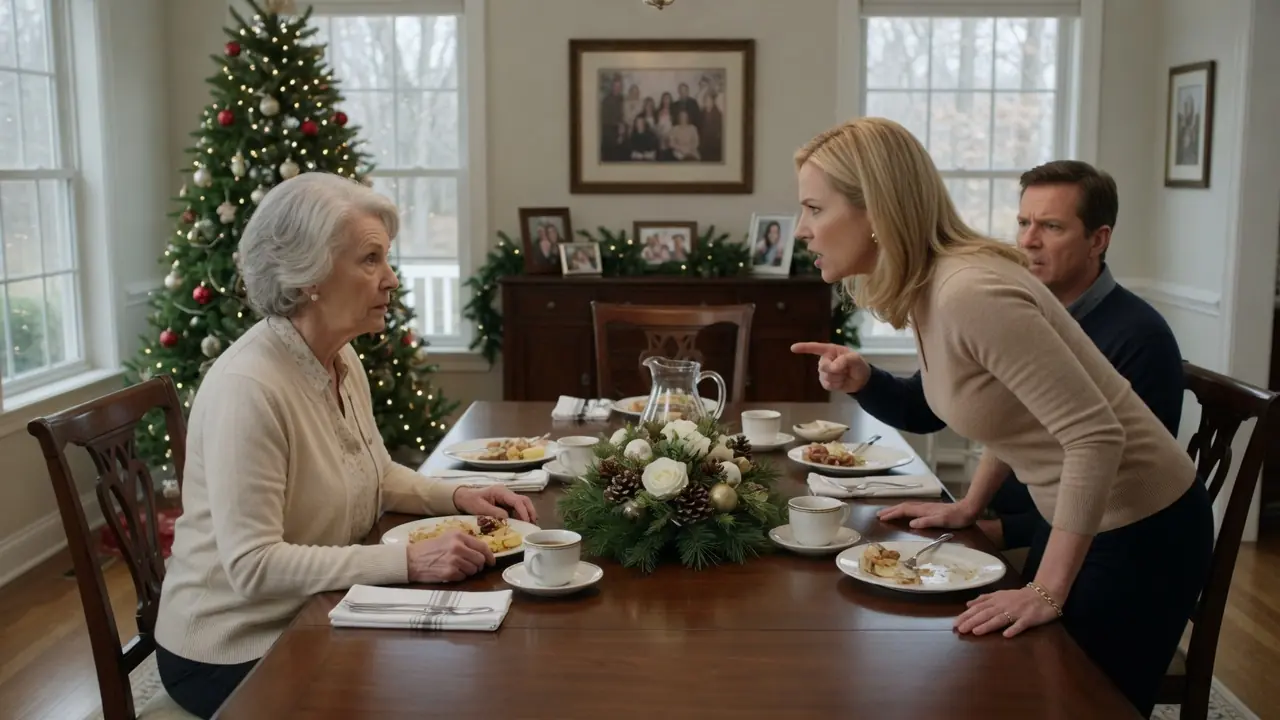
At lunch, my daughter-in-law smiled over her coffee and told me I would not be part of Christmas this year.
She said it sweetly.
That was the part that stayed with me.
Not the words themselves, though they were sharp enough.
Not even the way my son stared down at his plate and said nothing while his wife quietly removed me from the holiday I had been planning for six weeks. What stayed with me was the sweetness in her voice, the softness of her smile, the careful way she tried to dress cruelty in manners.
“This year,” Marlene said, lifting her coffee cup with both hands, “we’re keeping Christmas small. Just close family. You understand.”
My son Daniel sat beside her, scraping the edge of his fork against his eggs as if breakfast required his full attention.
I looked at him first.
Then at her.
Then back at him.
He did not lift his eyes.
That was when I understood that the conversation had been rehearsed before I arrived.
The restaurant was warm and bright, all polished glass, pale wood, soft music, and cinnamon-scented coffee. It was the sort of place crowded with families discussing gift lists, school breaks, travel plans, and holiday menus over expensive omelets. A small tree stood near the hostess stand, decorated in gold ribbon and tiny white lights. A server passed behind me carrying pancakes dusted with powdered sugar, and a child at the next table asked if Santa liked waffles.
Everything around me looked like Christmas.
Everything at my table felt like a door closing.
Marlene had chosen the restaurant.
She liked places where the hostess greeted her by name and the sunlight coming through the windows made everyone look softer than they really were. She liked cloth napkins, tall water glasses, and menus with words like locally sourced and seasonal glaze. She liked the appearance of warmth more than warmth itself.
Daniel sat in the navy sweater I had bought him the previous winter.
It was cashmere, though I had never told him that because he would have told me I should not have spent so much. He wore it often. I used to feel proud whenever I saw him in it, proud in the quiet way mothers are proud when something they give is actually used.
That morning, seeing it only made my chest ache.
“We’ve been talking,” Marlene continued, stirring a coffee she had not sweetened. “And this year, we really want something simple.”
I folded my hands in my lap.
“Simple can be lovely.”
She smiled with relief, but it was too early. She had not yet reached the part that mattered.
“Yes, exactly,” she said. “Simple. Calm. Not too much fuss. Just us, my parents, my sister’s family, the kids, and a few close friends. Nothing too crowded. Nothing with extra pressure.”
Extra pressure.
That was what I had become.
Not Daniel’s mother.
Not Luke and Emma’s grandmother.
Not the woman who stayed up past midnight icing sugar cookies because the grandchildren liked snowmen better than stars. Not the woman who picked them up on teacher workdays, sick days, and those surprise half-days when school closed early and nobody else could leave work. Not the woman who covered last Christmas dinner when Daniel said money was tight and Marlene still wanted everything “beautiful for the children.”
Not the woman who had quietly made mortgage payments for three months so they would not have to explain overdue notices to Marlene’s parents.
Just pressure.
I looked at Daniel again.
At last, he spoke.
“Mom,” he said softly, still not looking at me, “please don’t make this harder than it needs to be.”
There it was.
The sentence people use when they want your silence more than your understanding.
I had heard versions of it before.
Don’t take it personally.
Don’t make this awkward.
Don’t make us feel guilty.
Don’t make a scene.
But the real sentence underneath all of those was always the same.
Please absorb the hurt quietly so we can keep enjoying the benefits of hurting you.
I smoothed my napkin over my lap.
“Of course,” I said. “I understand.”
Marlene relaxed so quickly it was almost insulting.
Daniel exhaled as if I had solved a problem for him.
Neither of them seemed to realize that something inside me had gone very still.
My name is Margaret Whitman.
I am sixty-eight years old, a widow, a retired school librarian, a mother to one son, and grandmother to two children I love more than I can sensibly explain. My husband, Robert, died six years ago, suddenly, in the garden behind the house we had lived in for thirty-nine years. One minute he was pruning the rosebush near the fence, and the next he was gone, leaving behind a pair of gloves, a half-filled watering can, and a silence no amount of sympathy could fill.
Daniel was thirty-four then.
He cried at the funeral like a boy.
I remember holding his face in both hands outside the church and telling him, “Your father loved you every day of your life.”
He nodded into my palms and wept.
For a while after Robert died, Daniel called often. He came over on Sundays. He fixed the loose cabinet door in my kitchen and pretended not to notice when I left two mugs out by mistake. He asked if I needed groceries. He stayed for dinner. He let me send him home with leftovers.
Then life moved forward.
It always does, even when grief thinks that is rude.
Daniel married Marlene two years later.
I tried to love her because he loved her.
In the beginning, it was not difficult. She was charming, organized, pretty in a polished way, with blonde hair that never seemed to misbehave and a laugh that arrived exactly when people expected one. She worked in event design, which explained her obsession with themes, colors, table settings, and photographs that looked natural only because every detail had been arranged beforehand.
She called me Margaret, never Mom.
That was fine.
I was not her mother.
But over time, I noticed that she used my name most often when she wanted something.
Margaret, would you mind watching the kids Friday?
Margaret, Daniel says you make the best stuffing. Could you bring it?
Margaret, do you still have that old silver punch bowl?
Margaret, can you help Daniel understand this is a family investment?
That last one came three winters earlier.
Daniel and Marlene had bought a house they could not truly afford.
It was beautiful, I admit that. A white colonial with black shutters, a wide porch, and a staircase Marlene immediately decorated with cedar garland in the first Christmas photo she posted online. It had a large kitchen, four bedrooms, a fenced backyard, and a mortgage that made Daniel’s voice change whenever the subject came up.
At first, I said nothing.
They were adults.
Adults are allowed to buy houses, make decisions, stretch budgets, and learn.
Then Daniel called me one night in February.
His voice was too casual.
“Mom, can I ask you something?”
That sentence from an adult child can turn a mother’s bones cold.
The baby had an ear infection. The insurance had changed. Marlene’s business had a slow month. The heating bill was higher than expected. The mortgage payment was going to be late.
“Just this once,” he said.
I told him family helps family.
I meant it.
I wrote the check.
The next month, there was another problem. Marlene’s car needed repairs. The children’s preschool fees were due. Daniel’s bonus had been delayed. Could I cover half, just until things evened out?
Then came the roof repair.
Then a utility bill.
Then summer camp.
Then the quarterly property tax.
That is what mothers do.
We take a sharp thing and wrap it in softer words.
Sacrifice becomes help.
Resentment becomes patience.
Being used becomes being needed.
The trouble is that people can get used to your sacrifice faster than they can get used to your boundaries.
By the second year, Daniel no longer sounded ashamed.
Marlene no longer sent long texts.
The mortgage help became a “temporary arrangement,” though temporary had somehow survived three seasons, two birthdays, and one family vacation they posted about without mentioning who had paid the overdue insurance premium the week before.
When I gently asked Daniel when they expected to resume full payments, he said, “Soon, Mom. We’re just getting through this stretch.”
Every family seems to have a stretch that lasts as long as someone else keeps paying for it.
Still, I helped.
Because of Luke and Emma.
Luke was seven, missing two front teeth, always sticky, always asking questions about dinosaurs, planets, and whether Grandpa Robert could see him from heaven. Emma was five, solemn-eyed and dramatic, with curls that bounced when she ran and a habit of pressing flowers between the pages of books because I had shown her how once.
They called me Grandma Maggie.
I would have paid almost any price to keep hearing that.
Which is probably why Daniel and Marlene forgot there was a price at all.
At brunch, Marlene continued talking after she excluded me from Christmas, because people who wound you casually often assume you will keep listening politely.
“We just want the children to have a peaceful day,” she said. “Not too many moving pieces. You know how overwhelmed they get.”
Luke and Emma had never been overwhelmed by me.
Luke liked to sit beside me and build Lego spaceships while I pretended not to understand why a dinosaur pilot made perfect sense. Emma liked to crawl into my lap with a picture book and correct me if I skipped a word. On Christmas morning, they used to run to me before the coffee finished brewing, dragging wrapping paper behind them like a parade.
But I did not say any of that.
I only nodded.
Daniel finally looked up.
His eyes met mine for half a second, then slid away.
That half second told me he knew.
He knew this was wrong.
He knew I was being hurt.
He knew his wife had chosen the words carefully so she could claim innocence later.
And he had decided it was easier to let me absorb it than to challenge her.
The rest of brunch went on as if nothing important had happened.
Marlene discussed matching pajamas for the children.
Daniel mentioned a photographer she wanted to hire for what Marlene called natural family moments.
They talked about a cocoa bar, a dessert table, cedar garland over the staircase, the children’s outfits, whether Marlene’s parents would prefer white wine or red, and whether her sister’s twins should be included in the staircase photo before or after gifts.
I listened.
I nodded when expected.
I drank my coffee slowly enough to hide that my hands had gone cold.
Nobody seemed to notice that I had stopped smiling.
When the check arrived, Daniel reached for it, then hesitated.
It was a tiny hesitation.
Most people would not have noticed.
But mothers notice the shape of their children’s expectations.
For years, whenever we went out, I had usually paid. Not always, but often enough that Daniel had grown comfortable performing the gesture of reaching for the check while waiting for me to say, “I’ve got it.”
This time, I said nothing.
Marlene looked down at the folder.
Then at Daniel.
Daniel cleared his throat and slid in his card.
It was a small moment.
But most locked doors begin with a very small turn of the key.
After brunch, they hugged me in the restaurant parking lot.
Marlene’s hug was light, perfumed, barely there.
“We really do hope you understand,” she said.
“I do.”
Daniel kissed my cheek.
“We’ll see you soon, okay?”
I looked at him.
“Will you?”
He frowned slightly, not understanding the question.
Then he gave me a strained smile and followed Marlene to their SUV.
I watched them drive away.
The back window had two small handprints fogged against the glass. Luke and Emma had not come to brunch; Marlene said they were with her parents for the morning. I wondered if they knew yet that Grandma Maggie would not be coming for Christmas.
Probably not.
Children are often the last to learn when adults decide love is inconvenient.
I drove home to the townhouse I bought after Robert died.
The old family house had been too large after he was gone. Too many rooms. Too many echoes. Too many places where I expected to hear him and heard only the refrigerator hum instead.
The townhouse was smaller, quiet, easier to manage.
It had two bedrooms, a narrow kitchen, a small patio, and a living room where I had placed Robert’s favorite reading chair near the window. I no longer expected him to sit in it, but I had never been able to move it.
A widow’s house has a particular kind of quiet.
Orderly.
Familiar.
Full of absence.
I hung up my coat and stood in the living room without turning on the television. The Christmas tree glowed in the corner. I had decorated it the week before with the ornaments we collected over forty years: wooden angels, tiny bells, a felt snowman Daniel made in kindergarten, a glass bird Robert bought me on our twenty-fifth anniversary.
Beneath the tree were wrapped gifts.
Three for Luke.
Three for Emma.
One for Daniel.
One for Marlene, though she had never once worn, lit, displayed, used, or publicly acknowledged anything I gave her.
On the dining table sat the catering receipt.
Roast turkey.
Honey-baked ham.
Mashed potatoes.
Green beans with almonds.
Cranberry tartlets.
Two pies.
Dinner rolls.
Gravy.
A small tray of iced cookies shaped like stars, because Luke liked snowmen but Emma had recently decided stars were “more elegant.”
Enough food for the Christmas Eve dinner Daniel had asked me to help with six weeks earlier.
I remembered that phone call clearly.
“Mom, this year we want to host properly,” he had said. “Marlene wants it to be special, but it’s a lot. Could you maybe handle the catering? Just this once? We’ll pay you back after the holidays.”
Just this once.
Another phrase that had learned to stretch.
I picked up the phone and called the caterer.
A cheerful woman named Beth answered.
“Mrs. Whitman, we’re all set for the twenty-fourth. I was just reviewing the delivery window.”
“I’m calling to cancel the order.”
There was a pause.
“Cancel all of it?”
“All of it.”
“Oh. I’m sorry to hear that. Is everything all right?”
I looked at the tree.
“No,” I said. “But the food will not be needed.”
She was kind. She explained the cancellation window, the partial refund, the small fee. I thanked her. My voice did not shake until after I hung up.
Then the silence in the house changed.
It did not feel lonely.
It felt clear.
I went to the desk in the corner of the living room and opened the folder Daniel did not know I kept.
Bank statements.
Transfer confirmations.
Utility receipts.
The email chain about the roof repair.
The note from Marlene thanking me for “helping keep things smooth” when I paid for Emma’s dental work.
The mortgage payments from September.
October.
November.
And the payment scheduled for December.
Daniel had called it temporary help.
Marlene had called it family support.
I had called it love.
But love should not require a woman to fund a house where she is no longer welcome for Christmas.
I sat at my desk for a long time with the papers spread before me.
Not because I was unsure.
Because I was grieving the person I had been when I made each payment.
The woman who believed gratitude was simply quiet.
The woman who thought her son would notice.
The woman who told herself that being included did not matter as long as the children were cared for.
The woman who mistook access for affection.
Robert’s photograph sat on the mantel across from me. He was smiling in the picture, one hand raised as if he had been caught mid-wave. It had been taken on a beach vacation two years before he died. His hair was windblown, his glasses crooked, his eyes kind.
He used to say, “Grace is a virtue, Maggie, not a subscription plan.”
At the time, I laughed.
That afternoon, I finally understood.
I called the bank.
The representative verified my identity, asked several security questions, then pulled up the recurring transfer.
“Would you like to modify the amount?” she asked.
“No.”
“Change the date?”
“No.”
“Then how can I help you today?”
I looked at Robert’s photograph.
“End it.”
“End the recurring transfer?”
“Yes.”
“Effective immediately?”
“Yes.”
The representative typed for a moment.
“This transfer has been canceled. Would you like confirmation sent to your email?”
“Yes, please.”
When the email arrived, I printed it and placed it in the folder.
Then I made tea.
There was nothing dramatic left to do.
I heated a bowl of soup for dinner and sat by the window while daylight faded. Outside, the neighborhood began to glow with porch lights, wreaths, and the first shimmer of tree lights in front windows. A father across the street lifted a small child so she could hang a decoration on a low branch. Somewhere down the block, a dog barked at inflatable reindeer.
Inside, my gifts remained wrapped.
The catering was canceled.
The mortgage payments were stopped.
At 7:42 p.m., Daniel called.
I let it ring.
At 7:45, Marlene called.
I let that ring too.
Then came the messages.
Mom, did something happen with the caterer?
A minute later:
Mom, the bank sent us an alert. Call us.
Then:
Mom, please pick up.
Then Daniel called again.
This time, I answered.
His voice had changed.
It had lost all the calm certainty from brunch.
“Mom,” he said carefully, “there has to be some misunderstanding.”
I looked at my tree glowing in the corner.
“No misunderstanding.”
“The caterer said the order was canceled.”
“Yes.”
“And the bank says the transfer didn’t go through.”
“It won’t.”
Silence.
In the background, I heard Marlene’s voice, sharp and distant.
“What is she saying?”
Daniel lowered his voice.
“Mom, that’s not funny.”
“I wasn’t joking at brunch,” I said. “Why would I joke now?”
Another pause.
Then Marlene came onto the line without asking.
“You canceled the food?” she demanded. “For Christmas Eve?”
“And the mortgage transfer,” I said. “Yes.”
Her breath caught.
Daniel whispered, “Mom…”
I set my spoon down beside the bowl.
“For years, I paid quietly because I thought I was helping family,” I said. “But family does not call you pressure at brunch and still expect you to finance the table.”
Marlene’s voice sharpened.
“You are punishing us.”
“No. I am finally stepping out of the role you assigned me.”
“That is incredibly petty.”
I almost smiled.
Petty is often what entitled people call boundaries when those boundaries inconvenience them.
Daniel spoke again.
“Mom, please. We’re under a lot of stress. The mortgage payment is due next week.”
“I know.”
“And the catering—Marlene already told her parents dinner was handled.”
“I imagine that will be awkward.”
“Mom.”
There was pain in his voice now.
Not remorse.
Panic.
That distinction mattered.
“You can’t do this right before Christmas,” he said.
I looked at the wrapped gifts beneath the tree.
“You already did.”
He inhaled sharply.
“All I did,” I continued, “was believe you when you said you wanted to celebrate without me.”
No one spoke for a moment.
I could hear their breathing.
I could hear dishes clattering somewhere in the background of their kitchen.
I could hear, more clearly than anything, the sound of my own peace settling in where guilt used to live.
Then Daniel asked, very quietly, the question he should have thought about before they left me out of Christmas.
“Mom… if you stop helping, what happens to us?”
And I finally understood that neither of them had ever expected me to choose myself at all.
“I suppose,” I said softly, “you will have to find out.”
Marlene came back onto the line.
“This is unbelievable.”
“No, Marlene. What is unbelievable is asking a widow to help pay for a Christmas party she is not invited to attend.”
“It wasn’t a party. It was family Christmas.”
“Exactly.”
She went silent.
For the first time that day, she had heard herself.
Daniel said, “Mom, I didn’t mean for it to sound like that.”
“But it did.”
“I was trying to keep peace.”
“No,” I said. “You were trying to keep your wife comfortable and your mother useful.”
He made a wounded sound.
I might have softened once.
I had softened so many times before.
That was how we reached this moment.
“I love you, Daniel,” I said. “I always will. But my love is not a direct debit.”
Then I ended the call.
My phone began ringing again almost immediately.
Daniel.
Marlene.
Daniel.
Marlene.
Then a number I recognized as Marlene’s mother, Patricia.
I turned the phone face down.
For twenty minutes, I sat in the quiet and let them discover the shape of my absence.
At 8:30, Patricia left a voicemail.
I should not have listened.
Curiosity is a dangerous thing, especially when dignity is still new.
“Margaret,” Patricia said in a tight voice, “this is Patricia. I don’t know exactly what happened today, but Daniel and Marlene are very upset. Christmas is a stressful time for everyone, and I hope you aren’t making a rash decision over hurt feelings. Families should not behave this way.”
I laughed.
Actually laughed.
Not because it was funny.
Because the alternative was screaming.
Families should not behave this way.
How easily people defend the structure when they are not the ones being pushed outside it.
I did not call her back.
The next message was from Daniel.
“Mom, please. I know you’re hurt. We should have explained better. It’s just that Marlene’s parents are coming from out of state, and her sister’s family has been going through a lot, and we didn’t want things to feel crowded. It wasn’t about excluding you. It was just logistics.”
Logistics.
Another soft word for a sharp thing.
The next message was Marlene.
“We need that mortgage transfer, Margaret. You know we planned around it. You can’t just pull support without warning. That affects the kids.”
I stopped the message there.
There it was.
The kids.
Luke and Emma.
The lever they always reached for when guilt needed machinery.
I picked up the phone and typed one message to Daniel only.
I will not discuss money tonight. I am available tomorrow at noon if you want to speak respectfully. Do not send Marlene or Patricia to negotiate for you.
I sent it.
Then I turned off my phone.
The silence that followed was the first honest quiet I had felt in years.
I slept badly that night.
Not because I doubted my decision.
Because grief does not leave just because clarity arrives.
I woke at two, then three-thirty, then five. Each time, I thought of Daniel as a little boy waking from nightmares and calling for me. I thought of him at ten, proudly carrying a crooked birdhouse he made for Robert. I thought of him on his wedding day, hugging me so tightly after our dance that I could feel his tears against my temple.
How does a child become a man who lets his mother be dismissed over brunch?
Slowly, I suppose.
Not all at once.
Through convenience.
Through silence.
Through marrying someone who sees kindness as a resource.
Through accepting help until gratitude becomes embarrassment, and embarrassment becomes resentment.
By morning, my phone was full of messages.
Daniel had texted five times.
Marlene had texted eight.
Patricia had called twice.
There was also a message from my friend Ruth, which I opened first.
Ruth had been my friend for thirty-one years. She was seventy, widowed before me, sharp-tongued, and blessedly allergic to nonsense.
Heard from Carol who heard from Patricia that you “ruined Christmas.” I assume this means you finally stopped paying for something. Call me.
I called her.
She answered on the first ring.
“Tell me everything.”
So I did.
I told her about brunch.
Close family.
Extra pressure.
Daniel’s silence.
The catering.
The mortgage transfer.
The phone calls.
Ruth listened without interrupting, which was rare enough to prove the seriousness of the matter.
When I finished, she said, “Good.”
That one word nearly made me cry.
“You don’t think I overreacted?”
“Margaret, if anything, you underreacted for three years and then finally located your spine.”
“Ruth.”
“I love you, but I am not going to sprinkle sugar on this. Daniel is your son, not your tenant. Marlene is your daughter-in-law, not your employer. And you are not a family ATM with knitting skills.”
Despite everything, I laughed.
Ruth softened.
“Are you all right?”
“I don’t know.”
“That’s honest.”
“I miss the grandchildren already.”
“Of course you do.”
“What if Marlene keeps them from me?”
“She might try.”
The bluntness hurt.
Ruth continued, “But children grow. They notice. And if Daniel has any sense left, he will not let that happen.”
“I am not sure how much sense he has left.”
“No,” Ruth said. “But unpaid bills have been known to revive dormant wisdom.”
At noon, Daniel called.
I answered.
This time, he was alone. I could tell by the absence of Marlene’s sharp breathing nearby.
“Mom?”
“Yes.”
“I’m sorry.”
I closed my eyes.
Not because I accepted it instantly.
Because I had been waiting to hear those words since brunch.
“What are you sorry for?”
He exhaled.
“For yesterday.”
“That is broad.”
“For letting Marlene say you weren’t close family.”
“And?”
“For not saying anything.”
“And?”
A pause.
“For expecting you to keep helping after we hurt you.”
There.
A fuller sentence.
Still not enough, but a start.
I sat in Robert’s chair.
“Why did you let it happen, Daniel?”
He was quiet long enough that I knew he was either thinking or trying to find an answer that made him look better.
“I didn’t want another fight with Marlene,” he said finally.
I almost appreciated the honesty.
“About me?”
“About everything. Money. Her parents. The house. Christmas. She says you make her feel judged.”
“Do I?”
“No. Not exactly. But she thinks you do.”
“That sounds convenient.”
He sighed.
“I know.”
“Do you?”
His voice cracked.
“I don’t know how we got here, Mom.”
That sentence hurt because it sounded young.
Lost.
Human.
But I reminded myself that feeling sympathy did not require restoring the payment.
“You got here by accepting help until it became part of your budget,” I said. “Then you allowed the person helping to become optional.”
Daniel was silent.
“I never wanted you to feel used,” he said.
“But wanting and doing are different things.”
“I know.”
“Do you?”
This time, he did not answer quickly.
“I think I’m starting to.”
I looked toward the tree.
“Where are Luke and Emma?”
“At school.”
“Do they know?”
“No.”
“Know what?”
“That you’re not coming.”
The words opened the wound again.
“Were you planning to tell them?”
He whispered, “Marlene was going to say you had other plans.”
I pressed my fingers to my eyes.
Another lie.
A small lie, perhaps, compared with others in the world.
But small lies teach children the shape of larger ones.
“No,” I said.
“Mom—”
“No, Daniel. You will not tell my grandchildren that I chose to miss Christmas. If I am not welcome, you will say that the adults made that decision. You do not get to put your choices in my mouth.”
He breathed unevenly.
“Okay.”
“And the money?”
“Mom, please.”
“No.”
The word surprised both of us.
It was calm.
Simple.
Final.
“I will not resume the mortgage payments,” I said. “I will not pay for the catering. I will not cover Christmas costs. I will not send emergency funds this month.”
“But we can’t cover everything at once.”
“Then you need to make calls. Bank. Budget. Sell something. Cancel the photographer. Return the matching pajamas. Ask Marlene’s close family for help.”
He flinched through the phone.
“You know how that will look.”
“Yes,” I said. “I imagine that is why you preferred my money. It came quietly.”
“Mom.”
“Daniel, I am not trying to destroy you. But I will not keep protecting your image at the expense of my dignity.”
He was crying now.
I could hear it.
Not loudly.
Daniel had always cried quietly, even as a boy.
“I messed up,” he said.
“Yes.”
“I let it get bad.”
“Yes.”
“I don’t know how to fix it.”
“Start with the truth.”
After we hung up, I sat for a long time.
The call had not healed anything.
But it had opened a window.
That afternoon, Marlene came to my house.
I knew it was her before I opened the door because she rang the bell twice, impatiently, then knocked as if the house were misbehaving.
She stood on my porch wearing a cream wool coat, leather gloves, and the expression of someone who had practiced being offended during the drive.
“Margaret,” she said.
“Marlene.”
“May I come in?”
I considered saying no.
Then I stepped aside.
She entered and looked around my living room as if searching for evidence of cruelty. Her eyes landed on the wrapped gifts under the tree. Something flickered across her face.
“So you did buy gifts.”
“For my family, yes.”
Her mouth tightened.
“That is unfair.”
“Careful, Marlene. You are standing in my house, looking at gifts I bought for children you were prepared to tell I had abandoned Christmas voluntarily.”
Color rose in her cheeks.
“Daniel told you that?”
“Yes.”
“He shouldn’t have.”
“No. He shouldn’t have agreed to it.”
She looked away.
For a moment, I thought I saw embarrassment.
Then pride returned.
“You have to understand, my parents have expectations.”
“I know. So do I.”
“That house is important to us.”
“I know.”
“The children love that house.”
“I know.”
“Then how can you just stop helping?”
I gestured toward the sofa.
She sat reluctantly.
I remained standing.
“Because the help was never supposed to become permanent.”
“We were going to pay you back.”
“No, you weren’t.”
Her eyes flashed.
“You don’t know that.”
“Yes, Marlene, I do.”
I walked to the desk, opened the folder, and placed copies of the payments in front of her.
Her face shifted as she saw the stack.
Mortgage.
Utilities.
Repairs.
Dental bill.
School fees.
Catering deposits.
Camp payments.
Car repair.
Insurance.
One by one, the quiet record of my usefulness spread across the coffee table.
“I kept these for taxes at first,” I said. “Then I kept them because some part of me knew one day I would need proof, even if only for myself.”
Marlene stared at the papers.
“We thanked you.”
“When?”
She looked up.
“What?”
“When did you last thank me without needing something else?”
She opened her mouth.
Closed it.
I nodded.
“That is what I thought.”
Her face hardened.
“You are acting like we forced you.”
“No. That is why this took me so long. You did not force me. You simply accepted and accepted until I mistook my own willingness for obligation.”
She stood.
“You’re going to embarrass us in front of my family.”
“No, Marlene. You are going to explain your own budget to your own family.”
Her eyes filled, but the tears looked more angry than sad.
“My mother already thinks Daniel isn’t providing well enough.”
“And yet you excluded his mother from Christmas while relying on her money to make the evening look effortless.”
Marlene’s face crumpled then, not fully, but enough.
For the first time, I saw the fear beneath the polish.
“I can’t have them know.”
“Why?”
“Because they’ll judge me.”
I looked at her for a long moment.
“And there it is.”
She wiped beneath one eye quickly.
“I know you think I’m awful.”
“I think you are afraid of looking less successful than you pretend to be.”
Her lips trembled.
I continued, softer now.
“But your fear does not give you the right to use me.”
She sat again.
The anger had drained out of her.
“What do you want from us?”
That question was better than the others.
Still not enough.
But better.
“Respect,” I said. “Honesty. Gratitude when gratitude is due. And access to my grandchildren that is not dependent on whether I am paying for something.”
She looked down at the papers.
“And Christmas?”
“That decision was yours.”
“It can be changed.”
“Can it?”
She looked up.
For once, she did not have a quick answer.
I sat across from her.
“Marlene, if I come now, after canceling the money, will I be invited because I am loved or because dinner collapsed?”
Her silence answered.
I nodded.
“That is why I will not come.”
Her eyes widened.
“But the children—”
“I will see Luke and Emma another day. I will not attend a Christmas where I am being added back to the guest list like a missing ingredient.”
Marlene looked ashamed then.
Really ashamed.
It was not a grand transformation.
Life rarely offers those.
But for a second, I saw a woman who understood the ugliness of what she had done.
“I’m sorry,” she said quietly.
I believed she meant it in that moment.
I also knew meaning it in a moment was easier than living differently afterward.
“Thank you,” I said.
She left without asking for money again.
That, too, was a start.
The next few days were uncomfortable for everyone except Ruth, who enjoyed updates more than was strictly compassionate.
Daniel called the bank.
Marlene canceled the photographer.
The matching pajamas went back.
The cocoa bar became regular hot chocolate.
The cedar garland was returned.
Her sister agreed to bring two side dishes.
Her parents, after much discomfort, paid for part of the food.
When Patricia learned I had been paying the mortgage, she called me again.
This time, I answered.
Her voice was different.
Less sharp.
“Margaret,” she said. “I owe you an apology.”
I let the silence sit for a moment.
Then said, “All right.”
“I did not know the extent of your financial help.”
“No.”
“Marlene told us you occasionally assisted.”
“That is one way to phrase it.”
She sighed.
“I spoke too quickly.”
“Yes.”
“I’m sorry.”
I accepted the apology, not because she deserved immediate absolution, but because I had no interest in carrying her too.
The hardest call came from Luke.
Daniel called one evening and asked if the children could speak to me. My first instinct was to say yes immediately. My second was to remember that love does not require rushing into emotional traps.
“Are they calling because they asked to,” I said, “or because you need them to soften me?”
Daniel was quiet.
Then he said, “They asked.”
Luke came on first.
“Grandma Maggie?”
“Hello, sweetheart.”
“Are you sick?”
My throat tightened.
“No, darling.”
“Mom said you might not come for Christmas because grown-ups are talking.”
I closed my eyes.
That was at least closer to truth.
“Yes. The grown-ups have some things to work out.”
“Did I do something?”
“Oh, Luke. No. Never.”
“Emma cried because she thought you didn’t want to see us.”
I pressed my hand to my chest.
“I always want to see you. Always.”
“Then why can’t you come?”
There are questions from children that deserve answers and innocence at the same time.
“Because sometimes adults make plans that hurt feelings,” I said carefully. “And when that happens, we need to be honest and kind before we can sit at the same table.”
He was quiet.
“Can we still make cookies?”
“Yes.”
“When?”
“How about the day after Christmas? Just you, Emma, and me.”
“Can we make snowmen?”
“Of course.”
“And stars for Emma, even though stars are boring?”
I smiled through tears.
“Especially stars for Emma.”
Emma came on next.
“Grandma?”
“I’m here, little flower.”
“Do you still love me?”
That broke me.
Not loudly.
Not in a way she could hear.
But something inside me tore open.
“More than every light on every Christmas tree in the world,” I said.
She sniffled.
“Even the big one downtown?”
“Especially that one.”
“And the mall?”
“The mall too.”
“Okay.”
A small pause.
“Can I still give you my present?”
“Yes, sweetheart.”
“I made it at school. It has glitter, but Mommy said glitter is not for serious presents.”
“Mommy is wrong. Glitter is very serious.”
Emma giggled.
That giggle carried me through the rest of the week.
Christmas Eve arrived cold and bright.
For the first time in years, I did not spend the day cooking for Daniel’s house, arranging platters, double-checking delivery windows, or pretending not to be tired before the evening began.
Instead, I woke slowly.
I made coffee.
I put on Robert’s favorite Christmas record.
I drove to the community center where Ruth volunteered and helped serve lunch to seniors who had nowhere else to go.
Ruth raised an eyebrow when I arrived with two pies.
“Look at you,” she said. “Redirecting your labor toward people with manners.”
“Don’t start.”
“I already started. Keep up.”
The lunch was loud, imperfect, and strangely joyful.
A retired mailman sang carols off-key. A woman named Alice told me about her grandson in Oregon. A widower named Paul asked if I had made the apple pie and then asked for the recipe with such sincerity that I gave him two slices.
For the first time in a long time, my effort felt received.
Not expected.
Received.
That evening, I went home, lit the tree, made tea, and opened the small gift Ruth had left on my porch. It was a mug that read:
NOT THE FAMILY ATM
I laughed so hard I had to sit down.
At Daniel and Marlene’s house, Christmas Eve was apparently not the elegant event Marlene had imagined.
I know this because Daniel told me later, and because children are incapable of protecting adult vanity when retelling disaster.
The turkey was undercooked in one section and dry in another.
The gravy burned.
Marlene’s father complained quietly about the wine until Patricia told him to stop speaking.
Her sister’s twins spilled hot chocolate on the staircase runner before the photographer-who-never-came could have captured any natural family moments.
Luke asked three times why Grandma Maggie was not there.
Emma refused to wear the velvet dress because, according to her, “Grandma likes me in soft clothes.”
At some point, Daniel stepped into the garage and cried.
Marlene found him there.
And for once, instead of telling him to pull himself together before her parents noticed, she sat beside him on the concrete step and said, “We did something really ugly, didn’t we?”
Daniel said, “Yes.”
That was the beginning of their real conversation.
Not with me.
With each other.
The day after Christmas, Daniel brought Luke and Emma to my townhouse.
Marlene came too, but she stayed at the door.
“I thought maybe the children could have their time with you,” she said.
Her face was bare of makeup.
She looked younger.
Tired.
Less polished.
“Thank you,” I said.
She nodded.
Then she looked me in the eye.
“Margaret, I am sorry. Not because the money stopped. Because you were right. We made you feel like support staff in your own family.”
I said nothing for a moment.
Then, “That is the first apology that sounds like it belongs to what happened.”
Her eyes filled.
“I’m trying.”
“I hope you keep trying after the mortgage is still your responsibility.”
She gave a small, ashamed laugh.
“That’s fair.”
The children rushed past her and into my arms.
Luke smelled like winter air and peppermint gum. Emma smelled like strawberry shampoo and crayons. They hugged me with the full force of children who had spent a week afraid love might have rules they did not understand.
We made cookies.
Snowmen for Luke.
Stars for Emma.
A few crooked bells because I wanted them.
Daniel stayed in the kitchen, washing bowls, sweeping flour, and looking around my house like he was seeing it differently. At one point, he picked up the framed photo of Robert from the side table.
“Dad would be disappointed in me,” he said.
I wiped dough from my fingers.
“Yes.”
He looked at me, startled by the honesty.
Then he nodded.
“I know.”
“But he would not stop loving you.”
Daniel’s eyes filled.
“I know that too.”
“Good. Then do not confuse being loved with being excused.”
He set the frame down carefully.
“I won’t.”
Time did what time does.
It moved.
Not magically.
Not neatly.
Daniel and Marlene struggled for months.
Without my monthly payments, they had to face the size of their life. They refinanced what they could. Sold Marlene’s second car. Cut subscriptions, vacations, and image expenses. Marlene took on practical event work instead of only the high-prestige clients she preferred. Daniel picked up contract projects.
They did not lose the house.
But they did lose the illusion that appearances could be maintained by someone else’s quiet sacrifice.
My relationship with them did not heal overnight.
I did not resume paying the mortgage.
I did not rescue them when the water heater failed in March.
I did not cover summer camp.
I did not buy school clothes unless I chose to, as gifts, not obligations.
At first, every no felt like lifting a weight I had been trained to call love.
Eventually, no became easier.
So did yes.
Because when yes is no longer coerced by guilt, it becomes generous again.
I still babysat sometimes.
But only when asked respectfully and only when I wanted to.
I hosted Sunday dinner once a month.
Marlene brought food.
Daniel washed dishes.
The grandchildren set the table.
Nobody assumed I would pay for everything.
The first time Daniel picked up the restaurant check without hesitation, I had to look out the window so he would not see my tears.
A year later, Christmas came again.
This time, Daniel called me in October.
“Mom,” he said, “we would like you to spend Christmas Eve with us. Not because we need you to bring food. Not because we need help. Because we want you there.”
I listened carefully.
People reveal themselves in how they invite you.
“And Marlene?” I asked.
“She’s here. She wants to ask herself.”
Marlene came onto the phone.
“Margaret,” she said, “would you please come for Christmas Eve? We are keeping it small this year. Actually small. Just us, the kids, you, and my parents for dessert later if you feel comfortable. No photographer. No performance. I would be grateful if you came.”
Grateful.
There was the word.
I looked at Robert’s photograph.
Then at the Christmas ornament Daniel had made in kindergarten.
“Yes,” I said. “I’ll come.”
That Christmas was not perfect.
Real Christmas never is.
Luke dropped a roll under the table.
Emma put too many sprinkles on the cookies.
Daniel overcooked the carrots.
Marlene burned one tray of appetizers and laughed instead of crying.
I brought a pie because I wanted to.
Not because anyone expected it.
When dinner was over, Marlene stood and lifted her glass.
“I want to say something,” she said.
Daniel looked nervous.
Luke asked if it was going to be long.
Emma told him not to be rude.
Marlene smiled, then looked at me.
“Last year, I made Christmas about how it looked. I cared more about who would be impressed than who would feel loved. I hurt Margaret badly. Daniel and I both did.”
Daniel reached for her hand.
She continued.
“This year, I am thankful she taught us that family is not someone you use until they ask to be treated like family back.”
My throat tightened.
Patricia, sitting near the fireplace, wiped her eyes.
Luke whispered, “Did Grandma teach a lesson?”
Emma whispered back, “Grandma used consequences.”
Ruth would have loved that.
After dinner, I sat on the couch with Emma asleep against my side and Luke building a Lego rocket ship at my feet. Daniel brought me coffee without asking whether I wanted it because he remembered I always did after dinner. Marlene sat on the floor helping Luke find a tiny gray piece and did not once check whether anyone had posted photographs.
For the first time in years, Christmas felt less like work.
It felt like family.
Not the old version.
That one was gone.
Perhaps it needed to be.
Some families only become honest after the person holding everything together finally lets go.
I do not regret helping my son.
I want that understood.
Love is not foolish simply because someone mishandles it.
There were months when my help kept a roof over my grandchildren’s heads, medicine in the cabinet, and panic from swallowing Daniel whole. I would not erase that if I could.
But I regret helping silently for so long that my silence taught them the wrong lesson.
I taught them I did not need thanks.
I taught them I did not need inclusion.
I taught them that my presence could be optional as long as my money remained reliable.
Then, one brunch in December, my daughter-in-law smiled over coffee and said the quiet part beautifully.
Close family.
You understand.
And for once, I did understand.
I understood that I had been invited to fund memories I was not allowed to appear in.
I understood that my son had mistaken peacekeeping for love.
I understood that my daughter-in-law had mistaken polish for grace.
I understood that my grandchildren needed to see their grandmother treated with dignity, not hidden behind catering receipts and mortgage transfers.
So I canceled the food.
Stopped the payment.
Turned off my phone.
And waited.
By nightfall, my phone would not stop ringing.
By the next Christmas, my doorbell rang instead.
Luke and Emma stood on my porch holding a plate of uneven cookies. Daniel stood behind them with coffee. Marlene stood beside him with no perfect speech, no polished smile, no performance.
Just a quiet sentence.
“We wanted to come get you.”
That was all.
That was enough.
Because love without respect is only appetite.
Family without gratitude is only habit.
And a mother’s heart, no matter how generous, is not a permanent account for people who refuse to make room for her at the table.
I learned that late.
But not too late.
This year, when I sat beside my grandchildren beneath the cedar garland on Daniel’s staircase, Emma leaned against me and whispered, “Grandma, are you close family?”
I looked at Daniel.
He looked at me.
Then Marlene did.
There was shame in their faces still, yes.
But there was also something better.
Recognition.
I kissed Emma’s curls and smiled.
“Yes, little flower,” I said. “I am.”
And this time, no one at the table needed to be reminded.