“There’s no chair for you, Wilma. Go eat in the restroom.”
Tessa said it clearly, sweetly, and loudly enough for every person at the private dinner table to hear. Her manicured hand rested on the back of the last empty chair as if she were guarding a throne. The room went still, but no one looked brave enough to admit they had heard her.
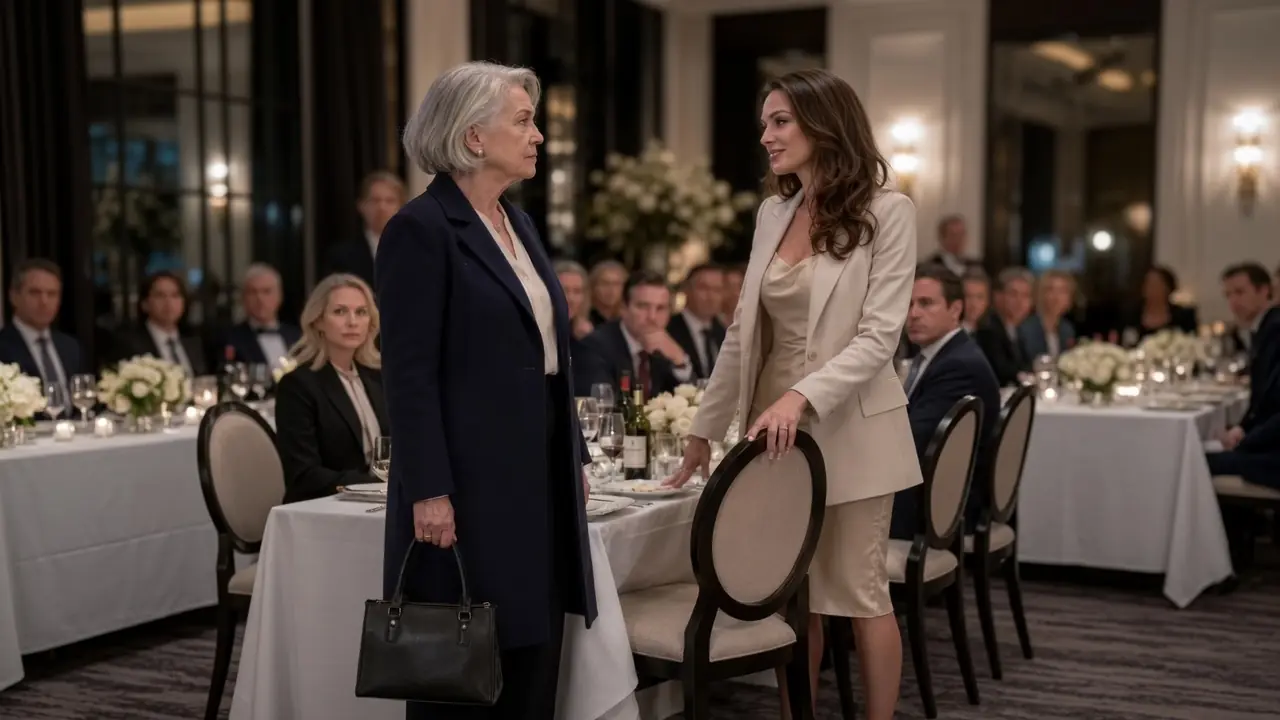
The private dining room at Bellmont House was filled with white roses, crystal glasses, polished silverware, and people who liked to speak softly because they believed softness made cruelty sound expensive. It was supposed to be my son Reid’s celebration. After years of chasing approval in a corporate tower where men half his age smiled at him like competition, he had finally been promoted to regional director. I had paid for the dinner because I wanted him to feel proud for one night.
No one at the table knew that. Reid did not know. Tessa did not know. The guests did not know that the flowers, the private room, the seven-course tasting menu, the wine pairings, and the ridiculous gold-leaf cake had all been arranged under my name and paid for with my card.
I did not tell them because I had never needed applause for loving my son. Mothers do a thousand invisible things and call it Tuesday. I had done that for Reid his whole life, from fixing his first car in secret to paying off a loan he swore he had under control. I knew he hated feeling small, so I had spent decades making sure he never had to know how often I saved him.
Tessa knew none of that, or maybe she knew just enough to despise me for it. She had married Reid four years earlier and quickly trained him to believe that every quiet person was weak. She liked expensive rooms, loud compliments, and photographs that made her life look softer than it was. To her, I was simply the older woman in the navy coat, the inconvenient mother-in-law who did not sparkle under chandelier light.
I had arrived ten minutes late because traffic on Sycamore Avenue had stopped behind a minor accident. When I stepped into the private room, the server recognized me immediately and gave the smallest nod, the kind professionals give when they understand discretion. I saw Reid at the head of the table, smiling tightly while two executives praised his “long-overdue rise.” Then I saw the empty chair near the center, and Tessa’s hand closing around it.
“There’s no chair for you, Wilma,” she said, smiling. “Go eat in the restroom.”
A few people gasped. One woman lowered her eyes into her wine glass. A man near the far end coughed into his napkin, pretending the sound covered a laugh.
I looked first at Tessa, then at Reid. My son sat very still, his fork in his right hand, his eyes fixed on the plate in front of him. He did not say, “Tessa, stop.” He did not stand. He did not even whisper my name.
That was when the humiliation changed shape inside me. Tessa’s cruelty was sharp, but it was expected. Reid’s silence was deeper, slower, and colder. A stranger can insult you and leave a bruise, but your own child can stay silent and make you question every sacrifice you ever made.
“Reid,” I said quietly. His eyes lifted for half a second, then dropped again. That half-second told me everything. He knew it was wrong, and he still chose comfort over courage.
Tessa tilted her head with fake sympathy. “Don’t look so wounded, Wilma. You’re used to being invisible, aren’t you?”
The table held its breath. Twenty-four people sat beneath warm lights, watching an old woman be publicly erased. Not one of them moved the chair.
I thought of Reid at seven years old, feverish and trembling, while I drove him to the emergency room in my slippers. I thought of him at sixteen, crying in the garage because he had backed into a neighbor’s fence and was terrified his father would yell. I thought of him at thirty-five, asking for “just a little help this one time,” while I wrote a check large enough to empty my savings account for six months. I had always stepped forward for him.
And now he could not step forward for me.
I buttoned my navy coat slowly. It gave my hands something to do while my heart finished breaking.
“Enjoy your dinner,” I said. My voice did not shake, and that seemed to disappoint Tessa. She had wanted tears. She had wanted me to beg for a seat, to prove to the room that I was exactly as small as she believed.
Instead, I turned and walked out. The servers near the door stepped aside with quiet respect. Behind me, the room remained silent until Tessa gave a brittle little laugh and said, “Well, that was dramatic.”
Outside, the night air felt clean after the perfumed cruelty of the dining room. Bellmont House stood on a corner downtown, its tall windows glowing with private celebrations and public lies. I walked half a block before my knees told me to sit. There was a stone bench beneath a streetlamp, and I lowered myself onto it with my purse in my lap.
For a few minutes, I did nothing. I watched cars pass. I watched couples leave nearby restaurants laughing into the cold air. I let the pain settle into a place where it could become useful.
Then I opened my phone and called my attorney, Henry Lowell. He answered on the third ring, his voice careful because he never liked late calls. “Wilma? Is everything all right?”
“No,” I said. “But it will be.”
Henry had been handling the pending sale of Tate Freight, the company I built from one leased truck and a borrowed office chair. I had started it after my husband died, back when bankers smiled at me like a widow with a hobby. Men told me freight was too rough, too competitive, too hard for a woman who had never owned more than a station wagon. Forty-two years later, my trucks crossed four states, and those same men called me Mrs. Tate.
“The buyer’s final offer is still open?” I asked. Henry paused. “Yes. One hundred sixty-five million. They want your answer by Friday.”
“They have it tonight,” I said. “Accept it.”
“Wilma, are you sure?”
I looked back at Bellmont House, at the bright windows where my son sat silently beside the woman who had sent me away. “Yes,” I said. “Close the sale.”
My second call was to the restaurant manager. He answered with warmth the moment he heard my name. “Mrs. Tate, good evening. Is everything satisfactory?”
“No,” I said. “Remove my card from the reservation.”
There was a pause so complete I could hear the wind move through the trees beside the sidewalk.
“Mrs. Tate,” he said carefully, “the party has already ordered the full dinner and wine service.”
“I know.”
“The bill will be substantial.”
“I know that too.”
“Should I inform them now?”
“No,” I said. “Wait until they ask for the check.”
Then I stood, walked to my car, and drove home to my small apartment on Sycamore Street. People always found that strange. I owned a freight company worth millions, but I lived in a two-bedroom apartment above a bakery because I liked hearing life outside my windows. The mansion Reid and Tessa loved using for photographs was not mine; it was rented for appearances, another stage set they mistook for success.
At home, I made tea and sat at my kitchen table. My hands finally began to tremble, but only after the decisions were made. I let them tremble. There is no shame in shaking after you have stood tall.
At 9:07, Reid called. I watched his name light up the screen and let it fade. At 9:12, he called again. At 9:18, again. By 9:23, I had finished my tea.
I answered on the fourth call. “Hello, Reid.”
“Mom?” His voice was tight, breathless, and embarrassed. “There’s been a mistake.”
“What kind of mistake?”
“The restaurant says the payment method was removed.”
“How unfortunate,” I said.
He lowered his voice. “The bill is nearly four thousand dollars.”
“That sounds right.”
“Everyone is still here, Mom. The manager won’t release the room until the bill is paid.”
For a moment, I closed my eyes. I could picture it perfectly. The executives checking their watches. The guests whispering. Tessa’s beautiful face tightening as the room she had controlled began to turn on her.
“Tessa is humiliated,” Reid said.
I leaned back in my chair. “Is she?”
“Mom, please. Can you just fix this?”
In the background, Tessa snapped, “Ask her if she’s paying or not.”
There it was. Still no apology. Still no shame. Only irritation that the invisible woman had stopped being useful.
“Put me on speaker,” I said.
“Mom, this isn’t the time.”
“Now, Reid.”
There was a click, then the faint echo of a dining room trying not to breathe.
I heard Tessa first. “Wilma, if this is your way of throwing a tantrum, it’s pathetic.”
“No,” I said calmly. “This is my way of correcting an accounting error.”
“What are you talking about?”
“I paid for the room you used to shame me. I paid for the flowers you posed beside. I paid for the wine you raised after sending me to the restroom.”
The silence that followed was beautiful in a terrible way. Someone whispered, “She paid?” Another voice, male and nervous, said, “Reid, is that true?”
Reid did not answer.
“Yes,” I continued. “Every plate, every glass, every centerpiece, every photograph you planned to post tonight was paid for by the woman you told to eat in a restroom.”
Tessa’s voice sharpened. “You never said that.”
“You never asked,” I said.
Reid finally spoke. “Mom, please don’t do this in front of everyone.”
That hurt, even then. Not because he asked me to stop, but because he still cared more about the audience than the injury.
“You had your chance to speak in front of everyone,” I said. “You chose silence.”
Tessa gave a short laugh, but it cracked in the middle. “Fine. You made your point. Now pay the bill.”
“No.”
The word was small, but it landed like a glass breaking.
“What do you mean, no?” she demanded.
“I mean the dinner is yours now. The humiliation is yours too.”
“Reid,” she hissed, forgetting the speakerphone. “Do something.”
For once, my son had nothing to say.
I ended the call before either of them could turn panic into pleading. Then I turned off my phone and sat in the quiet kitchen until the clock struck ten. Outside my window, the bakery downstairs had already gone dark. The whole world smelled faintly of sugar and rain.
The next morning, I woke before sunrise out of habit. For forty-two years, my days had begun before the world expected anything from me. I made coffee, opened my laptop, and found an email from Henry confirming the sale acceptance. Tate Freight would belong to Midline Logistics within thirty days.
The number in the document was almost absurd. One hundred sixty-five million dollars. I had stared down breakdowns, union disputes, fuel crises, lawsuits, storms, and men who thought calling me sweetheart would make me smaller. Now the company I built would fund the rest of my life and several lives after mine.
At 8:14, Reid came to my apartment. I knew it was him before he knocked because he always tapped twice, waited, then tapped again. When I opened the door, he looked older than he had the night before. His suit was wrinkled, and there were shadows beneath his eyes.
“Mom,” he said.
I stepped aside. “Come in.”
He entered slowly, as if he had never been in my apartment before, though he had visited dozens of times when he needed comfort or money.
“I’m sorry,” he said.
It was a good sentence, but not enough by itself.
“For what?” I asked.
He looked at me, uncomfortable. “For last night.”
I waited. He shifted his weight. “For letting Tessa talk to you that way.”
“And?”
His face tightened. “For not defending you.”
That was the first honest thing he had said.
We sat at the kitchen table. I did not offer coffee. He noticed, and the small hurt on his face told me he was only beginning to understand how much had changed.
“Tessa was angry,” he said.
“I’m sure.”
“She felt blindsided.”
I looked at him steadily. “By the bill or by the truth?”
He did not answer.
I opened the folder Henry had sent and placed one page on the table. Reid looked down, then frowned. “What is this?”
“The sale agreement for Tate Freight.”
His eyes moved across the page, then widened when he reached the number. “Mom.”
“Yes.”
“You sold the company?”
“I accepted the offer.”
“When were you going to tell me?”
“I was going to tell you last night at dinner.”
The words sat between us like something that could not be repaired quickly.
Reid leaned back, stunned. “You were going to announce it?”
“I was going to tell my son that I had finally decided to rest. I was going to tell him I was proud of him, and that his promotion felt like a good sign that we were both entering new chapters.”
His eyes filled, but I did not soften. Not yet.
“Instead, I learned which chapter I needed to close.”
He rubbed a hand over his face. “Tessa didn’t know.”
“No, Reid. But you did.”
“I didn’t know you paid.”
“You knew I was your mother.”
That broke something in him. He lowered his head and cried quietly, not with the dramatic grief of a man begging forgiveness, but with the shame of someone finally seeing himself clearly. I let him cry. Mothers are often expected to rush toward tears and clean them up, but I had spent a lifetime cleaning pain that other people caused.
When he looked up, I said, “I am changing my will.”
His face went pale. “Mom.”
“Not out of revenge. Out of clarity.”
He swallowed. “What does that mean?”
“It means my money will not go to people who believe love is silent obedience.”
I told him that a large part of the sale would go into a foundation for widows starting small businesses, women like I had been when every bank saw risk instead of resolve. Another portion would fund trade school scholarships for single parents. The rest would support my life, my care, and whatever peace I chose to buy with my remaining years.
“And me?” he asked.
“You are my son,” I said. “I love you. But love and inheritance are not the same thing.”
He flinched, but he did not argue. That was something.
Three days later, Tessa came alone. She arrived wearing sunglasses too large for the cloudy day and a cream coat that probably cost more than my first truck payment. She stood in my doorway without greeting me, lips tight and chin high.
“You embarrassed me,” she said.
I almost laughed.
“No, Tessa. I stopped financing your performance.”
Her eyes flashed. “You enjoyed it.”
“I endured it.”
“You think money makes you powerful?”
“No,” I said. “I think cruelty gets expensive when it chooses the wrong target.”
She stared at me as if seeing me for the first time. Not as Reid’s quiet mother. Not as a soft old woman in low heels. As the owner of the room she had mistaken for hers.
“Reid is devastated,” she said.
“Good,” I replied. “Devastation can become wisdom if a person lets it.”
“You’re going to ruin our future.”
“No, Tessa. I am refusing to fund it.”
She had no answer for that. People like Tessa prepare speeches for weakness, not boundaries. She left without apologizing, and I knew I would likely never receive one from her. That was fine. Closure does not always require the other person’s cooperation.
The story spread through the family faster than I expected. At first, it came dressed as gossip. Then, slowly, people began calling me. Cousins, old friends, Reid’s former neighbors, even one of the guests from the dinner who admitted she had laughed because she did not want to stand alone against Tessa.
“I should have offered you my chair,” she said.
“Yes,” I replied.
There was a long silence. “I’m sorry.”
This time, the apology was not mine to carry. “Thank you,” I said, and ended the call.
Two weeks later, the sale of Tate Freight closed. Henry brought champagne to my apartment, but we drank it from mismatched glasses because I did not own crystal flutes. He asked if I wanted to move somewhere grander now. I looked around at my small kitchen, my clean windows, my worn chair by the bookshelf, and the bakery sign glowing below.
“No,” I said. “I think I’ll stay where I can hear real people living.”
Reid and I did not heal overnight. We had coffee once a week, always at my kitchen table, always with honesty required. Sometimes he spoke of Tessa with confusion, sometimes with defense, sometimes with the exhausted voice of a man realizing he had mistaken control for love. I did not tell him what to do about his marriage. I had learned that saving people from every consequence only teaches them to repeat the fall.
One afternoon, he arrived with no tie and no wedding ring. He set it on the table between us, not as an announcement, but as a confession.
“I don’t know who I am without someone telling me,” he said.
I looked at my son, truly looked at him, and saw both the boy I had raised and the man who had failed me.
“Then it’s time you found out,” I said.
Months passed. My foundation opened quietly, the way I preferred. The first scholarship went to a forty-nine-year-old mother of three who wanted to become a diesel mechanic. When she shook my hand, she cried and said nobody had ever bet on her before. I told her someone once bet on me too, though that was not entirely true.
Mostly, I had bet on myself because no one else would.
That is a lonely way to build a life, but it makes the foundation strong.
And when someone tries to send you to the restroom, you remember that you have survived worse rooms than that.
On the first anniversary of that dinner, Bellmont House called. The manager said they were hosting an event for women entrepreneurs and wondered if I would consider speaking. I nearly said no. Then I thought about the private room, the empty chair, the way silence had once surrounded me.
I accepted.
That night, I wore the same navy coat. Not because I had nothing finer, but because I wanted to honor the woman who had walked out without crying. The room was full again, but this time every chair had a name card. Mine sat at the center.
When I stood to speak, I looked around at the women watching me. Some were young, some old, some polished, some tired, all of them carrying stories that had probably been underestimated by someone.
“I built a company because I needed to survive,” I said. “I sold it because I finally understood I deserved to live.”
No one laughed. No one looked away.
After the speech, Reid came up to me near the door. He looked steadier than he had in years.
“I saved you a chair,” he said softly.
I looked past him at a small table near the window, where two cups of coffee waited.
This time, I let myself smile.
A chair seems like a small thing until someone denies you one. A voice seems like a small thing until your own child refuses to use it. A dinner bill seems like a small thing until the person who paid it decides she will no longer pay for her own humiliation.
I did not destroy anyone that night. I simply removed my money, my silence, and my permission. What fell apart after that had never been love. It was only a performance built on the back of a woman they thought would never stand up.