The desert doesn’t lie.
It has no use for pretty words or comfortable stories.
It does not care what a person tells themselves in the dark, or what name they give their loneliness, or how carefully they lock away the memory of what they once wanted.
When the sun comes down hard on the red clay of New Mexico, everything soft burns away. The air turns sharp. The sky opens too wide. The land strips a person down until all that remains is bone, dust, and the truth they have been avoiding for years.
Ethan Carter had spent seven years avoiding his.
He stood at the fence of his ranch that morning, one hand resting on the top rail, watching the last of his cattle disappear behind the low ridge to the west.
He did not chase them.
He had not chased anything in a long time.
The cattle were not worth much anymore. Thin from a dry season, stubborn from bad grazing, and half-wild from too many months of being left to choose their own habits. They had drifted through a weak place in the north fence before dawn, and by the time Ethan saw them, they were already moving like they had made up their minds.
A younger man would have cursed.
A poorer man would have run for his horse.
A man still tied to the world would have felt urgency.
Ethan only watched.
The sun had barely cleared the eastern mesas, but the heat had already begun pressing into the land. The red dirt around his boots was cracked. The old windmill turned slowly, complaining with every rotation. Somewhere behind him, his mule snorted from the shade of the lean-to, unimpressed by the morning and everything in it.
Ethan Carter was forty-one years old.
He had a roof.
He had a mule.
He had enough dried beans to last the winter if he measured them carefully and did not invite company, which was easy because company did not come.
He had a cabin that held heat poorly in winter and trapped dust in summer.
He had a well that still gave water if treated with patience.
He had a Bible he rarely opened.
He had a shotgun above the door he rarely needed.
And he had a silence so thick it pressed against him like a second skin.
There had been a woman once.
Margaret.
Even after seven years, her name could still strike through him with an old, clean pain.
Margaret Carter had been small, dark-haired, quick to laugh, and stubborn in a way that made anger impossible because she smiled while refusing to yield. She had come west with him when people said New Mexico was no place for a woman raised near green fields and proper churches. She had come anyway, carrying two trunks, one wedding quilt, and enough courage to shame every man who had warned her.
There had been a dream of children.
A boy, maybe, who would carry Ethan’s name and learn the land by walking it beside him.
A girl who would laugh the way Margaret laughed and run barefoot across the yard no matter how many times her mother told her not to.
There had been plans spoken over supper.
A bigger garden.
A second room built onto the cabin.
A proper barn.
A cradle, one day.
A future.
Then the fever came through the valley like a whisper turned scream.
It began in a neighboring settlement, carried by travelers, spread by touch, breath, bad water, bad luck, and whatever else men blamed when they could not face helplessness. People sickened quickly. Some recovered. Some did not.
Margaret did not.
She was gone before the cottonwoods bloomed.
The children who had never been born became the children who would never be.
Ethan buried the dream right next to her in the red dirt east of the old oak.
That was seven years ago.
Since then, the ranch had grown quieter, and Ethan had grown harder.
At first, neighbors came.
They brought bread.
They brought stew.
They brought soft voices and gentle looks and all the unbearable kindness people offer when they do not know what else to do.
Ethan accepted the food because refusing would have made more conversation.
He thanked them.
He closed the door.
After a while, they came less often.
Then not at all.
Everyone in Rio Blanco County quietly decided that Ethan Carter was the kind of man who was done with living, even if he had not gotten around to dying yet.
He repaired only what was necessary.
He rode into town only when supplies demanded it.
He spoke in short sentences.
He paid in cash.
He did not linger.
If anyone mentioned Margaret, even by accident, his face went still in a way that taught them not to do it again.
He was not cruel.
That would have required more energy than he had.
He was simply absent from himself.
A man continuing out of habit.
A body moving through chores after the heart had already stepped away.
That morning, after the cattle disappeared behind the ridge, Ethan turned from the fence and walked toward the well.
The bucket rope was dry and frayed, but still strong enough. He lowered it carefully, listening to the wooden wheel complain as the rope ran over it. When the bucket hit water below, the sound echoed up cool and hollow.
He began pulling.
That was when he heard hooves on the road.
He did not look up at first.
Nobody came out that far without reason, and reason, in Ethan’s experience, was rarely welcome.
The hooves slowed.
Stopped at his gate.
The mule lifted its head.
Ethan kept pulling the bucket.
Then a voice, low, careful, and unmistakably young, called from the other side of the fence.
“My father said you wanted children.”
The rope slipped slightly in Ethan’s hands.
The bucket knocked against the stone wall of the well.
For a moment, the whole morning seemed to hold still.
The wind stopped moving.
The windmill creaked once, then paused.
Ethan looked up slowly, the way a man does when he has learned not to trust sudden things.
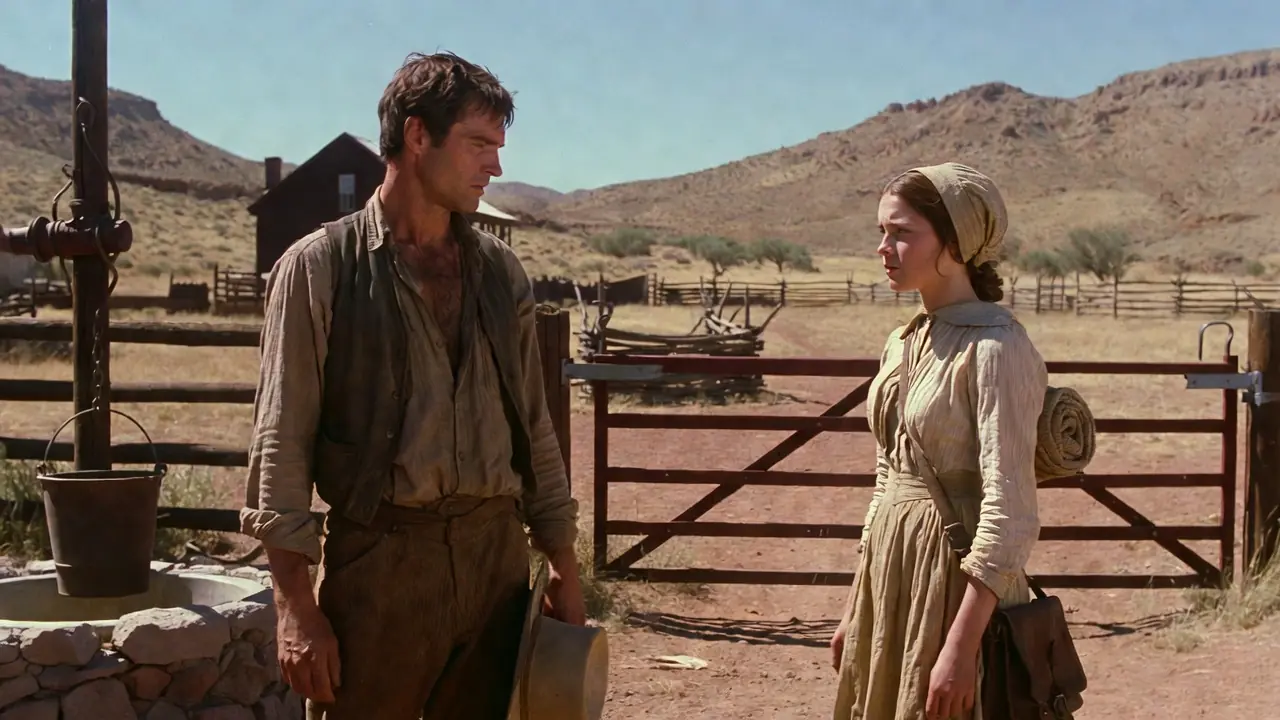
A young woman stood beyond his gate.
She was maybe nineteen, maybe twenty, white, with sun-faded brown hair tucked beneath a worn straw hat, pale skin browned at the edges by travel, and gray eyes that looked older than the rest of her face. She was tall for a woman, lean from hunger and road miles, wearing a plain cotton dress beneath a weather-stained coat that had been mended at both elbows. Her boots were cracked at the seams. A battered leather satchel hung from one shoulder, and under her left arm she carried a rolled blanket tied with twine.
She stood very still.
Not the stillness of calm.
The stillness of someone who had practiced not appearing afraid.
Her mare stood behind her, dusty and underfed but steady.
The young woman looked at Ethan the way a person looks at something they are not sure will hurt them.
Ethan walked to the gate.
He did not open it.
“Who’s your father?” he asked.
“Was,” she corrected.
Her voice did not break, but something in it tightened.
“He died three months ago. His name was Charles Whitaker.”
“You knew him as Charlie.”
Charlie.
The name landed somewhere old inside Ethan.
Charlie Whitaker.
Twelve years ago, before the dream and the fever and all of it, Ethan had ridden with Charlie for two seasons, driving cattle north through Arizona and east across rough country where men learned quickly who could be trusted. They had slept under the same stars, split the last of the coffee, taken turns keeping watch in bad weather, and once shared a single can of peaches with the reverence of church communion.
Charlie had been broad-shouldered, red-bearded, loud when he laughed, and quiet when danger came close. He had carried a harmonica he could barely play and had insisted that enthusiasm mattered more than skill.
Ethan had not seen him in ten years.
“Charlie’s dead,” Ethan said.
It was not a question.
“Yes.”
The young woman’s mouth pressed into a line.
“Consumption took him slow.”
Ethan studied her.
The satchel.
The cracked boots.
The careful eyes.
The exhaustion held upright by pride.
“He sent you here.”
“Before he died, he said…”
She stopped.
Her right hand tightened on the strap of her satchel.
Then she said it straight, as if she had practiced the words many times on the road.
“He said you always wanted children, but you gave up on the idea. He said you were a good man and a stubborn one. He told me you would probably tell me to go away.”
“He wasn’t wrong,” Ethan said.
“He also said,” she continued without blinking, “that if you said that, I should tell you a man who stops wanting things is a man who stops living.”
Ethan’s jaw tightened.
“And that you owed him a debt.”
“What kind of debt?” Ethan asked slowly.
She opened the satchel and pulled out a folded letter, worn from being handled too often.
“The kind you can only repay with time,” she said.
Ethan opened the gate then.
Not wide.
Just enough.
The young woman led the mare through.
“What’s your name?” he asked.
“Clara Whitaker.”
The name did not fit the road dust on her.
Or perhaps it did.
Some names became stronger after hardship wore them down.
Ethan tied the mare near the water trough and led Clara inside.
His cabin was plain. Two rooms, a stove, a table, a back room with a cot, and more dust than he cared to notice. Margaret’s chair still sat near the window, though no one had used it in years. Ethan rarely looked at it directly.
Clara stood just inside the door, not quite in the room and not quite out of it.
Ethan sat at the kitchen table and unfolded Charlie’s letter.
The handwriting was uneven and slow, the handwriting of a man who had learned to write late and never trusted it fully.
But the words were clear.
Ethan,
If you are reading this, my girl made it.
Her name is Clara. Her mother named her after light, and she has had to make her own of it ever since.
Clara is good and strong and too smart for her own safety. She has nowhere to go. Her mother died when she was small. I did the best I could, which is not the same as doing enough.
The towns will not keep a young woman alone unless she has a husband, kin, or a position, and sometimes those are only different kinds of cages.
I thought of you because I know you are honest, and because I know you are alone.
I am not asking you to love her like a daughter.
I am asking you to give her a season.
Work.
Shelter.
The chance to find her own way.
After that, if she wants to go, let her go. If she wants to stay, let her choose.
You told me once, sitting east of the Brazos, that you wished you had a family.
I told you it was not too late.
You said it was.
I am asking you one last time, from wherever I am now, prove me right.
Charlie.
Ethan folded the letter.
For a long moment, he said nothing.
Clara stood near the door with her chin lifted, waiting like someone expecting refusal and determined not to beg.
“He had no right to do this,” Ethan said quietly.
“No,” Clara agreed. “He didn’t.”
That answer caught him.
Most people in need defended the person who had sent them.
She did not.
“I’m not looking for charity,” she added.
“I didn’t say you were.”
“I am saying it before you do.”
Ethan looked at her.
There was a steadiness in her that reminded him of Charlie, but sharper. Charlie had met the world with humor. Clara met it with attention.
“I am not looking for a father,” she said. “Or a husband. Or pity. I am looking for one season of work for honest pay. That’s all.”
Ethan looked at the folded letter in his hands.
Outside, the wind moved through the dry grass with a long, low sound, like a question.
He thought of Margaret’s chair near the window.
He thought of the cattle behind the ridge.
He thought of Charlie riding beside him through desert country, laughing over coffee so burned it tasted like punishment.
He thought of children that never came.
He stood slowly.
“There’s a cot in the back room,” he said. “Supper’s at sundown.”
Clara’s face changed only slightly.
Relief, quickly controlled.
He walked toward the door, then stopped with his hand on the frame.
“One thing,” he said without turning around. “I don’t talk about Margaret. Not to anyone. Not ever.”
A pause.
“I need you to know that.”
Then he went outside.
Clara remained where she was.
She looked at the folded letter still on the table.
The letter had not mentioned any Margaret at all.
And in the silence of that cabin, she understood for the first time that Charlie had sent her not to a man with an empty house, but to a man with a haunted one.
The first two weeks were built entirely of silence, distance, and small practical things.
Clara woke before dawn without being asked.
The first morning, Ethan found her outside by the south fence with a hammer, a coil of wire, and two posts she had dragged from the old stack near the barn.
He stopped several yards away.
“That fence won’t hold cattle.”
“I know.”
“You know fencing?”
“I know bad fencing when I see it.”
He almost answered, then did not.
She worked the line post by post.
Not the patching Ethan had been doing for years, but a real repair. She reset the sagging posts. Tightened wire. Replaced a rotten rail. Cleared brush from the line so he could see the whole thing from the rise.
She worked carefully, conserving strength because she did not have much to spare.
By noon, sweat darkened the back of her dress, and dust clung to her face.
Ethan brought water.
She took the cup.
“Thank you.”
“You should eat.”
“I did.”
“What?”
“Biscuits from my satchel.”
“How old?”
“Old enough to be reliable.”
He looked at her.
She looked back.
He went inside and returned with beans and cornbread on a tin plate.
She accepted it without argument, which told him she was hungrier than she wanted to admit.
The next day, she learned the well’s temperament.
The rope stuck on cold mornings because it had worn a groove in the wheel. The bucket tilted badly because one side of the handle had bent. The windlass needed grease. Ethan had known these things vaguely, in the way a man knows small inconveniences and adjusts his body around them until he mistakes endurance for repair.
Clara fixed what she could.
She greased the wheel.
Straightened the bucket handle.
Reknotted the rope.
By the third morning, the bucket came up cleaner and faster than it had in years.
Ethan stood nearby, watching.
“You fix things,” he said.
“When they need it.”
“Everything needs fixing.”
“Yes,” she said, looking at the cabin, the fence, the barn, then finally at him.
He did not like the feeling that she had included him in the inventory.
So he walked away.
She cooked in the evenings.
At first, Ethan told her she did not have to.
She asked whether he preferred burned beans.
He did not argue again.
She made cornmeal cakes, beans with dried peppers, salt pork cut thinner than he thought worth cutting, and once a stew with roots she found near a wash that he did not recognize.
He ate it cautiously.
It was good.
“What is this?”
“Food.”
“I know that.”
“Then eat.”
The cabin began to change in ways Ethan found irritating because he noticed them only after they had improved his life.
The kitchen shelves were reorganized.
The torn curtain in the back room was mended.
The ashes were cleaned from the stove more regularly.
His coffee, which had long tasted like boiled regret, improved.
The chair leg he had meant to fix for three years stopped wobbling.
He noticed that Clara never touched Margaret’s chair.
She cleaned around it.
She dusted the windowsill near it.
But she never moved it, never sat in it, never asked why no one did.
That earned her something he did not name.
They did not talk much.
He asked about the work.
She answered in facts.
She asked about the land.
He answered in facts.
“How far does the creek run?”
“Dry half the year.”
“Where does it hold longest?”
“North bend.”
“Where is the best grazing?”
“West ridge after rain.”
“Does rain come?”
“Sometimes.”
They built a functional peace out of information.
Neither reached past it.
Ethan watched her the way he watched weather, carefully, from a distance, waiting to see what kind of storm she would become.
But Clara was not a storm.
She was the opposite.
The stillness after one.
On the fifteenth day, Ethan was repairing the barn roof when the ladder slipped.
He should not have been up there alone.
He knew that as soon as the ladder shifted.
There was a moment in every fall when the body understands before the mind does. His hand grabbed for the beam. He caught it enough to slow himself, not enough to stop. His boots missed the rung. His shoulder struck the side rail. Then the ground rose hard and fast.
He hit on his left side and lay staring at the sky while his body decided what was broken.
Dust drifted above him.
A buzzard circled high overhead.
“That would be fitting,” he muttered.
Clara appeared in his field of vision, crouching beside him.
She did not panic.
That impressed him, though he was in too much pain to appreciate it fully.
“Can you move your fingers?” she asked.
He did.
“Your feet?”
“Yes.”
“Breathe deep.”
“I am breathing.”
“Deep.”
He tried and winced.
“Ribs bruised. Maybe cracked.”
“You a doctor?”
“No. But I have watched men fall off things before.”
“That so?”
“My father once fell off a wagon while arguing with a mule.”
“That sounds like Charlie.”
“It was the mule’s finest hour.”
Something almost like a laugh moved through Ethan’s chest and punished him immediately.
Clara leaned closer.
“You’re not broken,” she said. “But you’re also not as careful as you think you are.”
“I’ve been doing this alone for seven years.”
“I know,” she said. “That’s the problem.”
She helped him sit.
He pulled his arm away too quickly when her hand steadied him.
She noticed.
Of course she noticed.
But she did not react.
She simply stood and said, “You’ll sit for a while before pretending you can work.”
“I don’t pretend.”
“You do little else.”
He looked at her sharply.
She met his eyes.
Then she walked to the well for water.
For the rest of the afternoon, Ethan found himself noticing exactly where she was.
At the stove.
At the doorway.
In the yard.
Near the fence.
It annoyed him because awareness was a form of dependence, and dependence was only another road toward loss.
That night at supper, neither of them spoke about the fall.
But the silence had changed shape.
Both knew it.
It started with a fire.
A contained one built low in the ring of stones east of the house.
Ethan had built fires there often in the first year after Margaret died. Back then, he had sat beside the flames until dawn, too tired to sleep, too alive to be dead, too dead to know what to do with life.
Over time, he stopped.
But that evening, his ribs aching and his mind restless, he carried wood to the fire ring and struck a flame.
He sat with it for nearly an hour before he heard Clara’s footsteps behind him.
He did not tell her to go back.
She did not ask permission.
She sat on the far side of the fire and looked up at the sky.
Not searching.
Just receiving.
The stars were cruelly bright in New Mexico. They made a person feel both watched and forgotten.
After a long time, Clara said, “My father used to say the stars were the campfires of everyone who went before us.”
“Charlie,” Ethan said.
“Yes.”
Ethan looked up.
The Milky Way cut across the black sky in its ancient, careless arc. He had sat beneath it a thousand times without feeling anything.
Tonight, for the first time in longer than he could say, he felt something.
Not comfort.
Not exactly.
Recognition, maybe.
As if the world had been there all along and he had only lately looked back.
“He talked about you,” Clara said.
Ethan said nothing.
“He said you were the only man he ever trusted with his back. He said you were fair and steady, and you didn’t pretend the world was something it wasn’t.”
“He was generous.”
“He was accurate.”
The way she said it, not like flattery but like a finding, made him look across the fire.
She was watching him without self-consciousness, the way a person watches something they are trying to understand rather than impress.
“What are you looking for?” he asked.
The question surprised them both.
Clara looked at the fire.
“After the season,” he said. “Where will you go?”
She was quiet for a while.
“I don’t know.”
It was the first answer she had given him that was not built like a fence.
“I used to think I knew,” she added. “When my father was alive, the road was hard, but there was always the next place. After he got sick, the knowing went away.”
She reached for a twig and turned it between her fingers.
“I think I’m looking for somewhere that feels like it could be mine.”
Ethan looked back at the fire.
He said nothing.
But something in his chest moved like a gate unlatched by wind, not by hand.
He did not say good night when he went inside.
He never did.
But that night, for the first time in seven years, he left the fire burning a little longer than necessary.
They rode into Rio Blanco together on the first of the month.
Supplies were needed.
There was no way around it.
Ethan had been dreading the trip since dawn.
Rio Blanco was not a generous town. It measured people carefully and found most of them wanting. A woman alone drew one kind of attention. A young woman living on an isolated ranch with a widower drew another.
He could feel the eyes as they tied the horses outside the general store.
Curious eyes.
Hard eyes.
Bored eyes grateful for new material.
Near the far end of the street, half-hidden beneath the overhang of the land office, a man Ethan did not recognize stood watching them with the particular stillness of someone paid to notice things.
Ethan filed it away without showing it.
Inside the store, Mrs. Galvin stood behind the counter arranging spools of thread.
She was a square-built woman with sharp eyes, a sharp nose, and a heart she kept hidden under practical manners.
She looked at Clara.
Then at Ethan.
Then back at Clara.
“Morning,” she said.
“Morning,” Ethan answered.
Clara nodded.
“Ma’am.”
Mrs. Galvin’s eyes moved over Clara’s worn dress, mended coat, cracked boots, and calm face.
“You need cloth?”
“Thread first,” Clara said. “Brown, black, and whatever color comes closest to dust.”
Mrs. Galvin’s mouth twitched.
“That would be most of New Mexico.”
Clara almost smiled.
Ethan bought flour, coffee, salt, lamp oil, nails, a new rope for the well, and beans. Clara added needles, thread, dried apples, and a small packet of cinnamon.
Ethan looked at the cinnamon.
She looked at him.
“It’s medicinal,” she said.
“For what?”
“Misery.”
Mrs. Galvin did smile then.
When they came back outside, a man named Doyle stood near the horses.
Ethan knew him.
Most people did.
Doyle was large, slow-moving, and convinced of his own importance. He owned more opinion than land and spent much of both in public.
His eyes moved from Ethan to Clara with a meaning that made Ethan’s hand go still on the sack of flour.
“That your girl, Carter?” Doyle said.
The words dropped into the street like a stone into still water.
The air changed.
A wagon wheel creaked somewhere behind them.
Someone stopped sweeping a porch.
Ethan felt Clara go still beside him.
He turned to Doyle with the kind of calm that was not peaceful, but very certain.
“No,” Ethan said. “She’s the best ranch hand in the county, and you’re going to step back from my horses.”
Doyle blinked.
He had expected embarrassment.
Or anger.
Or silence.
Ethan gave him none.
Just fact.
The kind that required obedience.
Doyle looked at Ethan’s face.
Then at his hands.
Then he stepped back.
Ethan loaded the supplies.
Clara helped.
They rode out without another word.
For half a mile, neither spoke.
The road stretched ahead in dusty gold. Heat shimmered low over the ground.
Finally, Clara said, “You didn’t have to do that.”
“I know.”
“Why did you?”
He looked at the road ahead.
“Because it was true.”
She did not answer.
“And because some things need to be said out loud,” he added.
She turned toward him for a moment.
Then back to the road.
The man beneath the land office overhang was already gone.
But he had seen everything.
On a Sunday afternoon in the sixth week, Ethan found the satchel open on the kitchen table.
He had come in looking for the small awl he used to repair tack. Clara had gone to check the chicken coop. The satchel sat open because one of the buckles had broken and she had been mending it.
He had not meant to look.
But what he saw stopped him cold.
Drawings.
Dozens of them.
Spread across the table in careful arrangement.
Horses, rendered in charcoal with an exactness that was not just skill, but love.
A hawk catching thermals over a canyon wall.
The line of mountains east of the ranch at dusk.
The old windmill, tilted slightly, drawn so true he could hear its complaining turn.
A hand, old and weathered, holding a harmonica.
Charlie’s hand.
Ethan knew it before he knew how.
And one drawing of the ranch itself.
The fence Clara had repaired.
The well.
The crooked barn roof.
The cabin with its sunken porch and small window.
The old oak east of the house.
All of it laid down in clean, true lines.
Ethan stood with the awl forgotten in his hand.
He had lived on that ranch for years and stopped seeing it.
Clara had been there six weeks and had seen everything.
She was standing in the doorway when he looked up.
He waited for embarrassment.
She showed none.
“My father taught me,” she said. “He said if you can draw something, you understand it.”
Ethan picked up the drawing of the ranch.
He looked at it for a long time.
At the exact lean of the old oak.
At the fence line curving where the ground dipped.
At the dark square of Margaret’s window.
“You made it look…” he began.
“Like what?”
He could not finish because the word that came to mind was alive.
“You’re wasting your time mending fences,” he said finally. “This is what you should be doing.”
“A person needs both,” Clara said. “The fence keeps the cattle. The drawing keeps me.”
Ethan set the paper down carefully, not like a drawing, but like something that mattered.
“Could you draw me something?” he asked.
“Anything you want.”
The answer came too quickly.
Too trustingly.
It unsettled him.
He looked toward the window, where sun had begun to sink behind the ridge.
“The well,” he said.
Clara looked at him, measuring.
Then she picked up her charcoal.
“I already know what it will be.”
Three days later, she gave him the drawing.
It was the well, but the way she had drawn it, it was not only a well.
There was a bucket mid-pull, water catching the morning light in clean diagonal lines. The stones were rough and exact.
The rope curved under strain. Ethan’s own hands were on the rope, rendered from memory with a detail that startled him.
And in the shallow water at the base of the stone wall, barely visible unless a person looked closely, were two small reflections.
A man and a woman standing side by side.
Ethan stared at it.
His throat tightened.
Clara stood near the stove, pretending not to watch him too closely.
“It’s good,” he said.
She lifted an eyebrow.
“You have a gift for understatement.”
“It’s very good.”
“Better.”
He looked again at the reflections.
“Why are there two people?”
“Because there are.”
He folded the drawing gently and placed it on the shelf above the table.
That evening, Clara was not at supper.
The beans sat warming.
The plates remained stacked.
Ethan waited longer than he intended before he admitted he was waiting.
He found her outside by the well, sitting with her knees drawn up, looking toward the hills.
Her face was turned away, but he could see the aftermath of tears.
Not crying now.
Past it.
That somehow hurt more.
“Clara.”
She wiped her face matter-of-factly before looking up.
“I need to tell you something.”
He sat across from her on the stone ledge of the well.
She looked at the ground.
“Something my father didn’t put in the letter because he knew if he did, you might not let me stay for the right reason.”
Ethan waited.
“A man named Aldous Rowe has been buying up claims east of here. He claims legal interest in the parcel where my father and I last camped before he got too sick to travel. He told me that a woman with no husband, no kin, and no formal position has no protection worth mentioning in this county.”
Ethan’s jaw tightened.
“He threatened you?”
“He smiled while doing it.”
That was worse.
“He said I had until the end of the season to find employment under a documented household or move on. If I stayed alone, he would have me removed as a vagrant or worse.”
“Worse?”
She looked at him.
“There are places women disappear into that still have doors and wages.”
He understood.
His hands closed slowly.
“Why didn’t Charlie tell me that?”
Clara’s voice was steady, sad, and proud all at once.
“Because he wanted you to keep me here because you chose to. Not because you felt sorry for me.”
Ethan said nothing for a long time.
The desert around them had gone copper in the falling light.
A hawk turned over the ridge.
The well rope shifted softly in the wind.
Clara looked toward the hills.
“I should have told you sooner.”
“Yes.”
“I didn’t want it to become the reason.”
He looked at her then.
“What reason?”
“For anything.”
The words stayed between them.
Ethan thought of the drawing inside.
The two reflections.
He did not sleep that night.
He lay in the dark thinking about locked rooms inside himself.
The one with Margaret’s name on the door.
The one full of children who never were.
The one he had built after the fever left and silence moved in.
He thought of Charlie’s letter.
Clara’s drawings.
The repaired fence.
The way she watched the land like it was worth understanding.
The way she had said, I think I’m looking for somewhere that feels like it could be mine.
Somewhere near three in the morning, Ethan admitted what he had been refusing to look at for weeks.
He was not ready for her to leave.
It was not gratitude, though there was that.
Not obligation, though Charlie had started this.
It was something without a clean name.
Something that had grown in the daily exchanges, in the fire and stars, in the careful way she looked at his land and saw something still living.
He was afraid of it.
Not the way he feared Rowe.
Not the way he feared drought.
The way a man fears a river he knows he must cross because the country on the other side might be home.
The next afternoon, he rode into Rio Blanco alone.
He went to the county office and asked about Rowe’s claim.
The clerk, a narrow man with spectacles and the defeated posture of someone who had read too many bad contracts, looked uncomfortable as soon as Rowe’s name was mentioned.
“Rowe has been filing interest statements on several parcels,” the clerk said.
“Can he force her out?”
“Depends.”
“That is not an answer.”
“It is the only honest one.”
The clerk lowered his voice.
“If she is formally employed and housed on an established ranch, she has standing. If she is merely drifting, Rowe can make trouble. A contract helps. Witnesses help. A household record helps.”
“What kind of household record?”
The clerk hesitated.
“A marriage record settles it fastest.”
Ethan stared at him.
The clerk looked away.
“I am not advising anything. I am explaining what men like Rowe respect because law makes them.”
Ethan rode home slowly.
He let the horse choose its own pace through the long grass.
He did not like the idea that marriage could become a weapon against another man’s paperwork. It made something sacred sound like a fence post.
But the thought had already entered him before the clerk said it.
Not marriage as strategy.
Marriage as truth.
That was the part that frightened him.
By the time he reached the gate, he knew he had to speak.
Not because of Rowe.
Not because of Charlie.
Because he had spent seven years being a man who had stopped wanting things, and he was slowly, terrifyingly, undeniably done with that.
He found Clara at the south fence, testing the wire with one gloved hand.
“Clara.”
She turned.
The afternoon light caught in her hair beneath the brim of her hat.
For the first time in seven years, Ethan Carter said something he had not planned, rehearsed, or hidden behind practicality.
“I don’t want you to go.”
She did not answer right away.
That was her way.
Not the silence of discomfort, but the silence of a person who respected words enough not to waste them.
Wind moved through the dry grass.
“What does that mean?” she asked.
Not suspicious.
Not hopeful.
Careful.
“It means the ranch is better with you here. It means I sleep better knowing someone is on the other side of the wall. It means that drawing you gave me is the first thing I’ve looked at in years that made me feel like I was still part of the world.”
He looked down at his hands.
“It means I’ve been alone so long I almost forgot what it felt like to want something. And I don’t want to forget again.”
Clara was quiet.
“I told myself I wasn’t going to let this happen,” she said.
“Neither did I.”
“I came here for work. For a season. That was all it was supposed to be.”
“I know.”
“I am not Margaret.”
The name struck him, but not the way it once had.
It still hurt.
But it did not close him.
“No,” he said. “You are Clara.”
She searched his face.
“I don’t want to be someone’s replacement.”
“You’re not.”
“I don’t want to be someone’s charity.”
“You’re not that either.”
“I don’t know what I am to you.”
He answered honestly.
“Neither do I. Not cleanly. But I think some words come after the decision, not before.”
She looked at him the way she had looked at the ranch when drawing it, finding the true lines beneath the worn surface.
“My father said you were a good man.”
“He was generous.”
“No,” she said softly. “He was accurate.”
Then she turned back to the fence.
“I’ll think about it.”
It was not yes.
But it was not no.
And for the first time in seven years, Ethan was afraid of something that was not loss.
That was new.
That was almost good.
Aldous Rowe came on a Thursday with two men he did not bother to introduce and a piece of paper he held like a weapon.
Ethan recognized one of them.
The man who had stood beneath the land office overhang in Rio Blanco, watching them load supplies.
So that was where he belonged.
Ethan was at the barn when the riders came.
Clara was at the well.
Rowe did not ride toward Ethan first.
He rode straight toward her.
That told Ethan everything he needed to know about the man.
Rowe was not large, but he wore confidence like armor. He had a narrow face, a trimmed mustache, and a clean coat entirely unsuited to the dust. His horse was better fed than half the people in Rio Blanco.
He dismounted slowly.
“Miss Whitaker.”
Clara turned from the well.
“Mr. Rowe.”
“Season’s end is tomorrow.”
Ethan walked from the barn.
Rowe glanced at him, then back at Clara.
“The arrangement with Carter is informal. It won’t hold in county records. I warned you clearly. You need to come with us to settle your status before matters become unpleasant.”
“She’s not going anywhere,” Ethan said.
He had not moved fast.
He did not need to.
He was simply suddenly there, standing between Rowe and Clara.
His voice carried the flatness of a man who had made a decision and was done deliberating.
Rowe’s mouth tightened.
“Carter, this isn’t your business.”
“This is my property,” Ethan said. “And this woman is under my protection.”
Rowe gave a thin smile.
“That is exactly the kind of vague statement that fails in front of a clerk.”
Ethan felt Clara behind him.
Still.
Listening.
He took one breath.
“Then write down something less vague,” he said. “She is my intended.”
The word landed between them all.
One of Rowe’s men shifted in the saddle.
The other looked toward Clara and away again.
Clara made no sound.
Rowe studied Ethan’s face.
Then Clara’s.
Then the yard, the repaired fence, the cabin, the well, the old oak, the land that looked poor unless a person understood stubbornness.
“You intend to marry her.”
“I do.”
“I’ll need documentation.”
“You’ll have it.”
Rowe retreated into procedure because men like him always preferred cruelty when it wore a clerk’s coat.
“By Monday.”
“By Monday,” Ethan said.
Rowe mounted.
Before leaving, he looked at Clara.
“Be careful, Miss Whitaker. Men make promises easily when pride is watching.”
Clara stepped around Ethan.
Her chin lifted.
“And cowards make threats when law gives them cover.”
Rowe’s face hardened.
Ethan almost smiled.
Almost.
Rowe rode out.
His men followed.
Dust rose behind them and thinned into the afternoon.
For a long moment, Ethan and Clara stood in the yard without speaking.
Then she turned to him.
“Your intended.”
“I know I should have asked first.”
“Yes,” she said. “You should have.”
He nodded.
“I’m sorry.”
She studied him.
Then, very quietly, she said, “Ask me now.”
He did not kneel.
That was not either of their style.
He stood in the evening light with the ranch behind him and the long red hills in every direction.
“I’m not an easy man,” he said. “I’m quiet. I’m set in my ways. I’ve spent seven years making peace with being alone, and I don’t know how to become something else quickly.”
Clara did not look away.
“I don’t know how to promise you a soft life,” he continued. “This land isn’t soft. I’m not soft. There will be dust and work and drought and town talk and likely more trouble from Rowe.”
A faint curve touched her mouth.
“You make a charming case.”
He almost lost his courage in the small warmth of that.
Then he kept going.
“I can promise you this. I will see you every day for the rest of my life. I will actually see you. Not what people say you are. Not what the law says you need to be. You.”
His voice roughened.
“And I think that is worth something.”
Clara’s eyes filled, but she did not cry.
“My father knew,” she said.
Ethan exhaled.
“Yes.”
“He knew this would happen.”
“He knew too much.”
“Stubborn old man.”
“Yes.”
“So am I,” she said.
“I know.”
“And I think…”
She stopped.
Took a breath.
“I think the answer is yes.”
The word did not come loudly.
It did not need to.
The desert heard it.
The wind heard it.
Somewhere beyond the ridge, perhaps Charlie heard it too.
They were married in Rio Blanco six weeks later, in the small courthouse with dust on the windowsill and a clerk who looked as if he had seen enough foolishness in life to appreciate something honest.
Mrs. Galvin stood as witness.
Ethan had not asked her.
Clara had.
When Ethan looked surprised, Mrs. Galvin sniffed.
“Some of us pay attention.”
Doyle stood across the street and pretended not to watch.
Rowe did not appear.
The clerk read the words.
Ethan and Clara spoke theirs.
No music.
No flowers except a small sprig of desert sage Mrs. Galvin pressed into Clara’s hand.
No crowd.
No feast.
Just two people standing before paper, law, and witness, making public what had already been decided in the yard.
Afterward, Mrs. Galvin kissed Clara’s cheek.
“You come by the store when you need proper cloth,” she said. “Not that brown misery you’ve been wearing.”
Clara looked down at her dress.
“It is practical.”
“So is a feed sack. We do not wear it to be married.”
Ethan watched Clara smile.
Not the careful almost-smile she used when uncertain.
A real one.
It changed her face completely.
On the ride home, neither spoke for a while.
The sky stretched pale and wide.
The horses moved steadily.
When the ranch came into view, Clara slowed.
Ethan looked at her.
“What is it?”
She looked at the cabin, the fence, the well, the old oak.
“Nothing,” she said.
But her eyes were bright.
He understood then.
She was seeing it not as shelter for a season.
Not as a place borrowed from a lonely man.
Home.
The ranch changed after that.
Not dramatically.
Not all at once.
But truly.
The south fence held.
The north fence was repaired next.
The barn roof was finally fixed right because Clara refused to let Ethan climb without someone holding the ladder, and Ethan refused to admit that he appreciated this.
A garden appeared east of the house, planted in careful rows.
Beans.
Corn.
Squash.
Peppers.
Herbs Clara claimed would make winter less punishing.
She moved Margaret’s chair one afternoon.
Ethan came in and stopped.
The chair had been near the window for seven years.
Clara stood beside it, one hand on the back.
“I cleaned beneath it,” she said.
He could not speak at first.
“I can put it back.”
He looked at the chair.
At the clean square of floor where it had stood.
At Clara, who was not afraid but understood the weight of what she had touched.
“No,” he said finally.
The word came rough.
“Leave it where it is.”
She had moved it beside the hearth.
Not hidden.
Not erased.
Included.
That night, Ethan sat in it for the first time since Margaret died.
Clara said nothing.
She only set coffee beside him and went back to mending.
The silence in the cabin was no longer empty.
It had become a place where two people could sit.
In spring, Clara told him she was with child.
He was at the well.
The morning was cool, washed clean after a rare rain. The desert smelled briefly alive, green things waking beneath red earth.
She stood near the door, one hand resting lightly against her middle though there was nothing to see yet.
“Ethan.”
He turned, rope in hand.
She said it simply, the way she said everything that mattered.
“I think there will be three of us by winter.”
For a moment, he did not understand.
Then he did.
The rope slid from his hand.
The bucket dropped back into the well with a distant splash.
He stood very still.
Clara watched him carefully.
Not afraid exactly.
But aware of all the ghosts in the sentence.
He crossed the yard slowly.
When he reached her, he stopped as if asking permission without words.
She stepped into him.
He held her.
Not dramatically.
Not with speeches.
He held her the way a man holds something he was certain life had taken from him forever.
His face pressed into her hair.
His breath shook once.
Only once.
Clara’s arms tightened around him.
“I’m afraid too,” she whispered.
He closed his eyes.
“Good,” he said roughly.
She leaned back enough to look at him.
“Good?”
“If we are both afraid, neither of us is alone in it.”
She smiled then.
And in that quiet morning, on that small stubborn ranch at the edge of the New Mexico desert, Ethan Carter finally came home.
The child was born during a cold rain in late November.
A daughter.
Small.
Furious.
Alive.
Mrs. Galvin came from Rio Blanco and took command of the cabin as if she had been waiting years to do so.
Ethan spent most of the labor outside chopping wood that did not need chopping because Mrs. Galvin had ordered him out after he turned pale.
“You can face Doyle in the street, but not childbirth,” she muttered.
“This is different.”
“Yes. This is useful.”
Clara laughed despite the pain.
At dawn, the baby cried.
Ethan heard it from the yard.
The sound struck him so hard he had to put one hand against the chopping block.
Mrs. Galvin opened the door.
“You have a daughter.”
Ethan entered slowly.
Clara lay exhausted but smiling, her hair damp against her face, the baby wrapped in a blanket beside her.
He approached as if the floor might vanish.
Clara looked up.
“She has your frown.”
“She is a newborn.”
“And already disappointed.”
Ethan sat on the edge of the bed.
The baby’s face was red and crumpled.
Her fist opened and closed against the blanket.
He touched one finger to her tiny hand.
She gripped it.
He stopped breathing for a moment.
“What will we name her?” Clara asked.
He looked at his daughter.
At Clara.
At the light coming pale through the window.
“Hope,” he said.
Clara’s eyes filled.
“That is a dangerous name.”
“Yes.”
He looked down at the child gripping his finger.
“But I think we can risk it.”
They named her Hope Margaret Carter.
Clara suggested the middle name.
Ethan could not speak when she did.
He only nodded.
Years later, people in Rio Blanco would tell the story many ways.
Some said Charlie Whitaker sent his daughter to Ethan Carter because he knew lonely people make room for each other if forced.
Some said Clara saved Ethan.
Some said Ethan saved Clara.
Mrs. Galvin said both versions were too simple and therefore likely told by men.
The truth was harder and better.
Ethan did not save Clara like a hero in a dime novel.
He gave her shelter, work, standing, and eventually love.
Clara did not save Ethan by softening him.
She stood beside him long enough for him to remember he was alive.
They saved each other by refusing to pretend the other was not wounded.
That is harder than romance.
That is rarer than rescue.
The ranch never became rich.
The desert did not turn gentle.
Drought still came.
Cattle still broke fences.
The well still required patience.
Rowe troubled them twice more and failed both times because documents, witnesses, and stubborn people are difficult to move when they stand together.
Hope grew wild and bright, running barefoot across the yard no matter how often Clara told her not to.
Ethan taught her to ride.
Clara taught her to draw.
Every year, on the day Charlie’s letter arrived, Clara placed wildflowers near the old oak east of the house, where Margaret rested beneath red dirt and silence no longer felt like abandonment.
Ethan came with her.
At first, he stood far away.
Then closer.
One year, when Hope was five, she asked who Margaret was.
Ethan looked at Clara.
Clara waited.
The desert wind moved through the dry grass.
And Ethan, who had once told Clara he did not talk about Margaret, knelt beside his daughter and said, “She was someone I loved before I knew love could come more than once.”
Hope accepted this with the solemn wisdom of children.
Then she placed a flower on the grave and ran back toward the house.
Clara stood beside Ethan.
He took her hand.
The old grief was still there.
But it no longer owned the whole room inside him.
That was healing.
Not forgetting.
Not replacing.
Making space.
The desert doesn’t lie.
It burns away pretty words and comfortable stories until only truth remains.
And the truth was this.
Ethan Carter had believed his life ended in the red dirt beside Margaret.
Clara Whitaker had believed she was only looking for one season of work.
Charlie Whitaker had believed, stubbornly and from the edge of death, that two lonely people might yet prove him right.
They were all wrong in the ways people are sometimes blessed to be wrong.
A letter crossed the desert.
A young white woman with cracked boots arrived at a locked gate.
A widower opened it just enough.
And through that narrow opening came work, fear, anger, truth, marriage, a child, laughter, drawings, repaired fences, and mornings where the sun still came down hard on the red clay, but no longer found Ethan Carter standing alone.
The hardest thing a human being can do is not face an armed man in a dusty street.
It is not survive drought.
It is not bury the life they thought they would have.
The hardest thing is to open a door they locked for good reason and say, maybe I am not done yet.
Ethan did that.
So did Clara.
And somewhere beyond the long gold ridge, or maybe only in the deep place where a father’s love outlasts his body, Charlie Whitaker was smiling.