She snapped, “Stop keeping track of where I go after work. You do not own me.”
“Perfect,” I answered.
That same night, I gathered everything that belonged to her, packed it neatly, and drove it to the address she had always dismissed as merely a coworker’s house. 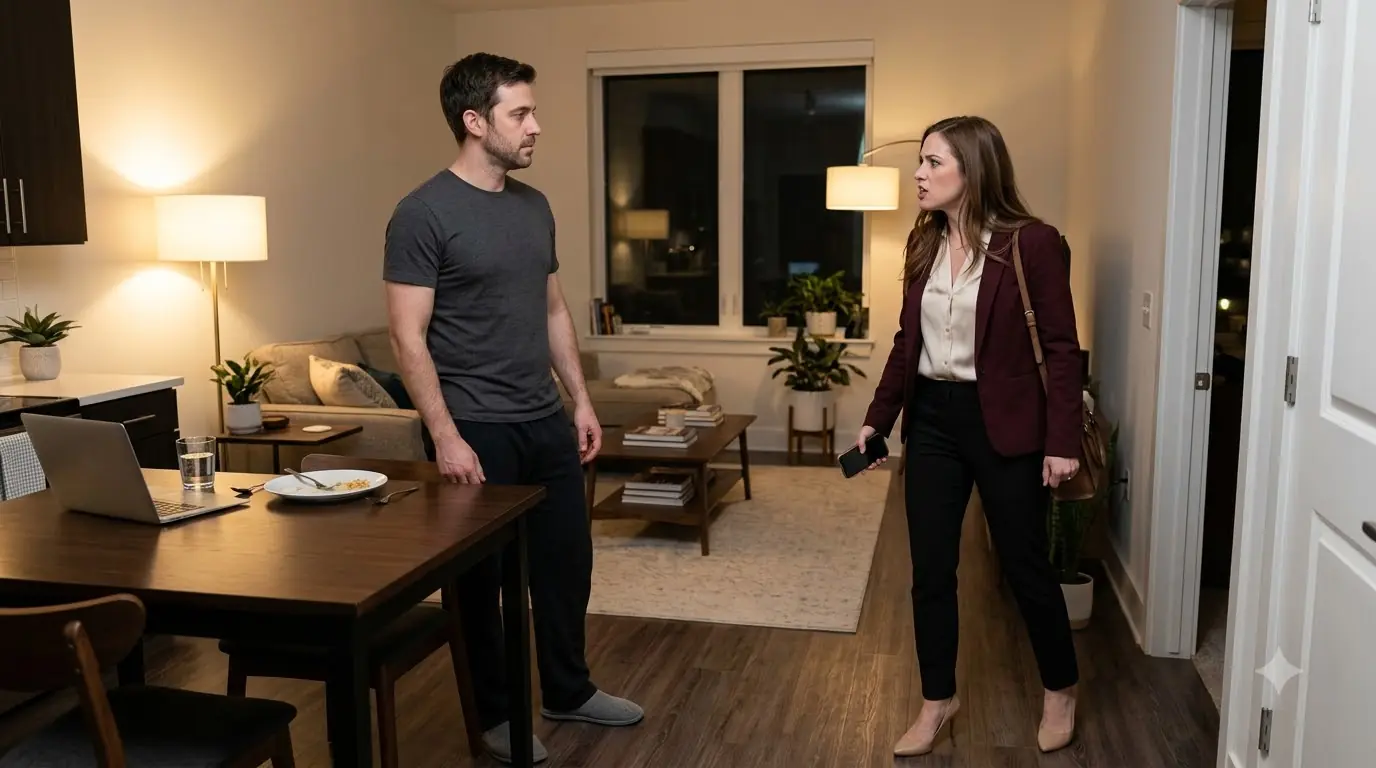
When the front door opened and she saw exactly who was standing there with all her belongings, every trace of color disappeared from her face.
I was thirty-four, and we had been together for nearly three years. For the previous year and a half, we shared my apartment, the one I owned outright before she ever entered my life.
She moved in after approximately six months of dating. Looking back, that decision was probably rushed, but everything felt stable at the time.
We had routines, private jokes, and plans for the future. At least, I believed we did.
Things began feeling wrong about four months earlier.
She had always been outgoing and occasionally met coworkers for drinks after work. That part was not unusual.
What changed was the frequency and the secrecy surrounding it.
She began arriving home later and later. Sometimes it was nine, sometimes ten, and occasionally nearly eleven at night.
There was always an explanation.
A team dinner.
Last-minute drinks after work.
A coworker’s birthday.
An urgent deadline that required everyone to stay late.
Her phone almost never left her hand anymore. It was always turned facedown, always locked, and always close enough for her to reach immediately.
I was not someone who enjoyed jumping to conclusions or playing detective. I did not search through phones or assume the worst every time a schedule changed.
Still, when someone’s behavior shifts that sharply, it becomes difficult not to notice.
The late nights became routine three or four times each week. Whenever I asked how her evening went, her answers were short and vague.
“Just the usual group.”
“You do not know them.”
“Nothing interesting. Only work things.”
The individual explanations sounded reasonable, but together, they no longer added up.
She began going directly to the shower whenever she came home, even though she had already showered that morning. She also changed to a lighter perfume, something more subtle and less noticeable.
Then came the defensiveness.
One evening, I asked whether everything was all right and whether work had been creating additional stress.
She reacted as though I had accused her of something terrible.
“Why are you interrogating me?”
“I am not interrogating you. I am asking how your day went.”
“No, you are tracking me. You want to control everything I do.”
That accusation hurt because it was completely untrue.
I had never attempted to control her friendships, career, or independence. I had supported all of those things.
Everything finally reached its breaking point on a Tuesday.
At approximately six that evening, she sent a message saying she would be late again because of another work event.
I prepared dinner and ate alone.
By 9:30, I was not even feeling especially suspicious. I was simply tired of the same pattern.
She arrived shortly before ten.
“Where were you?” I asked.
“Out with coworkers.”
She avoided looking at me.
“Which coworkers?”
She paused.
“Why does that matter?”
“It does not. I am making conversation.”
“You are checking up on me.”
Her voice began rising.
“You are always checking up on me.”
“I asked one question. That is not checking up on you. It is a normal conversation between two people who live together.”
That was when she exploded.
“Stop monitoring where I go after work. You do not own me. I do not have to explain every single thing I do to you. This relationship is suffocating.”
I stared at her for several seconds.
The anger.
The immediate defensiveness.
The way she transformed a simple question into an attack against her freedom.
Suddenly, everything made sense.
This was not about privacy or independence.
It was guilt disguising itself as outrage.
“Perfect,” I said.
She blinked.
“What?”
“Perfect. You are right. I do not own you, and you do not owe me anything.”
I walked into the bedroom, retrieved my laptop, and carried it to the kitchen table.
She followed.
Some of her confidence had already begun fading.
“What are you doing?”
“Checking something.”
We shared a phone plan.
We combined our accounts approximately one year earlier to save money. It was one of those practical decisions couples make when they believe they are building a life together.
I had never examined the detailed usage records because I had never possessed a reason to do so.
Until that night.
I opened the call and message history from the previous month.
One number appeared immediately.
It was everywhere.
Calls throughout the day.
Messages at all hours.
Conversations during lunch breaks.
Late-night texts.
Calls lasting longer than an hour.
I did not recognize the number.
“Who is this?”
I turned the screen toward her.
Her face became pale.
“That is none of your business.”
“It is listed on our shared account, so yes, it is.”
I pointed toward the screen.
“Who is it?”
She hesitated and stumbled through several incomplete answers.
Finally, she said, “A coworker. We handle projects together.”
“What is the coworker’s name?”
She paused too long.
“Why does that matter?”
“Because you are calling and messaging this person dozens of times every day while coming home at ten several nights a week.”
I kept my voice controlled.
“I will ask again. What is the name?”
“You are being paranoid.”
Her voice was no longer steady.
I stood from the table.
“Pack your belongings.”
“What?”
“Pack your things. You are staying somewhere else tonight while you decide what you actually want. I am finished with this.”
She began arguing immediately.
She called me jealous, controlling, insecure, and unreasonable.
I stopped responding.
I had no interest in continuing the circular conversation.
I entered the bedroom, removed two large suitcases from the closet, and began placing her clothes inside them.
She stood in the doorway and watched in disbelief.
“You are actually throwing me out?”
“Yes.”
I continued packing.
“You can return this weekend for anything that remains, but you are not staying here tonight.”
She began crying and accused me of being heartless. She repeatedly insisted that she had done nothing wrong.
I did not argue.
I packed clothing, shoes, toiletries, and anything else that fit.
When both suitcases were full, I placed them beside the front door.
“Where am I supposed to go?” she asked.
“I do not know.”
I looked directly at her.
“Perhaps you can stay with the coworker you contact fifty times each day.”
Her face became pale again.
“I cannot.”
“Why not? If this person is only a coworker, I am sure they will not mind helping you.”
She stared at me.
For the first time, she appeared completely cornered.
After a long silence, she seized the suitcases and left.
The door slammed hard enough to knock a framed photograph from the wall.
I did not sleep that night.
I sat on the couch replaying the previous several months.
The late arrivals.
The hidden phone.
The changing explanations.
The showers.
The defensiveness.
I felt foolish for failing to recognize the pattern earlier.
Then again, people rarely expect someone they love to lie to them every day.
The following morning, I called in sick.
I needed time to think.
At approximately ten, she sent a message.
“Can we talk?”
I did not reply.
Then she called.
I ignored it.
Eventually, she sent a much longer message.
“I stayed at a friend’s place last night. I am sorry for how I reacted. You were right. I should have communicated more openly. Can we please discuss this?”
A friend’s place.
Not the coworker’s house.
That detail caught my attention.
I decided I needed real answers.
I did something I was not particularly proud of, though I did not regret it afterward.
I opened her laptop.
She left it on the coffee table, completely unprotected, as she often did.
The messages were already accessible.
There were months of conversations with the coworker.
Flirtatious messages.
Late-night calls.
Plans to meet after work.
Nothing in writing explicitly confirmed a physical affair, but the emotional affair was undeniable.
They had spent nearly every evening together during the previous three months.
Dinner.
Drinks.
Long walks.
Hours sitting in his car beside a lake and talking late into the night.
One message from two months earlier stood out.
“I wish things were different. I wish we had met first.”
His reply appeared beneath it.
“Perhaps we did. Maybe this is simply bad timing.”
She answered, “Or maybe it is perfect timing. Maybe I am finally realizing what I truly want.”
Reading those words made me feel physically ill.
I continued anyway.
The worst part was that she had already told him about our argument.
She messaged him the previous night.
“He threw me out. Can I come over?”
His reply came shortly afterward.
“Not tonight. My roommate is home. I will see you tomorrow.”
That told me everything I needed to know about both of them.
He enjoyed being her fantasy and escape.
When the affair suddenly created real complications, he did not want responsibility for them.
I took screenshots of every important conversation and emailed them to myself.
Then I closed the laptop and leaned back against the couch.
I was no longer angry.
I felt drained.
I was exhausted by the betrayal, the daily lies, and the way she twisted ordinary questions until I doubted my own instincts.
That evening, I decided to return the rest of her belongings.
She had already sent another message asking when she could collect additional items.
I developed a better plan.
For approximately two hours, I packed everything she left behind.
Clothes.
Books.
Makeup.
Photographs.
Shoes.
Personal documents.
Every item I could identify as hers.
I carried it all into my car.
It required three separate trips between the apartment and the parking area before everything was loaded.
Then I located the coworker’s address.
She had once mentioned his street in a message to a friend while complaining about the lack of parking. A public property search combined with his first name helped narrow down the correct house.
There were certain advantages to living in a small town.
I arrived at approximately seven that evening.
It was a modest house inside a quiet residential neighborhood.
I pulled into the driveway, opened the trunk, and began unloading boxes onto the front porch.
I stacked them neatly beside the door.
I was not attempting to damage anything or create a scene.
I was being practical.
She wanted to spend her time there.
That was where her belongings belonged.
I had unloaded approximately half the car when the front door opened.
A man in his mid-thirties stepped outside holding a bottle of beer.
He looked confused.
“Can I help you?”
“I am returning some things.”
I lifted another box from the trunk.
“Returning what?”
“Her belongings.”
I placed the box on the porch.
“She has been spending most of her time here, so I assumed this was where they should go.”
His expression changed instantly.
The confusion became alarm.
“Wait. Who are you talking about?”
Before he could finish the question, she appeared behind him.
She had been inside the entire time.
When she saw me standing beside the growing pile of boxes, every trace of color disappeared from her face.
“What are you doing?” she asked quietly.
“Returning your belongings.”
I kept my tone calm.
“You said you needed everything. Now you have it.”
She looked at him.
Then at me.
Then at the boxes.
“You cannot simply…”
“I can, and I did.”
I pointed toward the porch.
“Your clothes, toiletries, books, photographs, and everything else are here. You are welcome.”
He turned toward her.
“What is he talking about? You told me you stayed with a friend last night.”
She said nothing.
She remained frozen inside the doorway.
“You did not tell him we lived together?” I asked.
I looked toward the man.
“Or that we had been together for nearly three years?”
His expression hardened.
The confusion became anger.
“You told me you broke up months ago.”
“We broke up two days ago,” I said, “when I discovered what was happening between the two of you.”
I placed the final box on the porch and brushed my hands together.
“Good luck with this.”
I gestured between them.
Then I entered my car and drove away.
My phone began exploding with notifications within minutes.
Calls.
Text messages.
Voicemails from her.
I ignored everything.
Then he sent a message.
“We need to talk. This is not what it looks like.”
I blocked both of them.
Over the next several days, mutual friends passed pieces of information to me.
Apparently, she told him our relationship had ended months earlier.
She claimed we were only continuing to live together temporarily.
She also portrayed me as controlling, jealous, and unstable.
She transformed me into the villain so that whatever existed between them would appear justified.
When I arrived with all of her belongings, he finally realized she had been lying to him too.
They had an enormous argument that evening.
The neighbors heard enough shouting to complain.
He eventually ordered her to leave and told her never to contact him again.
She attempted to reach me from several different telephone numbers.
She contacted mutual friends and asked them to speak for her.
Once, she even appeared inside my apartment building.
I did not engage.
I instructed building security not to allow her upstairs.
She left a handwritten letter with the doorman.
I threw it away without opening it.
Two weeks later, a mutual friend informed me that she had returned to her parents’ house in another city.
She had also lost her job.
There had been too much personal conflict and too many private problems spilling into the workplace.
The coworker filed a formal complaint after their argument, alleging that she continued contacting and harassing him after he asked her to stop.
Human Resources apparently decided it was easier to terminate her than continue managing the conflict.
As for the coworker, I heard he became engaged approximately one month later.
He had not been nearly as emotionally invested in her as she believed.
He maintained an on-and-off relationship with another woman during the entire affair.
They reconciled shortly before everything collapsed.
Three months passed.
I changed every lock and removed the remaining traces of her from the apartment.
I donated several items and reorganized the rooms.
The entire place felt lighter.
I no longer felt angry.
I did not hate her.
Mostly, I felt relieved.
I was relieved that I discovered the truth before sacrificing more years.
Relieved that I did not marry her.
Relieved that we did not have children.
Relieved that I had not permanently tied my life to someone incapable of honesty.
I started dating again, though nothing had become serious.
I was not rushing.
For the first time in years, I concentrated on myself, my work, and the friendships I had neglected.
I returned to activities I had slowly abandoned during the relationship.
Hiking.
Traveling.
Spending time with people who respected me without demanding that I ignore my own instincts.
The previous weekend, I went camping alone.
Sitting beside a fire beneath an open sky, I felt more peaceful than I had in months.
Several people told me that my response had been too harsh.
They believed I should have listened to her explanation or offered another opportunity to repair the relationship.
The truth was that she had already received countless opportunities to be honest.
Every time I asked about her day, she could have told me the truth.
Every time I asked whether something was wrong, she could have admitted what was happening.
Every night she returned late offered another chance to stop lying.
Instead, she denied everything.
She turned reasonable questions into accusations of control.
She made me doubt observations that were directly in front of me.
She attempted to position me as the villain inside a story created to excuse her own choices.
I did not regret what I did.
I gave her precisely what her decisions earned.
A reality check delivered neatly inside boxes and placed on the doorstep of the man she believed she wanted.
The most satisfying part was not watching either of them become embarrassed.
It was refusing to participate in another argument where the truth would be twisted until I somehow became responsible for her betrayal.
I did not shout.
I did not destroy her property.
I did not insult or threaten either of them.
I simply removed myself from the situation and placed her belongings where her attention had already been living for months.
Sometimes closure does not require a complicated conversation.
It does not always need tears, revenge, or one final explanation.
Sometimes closure is allowing people to face the consequences of their own decisions clearly and directly.
Then you turn around, drive home, and do not look back.